We just sent you a verification email. Please verify your account to gain access to
theCUBE + NYSE Wired: Physical AI & Robotics Leaders. If you don’t think you received an email check your
spam folder.
Sign in to theCUBE + NYSE Wired: Physical AI & Robotics Leaders.
In order to sign in, enter the email address you used to registered for the event. Once completed, you will receive an email with a verification link. Open this link to automatically sign into the site.
Register For theCUBE + NYSE Wired: Physical AI & Robotics Leaders
Please fill out the information below. You will recieve an email with a verification link confirming your registration. Click the link to automatically sign into the site.
You’re almost there!
We just sent you a verification email. Please click the verification button in the email. Once your email address is verified, you will have full access to all event content for theCUBE + NYSE Wired: Physical AI & Robotics Leaders.
I want my badge and interests to be visible to all attendees.
Checking this box will display your presense on the attendees list, view your profile and allow other attendees to contact you via 1-1 chat. Read the Privacy Policy. At any time, you can choose to disable this preference.
Select your Interests!
add
Upload your photo
Uploading..
OR
Connect via Twitter
Connect via Linkedin
EDIT PASSWORD
Share
Forgot Password
Almost there!
We just sent you a verification email. Please verify your account to gain access to
theCUBE + NYSE Wired: Physical AI & Robotics Leaders. If you don’t think you received an email check your
spam folder.
Sign in to theCUBE + NYSE Wired: Physical AI & Robotics Leaders.
In order to sign in, enter the email address you used to registered for the event. Once completed, you will receive an email with a verification link. Open this link to automatically sign into the site.
Sign in to gain access to theCUBE + NYSE Wired: Physical AI & Robotics Leaders
Please sign in with LinkedIn to continue to theCUBE + NYSE Wired: Physical AI & Robotics Leaders. Signing in with LinkedIn ensures a professional environment.
play_circle_outlineExploring AI's Transformative Role in Software Development and Robotics: Insights from Matan at Factory AI
replyShare Clip
play_circle_outlineFrom Agile to Parallel: Exploring Generational Shifts in Software Development Methodologies and Historical Transitions Over the Decades
replyShare Clip
play_circle_outlineEmphasizing foundational knowledge in computer science for new engineers.
replyShare Clip
play_circle_outlineMatan's perspective on the future of humanoid robotics and agent-native software development.
replyShare Clip
play_circle_outlineThe role of collaboration between developers and AI coding agents in improving productivity.
replyShare Clip
play_circle_outlineMatan's mission to bring autonomy to software engineering and the need for developer education.
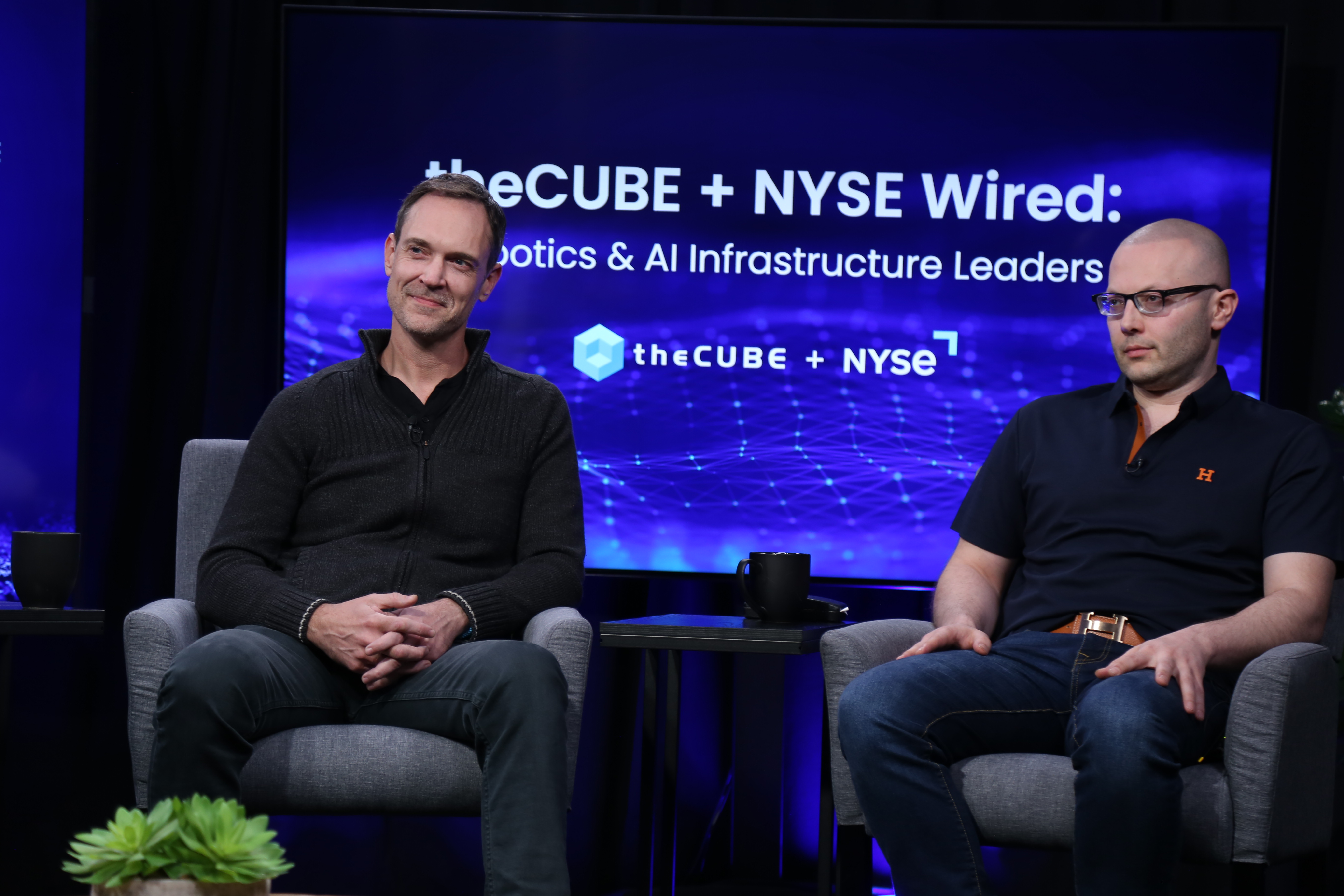
Matan Grinberg, chief executive officer at The San Francisco AI Factory Inc. (doing business as Factory), joins theCUBE’s John Furrier and Howie Xu, chief AI and innovation officer at Gen Digital Inc., at theCUBE + NYSE Wired: Robotics & AI Infrastructure Leaders 2025 event. The conversation explores Factory’s mission to reimagine software development through autonomous AI agents.
Grinberg shares how Factory empowers engineers to collaborate with AI to streamline coding, boost productivity and adapt faster to evolving demands. The discussion highligh...Read more
exploreKeep Exploring
What are the tasks that software engineers prefer not to do, and how might their roles change as a result of automation with AI coding agents?add
What is the mindset of the new AI builder and how does it relate to the transition from waterfall to Agile methodologies in software development?add
What qualities or backgrounds are considered important for engineers in the technology industry today?add
What is your perspective on the impact of advancements in software and robotics on innovation?add
What is the relationship between the code generation process and the Factory platform in software development?add
What are the key considerations and priorities when working to realize the mission of bringing autonomy to software engineering?add
>> Hello, everyone. This is Howie Xu, chief AI and the innovation officer at Gen, together with John Furrier. We are kicking off this session, theCUBE and the NYC-wide for the robotics and the AI. A few days of the non-stop talking about AI and the robotics.>> Yeah, it's a great event, Howie. We're focusing on the leaders across the board, robotics and AI leaders because robotics signifies the physical AI piece of it. Also, there's a decentralized angle, a little bit of crypto, programmable money, but all is powered by AI. So we're looking forward to having Matan. Here's the CEO of Factory AI. Thanks for joining us.
Matan Grinberg
>> Thank you for having me, guys. It's a pleasure to be here.>> So what's it feel like to live in this generation right now? You're looking at such massive opportunities. Everyone's coming out of the woodwork, a lot of builders, a lot of great minds coming together, building AI. What's it like right now for you?
Matan Grinberg
>> I mean, honestly, it's really the most incredible time. Obviously, I missed being a working adult for the mobile revolution and the internet revolution, and-
Howie Xu
>> When John and I were working hard, you were in elementary school.
Matan Grinberg
>> Yeah, exactly. It's like nothing else. And in particular, being in San Francisco, it's genuinely the most electrifying thing I've ever experienced. I'm calling now from New York and I can't wait to come home to San Francisco to come back to this little seven mile by seven mile square where people are building the future.>> Awesome. Well, talk about what you're working on. Let's set the table. What's the opportunity? What are you working on?
Matan Grinberg
>> Yeah, absolutely. So working on Factory and so at Factory our mission is to bring autonomy to software engineering. And more concretely, we are building end-to-end software development agents that we call droids. And these droids automate tasks that developers don't want to do, and in particular fully take them off their plate. So not just assist them, help speed them up, but instead fully take on the tasks entirely. For any developers who hate doing things like migrations, tests, refactors, documentation, just delegate it to a droid and it'll go and do it for you.
Howie Xu
>> So Matan, we created this series to talk to a number of the founders, CEOs of the AI coding agents. One of the fundamental questions I want to chase down is when, whether, how AI is going to replace software engineers. So you just mentioned that Factory.ai is doing stuff that software engineers do not want to do. Can you elaborate a little bit? For instance, if software engineers do not want to do this, what do you think software engineers will do and they can do and they should do?
Matan Grinberg
>> Yeah, that's a great question. I think something important to realize is that there's kind of a perception that software developers are there to write code, but that's really a misunderstanding of what it means to be a software developer and really what are the traits of the best software developers? The best software developers are not the ones who are the most fluent in every coding language or obsessed with every little detail of every little language, then they remember it off the top of their head. Instead, the best software developers are the ones who are the best at thinking about systems, thinking about constraints, understanding, holding at once in their mind, the business constraints, the product constraints, the customer perspective. And then once they kind of synthesize based on that, a pretty concrete plan for how to build the next feature or the next product, the reality has been, okay, well now you need to implement it. And how do you implement it such that a machine will listen to the constraints that you have in your head? Well, the reality has been you need to speak to the machine in a language that end understands which its code, over time has gone from binary to higher and higher levels of abstraction. But the implementation in the coding itself has never been what's made the best developers. That's just been kind of a reality of what it means to build. And what we are doing is removing this step that is kind of like a necessary step just because of how computers work to now these developers can focus on what they're the best at anyway, which is thinking about understanding and planning around the existing engineering system, what the business needs, what the customer needs, and so it allows them to do that with higher leverage.
Howie Xu
>> So Matan, what you just described is the vision and then I fully believe in, but then what are you going to tell people who actually see the current state, right? I just interviewed a software engineer this morning even, right? I was asking, "Hey, are you using AI coding agents?" His answer is he is and he's leveraging it, but it's like a junior engineer writing code here and there. What do you say to them? Like people who are kind of wanting to use it but apprehensive about it or not really all into it, or should they even be all into it today? Should they wait for a year or two? How do you think about the current state versus future?
Matan Grinberg
>> Yeah, that's a great question. I mean, we do need to be humble and realistic about where these tools are today and where they will be in the future. And so right now, obviously these are not as capable as the best human engineers, but the question is not is this as good as a human? It's instead, do I get higher leverage from using this versus not? As an example, if you're an engineer, you could in theory do all of your coding in binary. Now that would be extremely inefficient and very ill-advised. Now, similarly, you can go up the levels of abstraction and get to the programming languages that we see today, and those are high leverage. However, as these tools have emerged, they've become the next highest leverage thing to use. And if you are a developer who wants to stay at the cutting edge, you absolutely need to start adopting these tools. Now, I think there's also an interesting question about the time that we're in and something that I push myself and my team and our customers to do is you really need to every few months be ready and willing to take a sledgehammer to every existing habit and workflow that you have right now because these new tools are going to transform the way you go about doing things. Whether that's email, whether that's sales and business development, or in this case software development. It's really important to not get stuck in our ways and get too habit oriented because each new model that comes out, each new tool that comes out increases our leverage, but the behavior has to change in order to access that leverage. And I think the hardest thing is not even understanding, oh, can these tools work well? But actually can we change our own behavior to take advantage of them? That's the hard thing because we are habitual creatures. It's difficult to be used to coding in your IDE for the last 20 years and now say, "You know what? I'm going to be delegating tasks instead of writing the code myself." So it does require a little intentionality in the way of rethinking these workflows.>> Matan, I want to ask you about this generational shift. One of the things that's coming out of many of my conversations with folks in San Francisco, which again I agree with you, is super hot. I would say New York's popping too, but San Francisco is definitely on fire in terms of AI wave, the young guns that are moving up, they kind of have this attitude, I'm paraphrasing now, not a quote, kind of like who built this stuff? They kind of have that question of, I inheriting all these software methodologies. Even Agile is modern legacy, Howie, at this point. So in our generation, Howie, remember we had the whole waterfall software development life cycle. What is the vibe in terms of, not vibe coding, but what's the cultural view of the pre-existing software approaches and what's different now? What are some of the candidates you're hiring look like? What are they thinking? What are some of their first principles? Are they like, "Hey, faster time to be here, more creative systems thinking"? What is the mindset of this new AI builder?
Matan Grinberg
>> That's a great question. I'm really glad you brought up the switch from waterfall to Agile because that's actually something that we think about all the time internally at Factory because that's an example of a huge behavior change in the process of building software. And that was a behavior change that wasn't necessarily brought about because of some new transformational technology, but it was more like a philosophical difference of like, "Hey, we can ship much faster if we work a little bit more in parallel and less in series."
And I think that's such a beautiful analogy here because what is happening to software development and the coding itself? Some people call it the inner loop of software development, like the developer in their IDE. Well, we're very much also going from working in series to in parallel. Because now my mentality is not, how can I write this code faster for this file. It's instead, how do I take this large task, separate it out into four separable testable chunks, and then I delegate those four tasks in parallel. So now I'm not these four steps sequentially, but instead I have these four agents working on this in parallel. So who cares if an IDE made me 20% more productive, I just delegated these tasks and now I'm 4X more productive, right? And so I think that parallel is very apt.>> Do you say to engineers that are coming out of say, CS programs and there's some great programs out there, Howie, we know the names. Almost, they're obsolete at this point. Some of them don't even study operating systems, for instance. What do you say to the new guys? Forget everything you learned, let's go to work.
Matan Grinberg
>> I would push back. I actually think still to this day, the best engineers that are coming out of the universities, and a lot of the team at Factory are like new grads, are the ones who still understand that full stack of abstraction down to the machine code, understanding how all of that works. Now, of course, they're not using it on a daily basis, but I'm a very strong believer in a good technical background that teaches you systems thinking, that will always matter. I mean, I have to believe that. Prior to Factory I was doing theoretical physics. Now that has very little to do with AI and software engineering, but the point is, it teaches you really good systems thinking, reasoning around a huge mass of information that existed before you and how to get your bearings and pull in what's necessary and figure out how to make that next step, that is always going to be important. And so I know there's a lot of questions people bring up of like, should my kids even study computer science? Should they go to university? All that stuff. I think at the end of the day, complex reasoning, systems thinking, thinking around constraints that will always be high leverage. It'll just vary. You might not actually do any of that machine code in your day-to-day work. Similarly, you might not do any of the coding itself in your day-to-day work, but having that understanding always lends perspective and always leads to the best engineers.
Howie Xu
>> I think another thing is we went from, like you said, old school maybe assembly language to the higher level language, but that doesn't mean people that program at a Java, C++ do not need to have system level understanding, right?>> And networking too, Howie, because networking with large scale systems is huge too. Software and networking is the hottest area.
Howie Xu
>> Yeah, yeah. I think from my point of view, we came from waterfall to Agile now to almost the multi-core. It's a new game at this point. I think people without system level thinking, without being able to thinking about lots of different constraints, how to plan things, it's not going to do well in this sort of linear world.>> I think the system wave is definitely going to replace Agile. Totally agree. And I think when you look at the robotics theme, and the reason why we have robotics, Matan, is that physical AI is hot right now. And again, software, I would say at a first party layer physically is there. We're seeing the best developers and software engineers, let's say, are going lower in the stack, Howie. We were talking about this last time we were on theCUBE, that that's where the efficiencies are. Now, not to throw back to the '90s, but back then, memory management was a big deal. Now we got a high bandwidth memory. You got to see solid state as a storage tier. The role of data is huge, data programming. Not data science like in an analytic sense, but actually squeezing more value.
Howie Xu
>> At this point, I think we are going to apply the similar methodology, but this time to the AI coding agents, plan things in multiple agents.>> Matan, what's your reaction to the whole robotics integration? Because it's still a software paradigm, physical AI is hot. What's your reaction to that and perspective?
Matan Grinberg
>> Yeah, so one thing that you mentioned there that I very much align with is this idea that in this world where you have these agents that can spin up software that would've taken hundreds or thousands of human hours, but now in a matter of minutes or hours, it does really push the area for innovation to the extremes, whether that's super low level code or very high level, and it kind of pushes out to the extremes there. So definitely aligned on that. When it comes to robotics, I mean, I think this also is very in line with my understanding, for the last 20 years we've been talking about humanoid robotics, when are we going to get robotics that can kind of do more? We're starting to see that, especially with things like Waymo, which is more in the physical world. I think the reality that's constrained physical robotics for such a long time has been the software, and people are rightly realizing that basically the bottleneck is being alleviated. And so now where there's still a big bottleneck is actually at the control level and getting these physical systems to move in the way that we want them to. So I'm extremely bullish on that. I mean, I think an interesting question that I love asking new hires at Factory is what year do you think the population of San Francisco will be equal human and humanoid robots? I'm curious to hear both of your gut reaction to that.>> I think in the next decade, I think you're going to see robots for sure. Population wise, I mean, it could be 10 years, Howie. I think in this decade, just go back 10 years, where were we? I mean, look at the progress in the past three years. If you just go back three years, look at OpenAI, what's happened with them and they're continuing to do more. Look at Nvidia. The advances just in the past three years alone could be a trajectory that says, "Okay, we're starting to see stuff we've never seen before."
Multi-purpose robotics, was talking to an entrepreneur who's built, he's growing cells, he's in the life science areas, he's got access to supercomputing capability. Now his software vision is unleashed because now he's not constrained around software. He doesn't know what to do. So what does he do? He plugs open source in. Turns out there's another community building chemistry version of wet lab software that plugs into the robot. So that's very matrix-like. Upload how to fly a helicopter. I mean, that's basically what's happening. So I think we're going to see the next 24 months a surge of robots. I think Waymo, what they're doing now could replace Uber. If you look at Uber sales, I would speculate that it's down compared to what Waymo's go steady state. I think that they-
Matan Grinberg
>> They already surpassed Lyft in San Francisco.>> Yeah. So I think we're on a trajectory. I think I would focus on the next 24 months and look at the past three years and then say, "Okay, what does OpenAI know that we don't know?" We posted this morning that they're trying to renegotiate their Microsoft, and I posted they have leverage. Why? Because they're kicking ass. I think that that's a serious data point. A lot of people didn't see that. They call them the Netscape moment. Howie, remember, and I said on theCUBE podcast, Dave was there, we argued this. I said, first mover with that kind of skill. But I think in the past year, I was put in this decade.
Howie Xu
>> We started talking about AI a lot, of course, in the last few years. There was a series called Super Cloud. You and Dave started, and on the way here actually we're thinking, I mean, super cloud should still be relevant, but that super cloud today is really are all the autonomous AI agents. We used to call the machine or storage or computers what API call away, now program is what API call away. So that's the super cloud.>> Matan, you're definitely now a host of theCUBE, so we appreciate more commentary. You can come on anytime. Just putting that out there. I know you've got a company to build. What do you think? What's your answer to the question?
Matan Grinberg
>> Yeah, I think you're about right. I'd probably say I think I put my even odds at 12 years when the population of San Francisco will be equal, carbon and silicon, which is->> Well, home penetration will be key. Once the Jetson moment happens where you have cleaning... I interviewed the Ness founder, he's made a lot of money. He's building $2,000 trash can, fully automated. Takes all the air out. Again, starting to see devices and humanoids in homes, I think that's a tipping point because that makes it more real, I think the numbers will go up.
Howie Xu
>> So another interesting question would be in San Francisco, how many of the one person, or even 10% unicorn, there would be? Like Sam Altman has been talking about one person unicorn, right? With AI, it's possible or started possible to have very small company doing pretty well. What do you think, Matan? Like how many people in your company? And without AI, without coding agents, how big a company would that be? I'm curious.
Matan Grinberg
>> Yeah, so our team right now is 30 and we've been around for two years. There is no world in which we would've been able to ship so fast what we've done in the last two years with a team of 30, and really it's 20 engineers. And we obviously use our product to build our product, but yeah. I think-
Howie Xu
>> What percentage of the code your company is producing this week is by human versus coding agent?
Matan Grinberg
>> I mean, the answer is it's really, it's like a symbiosis because all of the code is coming through the Factory itself. Now, there might be some back and forth or there might be an edit that the human provides, but there is no code that's not happening in the Factory platform where the droids are going, and at least creating that first pass. Now you can then get into some semantics of, "Oh, okay, but if a human edits that line of code, is it still generated by the droid?" But the reality is it's like depending on how you calculate it, every line of code is going through Factory itself, which is, it's pretty crazy to imagine even just looking at what software development teams looked like five years ago. And to your question about the first single person unicorn that I think everyone is eagerly awaiting. I think that's certainly going to happen in the next 10 years. I think the reality though is that you have to be aware of what are the types of companies that are conducive to a single person versus a 10 or 100 person org. And so the idea there is that the insight there cannot be one of some deep software or research innovation. It likely has to be something more about a social phenomenon or an interest or a latent desire that a lot of people have that no one else was able to tap into in the right way. So companies that have capitalized on that, companies like Facebook or Spotify or Instagram, I think those are the angle of company that could be captured at least to start by that sort of one person unicorn. Although I think once you're getting into a really competitive space, you're still going to want more humans around you.
Howie Xu
>> So that's within your own company, and then you are helping the enterprise a lot, right? When do you see the enterprise out there, the traditional Fortune 2000 companies, their software engineering practice is like 90% of the code is done by AI. When do you think that will be? Five years from now, two years from now? Why is that?
Matan Grinberg
>> Yeah. I mean, I think it's really org by org. What's been really surprising for me is speaking with a lot of the Fortune 500 and having some of them as customers, so many of them have this really strong motivation to be at the cutting edge. And I think part of the reason is, so one might be some scars from missing mobile or cloud or rather being late to those two, and so they're like, "We are not going to miss this one."
But also these large companies have more developers, and so they have more to win or lose by being early or late to adopting this. And I think at the same time, they have a leadership team that really sees this future of agent native software development. They can have the added emphasis of a top down like, "We need to change the way that we currently build. We need to be agent native in how we build software." And then that combined with a product that developers themselves love really drives a pretty quick behavior change and adoption.
Howie Xu
>> And when is that magic moment of the ?
Matan Grinberg
>> We're going to see that by the end of this year, if not already. Now I think that'll be at the leading, Fortune 500 companies who have this very top of mind, I think it'll probably take a couple quarters for their competitors who might not be as forward-thinking to realize, "We are going to be completely lapped if we don't do this too." And so then I think after some results on the business come out from doing that, then I think basically every other competitor in the space of whatever Fortune 500, they'll realize that they need to do it too.>> Matan, what are you seeing in the enterprise in terms of the coding and the access to the data? There's been talk about the data in the enterprise not being unlocked, and there's a big wave of unlocking coming from the data. Are they on-premise data being utilized? What are you seeing there? Because that's a major unlock potential.
Matan Grinberg
>> Yeah, totally. So we do both on-prem and SaaS deployments. I think a differentiator of us versus most of the other tools out there is that we've built this from day one for the enterprise in particular. Especially, there are so many security considerations when you have agents that can execute code in an enterprise environment. And I think a lot of the other tools out there just aren't really building with that in mind, but are instead... Which to be fair, it makes sense. You're building a tool for solo developers, that's kind of going the PLG angle. You don't want to build too many stops in the way of having the cool agentic experience, but for us, this is for the enterprise, and having the governance and control over these agentic systems is extremely important.>> To your point-
Matan Grinberg
>> I think something... Oh, sorry, please.>> To your point, with the control point, that's a big constraint.
Matan Grinberg
>> Absolutely. Something that my co-founder, Eno, mentions a lot that I think unfortunately will probably be looked back on as quite prescient, is I think there are a lot of orgs who are adopting tools that don't take this governance as seriously, and there will likely be a billion dollar incident because of people letting agentic systems run wild in their enterprise code base without the proper governance in place. We're trying to ring the alarm bells on this and make sure people are giving this the respect that it deserves. But yeah, its very top of mind.>> What are some of those governance things that you guys see that people may miss? Can you highlight that?
Matan Grinberg
>> Yeah. Providing the agentic systems with like whitelists and blacklists on certain commands that can be run. Making sure that if it's accessing certain data sources, that there's both audit logs and again, permissioning provided to the agentic systems, so it's constrained to only being able to execute command. It's in these directories only touching these files or these data sources. Only being allowed to use certain commands, making sure that these agents are running in sandboxed instances, so they can't actually go to production. These are just a couple of things that are kind of table stakes for deploying to the enterprise.>> Matan, as a young founder, you're leading a great company. You're on the front end, this generational wave. What are you optimizing for in your business as CEO? When you wake up every day, what are some of the things you think about and what do you optimize for?
Matan Grinberg
>> Yeah, I mean, I think the number one thing at the end of the day is realizing our mission, which is bringing autonomy to software engineering. And I think something that's really important for us is half of that battle is having the best software out there. The other half of that battle is actually working with developers and showing them what this new behavior looks like. And this is something that I think sometimes the Silicon Valley is a little quick to dismiss. There's this idea of, "Oh, you build a perfect product and everyone will just manifestly know how to use it and want to use it and adopt it, and everything's great."
And that's obviously, it's incredibly important to have the best product. It's equally important when you work with these organizations with tens of thousands of developers, some of whom are still on VIM or on Emacs. You need to meet them where they are and show them the kind of future and where things are going and why their life as a developer will be better as they use these agentic systems and they delegate these tasks. And so I think that's something that I think about a lot is working with developers, helping them change behavior to see this new way of building, I think that's something that we're particularly strong at.
Howie Xu
>> Great. I think we covered the behavior change as the key theme. It's not just the technology, but also all the behavior changes. That's one of the things that myself in my company and the many people in the industry are working on it. Last question from my point of view, we touch upon this. What's your advice to software engineers? Behavior change, sure. But can you just leave your last advice to software engineers? What should they think, do? Other than just the behavior change? Give them some more concrete advice.
Matan Grinberg
>> Yeah, try all the tools out there. See what works for you. See what doesn't. Be as flexible as possible. I think there's a certain humility required from myself and all of our team and developers to know that we can't predict exactly what the future of software development is going to look like, and we can build towards where we want it to go. But the way that we do that is by trial and error, being adaptable, trying out these new tools. Seeing what works, how you can iterate to make it an even more seamless experience. Making sure that when things go wrong, there's a happy exit path to go back to whatever your standard development practice is, and work with others on it. I think something that we've seen that's really exciting is the collaborative nature of working with agents. Because it's not just you and agents, but it's also you and your colleagues and the agents that you can work with. And I think there's a lot of interesting dynamics there, and there's a lot to learn from working with others on seeing how they're taking up new tools and how it's fitting into their new habits.
Howie Xu
>> I really like it. That's something that I definitely will take to myself and my team. Even for myself, I tried AI coding agents forever, AI coding tool forever, but in the last three, four months, I realized, wow, this AI coding agents evolved very fast just in the last three, four months alone. So resonating with me very well. Cool. Thank you so much, Matan. I'm glad that the three of us all came from Palo Alto, had a chance to kick off this event. We're going to do a lot more conversation on AI for the next three days. Thank you, Matan. Thank you, John.>> All right.