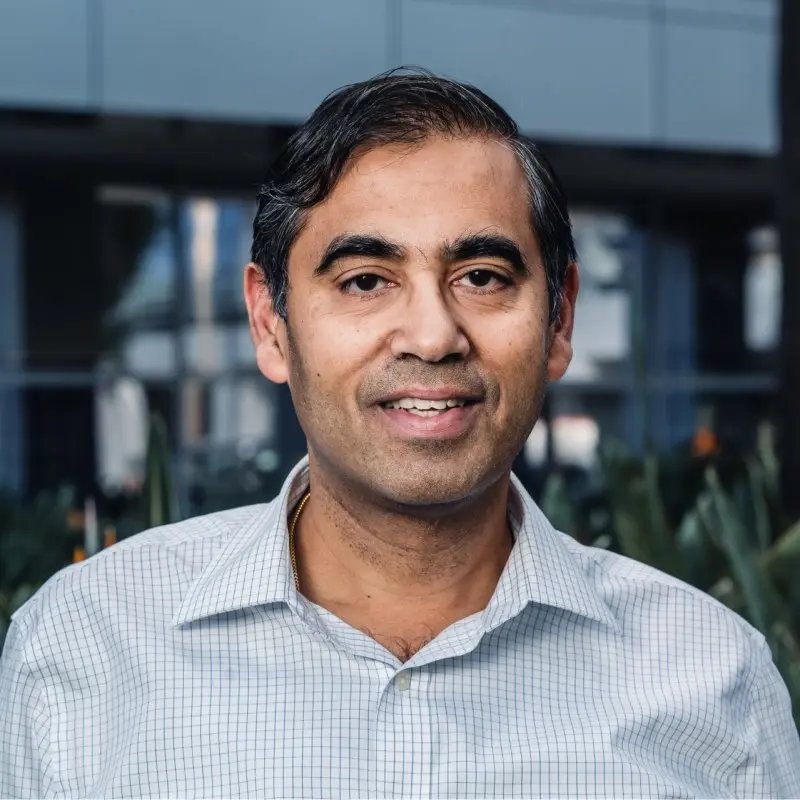
Ashutosh Garg of eightfold.ai participates in a discussion on theCUBE during NYSE Wired Robotics and AI Media Week to explore innovative approaches in talent management using artificial intelligence. Hosted by John Furrier, this insightful conversation addresses technology, talent, and business strategy.
In this video, Garg shares their expertise in machine learning and artificial intelligence, drawing from extensive experience with Google and Bloomreach. They elaborate on eightfold.ai's mission to transform talent acquisition and management by leveraging AI. TheCUBE hosts steer the conversation toward understanding how AI reshapes the recruitment landscape.
Garg highlights several key takeaways, such as the significance of understanding candidates' potential and learnability, and how data-driven insights can enhance recruitment efficiency. They state that AI can redefine job descriptions and improve talent matching, ultimately enhancing performance and retention. The session emphasizes the criticality of combining deep domain knowledge with AI-powered solutions to address evolving enterprise needs.
Find more SiliconANGLE news and analysis https://siliconangle.com/
Follow theCUBE's wall-to-wall event coverage https://siliconangle.com/events/
Learn about the latest theCUBE events https://www.thecube.net/
00:00 - Intro
00:07 - Revolutionizing Talent Management: An Introduction to Eightfold AI's Mission and Impact
03:08 - Advancing Recruitment: Integrating Deep Domain Expertise
05:58 - Connecting Talent through Eightfold AI: Opportunities and Implementation
09:05 - Empowering Success Through Talent and Customer Excellence
11:54 - Ashu’s Unique Perspective and Background
15:06 - Harmonizing Profit with Purpose: Reflections and Future Outlook
#AI #TalentManagement #eightfoldAI #MachineLearning #NYWiredWeek #TheCUBE #NYSE #HumanResources #TechInnovation
Forgot Password
Almost there!
We just sent you a verification email. Please verify your account to gain access to
theCUBE + NYSE Wired: Physical AI & Robotics Leaders. If you don’t think you received an email check your
spam folder.
Sign in to theCUBE + NYSE Wired: Physical AI & Robotics Leaders.
In order to sign in, enter the email address you used to registered for the event. Once completed, you will receive an email with a verification link. Open this link to automatically sign into the site.
Register For theCUBE + NYSE Wired: Physical AI & Robotics Leaders
Please fill out the information below. You will recieve an email with a verification link confirming your registration. Click the link to automatically sign into the site.
You’re almost there!
We just sent you a verification email. Please click the verification button in the email. Once your email address is verified, you will have full access to all event content for theCUBE + NYSE Wired: Physical AI & Robotics Leaders.
I want my badge and interests to be visible to all attendees.
Checking this box will display your presense on the attendees list, view your profile and allow other attendees to contact you via 1-1 chat. Read the Privacy Policy. At any time, you can choose to disable this preference.
Select your Interests!
add
Upload your photo
Uploading..
OR
Connect via Twitter
Connect via Linkedin
EDIT PASSWORD
Share
Forgot Password
Almost there!
We just sent you a verification email. Please verify your account to gain access to
theCUBE + NYSE Wired: Physical AI & Robotics Leaders. If you don’t think you received an email check your
spam folder.
Sign in to theCUBE + NYSE Wired: Physical AI & Robotics Leaders.
In order to sign in, enter the email address you used to registered for the event. Once completed, you will receive an email with a verification link. Open this link to automatically sign into the site.
Sign in to gain access to theCUBE + NYSE Wired: Physical AI & Robotics Leaders
Please sign in with LinkedIn to continue to theCUBE + NYSE Wired: Physical AI & Robotics Leaders. Signing in with LinkedIn ensures a professional environment.
Are you sure you want to remove access rights for this user?
Details
Manage Access
email address
Community Invitation
Ashutosh Garg, eightfold.ai
Ashutosh Garg of eightfold.ai participates in a discussion on theCUBE during NYSE Wired Robotics and AI Media Week to explore innovative approaches in talent management using artificial intelligence. Hosted by John Furrier, this insightful conversation addresses technology, talent, and business strategy.
In this video, Garg shares their expertise in machine learning and artificial intelligence, drawing from extensive experience with Google and Bloomreach. They elaborate on eightfold.ai's mission to transform talent acquisition and management by leveraging AI. TheCUBE hosts steer the conversation toward understanding how AI reshapes the recruitment landscape.
Garg highlights several key takeaways, such as the significance of understanding candidates' potential and learnability, and how data-driven insights can enhance recruitment efficiency. They state that AI can redefine job descriptions and improve talent matching, ultimately enhancing performance and retention. The session emphasizes the criticality of combining deep domain knowledge with AI-powered solutions to address evolving enterprise needs.
Find more SiliconANGLE news and analysis https://siliconangle.com/
Follow theCUBE's wall-to-wall event coverage https://siliconangle.com/events/
Learn about the latest theCUBE events https://www.thecube.net/
00:00 - Intro
00:07 - Revolutionizing Talent Management: An Introduction to Eightfold AI's Mission and Impact
03:08 - Advancing Recruitment: Integrating Deep Domain Expertise
05:58 - Connecting Talent through Eightfold AI: Opportunities and Implementation
09:05 - Empowering Success Through Talent and Customer Excellence
11:54 - Ashu’s Unique Perspective and Background
15:06 - Harmonizing Profit with Purpose: Reflections and Future Outlook
#AI #TalentManagement #eightfoldAI #MachineLearning #NYWiredWeek #TheCUBE #NYSE #HumanResources #TechInnovation
Ashutosh Garg of eightfold.ai participates in a discussion on theCUBE during NYSE Wired Robotics and AI Media Week to explore innovative approaches in talent management using artificial intelligence. Hosted by John Furrier, this insightful conversation addresses technology, talent, and business strategy.
In this video, Garg shares their expertise in machine learning and artificial intelligence, drawing from extensive experience with Google and Bloomreach. They elaborate on eightfold.ai's mission to transform talent acquisition and management by leverag...Read more
exploreKeep Exploring
What is the focus and purpose of the conversation regarding the tech community and hiring practices?add
What is the key thesis and approach of Eightfold regarding understanding career trajectories and predicting success in roles?add
What insights can be derived from observations across sectors regarding human learnability and potential in job interviews?add
What is currently being developed or changed in the field of AI and HR?add
>> Welcome back everyone. I'm John Furrier, host of theCUBE. We're here at our NYSE CUBE Studios, CUBE East, we're access point for all the technology action in New York. Of course, we've got Silicon Valley and Palo Alto connecting Silicon Valley and Wall Street, technology and money all in one community under the NYSE Wired partnership. Ashu's here, Ashu Garg, CEO of Eightfold AI, doing some really interesting and compelling work on using AI in areas that we all can relate to. Talent platform, talent management, acquisition, retention, the hardest, most important job in any company. Managing personnel, making sure people are happy. Well, there's so much trickle-down effect. Ashu, thanks for coming on theCUBE and taking the time.
Ashutosh Garg
>> Thank you for hosting me. Very excited to be here.
John Furrier
>> So we love this Mixture of Experts series we're doing with NYSE Wired community, because it's a pun on AI mixture of experts as a term. And so we have a lot of people in our network that are all experts. So we call them a mixture of experts. So very AI compatible.
Ashutosh Garg
>> Actually, it reminds me of my time when I was doing my PhD, so actually believe it or not, I wrote a few papers on mixture of experts methodology. So it reminds me-
John Furrier
>> All right, that's good. So you like the kind of analogy, it's got a double entendre there, but it's true. I mean, our whole philosophy is get the word out with an expert, because trust networks are building right now and you're seeing what theCUBE has done with the NYSE, has merged our communities, because there's no merger papers or anything. It's just saying, "Hey, let's bring our people together." Brian Baumann and myself, and Dave Vellante because we have a tech community at theCUBE and NYSE, we're at Wall Street. They know investors, but tech and invest in money are very tied, because not only to make money, because they're not doing that today, but investments, capitalism, money making, and just value creation, it's entrepreneurship.
Ashutosh Garg
>> Exactly.
John Furrier
>> And that's where you are right now in hiring. So talk about your company, because you solve a big problem, hiring talent, retaining them, making sure everyone's happy, and you're using AI to do it. Give us the update.
Ashutosh Garg
>> Absolutely. First of all, thank you for hosting me. I'm super excited to be here. We are roughly an eight-year-old company, Eightfold.ai. We started the company in 2016. My background is machine learning, artificial intelligence, got my PhD back in the days, led personalization efforts at Google. We started a company in the personalization space, Bloomreach. And in 2016, my key thesis was that if we could understand people, if we can really see what all they have done in their past, we can understand their potential around skills, what skills they can quickly acquire. And if we can do that, we can fundamentally transform the concept of talent in enterprises. Talent is the most important commodity, the most important thing needed for any enterprise to be successful. But today we have been hiring people based on who you know, not based on what they can do. And that gives a massive mismatch between demand and supply. But if we can understand people's potential, what skills you can acquire, and now eight years in, that problem is even more relevant today with the rate at which technology is evolving, you need to be able to understand who can do this work going forward.
John Furrier
>> Ashu, I love how your background is really rooted in computer science and how you're doing something in this area. It's not obvious, but with AI it is obvious, because it's disruptive. And if you think about, like I used to work for Hewlett Packard in the late '80s, '90s, and the interviewing process was structured, because they had to structure it, because it was a process. Behavioral interviewing, five people interview, you go around, take some time, people ask questions, "What have you done here?" So they're basically trying to get at who you are to vet you and see if you're a good fit. But then, it also works the other way from the candidate, is the job going to be good for me?
Ashutosh Garg
>> Exactly.
John Furrier
>> And so, AI takes process and domains, and creates so much value, because you can shrink and change the process.
Ashutosh Garg
>> You can redefine the process, and you can make it now a lot more relevant for everyone involved in the team. As a candidate, you are able to apply for the right job. As a director, you are able to assess the candidate a lot more efficiently. As an interviewer, you're able to focus on the strengths and weaknesses of this candidate. And what we have done through data shown that when you use AI, actually the retention of employees increases dramatically and their performance increases. So it really works.
John Furrier
>> Well, what I love about being at the NYSE is this active trading options floor right here. We're in the luxury box looking down over the floor. It's been a wild day on Wall Street, and this again shows that we're in a market transition. As the CEO and having your PhD background in machine learning, mixture of experts and things, with AI now, you can actually codify process. So domain-specific knowledge is super important.
Ashutosh Garg
>> So here's an analogy for you. When you have a sick child at home, you trust parents versus an outsider, because they have the deep understanding of the child. Same is the domain. Deep domain understanding with AI is super crucial, critical to ensure you are doing the right things. And at Eightfold, our key thesis was, so my background, I was at Google for a while where I led all the personalization efforts. So I've been-
John Furrier
>> You know large-scale data scale.
Ashutosh Garg
>> I have been used to large-scale data. And our thesis was if we can look at the career trajectories of pretty much everyone across the globe, we can understand how people have moved in their career. And if we can understand that, we can really understand who is likely to be successful in this role. And now by redefining the process and automating it, we can connect people to the right opportunities in a lot more efficient fashion.
John Furrier
>> Okay. So take me through how you do this. I find this fascinating, because I look at my career, like I've worked at a big company, then a bunch of startups. So I guess I would be pegged as an entrepreneur. So, he's going to leave or give him something compelling to do, because that's my makeup.
Ashutosh Garg
>> Yes.
John Furrier
>> You have an inherent kind of north star personality and skill, superpower, but also education or hands-on skills.
Ashutosh Garg
>> So we look at everything. Effectively, we look at over the last, your professional life, right? What education you have had, what skills you have had, what experiences you have had, and more importantly, how you have gone from one role to another, one skill to another. That gives me understanding of your learnability, what skills you can quickly acquire based on your aptitude and attitude.
John Furrier
>> Got it.
Ashutosh Garg
>> So that's one side of the equation. The flip side of that is it also helps me understand who are the different people in a specific role, who is succeeding in that role? Like, one simple thing is as an enterprise, right? Today our recruiters rely on job descriptions, but they're poorly written. They're just cut-paste from another place. But now by looking at the people who are successful in their job, we are able to model each role a lot more efficiently.
John Furrier
>> I see. You're almost doing a digital twin of success and backing into it, and kind of putting a model together around it, and mapping it into kind of what domain data's out there. So you could probably write, are you writing job descriptions?
Ashutosh Garg
>> We are effectively writing job descriptions as well. Or more importantly, we're redefining the concept of job descriptions, making them a lot more skill-based.
John Furrier
>> You sold me on this. I love it. I'm not just selling, I like it. So take me through how it's deployed, what happens? Because this is such a great value, because you're working on behalf of both the candidate, the person, the human being who's working, who wants to do a good job, get paid or whatever, and the company. It's a win-win.
Ashutosh Garg
>> It's a win-win. And that's why I don't think it's a surprise today. Two of the $2 trillion plus companies are our customers. We have customers using us in 100 plus countries across the globe, across 20 plus languages, across 20 plus industries. We have companies in the mining space to largest financial institutions, to the pharma companies-
John Furrier
>> How many customers do you have, roughly?
Ashutosh Garg
>> 100 plus.
John Furrier
>> 100 plus. Is there a certain size? Is it big enterprises? Small, medium?
Ashutosh Garg
>> Most of them are 10,000 plus employee companies.
John Furrier
>> So big.
Ashutosh Garg
>> Big, big companies, right.
John Furrier
>> Is that a requirement or is that just entry strategy, more of a market?
Ashutosh Garg
>> I think they have a lot more data.
John Furrier
>> Okay, got it. Okay. So data is a key part of your success.
Ashutosh Garg
>> Data is a key part of it.
John Furrier
>> All right, take us through the secret sauce, the product, how's it work.
Ashutosh Garg
>> And actually, by the way, we also have public sector as our customers. Puerto Rico is our customer. So is the state of New York, where we are today. So number of government organizations are also using us. So the way it works is, I mean, it's a large deal product. We sell to large enterprises. There's a 12-month sales cycle, all that is there. But we go in, we look at all the data they have accumulated over the years. Just to give you a perspective, our 10,000 employee company has interviewed or screened more than a million people over the last couple of years.
John Furrier
>> That's a lot.
Ashutosh Garg
>> They are sitting on that data and not doing anything with that today. So what we do is we go in, we look at all the data, we look at what are their roles, who are the employees, who are successful in those roles on one site.
John Furrier
>> It's basically the file, the employee files.
Ashutosh Garg
>> The entire employee file. Then we also look at their applicant tracking system. So we deploy our applicant tracking system, look at every candidate they have ever talked to, what happened, who they interviewed, who they screened, who they hired, who accepted their offer, who rejected their offer. We use that and large language models to build a model for that enterprise to understand who is likely to be successful in each role. Once we have built these language models, now we transform the entire talent acquisition, talent management process. On the acquisition side, we help candidates understand what roles to apply for, recruiters to understand who to screen, who should be interviewing this person, what should the interview process look like, how should we assess this candidate? On the talent management side, helping understand what is the career path for each employee in the company, what they can do to get to the next level, who should be the successor for each person? So what is the succession planning over there? Who can mentor each person? What should the courses someone do? What is the internal mobility around the organization? What is the internal talent marketplace, so that they can be deployed quickly? So one very interesting thing is, which we don't talk about, is that today in enterprises, they have taken talent acquisition, talent management as fragmented processes.
John Furrier
>> Yeah.
Ashutosh Garg
>> Enterprises don't have a talent acquisition problem or a retention problem.
John Furrier
>> They usually outsource a lot of the talent acquisition. So that's a problem.
Ashutosh Garg
>> Ultimately as a CEO, all you care about is to have the right talent and the right job, whether it is by hiring internal people, whether it is mobilizing them, whether it is developing them-
John Furrier
>> Performance too.
Ashutosh Garg
>> It's hiring from outside.
John Furrier
>> Performance too, obviously table stakes.
Ashutosh Garg
>> Exactly. So we solve for that. In fact, now as part of our applicant tracking system, we are also producing the compensation analytics, so that now you can pay people based on their skills versus just the simple job code.
John Furrier
>> Yeah, I mean, it's always skewed in payments. That's been very controversial, certainly by gender, but people tend to get paid by, hey, the manager likes that, the teacher's pet gets more or whatever. But here you can actually take a much more holistic view across levels, right?
Ashutosh Garg
>> You can take a holistic view across levels, across skillset, across the performance, right? So leveling the playing field for you.
John Furrier
>> All right. So you're at Google, you did personalization, you did large scale data. So when you tackled this problem, what was the first thing that you saw right away that you honed in on when you saw this venture?
Ashutosh Garg
>> I would say my secret sauce was that I'm not from HR. I had no idea how these things work.
John Furrier
>> So you had fresh eyes.
Ashutosh Garg
>> My perspective was that I've been a candidate, I've been a hiring manager. What are my challenges on both sides and what did I need to solve that problem? I think that was the key differentiator for us on day one. And what made us do as a result of that, think about this problem holistically. Don't look at a piecemeal problem of screening or sourcing, or interviewing, or retention. Think of the talent life cycle as a product.
John Furrier
>> So you said, okay, opportunity recognition. Opportunity, yeah that would be, let's solve that problem, because it's a pain in the butt. My words not yours. And then you say, okay, once you go in and realize all the data's there, then the geek side of you kicks in and you say, "Well, I can actually get the data."
Ashutosh Garg
>> So actually, I would say that it was a three-step process for me. First, let's do something, which is good for society.
John Furrier
>> Awesome. Double bottom line.
Ashutosh Garg
>> And our mission is enable the right career for everyone in the world. I looked at healthcare and education, but then the realization was employment is the most critical thing in our society. Let's solve for employment number one. Second, again, coming from Google and Bloomreach, it's a data problem. If we can predict what video you are going to watch or which product you're going to buy, why not look at your skills and jobs? So it's a data problem. That is in my wheelhouse, let's do that.
John Furrier
>> Yeah. Awesome. And then-
Ashutosh Garg
>> And then, third is it's a crazy large market.
John Furrier
>> Yeah, it's a crazy large market.
Ashutosh Garg
>> Companies spend $5,000 to hire one person.
John Furrier
>> Just a quick company update. How many people work in there? Is there funding? What's the-
Ashutosh Garg
>> So we have raised around $425 million.
John Furrier
>> How many?
Ashutosh Garg
>> 425.
John Furrier
>> Yeah. That's a lot of capital. It's a big market.
Ashutosh Garg
>> It's a big market. It's a big market, big opportunity. And that's-
John Furrier
>> How many employees?
Ashutosh Garg
>> We have around 700 employees across the globe.
John Furrier
>> You're massive.
Ashutosh Garg
>> We are a good-sized company now.
John Furrier
>> Okay, Ashu. God damn. I've not been paying attention to this sector of the market. So I mean, I think it's a great opportunity and certainly it's a data problem. What's the biggest thing you've learned from the data? Okay, you have a lot of data coming in. You have a horizontal use case. You're seeing a lot of observations across sectors. Is there anything coming out of the data, Ashu?
Ashutosh Garg
>> I think the key thing is humans are quite prepareable. If you build the right models, you can really understand people's learnability. I'll give you one story. When I applied for a job at Google, I did not know programming. Someone came in to interview me for that and I said, "Please don't interview me for something I don't know. Interview me for something that I have done, and I promise you I will do what you're asking me to do." It was my potential-
John Furrier
>> What did they say?
Ashutosh Garg
>> I got the job.
John Furrier
>> Did they say, "Yes, I won't ask you." Did they prompt you for a prompt or did you, how did that go down?
Ashutosh Garg
>> Actually, I got lucky, because the person who was interviewing me, I knew about his PhD thesis.
John Furrier
>> Oh, so you flipped it on him.
Ashutosh Garg
>> I'm like, "You can ask me anything about your PhD thesis, and I will answer that."
John Furrier
>> That's a great way to flip it back to him. So that's a nice connection. Again, that's part of your learnings.
Ashutosh Garg
>> Those are the part of the learnings that I applied over here, right?
John Furrier
>> What's the coolest thing you're working on right now?
Ashutosh Garg
>> I think now with AI, I fundamentally believe that everything is going to change. So in a month we are going to announce number of products coming out of Eightfold. The way we have thought about HR function is going to flip on its head.
John Furrier
>> Yeah, yeah.
Ashutosh Garg
>> Whether you talk about the talent acquisition, what is the process we go through? Today our process is brittle. It is biased. It is non-scalable.
John Furrier
>> Yeah, I agree.
Ashutosh Garg
>> And I think that there's an opportunity with AI to completely transform that.
John Furrier
>> Yeah. And make it, I love how you got this tech for good kind of built into your mindset, but that's not why you're doing it. You're there to make money. You've got $400 million. You've got investors demanding a return. That's a lot of return you got to deliver. So you got to go public. You got to do all those things. But it's interesting. I want to get your thoughts, because we've been around the industry. I've never seen this in my career where technology, money and culture being impact investing, they're all at a nexus. You can do tech for good without changing your behavior on the entrepreneurial side, capitalism side. It's all, I've never seen that. Usually get rich, then donate money. But now you can sidecar impact, which you're doing, because your outcome happens to be what people want to fund with philanthropy. But you're doing it for profit, I think. I mean, I've never seen that before. Have you?
Ashutosh Garg
>> I mean, that is why I'm doing this.
John Furrier
>> But I think that's why the philanthropy's not working, because their models are changing. I did a big story on this with Elliott Donnelley in that their world, they want outcome. That philanthropy is like money from rich people that says, "Hey, I want to help social change, education." But their distribution to get that impact is not connected to how to get impact. So they're looking for ways to sidecar in.
Ashutosh Garg
>> I believe that anything you are doing, you need to be able to measure the ROI, return on investment of what you are doing, whether it is the philanthropy or the business. In this case, if I can help someone get the right job, it is good for everyone and I should be able to make money with that.
John Furrier
>> Yeah, and it's a big market. You hit all the boxes, certainly on the VC side, big market, big Tam, unique solution, scalable, exponential.
Ashutosh Garg
>> And John, life is too short. Let's do something that can be impactful, that can be large.
John Furrier
>> I mean, we're doing the same with theCUBE. We could make a lot more money by doing other things, but we'd love getting people's voice. That's why we're partnering with this trust network we're building out, because at the end of the day, everybody wins. We're like Red Hat. We monetize the open source community by just being part of it, embedded. And again, love your vision. Thanks for coming on and being part of the community. Looking forward to doing more. A lot more to talk about for sure. I think a lot of threads to pull after this is, we'll get back to Palo Alto and be there.
Ashutosh Garg
>> We'd love to meet you when you're there.
John Furrier
>> All right. Thanks for coming on. Appreciate it.
Ashutosh Garg
>> Thank you, John.
John Furrier
>> Okay. I'm John Furrier with theCUBE. We are here at the NYSE. It's a crazy day on Wall Street. I'm telling you right now, it is crazy. Second day in a row, market is down. We're above the option floor trade. It is loud, it's outcry high. A lot of interactions. Stocks are moving. So volatile, kicked out of the gate, down a thousand points. We're in the first minute of trading here in the New York Stock Exchange. Again, we got all the action. Bringing New York and Silicon Valley together with theCUBE and the NYSE Wired community. Thanks for watching.