Joe Diamond of Axonius, newly appointed chief executive officer with a product and marketing background, joins theCUBE Research hosts Gemma Allen and John Furrier to discuss asset intelligence, artificial intelligence-driven threat vectors and platform strategy on Mixture of Experts produced by theCUBE and NYSE Wired. Diamond outlines Axonius's API-based bidirectional adapter architecture and how the platform integrates with more than 1,400 solutions to improve discoverability across endpoints, containers, identities and AI agents. They explain the cross-functional benefits for security, IT, governance and finance teams.
Key takeaways highlight the imperative of answering what is in the environment and treating asset intelligence as a foundational cybersecurity practice. Diamond emphasizes API integrations and automated enforcement. They describe a maturity curve from human-in-the-loop to autonomous responses and advocate best-of-breed tooling over single-vendor consolidation. Hosts and analyst dialogue reinforce these points.
Forgot Password
Almost there!
We just sent you a verification email. Please verify your account to gain access to
theCUBE + NYSE Wired: Mixture of Experts Series. If you don’t think you received an email check your
spam folder.
Sign in to theCUBE + NYSE Wired: Mixture of Experts Series.
In order to sign in, enter the email address you used to registered for the event. Once completed, you will receive an email with a verification link. Open this link to automatically sign into the site.
Register For theCUBE + NYSE Wired: Mixture of Experts Series
Please fill out the information below. You will recieve an email with a verification link confirming your registration. Click the link to automatically sign into the site.
You’re almost there!
We just sent you a verification email. Please click the verification button in the email. Once your email address is verified, you will have full access to all event content for theCUBE + NYSE Wired: Mixture of Experts Series.
I want my badge and interests to be visible to all attendees.
Checking this box will display your presense on the attendees list, view your profile and allow other attendees to contact you via 1-1 chat. Read the Privacy Policy. At any time, you can choose to disable this preference.
Select your Interests!
add
Upload your photo
Uploading..
OR
Connect via Twitter
Connect via Linkedin
EDIT PASSWORD
Share
Forgot Password
Almost there!
We just sent you a verification email. Please verify your account to gain access to
theCUBE + NYSE Wired: Mixture of Experts Series. If you don’t think you received an email check your
spam folder.
Sign in to theCUBE + NYSE Wired: Mixture of Experts Series.
In order to sign in, enter the email address you used to registered for the event. Once completed, you will receive an email with a verification link. Open this link to automatically sign into the site.
Sign in to gain access to theCUBE + NYSE Wired: Mixture of Experts Series
Please sign in with LinkedIn to continue to theCUBE + NYSE Wired: Mixture of Experts Series. Signing in with LinkedIn ensures a professional environment.
Are you sure you want to remove access rights for this user?
Details
Manage Access
email address
Community Invitation
Joe Diamond, Axonius
In this theCUBE + NYSE Wired: Mixture of Experts segment from the New York Stock Exchange, theCUBE’s John Furrier sits down with Raj Verma, CEO of SingleStore, to unpack how the intersection of technology and finance is shaping enterprise strategy. Verma shares why SingleStore is “on course” for the public markets, reflects on brand-building through the company’s partnership with golf Hall of Famer Padraig Harrington and connects that ethos to how SingleStore helps organizations fix struggling data “swings.” The discussion zeroes in on what’s next as Wall Street watches the AI infrastructure buildout: after chips and systems, the software and data layers set the pace for value creation.
Verma outlines why enterprises must modernize “brown” data estates into “green” ones to safely bring corporate context, governance and compliance into LLM workflows via RAG – and why commoditized data-at-rest puts the advantage at the query layer that unifies data in motion with data at rest. He predicts agentic AI will gain reasoning capabilities in roughly 18 months, cites industry indicators like Google reporting ~25% of its software now built by AI and argues that high switching costs will give way to disruption as buyers reassess legacy vendors. The conversation closes with concrete momentum: ~33% YoY growth, ARR in the ~$135M range, gross dollar retention ~98%, cloud NDR ~130, ~50% of business now in the cloud, landing ~3 new customers per day, a path to cash-flow breakeven in the next two quarters and a teaser for AI-related announcements in the next two months. Listeners will find notable stats, real-world use cases and forward-looking views on how databases power reliable AI at enterprise scale.
>> Palo Alto Studio Connections, Silicon Valley and Wall Street. I'm John Furrier, host, and here with Dave Vellante, my co-host.
Gemma Allen
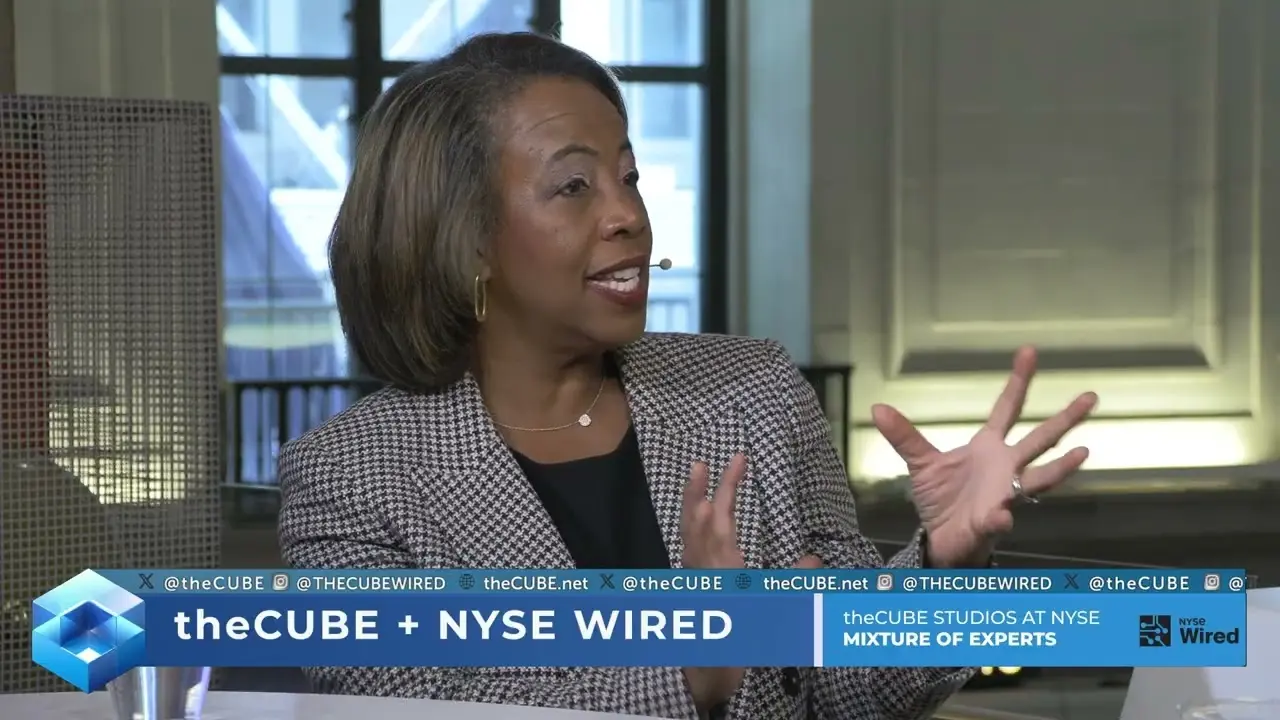
>> Welcome back to theCUBE Studio here at the New York Stock Exchange. I'm Gemma Allen and this is Mixture of Experts, one of our programs with NYSE Wired. And joining me now from Austin, Texas is a man who's in his eighth day as the newly appointed CEO of Axonius, Joe Diamond. Welcome, Joe.
Joe Diamond
>> Thanks. It's great to be here. And eight days, I'm just a veteran, right?
Gemma Allen
>> Eight days, but two years in the company. Joe, maybe talk us through Axonius. Give me the lowdown on this company, where you're at, and what made you step up to this moment.
Joe Diamond
>> Yeah, absolutely. I'm happy to do so. So we are the company that specializes in making sure that every company in the world is able to answer a very fundamental question, which is what is in their environment. And the reason why that is so important is if you sit down with any CIO, you sit down with any CISO and you ask them, "Hey, where are your endpoints? What do your networks look like? Where are your containers? Where are the AI agents?", and so forth, even prior to introducing AI agents in the last 12 months or so, they would have an answer that might represent at most 40% of that environment. So that means that you have 50, 60% of their entire attack surface that is effectively dark matter. So we help organizations at scale answer that question in a very repeatable way and then extend that into helping them understand the risks, the vulnerabilities and the exposures that exist across that environment. And then we can extend that to what we call other asset classes. And those other asset classes are everything from containers to package software that is installed on endpoints to networks to identities and to also AI agents, which has of course been a very interesting emerging threat vector that folks are very concerned about.
Gemma Allen
>> Wow. So this whole issue with discoverability, CIOs, CTOs not fully understanding the scope of their stack has existed for a long time. And in some respects, some hyperscalers might, you might be led to believe it was almost by design, right? If you think about how enterprise licensing has worked, how true-ups have worked across the industry for a very long time, but AI has fundamentally shifted things in respect to what that threat looks like. Talk us through how that technology is integrating and emerging into a threat vector. Is this because of outside vulnerabilities? What is fundamentally shifting in terms of what you're seeing underneath the hood of these enterprises?
Joe Diamond
>> Yeah, it's a great question. So I think it largely starts with, if you don't know what's out there, it's the very simple old adage that has become somewhat a cliche of you can't protect what you can't see. So if 60% of your estate is out there and you don't know about it and as Mythos goes into production and 60% has numerous vulnerabilities that you're not necessarily paying attention to, you have to be able to understand and prioritize what those vulnerabilities look like. So not having that perspective doesn't work well for companies. You can't really be an ostrich today, bury your head in the sand and hope for the best, that's not something that's going to work. And the reason why AI has been an accelerant to that is now you're going to have agents out there that can move at quote, unquote "machine speed" and they're going to have visibility and access to all of these downstream devices. They're going to have visibility and access to all of these downstream applications, all these cloud apps that organizations are using, whether it's shadow or not. And they're not going to be particularly well governed or secured for an extended period of time while we figure out what the defense in depth measures are going to be for how it is as an industry that we protect, govern, and harden AI both from an attack perspective and a sanctioned usage perspective. Because many organizations right now are rolling out AI agents to do things at operational scale because in the future you're going to be in a position where you can get 10X the return on one headcount just by giving one headcount the ability to leverage AI to its fullest extent. So making sure that you have the purview, making sure that you have the controls in place and you actually understand everything from end to end has never been a more important question to have answered and you're not going to be doing this in spreadsheets. And that's the way that it's done today is largely in spreadsheets.
Gemma Allen
>> Well, I can well imagine it, having worked in tech myself and worked with SCOM quite regularly. So asset intelligence, it's a new asset class in and of itself in some respects, right? A new enterprise knowhow. Where does this decision, this live? Where does this knowledge live? Is this a CIO, CISO, CTO, mix of everybody? Who is the ultimate buyer here and what does the deployment look like? Is this another operation center where you manage your full stack? What does it look like in enterprise in real life?
Joe Diamond
>> Yeah, it is definitely a cyber question. We primarily sell and engage with CISOs and cybersecurity teams, but everyone implicitly understands there is no cyber sale that happens more often than not without IT engaged as well. And most importantly, the data and the insights that Axonius as a platform provides really can benefit all the different teams. So whether you're a cyber team, whether you're an IT team, whether you're a governance team, whether you're a compliance team, the insights that the platform gives are insights that can benefit everyone. I mean, even the finance team benefits from understanding the data that you can get from within Axonius as a platform. And in terms of answering your question about how it is that we work from an architecture perspective and what an implementation looks like, the way that this historically was solved, like I said, has largely been with spreadsheets. And when people try to address it from a technical perspective, there were two ways. It was either agent-based solutions or network sensor-based solutions. What Axonius did is flip that on its head and said, "The way that this should be addressed is through API integrations." So we have something that we call adapters and adapters are API based integrations into more than 1,400 different solutions that exist across the cyber stack and across the IT stack. And most importantly, these are bidirectional integrations. So we're consuming information from these downstream solutions, but we're also writing back to them so you can actually take enforcement actions when things go wrong or when you see things that aren't supposed to be that way. So identifying a system that needs a patch, you can actually do the response to actually tell a system to go up and do that patch or seeing that a solution doesn't have a particular on it. You take CrowdStrike as an example, go and deploy CrowdStrike to that downstream system and so forth. So there's more than 400 different types of actions that you can take within the platform and you can automate all of that at scale and in the future you'll actually be able to deploy agents on top of Axonius to do this through swarms of agents all automatically while at the same time making all of that data available via MCP and being able to use downstream solutions as well.
Gemma Allen
>> Wow. Well, in one way you answered my next question, but I'm going to try and reshape a little bit.
Joe Diamond
>> Go for it.
Gemma Allen
>> You have this information and like you said, there's immediate knowledge here and there's also long-term knowledge, right? Maybe there's products and features you're not utilizing, wastage and redundancy is obviously so common in IT, so I'm sure the discoverability is powerful, but you have this immediate action that's required. Are you seeing scenarios whereby at an enterprise level you're seeing fully autonomous reactive behavior or is this again, like a human in the loop? How is this sign off happening in terms of actually actively making changes in these environments right now in May of 2026 and where is it headed?
Joe Diamond
>> It's like anything else. It's a maturity curve or another way of describing it is you got to crawl before you walk before you run. The cyber industry has been talking about automating things for the last 15 years. We've been talking about the autonomous SOC for the last 10-plus years. For the most part, there's still a lot of human in the loop sort of responses that are happening with most security teams because people are scared that they're going to inadvertently potentially do a response that takes an application down or takes a network down or does something that actually adversely impacts the business. So right now I would say there is largely a human in the loop for the most part where organizations are determining that the response might not break things. There is a little bit more automation in those spots, but where there could potentially be the breaks, still human in the loop. I think it's going to be some time before we get into fully autonomous responses, but I think relatively soon we have to get to autonomous responses. We have to get to self-healing because we will not be able to do human in the loop responses fast enough for how quickly things are going to be dynamically changing in our environments and how quickly threat actors are going to be able to move as they deploy AI for their at-scale attacks as well.
Gemma Allen
>> So you mentioned Mythos. I mean, it was definitely a hot topic and I think a great marketing play by Anthropic, if I'm candid for a second, right?
Joe Diamond
>> Absolutely.
Gemma Allen
>> But definitely got people talking and there is somewhat of a maybe misled assumption, I think right now in enterprise too, that as these frontier models become more integrated, become somewhat of an orchestration layer, if that's the journey they're headed on, that there is a level of compliance and governance built in, right? Especially in the case of Anthropic, they seem to have really won this governance narrative, guardrails narrative. What are you actually seeing out in the field from the perspective of these LLMs and how they're being broadly used in industry? And do you think that there is a real wake-up needed around just what level of observability and cyber security is needed to truly be safe like three, five years from now?
Joe Diamond
>> Yeah. It's an interesting angle. First and foremost, there's the notion of like, what is truly safe, right? I mean, is anything truly safe? Like that's a rather existential question, but it's one that I think of all the time. When you think about what AI represents, I think it's the biggest thing that we've seen in our lifetime since the invention and the propensity of the internet itself. It could even potentially be bigger than that in terms of the impact to our industry. In terms of securing it and governing it, I don't think it's going to be through Anthropic, through OpenAI and so forth that the security is going to exist in the same way that as operating systems were being popularized and rolled out, it wasn't the first-party providers of those operating systems that were securing those systems. There were some things and some controls that were built into the operating system, but it was the ecosystem around those operating systems that actually dealt with securing the environment. And then that's where endpoint security came from and network security came from and email security and so forth and so forth. So as with anything else, this is just a new threat vector that is going to have new mechanisms for defense in depth, which is going to be multiple types of controls from governance to response to visibility to orchestration. In some cases, you might start to see some overlap and whatnot, but for the most part, you're going to see a bunch of Gartner Magic Quadrants and Forrester Waves of new security solutions that are being created to create this new landscape and this new attack surface that we've created. It's totally normal and we've seen this cycle before. It's just going to be created again.
Gemma Allen
>> And in that scenario, we've heard for a long time that the cybersecurity industry broadly is overly fragmented, right? Do you see a future where it becomes less or more fragmented and why?
Joe Diamond
>> That's an interesting one because it's a message that I think has been popularized by platform players that are trying to drive consolidation into a single place. Oh, you have to have one place where you're going to get your data, you have to have one place where you're going to have a single throat to choke or a single pane of glass where you're going to solve everything. And to be blunt, I think it is a message of convenience from vendors that benefit from that approach. I would actually argue that it's the opposite and that best of breed is what matters the most. So we've tried to basically be the system of record, if you will, that brings all of the different security controls and all of the different IT systems together because we recognize that people are always going to want to choose the best solution that solves the problem the best way and not just because you have an ELA in place that is going to solve it at an 80% cost reduction, but it's going to increase your likelihood of being compromised by 3,000% as an example. So I think efficacy will always reign supreme and I think making sure that you have a solution that enables you to choose what it is that you want to use is going to be absolutely critical today and potentially even more critical in the future.
Gemma Allen
>> So Joe, Axonius, you're eight days in the job, you've been with this company for two years. You guys have passed 200 million in ARR, correct me if I'm wrong on that.
Joe Diamond
>> It's correct.
Gemma Allen
>> Correct?
Joe Diamond
>> 200 million, 100% growth in two years.
Gemma Allen
>> Well, it's certainly an interesting time and an opportunistic time, I think for a company like this as the world of tech becomes more and more ambiguous and the buyers and decision makers become, it seems more converged and more confused, right? In my humble opinion. Talk about what's ahead for you. I see you have some federal momentum, you guys have won some big federal contracts. Where's the focus now for the next year or so ahead? Which feels like a decade in the world of IT.
Joe Diamond
>> It does. I mean, ultimately we look at ourselves as the platform of platforms, right? So we want to continue building on that vision. We have a lot of momentum in market. Our customers are the success that are really driving us. They're giving us a lot of perspective in terms of where it is that they want to see us go. Like I said, AI has been a huge tailwind for us, for our business, for our platform in terms of frankly creating more risk for organizations to try to deal with, which is driving the impetus for asset intelligence being really the foundation of every cybersecurity program in the world. So focus is the name of the game for us. We're going to continue making sure that we deliver on that vision, that we deliver on it well, make it more approachable, easier to consume and so forth. And you'll continue to see us hitting additional segments and going a little bit further downmarket into enterprise rather than where we typically tend to focus, which is largely in the federal entities and strategic accounts in the largest of the large organizations in the world.
Gemma Allen
>> Well, Joe, it seems though there is so much opportunity on this journey ahead and plenty of long tail opportunities too. Like we spoke about, congrats on your new appointment and good luck to you and the team. Thanks so much for joining us on theCUBE.
Joe Diamond
>> Thank you very much. It's been a pleasure. You have a good one.
Gemma Allen
>> I'm Gemma Allen coming to you from theCUBE Studio here at the New York Stock Exchange. This is Mixture of Experts, part of our program with NYSE Wired. Thanks for watching.
>> Palo Alto Studio Connections, Silicon Valley and Wall Street. I'm John Furrier, host, and here with Dave Vellante, my co-host.
Gemma Allen
>> Welcome back to theCUBE Studio here at the New York Stock Exchange. I'm Gemma Allen and this is Mixture of Experts, one of our programs with NYSE Wired. And joining me now from Austin, Texas is a man who's in his eighth day as the newly appointed CEO of Axonius, Joe Diamond. Welcome, Joe.
Joe Diamond
>> Thanks. It's great to be here. And eight days, I'm just a veteran, right?
Gemma Allen
>> Eight days, but two years in the company. Joe, maybe talk us through Axonius. Give me the lowdown on this company, where you're at, and what made you step up to this moment.
Joe Diamond
>> Yeah, absolutely. I'm happy to do so. So we are the company that specializes in making sure that every company in the world is able to answer a very fundamental question, which is what is in their environment. And the reason why that is so important is if you sit down with any CIO, you sit down with any CISO and you ask them, "Hey, where are your endpoints? What do your networks look like? Where are your containers? Where are the AI agents?", and so forth, even prior to introducing AI agents in the last 12 months or so, they would have an answer that might represent at most 40% of that environment. So that means that you have 50, 60% of their entire attack surface that is effectively dark matter. So we help organizations at scale answer that question in a very repeatable way and then extend that into helping them understand the risks, the vulnerabilities and the exposures that exist across that environment. And then we can extend that to what we call other asset classes. And those other asset classes are everything from containers to package software that is installed on endpoints to networks to identities and to also AI agents, which has of course been a very interesting emerging threat vector that folks are very concerned about.
Gemma Allen
>> Wow. So this whole issue with discoverability, CIOs, CTOs not fully understanding the scope of their stack has existed for a long time. And in some respects, some hyperscalers might, you might be led to believe it was almost by design, right? If you think about how enterprise licensing has worked, how true-ups have worked across the industry for a very long time, but AI has fundamentally shifted things in respect to what that threat looks like. Talk us through how that technology is integrating and emerging into a threat vector. Is this because of outside vulnerabilities? What is fundamentally shifting in terms of what you're seeing underneath the hood of these enterprises?
Joe Diamond
>> Yeah, it's a great question. So I think it largely starts with, if you don't know what's out there, it's the very simple old adage that has become somewhat a cliche of you can't protect what you can't see. So if 60% of your estate is out there and you don't know about it and as Mythos goes into production and 60% has numerous vulnerabilities that you're not necessarily paying attention to, you have to be able to understand and prioritize what those vulnerabilities look like. So not having that perspective doesn't work well for companies. You can't really be an ostrich today, bury your head in the sand and hope for the best, that's not something that's going to work. And the reason why AI has been an accelerant to that is now you're going to have agents out there that can move at quote, unquote "machine speed" and they're going to have visibility and access to all of these downstream devices. They're going to have visibility and access to all of these downstream applications, all these cloud apps that organizations are using, whether it's shadow or not. And they're not going to be particularly well governed or secured for an extended period of time while we figure out what the defense in depth measures are going to be for how it is as an industry that we protect, govern, and harden AI both from an attack perspective and a sanctioned usage perspective. Because many organizations right now are rolling out AI agents to do things at operational scale because in the future you're going to be in a position where you can get 10X the return on one headcount just by giving one headcount the ability to leverage AI to its fullest extent. So making sure that you have the purview, making sure that you have the controls in place and you actually understand everything from end to end has never been a more important question to have answered and you're not going to be doing this in spreadsheets. And that's the way that it's done today is largely in spreadsheets.
Gemma Allen
>> Well, I can well imagine it, having worked in tech myself and worked with SCOM quite regularly. So asset intelligence, it's a new asset class in and of itself in some respects, right? A new enterprise knowhow. Where does this decision, this live? Where does this knowledge live? Is this a CIO, CISO, CTO, mix of everybody? Who is the ultimate buyer here and what does the deployment look like? Is this another operation center where you manage your full stack? What does it look like in enterprise in real life?
Joe Diamond
>> Yeah, it is definitely a cyber question. We primarily sell and engage with CISOs and cybersecurity teams, but everyone implicitly understands there is no cyber sale that happens more often than not without IT engaged as well. And most importantly, the data and the insights that Axonius as a platform provides really can benefit all the different teams. So whether you're a cyber team, whether you're an IT team, whether you're a governance team, whether you're a compliance team, the insights that the platform gives are insights that can benefit everyone. I mean, even the finance team benefits from understanding the data that you can get from within Axonius as a platform. And in terms of answering your question about how it is that we work from an architecture perspective and what an implementation looks like, the way that this historically was solved, like I said, has largely been with spreadsheets. And when people try to address it from a technical perspective, there were two ways. It was either agent-based solutions or network sensor-based solutions. What Axonius did is flip that on its head and said, "The way that this should be addressed is through API integrations." So we have something that we call adapters and adapters are API based integrations into more than 1,400 different solutions that exist across the cyber stack and across the IT stack. And most importantly, these are bidirectional integrations. So we're consuming information from these downstream solutions, but we're also writing back to them so you can actually take enforcement actions when things go wrong or when you see things that aren't supposed to be that way. So identifying a system that needs a patch, you can actually do the response to actually tell a system to go up and do that patch or seeing that a solution doesn't have a particular on it. You take CrowdStrike as an example, go and deploy CrowdStrike to that downstream system and so forth. So there's more than 400 different types of actions that you can take within the platform and you can automate all of that at scale and in the future you'll actually be able to deploy agents on top of Axonius to do this through swarms of agents all automatically while at the same time making all of that data available via MCP and being able to use downstream solutions as well.
Gemma Allen
>> Wow. Well, in one way you answered my next question, but I'm going to try and reshape a little bit.
Joe Diamond
>> Go for it.
Gemma Allen
>> You have this information and like you said, there's immediate knowledge here and there's also long-term knowledge, right? Maybe there's products and features you're not utilizing, wastage and redundancy is obviously so common in IT, so I'm sure the discoverability is powerful, but you have this immediate action that's required. Are you seeing scenarios whereby at an enterprise level you're seeing fully autonomous reactive behavior or is this again, like a human in the loop? How is this sign off happening in terms of actually actively making changes in these environments right now in May of 2026 and where is it headed?
Joe Diamond
>> It's like anything else. It's a maturity curve or another way of describing it is you got to crawl before you walk before you run. The cyber industry has been talking about automating things for the last 15 years. We've been talking about the autonomous SOC for the last 10-plus years. For the most part, there's still a lot of human in the loop sort of responses that are happening with most security teams because people are scared that they're going to inadvertently potentially do a response that takes an application down or takes a network down or does something that actually adversely impacts the business. So right now I would say there is largely a human in the loop for the most part where organizations are determining that the response might not break things. There is a little bit more automation in those spots, but where there could potentially be the breaks, still human in the loop. I think it's going to be some time before we get into fully autonomous responses, but I think relatively soon we have to get to autonomous responses. We have to get to self-healing because we will not be able to do human in the loop responses fast enough for how quickly things are going to be dynamically changing in our environments and how quickly threat actors are going to be able to move as they deploy AI for their at-scale attacks as well.
Gemma Allen
>> So you mentioned Mythos. I mean, it was definitely a hot topic and I think a great marketing play by Anthropic, if I'm candid for a second, right?
Joe Diamond
>> Absolutely.
Gemma Allen
>> But definitely got people talking and there is somewhat of a maybe misled assumption, I think right now in enterprise too, that as these frontier models become more integrated, become somewhat of an orchestration layer, if that's the journey they're headed on, that there is a level of compliance and governance built in, right? Especially in the case of Anthropic, they seem to have really won this governance narrative, guardrails narrative. What are you actually seeing out in the field from the perspective of these LLMs and how they're being broadly used in industry? And do you think that there is a real wake-up needed around just what level of observability and cyber security is needed to truly be safe like three, five years from now?
Joe Diamond
>> Yeah. It's an interesting angle. First and foremost, there's the notion of like, what is truly safe, right? I mean, is anything truly safe? Like that's a rather existential question, but it's one that I think of all the time. When you think about what AI represents, I think it's the biggest thing that we've seen in our lifetime since the invention and the propensity of the internet itself. It could even potentially be bigger than that in terms of the impact to our industry. In terms of securing it and governing it, I don't think it's going to be through Anthropic, through OpenAI and so forth that the security is going to exist in the same way that as operating systems were being popularized and rolled out, it wasn't the first-party providers of those operating systems that were securing those systems. There were some things and some controls that were built into the operating system, but it was the ecosystem around those operating systems that actually dealt with securing the environment. And then that's where endpoint security came from and network security came from and email security and so forth and so forth. So as with anything else, this is just a new threat vector that is going to have new mechanisms for defense in depth, which is going to be multiple types of controls from governance to response to visibility to orchestration. In some cases, you might start to see some overlap and whatnot, but for the most part, you're going to see a bunch of Gartner Magic Quadrants and Forrester Waves of new security solutions that are being created to create this new landscape and this new attack surface that we've created. It's totally normal and we've seen this cycle before. It's just going to be created again.
Gemma Allen
>> And in that scenario, we've heard for a long time that the cybersecurity industry broadly is overly fragmented, right? Do you see a future where it becomes less or more fragmented and why?
Joe Diamond
>> That's an interesting one because it's a message that I think has been popularized by platform players that are trying to drive consolidation into a single place. Oh, you have to have one place where you're going to get your data, you have to have one place where you're going to have a single throat to choke or a single pane of glass where you're going to solve everything. And to be blunt, I think it is a message of convenience from vendors that benefit from that approach. I would actually argue that it's the opposite and that best of breed is what matters the most. So we've tried to basically be the system of record, if you will, that brings all of the different security controls and all of the different IT systems together because we recognize that people are always going to want to choose the best solution that solves the problem the best way and not just because you have an ELA in place that is going to solve it at an 80% cost reduction, but it's going to increase your likelihood of being compromised by 3,000% as an example. So I think efficacy will always reign supreme and I think making sure that you have a solution that enables you to choose what it is that you want to use is going to be absolutely critical today and potentially even more critical in the future.
Gemma Allen
>> So Joe, Axonius, you're eight days in the job, you've been with this company for two years. You guys have passed 200 million in ARR, correct me if I'm wrong on that.
Joe Diamond
>> It's correct.
Gemma Allen
>> Correct?
Joe Diamond
>> 200 million, 100% growth in two years.
Gemma Allen
>> Well, it's certainly an interesting time and an opportunistic time, I think for a company like this as the world of tech becomes more and more ambiguous and the buyers and decision makers become, it seems more converged and more confused, right? In my humble opinion. Talk about what's ahead for you. I see you have some federal momentum, you guys have won some big federal contracts. Where's the focus now for the next year or so ahead? Which feels like a decade in the world of IT.
Joe Diamond
>> It does. I mean, ultimately we look at ourselves as the platform of platforms, right? So we want to continue building on that vision. We have a lot of momentum in market. Our customers are the success that are really driving us. They're giving us a lot of perspective in terms of where it is that they want to see us go. Like I said, AI has been a huge tailwind for us, for our business, for our platform in terms of frankly creating more risk for organizations to try to deal with, which is driving the impetus for asset intelligence being really the foundation of every cybersecurity program in the world. So focus is the name of the game for us. We're going to continue making sure that we deliver on that vision, that we deliver on it well, make it more approachable, easier to consume and so forth. And you'll continue to see us hitting additional segments and going a little bit further downmarket into enterprise rather than where we typically tend to focus, which is largely in the federal entities and strategic accounts in the largest of the large organizations in the world.
Gemma Allen
>> Well, Joe, it seems though there is so much opportunity on this journey ahead and plenty of long tail opportunities too. Like we spoke about, congrats on your new appointment and good luck to you and the team. Thanks so much for joining us on theCUBE.
Joe Diamond
>> Thank you very much. It's been a pleasure. You have a good one.
Gemma Allen
>> I'm Gemma Allen coming to you from theCUBE Studio here at the New York Stock Exchange. This is Mixture of Experts, part of our program with NYSE Wired. Thanks for watching.














































 John Furrier
 Gemma Allen