We just sent you a verification email. Please verify your account to gain access to
theCUBE + NYSE Wired: Crypto Trailblazers. If you don’t think you received an email check your
spam folder.
Sign in to theCUBE + NYSE Wired: Crypto Trailblazers.
In order to sign in, enter the email address you used to registered for the event. Once completed, you will receive an email with a verification link. Open this link to automatically sign into the site.
Register For theCUBE + NYSE Wired: Crypto Trailblazers
Please fill out the information below. You will recieve an email with a verification link confirming your registration. Click the link to automatically sign into the site.
You’re almost there!
We just sent you a verification email. Please click the verification button in the email. Once your email address is verified, you will have full access to all event content for theCUBE + NYSE Wired: Crypto Trailblazers.
I want my badge and interests to be visible to all attendees.
Checking this box will display your presense on the attendees list, view your profile and allow other attendees to contact you via 1-1 chat. Read the Privacy Policy. At any time, you can choose to disable this preference.
Select your Interests!
add
Upload your photo
Uploading..
OR
Connect via Twitter
Connect via Linkedin
EDIT PASSWORD
Share
Forgot Password
Almost there!
We just sent you a verification email. Please verify your account to gain access to
theCUBE + NYSE Wired: Crypto Trailblazers. If you don’t think you received an email check your
spam folder.
Sign in to theCUBE + NYSE Wired: Crypto Trailblazers.
In order to sign in, enter the email address you used to registered for the event. Once completed, you will receive an email with a verification link. Open this link to automatically sign into the site.
Sign in to gain access to theCUBE + NYSE Wired: Crypto Trailblazers
Please sign in with LinkedIn to continue to theCUBE + NYSE Wired: Crypto Trailblazers. Signing in with LinkedIn ensures a professional environment.
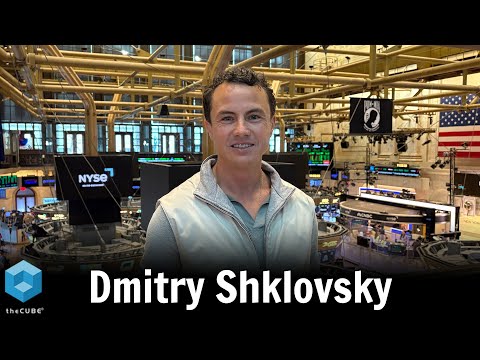
>> Hello everyone. Welcome back to the Crypto Trailblazer series. I'm John Furrier, host of theCUBE. We're in theCUBE Studios in Palo Alto, California, part of theCUBE plus NYC Wired event featuring all the trailblazers in crypto blockchain, really setting the infrastructure for the next generation. Dmitry's here, Co-Founder and Co-CEO of QuickNode. Dmitry, thanks for coming on, appreciate you.
Dmitry Shklovsky
>> Thank you. My pleasure, pleasure to be here.>> We've been really seeing a lot of activity, the maturization of crypto. It's obviously had its cycles, now we've got a different environment certainly here in the US, but it hasn't changed the game around the world. You guys are doing some cool stuff. Do a quick intro to QuickNode, what you guys do, set the table and then we'll dig in. What you guys do, why you were founded, and what you're building.
Dmitry Shklovsky
>> Thank you, John. QuickNode is a leading on-chain developer platform so we provide developers and businesses with the tools to build, scale, and manage quality blockchain applications. From things like high-performance nodes, elastic APIs, and most everything in between, we simplify the complexities of working with blockchain technology. So whether you're launching a decentralized app, exploring layer 2 solutions, or looking to bring the benefits of blockchain to your enterprise, QuickNode delivers reliable, scalable infrastructure backed by four nines SLA and a team of a hundred plus around the world to make sure that you succeed.>> We've seen the movie many times. I've seen a few waves around the track, so to speak. Not to mix metaphors, but every wave, there's always this enablement. Obviously blockchain is key, but software apps, D apps, decentralized applications will be big, right? The question everyone says is, "Okay, how do they work?"
So what is the state of the art for if I want to build a decentralized application, how do I think about that? Because if I'm a developer, maybe I'm old school developer, or I have a database, I got serverless, I'm in the cloud. Now I want to go to full, efficient, transparent onchain, I want immutability, I want all the benefits of decentralized infrastructure. What do I need to think about? What are the core principles, concepts that I have to lock into as a developer?
Dmitry Shklovsky
>> Right, so you want your application to be as good, if not better, than the current web, let's call it Web2. It needs to be fast, it needs to be reliable, it has to be easy to use. This is what we help businesses realize. When you bring your application onchain, you can leverage this permissionless, transparent, interoperable ledger let's call it, or database, where anything that you build can easily be used by anyone, and can also be used with other instruments and applications so you don't need to ask permissions or you don't need to go to another company and say, "Hey, can we do business?"
These are all open on the blockchain, and it just removes a lot of friction, a lot of barriers to building complex and very elaborate applications.>> Talk about your business model. Are you guys targeting developers? Are you guys providing a marketplace? Is it a dev platform? Do I have to pick a chain? I got Ethereum, maybe Bitcoins, obviously everyone's talking about Bitcoin. What's the approach for you guys? What are you guys offering?
Dmitry Shklovsky
>> Right, so at the end of the day, the user of the platform is typically a developer, although we do have prosumers. Maybe you're looking for a reliable RPC API for your wallet, or maybe you're running an arbitrage script or bot and you need something that can fetch data within milliseconds and then execute a trade using that data. Or if you're a larger company such as Coinbase or Uniswap or even Binance, you want to make sure that your millions of customers are able to read and write things onchain. Finding out token balances, finding out what kind of NFTs are in your wallet, any kind of interaction that you do onchain, you want to have a reliable infrastructure partner. We started this project in 2017, so we've been through a number of these waves. We've been through a number of cycles, and we've stuck around because we're not a DeFi project or we're not an NFT project. We're like the underlying infrastructure, the pipes and the wiring that provide a utility, a basic utility to do basically anything you want onchain.>> It's interesting you mentioned 2017. If you think about that time period and now, a lot's changed. Obviously, there's been some stuff happening in the market, but that early days was about developers and building two-sided marketplaces, real infrastructure, right? And applications, that's like, I call that hardcore "cloud-like," in the sense I say cloud-like in quotes, because the cloud was great because I can just go to the cloud as a developer, I don't have to provision a data center. So it sounds like you guys have that same ethos where, hey, I just want to do stuff. I don't want to have to do all this heavy lifting. If I want to build, say theCUBE coin for theCUBE, I can say, "Guys, set me up. I want to use MetaMask, I want to have a wallet. I want to have a token."
Is that where you're thinking about the market right now? Is it that target or is it more mission-critical applications like trading? What are some of the use cases? Because I can see people shifting over quickly. If there was an easy platform, like what you're doing, saying, "Okay, I know how to deal with databases."
Okay, cool. Now I just need, how do I set this up? What's the infrastructure? Do I stand it up on QuickNode? Can you support that? Like what-
Dmitry Shklovsky
>> We save you time to market from weeks or months to days, and you don't have to hire a full-time DevOps team or infrastructure team to manage things like nodes and APIs and other various technologies that you need to run blockchain applications. Our core founding team comes from about two decades of experience running data centers, managed hosting, and content delivery networks. We managed 14 data centers around the world prior to starting QuickNode. Our previous company was a CDN company which was acquired. And as we were exiting that company, this was around August 2017, we saw a big boom in the ICO space. The amount, the influx of users that were being onboarded to blockchain were so immense that they were bringing the premier wallet applications and trading platforms at the time, which like you said, they've come a long way since 2017. They were bringing a lot of those platforms down. So what we did was we solved the problem, A, for ourselves, and then we made that customer facing. We did envision that the Web3 is this new layer of the internet, which simply wasn't possible before, but today, it is possible because there's broadband to most households, there's even one gigabit or 10 gigabit fiber so it makes this a lot more feasible. But we did see that future and we wanted to enable that. We wanted to bring those decades of experience in infrastructure to this new layer of the internet, and allow the front end developers and the builders to execute on their vision and not have to worry about things like TCP/IP and security and standing up infrastructure and scaling that. Our core service is RPC API. With a single line of code that you plug into your application, you can scale from 10 to a million users pretty much overnight. Like I mentioned before, team of over a hundred people with support around the sun there to support you, making sure that you have somebody to talk to. We basically become an extension of your team, become your partner in whatever you're doing onchain.>> That's awesome. Well, congratulations. By the way, that's great DNA having that experience with large data centers, hosting/service providing a critical infrastructure. I want to ask you about the use cases with the developer. I mean, we saw the rise of smart contracts, that's a no-brainer. You look at smart contracts, you say, "Okay, I can see that working onchain."
I think people can get there in their minds that are going to be moving to blockchain. What languages are we programming in? Solidity? Is there other things? It used to be for Ethereum, it was Solidity. What's the state-of-the-art coding? Take me through someone who wants to have infrastructure to run their business, whether it's smart contracts between two parties, no middleman. What do we do? Give us a use case. What's the steps? What are the sequence of events?
Dmitry Shklovsky
>> Sure. So typically for blockchain on EVM, you are going to use Solidity. There are alternatives like Viper. For a blockchain like Solana, Rust is mega popular. We have multiple resources. We have guides, we have YouTube videos, we have courses that you can take to learn how to port your app, how to build applications, how to do pretty much anything with Web3 development, whether you're a new to the space and just starting to build a blockchain or you're more seasoned and looking to optimize your application, run it more efficiently, make it run faster, we have guides for that ranging from beginner to expert.>> Tell me about the coolest thing you're working on right now, and then give some stats on what's the activity look like. The coolest thing you're working on right now that you're excited about, and then some stats on what you're seeing in your network.
Dmitry Shklovsky
>> Cool. We served over 3 trillion API requests last year. That's more than Google did search queries. We also received our SOC 1 Type 2, SOC 2 Type 2, and ISO 27001 certifications. Our focus is to continue on delivering the fastest, most reliable service to our customers, which range, like I mentioned, from small projects to Fortune 1000 companies. Coolest thing, yeah, so we recently->> Coolest thing you're working on right now.
Dmitry Shklovsky
>> Absolutely, yeah, we recently launched a roll up accelerator. We partnered with about two dozen companies, which are the most notable in the space, so if you're looking to build a layer 2 chain, we take you through an eight-week course and provide connections to everything you need to build and run a chain so that's everything from bridges to block explorers to VCs and everything in between. Today, we support over 60 blockchains and over 95 networks and we do see a multichain world in the future where each chain is essentially like a server. There's not one server fits all. So one server may need to prioritize speed over security, or one server may need faster block times or larger blocks. With rollups, we help you customize that and bring you from testnet to mainnet, so then you can run your application specific chain and build your business.>> Dmitry, that is great stuff. I love that. Quality of chain service. It's very networking already. Give me some QOS. Pick your chain. Pick your layer. Final question, since you brought up layer 2, what should people know about in terms of as they go in and start moving operations from testnet and then getting to the mainnets for their, whether it's business model transformation or just net new born in the chain ventures, what's the difference between picking the layer approach? I mean, layer 2, layer 3, there's a distinction that's important. How would you describe the importance of knowing the layer approach?
Dmitry Shklovsky
>> Right. We do have a chain selector, and we give you the pros and cons of which framework to use, which settings to use for your chain. It's really important to work with people that, as Naval Ravikant says, play long-term games with long-term people. If you have a long-term vision, you want to make sure that you partner with people that will be there for you long-term and have the experience and the knowledge to help you succeed.>> Yeah, and I think that low-level layer's critical. Dmitry, thank you so much. And again, congratulations on QuickNode, love the service. Reminds me of the early days of cloud where you want to stand up some stuff fast and get in there and innovate and figure it out, and then when you figure it out, scaling it up, really critical. You guys got that infrastructure platform for blockchain. Thanks for coming on theCUBE for trailblazing crypto.
Dmitry Shklovsky
>> My pleasure, John. Thank you for having me.>> Thanks for coming on. Okay, I'm John Furrier here for the Crypto Trailblazer. It's theCUBE in Palo Alto. We've got theCUBE in New York at the NYSE, and of course theCUBE and NYSE Wired community bringing a trust network together. Maybe we'll bring back theCUBE coin onchain for theCUBE coin for trust. Thanks for watching, more next.
>> Hello everyone. Welcome back to the Crypto Trailblazer series. I'm John Furrier, host of theCUBE. We're in theCUBE Studios in Palo Alto, California, part of theCUBE plus NYC Wired event featuring all the trailblazers in crypto blockchain, really setting the infrastructure for the next generation. Dmitry's here, Co-Founder and Co-CEO of QuickNode. Dmitry, thanks for coming on, appreciate you.
Dmitry Shklovsky
>> Thank you. My pleasure, pleasure to be here.>> We've been really seeing a lot of activity, the maturization of crypto. It's obviously had its cycles, now we've got a different environment certainly here in the US, but it hasn't changed the game around the world. You guys are doing some cool stuff. Do a quick intro to QuickNode, what you guys do, set the table and then we'll dig in. What you guys do, why you were founded, and what you're building.
Dmitry Shklovsky
>> Thank you, John. QuickNode is a leading on-chain developer platform so we provide developers and businesses with the tools to build, scale, and manage quality blockchain applications. From things like high-performance nodes, elastic APIs, and most everything in between, we simplify the complexities of working with blockchain technology. So whether you're launching a decentralized app, exploring layer 2 solutions, or looking to bring the benefits of blockchain to your enterprise, QuickNode delivers reliable, scalable infrastructure backed by four nines SLA and a team of a hundred plus around the world to make sure that you succeed.>> We've seen the movie many times. I've seen a few waves around the track, so to speak. Not to mix metaphors, but every wave, there's always this enablement. Obviously blockchain is key, but software apps, D apps, decentralized applications will be big, right? The question everyone says is, "Okay, how do they work?"
So what is the state of the art for if I want to build a decentralized application, how do I think about that? Because if I'm a developer, maybe I'm old school developer, or I have a database, I got serverless, I'm in the cloud. Now I want to go to full, efficient, transparent onchain, I want immutability, I want all the benefits of decentralized infrastructure. What do I need to think about? What are the core principles, concepts that I have to lock into as a developer?
Dmitry Shklovsky
>> Right, so you want your application to be as good, if not better, than the current web, let's call it Web2. It needs to be fast, it needs to be reliable, it has to be easy to use. This is what we help businesses realize. When you bring your application onchain, you can leverage this permissionless, transparent, interoperable ledger let's call it, or database, where anything that you build can easily be used by anyone, and can also be used with other instruments and applications so you don't need to ask permissions or you don't need to go to another company and say, "Hey, can we do business?"
These are all open on the blockchain, and it just removes a lot of friction, a lot of barriers to building complex and very elaborate applications.>> Talk about your business model. Are you guys targeting developers? Are you guys providing a marketplace? Is it a dev platform? Do I have to pick a chain? I got Ethereum, maybe Bitcoins, obviously everyone's talking about Bitcoin. What's the approach for you guys? What are you guys offering?
Dmitry Shklovsky
>> Right, so at the end of the day, the user of the platform is typically a developer, although we do have prosumers. Maybe you're looking for a reliable RPC API for your wallet, or maybe you're running an arbitrage script or bot and you need something that can fetch data within milliseconds and then execute a trade using that data. Or if you're a larger company such as Coinbase or Uniswap or even Binance, you want to make sure that your millions of customers are able to read and write things onchain. Finding out token balances, finding out what kind of NFTs are in your wallet, any kind of interaction that you do onchain, you want to have a reliable infrastructure partner. We started this project in 2017, so we've been through a number of these waves. We've been through a number of cycles, and we've stuck around because we're not a DeFi project or we're not an NFT project. We're like the underlying infrastructure, the pipes and the wiring that provide a utility, a basic utility to do basically anything you want onchain.>> It's interesting you mentioned 2017. If you think about that time period and now, a lot's changed. Obviously, there's been some stuff happening in the market, but that early days was about developers and building two-sided marketplaces, real infrastructure, right? And applications, that's like, I call that hardcore "cloud-like," in the sense I say cloud-like in quotes, because the cloud was great because I can just go to the cloud as a developer, I don't have to provision a data center. So it sounds like you guys have that same ethos where, hey, I just want to do stuff. I don't want to have to do all this heavy lifting. If I want to build, say theCUBE coin for theCUBE, I can say, "Guys, set me up. I want to use MetaMask, I want to have a wallet. I want to have a token."
Is that where you're thinking about the market right now? Is it that target or is it more mission-critical applications like trading? What are some of the use cases? Because I can see people shifting over quickly. If there was an easy platform, like what you're doing, saying, "Okay, I know how to deal with databases."
Okay, cool. Now I just need, how do I set this up? What's the infrastructure? Do I stand it up on QuickNode? Can you support that? Like what-
Dmitry Shklovsky
>> We save you time to market from weeks or months to days, and you don't have to hire a full-time DevOps team or infrastructure team to manage things like nodes and APIs and other various technologies that you need to run blockchain applications. Our core founding team comes from about two decades of experience running data centers, managed hosting, and content delivery networks. We managed 14 data centers around the world prior to starting QuickNode. Our previous company was a CDN company which was acquired. And as we were exiting that company, this was around August 2017, we saw a big boom in the ICO space. The amount, the influx of users that were being onboarded to blockchain were so immense that they were bringing the premier wallet applications and trading platforms at the time, which like you said, they've come a long way since 2017. They were bringing a lot of those platforms down. So what we did was we solved the problem, A, for ourselves, and then we made that customer facing. We did envision that the Web3 is this new layer of the internet, which simply wasn't possible before, but today, it is possible because there's broadband to most households, there's even one gigabit or 10 gigabit fiber so it makes this a lot more feasible. But we did see that future and we wanted to enable that. We wanted to bring those decades of experience in infrastructure to this new layer of the internet, and allow the front end developers and the builders to execute on their vision and not have to worry about things like TCP/IP and security and standing up infrastructure and scaling that. Our core service is RPC API. With a single line of code that you plug into your application, you can scale from 10 to a million users pretty much overnight. Like I mentioned before, team of over a hundred people with support around the sun there to support you, making sure that you have somebody to talk to. We basically become an extension of your team, become your partner in whatever you're doing onchain.>> That's awesome. Well, congratulations. By the way, that's great DNA having that experience with large data centers, hosting/service providing a critical infrastructure. I want to ask you about the use cases with the developer. I mean, we saw the rise of smart contracts, that's a no-brainer. You look at smart contracts, you say, "Okay, I can see that working onchain."
I think people can get there in their minds that are going to be moving to blockchain. What languages are we programming in? Solidity? Is there other things? It used to be for Ethereum, it was Solidity. What's the state-of-the-art coding? Take me through someone who wants to have infrastructure to run their business, whether it's smart contracts between two parties, no middleman. What do we do? Give us a use case. What's the steps? What are the sequence of events?
Dmitry Shklovsky
>> Sure. So typically for blockchain on EVM, you are going to use Solidity. There are alternatives like Viper. For a blockchain like Solana, Rust is mega popular. We have multiple resources. We have guides, we have YouTube videos, we have courses that you can take to learn how to port your app, how to build applications, how to do pretty much anything with Web3 development, whether you're a new to the space and just starting to build a blockchain or you're more seasoned and looking to optimize your application, run it more efficiently, make it run faster, we have guides for that ranging from beginner to expert.>> Tell me about the coolest thing you're working on right now, and then give some stats on what's the activity look like. The coolest thing you're working on right now that you're excited about, and then some stats on what you're seeing in your network.
Dmitry Shklovsky
>> Cool. We served over 3 trillion API requests last year. That's more than Google did search queries. We also received our SOC 1 Type 2, SOC 2 Type 2, and ISO 27001 certifications. Our focus is to continue on delivering the fastest, most reliable service to our customers, which range, like I mentioned, from small projects to Fortune 1000 companies. Coolest thing, yeah, so we recently->> Coolest thing you're working on right now.
Dmitry Shklovsky
>> Absolutely, yeah, we recently launched a roll up accelerator. We partnered with about two dozen companies, which are the most notable in the space, so if you're looking to build a layer 2 chain, we take you through an eight-week course and provide connections to everything you need to build and run a chain so that's everything from bridges to block explorers to VCs and everything in between. Today, we support over 60 blockchains and over 95 networks and we do see a multichain world in the future where each chain is essentially like a server. There's not one server fits all. So one server may need to prioritize speed over security, or one server may need faster block times or larger blocks. With rollups, we help you customize that and bring you from testnet to mainnet, so then you can run your application specific chain and build your business.>> Dmitry, that is great stuff. I love that. Quality of chain service. It's very networking already. Give me some QOS. Pick your chain. Pick your layer. Final question, since you brought up layer 2, what should people know about in terms of as they go in and start moving operations from testnet and then getting to the mainnets for their, whether it's business model transformation or just net new born in the chain ventures, what's the difference between picking the layer approach? I mean, layer 2, layer 3, there's a distinction that's important. How would you describe the importance of knowing the layer approach?
Dmitry Shklovsky
>> Right. We do have a chain selector, and we give you the pros and cons of which framework to use, which settings to use for your chain. It's really important to work with people that, as Naval Ravikant says, play long-term games with long-term people. If you have a long-term vision, you want to make sure that you partner with people that will be there for you long-term and have the experience and the knowledge to help you succeed.>> Yeah, and I think that low-level layer's critical. Dmitry, thank you so much. And again, congratulations on QuickNode, love the service. Reminds me of the early days of cloud where you want to stand up some stuff fast and get in there and innovate and figure it out, and then when you figure it out, scaling it up, really critical. You guys got that infrastructure platform for blockchain. Thanks for coming on theCUBE for trailblazing crypto.
Dmitry Shklovsky
>> My pleasure, John. Thank you for having me.>> Thanks for coming on. Okay, I'm John Furrier here for the Crypto Trailblazer. It's theCUBE in Palo Alto. We've got theCUBE in New York at the NYSE, and of course theCUBE and NYSE Wired community bringing a trust network together. Maybe we'll bring back theCUBE coin onchain for theCUBE coin for trust. Thanks for watching, more next.