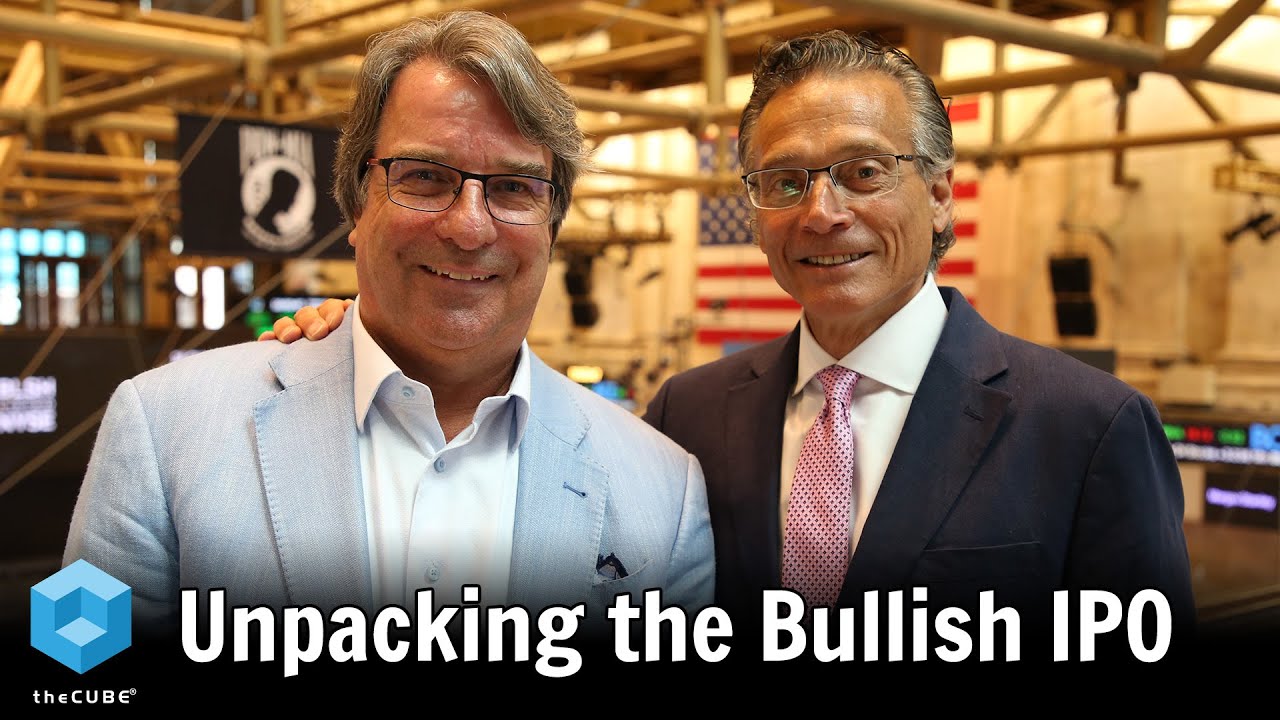
In this exclusive conversation from theCUBE + NYSE Wired’s “Crypto Trailblazers: Wall St On Chain” event, Randall Little, partner at 50T Funds, joins theCUBE’s John Furrier to unpack where crypto and Wall Street intersect as institutional adoption accelerates. Little explains why the market is still “early” despite unprecedented momentum over the last six months, how regulatory clarity is unlocking institutional demand and why digitization of value (beyond the earlier electronification of markets) is rewiring the financial “plumbing.” He shares why payments remain the most obvious near-term use case and why real businesses – not “one-trick ponies” – are now in the IPO spotlight. Little details 50T Funds’ growth-stage thesis (tilting toward $50M+ revenue, institutional demand and downside protection) and highlights portfolio activity around Figure, Gemini and Kraken.
The discussion dives into what it really takes to be public-market ready – from SOX and accounting blocking-and-tackling to proving modelable, multi-product revenue that can endure cycles. Little contrasts retail-driven token hype with equity value creation as the IPO window opens and cautions founders to optimize for optionality, avoid over-hiring and to tune out “shiny objects.” Looking forward, he expects mainstream experiences to abstract DeFi complexity as hundreds of millions adopt crypto for payments and trading, with ecosystem building (and a community mindset) helping later-stage companies scale in tandem with institutions like BlackRock and Fidelity alongside moves from firms such as Stripe and Circle.
Forgot Password
Almost there!
We just sent you a verification email. Please verify your account to gain access to
theCUBE + NYSE Wired: Crypto Trailblazers. If you don’t think you received an email check your
spam folder.
Sign in to theCUBE + NYSE Wired: Crypto Trailblazers.
In order to sign in, enter the email address you used to registered for the event. Once completed, you will receive an email with a verification link. Open this link to automatically sign into the site.
Register For theCUBE + NYSE Wired: Crypto Trailblazers
Please fill out the information below. You will recieve an email with a verification link confirming your registration. Click the link to automatically sign into the site.
You’re almost there!
We just sent you a verification email. Please click the verification button in the email. Once your email address is verified, you will have full access to all event content for theCUBE + NYSE Wired: Crypto Trailblazers.
I want my badge and interests to be visible to all attendees.
Checking this box will display your presense on the attendees list, view your profile and allow other attendees to contact you via 1-1 chat. Read the Privacy Policy. At any time, you can choose to disable this preference.
Select your Interests!
add
Upload your photo
Uploading..
OR
Connect via Twitter
Connect via Linkedin
EDIT PASSWORD
Share
Forgot Password
Almost there!
We just sent you a verification email. Please verify your account to gain access to
theCUBE + NYSE Wired: Crypto Trailblazers. If you don’t think you received an email check your
spam folder.
Sign in to theCUBE + NYSE Wired: Crypto Trailblazers.
In order to sign in, enter the email address you used to registered for the event. Once completed, you will receive an email with a verification link. Open this link to automatically sign into the site.
Sign in to gain access to theCUBE + NYSE Wired: Crypto Trailblazers
Please sign in with LinkedIn to continue to theCUBE + NYSE Wired: Crypto Trailblazers. Signing in with LinkedIn ensures a professional environment.
Are you sure you want to remove access rights for this user?
Details
Manage Access
email address
Community Invitation
Paul Frambot, Morpho
In this exclusive conversation from theCUBE + NYSE Wired’s “Crypto Trailblazers: Wall St On Chain” event, Randall Little, partner at 50T Funds, joins theCUBE’s John Furrier to unpack where crypto and Wall Street intersect as institutional adoption accelerates. Little explains why the market is still “early” despite unprecedented momentum over the last six months, how regulatory clarity is unlocking institutional demand and why digitization of value (beyond the earlier electronification of markets) is rewiring the financial “plumbing.” He shares why payments remain the most obvious near-term use case and why real businesses – not “one-trick ponies” – are now in the IPO spotlight. Little details 50T Funds’ growth-stage thesis (tilting toward $50M+ revenue, institutional demand and downside protection) and highlights portfolio activity around Figure, Gemini and Kraken.
The discussion dives into what it really takes to be public-market ready – from SOX and accounting blocking-and-tackling to proving modelable, multi-product revenue that can endure cycles. Little contrasts retail-driven token hype with equity value creation as the IPO window opens and cautions founders to optimize for optionality, avoid over-hiring and to tune out “shiny objects.” Looking forward, he expects mainstream experiences to abstract DeFi complexity as hundreds of millions adopt crypto for payments and trading, with ecosystem building (and a community mindset) helping later-stage companies scale in tandem with institutions like BlackRock and Fidelity alongside moves from firms such as Stripe and Circle.
>> Hello, I'm John Furrier, host of theCUBE, here at our NYSE CUBE Studios as part of our NYSE Wired program and community. This is the Crypto Trailblazer series, where we are talking to the leaders who are making it happen in crypto, crypto infrastructure. As the world and finance infrastructure changes and stablecoins comes in, you're starting to see a sea change, a surge in entrepreneurship, a surge of new business models. Paul Frambot is here, co-founder and CEO of Morpho, morpho.org, check it out. Paul, great to have you on this podcast. Thanks for coming on our Trailblazer series.
Paul Frambot
>> Yeah, thanks for having me.>> We've had some pretty big names on, some older guys, you're a young gun coming in, you've got a cool venture you're developing, I've got a lot of questions. But first, start out by explaining what you guys do, what was the origination story, how did it all come together?
Paul Frambot
>> Sure. So Morpho is a non-chain lending and borrowing infrastructure, so we allow people to earn yield on one end and to take out loans on the other end, and this is fully done on-chain, on 20 different chains, and it's being integrated by mostly FinTechs, exchanges, et cetera, that want to power yields or loans services, but they do so by plugging on-chain and they get access to global liquidity, better terms, by doing so. And the founding story is that I was a student in Paris, in polytechnique, and essentially started playing around consensus algorithms, and that's what was my way into blockchain and then crypto and then DeFi, and then wanting to do a project in DeFi and financing is obviously a huge thing in finance, and so I ended up working in this, and got funded by some VCs, and that's how it->> Who was the backers?
Paul Frambot
>> So Andreessen Horowitz initially and Nascent and Variant, we had a lot, we had a hundred different investors. But that was a fun story, back then, I was in my second year at university, so I did not know much about fundraising.>> Come on, come into the fold, Andreessen Horowitz lured you in.
Paul Frambot
>> Exactly. But that was a lot of fun. And then, obviously, the company has grown a lot since then, we've done multiple rounds of funding, but that's how->> How much did you guys raise, roughly? Can you talk abou it?
Paul Frambot
>> Close to a hundred in total.>> Yeah, nice. Well, what's cool about this market is that it really is a young and old coming together. The old days, when I was your age, it was the young beats the old down to the ground and takes over territory. But in crypto, it's kind of like a blending of cultures. So as a young gun, you're like this in university, what's your feeling right now? Do you agree with that statement, that it's kind of like a blending? You've got the big gatekeepers, now, they know they're going to get disrupted, they've got to either accept or reject it, and some who reject it will probably be burned to the ground by the forces.
Paul Frambot
>> Right. So I think I've changed my opinion over time with this. Two years ago, I think the crypto industry in general was a bit arrogant with regard to the financial industry overall, thinking everything was outdated and that they were going to disrupt everybody. And over the last six months, we've clearly seen very important institutional interest, and what we've realized is that the people in traditional finance not only get it fast, but they also build very fast, much faster than we anticipated, and within just nine months, they've been able to integrate and educate their own companies and people to the Web 3.0 technologies at a pace I would never have imagined. I'm very impressed in general.>> Yeah. I'll tell you, from my perspective, seeing the many waves I've lived through, the New York crowd, or the institutional crowd, even globally, they hold back, because they control the money. When we talk about money, money's on the line, people change their behavior.
Paul Frambot
>> That's completely fair. And I think really, the trigger, what's interesting is that initially, people were thinking, oh, they're going to get in for technology. But actually, what made people get in was the distribution, there's a lot of money on-chain and all those players were like, "Hey, let's tokenize our funds to get access to this capital, let's run and manage vaults to be able to essentially make money out of it.">> Okay. So let's get into some of the things you're working on. So obviously, well, congratulations on the opportunity, so I think it's going to be great, I think you're going to do well. It's so early. What are you targeting? Who's your customer? What's the focus?
Paul Frambot
>> Right. So Morpho is a $15 billion infrastructure, in which different types of FinTechs, exchanges, would integrate to offer yield and loan services. So one famous example of that is that if you're earning yield on Coinbase, or if you're taking loans from your Coinbase app, behind the scenes, Coinbase is going to spin off a wallet, and this wallet is going to directly interact with the Morpho smart contract. This smart contract is going to be the connector between all those different front-ends and is going to aggregate liquidity in one single marketplace, where everybody can draw from or earn yield on. So we integrate with Gemini, Crypto.com, Ledger, Binance, all of those players, they all connect to this universal lending network that we operate on-chain and that is fully decentralized that allows people to directly plug from. And so, customers could basically be... If you have a crypto wallet, you can directly interact with the protocol. But most interestingly, it has become institutions and distributors themselves that want to offer yield on their crypto, but also on the USD and euro accounts. And so, more and more, anyone that's looking to integrate yield into their platform or loans is a user of Morpho.>> So you're basically building a smart contract layer as a mechanism to manage the different other mechanisms, you're like an abstraction layer?
Paul Frambot
>> Yeah. So we connect lenders with borrowers. Effectively, what the smart contract will do is that it will account for the interest, who should be paying what, what is the liquidation threshold, at what point people should be liquidated if they have some collateral, et cetera, et cetera. And so, a bank would use this to move their loan books on-chain, for example, like we just announced recently, so is moving on-chain with Morpho, where effectively, what they do is they would lend out their own stablecoin in the Morpho books, and then they wait for borrowers to take those orders.>> So if I'm a whale and I have a lot of Bitcoin, am I a prospect or am I having to go through-
Paul Frambot
>> Yes. So two main use cases. You can either earn yield on your Bitcoin, on Morpho, by making it available to borrow to some other people, or you can get some financing out of your Bitcoin. So your use case, what it would look like is you'd deposit the Bitcoin in the smart contract and you'd ake out some USDC or USDT or whatever the stablecoin you want, and with this, you can do pretty much anything you want, whether it is buying a house, taking on some leverage, repaying some credit line, et cetera. And obviously, you don't have to interact natively with the smart contract, you would usually do this for an app, that abstracts this for you.>> One of the things Marc Andreessen was very vocal about was the debanking during the last regime. So since the new regime in the US is in place, liquidity was a huge problem, no banks, now, with you guys, that changes the game, right?
Paul Frambot
>> That's completely fair. And I think in general, when you start to see all the things that are happening on-chain right now, if you have a wallet, you have access to payments with stablecoins, so that's like your checking accounts. Now, you have Morpho Vaults that allow you to earn yield and through different risk profiles. With all types of assets, that can be productive. So now, you have access to yields, but you can also take loans and you have those crypto credit cards that are happening. And so, you start to wonder, do I even need a bank account? And I think it's fair to say that we're going to see some FinTechs emerge where they're able, in just a few days, to spin off an app that's an entire fully fledged financial app that gives you access to a breadth of financial products with immense liquidity and diversity of products for all types of users in a way that's very accessible.>> What's your vision? How do you see this, the preferred future state? If you can connect the dots with what you've seen, how you started, where you are now, where the market is, what's the vision look like? Paint us a picture.
Paul Frambot
>> I think blockchain enables us to have this open computer, where everybody can operate in the same environment and create financial products in a very open fashion, and what openness enables is competition, meaning that people that are going to be competing much more fiercely than in traditional finance, and so the take rate for end users is going to go down, so the prices of all those products is going to go down and the consumer is going to benefit a lot. The second thing is liquidity. There's going to be much more connectivity because the system is open, and so as a result, the depths of the pools of the trading books or the lending books is going to be much more important and you're going to be able to take out very large loans at a very good price. And then, finally, the integrability is extremely, extremely interesting, because everything's open source, so it's going to be very easy for anyone to get access to those financial services, because purely technically, it's very easy to do.>> We've got the option closing behind us, that's the option floor. The bell rang at 4:00. Now, that's the option is now closed for the day. All the trades, a lot of red on the calls today, almost all red, actually all red, and a few greens on the tape on the puts. Obviously, the market's hot for crypto. You know what's interesting about the NYSE? It's becoming the exchange of choice for crypto. It's almost similar to the NASDAQ during the tech bubble, when... Again, I was a little bit older than you, the dot-com bubble.
Paul Frambot
>> I wasn't born.>> You weren't born yet. And so, Intel and those guys, they went to the NASDAQ, because it was the young guns who were mercenaries. Now, we're missionaries. Again, that's why I asked the question earlier. The NYSE is like the symbol of capitalism and financial systems, and this market in New York, crypto's going mainstream, because of, one, stablecoin, the Clarity Act and GENIUS Act have been awesome and that's setting the table a bit. I think there's going to be a tsunami of entrepreneurship in finance tech and infrastructure, because if it's a large computer, that's like Nvidia, it's like AMD, it's like what we're seeing on the AI side, you basically have supercomputing capability that changes the software game. So now, you have programmability, you have programmable money, all these things were siloed in the past. Now, it's completely leveled, and now a new playing field emerges. That's why I think the young and old are coming in, because money's on the table.
Paul Frambot
>> Yeah, no, 100%. And this open system is going to create so much more efficiency for everybody, a much easier integration. Also, another thing is effectively transparency. We saw through the market crash a few days ago, DeFi did not suffer at all from this. Obviously, there has been liquidation, but very, very little bad debt from the lenders. And so, effectively, what we're seeing is a shift of trust from the Binances of the world to the DeFi systems.>> Yeah. Well, I have to ask you, because now that's going mainstream, I get this question all the time, and I also ask it myself, what chain do I domicile on? What do I hang out my stuff on? What do I build on? That's one. The other one is, okay, I want to move all my money out of the bank into crypto, who do I use? Do I use Coinbase? Do I use Binance? As someone who's on the plumbing side of the business, and as all this... I won't call it middleware, that's an old term. But as now these glue layers come in with smart contracts, we now have clean mechanisms for handling the fluidity of the cash. What do I do? Where do I put my cash? If some retail person says, or a user, what do you advise? What would be your...
Paul Frambot
>> It's a good question. So maybe first on the chain question, it depends if you're taking the builder perspective or the user perspective. From a user perspective, you should not care. The blockchain should be hidden completely from you through those FinTechs and financial apps, that should completely abstract it away from you. Unless you're tech-savvy and you have your own wallet, in which case, you can decide to go on Solana Lands, where everything is fast and cheap, or you can go into the Ethereum community, where you have a larger breadth of financial products and the systems are more battle tested and decentralized. For developers, we are personally deployed on mostly the Ethereum ecosystem, our code and smart contracts are compatible with Ethereum. But technically, we're chain-agnostic, so we could work with any blockchain. On the user side, how do you use your money and how do you park your money these days, I think it really depends, again, on how tech-savvy you are. The ideal situation is that if you have your own wallet and you're able to use it through DeFi, because this is where you get the least amount of intermediaries and be able to trade freely and also invest freely into a very large breadth of financial products. However, if you don't feel comfortable with self-custody, which is a real challenge and really a pain to use, then I would recommend going through exchanges or FinTechs that are particularly crypto-oriented.>> Like who?
Paul Frambot
>> So the Robinhoods of the world, they've announced the Robinhood Chain, apparently they're going to settle everything on a blockchain sometime in the future, is a great option. The Coinbases of the world have a similar strategy. Crypto.com, Gemini, et cetera, they all have a plan to interface directly with the chain and give their users the benefits of the chain. And coming back to our earlier discussion about banks, they're giving the full suite of products, like your credit card, they're going to give you loans, they're giving you yield, they're giving you trading on thousands and thousands of assets, and that's really... Without a banking license, so that's pretty great.>> Well, the question that everyone wants to know that's on the builder side is, what's the secret sauce? What are you most proud of? What's the differentiator for you guys? What's going to make you continue to thunder away and innovate?
Paul Frambot
>> Yeah. I think for us, one of our biggest prides is the quality of the smart contract that we're building on top. DeFi is great, but we've had a lot of hacks and troubles in the DeFi space. And I think one thing that the Morpho team is very reputable for is the quality of the code that we produce as the core engine for lending, and that's one of the things we pride ourselves for. And then, the other thing is most broadly the enterprise adoption that Morpho's had recently makes it the very first DeFi application that gets fully enshrined and abstracted away by large-scale platforms. So for the first time ever, you're seeing now, in the likes of Coinbase, use cases where you don't get to see it's blockchain behind the scenes, you don't see the wallets, you don't see->> Like a bank statement.
Paul Frambot
>> Exactly. But behind the scenes... So you have feature parity with all the traditional applications, but you get the superpowers of Web 3.0 behind the scenes that's going to give you more liquidity, better pricing, better diversity of products, et cetera, et cetera.>> We cover Ethereum community, Solana, all the top chains. A question for you is, what's the main area that needs the most improvement right now to continue to move the needle in the market? Are there areas that people are drilling away on, working hard on? What is the key focus areas that people need to work on, continue to iterate on?
Paul Frambot
>> I think at the chain infrastructure level, the three main things are always account abstraction, meaning how do you improve the user experience and the developer experience for those large platforms to be able to integrate seamless experiences, scalability, which is how do you drive the fees down, and privacy, because right now one of the biggest problems and the biggest blockers for large-scale institutions to be able to integrate with traditional financial products on-chain is the privacy of the transactions. So if we really want massive scales, those things are the three main things. At the application level, so for the people building on top of the blockchain, what's very important is resiliency, modularity, being able to have a lending product that is not one-size-fits-all, but more something that you can adapt for the risk profile of the platform, for the compliance profile of the platform.>> What are some of the things you're looking at from the business? Can you share any stats on metrics, how you measure the business, customers? Give some examples.
Paul Frambot
>> Yeah. So Morpho currently, we have $15 billion deposited in the protocol. Interestingly, this volume historically has been mostly DeFi-native users, so people that had a lot of crypto, that are, quote-unquote, "whales", that have their crypto wallets and they deposit into the different protocols. But the shift happened like nine months ago, where we started saying large-scale enterprises, integrating those infrastructure. And so, what we track internally and what we get excited about is not the amount of money that we have in total, but more specifically, what's the volume coming from large-scale integration, because we believe this is what's going to drive the volume in the end, and that's what's going to be interesting.>> Yeah, you're connected to the institutions and the exchanges-
Paul Frambot
>> Exactly.... >> making all the money work, the money system.
Paul Frambot
>> Exactly.>> It's a reboot of the money system.
Paul Frambot
>> Exactly.>> It's programmable.
Paul Frambot
>> Yeah, absolutely. And so, for us, the shift has been, how do we move from B2C to really B2B, and make sure we are fully abstracted away, as an infrastructure, embedded into all those financial apps?>> All right. Put a plug in for the company. Obviously, you're in Paris. Do you have US operations yet?
Paul Frambot
>> Yes, yes, we have 10 people->> You're hiring? Put a plug in.
Paul Frambot
>> Yeah. So Morpho, we're a 60-person company across New York, California and Paris mostly. We're very actively hiring on all fronts, from tech to actually sales and institutional sales. One of the main reasons we're here in New York for the next two months is actually all the institutional interest has been tremendous, to be honest, and we need to bring in a lot of people to help us with that.>> All right, Paul Frambot, he is the co-founder and CEO of Morpho. Again, the revolution went from damn the banks, damn the torpedoes, to now collaboration, because as mainstream money hits the system and with the culture we're in now, it's pro-digital, and of course, digital transformation is happening in finance with decentralized, so this is what the trailblazers are working on. I'm John Furrier, your host of Crypto Trailblazers, thanks for watching.
>> Hello, I'm John Furrier, host of theCUBE, here at our NYSE CUBE Studios as part of our NYSE Wired program and community. This is the Crypto Trailblazer series, where we are talking to the leaders who are making it happen in crypto, crypto infrastructure. As the world and finance infrastructure changes and stablecoins comes in, you're starting to see a sea change, a surge in entrepreneurship, a surge of new business models. Paul Frambot is here, co-founder and CEO of Morpho, morpho.org, check it out. Paul, great to have you on this podcast. Thanks for coming on our Trailblazer series.
Paul Frambot
>> Yeah, thanks for having me.>> We've had some pretty big names on, some older guys, you're a young gun coming in, you've got a cool venture you're developing, I've got a lot of questions. But first, start out by explaining what you guys do, what was the origination story, how did it all come together?
Paul Frambot
>> Sure. So Morpho is a non-chain lending and borrowing infrastructure, so we allow people to earn yield on one end and to take out loans on the other end, and this is fully done on-chain, on 20 different chains, and it's being integrated by mostly FinTechs, exchanges, et cetera, that want to power yields or loans services, but they do so by plugging on-chain and they get access to global liquidity, better terms, by doing so. And the founding story is that I was a student in Paris, in polytechnique, and essentially started playing around consensus algorithms, and that's what was my way into blockchain and then crypto and then DeFi, and then wanting to do a project in DeFi and financing is obviously a huge thing in finance, and so I ended up working in this, and got funded by some VCs, and that's how it->> Who was the backers?
Paul Frambot
>> So Andreessen Horowitz initially and Nascent and Variant, we had a lot, we had a hundred different investors. But that was a fun story, back then, I was in my second year at university, so I did not know much about fundraising.>> Come on, come into the fold, Andreessen Horowitz lured you in.
Paul Frambot
>> Exactly. But that was a lot of fun. And then, obviously, the company has grown a lot since then, we've done multiple rounds of funding, but that's how->> How much did you guys raise, roughly? Can you talk abou it?
Paul Frambot
>> Close to a hundred in total.>> Yeah, nice. Well, what's cool about this market is that it really is a young and old coming together. The old days, when I was your age, it was the young beats the old down to the ground and takes over territory. But in crypto, it's kind of like a blending of cultures. So as a young gun, you're like this in university, what's your feeling right now? Do you agree with that statement, that it's kind of like a blending? You've got the big gatekeepers, now, they know they're going to get disrupted, they've got to either accept or reject it, and some who reject it will probably be burned to the ground by the forces.
Paul Frambot
>> Right. So I think I've changed my opinion over time with this. Two years ago, I think the crypto industry in general was a bit arrogant with regard to the financial industry overall, thinking everything was outdated and that they were going to disrupt everybody. And over the last six months, we've clearly seen very important institutional interest, and what we've realized is that the people in traditional finance not only get it fast, but they also build very fast, much faster than we anticipated, and within just nine months, they've been able to integrate and educate their own companies and people to the Web 3.0 technologies at a pace I would never have imagined. I'm very impressed in general.>> Yeah. I'll tell you, from my perspective, seeing the many waves I've lived through, the New York crowd, or the institutional crowd, even globally, they hold back, because they control the money. When we talk about money, money's on the line, people change their behavior.
Paul Frambot
>> That's completely fair. And I think really, the trigger, what's interesting is that initially, people were thinking, oh, they're going to get in for technology. But actually, what made people get in was the distribution, there's a lot of money on-chain and all those players were like, "Hey, let's tokenize our funds to get access to this capital, let's run and manage vaults to be able to essentially make money out of it.">> Okay. So let's get into some of the things you're working on. So obviously, well, congratulations on the opportunity, so I think it's going to be great, I think you're going to do well. It's so early. What are you targeting? Who's your customer? What's the focus?
Paul Frambot
>> Right. So Morpho is a $15 billion infrastructure, in which different types of FinTechs, exchanges, would integrate to offer yield and loan services. So one famous example of that is that if you're earning yield on Coinbase, or if you're taking loans from your Coinbase app, behind the scenes, Coinbase is going to spin off a wallet, and this wallet is going to directly interact with the Morpho smart contract. This smart contract is going to be the connector between all those different front-ends and is going to aggregate liquidity in one single marketplace, where everybody can draw from or earn yield on. So we integrate with Gemini, Crypto.com, Ledger, Binance, all of those players, they all connect to this universal lending network that we operate on-chain and that is fully decentralized that allows people to directly plug from. And so, customers could basically be... If you have a crypto wallet, you can directly interact with the protocol. But most interestingly, it has become institutions and distributors themselves that want to offer yield on their crypto, but also on the USD and euro accounts. And so, more and more, anyone that's looking to integrate yield into their platform or loans is a user of Morpho.>> So you're basically building a smart contract layer as a mechanism to manage the different other mechanisms, you're like an abstraction layer?
Paul Frambot
>> Yeah. So we connect lenders with borrowers. Effectively, what the smart contract will do is that it will account for the interest, who should be paying what, what is the liquidation threshold, at what point people should be liquidated if they have some collateral, et cetera, et cetera. And so, a bank would use this to move their loan books on-chain, for example, like we just announced recently, so is moving on-chain with Morpho, where effectively, what they do is they would lend out their own stablecoin in the Morpho books, and then they wait for borrowers to take those orders.>> So if I'm a whale and I have a lot of Bitcoin, am I a prospect or am I having to go through-
Paul Frambot
>> Yes. So two main use cases. You can either earn yield on your Bitcoin, on Morpho, by making it available to borrow to some other people, or you can get some financing out of your Bitcoin. So your use case, what it would look like is you'd deposit the Bitcoin in the smart contract and you'd ake out some USDC or USDT or whatever the stablecoin you want, and with this, you can do pretty much anything you want, whether it is buying a house, taking on some leverage, repaying some credit line, et cetera. And obviously, you don't have to interact natively with the smart contract, you would usually do this for an app, that abstracts this for you.>> One of the things Marc Andreessen was very vocal about was the debanking during the last regime. So since the new regime in the US is in place, liquidity was a huge problem, no banks, now, with you guys, that changes the game, right?
Paul Frambot
>> That's completely fair. And I think in general, when you start to see all the things that are happening on-chain right now, if you have a wallet, you have access to payments with stablecoins, so that's like your checking accounts. Now, you have Morpho Vaults that allow you to earn yield and through different risk profiles. With all types of assets, that can be productive. So now, you have access to yields, but you can also take loans and you have those crypto credit cards that are happening. And so, you start to wonder, do I even need a bank account? And I think it's fair to say that we're going to see some FinTechs emerge where they're able, in just a few days, to spin off an app that's an entire fully fledged financial app that gives you access to a breadth of financial products with immense liquidity and diversity of products for all types of users in a way that's very accessible.>> What's your vision? How do you see this, the preferred future state? If you can connect the dots with what you've seen, how you started, where you are now, where the market is, what's the vision look like? Paint us a picture.
Paul Frambot
>> I think blockchain enables us to have this open computer, where everybody can operate in the same environment and create financial products in a very open fashion, and what openness enables is competition, meaning that people that are going to be competing much more fiercely than in traditional finance, and so the take rate for end users is going to go down, so the prices of all those products is going to go down and the consumer is going to benefit a lot. The second thing is liquidity. There's going to be much more connectivity because the system is open, and so as a result, the depths of the pools of the trading books or the lending books is going to be much more important and you're going to be able to take out very large loans at a very good price. And then, finally, the integrability is extremely, extremely interesting, because everything's open source, so it's going to be very easy for anyone to get access to those financial services, because purely technically, it's very easy to do.>> We've got the option closing behind us, that's the option floor. The bell rang at 4:00. Now, that's the option is now closed for the day. All the trades, a lot of red on the calls today, almost all red, actually all red, and a few greens on the tape on the puts. Obviously, the market's hot for crypto. You know what's interesting about the NYSE? It's becoming the exchange of choice for crypto. It's almost similar to the NASDAQ during the tech bubble, when... Again, I was a little bit older than you, the dot-com bubble.
Paul Frambot
>> I wasn't born.>> You weren't born yet. And so, Intel and those guys, they went to the NASDAQ, because it was the young guns who were mercenaries. Now, we're missionaries. Again, that's why I asked the question earlier. The NYSE is like the symbol of capitalism and financial systems, and this market in New York, crypto's going mainstream, because of, one, stablecoin, the Clarity Act and GENIUS Act have been awesome and that's setting the table a bit. I think there's going to be a tsunami of entrepreneurship in finance tech and infrastructure, because if it's a large computer, that's like Nvidia, it's like AMD, it's like what we're seeing on the AI side, you basically have supercomputing capability that changes the software game. So now, you have programmability, you have programmable money, all these things were siloed in the past. Now, it's completely leveled, and now a new playing field emerges. That's why I think the young and old are coming in, because money's on the table.
Paul Frambot
>> Yeah, no, 100%. And this open system is going to create so much more efficiency for everybody, a much easier integration. Also, another thing is effectively transparency. We saw through the market crash a few days ago, DeFi did not suffer at all from this. Obviously, there has been liquidation, but very, very little bad debt from the lenders. And so, effectively, what we're seeing is a shift of trust from the Binances of the world to the DeFi systems.>> Yeah. Well, I have to ask you, because now that's going mainstream, I get this question all the time, and I also ask it myself, what chain do I domicile on? What do I hang out my stuff on? What do I build on? That's one. The other one is, okay, I want to move all my money out of the bank into crypto, who do I use? Do I use Coinbase? Do I use Binance? As someone who's on the plumbing side of the business, and as all this... I won't call it middleware, that's an old term. But as now these glue layers come in with smart contracts, we now have clean mechanisms for handling the fluidity of the cash. What do I do? Where do I put my cash? If some retail person says, or a user, what do you advise? What would be your...
Paul Frambot
>> It's a good question. So maybe first on the chain question, it depends if you're taking the builder perspective or the user perspective. From a user perspective, you should not care. The blockchain should be hidden completely from you through those FinTechs and financial apps, that should completely abstract it away from you. Unless you're tech-savvy and you have your own wallet, in which case, you can decide to go on Solana Lands, where everything is fast and cheap, or you can go into the Ethereum community, where you have a larger breadth of financial products and the systems are more battle tested and decentralized. For developers, we are personally deployed on mostly the Ethereum ecosystem, our code and smart contracts are compatible with Ethereum. But technically, we're chain-agnostic, so we could work with any blockchain. On the user side, how do you use your money and how do you park your money these days, I think it really depends, again, on how tech-savvy you are. The ideal situation is that if you have your own wallet and you're able to use it through DeFi, because this is where you get the least amount of intermediaries and be able to trade freely and also invest freely into a very large breadth of financial products. However, if you don't feel comfortable with self-custody, which is a real challenge and really a pain to use, then I would recommend going through exchanges or FinTechs that are particularly crypto-oriented.>> Like who?
Paul Frambot
>> So the Robinhoods of the world, they've announced the Robinhood Chain, apparently they're going to settle everything on a blockchain sometime in the future, is a great option. The Coinbases of the world have a similar strategy. Crypto.com, Gemini, et cetera, they all have a plan to interface directly with the chain and give their users the benefits of the chain. And coming back to our earlier discussion about banks, they're giving the full suite of products, like your credit card, they're going to give you loans, they're giving you yield, they're giving you trading on thousands and thousands of assets, and that's really... Without a banking license, so that's pretty great.>> Well, the question that everyone wants to know that's on the builder side is, what's the secret sauce? What are you most proud of? What's the differentiator for you guys? What's going to make you continue to thunder away and innovate?
Paul Frambot
>> Yeah. I think for us, one of our biggest prides is the quality of the smart contract that we're building on top. DeFi is great, but we've had a lot of hacks and troubles in the DeFi space. And I think one thing that the Morpho team is very reputable for is the quality of the code that we produce as the core engine for lending, and that's one of the things we pride ourselves for. And then, the other thing is most broadly the enterprise adoption that Morpho's had recently makes it the very first DeFi application that gets fully enshrined and abstracted away by large-scale platforms. So for the first time ever, you're seeing now, in the likes of Coinbase, use cases where you don't get to see it's blockchain behind the scenes, you don't see the wallets, you don't see->> Like a bank statement.
Paul Frambot
>> Exactly. But behind the scenes... So you have feature parity with all the traditional applications, but you get the superpowers of Web 3.0 behind the scenes that's going to give you more liquidity, better pricing, better diversity of products, et cetera, et cetera.>> We cover Ethereum community, Solana, all the top chains. A question for you is, what's the main area that needs the most improvement right now to continue to move the needle in the market? Are there areas that people are drilling away on, working hard on? What is the key focus areas that people need to work on, continue to iterate on?
Paul Frambot
>> I think at the chain infrastructure level, the three main things are always account abstraction, meaning how do you improve the user experience and the developer experience for those large platforms to be able to integrate seamless experiences, scalability, which is how do you drive the fees down, and privacy, because right now one of the biggest problems and the biggest blockers for large-scale institutions to be able to integrate with traditional financial products on-chain is the privacy of the transactions. So if we really want massive scales, those things are the three main things. At the application level, so for the people building on top of the blockchain, what's very important is resiliency, modularity, being able to have a lending product that is not one-size-fits-all, but more something that you can adapt for the risk profile of the platform, for the compliance profile of the platform.>> What are some of the things you're looking at from the business? Can you share any stats on metrics, how you measure the business, customers? Give some examples.
Paul Frambot
>> Yeah. So Morpho currently, we have $15 billion deposited in the protocol. Interestingly, this volume historically has been mostly DeFi-native users, so people that had a lot of crypto, that are, quote-unquote, "whales", that have their crypto wallets and they deposit into the different protocols. But the shift happened like nine months ago, where we started saying large-scale enterprises, integrating those infrastructure. And so, what we track internally and what we get excited about is not the amount of money that we have in total, but more specifically, what's the volume coming from large-scale integration, because we believe this is what's going to drive the volume in the end, and that's what's going to be interesting.>> Yeah, you're connected to the institutions and the exchanges-
Paul Frambot
>> Exactly.... >> making all the money work, the money system.
Paul Frambot
>> Exactly.>> It's a reboot of the money system.
Paul Frambot
>> Exactly.>> It's programmable.
Paul Frambot
>> Yeah, absolutely. And so, for us, the shift has been, how do we move from B2C to really B2B, and make sure we are fully abstracted away, as an infrastructure, embedded into all those financial apps?>> All right. Put a plug in for the company. Obviously, you're in Paris. Do you have US operations yet?
Paul Frambot
>> Yes, yes, we have 10 people->> You're hiring? Put a plug in.
Paul Frambot
>> Yeah. So Morpho, we're a 60-person company across New York, California and Paris mostly. We're very actively hiring on all fronts, from tech to actually sales and institutional sales. One of the main reasons we're here in New York for the next two months is actually all the institutional interest has been tremendous, to be honest, and we need to bring in a lot of people to help us with that.>> All right, Paul Frambot, he is the co-founder and CEO of Morpho. Again, the revolution went from damn the banks, damn the torpedoes, to now collaboration, because as mainstream money hits the system and with the culture we're in now, it's pro-digital, and of course, digital transformation is happening in finance with decentralized, so this is what the trailblazers are working on. I'm John Furrier, your host of Crypto Trailblazers, thanks for watching.