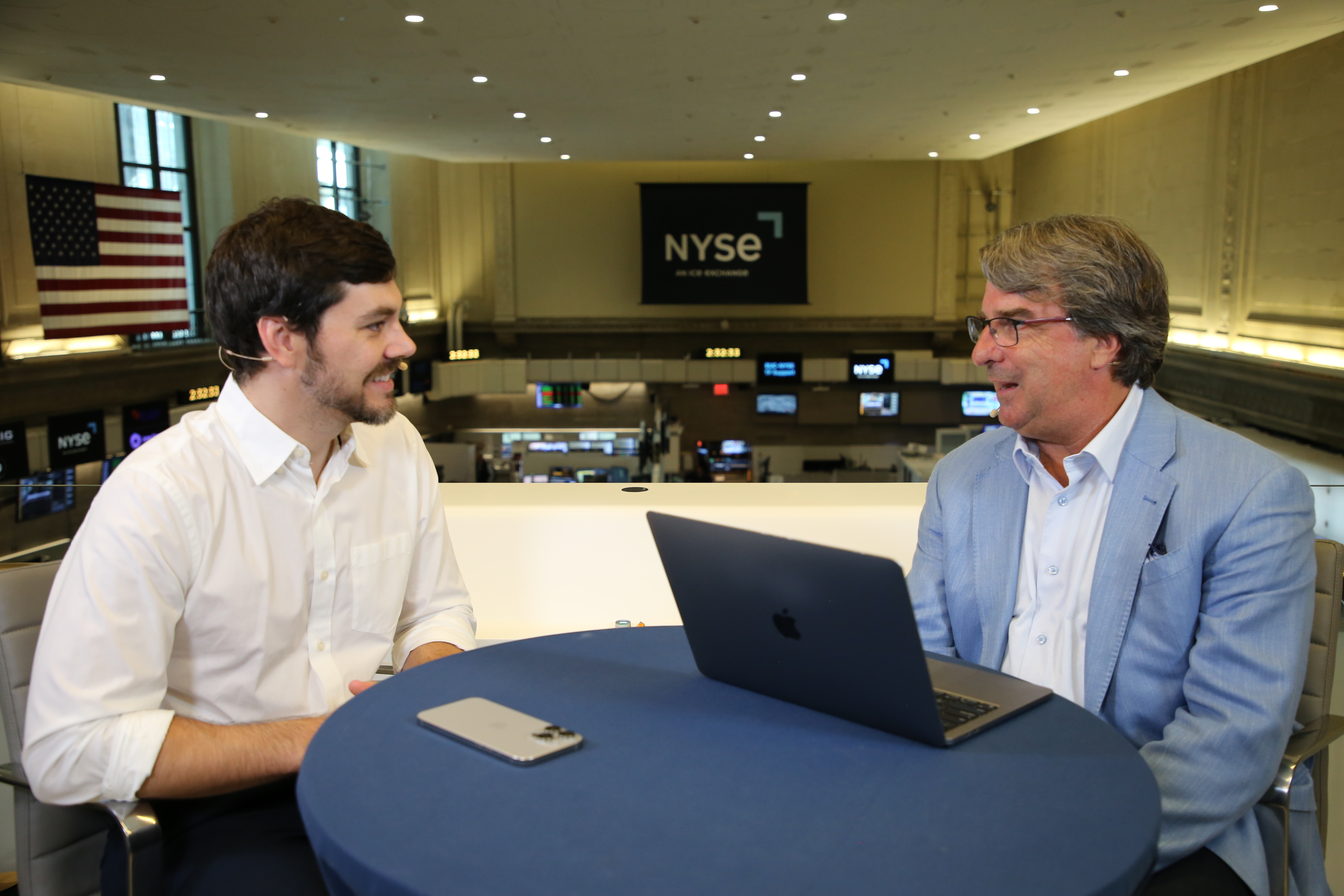
In this Crypto Trailblazers interview at the NYSE, theCUBE’s John Furrier talks with Nikil Viswanathan, co-founder and CEO of Alchemy, about building the infrastructure powering the next wave of blockchain adoption. Viswanathan traces his path from Stanford to scaling Alchemy into what he calls the “AWS for blockchain,” delivering the core primitives for reading and writing blockchain data, wallet services and developer tools used by top financial institutions, Web3 startups and global enterprises.
The discussion unpacks the parallels between blockchain’s evolution and earlier technology shifts, detailing how Alchemy’s operating system–like platform abstracts complexity so developers can focus on building high-impact applications. Viswanathan shares real-world examples, from powering stablecoin transactions to enabling NFT platforms, and reveals a six-step playbook for financial institutions entering crypto – from offering ETFs to launching their own chains. He also provides fresh metrics on Alchemy’s scale, including $150B+ in annual transactions and hundreds of millions of end users, and explains how recent infrastructure rebuilds have cut latency by more than half.
Viewers will gain insight into how Alchemy is meeting rising enterprise demand for secure, scalable blockchain capabilities, why global financial organizations are accelerating adoption and what the mainstreaming of decentralized infrastructure means for the future of digital commerce.
Forgot Password
Almost there!
We just sent you a verification email. Please verify your account to gain access to
theCUBE + NYSE Wired: Crypto Trailblazers. If you don’t think you received an email check your
spam folder.
Sign in to theCUBE + NYSE Wired: Crypto Trailblazers.
In order to sign in, enter the email address you used to registered for the event. Once completed, you will receive an email with a verification link. Open this link to automatically sign into the site.
Register For theCUBE + NYSE Wired: Crypto Trailblazers
Please fill out the information below. You will recieve an email with a verification link confirming your registration. Click the link to automatically sign into the site.
You’re almost there!
We just sent you a verification email. Please click the verification button in the email. Once your email address is verified, you will have full access to all event content for theCUBE + NYSE Wired: Crypto Trailblazers.
I want my badge and interests to be visible to all attendees.
Checking this box will display your presense on the attendees list, view your profile and allow other attendees to contact you via 1-1 chat. Read the Privacy Policy. At any time, you can choose to disable this preference.
Select your Interests!
add
Upload your photo
Uploading..
OR
Connect via Twitter
Connect via Linkedin
EDIT PASSWORD
Share
Forgot Password
Almost there!
We just sent you a verification email. Please verify your account to gain access to
theCUBE + NYSE Wired: Crypto Trailblazers. If you don’t think you received an email check your
spam folder.
Sign in to theCUBE + NYSE Wired: Crypto Trailblazers.
In order to sign in, enter the email address you used to registered for the event. Once completed, you will receive an email with a verification link. Open this link to automatically sign into the site.
Sign in to gain access to theCUBE + NYSE Wired: Crypto Trailblazers
Please sign in with LinkedIn to continue to theCUBE + NYSE Wired: Crypto Trailblazers. Signing in with LinkedIn ensures a professional environment.
Are you sure you want to remove access rights for this user?
Details
Manage Access
email address
Community Invitation
Nikil Viswanathan, Alchemy
In this Crypto Trailblazers interview at the NYSE, theCUBE’s John Furrier talks with Nikil Viswanathan, co-founder and CEO of Alchemy, about building the infrastructure powering the next wave of blockchain adoption. Viswanathan traces his path from Stanford to scaling Alchemy into what he calls the “AWS for blockchain,” delivering the core primitives for reading and writing blockchain data, wallet services and developer tools used by top financial institutions, Web3 startups and global enterprises.
The discussion unpacks the parallels between blockchain’s evolution and earlier technology shifts, detailing how Alchemy’s operating system–like platform abstracts complexity so developers can focus on building high-impact applications. Viswanathan shares real-world examples, from powering stablecoin transactions to enabling NFT platforms, and reveals a six-step playbook for financial institutions entering crypto – from offering ETFs to launching their own chains. He also provides fresh metrics on Alchemy’s scale, including $150B+ in annual transactions and hundreds of millions of end users, and explains how recent infrastructure rebuilds have cut latency by more than half.
Viewers will gain insight into how Alchemy is meeting rising enterprise demand for secure, scalable blockchain capabilities, why global financial organizations are accelerating adoption and what the mainstreaming of decentralized infrastructure means for the future of digital commerce.
>> Welcome back, everyone, to theCUBE here at the NYSC. This is our East Coast studio. Of course, we've got Palo Alto and Wall Street here at the NYSC, it's part of the NYSC Wired partnership with theCUBE and SiliconANGLE. We've got a great lineup of two days of interviewing the crypto trailblazers, people who are making it happen and enabling the mainstreaming of what has already been a great market. But now as the whole world wakes up in digital commerce, digital assets are all on decentralized infrastructure, innovations exploding, entrepreneurship, new ventures, new money systems being wired up in real time. We've got a great lineup. Nikil's here. He's the co-founder and CEO of Alchemy, one of the hottest companies in Silicon Valley, New York, Stanford, computer science. You got to be smart to go to Stanford. Well, that's God venture worth $10 billion. Congratulations. You're powering all the top projects. This internet infrastructure evolution to now crypto infrastructure is changing the game. It's a whole nother dawn of a new era. You're at the beginning of it and it's still early. It's just getting started.
Nikil Viswanathan
>> It's Windows '95 days. It's that.>> I know. I mean, so think about, give the stats on the company. Talk about the origination real quick. Just set the table because you guys are scaling up infrastructure that's going to enable change developers and solutions. You have the Amazon for blockchain, AWS for blockchain, which I want to get into because that was a revolution.
Nikil Viswanathan
>> Yeah.>> Set the table.
Nikil Viswanathan
>> Totally. So like you mentioned, went to Stanford. I'd grown up in this super small town in Texas, went to Stanford, met my co-founder there. We were actually, funny story, teaching assistants for the database class at Stanford, which was this Steve Jobs, looking back, "connect the dots" moment. We normally, the database class is 100 students, very easy to teach. That quarter, it was 100,000 students and it was this thing where they said online learning, online education, and that was the first time it'd ever been tried. Right after that, that spun out and became Coursera, which was kind of the pioneer of internet education. So from the very beginning, my co-founder and I were, number one, thrown into databases. Blockchain is effectively a new type of database. And number two, we were thrown into startup life since day one. We're the first unpaid interns at Coursera. After that, we spent several years building.>> By the way, database wasn't hot until big data had duplicated the same.
Nikil Viswanathan
>> Exactly, exactly. The funny thing was when I went to Stanford, I assumed Stanford was an engineering school. At the time, all of Stanford engineering, including electrical, computer science, everything was sub-20% of Stanford today. I don't know the exact stats, but I heard it's something like 40 to 60% of people do computer science alone. So it was not cool back. This was the time after the dot-com bubble when everyone's like, "Computer science is not a thing." And then it became a thing again.>> Oh, look at me, how old I am. Wasn't cool when I went to Stanford, got my CS degree, but you got thrown into it. You connect the dots. And then on this venture here, I'll say there was a tough time. I mean you go back to 2015, 2016, the smartest people were working on this. Then it kind of went into this whole regulatory, and then the ICO kicked in and then it was a dark time.
Nikil Viswanathan
>> Yes, totally.>> Headwinds and also weirdness.
Nikil Viswanathan
>> Yes.>> But then now it's with AI. All the crypto miners turn into data centers for AI. Those are same communities. So you have crypto now back to the alpha developers and engineers going, "There's no hard problems and the money's flowing."
Nikil Viswanathan
>> Yes. I think you said it very accurately. There were several boom and bust cycles. We started in 2017 when there was the bull run of 2017 fueled by Ethereum in a large way. What was really exciting to us was for the first time there was a new primitive, and when I say primitive, I mean the programming sense. It's a new building block that allowed developers to create new products. When you think about the big shifts in technology over the last 100 years, there's really three shifts. The first one is a computer, the idea that machines can process information and follow in human instructions repeatedly. Then the internet comes along and says, "Machines can now talk to each other and exchange information." That was mind-blowing. And then crypto was the first next kind of building block, which was the idea that machines can now transact and exchange information. Sorry, exchange value. And if you think about it, even things like AI, which are just so fundamentally going to change the world, those were built, AI was built on machines following instructions, machines talking to each other. Those were the two primitive building blocks that AI was built on. So I think this will unlock a whole new set of applications, a whole new type of applications that would never possible before.>> When you guys did your first round of funding around 2017, what was the pitch? If you had to look back at your, I guess what they call it, pre-seed deck?
Nikil Viswanathan
>> Yeah, pre-seed deck.>> What words were used at the time? Seed. Pre-seed? Now it's like super, super pre-seed.
Nikil Viswanathan
>> I know. There was no pre-seed at the time. It was just seed. So it's interesting because before we did this, Joe and I built a lot of consumer apps and we wanted to make you feel like you lived with your friends and we built a bunch of things, nothing worked. And we built this one app, which ends up being the number one social app in the world at the time. And the funny comparison here was the idea for the social app we pivoted all the time, but in crypto, actually we started, the last pivot we did was we started building this hedge fund data science machine learning platform. Think like Bloomberg terminal meets data science. And one month in we said, "Okay, we're huge nerds. We're engineers. We've coded every single day of our lives for 15 years. If this industry's going to explode and be broadly used, it can't be this hard."
It's really hard for us. We have master's degree in artificial intelligence from Stanford, and it's hard for us to code. So we actually drew this diagram, we call it the nine grid, where it's like the three shifts in technology, the computer, internet, blockchain, and each one is powered by some. There's some core technology primitive. So for the computer, that's your ram, your CPU, your hard drive. But in order to have applications like Word, Excel, Chrome, you have this thing called the operating system. So Windows and Mac, and it abstracts underlying technology. It makes it easy for people to build apps, and that's what spins the cycle. Innovation developers build apps, some more users come, some more developers and so on and so forth. With the internet, you have a similar structure where you have HTTP, FTP, SMTP, the core protocols which are on the internet, but on top of that you have this business that you've heard of that most people haven't, it's called Amazon. Amazon has two businesses, one where you buy things, the other one where they make all their money. And AWS or GCP or Azure is what powers the internet. And what we said was if crypto is going to be widely used, there's going to be a developer platform that will have the same purpose here.>> Yeah. What I love about that analogy is there was always that disruptive enabler. The protocols. With Amazon, Web Services was also happening. So you had some syndication capabilities and then everything changed. What is the crypto primitive? What would you say is that kind of linchpin that's going to be the disruptive enabler, the equivalent protocol? Is it the chain? What is it?
Nikil Viswanathan
>> I would say the first one, well obviously Bitcoin, but the main disruptive innovator was Ethereum. It was this idea you can have a blockchain and you can program it and you can build apps. So when we think of ourselves, we are the middle layer between apps on the top and apps can be Uniswap or OpenSea or it can be JP Morgan or Fidelity or Facebook, and underneath. And then we are that layer in between. And then underneath is Bitcoin, Ethereum, Solana, you name it, the chains.>> So when the DApps hit, okay, you saw smart contracts emerge. Okay, you saw the benefits of distributed basically assets.
Nikil Viswanathan
>> Yep.>> Or data. So the question I have for you, this come up a lot this week, is everyone says, "What's your moat?" Data moat is talked about most in the AI world. You have the JP Morgan Chase, they're going to never leave their intellectual properties, their data. On chain, you now have a data moat potential. It's immutable. So these are characteristics. How do you see that developing? Because as people start using it, what emerges? What use cases do... Is it more data storage? You mentioned databases. So what is the first beachhead position or low hanging fruit that someone might want to-
Nikil Viswanathan
>> In terms of applications?>> In terms of applications that you're enabling? So what do you have to do to fundamentally set the table or building blocks? If you say we are the Amazon of blockchain, they have basic primitives and building blocks, they were core EC2's, their biggest. What's your building blocks and then what happens?
Nikil Viswanathan
>> Yes, that's a great question. So I would say our building blocks are in a lot of ways similar. So we have two kind of core factors, which is how do you read data from the blockchain and how do you write data from the blockchain? So the thing that people don't realize is what we have done effectively is if you think about Google, before Google, there was all these search engines, but the problem was that was pre-product market fit of the internet and the internet wasn't that big. There weren't scammers, all this stuff. Once internet had product market fit, billions of webpages are created, Google had to do two things. One, create a distributed storage infrastructure that could store the entire web. Two, they had to build a search algorithm that could go find everything that you needed. We essentially did the same thing. We said in 2017, 2018, Ethereum was kind of like pre-product market fit, to a degree. Actually, to a large degree.>> It set the agenda though, because programmable was key.
Nikil Viswanathan
>> Exactly. It's still early. It was like the early nineties of the internet. And what we did was we built this distributed storage, distributed storage infrastructure, and then we built a consensus algorithm on top. And what that has allowed us to do is we think of ourselves as AWS kind of built this hardware layer and then layered services on top. We built this intelligent software layer and then we layer services on top. So we have a whole suite of different tools for how to read data. If you want to get NFTs, if you want to get your transaction history, if you want to get token balances, if you want to get specific events that are happening on the blockchain. In the early days, if you used crypto apps, you didn't get push notifications when somebody sent you crypto. That's because there's no API on the blockchain to get notifications. We kind of pioneered that. We built out the first infrastructure to be an event listener and indexed everything and said, now when John gets cryptos, when I send crypto to John, it'll pop up on his phone.>> So you basically, you guys essentially saw the kind of bare bones infrastructure of decentralized infrastructure and the chains that they were on and essentially built an abstraction, OS layer.
Nikil Viswanathan
>> Yes.>> A service layer.
Nikil Viswanathan
>> Yes. That's the way we think about it. We think of ourselves as an operating system layer over the chains.>> Notifications, observability, measurement, data gathering.
Nikil Viswanathan
>> All of that, all of the above. And we also do wallets. So now if you want, so JP Morgan just launched their deposit token and we power all of the backend up for the wallets of that.>> All right, so let's get back to some of the stats because you guys have some significant credentials. Obviously the great founding team, you guys have been working hard.
Nikil Viswanathan
>> Tired founding team. We've been working really hard.>> It's like a marriage, as you know. "Don't leave the dishes in the sink. Finish the code." You have big time fund backers. I mean, how many investors do you have? You have also big names in there too. Big amount, 500 million roughly plus.
Nikil Viswanathan
>> Yeah, so we've done about 500 million and we saw most of it in the bank, knock on wood. Very lucky. We've been very fortunate to have incredible, incredible investors. Pantera did our series A and then we had Code Two and Addition and Andreessen Horowitz and Lightspeed and Silver Lake. Just super blessed and kind of the rock star list of our dream angels.>> Founder friendly.
Nikil Viswanathan
>> Yes, can only say great things about our investors. All of our investors are fantastic and I've had a lot of great mentorship, like John Hennessy who's the chairman of board of Google and President of Stanford.>> He's a Cube alumni, by the way.
Nikil Viswanathan
>> Sorry?>> I've interviewed him. He's a Cube alumni.
Nikil Viswanathan
>> Amazing. Yeah, he's a great advisor. Jerry Yang from Yahoo. We've had a lot of people who have helped us along the way.>> I have to ask you a personal question because I find that my experience is that most entrepreneurs that are technical love blockchain.
Nikil Viswanathan
>> Yeah.>> Do you agree with that? Because people, it's a technical problem, it's an obvious dot connecting thing.
Nikil Viswanathan
>> I think there's this really interesting dichotomy where what I have found, if you primarily... There's people who like it for the kind of intellectual interest. What I have found is Silicon Valley in general was very late to crypto. I call it the WhatsApp effect. So when I was at Stanford, I would go and play Frisbee. Actually, right when I graduated I would go and play Frisbee at this one ultimate Frisbee game. And there was this in Menlo Park and I met this guy and we were talking about it and I was like, "Oh, you should come to this other game." He is like, "Oh, but my work is near here." I was like, "What's your work?" He's like, "WhatsApp." I was like, "What do you do?" He's like, "Oh, sweep the floors, whatever's needed." I was like, "You're the founder, aren't you?" He's like, "Yeah."
But my point at the time was I didn't get WhatsApp. I was like, why do people use this? All my friends live in the U.S. I have free texting. Most of my friends have iPhones. I can just text everyone. I was like, why is this a problem? Then you go outside the US, data is very expensive.>> Signal is terrible.
Nikil Viswanathan
>> Yeah, signal was terrible. People live in different countries. You can't do group message across countries and it's just a problem that you don't experience if you live in Silicon Valley or the United States and you have an iPhone. Similarly, you look at people who are in Silicon Valley or in the US, and you have generally, we did have 50%. Doubling the money supply now, so it's a totally different story. But generally we have good banking or reasonable banking. You have a relatively stable dollar currency and that is not the experience of most of the world. And I give a couple of examples of this. One, you can go to the stats where 25% of the world, it's actually 24, 24% of adults in the world do not have a bank account, which means you hold your money in physical cash under your bed, you can get robbed, you have to walk hours to pay your utility bill. If your house burns down, you lose all your life savings. And similarly, this concept of hyperinflation is not this thing from 1900 or 1800. Argentina tripled the prices of goods within one year in 2023.>> So if you got hold in cash, you're screwed.
Nikil Viswanathan
>> Exactly. You're literally screwed. So what I have found is anybody who's international just gets crypto way more. Like, instantly. Instantly. And I think here's a silly first world problem example. I was traveling internationally, my friends and I, we were staying in this house and it had mold in it and I was getting really sick, so I had to move to another house, but then it was Friday, I just couldn't transfer the money to the person. It's like credit card, can't do a credit card, they don't have a point of sale system.>> Not Venmo.
Nikil Viswanathan
>> You can't do Venmo. Can't do Venmo internationally. PayPal takes 7%, which is a big cut if you're staying for a week at a place several hundreds or thousands of dollars. Then we had to go, four of us had to go to three banks at 10:00 P.M. in the rain, super sketchy banks and try to pull enough money. And we barely managed to do it. And I was like, wow, this is absolutely insane.>> And now wallets can transfer. You got all the things happening.
Nikil Viswanathan
>> Yeah.>> All right, so talk about the business. What is the coolest thing you're working on? Why are you guys so successful? What is the core differentiator, value proposition? Take us through the product.
Nikil Viswanathan
>> Totally. So maybe a little bit about the scale of our business where we are today. Again, we've just been very fortunate. We have an incredible team who's worked really, really hard every single day for eight years. Today we do over $150 billion in transactions annually. Every country in the world. 100 million end users. So it's very significant scale. If you were using everything from you open your Robinhood app and we're powering the crypto wallet behind there. When Facebook was doing all their crypto NFTs on Instagram, we are powering all of that. If you're using a stable coin, we're powering technology to any NFT you look at. It's like we are powering that under the hood. So it's this->> You become the platform.
Nikil Viswanathan
>> Yes. The invisible platform. Just like AWS is an invisible platform. When you open Uber or Netflix or DoorDash, you're using AWS.>> It's an ecosystem.
Nikil Viswanathan
>> Yeah, I would love to call it that.>> I mean people are on top of it, leveraging it.
Nikil Viswanathan
>> Exactly. So the way that I think about our products is we have a full, very broad suite just similar to like AWS. So we have your basic read-write product. So there's a standard node API that everyone uses and that's where we started. It's very strategic because we said you can swap to us, no changes in your code and it just works out of the box. And the thing here is the industry is very early and we brought our team was like Stanford, MIT, like had scaled infrastructure at Google and Facebook and we spent every single day. And to give you a sense of scale->> You knew the SRE problem that they solved. You knew the problem that you experienced and-
Nikil Viswanathan
>> Exactly.>> ... when you were coding how hard it was.
Nikil Viswanathan
>> Exactly.>> And you wanted to make it easier. That was kind of part of it.
Nikil Viswanathan
>> Exactly. And to give you a sense of scale, a large financial institution or financial API company, like a Stripe or whatever, I think their last published number was, they do I think 250 million API requests a day. It's obviously not one-to-one, but we do many, many billions of API requests a today. So it's like significant volume. If we go down, it's not good.>> People will be pissed.
Nikil Viswanathan
>> Yeah, people will be pissed. A lot of the internet.>> So what are you running on? What servers?
Nikil Viswanathan
>> So we have a mix. So we chose not to do the hardware layer. So we are a software layer. So we actually have our own servers and->> Your own data centers?
Nikil Viswanathan
>> We kind of rent from data centers right now, but we->> But you're on the cloud.
Nikil Viswanathan
>> We started with AWS, then we were with AWS, GCP, Azure, then now we actually bought a company in Romania that does bare metal. And then we're kind of moving more and more.>> You're moving to your own kind of infrastructure.
Nikil Viswanathan
>> Yeah, we're moving to our own infrastructure. Today, we use a combination of everything.>> Multi-cloud when you need data processing, whatever.
Nikil Viswanathan
>> Exactly, exactly. But we're moving more and more into the realm of building our own. Yeah.>> All right, so you've got that product. What about the performance? I saw some stats in the news about you guys. You've reduced latency down.
Nikil Viswanathan
>> Oh man, this is really cool.>> Latency is a huge problem. Take us through some of the advances going on. It's state of the art.
Nikil Viswanathan
>> Totally. So one of the things to think about is when you are in hyper scaling mode, you are building a system. The number one, do you guys remember Donald Knuth, one of the OGs? He was a professor of Stanford. He's the founder of algorithms. Yeah, algorithms.>> Database walking. He was a king.
Nikil Viswanathan
>> Exactly. And he has this quote which I think is very accurate, which is, "Premature optimization is the root of all evil." And that is a tendency that I try to instill on our team of we are here not to build technology. We are here to build products that actually change people's lives. In order for us to do that, we need to focus on the end result. And if you're moving quickly, tech debt is the benefit you get from or tech debt is what you get from the benefit of being able to serve users. So if you look at->> And drawing that down and managing it.
Nikil Viswanathan
>> Exactly. So for YouTube, I was talking to the founder back when I was in school at Stanford, before they sold to Google, they rebuilt their entire stack three times. So over the last year and a half we actually sat down and took a totally fresh look and rebuilt our infrastructure from the ground up. It was a big project and it actually used a lot of intelligence for, we spent powering probably close to a trillion dollars in assets over the last eight years. We took all that information and said how do we optimize this and how do we build a really smart system that can serve us for the next, who knows how long. So that system which obviously uses AI and bunch of different techniques now is way faster to the tune of two to two and a half X. It can go to effectively infinite scale. If you have a product that's used by billions of users, we can handle that. And we have the ability for all these new types of capabilities. If you want today, this is a little technical, but if you want to query data in a certain way, it's very limited in crypto. We have now kind of exploded that out. So you can have very flexible querying of data in any way possible.>> So if someone knows SQL, they speak SQL, you can kind of convert that in.
Nikil Viswanathan
>> We actually have a product that's like Simlish, but yeah, totally.>> All right, so take us to the use cases. I know it's getting late and I really appreciate you coming in. Great conversation. Could probably go an hour or more. Talk about the use cases because the feedback here on this episode of the Crypto Trailblazers is mainstream is adopting.
Nikil Viswanathan
>> Oh my gosh.>> And the platformization is happening. Seeing it in cyber security and other sectors in the cloud, but they just want to trade. They want a trading app or they want to do an institutional deal or they're going to do a treasury thing. So the apps, they want to do something. They don't want to actually build the platform.
Nikil Viswanathan
>> Yes, they want to use.>> And by the way, it's not a build by decision, it's they don't have the chops to do it and it takes too long.
Nikil Viswanathan
>> Yep, totally.>> So they want a platform that's got best of breed everything.
Nikil Viswanathan
>> Totally.>> One best of breed element.
Nikil Viswanathan
>> Totally.>> Everything's got to be solved.
Nikil Viswanathan
>> Yep. 100%.>> What are they doing with you guys? So okay, they go to you and say, "Great, you're the leading platform. Great performance, good scale. Checks the boxes." What do they run on it? What are some of the use cases?
Nikil Viswanathan
>> Great question. So I've never said this on recorded media, which this will be the first time. After the regulatory shift, so basically there's this massive influx of all financial institutions and enterprises. I saw a stat today that 90% of businesses have either deployed crypto or are in the process of deploying crypto applications throughout their business. We saw a shift because there was this trade-off that completely flipped. In the previous administration, you had a lot of regulatory concern that if you entered crypto, your core business would get regulated. At the same time, there's not a big monetary upside that was obvious. Now that's shifted where Coinbase has proven that you can make a bunch of money and the administration is way more crypto-friendly. So we had this influx of every financial institution in the world kind of reaching out and saying, "Oh, we're interested in this." And we have this kind of six-step playbook, which we've never talked about, but happy to share publicly, first time. So at a high level, and we came up with this in partnership with working with some of these large institutions, there's six steps which you need to do if you're an institution to maximally benefit from crypto. Number one, you need to let your users hold crypto in some form and typically this means a derivative that's easier to use. And ETF so you don't have to actually hold the crypto, manage the keys and all this stuff. The second step is you want to let people hold the native asset. So buy, sell Bitcoin, ETH. The third step is you want to take those assets that they have and let them do things with it. So yield, staking, defi, loans. Exactly, exactly. So that's the third piece. Fourth step is if you have a user base, you want to launch a stable coin, because as we've seen with Circle, incredible business and if you have a large user base, that game is still up for grabs. It's still the 1995 of web browsers. No one's won the stable coin business yet. Tether has a very strong lead, but that could totally change. The fifth step is bring your applications on chain. And this is not for the sake of crypto but for accessing more users. Robinhood is a perfect example. They just announced that they're going to be moving their brokerage product on chain and now they can tap into more users, they can expand new markets much quicker, helps with regulatory, all these other reasons. And then the last one is kind of the end game, which is super exciting to see, which is launch your own chain and have it become an ecosystem. Coinbase has done this with Base, but imagine if... These are not actual names. I'm making up names because we're under strict NDAs, but imagine if a company like a Goldman Sachs or JP Morgan or Fidelity launched their own blockchain. That could very quickly be the hub for traditional finance on chain. So that->> Rather than me paying them, I get a yield.
Nikil Viswanathan
>> Yeah, exactly. So it's super exciting.>> Interesting. First of all, thank you for sharing that first time scoop here on theCUBE here in New York. I remember during the internet days, Mary Meeker used to put up a slide that said internet population growth, and the function of adoption was based upon the number of people getting online. What you basically just said is the number of people getting online crypto is exactly the same kind of trajectory. It's a similar phenomenon where if you go in now, you'll from that ecosystem, you'll benefit from those users.
Nikil Viswanathan
>> 100%. And it's a land grab and it's really interesting. We were talking about this before we went on air, but if you look at crypto or let's say you look at any kind of social network, YouTube, Facebook, Instagram, 0.1% of people are the creators, up to 1% depending on the type. If it's a YouTube video, it's a lower ratio. But if it's Instagram post, more people post on Instagram. 99% of the activity is actually viewing. And that's true across all social media and it's true across all consumer applications in general, probably slightly different numbers, but as a rule. If you look at crypto, it's the same. 1% of actions in crypto are transactions. 99% are just reads or viewing applications. The 1% is public on chain. We are the only people in the world who see the 99%. And obviously I can't go into private data, but the general gist you should take away is as a business, we power developers and those developers pay us per the number of effectively page reloads. And what we saw over the last bear market was in the 2017, 2018 bear market, after that we saw a pretty sharp decrease in the usage because people were like crypto's dead. In the '21, '22 market, that was actually not the case where there was this narrative shift of crypto's not dead, it's just taking a bit longer with regulatory.>> FTX happened. A lot of shit happened.
Nikil Viswanathan
>> Exactly. During that time we've seen, and I don't think I've said this publicly either, we've seen over a four X growth from the bear market to the beginning of this bull market.>> And we saw an IPO today at the NYSE. It's later, the market's closed now. It's late in the evening here. I mean, this is now lining up.
Nikil Viswanathan
>> Yep.>> The IPOs are lining up. They're real businesses.
Nikil Viswanathan
>> And even though the price went down, the activity went up and that was very exciting to see. There was sharp anti-correlation there.>> All right, so you're in the arena, as they say, in the entrepreneurial circles. You got a great venture, great pedigree of entrepreneurs. You have plenty of money. Changing the game of the platform. What's the vision next? What's on your to-do list now?
Nikil Viswanathan
>> Yeah, honestly the same as eight years ago. It's build the best product we can to enable developers to build their apps. We are here to serve people building great apps. If you're watching this and you're building an app, come talk to us. We're here to help. But the better, it's almost the faster... When we release this upgrade, every time you use the stable coin, it effectively got two X faster. And no one knows that. The people who are using stable coin in Nigeria, they don't know about us. They don't give a shit. And they just want to use their products in a very reliable, scalable, and fast way.>> They don't have a consumer experience. It's slow. It sucks. So it's actually better.
Nikil Viswanathan
>> Exactly. So for us, we are very happy to be behind the scenes. We're not here to be in the spotlight. We're here to be behind the scenes and serve people who are the true heroes, who are building the applications.>> And your success criteria, your KPI would be happy ecosystem partners, users, people plugging into the system.
Nikil Viswanathan
>> Yeah, our end criteria is like we are here to bring this technology to the world. And I think the thing that's really exciting is if you look at who has shaped the world the most, before 20 years ago it was government, religion, politics. As of within the last 20 years, if you ask who has really shaped the globe as we know today, probably the first 100 people at Facebook, Google, Amazon, Microsoft, Apple, and then Bitcoin. And that is such an exciting time to live where we can press buttons on this magic metal box and build something everyone on the planet uses. So for us, it's not about the press, it's not about the money, it's not about the investors. It's really, can we look back on this in 80 years and say, "Hey, we helped build this thing, which was like the internet and had that big of an impact?">> Well, that's awesome, Nikil. Thanks for coming on. Give a quick plug, what you're looking to do, hire, how do people engage with you? What kind of people are you looking to engage with for customers? Give a quick plug.
Nikil Viswanathan
>> Perfect. So we power everyone and a broad spectrum, the ecosystem. So what I'll say is if you're an indie crypto developer, come talk to us. We will hook you up with some free starter credits. If you are a large enterprise, we have a special program where we kind of handhold you and for free, no charge, help you build out your crypto plans internally. And then we are always looking to hire. So great product people, great engineers, great marketing, hiring across the board.>> If you don't mind, if I can ask, if someone out there is saying, "Hey, you know what? Computer science is changing. I'm changing, but I'm smart. I want to get in and learn," where do they go to learn about some of the cool features?
Nikil Viswanathan
>> Great question. So we actually have this thing called Alchemy University. We went and looked at the best boot camps that taught you how to code and build in crypto, and we bought the best one and we gave it away for free. So it's purely to help grow the community. So check out Alchemy University and you can learn.>> Great, thanks for coming in. I appreciate it.
Nikil Viswanathan
>> Thank you for hosting.>> Crypto Trailblazers are here. The world's infrastructure defines the future. And as the online population, if I can say that, with crypto continues to go mainstream, obviously the market's voting, it's a major, major tailwind, IPOs are here, real money's being made, the plumbing is being reset, the apps are being rebuilt. Again, new apps are coming in, entrepreneurs are cranking away. So we're going to do our best to keep up and bring that with you. I'm John Furrier, host of theCUBE. Thanks for watching.
>> Welcome back, everyone, to theCUBE here at the NYSC. This is our East Coast studio. Of course, we've got Palo Alto and Wall Street here at the NYSC, it's part of the NYSC Wired partnership with theCUBE and SiliconANGLE. We've got a great lineup of two days of interviewing the crypto trailblazers, people who are making it happen and enabling the mainstreaming of what has already been a great market. But now as the whole world wakes up in digital commerce, digital assets are all on decentralized infrastructure, innovations exploding, entrepreneurship, new ventures, new money systems being wired up in real time. We've got a great lineup. Nikil's here. He's the co-founder and CEO of Alchemy, one of the hottest companies in Silicon Valley, New York, Stanford, computer science. You got to be smart to go to Stanford. Well, that's God venture worth $10 billion. Congratulations. You're powering all the top projects. This internet infrastructure evolution to now crypto infrastructure is changing the game. It's a whole nother dawn of a new era. You're at the beginning of it and it's still early. It's just getting started.
Nikil Viswanathan
>> It's Windows '95 days. It's that.>> I know. I mean, so think about, give the stats on the company. Talk about the origination real quick. Just set the table because you guys are scaling up infrastructure that's going to enable change developers and solutions. You have the Amazon for blockchain, AWS for blockchain, which I want to get into because that was a revolution.
Nikil Viswanathan
>> Yeah.>> Set the table.
Nikil Viswanathan
>> Totally. So like you mentioned, went to Stanford. I'd grown up in this super small town in Texas, went to Stanford, met my co-founder there. We were actually, funny story, teaching assistants for the database class at Stanford, which was this Steve Jobs, looking back, "connect the dots" moment. We normally, the database class is 100 students, very easy to teach. That quarter, it was 100,000 students and it was this thing where they said online learning, online education, and that was the first time it'd ever been tried. Right after that, that spun out and became Coursera, which was kind of the pioneer of internet education. So from the very beginning, my co-founder and I were, number one, thrown into databases. Blockchain is effectively a new type of database. And number two, we were thrown into startup life since day one. We're the first unpaid interns at Coursera. After that, we spent several years building.>> By the way, database wasn't hot until big data had duplicated the same.
Nikil Viswanathan
>> Exactly, exactly. The funny thing was when I went to Stanford, I assumed Stanford was an engineering school. At the time, all of Stanford engineering, including electrical, computer science, everything was sub-20% of Stanford today. I don't know the exact stats, but I heard it's something like 40 to 60% of people do computer science alone. So it was not cool back. This was the time after the dot-com bubble when everyone's like, "Computer science is not a thing." And then it became a thing again.>> Oh, look at me, how old I am. Wasn't cool when I went to Stanford, got my CS degree, but you got thrown into it. You connect the dots. And then on this venture here, I'll say there was a tough time. I mean you go back to 2015, 2016, the smartest people were working on this. Then it kind of went into this whole regulatory, and then the ICO kicked in and then it was a dark time.
Nikil Viswanathan
>> Yes, totally.>> Headwinds and also weirdness.
Nikil Viswanathan
>> Yes.>> But then now it's with AI. All the crypto miners turn into data centers for AI. Those are same communities. So you have crypto now back to the alpha developers and engineers going, "There's no hard problems and the money's flowing."
Nikil Viswanathan
>> Yes. I think you said it very accurately. There were several boom and bust cycles. We started in 2017 when there was the bull run of 2017 fueled by Ethereum in a large way. What was really exciting to us was for the first time there was a new primitive, and when I say primitive, I mean the programming sense. It's a new building block that allowed developers to create new products. When you think about the big shifts in technology over the last 100 years, there's really three shifts. The first one is a computer, the idea that machines can process information and follow in human instructions repeatedly. Then the internet comes along and says, "Machines can now talk to each other and exchange information." That was mind-blowing. And then crypto was the first next kind of building block, which was the idea that machines can now transact and exchange information. Sorry, exchange value. And if you think about it, even things like AI, which are just so fundamentally going to change the world, those were built, AI was built on machines following instructions, machines talking to each other. Those were the two primitive building blocks that AI was built on. So I think this will unlock a whole new set of applications, a whole new type of applications that would never possible before.>> When you guys did your first round of funding around 2017, what was the pitch? If you had to look back at your, I guess what they call it, pre-seed deck?
Nikil Viswanathan
>> Yeah, pre-seed deck.>> What words were used at the time? Seed. Pre-seed? Now it's like super, super pre-seed.
Nikil Viswanathan
>> I know. There was no pre-seed at the time. It was just seed. So it's interesting because before we did this, Joe and I built a lot of consumer apps and we wanted to make you feel like you lived with your friends and we built a bunch of things, nothing worked. And we built this one app, which ends up being the number one social app in the world at the time. And the funny comparison here was the idea for the social app we pivoted all the time, but in crypto, actually we started, the last pivot we did was we started building this hedge fund data science machine learning platform. Think like Bloomberg terminal meets data science. And one month in we said, "Okay, we're huge nerds. We're engineers. We've coded every single day of our lives for 15 years. If this industry's going to explode and be broadly used, it can't be this hard."
It's really hard for us. We have master's degree in artificial intelligence from Stanford, and it's hard for us to code. So we actually drew this diagram, we call it the nine grid, where it's like the three shifts in technology, the computer, internet, blockchain, and each one is powered by some. There's some core technology primitive. So for the computer, that's your ram, your CPU, your hard drive. But in order to have applications like Word, Excel, Chrome, you have this thing called the operating system. So Windows and Mac, and it abstracts underlying technology. It makes it easy for people to build apps, and that's what spins the cycle. Innovation developers build apps, some more users come, some more developers and so on and so forth. With the internet, you have a similar structure where you have HTTP, FTP, SMTP, the core protocols which are on the internet, but on top of that you have this business that you've heard of that most people haven't, it's called Amazon. Amazon has two businesses, one where you buy things, the other one where they make all their money. And AWS or GCP or Azure is what powers the internet. And what we said was if crypto is going to be widely used, there's going to be a developer platform that will have the same purpose here.>> Yeah. What I love about that analogy is there was always that disruptive enabler. The protocols. With Amazon, Web Services was also happening. So you had some syndication capabilities and then everything changed. What is the crypto primitive? What would you say is that kind of linchpin that's going to be the disruptive enabler, the equivalent protocol? Is it the chain? What is it?
Nikil Viswanathan
>> I would say the first one, well obviously Bitcoin, but the main disruptive innovator was Ethereum. It was this idea you can have a blockchain and you can program it and you can build apps. So when we think of ourselves, we are the middle layer between apps on the top and apps can be Uniswap or OpenSea or it can be JP Morgan or Fidelity or Facebook, and underneath. And then we are that layer in between. And then underneath is Bitcoin, Ethereum, Solana, you name it, the chains.>> So when the DApps hit, okay, you saw smart contracts emerge. Okay, you saw the benefits of distributed basically assets.
Nikil Viswanathan
>> Yep.>> Or data. So the question I have for you, this come up a lot this week, is everyone says, "What's your moat?" Data moat is talked about most in the AI world. You have the JP Morgan Chase, they're going to never leave their intellectual properties, their data. On chain, you now have a data moat potential. It's immutable. So these are characteristics. How do you see that developing? Because as people start using it, what emerges? What use cases do... Is it more data storage? You mentioned databases. So what is the first beachhead position or low hanging fruit that someone might want to-
Nikil Viswanathan
>> In terms of applications?>> In terms of applications that you're enabling? So what do you have to do to fundamentally set the table or building blocks? If you say we are the Amazon of blockchain, they have basic primitives and building blocks, they were core EC2's, their biggest. What's your building blocks and then what happens?
Nikil Viswanathan
>> Yes, that's a great question. So I would say our building blocks are in a lot of ways similar. So we have two kind of core factors, which is how do you read data from the blockchain and how do you write data from the blockchain? So the thing that people don't realize is what we have done effectively is if you think about Google, before Google, there was all these search engines, but the problem was that was pre-product market fit of the internet and the internet wasn't that big. There weren't scammers, all this stuff. Once internet had product market fit, billions of webpages are created, Google had to do two things. One, create a distributed storage infrastructure that could store the entire web. Two, they had to build a search algorithm that could go find everything that you needed. We essentially did the same thing. We said in 2017, 2018, Ethereum was kind of like pre-product market fit, to a degree. Actually, to a large degree.>> It set the agenda though, because programmable was key.
Nikil Viswanathan
>> Exactly. It's still early. It was like the early nineties of the internet. And what we did was we built this distributed storage, distributed storage infrastructure, and then we built a consensus algorithm on top. And what that has allowed us to do is we think of ourselves as AWS kind of built this hardware layer and then layered services on top. We built this intelligent software layer and then we layer services on top. So we have a whole suite of different tools for how to read data. If you want to get NFTs, if you want to get your transaction history, if you want to get token balances, if you want to get specific events that are happening on the blockchain. In the early days, if you used crypto apps, you didn't get push notifications when somebody sent you crypto. That's because there's no API on the blockchain to get notifications. We kind of pioneered that. We built out the first infrastructure to be an event listener and indexed everything and said, now when John gets cryptos, when I send crypto to John, it'll pop up on his phone.>> So you basically, you guys essentially saw the kind of bare bones infrastructure of decentralized infrastructure and the chains that they were on and essentially built an abstraction, OS layer.
Nikil Viswanathan
>> Yes.>> A service layer.
Nikil Viswanathan
>> Yes. That's the way we think about it. We think of ourselves as an operating system layer over the chains.>> Notifications, observability, measurement, data gathering.
Nikil Viswanathan
>> All of that, all of the above. And we also do wallets. So now if you want, so JP Morgan just launched their deposit token and we power all of the backend up for the wallets of that.>> All right, so let's get back to some of the stats because you guys have some significant credentials. Obviously the great founding team, you guys have been working hard.
Nikil Viswanathan
>> Tired founding team. We've been working really hard.>> It's like a marriage, as you know. "Don't leave the dishes in the sink. Finish the code." You have big time fund backers. I mean, how many investors do you have? You have also big names in there too. Big amount, 500 million roughly plus.
Nikil Viswanathan
>> Yeah, so we've done about 500 million and we saw most of it in the bank, knock on wood. Very lucky. We've been very fortunate to have incredible, incredible investors. Pantera did our series A and then we had Code Two and Addition and Andreessen Horowitz and Lightspeed and Silver Lake. Just super blessed and kind of the rock star list of our dream angels.>> Founder friendly.
Nikil Viswanathan
>> Yes, can only say great things about our investors. All of our investors are fantastic and I've had a lot of great mentorship, like John Hennessy who's the chairman of board of Google and President of Stanford.>> He's a Cube alumni, by the way.
Nikil Viswanathan
>> Sorry?>> I've interviewed him. He's a Cube alumni.
Nikil Viswanathan
>> Amazing. Yeah, he's a great advisor. Jerry Yang from Yahoo. We've had a lot of people who have helped us along the way.>> I have to ask you a personal question because I find that my experience is that most entrepreneurs that are technical love blockchain.
Nikil Viswanathan
>> Yeah.>> Do you agree with that? Because people, it's a technical problem, it's an obvious dot connecting thing.
Nikil Viswanathan
>> I think there's this really interesting dichotomy where what I have found, if you primarily... There's people who like it for the kind of intellectual interest. What I have found is Silicon Valley in general was very late to crypto. I call it the WhatsApp effect. So when I was at Stanford, I would go and play Frisbee. Actually, right when I graduated I would go and play Frisbee at this one ultimate Frisbee game. And there was this in Menlo Park and I met this guy and we were talking about it and I was like, "Oh, you should come to this other game." He is like, "Oh, but my work is near here." I was like, "What's your work?" He's like, "WhatsApp." I was like, "What do you do?" He's like, "Oh, sweep the floors, whatever's needed." I was like, "You're the founder, aren't you?" He's like, "Yeah."
But my point at the time was I didn't get WhatsApp. I was like, why do people use this? All my friends live in the U.S. I have free texting. Most of my friends have iPhones. I can just text everyone. I was like, why is this a problem? Then you go outside the US, data is very expensive.>> Signal is terrible.
Nikil Viswanathan
>> Yeah, signal was terrible. People live in different countries. You can't do group message across countries and it's just a problem that you don't experience if you live in Silicon Valley or the United States and you have an iPhone. Similarly, you look at people who are in Silicon Valley or in the US, and you have generally, we did have 50%. Doubling the money supply now, so it's a totally different story. But generally we have good banking or reasonable banking. You have a relatively stable dollar currency and that is not the experience of most of the world. And I give a couple of examples of this. One, you can go to the stats where 25% of the world, it's actually 24, 24% of adults in the world do not have a bank account, which means you hold your money in physical cash under your bed, you can get robbed, you have to walk hours to pay your utility bill. If your house burns down, you lose all your life savings. And similarly, this concept of hyperinflation is not this thing from 1900 or 1800. Argentina tripled the prices of goods within one year in 2023.>> So if you got hold in cash, you're screwed.
Nikil Viswanathan
>> Exactly. You're literally screwed. So what I have found is anybody who's international just gets crypto way more. Like, instantly. Instantly. And I think here's a silly first world problem example. I was traveling internationally, my friends and I, we were staying in this house and it had mold in it and I was getting really sick, so I had to move to another house, but then it was Friday, I just couldn't transfer the money to the person. It's like credit card, can't do a credit card, they don't have a point of sale system.>> Not Venmo.
Nikil Viswanathan
>> You can't do Venmo. Can't do Venmo internationally. PayPal takes 7%, which is a big cut if you're staying for a week at a place several hundreds or thousands of dollars. Then we had to go, four of us had to go to three banks at 10:00 P.M. in the rain, super sketchy banks and try to pull enough money. And we barely managed to do it. And I was like, wow, this is absolutely insane.>> And now wallets can transfer. You got all the things happening.
Nikil Viswanathan
>> Yeah.>> All right, so talk about the business. What is the coolest thing you're working on? Why are you guys so successful? What is the core differentiator, value proposition? Take us through the product.
Nikil Viswanathan
>> Totally. So maybe a little bit about the scale of our business where we are today. Again, we've just been very fortunate. We have an incredible team who's worked really, really hard every single day for eight years. Today we do over $150 billion in transactions annually. Every country in the world. 100 million end users. So it's very significant scale. If you were using everything from you open your Robinhood app and we're powering the crypto wallet behind there. When Facebook was doing all their crypto NFTs on Instagram, we are powering all of that. If you're using a stable coin, we're powering technology to any NFT you look at. It's like we are powering that under the hood. So it's this->> You become the platform.
Nikil Viswanathan
>> Yes. The invisible platform. Just like AWS is an invisible platform. When you open Uber or Netflix or DoorDash, you're using AWS.>> It's an ecosystem.
Nikil Viswanathan
>> Yeah, I would love to call it that.>> I mean people are on top of it, leveraging it.
Nikil Viswanathan
>> Exactly. So the way that I think about our products is we have a full, very broad suite just similar to like AWS. So we have your basic read-write product. So there's a standard node API that everyone uses and that's where we started. It's very strategic because we said you can swap to us, no changes in your code and it just works out of the box. And the thing here is the industry is very early and we brought our team was like Stanford, MIT, like had scaled infrastructure at Google and Facebook and we spent every single day. And to give you a sense of scale->> You knew the SRE problem that they solved. You knew the problem that you experienced and-
Nikil Viswanathan
>> Exactly.>> ... when you were coding how hard it was.
Nikil Viswanathan
>> Exactly.>> And you wanted to make it easier. That was kind of part of it.
Nikil Viswanathan
>> Exactly. And to give you a sense of scale, a large financial institution or financial API company, like a Stripe or whatever, I think their last published number was, they do I think 250 million API requests a day. It's obviously not one-to-one, but we do many, many billions of API requests a today. So it's like significant volume. If we go down, it's not good.>> People will be pissed.
Nikil Viswanathan
>> Yeah, people will be pissed. A lot of the internet.>> So what are you running on? What servers?
Nikil Viswanathan
>> So we have a mix. So we chose not to do the hardware layer. So we are a software layer. So we actually have our own servers and->> Your own data centers?
Nikil Viswanathan
>> We kind of rent from data centers right now, but we->> But you're on the cloud.
Nikil Viswanathan
>> We started with AWS, then we were with AWS, GCP, Azure, then now we actually bought a company in Romania that does bare metal. And then we're kind of moving more and more.>> You're moving to your own kind of infrastructure.
Nikil Viswanathan
>> Yeah, we're moving to our own infrastructure. Today, we use a combination of everything.>> Multi-cloud when you need data processing, whatever.
Nikil Viswanathan
>> Exactly, exactly. But we're moving more and more into the realm of building our own. Yeah.>> All right, so you've got that product. What about the performance? I saw some stats in the news about you guys. You've reduced latency down.
Nikil Viswanathan
>> Oh man, this is really cool.>> Latency is a huge problem. Take us through some of the advances going on. It's state of the art.
Nikil Viswanathan
>> Totally. So one of the things to think about is when you are in hyper scaling mode, you are building a system. The number one, do you guys remember Donald Knuth, one of the OGs? He was a professor of Stanford. He's the founder of algorithms. Yeah, algorithms.>> Database walking. He was a king.
Nikil Viswanathan
>> Exactly. And he has this quote which I think is very accurate, which is, "Premature optimization is the root of all evil." And that is a tendency that I try to instill on our team of we are here not to build technology. We are here to build products that actually change people's lives. In order for us to do that, we need to focus on the end result. And if you're moving quickly, tech debt is the benefit you get from or tech debt is what you get from the benefit of being able to serve users. So if you look at->> And drawing that down and managing it.
Nikil Viswanathan
>> Exactly. So for YouTube, I was talking to the founder back when I was in school at Stanford, before they sold to Google, they rebuilt their entire stack three times. So over the last year and a half we actually sat down and took a totally fresh look and rebuilt our infrastructure from the ground up. It was a big project and it actually used a lot of intelligence for, we spent powering probably close to a trillion dollars in assets over the last eight years. We took all that information and said how do we optimize this and how do we build a really smart system that can serve us for the next, who knows how long. So that system which obviously uses AI and bunch of different techniques now is way faster to the tune of two to two and a half X. It can go to effectively infinite scale. If you have a product that's used by billions of users, we can handle that. And we have the ability for all these new types of capabilities. If you want today, this is a little technical, but if you want to query data in a certain way, it's very limited in crypto. We have now kind of exploded that out. So you can have very flexible querying of data in any way possible.>> So if someone knows SQL, they speak SQL, you can kind of convert that in.
Nikil Viswanathan
>> We actually have a product that's like Simlish, but yeah, totally.>> All right, so take us to the use cases. I know it's getting late and I really appreciate you coming in. Great conversation. Could probably go an hour or more. Talk about the use cases because the feedback here on this episode of the Crypto Trailblazers is mainstream is adopting.
Nikil Viswanathan
>> Oh my gosh.>> And the platformization is happening. Seeing it in cyber security and other sectors in the cloud, but they just want to trade. They want a trading app or they want to do an institutional deal or they're going to do a treasury thing. So the apps, they want to do something. They don't want to actually build the platform.
Nikil Viswanathan
>> Yes, they want to use.>> And by the way, it's not a build by decision, it's they don't have the chops to do it and it takes too long.
Nikil Viswanathan
>> Yep, totally.>> So they want a platform that's got best of breed everything.
Nikil Viswanathan
>> Totally.>> One best of breed element.
Nikil Viswanathan
>> Totally.>> Everything's got to be solved.
Nikil Viswanathan
>> Yep. 100%.>> What are they doing with you guys? So okay, they go to you and say, "Great, you're the leading platform. Great performance, good scale. Checks the boxes." What do they run on it? What are some of the use cases?
Nikil Viswanathan
>> Great question. So I've never said this on recorded media, which this will be the first time. After the regulatory shift, so basically there's this massive influx of all financial institutions and enterprises. I saw a stat today that 90% of businesses have either deployed crypto or are in the process of deploying crypto applications throughout their business. We saw a shift because there was this trade-off that completely flipped. In the previous administration, you had a lot of regulatory concern that if you entered crypto, your core business would get regulated. At the same time, there's not a big monetary upside that was obvious. Now that's shifted where Coinbase has proven that you can make a bunch of money and the administration is way more crypto-friendly. So we had this influx of every financial institution in the world kind of reaching out and saying, "Oh, we're interested in this." And we have this kind of six-step playbook, which we've never talked about, but happy to share publicly, first time. So at a high level, and we came up with this in partnership with working with some of these large institutions, there's six steps which you need to do if you're an institution to maximally benefit from crypto. Number one, you need to let your users hold crypto in some form and typically this means a derivative that's easier to use. And ETF so you don't have to actually hold the crypto, manage the keys and all this stuff. The second step is you want to let people hold the native asset. So buy, sell Bitcoin, ETH. The third step is you want to take those assets that they have and let them do things with it. So yield, staking, defi, loans. Exactly, exactly. So that's the third piece. Fourth step is if you have a user base, you want to launch a stable coin, because as we've seen with Circle, incredible business and if you have a large user base, that game is still up for grabs. It's still the 1995 of web browsers. No one's won the stable coin business yet. Tether has a very strong lead, but that could totally change. The fifth step is bring your applications on chain. And this is not for the sake of crypto but for accessing more users. Robinhood is a perfect example. They just announced that they're going to be moving their brokerage product on chain and now they can tap into more users, they can expand new markets much quicker, helps with regulatory, all these other reasons. And then the last one is kind of the end game, which is super exciting to see, which is launch your own chain and have it become an ecosystem. Coinbase has done this with Base, but imagine if... These are not actual names. I'm making up names because we're under strict NDAs, but imagine if a company like a Goldman Sachs or JP Morgan or Fidelity launched their own blockchain. That could very quickly be the hub for traditional finance on chain. So that->> Rather than me paying them, I get a yield.
Nikil Viswanathan
>> Yeah, exactly. So it's super exciting.>> Interesting. First of all, thank you for sharing that first time scoop here on theCUBE here in New York. I remember during the internet days, Mary Meeker used to put up a slide that said internet population growth, and the function of adoption was based upon the number of people getting online. What you basically just said is the number of people getting online crypto is exactly the same kind of trajectory. It's a similar phenomenon where if you go in now, you'll from that ecosystem, you'll benefit from those users.
Nikil Viswanathan
>> 100%. And it's a land grab and it's really interesting. We were talking about this before we went on air, but if you look at crypto or let's say you look at any kind of social network, YouTube, Facebook, Instagram, 0.1% of people are the creators, up to 1% depending on the type. If it's a YouTube video, it's a lower ratio. But if it's Instagram post, more people post on Instagram. 99% of the activity is actually viewing. And that's true across all social media and it's true across all consumer applications in general, probably slightly different numbers, but as a rule. If you look at crypto, it's the same. 1% of actions in crypto are transactions. 99% are just reads or viewing applications. The 1% is public on chain. We are the only people in the world who see the 99%. And obviously I can't go into private data, but the general gist you should take away is as a business, we power developers and those developers pay us per the number of effectively page reloads. And what we saw over the last bear market was in the 2017, 2018 bear market, after that we saw a pretty sharp decrease in the usage because people were like crypto's dead. In the '21, '22 market, that was actually not the case where there was this narrative shift of crypto's not dead, it's just taking a bit longer with regulatory.>> FTX happened. A lot of shit happened.
Nikil Viswanathan
>> Exactly. During that time we've seen, and I don't think I've said this publicly either, we've seen over a four X growth from the bear market to the beginning of this bull market.>> And we saw an IPO today at the NYSE. It's later, the market's closed now. It's late in the evening here. I mean, this is now lining up.
Nikil Viswanathan
>> Yep.>> The IPOs are lining up. They're real businesses.
Nikil Viswanathan
>> And even though the price went down, the activity went up and that was very exciting to see. There was sharp anti-correlation there.>> All right, so you're in the arena, as they say, in the entrepreneurial circles. You got a great venture, great pedigree of entrepreneurs. You have plenty of money. Changing the game of the platform. What's the vision next? What's on your to-do list now?
Nikil Viswanathan
>> Yeah, honestly the same as eight years ago. It's build the best product we can to enable developers to build their apps. We are here to serve people building great apps. If you're watching this and you're building an app, come talk to us. We're here to help. But the better, it's almost the faster... When we release this upgrade, every time you use the stable coin, it effectively got two X faster. And no one knows that. The people who are using stable coin in Nigeria, they don't know about us. They don't give a shit. And they just want to use their products in a very reliable, scalable, and fast way.>> They don't have a consumer experience. It's slow. It sucks. So it's actually better.
Nikil Viswanathan
>> Exactly. So for us, we are very happy to be behind the scenes. We're not here to be in the spotlight. We're here to be behind the scenes and serve people who are the true heroes, who are building the applications.>> And your success criteria, your KPI would be happy ecosystem partners, users, people plugging into the system.
Nikil Viswanathan
>> Yeah, our end criteria is like we are here to bring this technology to the world. And I think the thing that's really exciting is if you look at who has shaped the world the most, before 20 years ago it was government, religion, politics. As of within the last 20 years, if you ask who has really shaped the globe as we know today, probably the first 100 people at Facebook, Google, Amazon, Microsoft, Apple, and then Bitcoin. And that is such an exciting time to live where we can press buttons on this magic metal box and build something everyone on the planet uses. So for us, it's not about the press, it's not about the money, it's not about the investors. It's really, can we look back on this in 80 years and say, "Hey, we helped build this thing, which was like the internet and had that big of an impact?">> Well, that's awesome, Nikil. Thanks for coming on. Give a quick plug, what you're looking to do, hire, how do people engage with you? What kind of people are you looking to engage with for customers? Give a quick plug.
Nikil Viswanathan
>> Perfect. So we power everyone and a broad spectrum, the ecosystem. So what I'll say is if you're an indie crypto developer, come talk to us. We will hook you up with some free starter credits. If you are a large enterprise, we have a special program where we kind of handhold you and for free, no charge, help you build out your crypto plans internally. And then we are always looking to hire. So great product people, great engineers, great marketing, hiring across the board.>> If you don't mind, if I can ask, if someone out there is saying, "Hey, you know what? Computer science is changing. I'm changing, but I'm smart. I want to get in and learn," where do they go to learn about some of the cool features?
Nikil Viswanathan
>> Great question. So we actually have this thing called Alchemy University. We went and looked at the best boot camps that taught you how to code and build in crypto, and we bought the best one and we gave it away for free. So it's purely to help grow the community. So check out Alchemy University and you can learn.>> Great, thanks for coming in. I appreciate it.
Nikil Viswanathan
>> Thank you for hosting.>> Crypto Trailblazers are here. The world's infrastructure defines the future. And as the online population, if I can say that, with crypto continues to go mainstream, obviously the market's voting, it's a major, major tailwind, IPOs are here, real money's being made, the plumbing is being reset, the apps are being rebuilt. Again, new apps are coming in, entrepreneurs are cranking away. So we're going to do our best to keep up and bring that with you. I'm John Furrier, host of theCUBE. Thanks for watching.