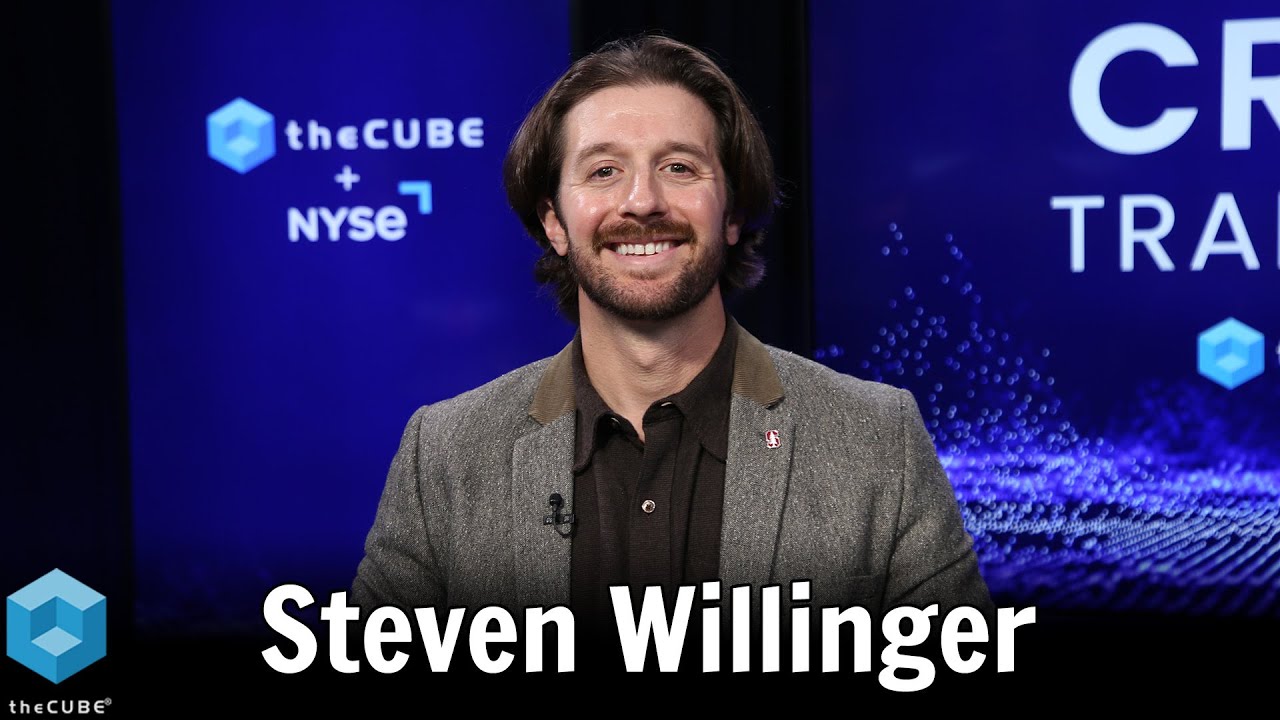
Steven Willinger of Stanford Blockchain Accelerator and Blockchain Builders discusses the "Crypto Trailblazers" series, a virtual event co-hosted by theCUBE and NYSE Wired. This event, in collaboration with the Ethereum Foundation and Stanford University, aims to explore blockchain innovations occurring in Silicon Valley.
In this segment, Willinger examines the evolving blockchain landscape. Drawing from his experience at Coinbase, Willinger addresses the collaborative efforts within the blockchain community that include Stanford University, the University of California Berkeley, and the Ethereum Foundation. The discussion emphasizes the momentum in decentralized finance, the significant shift in regulatory landscapes, and the rise of stablecoins.
Willinger notes that technology and finance-driven initiatives within the blockchain space are progressing, supported by considerable expertise and focused discussions, such as those held during ETHSF. They identify significant industry trends, noting that the forefront is the intersection of blockchain and AI. Hosts from theCUBE also provide additional insights into these promising developments.
#BlockchainBuilders #StanfordBlockchainAccelerator #CryptoTrailblazers #theCUBE #ETHSF #DecentralizedFinance #Stablecoins #AIandBlockchain #CryptoInnovation
Find more SiliconANGLE news and analysis https://siliconangle.com/
Follow theCUBE's wall-to-wall event coverage https://siliconangle.com/events/
Learn about the latest theCUBE events https://www.thecube.net/
00:00 - Intro
00:05 - Exploring the Blockchain Ecosystem: Community, Innovation, and Regulation
02:12 - Entrepreneurship, Impact, and Commercialization in Crypto
04:57 - Changing Paradigms: Business Models and Investments
07:56 - Stanford's Role in Blockchain and AI
10:53 - Innovations in Crypto and AI
13:27 - Infrastructure Opportunities in Blockchain
15:51 - The Challenges and Opportunities of Community-Building
18:10 - Accelerating Innovation: The Intersection of Incubators and Blockchain Initiatives
Forgot Password
Almost there!
We just sent you a verification email. Please verify your account to gain access to
theCUBE + NYSE Wired: Crypto Trailblazers. If you don’t think you received an email check your
spam folder.
Sign in to theCUBE + NYSE Wired: Crypto Trailblazers.
In order to sign in, enter the email address you used to registered for the event. Once completed, you will receive an email with a verification link. Open this link to automatically sign into the site.
Register For theCUBE + NYSE Wired: Crypto Trailblazers
Please fill out the information below. You will recieve an email with a verification link confirming your registration. Click the link to automatically sign into the site.
You’re almost there!
We just sent you a verification email. Please click the verification button in the email. Once your email address is verified, you will have full access to all event content for theCUBE + NYSE Wired: Crypto Trailblazers.
I want my badge and interests to be visible to all attendees.
Checking this box will display your presense on the attendees list, view your profile and allow other attendees to contact you via 1-1 chat. Read the Privacy Policy. At any time, you can choose to disable this preference.
Select your Interests!
add
Upload your photo
Uploading..
OR
Connect via Twitter
Connect via Linkedin
EDIT PASSWORD
Share
Forgot Password
Almost there!
We just sent you a verification email. Please verify your account to gain access to
theCUBE + NYSE Wired: Crypto Trailblazers. If you don’t think you received an email check your
spam folder.
Sign in to theCUBE + NYSE Wired: Crypto Trailblazers.
In order to sign in, enter the email address you used to registered for the event. Once completed, you will receive an email with a verification link. Open this link to automatically sign into the site.
Sign in to gain access to theCUBE + NYSE Wired: Crypto Trailblazers
Please sign in with LinkedIn to continue to theCUBE + NYSE Wired: Crypto Trailblazers. Signing in with LinkedIn ensures a professional environment.
Are you sure you want to remove access rights for this user?
Details
Manage Access
email address
Community Invitation
Kyle Samani, Multicoin Capital
Steven Willinger of Stanford Blockchain Accelerator and Blockchain Builders discusses the "Crypto Trailblazers" series, a virtual event co-hosted by theCUBE and NYSE Wired. This event, in collaboration with the Ethereum Foundation and Stanford University, aims to explore blockchain innovations occurring in Silicon Valley.
In this segment, Willinger examines the evolving blockchain landscape. Drawing from his experience at Coinbase, Willinger addresses the collaborative efforts within the blockchain community that include Stanford University, the University of California Berkeley, and the Ethereum Foundation. The discussion emphasizes the momentum in decentralized finance, the significant shift in regulatory landscapes, and the rise of stablecoins.
Willinger notes that technology and finance-driven initiatives within the blockchain space are progressing, supported by considerable expertise and focused discussions, such as those held during ETHSF. They identify significant industry trends, noting that the forefront is the intersection of blockchain and AI. Hosts from theCUBE also provide additional insights into these promising developments.
#BlockchainBuilders #StanfordBlockchainAccelerator #CryptoTrailblazers #theCUBE #ETHSF #DecentralizedFinance #Stablecoins #AIandBlockchain #CryptoInnovation
Find more SiliconANGLE news and analysis https://siliconangle.com/
Follow theCUBE's wall-to-wall event coverage https://siliconangle.com/events/
Learn about the latest theCUBE events https://www.thecube.net/
00:00 - Intro
00:05 - Exploring the Blockchain Ecosystem: Community, Innovation, and Regulation
02:12 - Entrepreneurship, Impact, and Commercialization in Crypto
04:57 - Changing Paradigms: Business Models and Investments
07:56 - Stanford's Role in Blockchain and AI
10:53 - Innovations in Crypto and AI
13:27 - Infrastructure Opportunities in Blockchain
15:51 - The Challenges and Opportunities of Community-Building
18:10 - Accelerating Innovation: The Intersection of Incubators and Blockchain Initiatives
>> Welcome back everyone to the Crypto Trailblazers Series, theCUBE and the NYSE Wired program and community putting this program together to feature the leaders in crypto as it goes mainstream. You started to see mainstream benefits, but also all the hard work done in the early days coming to fruition. Governments are getting behind it. The financial markets are changing. A lot of momentum and real world impact changing retail. You're starting to see integrations, all kinds of new things. Of course, money making, can't ignore the money making side of it. Kyle is here, he's Co-Founder, Managing Partner of Multicoin Capital, investing, he's got a hedge fund, VC fund, involved in a lot of early stage deals going back 5, 6, 8 years ago. Kyle, great to have you here on theCUBE. Thanks for joining us.
Kyle Samani
>> John, thanks for having me here. Pleasure to be here. Incredible to be here on the floor of the NYSE.
John Furrier
>> Yeah, and you're a trailblazer. We were talking before you came on camera. First investor in Solana.
Kyle Samani
>> That's correct.
John Furrier
>> Doing pretty good. Looking good off the tee, as they say, middle of the fairway.
Kyle Samani
>> Thanks. I think I might've drove the green on that one.
John Furrier
>> Yeah, exactly. Looking good. But the ecosystem of Solana is kicking, but just crypto in general is mainstreaming.
Kyle Samani
>> It is.
John Furrier
>> So this series is really to kind of document the mainstreaming of crypto, but also to look at the original gangsters, if you will, the OGs inside the ropes. A lot of people were grinding. You go back to 2015, 2014, a lot of alpha blockchain engineers and attracted engineers, hard problems to solve. Then you got the coins coming in, you start to see the economics of decentralization. Take us through why the leaders succeeded through that kind of then nuclear winter years of either uncertainty on the government side here in the US and abroad, but also the evolution of the market. And they penetrated through, so the ones who made it through both investors and companies built mega businesses. What was the keys to those?
Kyle Samani
>> Yeah, I had the good fortune of meeting Anatoly and Raj in April of 2018 right as they were kind of starting Solana. And one thing stood out to me about both of them very quickly early on is they were very clear that they were going to persevere and they were going to survive no matter what came at them. Anatoly specifically had a vision for what he wanted to build. At the time, he called it blockchain and NASDAQ speed. That kind of idea has now morphed into what we call internet capital markets. I had the good fortune of talking about 3,000 or 4,000 founders at this point, but it's become very clear now when you guys see a founder that has a very specific vision and they have the technical skills to do it and you know they're just going to push through and grind, those are bets you want to take. And I got to meet Anatoly and Raj super early. They absolutely stood out to me so clearly on all of those fronts. And look, they were the only founders back in crypto at the time. They really had a clear vision. Most of their founders have talked about Web3 and decentralize the internet and all of these kind of grandiose concepts. And Anatoly and Raj were saying, "Look, these blockchains are for trading systems and we're going to build a new way for people to trade." And that clarity of thought even back in 2018 was really present.
John Furrier
>> And the thing about latency, he's got the Qualcomm background. We were chatting about the moment he had the idea for blockchain, he was actually working on some AI stuff pre-transformer and then boom, he locks in and the rest is history. So okay, you made that investment. What happened next? Because what happened next was adoption and that's the key to all success on these technical platforms that had protocols, adoption. What was the driver for the adoption in your opinion? What was the main thing?
Kyle Samani
>> So Solana blockchain launched in April of 2020. So right as we went into COVID, it was a really dark time. Solana, they were running out of money. We had the bridge them in 2019. It was a tough time. And we launched this thing and a whole bunch of entrepreneurs at the time in building in the crypto space, specifically these DeFi entrepreneurs were really frustrated with Ethereum. Gas fees in the summer of 2020 were north of $100 per transaction. And a lot of people looked at Ethereum and they were like, "This is not going to work, obviously."
And meanwhile, Solana was three months, two, three, four months old at the time. And people said, "Hey, I'm going to have a fresh open mind. I'm going to go look for some alternatives." And as those people all looked around, they found Solana. And the beautiful thing about that time was those people who were willing to say, "Hey, I think Ethereum is not going to work." Those are the kinds of people who are going to be open-minded to a new idea, because Ethereum had 100% market share and 99% mind share. And so to be in that 1%, you've really had to say, "I don't care about the status quo, because I see something broken in the status quo." We had the good fortune of meeting a ton of those early entrepreneurs, the folks at Jito, the folks at Camino, folks at Drift, and all these other early builders in the space.
John Furrier
>> And the speed and the gas prices was key.
Kyle Samani
>> Correct. Solana has been running for five and a half years and the median transaction fee over five and a half years is a hundredth of a penny or thousandth of a penny over the course of billions and billions of transactions.
John Furrier
>> Talk about your firm. What are you guys doing now? Because you guys have a broad set of services, you're pretty lean on the staff side, it's not like you're not a mega fund. Talk about how you guys are structured.
Kyle Samani
>> Yeah. So Multicoin is an SEC registered investment advisor. We're today one of the oldest and largest crypto-focused investment firms in the world, and there's about 3 billion in AUM. We have about 18 employees. Multicoin is a firm, I like to say we have one strategy deployed across two fund vehicles. And that strategy is we buy things we like and then we don't sell them. And I would posit to you that step two is harder than step one. And so we've really institutionalized that long-term culture at our firm. We look for very deep, deep truths in the world that we think are either mispriced or misunderstood, and then we put on positions and hold them for a very long period of time to allow those gains to compound. Sometimes we're wrong, but when we're right, we tend to be really right.
John Furrier
>> One observation I have coming from California here to open up the studio at the NYC for theCUBE is in the financial side, there's an entrepreneurial mainstreaming too, but they're thinking like tech entrepreneurs in the sense of they want to take down structural positions and have durable businesses, which in finance was kind of controlled by the main institutions. Again, this is my observation, correct me if you have a different opinion. It's less mercenary, more missionary in the sense of the two worlds are kind of coming together because the distribution on the financial side is significant and they're leaning in. So what's your take on that? It seems like there's like a DMZ zone developing between the new guard and the old guard in finance.
Kyle Samani
>> Yeah, I mean, I think to be a successful technology entrepreneur today, you have to be a missionary because the amount of work required is so large, the degree of uncertainty is so high that if you were strictly doing some EV math, at some point shit is going to hit the fan and things are going to go wrong and you're going to give up if you're just ... Because at that point, your EV assigned, EV will decrease to the point that you're going to say, "I don't want to do this anymore." And so kind of by definition, only the missionaries survive and there's lot of guys have had multiple near-death experiences and I've been there through right alongside from .
John Furrier
>> Therapist/bridge/coach.
Kyle Samani
>> Yeah, there were a few times it was pretty rough. But look, the flip side of that is when you work with an entrepreneur and they go through that first crisis and they persevere, that is one of the most redeeming qualities you can look for. And that's frequently what gives us as venture capitalists the conviction to double down on those entrepreneurs.
John Furrier
>> And your added value, you stick with the founders. Tell a story that encapsulates that, if it's not confidential.
Kyle Samani
>> I mean with Anatoly and Raj specifically ... Oh man, I think these are all kind of sensitive.
John Furrier
>> Okay.
Kyle Samani
>> I think they're all sensitive.
John Furrier
>> I'll rephrase. Tell me a story about the innovation around what's happening now, because you're making new bets. Is it just Solana? Are you looking at other things? Multicoin implies multiple networks. It seems to be everyone's popping up with a blockchain. Private networks are coming out, private chains. What's your landscape view right now as an investor?
Kyle Samani
>> Yeah, so Multicoin today is one of the most active investors in the Solana ecosystem. We've invested in probably roughly 30 teams or so building on top of Solana in the last five, five and a half years. I'd say one very hot area these days is stablecoins, and we've recently put on a pretty large position in our hedge fund and a protocol called Ethena. The ticker is ENA and Ethena is actually making a big rollout on Solana right now. And what their coin or core protocol does is it pays ... It basically runs the basis trade, so think long Bitcoin, short Bitcoin perp, that funding rate today is in the neighborhood of 12% or so, and then represents that tokenized position as basically a stablecoin yield. Ethena today, I think there's 12 billion USDe tokens in circulation. And we think with the velocity of the Solana network and the blockchain, having this high yield bearing instrument combined with the performance and global liquidity of Solana is really a perfect match made in heaven.
John Furrier
>> Yeah. And totally was talking about the stable coin being a key thing on the liquidity piece on the financial side, and you mentioned internet capital markets, a term you guys are kicking around. What does that mean to you? What does that mean for the person that never heard of it? What does internet capital markets mean?
Kyle Samani
>> The idea of internet capital markets I think can be boiled down to this idea of any person anywhere in the world with just a phone and an internet connection should be able to trade any asset 24 hours a day, and that's it at its core. And for anyone who's used the internet, like what I just described, you should be able to go any website, stream any song, watch any YouTube video. All of these things we now viscerally understand about how the internet should work, should just be applied to finance. But the reality of finance today is it's like, whatever, 40 hours a week or 30 hours a week. And if you live in most Third World countries or emerging markets, you can't access these systems directly and there's all these intermediaries and all this stuff. And so internet capital markets is about making finance feel like an internet native primitive, just like music and video and texts do today.
John Furrier
>> Yeah, and the money side with the US dollar pegged to the stablecoin makes it more of an international ... I mean, that's an opportunity for the US to extend.
Kyle Samani
>> Massive.
John Furrier
>> What's your reaction? How would you explain that to someone at a cocktail party, why the stablecoin backed by the USD would be important for the benefit of America?
Kyle Samani
>> Yeah. I had the good fortune of working very closely with Bill Hagerty on the GENIUS Act that President Trump signed in the law a few months ago. And I think the GENIUS Act when we look back in 30 or 40 years, will be looked upon as one of the most consequential pieces of financial regulation ever for the simple reason that I think most people in the world do not trust their local governments and their local government's management of their respective fiat currencies. I have a hypothesis that if you could go ... There's 8 billion people in the world, and if you could go to each of those 8 billion people and ask them what asset would you choose to nominate your wealth in, if you could pick any asset, and it can be bars of gold, it can be Apple stock, it could be S&P 500, it can be Bitcoin, like whatever you want, euros, dollars, yen, yuan, anything. My suspicion is if you go to those 8 billion people in the world and ask them that question and they can answer without fear of political persecution in their local jurisdictions, I suspect between 50% and 75% of them would say US dollars. Today, about four and a half percent of the global population lives in the United States. And so that arbitrage of, call it 45% to 70% of people is the arbitrage opportunity that the GENIUS Act represents. In the next couple of years, we expect to see Apple and Google embed stablecoins and crypto wallets as first class primitives in iOS and Android. And when they do, that's the overnight moment when the world just completely-
John Furrier
>> I mean, that's an Apple Pay moment for the wallet.
Kyle Samani
>> I think it's bigger than that, because you're going to enable any guy in Argentina, in the Philippines, in Nigeria, in India, wherever they may be, to hold US dollars for zero cost with zero KYC.
John Furrier
>> So if I'm living in a country that's got massive inflation, which causes people high anxiety, I can just transact e-commerce with the dollar.
Kyle Samani
>> There's already a lot of countries that are already either partially dollarized or fully dollarized. In large parts of LATAM, there's well-known gray markets for dollars that are well-known. I believe it's Ecuador is fully dollarized. So this is not even a particularly new idea. There's actually a lot of economists that have written about this extensively.
John Furrier
>> Yeah, good point about the gray market. All right, so what's your big focus and view on innovation? What happens next? We continue down this path GENIUS Act, I totally agree, that's awesome. Stablecoins bring some stability, so to speak. What happens next in the financial markets? Is it infrastructure enablement? Is it the app layer? Is it entrepreneurship, all of the above? What's going to be the key shoes that drop in the sequence of events in the next couple of years?
Kyle Samani
>> Yeah, I think what you're seeing now is, look, every major firm on Wall Street is kind of figuring out what they're doing with crypto. Obviously, ICE just announced there being an investment in Polymarket and prediction markets. JP Morgan just announced crypto as collateral for their private wealth management. Morgan Stanley announced E*TRADE is going to enable crypto trading and support. Mastercard just bought Zerohash for 2 billion. So you're seeing all of these announcements basically every week at this point. What's pretty clear to me is you should think about kind of crypto adoption through two lenses. We're seeing the big trusted American financial institutions, both trading side and Wall Street and payment side. So I think Visa, Stripe, those guys are all embedding crypto into their core business operations and enabling their customers to hold crypto and trade crypto. The other side of this is what I call the entrepreneur side, and this is all of the groups like DolarApp and El Dorado and Redotpay and Felix Pago and these other amazing entrepreneurs who are building what we call kind of loosely stablecoin neobanks, where they're making it as easy as possible for people in Argentina, Ecuador, Bolivia, Venezuela, India, Philippines, et cetera, to hold dollars and to save in dollars, earn yield in dollars, and then also be able to quickly convert back to their local fiat currencies if and when they need to for buying milk at the grocery store.
John Furrier
>> Kyle, one of the things that's come up is this entrepreneurial view. I mentioned it earlier, product management kind of thinking is coming into finance. Infrastructure, that's clear. We saw Solana doing stuff, Layer 2, others. But when you think about products, what you just kind of mentioned, these are net new things that are going to emerge. New products, financial products, not protocols. That's kind of happening. If that continue, that's going to enable and accelerate new things. What's your view on that? What do you see on the horizon? I mean, I could take a little bit of a credit app here, put some cash, I'm holding dollars. And I'm holding dollars and that means I have leverage. So there's all kinds of new side order effects of the enablement of the money. What do you see as the products that might emerge as smart people out there seeing opportunity? Entrepreneurs see some white space here, they grab a little bit, get some beach head. What are some of the product? If you and I were product manager sitting on a white board, what would we be thinking about?
Kyle Samani
>> Well, I have a good fortune of backing a lot of those guys. I can kind of borrow liberally across all of their collective minds. I think the most important financial instrument that the world does not appreciated yet today is the perpetual swap contract. And today in crypto, that's the predominant vehicle by which derivatives are traded in crypto, but perhaps perps don't exist at all in American regulated finance. There's a lot of smart people working on bringing perps to TradFi and that's going to happen over the next few years. Coinbase and many others are working on that. Meanwhile, I think we are now seeing a whole cohort of entrepreneurs look at the beauty and elegance of the perpetual swap contract and start to apply it to all kinds of other things. So for example, we're seeing this apply to the notion of having a real estate index. One of the most common things people have heard in the last six years is, "I want to go long Miami, short SF, or long New York, short Austin, or whatever." But this is actually a saying you hear people say commonly. There's now a protocol called Parcel that allows you to literally go long. The median price per square foot of real estate transactions in the city of Miami over the last 30 days. Or of course someone can go short that same index. The idea of being able to just take an index as an input and then have people go long or short that index is a really breakthrough idea that's going to unlock a lot of efficiency and capital markets and we expect basically all of that innovation is going to happen on Solana because that's where the intellectual capital is today. That's where the latency is and that's where the trading and liquidity is.
John Furrier
>> It's funny, I've been comparing AI and NVIDIA relationship with Solana and Crypto. NYSE institution, well-recognized around the world is now owned by ICE. They have a lot of other businesses, data businesses. I mean the NYSE is becoming the crypto exchange because of what it touches. People, image, prestige, but also ICE is innovating. Polymarket is also a tell sign that what you were just talking about. Why would they get involved in Polymarket? Because it's kind of on that same track. What's your take on ICE and NYSE's opportunity?
Kyle Samani
>> Yeah. I mean, look, I think there's a lot of pretty obvious opportunities for ICE here. The first is obviously prediction markets. They made it very clear they're going to do something very big there with Polymarket. Full disclosure, I'm an investor in Kalshi so on the other side of that one, but we obviously are following that space very closely. The other very obvious opportunity for ICE, I think, is to get into purpose and derivatives. Now, in the current regulatory regime that gets into the DCOs and the prime world of the banks, so that's going to be I think a challenge for ICE in terms of managing those relationships. But if you look at what Kalshi is doing, if you look at what Coinbase is trying to do and others, they're trying to bundle both the exchange and the prime services and the clearing and derivatives, and I think that's a pretty big opportunity for us.
John Furrier
>> All right. Final question for you. You talked to thousands of entrepreneurs, you've seen the patterns. Is there a new breed of entrepreneur? What's the current cohort like? You pointed out the kind of first principles of what you look for. What's the vibe of the current founder batch of entrepreneurs that you're seeing? Mindset, age, demographics? Is there some rhyme and reason? Or same old, same old?
Kyle Samani
>> No, I mean I think it would be bad if we tried to lump our entrepreneurs together, because look, we backed guys who were in their 50s, we've backed in their 40s, backed in their 30s, backed in their 20s.
John Furrier
>> So diverse?
Kyle Samani
>> And maybe even their teens. Yeah, I don't think we've backed anyone in their teens, but definitely early 20s. We backed guys and girls, people of all different skin color and race, people all over the world.
John Furrier
>> How about mindset? What's the mindset?
Kyle Samani
>> I mean, look, common mindset is you got to want to win. You got to want to work really hard and you have to have a very clear vision that you're working towards that not only you can convince investors to back, but that you have to convince other ... Look, employee number two, three, four, five and six is your company, they shouldn't be joining your company. They have to believe in the vision of what you're trying to do. They're not joining for the paycheck because there's always a bigger company that can pay better somewhere. And so that clarity of thought and ability to communicate it, we look for.
John Furrier
>> All right. Kyle, thanks for coming on the Trailblazers, you've been blazing the trails. Continue to do that. Congratulations. Thanks for coming on.
Kyle Samani
>> John, thanks so much.
John Furrier
>> All right. All right. I'm John Furrier with the Crypto Trailblazers part of theCUBE and the NYSE Wired program and community featuring the leaders. Because as the mainstream market adapts crypto, it's going to be soon abstracted away, and it's going to be just another piece of infrastructure. Again, real-world assets coming on chain, financial markets being enabled and disrupted and accelerated into new financial systems. And we're best to bring that content to you. Thanks for watching.
>> Welcome back everyone to the Crypto Trailblazers Series, theCUBE and the NYSE Wired program and community putting this program together to feature the leaders in crypto as it goes mainstream. You started to see mainstream benefits, but also all the hard work done in the early days coming to fruition. Governments are getting behind it. The financial markets are changing. A lot of momentum and real world impact changing retail. You're starting to see integrations, all kinds of new things. Of course, money making, can't ignore the money making side of it. Kyle is here, he's Co-Founder, Managing Partner of Multicoin Capital, investing, he's got a hedge fund, VC fund, involved in a lot of early stage deals going back 5, 6, 8 years ago. Kyle, great to have you here on theCUBE. Thanks for joining us.
Kyle Samani
>> John, thanks for having me here. Pleasure to be here. Incredible to be here on the floor of the NYSE.
John Furrier
>> Yeah, and you're a trailblazer. We were talking before you came on camera. First investor in Solana.
Kyle Samani
>> That's correct.
John Furrier
>> Doing pretty good. Looking good off the tee, as they say, middle of the fairway.
Kyle Samani
>> Thanks. I think I might've drove the green on that one.
John Furrier
>> Yeah, exactly. Looking good. But the ecosystem of Solana is kicking, but just crypto in general is mainstreaming.
Kyle Samani
>> It is.
John Furrier
>> So this series is really to kind of document the mainstreaming of crypto, but also to look at the original gangsters, if you will, the OGs inside the ropes. A lot of people were grinding. You go back to 2015, 2014, a lot of alpha blockchain engineers and attracted engineers, hard problems to solve. Then you got the coins coming in, you start to see the economics of decentralization. Take us through why the leaders succeeded through that kind of then nuclear winter years of either uncertainty on the government side here in the US and abroad, but also the evolution of the market. And they penetrated through, so the ones who made it through both investors and companies built mega businesses. What was the keys to those?
Kyle Samani
>> Yeah, I had the good fortune of meeting Anatoly and Raj in April of 2018 right as they were kind of starting Solana. And one thing stood out to me about both of them very quickly early on is they were very clear that they were going to persevere and they were going to survive no matter what came at them. Anatoly specifically had a vision for what he wanted to build. At the time, he called it blockchain and NASDAQ speed. That kind of idea has now morphed into what we call internet capital markets. I had the good fortune of talking about 3,000 or 4,000 founders at this point, but it's become very clear now when you guys see a founder that has a very specific vision and they have the technical skills to do it and you know they're just going to push through and grind, those are bets you want to take. And I got to meet Anatoly and Raj super early. They absolutely stood out to me so clearly on all of those fronts. And look, they were the only founders back in crypto at the time. They really had a clear vision. Most of their founders have talked about Web3 and decentralize the internet and all of these kind of grandiose concepts. And Anatoly and Raj were saying, "Look, these blockchains are for trading systems and we're going to build a new way for people to trade." And that clarity of thought even back in 2018 was really present.
John Furrier
>> And the thing about latency, he's got the Qualcomm background. We were chatting about the moment he had the idea for blockchain, he was actually working on some AI stuff pre-transformer and then boom, he locks in and the rest is history. So okay, you made that investment. What happened next? Because what happened next was adoption and that's the key to all success on these technical platforms that had protocols, adoption. What was the driver for the adoption in your opinion? What was the main thing?
Kyle Samani
>> So Solana blockchain launched in April of 2020. So right as we went into COVID, it was a really dark time. Solana, they were running out of money. We had the bridge them in 2019. It was a tough time. And we launched this thing and a whole bunch of entrepreneurs at the time in building in the crypto space, specifically these DeFi entrepreneurs were really frustrated with Ethereum. Gas fees in the summer of 2020 were north of $100 per transaction. And a lot of people looked at Ethereum and they were like, "This is not going to work, obviously."
And meanwhile, Solana was three months, two, three, four months old at the time. And people said, "Hey, I'm going to have a fresh open mind. I'm going to go look for some alternatives." And as those people all looked around, they found Solana. And the beautiful thing about that time was those people who were willing to say, "Hey, I think Ethereum is not going to work." Those are the kinds of people who are going to be open-minded to a new idea, because Ethereum had 100% market share and 99% mind share. And so to be in that 1%, you've really had to say, "I don't care about the status quo, because I see something broken in the status quo." We had the good fortune of meeting a ton of those early entrepreneurs, the folks at Jito, the folks at Camino, folks at Drift, and all these other early builders in the space.
John Furrier
>> And the speed and the gas prices was key.
Kyle Samani
>> Correct. Solana has been running for five and a half years and the median transaction fee over five and a half years is a hundredth of a penny or thousandth of a penny over the course of billions and billions of transactions.
John Furrier
>> Talk about your firm. What are you guys doing now? Because you guys have a broad set of services, you're pretty lean on the staff side, it's not like you're not a mega fund. Talk about how you guys are structured.
Kyle Samani
>> Yeah. So Multicoin is an SEC registered investment advisor. We're today one of the oldest and largest crypto-focused investment firms in the world, and there's about 3 billion in AUM. We have about 18 employees. Multicoin is a firm, I like to say we have one strategy deployed across two fund vehicles. And that strategy is we buy things we like and then we don't sell them. And I would posit to you that step two is harder than step one. And so we've really institutionalized that long-term culture at our firm. We look for very deep, deep truths in the world that we think are either mispriced or misunderstood, and then we put on positions and hold them for a very long period of time to allow those gains to compound. Sometimes we're wrong, but when we're right, we tend to be really right.
John Furrier
>> One observation I have coming from California here to open up the studio at the NYC for theCUBE is in the financial side, there's an entrepreneurial mainstreaming too, but they're thinking like tech entrepreneurs in the sense of they want to take down structural positions and have durable businesses, which in finance was kind of controlled by the main institutions. Again, this is my observation, correct me if you have a different opinion. It's less mercenary, more missionary in the sense of the two worlds are kind of coming together because the distribution on the financial side is significant and they're leaning in. So what's your take on that? It seems like there's like a DMZ zone developing between the new guard and the old guard in finance.
Kyle Samani
>> Yeah, I mean, I think to be a successful technology entrepreneur today, you have to be a missionary because the amount of work required is so large, the degree of uncertainty is so high that if you were strictly doing some EV math, at some point shit is going to hit the fan and things are going to go wrong and you're going to give up if you're just ... Because at that point, your EV assigned, EV will decrease to the point that you're going to say, "I don't want to do this anymore." And so kind of by definition, only the missionaries survive and there's lot of guys have had multiple near-death experiences and I've been there through right alongside from .
John Furrier
>> Therapist/bridge/coach.
Kyle Samani
>> Yeah, there were a few times it was pretty rough. But look, the flip side of that is when you work with an entrepreneur and they go through that first crisis and they persevere, that is one of the most redeeming qualities you can look for. And that's frequently what gives us as venture capitalists the conviction to double down on those entrepreneurs.
John Furrier
>> And your added value, you stick with the founders. Tell a story that encapsulates that, if it's not confidential.
Kyle Samani
>> I mean with Anatoly and Raj specifically ... Oh man, I think these are all kind of sensitive.
John Furrier
>> Okay.
Kyle Samani
>> I think they're all sensitive.
John Furrier
>> I'll rephrase. Tell me a story about the innovation around what's happening now, because you're making new bets. Is it just Solana? Are you looking at other things? Multicoin implies multiple networks. It seems to be everyone's popping up with a blockchain. Private networks are coming out, private chains. What's your landscape view right now as an investor?
Kyle Samani
>> Yeah, so Multicoin today is one of the most active investors in the Solana ecosystem. We've invested in probably roughly 30 teams or so building on top of Solana in the last five, five and a half years. I'd say one very hot area these days is stablecoins, and we've recently put on a pretty large position in our hedge fund and a protocol called Ethena. The ticker is ENA and Ethena is actually making a big rollout on Solana right now. And what their coin or core protocol does is it pays ... It basically runs the basis trade, so think long Bitcoin, short Bitcoin perp, that funding rate today is in the neighborhood of 12% or so, and then represents that tokenized position as basically a stablecoin yield. Ethena today, I think there's 12 billion USDe tokens in circulation. And we think with the velocity of the Solana network and the blockchain, having this high yield bearing instrument combined with the performance and global liquidity of Solana is really a perfect match made in heaven.
John Furrier
>> Yeah. And totally was talking about the stable coin being a key thing on the liquidity piece on the financial side, and you mentioned internet capital markets, a term you guys are kicking around. What does that mean to you? What does that mean for the person that never heard of it? What does internet capital markets mean?
Kyle Samani
>> The idea of internet capital markets I think can be boiled down to this idea of any person anywhere in the world with just a phone and an internet connection should be able to trade any asset 24 hours a day, and that's it at its core. And for anyone who's used the internet, like what I just described, you should be able to go any website, stream any song, watch any YouTube video. All of these things we now viscerally understand about how the internet should work, should just be applied to finance. But the reality of finance today is it's like, whatever, 40 hours a week or 30 hours a week. And if you live in most Third World countries or emerging markets, you can't access these systems directly and there's all these intermediaries and all this stuff. And so internet capital markets is about making finance feel like an internet native primitive, just like music and video and texts do today.
John Furrier
>> Yeah, and the money side with the US dollar pegged to the stablecoin makes it more of an international ... I mean, that's an opportunity for the US to extend.
Kyle Samani
>> Massive.
John Furrier
>> What's your reaction? How would you explain that to someone at a cocktail party, why the stablecoin backed by the USD would be important for the benefit of America?
Kyle Samani
>> Yeah. I had the good fortune of working very closely with Bill Hagerty on the GENIUS Act that President Trump signed in the law a few months ago. And I think the GENIUS Act when we look back in 30 or 40 years, will be looked upon as one of the most consequential pieces of financial regulation ever for the simple reason that I think most people in the world do not trust their local governments and their local government's management of their respective fiat currencies. I have a hypothesis that if you could go ... There's 8 billion people in the world, and if you could go to each of those 8 billion people and ask them what asset would you choose to nominate your wealth in, if you could pick any asset, and it can be bars of gold, it can be Apple stock, it could be S&P 500, it can be Bitcoin, like whatever you want, euros, dollars, yen, yuan, anything. My suspicion is if you go to those 8 billion people in the world and ask them that question and they can answer without fear of political persecution in their local jurisdictions, I suspect between 50% and 75% of them would say US dollars. Today, about four and a half percent of the global population lives in the United States. And so that arbitrage of, call it 45% to 70% of people is the arbitrage opportunity that the GENIUS Act represents. In the next couple of years, we expect to see Apple and Google embed stablecoins and crypto wallets as first class primitives in iOS and Android. And when they do, that's the overnight moment when the world just completely-
John Furrier
>> I mean, that's an Apple Pay moment for the wallet.
Kyle Samani
>> I think it's bigger than that, because you're going to enable any guy in Argentina, in the Philippines, in Nigeria, in India, wherever they may be, to hold US dollars for zero cost with zero KYC.
John Furrier
>> So if I'm living in a country that's got massive inflation, which causes people high anxiety, I can just transact e-commerce with the dollar.
Kyle Samani
>> There's already a lot of countries that are already either partially dollarized or fully dollarized. In large parts of LATAM, there's well-known gray markets for dollars that are well-known. I believe it's Ecuador is fully dollarized. So this is not even a particularly new idea. There's actually a lot of economists that have written about this extensively.
John Furrier
>> Yeah, good point about the gray market. All right, so what's your big focus and view on innovation? What happens next? We continue down this path GENIUS Act, I totally agree, that's awesome. Stablecoins bring some stability, so to speak. What happens next in the financial markets? Is it infrastructure enablement? Is it the app layer? Is it entrepreneurship, all of the above? What's going to be the key shoes that drop in the sequence of events in the next couple of years?
Kyle Samani
>> Yeah, I think what you're seeing now is, look, every major firm on Wall Street is kind of figuring out what they're doing with crypto. Obviously, ICE just announced there being an investment in Polymarket and prediction markets. JP Morgan just announced crypto as collateral for their private wealth management. Morgan Stanley announced E*TRADE is going to enable crypto trading and support. Mastercard just bought Zerohash for 2 billion. So you're seeing all of these announcements basically every week at this point. What's pretty clear to me is you should think about kind of crypto adoption through two lenses. We're seeing the big trusted American financial institutions, both trading side and Wall Street and payment side. So I think Visa, Stripe, those guys are all embedding crypto into their core business operations and enabling their customers to hold crypto and trade crypto. The other side of this is what I call the entrepreneur side, and this is all of the groups like DolarApp and El Dorado and Redotpay and Felix Pago and these other amazing entrepreneurs who are building what we call kind of loosely stablecoin neobanks, where they're making it as easy as possible for people in Argentina, Ecuador, Bolivia, Venezuela, India, Philippines, et cetera, to hold dollars and to save in dollars, earn yield in dollars, and then also be able to quickly convert back to their local fiat currencies if and when they need to for buying milk at the grocery store.
John Furrier
>> Kyle, one of the things that's come up is this entrepreneurial view. I mentioned it earlier, product management kind of thinking is coming into finance. Infrastructure, that's clear. We saw Solana doing stuff, Layer 2, others. But when you think about products, what you just kind of mentioned, these are net new things that are going to emerge. New products, financial products, not protocols. That's kind of happening. If that continue, that's going to enable and accelerate new things. What's your view on that? What do you see on the horizon? I mean, I could take a little bit of a credit app here, put some cash, I'm holding dollars. And I'm holding dollars and that means I have leverage. So there's all kinds of new side order effects of the enablement of the money. What do you see as the products that might emerge as smart people out there seeing opportunity? Entrepreneurs see some white space here, they grab a little bit, get some beach head. What are some of the product? If you and I were product manager sitting on a white board, what would we be thinking about?
Kyle Samani
>> Well, I have a good fortune of backing a lot of those guys. I can kind of borrow liberally across all of their collective minds. I think the most important financial instrument that the world does not appreciated yet today is the perpetual swap contract. And today in crypto, that's the predominant vehicle by which derivatives are traded in crypto, but perhaps perps don't exist at all in American regulated finance. There's a lot of smart people working on bringing perps to TradFi and that's going to happen over the next few years. Coinbase and many others are working on that. Meanwhile, I think we are now seeing a whole cohort of entrepreneurs look at the beauty and elegance of the perpetual swap contract and start to apply it to all kinds of other things. So for example, we're seeing this apply to the notion of having a real estate index. One of the most common things people have heard in the last six years is, "I want to go long Miami, short SF, or long New York, short Austin, or whatever." But this is actually a saying you hear people say commonly. There's now a protocol called Parcel that allows you to literally go long. The median price per square foot of real estate transactions in the city of Miami over the last 30 days. Or of course someone can go short that same index. The idea of being able to just take an index as an input and then have people go long or short that index is a really breakthrough idea that's going to unlock a lot of efficiency and capital markets and we expect basically all of that innovation is going to happen on Solana because that's where the intellectual capital is today. That's where the latency is and that's where the trading and liquidity is.
John Furrier
>> It's funny, I've been comparing AI and NVIDIA relationship with Solana and Crypto. NYSE institution, well-recognized around the world is now owned by ICE. They have a lot of other businesses, data businesses. I mean the NYSE is becoming the crypto exchange because of what it touches. People, image, prestige, but also ICE is innovating. Polymarket is also a tell sign that what you were just talking about. Why would they get involved in Polymarket? Because it's kind of on that same track. What's your take on ICE and NYSE's opportunity?
Kyle Samani
>> Yeah. I mean, look, I think there's a lot of pretty obvious opportunities for ICE here. The first is obviously prediction markets. They made it very clear they're going to do something very big there with Polymarket. Full disclosure, I'm an investor in Kalshi so on the other side of that one, but we obviously are following that space very closely. The other very obvious opportunity for ICE, I think, is to get into purpose and derivatives. Now, in the current regulatory regime that gets into the DCOs and the prime world of the banks, so that's going to be I think a challenge for ICE in terms of managing those relationships. But if you look at what Kalshi is doing, if you look at what Coinbase is trying to do and others, they're trying to bundle both the exchange and the prime services and the clearing and derivatives, and I think that's a pretty big opportunity for us.
John Furrier
>> All right. Final question for you. You talked to thousands of entrepreneurs, you've seen the patterns. Is there a new breed of entrepreneur? What's the current cohort like? You pointed out the kind of first principles of what you look for. What's the vibe of the current founder batch of entrepreneurs that you're seeing? Mindset, age, demographics? Is there some rhyme and reason? Or same old, same old?
Kyle Samani
>> No, I mean I think it would be bad if we tried to lump our entrepreneurs together, because look, we backed guys who were in their 50s, we've backed in their 40s, backed in their 30s, backed in their 20s.
John Furrier
>> So diverse?
Kyle Samani
>> And maybe even their teens. Yeah, I don't think we've backed anyone in their teens, but definitely early 20s. We backed guys and girls, people of all different skin color and race, people all over the world.
John Furrier
>> How about mindset? What's the mindset?
Kyle Samani
>> I mean, look, common mindset is you got to want to win. You got to want to work really hard and you have to have a very clear vision that you're working towards that not only you can convince investors to back, but that you have to convince other ... Look, employee number two, three, four, five and six is your company, they shouldn't be joining your company. They have to believe in the vision of what you're trying to do. They're not joining for the paycheck because there's always a bigger company that can pay better somewhere. And so that clarity of thought and ability to communicate it, we look for.
John Furrier
>> All right. Kyle, thanks for coming on the Trailblazers, you've been blazing the trails. Continue to do that. Congratulations. Thanks for coming on.
Kyle Samani
>> John, thanks so much.
John Furrier
>> All right. All right. I'm John Furrier with the Crypto Trailblazers part of theCUBE and the NYSE Wired program and community featuring the leaders. Because as the mainstream market adapts crypto, it's going to be soon abstracted away, and it's going to be just another piece of infrastructure. Again, real-world assets coming on chain, financial markets being enabled and disrupted and accelerated into new financial systems. And we're best to bring that content to you. Thanks for watching.







































 John Furrier