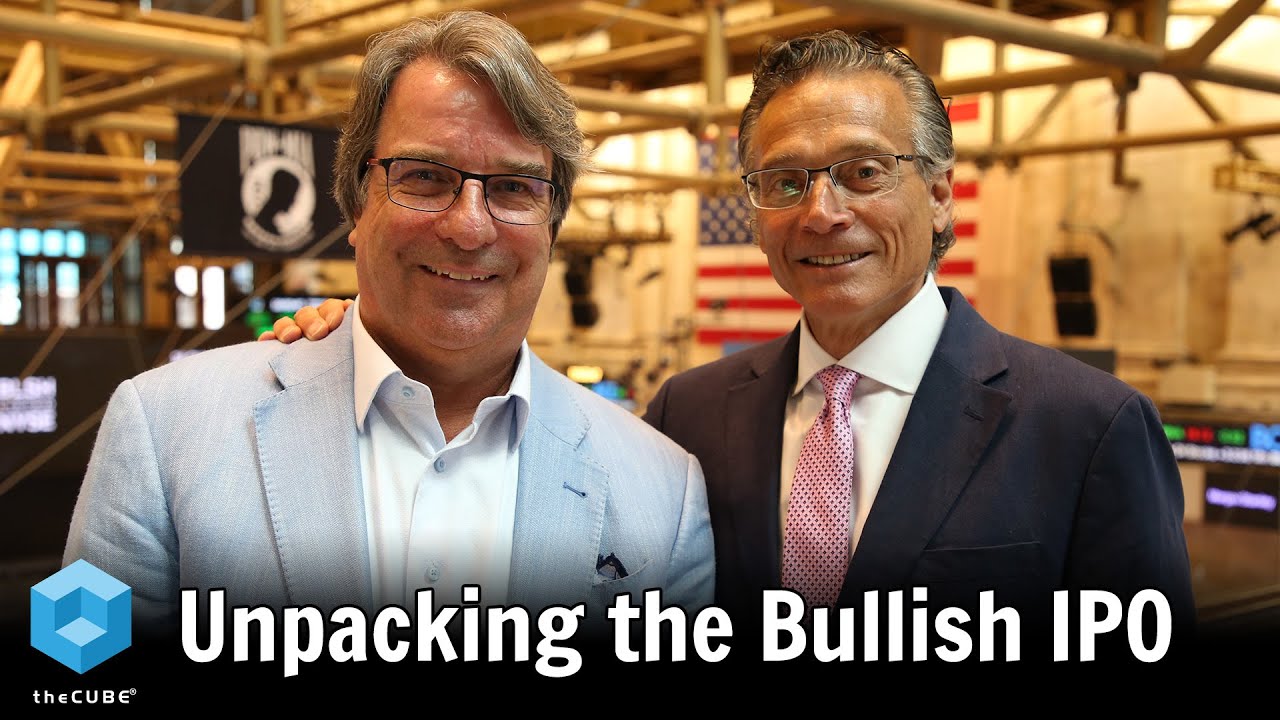
At the Crypto Trailblazers event, theCUBE’s Dave Vellante speaks with Andrew Keys, co-founder and chairman of Ether Machine, to unpack the company’s mission to deliver institutional-grade Ethereum exposure and yield generation. Keys explains how Ether Machine was created to address a key gap in ETF staking capacity, enabling 100% staking, restaking and DeFi participation compared to the limited yield strategies available in traditional Ether ETFs. He outlines the technical nuances of Ethereum’s proof-of-stake model, its programmability compared to Bitcoin and why Ethereum’s uptime, decentralization and Layer 2 scalability make it the preferred substrate for global financial transactions.
The discussion explores Ether Machine’s clean corporate structure, its use of SPAC integration to avoid legacy liabilities and its approach to financing through convertible debt and preferred shares rather than shareholder-diluting equity issuance. Keys also addresses the evolving regulatory climate, the rise of institutional stablecoins under the GENIUS Act and the competitive dynamics between Ethereum and other blockchains. By leveraging volatility, yield generation and pristine block production, Ether Machine aims to position itself as the premier vehicle for institutions seeking both Ether price participation and optimized returns.
Forgot Password
Almost there!
We just sent you a verification email. Please verify your account to gain access to
theCUBE + NYSE Wired: Crypto Trailblazers. If you don’t think you received an email check your
spam folder.
Sign in to theCUBE + NYSE Wired: Crypto Trailblazers.
In order to sign in, enter the email address you used to registered for the event. Once completed, you will receive an email with a verification link. Open this link to automatically sign into the site.
Register For theCUBE + NYSE Wired: Crypto Trailblazers
Please fill out the information below. You will recieve an email with a verification link confirming your registration. Click the link to automatically sign into the site.
You’re almost there!
We just sent you a verification email. Please click the verification button in the email. Once your email address is verified, you will have full access to all event content for theCUBE + NYSE Wired: Crypto Trailblazers.
I want my badge and interests to be visible to all attendees.
Checking this box will display your presense on the attendees list, view your profile and allow other attendees to contact you via 1-1 chat. Read the Privacy Policy. At any time, you can choose to disable this preference.
Select your Interests!
add
Upload your photo
Uploading..
OR
Connect via Twitter
Connect via Linkedin
EDIT PASSWORD
Share
Forgot Password
Almost there!
We just sent you a verification email. Please verify your account to gain access to
theCUBE + NYSE Wired: Crypto Trailblazers. If you don’t think you received an email check your
spam folder.
Sign in to theCUBE + NYSE Wired: Crypto Trailblazers.
In order to sign in, enter the email address you used to registered for the event. Once completed, you will receive an email with a verification link. Open this link to automatically sign into the site.
Sign in to gain access to theCUBE + NYSE Wired: Crypto Trailblazers
Please sign in with LinkedIn to continue to theCUBE + NYSE Wired: Crypto Trailblazers. Signing in with LinkedIn ensures a professional environment.
Are you sure you want to remove access rights for this user?
Details
Manage Access
email address
Community Invitation
Andrew Keys, Ether Machine
In this insightful episode of the Crypto Trailblazers series hosted by theCUBE, Mike Cagney of Figure Markets sits down with analysts from theCUBE Research to discuss groundbreaking advancements in blockchain technology and their implications for the finance sector. This video is part of the NYSE Wired digital event, aimed at bridging the gap between Silicon Valley and Wall Street by integrating technology and finance.
Cagney, an eminent figure in fintech, shares expertise on the transformative role of blockchain in financial markets during this interview. Conducted by seasoned analysts at theCUBE, the discussion delves into Figure’s innovative contributions, including their blockchain-native loan origination and securitization process. He outlines how Figure leverages blockchain to achieve cost reductions, enhanced security and improved liquidity in financial transactions.
Key takeaways from the interview highlight insights on the evolution of the Web3 ecosystem, such as the emergence of stablecoins as pivotal to transaction processes and the rise of decentralized finance (DeFi). Oltsik states these developments signify a shift towards democratizing finance, wherein truth and transparency are foundational. The conversation concludes with a look at Figure’s pioneering efforts in creating a new financial marketplace utilizing blockchain technology.
#CryptoTrailblazers #FigureMarkets #BlockchainInnovation #Web3 #NYEWired #BlockchainFinance #DecentralizedFinance #Fintech #Stablecoins
Find more SiliconANGLE news and analysis https://siliconangle.com/.
Follow theCUBE's wall-to-wall event coverage https://siliconangle.com/events/
Learn about the latest theCUBE events https://www.thecube.net/
00:00 - Intro
00:05 - Emerging Innovations in Financial Technology and Market Dynamics
02:45 - Key Elements in Financial Ecosystem Dynamics
06:20 - Blockchain: Truth and Transformation
09:39 - Shaping the Future: Innovations in Financial Markets and Stablecoin Integration
13:15 - Enabling the Future: Navigating Disruptions in Banking and Lending
16:51 - Exploring Opportunities and Building Confidence in the Blockchain Ecosystem
>> Hi there, welcome back to Crypto Trailblazers, theCUBE plus NYSE Wired. My name is Dave Vellante, and I'm here with John Furrier who's also in the house, but right now Andrew Keys is in the house, he's Co-founder and Chairman of Ether Machine. Andrew, good to see you. Thanks for coming in.
Andrew Keys
>> Thanks for having me.
Dave Vellante
>> Good. Having a good summer, right?
Andrew Keys
>> Yeah.
Dave Vellante
>> We're talking about all that, the beach action, but we are here with all the trading going on. It's quiet right now, but it'll heat up right before the bell rings. I got to ask you, why did you and your co-founders start Ether Machine?
Andrew Keys
>> We started the Ether Machine because we ran an institutional staking business. We already managed billions of dollars of Ether for institutional investors. And one of the ETFs approached me, one of the institutional ETFs. And basically, there is a technical nuance within Ethereum where ETFs that hold Ether are only able to stake a small percentage of the Ether that they hold. So basically, that's like having a stock that has a dividend but not availing yourself to a dividend. In America, the ETFs do not enable any staking at all, and that's more of a relic of the Gensler era where we had headwinds.
Dave Vellante
>> No crypto for you.
Andrew Keys
>> But in Canada and Europe, as a proxy, you can see that the ETFs only have what I call 50% staking capacity. If there's a billion dollars in an ETF and they enable staking like in Canada and Europe, they're only staking $500 million and they're only earning the yield of what I would call vanilla floor staking. And so basically, I said, well, and the reason that happens is in Ethereum, there is a technical nuance called a withdrawal queue, meaning that if you wanted to unstake your Ether today, you'd get it back in a week. But if the whole world, for one reason or another wanted to unstake at the same time, that withdrawal queue would grow from a couple days to six months a year, and that doesn't jive well with the 24-hour redemption requirements with exchange traded products. What we saw is there was this opportunity where we could stake at full capacity in that example, instead of 50%, we could do 100%, and we could also employ other risk management to earn additional yield by restaking, which is taking Ethereum's proof of stake network, which is over 100 billion dollars of security, and securing other technology and participating in DeFi. Basically, the ETFs can avail themselves to 50% of the first bucket of yield generation, whereas in this vehicle, we could do 100% of the first bucket, 100% of the second bucket, 100% of the third.
Dave Vellante
>> So you're generating yield through staking and restaking, and you also provide infrastructure solutions. Explain your business a little bit.
Andrew Keys
>> We are an institutionally focused vehicle for public market investors who are looking to avail themselves to Ether price participation and ether generated yield. The three ways to generate yield in Ethereum is staking, restaking, and participating in the DeFi economy. We do that on the blockchain side of the equation. And then we also, because we have a public vehicle, are able to participate in the traditional capital market side of the equation where we can sell stock, and we can sell debt like MSTR did, MicroStrategy, in the form of convertible bonds or preferred shares to essentially acquire more of the underlying asset of Ether.
Dave Vellante
>> Okay. So you will issue debt to acquire more of that underlying asset, explain how you take advantage of the volatility.
Andrew Keys
>> Yeah, so the volatility of these assets is key to understanding these vehicles and basically MicroStrategy, what they did was they sold a volatile asset of Bitcoin. They were able to sell the volatility to convertible arbitrage, hedge funds like Jane Street, Citadel, AQR, et cetera, that basically wanted to acquire that volatility, and then they were able to use the proceeds of that, the cash to purchase the underlying asset. And the good news is that Ether is essentially double the volatility of Bitcoin and it generates this yield that Bitcoin doesn't generate.
Dave Vellante
>> Because of the staking.
Andrew Keys
>> Because of the staking, restaking DeFi.
Dave Vellante
>> And explain why staking and Bitcoin don't go together.
Andrew Keys
>> First and foremost just to juxtapose Bitcoin versus Ethereum, and then I'll dig into the staking. On the Bitcoin blockchain, there is one asset, a Bitcoin, and there is one function: send. And if you consider an abacus, I can send you the bead and you can send it back to me, and that's the only thing that it can do. With Ethereum, we can digitize any asset, we can digitize the US dollar, a stock, a bond, a derivative, an insurance policy-
Dave Vellante
>> Maybe real estate, some. I mean, you can real estate, but it's a little more complicated.
Andrew Keys
>> Real estate, intellectual property like art-
Dave Vellante
>> Like art.
Andrew Keys
>> ... or music. And we can embed these assets into digital legal agreements named smart contracts. We can have, our world is transitioning from Microsoft Word document legal agreements to actual software code. It's transitioning to these if then L statements and you can say, "If something happens, then send the payment, else failure," for simplicity.
Dave Vellante
>> Ethereum is programmable, Bitcoin is not.
Andrew Keys
>> Is not. And so first and foremost, you've got a total addressable market of Bitcoin if we're being generous to gold, and that's not to say that some people will always still have gold, so they'll be sharing that TAM with Bitcoin versus I think there's an almost infinite total addressable market where you can talk about digitizing any asset and basically what is the total addressable market of the internet. And so when you can consider this as the next substrate of the internet, that's the TAM. But to your point of with staking versus not staking with Bitcoin, so the Bitcoin blockchain forms consensus or agrees by having hardware, real estate, and electricity. We have to put hardware into data centers, and spend money on electricity to solve math problems to generate additional Bitcoin and secure that network. Ethereum has a different way to create block space for people, institutions, nation states to transact in, and they do that through what's called proof of stake, where you can stake a deposit of Ether. And as long as you're a rational actor, self-interested that wants to earn income, you can validate transactions via proof of stake and then you will earn additional income. This is a big difference because with Ether, all you need is the Ether to stake, and the know-how to stake. Whereas with Bitcoin, you have hardware spend, you have electricity spend, and you have real estate spend. And so Ethereum is this productive asset that generates this intrinsic yield.
Dave Vellante
>> And now you have just really the Ethereum moment where stablecoins are being backed by US treasuries as well as other assets. But that's like a lift for US treasuries at a point where many people think they're under attack, so explain how stablecoins fit.
Andrew Keys
>> Sure. The GENIUS Act just passed about a month ago, and GENIUS Act gave regulatory clarity for stablecoins. And what we're going to see, and we're starting to see is that every institution is going to issue their own version of a stablecoin. We're here at New York stock, one of those large beneficiaries is Circle, CRCL. I venture to guess each one of the systemically important financial institutions, Goldman Sachs, JP Morgan, Bank of America, are going to issue their own version of a stablecoin, but not only them. You're going to see Walmart do this, you're going to see ExxonMobil do this because basically, it's a better mousetrap for capital efficiencies. You can move these tokens in real-time and solve what's called the Herstatt problem, which is real-time global settlement, and you can move these things much more efficiently. And there is a term which is high-quality liquid assets that's defined by the Financial Accounting Standards Board, and with the high-quality liquid assets such as stablecoins, there's about 250 billion worth of those on all blockchains, just not that much considering the TAM of the world.
Dave Vellante
>> Which is, I don't know, 14, no, more than that, 115 trillion.
Andrew Keys
>> And more. I mean you do stocks, bonds, derivatives, there's more commas than we know what to do with. But of that, we are seeing 90% of those high-quality liquid assets including stablecoins settling to Ethereum. And then there's about 50 other blockchains that are consuming the rest where these high-quality liquid assets are settling. What we're seeing is power law dynamics similar to Google with search where 90% of searches happen on Google, and Bing gets 1% and Yahoo gets 1%, and when's the last time you used Ask Jeeves? And so basically, we're seeing this happening and settling onto Ethereum.
Dave Vellante
>> Yeah, so interesting. I'm thinking back to when we first, we had Anthony Di Iorio on.
Andrew Keys
>> Sure.
Dave Vellante
>> And we lit up our brains with, okay, this is going to be the future, the next internet, everybody can participate, the little guys are in. But then we hit this wall where people were saying, "Well, Solana is going to compete with Ethereum," and now Ethereum has really started to take off again. Is that because it started to mature all the investments that went in? Can you help explain that?
Andrew Keys
>> I think it's a confluence of factors. I think we've had four years of work under the hood in regulatory headwinds. And now that we're out of that regulatory regime, we're starting to see some of that work that's occurred. And then from a technical perspective, there are considerations that institutions, nation states, and frankly even people have to consider when choosing where they're going to transact. And really, for you and me as the end user, we shouldn't care, right? All we want is a better app that has a thinning of the intermediary layer. So like the ride-share used to 10 years ago from downtown Manhattan to uptown Manhattan maybe cost 50 bucks, but now it cost 150 bucks. And this technology really should create a price discovery mechanism-
Dave Vellante
>> Should go the other way.
Andrew Keys
>> ... for the value of intermediation. And more value should sit between the driver and the passenger and less should sit between the intermediary.
Dave Vellante
>> Right.
Andrew Keys
>> But when institutions are considering their technological architecture, they have to think about things like uptime. Ethereum over the last 10 years has never gone down. They have to think about concepts like client robustness or client diversity. You reference Solana, there's one implementation of Solana, there's one implementation of Bitcoin. There's nine implementations of Ethereum that all have to agree every six seconds as the blocks occur. So basically, that becomes a very difficult attack vector. There's concepts of decentralization. You can see that some of these blockchains are owned 40% by one venture capital fund, and if they have the one data center that they're staking out of, that's an easily verifiable attack vector. And so when you consider creating a global substrate for the economy, there's really only one consideration which is Ethereum.
Dave Vellante
>> To reconcile those nine points, what kind of overhead is involved? How is Ethereum dealing with transaction scale?
Andrew Keys
>> Basically, there's what's called a Layer 2 scaling architecture. And the simplest way to explain this is if I took you to the restaurant down the street and I gave the server my credit card and we ordered a round of drinks, a round of appetizers, a round of entrees, a round of desserts. We would've started the bill at zero, and then we would have a $20 bill, a $50 bill, $100 bill, and then when we pay the tip, we have a $200 bill. And those transactions, those basically microtransactions can occur at what's called the Layer 2, and the opening and the closing of the bill from zero to 200 get settled down to Ethereum Layer 1. And companies like Coinbase have created base, which is their Layer 2 scaling solution where millions of microtransactions can occur in a day, and then one transaction settles to Ethereum. As an example, Robinhood just announced tokenizing securities on their Ethereum Layer 2 scaling solution, and that anchors down to Ethereum Layer 1. Another example of that is Kraken, who's probably going public in Q1 of '26. They have Ink, which is their Ethereum Layer 2 scaling solution. What we're seeing is this architecture where institutions like these kind of fast mover, publicly traded companies can create their own technology, their own constraints, they can optimize for privacy, or they can optimize for speed or they can optimize for transaction throughput, and then that anchors to Ethereum Layer 1.
Dave Vellante
>> So we're seeing, I mean go back to the days of the ICO craze, 2017, maybe even into 2018, pre-Gensler I guess. We're seeing all that investment really start to pay off and this new internet being built out. That's really what's hitting right now with the Ethereum wave. We're seeing it's testing new highs today, which has been expected. Explain why your business, explain the economics of your business and why it's such a good business.
Andrew Keys
>> We sought out to create a pure play way for institutions to access Ethereum, and Ethereum generated yield because the ETFs only availed themselves to a 50% capacity of staking, and didn't avail themselves to the other yield generation strategies like restaking and DeFi. And so when creating this, I had to think of should I do a reverse takeover of a previously dying biotech, gambling company, a Bitcoin miner? And basically with that route, there is essentially a pre-existing operating business that still has to be run due to change of control provisions within the SEC. And then there's existing management, existing operating costs, existing debts, and then pre-existing liabilities. We're seeing vehicles that are allocating proceeds of their capital raises to settle lawsuits from the statute of limitations from now the company's being taken over by a new direction, but they may have four years of statute of limitations for lawsuits.
Dave Vellante
>> So there's some hair on those deals.
Andrew Keys
>> Basically, I wanted to deploy my own capital into something, and so I didn't want 80% exposure to Ethereum and 20% exposure to pre-existing operating businesses liabilities. We created a de novo entity, so a brand new entity and did a business combination with a special purpose acquisition company so a publicly traded vehicle that has no operating business. We are going through that process, right, of what's called S-4 registration. And we believe that we look at Ethereum like a perpetual bond. And when you ask about the economics I look at versus the ETFs, the ETFs generate this one and a half percent yield where we are able to, through our active management generate maybe 2, 3, 4 times that. And when you think about a bond, if you can generate 2, 3, 4 times the yield, it's probably worth 2, 3, 4 times the price. In doing that, we also think that this is the cleanest vehicle for institutional counterparties to work with, and specifically to the staking business, there are systemically important financial institutions, big banks that are starting to actually participate in public Ethereum DeFi. BlackRock created a tokenized fund on public permissionless Ethereum, and that was a proof of concept. As these things go from proof of concept into production, what they're going to want are what's called clean blocks, which basically that have no other transactions in it because of AML, KYC. And the validator, so the staker, they want to know who that is. And so basically our north star is to be that pristine block building institutional vehicle that can produce clean blocks for these systemically important financial institutions to be able to transact on public permissionless Ethereum.
Dave Vellante
>> So your investors get yield, and you play the vol, so you get the upside. Do you also plan on issuing other vehicles, credit vehicles, structured notes that maybe limit the upside and downside and maybe are less risky for investors, less volatile?
Andrew Keys
>> MicroStrategy pioneered this, right? They started issuing equity, and what I'd say about the equity part of the equation is at the money at a multiple to NAV can be dilutionary to shareholders. I am the anchoring tenant of this, and basically, I think maniacally about my ether concentration per share. If I have for round numbers, 100,000 ether, and I issue infinite shares, I diluted myself because now I have the same amount of shares, but that ether is diluted amongst the infinite shareholders. We have to think about what's the best thing for shareholders because I'm going to do something, I'm not going to let others do anything that I wouldn't do myself. We are actually not as reliant on the ATM, which I think could have very negative effects to shareholders. We are going to concentrate more on the convertible side of the equation. The preferred side of the equation, which is primarily what you saw drove MSTR from a single-digit billion-dollar company to a centibillion dollar company. The growth is not in issuing equity at a multiple TNAV, it's actually issuing debt and preferred credit shares, and that's what we're focused on.
Dave Vellante
>> As opposed to by ATM, you mean diluting the-
Andrew Keys
>> Diluting these shareholders, which goes back to the point that what you need for that is you need a clean entity with a Big Four auditor that's SOC 1, SOC 2 compliant. And I think that when time will tell, you're going to see a lot of these micro caps having trouble getting a big four auditor to actually audit their books to employ the preferred shared and the convertible debt. And basically, they're going to get underwritten as worse paper if you will.
Dave Vellante
>> And you don't have that problem because you funded the entity, correct?
Andrew Keys
>> Well, I anchored it, and then we did the largest common equity offering in the last five years. We have 1.6 billion of committed capital that's been announced so far with more coming. And that $1.6 billion, all common equity is the largest common equity offering since 2021.
Dave Vellante
>> Part of your competitive advantage is the cleanliness of the structure of your deal, the pristine nature, the auditors are going to flock to you and flock for your business presumably.
Andrew Keys
>> And the game theoretic notion that I actually have skin in the game, and I'm not going to dilute myself.
Dave Vellante
>> Right.
Andrew Keys
>> So basically, self-interested rational acting will ensure that I'm not going to go hit the ATM and dilute shareholders.
Dave Vellante
>> When the average listener listens to Michael Slater talk, you got to go back and re-listen because he talks so fast and it's very sophisticated. I'm sure you understand more than most. What would you tell that individual, that retail investor of what could go wrong? What are the risks associated with this whole play?
Andrew Keys
>> I think there are lots of cobwebs in the houses of shell companies that were essentially previously dying micro caps. And one probably can understand, "Well, I want Ether exposure and I can go to this vehicle, or I want Solana exposure, I can go to this vehicle, I can want Bitcoin exposure, I can go to this vehicle." So I would say first and foremost, one needs to understand a clean vehicle versus a vehicle that was a previously dying microcap. I would say that's important, A. B, I think one needs to understand the notion of increasing the underlying asset, whether it's Bitcoin, Ether, or whatever per share, and the difference between issuing stock at the money and debt at the money. And basically, there are risks and rewards to both where you're essentially paying back dollars later. Frankly, I think that we're in a hyperinflationary economy, and the dollar is continuing to be debased, and I don't see the debt ceiling going down anytime soon. I see interest rates going down, and basically I think that I'd rather pay dollars later because I think they'll be worth less in three, five years from now versus selling at the money equity which would dilute a shareholder base, so I think that that's important. And then I think understanding the nuance to the assets that are sitting in these treasuries, and basically, we've seen a lot come to market, but there's probably more and they're starting to get a little silly, and I'll give you an example. We're starting to see treasuries where there are tokens that are deployed in the treasuries that are locked. Typically, if you had an asset, if you had a million dollars worth of a token but it was locked and you wanted to get out of it, you would say, "I'll take 60 cents-"
Dave Vellante
>> Just to get liquid.
Andrew Keys
>> "... for the dollar. I'll take 70 cents for the dollar," but these things are trading one-to-one and that's not right. And these are the kind of nuances that retail may not understand, and if you play silly games, you win silly prizes.
Dave Vellante
>> But it sounds Andrew, like you're making a case that cash is actually not king, right? With the dollar debasing, it makes a really interesting argument for crypto generally. I'd say Bitcoin specifically, but the way you framed it at the beginning is you're basically competing with the TAM for gold. It seems to me like given the utility of Ethereum, relatively speaking, it's undervalued. I mean now of course you're going to agree with that, you're biased, but nonetheless, I mean-
Andrew Keys
>> Well, my bias came from meritocratic debate with myself.
Dave Vellante
>> Being objective about it, you've got all this utility, you've got Ethereum going sideways. It never reached its old highs, even though Bitcoin has blew through 120, and now it seems to be like people are starting to realize the undervalued nature of this asset.
Andrew Keys
>> There's absolutely a catch-up trade happening. There's absolutely a utility curve that's occurring here where we're actually seeing 80 plus percent of stablecoins settling to specifically Ethereum. There's not a single stablecoin that settles to Bitcoin. And furthermore, we've gotten 10 years of use cases stifled. I would say the last four years have been stifled during the Gensler era, and now you're seeing all of that stuff that's been worked on in closed doors quietly start to come to market.
Dave Vellante
>> What would be the strategy for the average investor if, put money in Bitcoin, that's fine. Ethereum we agree is undervalued, so you want to play that. What's the best way to play Ethereum?
Andrew Keys
>> Well, I think this vehicle is the best way to play Ethereum. If one understands that this is a productive asset that can generate yield. And if we debate if one could do that on an exchange, and we just had one of your colleagues say he was getting charged 60% of the staking yield generation, basically the vanilla staking reward is 3%. He was getting paid one, because he had a little bit of it, and basically they take the majority of the staking point.
Dave Vellante
>> What's the point, yeah.
Andrew Keys
>> So that's not good going to a major exchange and doing it, then the ETFs only can do it at 50% capacity. Then in these vehicles we have the ability to generate the staking yield at full capacity, plus restaking, plus participate in DeFi. And we are, of the three major ones, the only one that's a de novo entity with no pre-existing liabilities.
Dave Vellante
>> What's the status of that?
Andrew Keys
>> We are going through the S-4 registration now, probably got 60 days.
Dave Vellante
>> So within 60 days you would say that when that becomes investable, that would be-
Andrew Keys
>> Well, it's investable now.
Dave Vellante
>> How would one invest?
Andrew Keys
>> DYNX is currently the ticker of Dynamix that is going through a business combination with our de novo LLC, The Ether Reserve.
Dave Vellante
>> And then once the SPAC, and it goes finalized.
Andrew Keys
>> Once it de-SPACs, it will be ETHM for The Ether Machine, but DYNX exposure now will just evolve into.
Dave Vellante
>> And you've referenced indirectly some of the other competitors with some of the structures being not as clean as yours, it sounds like. However, you like MicroStrategy as a pioneer.
Andrew Keys
>> Well, they were a pioneer. And remember, Michael Saylor was the CEO of MicroStrategy, right? He had a software business, albeit a dying software business, which is basically this de minimis business now, versus these next generation treasuries where they've taken blockchain operators and plugged them on, bolted them on to these existing operating businesses. So basically, you've got to pay for the CEO of the biotech company and the CFO, but that person doesn't know how to spell Ethereum, and not to mention the preexisting liabilities. With MSTR, he basically started adding Bitcoin to the balance sheet and then has basically made his operating business essentially de minimis in the grand scheme of things, and he's done a great job. I mean, he's been a great evangelist for Bitcoin. He pioneered the notion of initially equity ATM to debt to preferred shares, and basically there's a financial engineering part of the equation that he should really be credit, or they should be credited for. That said, Bitcoin's unproductive, so all you can do is buy it and hold it. And if you don't want to avail yourself to leverage, that makes sense maybe just to buy the spot ETF.
Dave Vellante
>> Right.
Andrew Keys
>> Whereas with this vehicle, we can actually actively manage the risk and there's reason to do so versus the ETF.
Dave Vellante
>> I would say they've also done a good job of developing ancillary products that serve different markets.
Andrew Keys
>> Like the preferred shares.
Dave Vellante
>> And even something that I would call it-
Andrew Keys
>> I don't know anyone's buying the software like the MicroStrategy-
Dave Vellante
>> MicroStrategy software, the analytics software, is it-
Andrew Keys
>> When I think of a product-
Dave Vellante
>> They probably have an install base that they can jack up the price and you can't migrate off of it. Okay, so you're a big bet. How would you describe it?
Andrew Keys
>> I believe Ethereum to be the next generation of the worldwide web. I believe we are in a transition period where our assets are going from natively analog to natively digital. I believe that we are in a transition period where our agreements and how the world agrees with each other is going from Microsoft Word documents drafted by attorneys to software code drafted by attorneys that also have computer science degrees. These digital tokens are going to be embedded into these digital agreements, and they're all going to require a micropayment of a digital commodity called Ether. And that Ether has the ability to generate intrinsic yield. So if one believes that there is value in Ethereum, then the next way is how do we participate in that exposure? I believe that this vehicle, The Ether Machine, is the best way to have Ether exposure with active, institutionally focused, and institutionally grade risk management and yield generation.
Dave Vellante
>> So less friction, obviously lower cost, but much, much higher volume that long tail that presents a TAM that's actually probably much larger than anything we've ever seen. Andrew, thanks so much for coming on theCUBE. It was great to have you.
Andrew Keys
>> Thank you, sir.
Dave Vellante
>> All right. Thank you for watching the NYSE Wired plus theCUBE. This is Dave Vellante, John Furrier also was in the house. We'll be right back right after this short break.
>> Hi there, welcome back to Crypto Trailblazers, theCUBE plus NYSE Wired. My name is Dave Vellante, and I'm here with John Furrier who's also in the house, but right now Andrew Keys is in the house, he's Co-founder and Chairman of Ether Machine. Andrew, good to see you. Thanks for coming in.
Andrew Keys
>> Thanks for having me.
Dave Vellante
>> Good. Having a good summer, right?
Andrew Keys
>> Yeah.
Dave Vellante
>> We're talking about all that, the beach action, but we are here with all the trading going on. It's quiet right now, but it'll heat up right before the bell rings. I got to ask you, why did you and your co-founders start Ether Machine?
Andrew Keys
>> We started the Ether Machine because we ran an institutional staking business. We already managed billions of dollars of Ether for institutional investors. And one of the ETFs approached me, one of the institutional ETFs. And basically, there is a technical nuance within Ethereum where ETFs that hold Ether are only able to stake a small percentage of the Ether that they hold. So basically, that's like having a stock that has a dividend but not availing yourself to a dividend. In America, the ETFs do not enable any staking at all, and that's more of a relic of the Gensler era where we had headwinds.
Dave Vellante
>> No crypto for you.
Andrew Keys
>> But in Canada and Europe, as a proxy, you can see that the ETFs only have what I call 50% staking capacity. If there's a billion dollars in an ETF and they enable staking like in Canada and Europe, they're only staking $500 million and they're only earning the yield of what I would call vanilla floor staking. And so basically, I said, well, and the reason that happens is in Ethereum, there is a technical nuance called a withdrawal queue, meaning that if you wanted to unstake your Ether today, you'd get it back in a week. But if the whole world, for one reason or another wanted to unstake at the same time, that withdrawal queue would grow from a couple days to six months a year, and that doesn't jive well with the 24-hour redemption requirements with exchange traded products. What we saw is there was this opportunity where we could stake at full capacity in that example, instead of 50%, we could do 100%, and we could also employ other risk management to earn additional yield by restaking, which is taking Ethereum's proof of stake network, which is over 100 billion dollars of security, and securing other technology and participating in DeFi. Basically, the ETFs can avail themselves to 50% of the first bucket of yield generation, whereas in this vehicle, we could do 100% of the first bucket, 100% of the second bucket, 100% of the third.
Dave Vellante
>> So you're generating yield through staking and restaking, and you also provide infrastructure solutions. Explain your business a little bit.
Andrew Keys
>> We are an institutionally focused vehicle for public market investors who are looking to avail themselves to Ether price participation and ether generated yield. The three ways to generate yield in Ethereum is staking, restaking, and participating in the DeFi economy. We do that on the blockchain side of the equation. And then we also, because we have a public vehicle, are able to participate in the traditional capital market side of the equation where we can sell stock, and we can sell debt like MSTR did, MicroStrategy, in the form of convertible bonds or preferred shares to essentially acquire more of the underlying asset of Ether.
Dave Vellante
>> Okay. So you will issue debt to acquire more of that underlying asset, explain how you take advantage of the volatility.
Andrew Keys
>> Yeah, so the volatility of these assets is key to understanding these vehicles and basically MicroStrategy, what they did was they sold a volatile asset of Bitcoin. They were able to sell the volatility to convertible arbitrage, hedge funds like Jane Street, Citadel, AQR, et cetera, that basically wanted to acquire that volatility, and then they were able to use the proceeds of that, the cash to purchase the underlying asset. And the good news is that Ether is essentially double the volatility of Bitcoin and it generates this yield that Bitcoin doesn't generate.
Dave Vellante
>> Because of the staking.
Andrew Keys
>> Because of the staking, restaking DeFi.
Dave Vellante
>> And explain why staking and Bitcoin don't go together.
Andrew Keys
>> First and foremost just to juxtapose Bitcoin versus Ethereum, and then I'll dig into the staking. On the Bitcoin blockchain, there is one asset, a Bitcoin, and there is one function: send. And if you consider an abacus, I can send you the bead and you can send it back to me, and that's the only thing that it can do. With Ethereum, we can digitize any asset, we can digitize the US dollar, a stock, a bond, a derivative, an insurance policy-
Dave Vellante
>> Maybe real estate, some. I mean, you can real estate, but it's a little more complicated.
Andrew Keys
>> Real estate, intellectual property like art-
Dave Vellante
>> Like art.
Andrew Keys
>> ... or music. And we can embed these assets into digital legal agreements named smart contracts. We can have, our world is transitioning from Microsoft Word document legal agreements to actual software code. It's transitioning to these if then L statements and you can say, "If something happens, then send the payment, else failure," for simplicity.
Dave Vellante
>> Ethereum is programmable, Bitcoin is not.
Andrew Keys
>> Is not. And so first and foremost, you've got a total addressable market of Bitcoin if we're being generous to gold, and that's not to say that some people will always still have gold, so they'll be sharing that TAM with Bitcoin versus I think there's an almost infinite total addressable market where you can talk about digitizing any asset and basically what is the total addressable market of the internet. And so when you can consider this as the next substrate of the internet, that's the TAM. But to your point of with staking versus not staking with Bitcoin, so the Bitcoin blockchain forms consensus or agrees by having hardware, real estate, and electricity. We have to put hardware into data centers, and spend money on electricity to solve math problems to generate additional Bitcoin and secure that network. Ethereum has a different way to create block space for people, institutions, nation states to transact in, and they do that through what's called proof of stake, where you can stake a deposit of Ether. And as long as you're a rational actor, self-interested that wants to earn income, you can validate transactions via proof of stake and then you will earn additional income. This is a big difference because with Ether, all you need is the Ether to stake, and the know-how to stake. Whereas with Bitcoin, you have hardware spend, you have electricity spend, and you have real estate spend. And so Ethereum is this productive asset that generates this intrinsic yield.
Dave Vellante
>> And now you have just really the Ethereum moment where stablecoins are being backed by US treasuries as well as other assets. But that's like a lift for US treasuries at a point where many people think they're under attack, so explain how stablecoins fit.
Andrew Keys
>> Sure. The GENIUS Act just passed about a month ago, and GENIUS Act gave regulatory clarity for stablecoins. And what we're going to see, and we're starting to see is that every institution is going to issue their own version of a stablecoin. We're here at New York stock, one of those large beneficiaries is Circle, CRCL. I venture to guess each one of the systemically important financial institutions, Goldman Sachs, JP Morgan, Bank of America, are going to issue their own version of a stablecoin, but not only them. You're going to see Walmart do this, you're going to see ExxonMobil do this because basically, it's a better mousetrap for capital efficiencies. You can move these tokens in real-time and solve what's called the Herstatt problem, which is real-time global settlement, and you can move these things much more efficiently. And there is a term which is high-quality liquid assets that's defined by the Financial Accounting Standards Board, and with the high-quality liquid assets such as stablecoins, there's about 250 billion worth of those on all blockchains, just not that much considering the TAM of the world.
Dave Vellante
>> Which is, I don't know, 14, no, more than that, 115 trillion.
Andrew Keys
>> And more. I mean you do stocks, bonds, derivatives, there's more commas than we know what to do with. But of that, we are seeing 90% of those high-quality liquid assets including stablecoins settling to Ethereum. And then there's about 50 other blockchains that are consuming the rest where these high-quality liquid assets are settling. What we're seeing is power law dynamics similar to Google with search where 90% of searches happen on Google, and Bing gets 1% and Yahoo gets 1%, and when's the last time you used Ask Jeeves? And so basically, we're seeing this happening and settling onto Ethereum.
Dave Vellante
>> Yeah, so interesting. I'm thinking back to when we first, we had Anthony Di Iorio on.
Andrew Keys
>> Sure.
Dave Vellante
>> And we lit up our brains with, okay, this is going to be the future, the next internet, everybody can participate, the little guys are in. But then we hit this wall where people were saying, "Well, Solana is going to compete with Ethereum," and now Ethereum has really started to take off again. Is that because it started to mature all the investments that went in? Can you help explain that?
Andrew Keys
>> I think it's a confluence of factors. I think we've had four years of work under the hood in regulatory headwinds. And now that we're out of that regulatory regime, we're starting to see some of that work that's occurred. And then from a technical perspective, there are considerations that institutions, nation states, and frankly even people have to consider when choosing where they're going to transact. And really, for you and me as the end user, we shouldn't care, right? All we want is a better app that has a thinning of the intermediary layer. So like the ride-share used to 10 years ago from downtown Manhattan to uptown Manhattan maybe cost 50 bucks, but now it cost 150 bucks. And this technology really should create a price discovery mechanism-
Dave Vellante
>> Should go the other way.
Andrew Keys
>> ... for the value of intermediation. And more value should sit between the driver and the passenger and less should sit between the intermediary.
Dave Vellante
>> Right.
Andrew Keys
>> But when institutions are considering their technological architecture, they have to think about things like uptime. Ethereum over the last 10 years has never gone down. They have to think about concepts like client robustness or client diversity. You reference Solana, there's one implementation of Solana, there's one implementation of Bitcoin. There's nine implementations of Ethereum that all have to agree every six seconds as the blocks occur. So basically, that becomes a very difficult attack vector. There's concepts of decentralization. You can see that some of these blockchains are owned 40% by one venture capital fund, and if they have the one data center that they're staking out of, that's an easily verifiable attack vector. And so when you consider creating a global substrate for the economy, there's really only one consideration which is Ethereum.
Dave Vellante
>> To reconcile those nine points, what kind of overhead is involved? How is Ethereum dealing with transaction scale?
Andrew Keys
>> Basically, there's what's called a Layer 2 scaling architecture. And the simplest way to explain this is if I took you to the restaurant down the street and I gave the server my credit card and we ordered a round of drinks, a round of appetizers, a round of entrees, a round of desserts. We would've started the bill at zero, and then we would have a $20 bill, a $50 bill, $100 bill, and then when we pay the tip, we have a $200 bill. And those transactions, those basically microtransactions can occur at what's called the Layer 2, and the opening and the closing of the bill from zero to 200 get settled down to Ethereum Layer 1. And companies like Coinbase have created base, which is their Layer 2 scaling solution where millions of microtransactions can occur in a day, and then one transaction settles to Ethereum. As an example, Robinhood just announced tokenizing securities on their Ethereum Layer 2 scaling solution, and that anchors down to Ethereum Layer 1. Another example of that is Kraken, who's probably going public in Q1 of '26. They have Ink, which is their Ethereum Layer 2 scaling solution. What we're seeing is this architecture where institutions like these kind of fast mover, publicly traded companies can create their own technology, their own constraints, they can optimize for privacy, or they can optimize for speed or they can optimize for transaction throughput, and then that anchors to Ethereum Layer 1.
Dave Vellante
>> So we're seeing, I mean go back to the days of the ICO craze, 2017, maybe even into 2018, pre-Gensler I guess. We're seeing all that investment really start to pay off and this new internet being built out. That's really what's hitting right now with the Ethereum wave. We're seeing it's testing new highs today, which has been expected. Explain why your business, explain the economics of your business and why it's such a good business.
Andrew Keys
>> We sought out to create a pure play way for institutions to access Ethereum, and Ethereum generated yield because the ETFs only availed themselves to a 50% capacity of staking, and didn't avail themselves to the other yield generation strategies like restaking and DeFi. And so when creating this, I had to think of should I do a reverse takeover of a previously dying biotech, gambling company, a Bitcoin miner? And basically with that route, there is essentially a pre-existing operating business that still has to be run due to change of control provisions within the SEC. And then there's existing management, existing operating costs, existing debts, and then pre-existing liabilities. We're seeing vehicles that are allocating proceeds of their capital raises to settle lawsuits from the statute of limitations from now the company's being taken over by a new direction, but they may have four years of statute of limitations for lawsuits.
Dave Vellante
>> So there's some hair on those deals.
Andrew Keys
>> Basically, I wanted to deploy my own capital into something, and so I didn't want 80% exposure to Ethereum and 20% exposure to pre-existing operating businesses liabilities. We created a de novo entity, so a brand new entity and did a business combination with a special purpose acquisition company so a publicly traded vehicle that has no operating business. We are going through that process, right, of what's called S-4 registration. And we believe that we look at Ethereum like a perpetual bond. And when you ask about the economics I look at versus the ETFs, the ETFs generate this one and a half percent yield where we are able to, through our active management generate maybe 2, 3, 4 times that. And when you think about a bond, if you can generate 2, 3, 4 times the yield, it's probably worth 2, 3, 4 times the price. In doing that, we also think that this is the cleanest vehicle for institutional counterparties to work with, and specifically to the staking business, there are systemically important financial institutions, big banks that are starting to actually participate in public Ethereum DeFi. BlackRock created a tokenized fund on public permissionless Ethereum, and that was a proof of concept. As these things go from proof of concept into production, what they're going to want are what's called clean blocks, which basically that have no other transactions in it because of AML, KYC. And the validator, so the staker, they want to know who that is. And so basically our north star is to be that pristine block building institutional vehicle that can produce clean blocks for these systemically important financial institutions to be able to transact on public permissionless Ethereum.
Dave Vellante
>> So your investors get yield, and you play the vol, so you get the upside. Do you also plan on issuing other vehicles, credit vehicles, structured notes that maybe limit the upside and downside and maybe are less risky for investors, less volatile?
Andrew Keys
>> MicroStrategy pioneered this, right? They started issuing equity, and what I'd say about the equity part of the equation is at the money at a multiple to NAV can be dilutionary to shareholders. I am the anchoring tenant of this, and basically, I think maniacally about my ether concentration per share. If I have for round numbers, 100,000 ether, and I issue infinite shares, I diluted myself because now I have the same amount of shares, but that ether is diluted amongst the infinite shareholders. We have to think about what's the best thing for shareholders because I'm going to do something, I'm not going to let others do anything that I wouldn't do myself. We are actually not as reliant on the ATM, which I think could have very negative effects to shareholders. We are going to concentrate more on the convertible side of the equation. The preferred side of the equation, which is primarily what you saw drove MSTR from a single-digit billion-dollar company to a centibillion dollar company. The growth is not in issuing equity at a multiple TNAV, it's actually issuing debt and preferred credit shares, and that's what we're focused on.
Dave Vellante
>> As opposed to by ATM, you mean diluting the-
Andrew Keys
>> Diluting these shareholders, which goes back to the point that what you need for that is you need a clean entity with a Big Four auditor that's SOC 1, SOC 2 compliant. And I think that when time will tell, you're going to see a lot of these micro caps having trouble getting a big four auditor to actually audit their books to employ the preferred shared and the convertible debt. And basically, they're going to get underwritten as worse paper if you will.
Dave Vellante
>> And you don't have that problem because you funded the entity, correct?
Andrew Keys
>> Well, I anchored it, and then we did the largest common equity offering in the last five years. We have 1.6 billion of committed capital that's been announced so far with more coming. And that $1.6 billion, all common equity is the largest common equity offering since 2021.
Dave Vellante
>> Part of your competitive advantage is the cleanliness of the structure of your deal, the pristine nature, the auditors are going to flock to you and flock for your business presumably.
Andrew Keys
>> And the game theoretic notion that I actually have skin in the game, and I'm not going to dilute myself.
Dave Vellante
>> Right.
Andrew Keys
>> So basically, self-interested rational acting will ensure that I'm not going to go hit the ATM and dilute shareholders.
Dave Vellante
>> When the average listener listens to Michael Slater talk, you got to go back and re-listen because he talks so fast and it's very sophisticated. I'm sure you understand more than most. What would you tell that individual, that retail investor of what could go wrong? What are the risks associated with this whole play?
Andrew Keys
>> I think there are lots of cobwebs in the houses of shell companies that were essentially previously dying micro caps. And one probably can understand, "Well, I want Ether exposure and I can go to this vehicle, or I want Solana exposure, I can go to this vehicle, I can want Bitcoin exposure, I can go to this vehicle." So I would say first and foremost, one needs to understand a clean vehicle versus a vehicle that was a previously dying microcap. I would say that's important, A. B, I think one needs to understand the notion of increasing the underlying asset, whether it's Bitcoin, Ether, or whatever per share, and the difference between issuing stock at the money and debt at the money. And basically, there are risks and rewards to both where you're essentially paying back dollars later. Frankly, I think that we're in a hyperinflationary economy, and the dollar is continuing to be debased, and I don't see the debt ceiling going down anytime soon. I see interest rates going down, and basically I think that I'd rather pay dollars later because I think they'll be worth less in three, five years from now versus selling at the money equity which would dilute a shareholder base, so I think that that's important. And then I think understanding the nuance to the assets that are sitting in these treasuries, and basically, we've seen a lot come to market, but there's probably more and they're starting to get a little silly, and I'll give you an example. We're starting to see treasuries where there are tokens that are deployed in the treasuries that are locked. Typically, if you had an asset, if you had a million dollars worth of a token but it was locked and you wanted to get out of it, you would say, "I'll take 60 cents-"
Dave Vellante
>> Just to get liquid.
Andrew Keys
>> "... for the dollar. I'll take 70 cents for the dollar," but these things are trading one-to-one and that's not right. And these are the kind of nuances that retail may not understand, and if you play silly games, you win silly prizes.
Dave Vellante
>> But it sounds Andrew, like you're making a case that cash is actually not king, right? With the dollar debasing, it makes a really interesting argument for crypto generally. I'd say Bitcoin specifically, but the way you framed it at the beginning is you're basically competing with the TAM for gold. It seems to me like given the utility of Ethereum, relatively speaking, it's undervalued. I mean now of course you're going to agree with that, you're biased, but nonetheless, I mean-
Andrew Keys
>> Well, my bias came from meritocratic debate with myself.
Dave Vellante
>> Being objective about it, you've got all this utility, you've got Ethereum going sideways. It never reached its old highs, even though Bitcoin has blew through 120, and now it seems to be like people are starting to realize the undervalued nature of this asset.
Andrew Keys
>> There's absolutely a catch-up trade happening. There's absolutely a utility curve that's occurring here where we're actually seeing 80 plus percent of stablecoins settling to specifically Ethereum. There's not a single stablecoin that settles to Bitcoin. And furthermore, we've gotten 10 years of use cases stifled. I would say the last four years have been stifled during the Gensler era, and now you're seeing all of that stuff that's been worked on in closed doors quietly start to come to market.
Dave Vellante
>> What would be the strategy for the average investor if, put money in Bitcoin, that's fine. Ethereum we agree is undervalued, so you want to play that. What's the best way to play Ethereum?
Andrew Keys
>> Well, I think this vehicle is the best way to play Ethereum. If one understands that this is a productive asset that can generate yield. And if we debate if one could do that on an exchange, and we just had one of your colleagues say he was getting charged 60% of the staking yield generation, basically the vanilla staking reward is 3%. He was getting paid one, because he had a little bit of it, and basically they take the majority of the staking point.
Dave Vellante
>> What's the point, yeah.
Andrew Keys
>> So that's not good going to a major exchange and doing it, then the ETFs only can do it at 50% capacity. Then in these vehicles we have the ability to generate the staking yield at full capacity, plus restaking, plus participate in DeFi. And we are, of the three major ones, the only one that's a de novo entity with no pre-existing liabilities.
Dave Vellante
>> What's the status of that?
Andrew Keys
>> We are going through the S-4 registration now, probably got 60 days.
Dave Vellante
>> So within 60 days you would say that when that becomes investable, that would be-
Andrew Keys
>> Well, it's investable now.
Dave Vellante
>> How would one invest?
Andrew Keys
>> DYNX is currently the ticker of Dynamix that is going through a business combination with our de novo LLC, The Ether Reserve.
Dave Vellante
>> And then once the SPAC, and it goes finalized.
Andrew Keys
>> Once it de-SPACs, it will be ETHM for The Ether Machine, but DYNX exposure now will just evolve into.
Dave Vellante
>> And you've referenced indirectly some of the other competitors with some of the structures being not as clean as yours, it sounds like. However, you like MicroStrategy as a pioneer.
Andrew Keys
>> Well, they were a pioneer. And remember, Michael Saylor was the CEO of MicroStrategy, right? He had a software business, albeit a dying software business, which is basically this de minimis business now, versus these next generation treasuries where they've taken blockchain operators and plugged them on, bolted them on to these existing operating businesses. So basically, you've got to pay for the CEO of the biotech company and the CFO, but that person doesn't know how to spell Ethereum, and not to mention the preexisting liabilities. With MSTR, he basically started adding Bitcoin to the balance sheet and then has basically made his operating business essentially de minimis in the grand scheme of things, and he's done a great job. I mean, he's been a great evangelist for Bitcoin. He pioneered the notion of initially equity ATM to debt to preferred shares, and basically there's a financial engineering part of the equation that he should really be credit, or they should be credited for. That said, Bitcoin's unproductive, so all you can do is buy it and hold it. And if you don't want to avail yourself to leverage, that makes sense maybe just to buy the spot ETF.
Dave Vellante
>> Right.
Andrew Keys
>> Whereas with this vehicle, we can actually actively manage the risk and there's reason to do so versus the ETF.
Dave Vellante
>> I would say they've also done a good job of developing ancillary products that serve different markets.
Andrew Keys
>> Like the preferred shares.
Dave Vellante
>> And even something that I would call it-
Andrew Keys
>> I don't know anyone's buying the software like the MicroStrategy-
Dave Vellante
>> MicroStrategy software, the analytics software, is it-
Andrew Keys
>> When I think of a product-
Dave Vellante
>> They probably have an install base that they can jack up the price and you can't migrate off of it. Okay, so you're a big bet. How would you describe it?
Andrew Keys
>> I believe Ethereum to be the next generation of the worldwide web. I believe we are in a transition period where our assets are going from natively analog to natively digital. I believe that we are in a transition period where our agreements and how the world agrees with each other is going from Microsoft Word documents drafted by attorneys to software code drafted by attorneys that also have computer science degrees. These digital tokens are going to be embedded into these digital agreements, and they're all going to require a micropayment of a digital commodity called Ether. And that Ether has the ability to generate intrinsic yield. So if one believes that there is value in Ethereum, then the next way is how do we participate in that exposure? I believe that this vehicle, The Ether Machine, is the best way to have Ether exposure with active, institutionally focused, and institutionally grade risk management and yield generation.
Dave Vellante
>> So less friction, obviously lower cost, but much, much higher volume that long tail that presents a TAM that's actually probably much larger than anything we've ever seen. Andrew, thanks so much for coming on theCUBE. It was great to have you.
Andrew Keys
>> Thank you, sir.
Dave Vellante
>> All right. Thank you for watching the NYSE Wired plus theCUBE. This is Dave Vellante, John Furrier also was in the house. We'll be right back right after this short break.








































 Dave Vellante