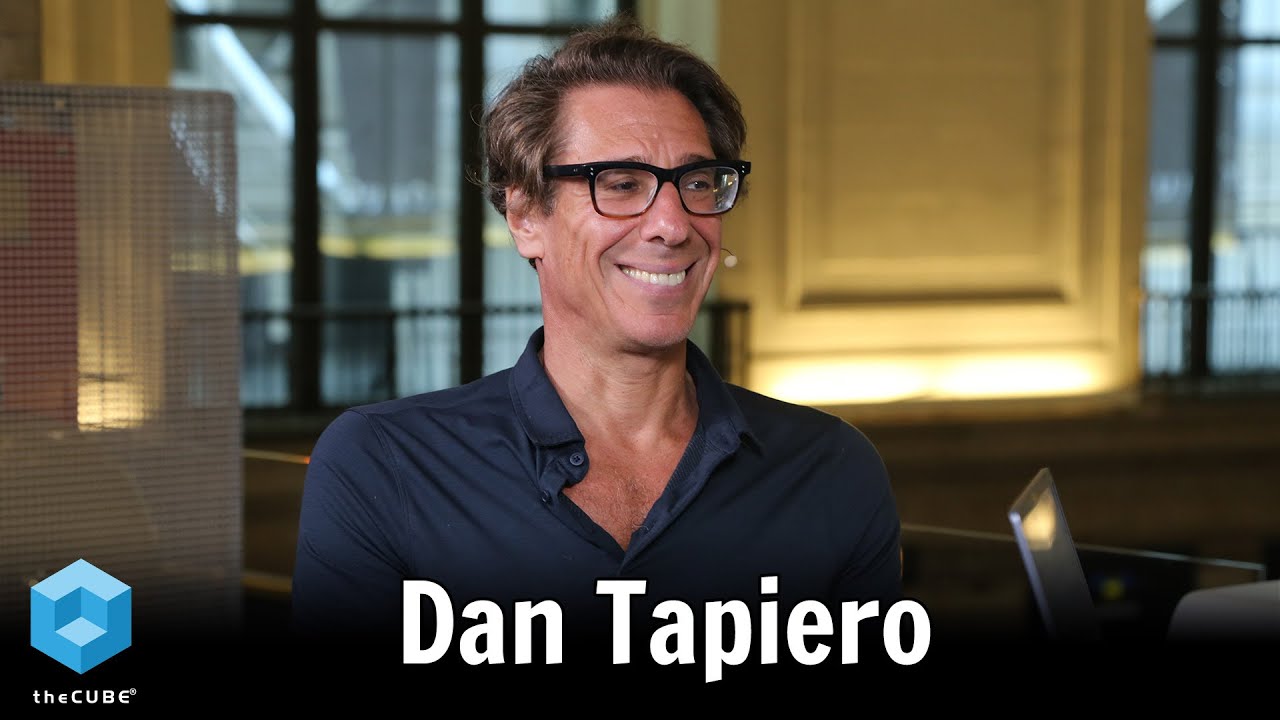
Dan Tapiero, co-founder and CEO of RoundTable Partners and 10T Holdings, joins theCUBE at the NYSE to discuss his extensive background in finance and his transition into the digital asset ecosystem. With over 20 years in the macro hedge fund industry, Tapiero brings valuable insights as he highlights the role of cryptocurrencies and blockchain in transforming business finance and infrastructure. theCUBE Research team, led by John Furrier, engages Tapiero in an in-depth discussion on the evolution of digital assets and the future of growth in this sector.
Tapiero emphasizes the potential of digital assets, predicting a substantial market value increase from $300 billion to a projected $10 trillion within the next decade. According to Tapiero, the current environment favors companies building this new ecosystem, as businesses generate significant revenue and prepare to enter public markets. The interview explores the role of US regulatory shifts in fostering a supportive atmosphere for cryptocurrencies, along with the importance of positioning the US as a global hub for blockchain technology and digital assets. #DanTapiero #DigitalAssets #theCUBE #NYSE #Crypto #Blockchain #Web3
Explore more about this topic and related insights on SiliconANGLE: siliconangle.com. Subscribe to our blockchain playlist for further discussions: [Blockchain Playlist](#).
00:00 - Intro
00:06 - Cryptocurrency and Blockchain: An Introductory Overview
02:31 - The Journey of Dan Tapiero and the Rise of 10T Holdings
09:09 - Crypto Industry Developments and Challenges
16:31 - Crypto Companies and Public Offerings
20:44 - The Future of Digital Assets
23:10 - The Digital Cultural Revolution: Final Reflections
Forgot Password
Almost there!
We just sent you a verification email. Please verify your account to gain access to
theCUBE + NYSE Wired: Crypto Trailblazers. If you don’t think you received an email check your
spam folder.
Sign in to theCUBE + NYSE Wired: Crypto Trailblazers.
In order to sign in, enter the email address you used to registered for the event. Once completed, you will receive an email with a verification link. Open this link to automatically sign into the site.
Register For theCUBE + NYSE Wired: Crypto Trailblazers
Please fill out the information below. You will recieve an email with a verification link confirming your registration. Click the link to automatically sign into the site.
You’re almost there!
We just sent you a verification email. Please click the verification button in the email. Once your email address is verified, you will have full access to all event content for theCUBE + NYSE Wired: Crypto Trailblazers.
I want my badge and interests to be visible to all attendees.
Checking this box will display your presense on the attendees list, view your profile and allow other attendees to contact you via 1-1 chat. Read the Privacy Policy. At any time, you can choose to disable this preference.
Select your Interests!
add
Upload your photo
Uploading..
OR
Connect via Twitter
Connect via Linkedin
EDIT PASSWORD
Share
Forgot Password
Almost there!
We just sent you a verification email. Please verify your account to gain access to
theCUBE + NYSE Wired: Crypto Trailblazers. If you don’t think you received an email check your
spam folder.
Sign in to theCUBE + NYSE Wired: Crypto Trailblazers.
In order to sign in, enter the email address you used to registered for the event. Once completed, you will receive an email with a verification link. Open this link to automatically sign into the site.
Sign in to gain access to theCUBE + NYSE Wired: Crypto Trailblazers
Please sign in with LinkedIn to continue to theCUBE + NYSE Wired: Crypto Trailblazers. Signing in with LinkedIn ensures a professional environment.
Are you sure you want to remove access rights for this user?
Details
Manage Access
email address
Community Invitation
Santiago Roel Santos, Inversion
Dan Tapiero, co-founder and CEO of RoundTable Partners and 10T Holdings, joins theCUBE at the NYSE to discuss his extensive background in finance and his transition into the digital asset ecosystem. With over 20 years in the macro hedge fund industry, Tapiero brings valuable insights as he highlights the role of cryptocurrencies and blockchain in transforming business finance and infrastructure. theCUBE Research team, led by John Furrier, engages Tapiero in an in-depth discussion on the evolution of digital assets and the future of growth in this sector.
Tapiero emphasizes the potential of digital assets, predicting a substantial market value increase from $300 billion to a projected $10 trillion within the next decade. According to Tapiero, the current environment favors companies building this new ecosystem, as businesses generate significant revenue and prepare to enter public markets. The interview explores the role of US regulatory shifts in fostering a supportive atmosphere for cryptocurrencies, along with the importance of positioning the US as a global hub for blockchain technology and digital assets. #DanTapiero #DigitalAssets #theCUBE #NYSE #Crypto #Blockchain #Web3
Explore more about this topic and related insights on SiliconANGLE: siliconangle.com. Subscribe to our blockchain playlist for further discussions: [Blockchain Playlist](#).
00:00 - Intro
00:06 - Cryptocurrency and Blockchain: An Introductory Overview
02:31 - The Journey of Dan Tapiero and the Rise of 10T Holdings
09:09 - Crypto Industry Developments and Challenges
16:31 - Crypto Companies and Public Offerings
20:44 - The Future of Digital Assets
23:10 - The Digital Cultural Revolution: Final Reflections
>> Welcome back, everyone, to the Crypto Trailblazer Series. I'm John Furrier, your host of theCUBE. This is part of our ongoing series with theCUBE and the NYSE Wired program and community where we feature the leaders who are making it happen in crypto, crypto infrastructure as the world transforms from physical to digital and intersects this huge enablement, disruptive enablement, economics, value creation, and extraction. Got a great leader here. We got Santiago Roel Santos, founder and CEO of Inversion, a unique investment approach to kind of bring real-world use cases and businesses and bring them into the crypto infrastructure. Santiago, thank you so much for coming on, and congratulations on your project and your success, and you got a lot of good investments, and you're a trailblazer.
Santiago Roel Santos
>> Thank you, John. I appreciate that. It's too generous.
John Furrier
>> Yeah, before camera, you were saying you invested in some good deals. You're inside the roast, but now the mainstreaming of crypto is happening. You're starting to see the money on the table. I've been like a broken record on this. You can ignore the hype. Pre-regime here in the US, it was the crypto community, "We're going to transform and replace the old guard." And now you have the old guard government and financial institutions connecting into the infrastructure. That's a sign that they're leaning in. My point is, money's on the table. So you can have all the dogma about a vision, but when there's money sitting there, it's going to be... People are going to go after it. And so this is classic disruption. You have a unique approach. Explain what you're doing, because I think it's super compelling, what you're targeting, your investment thesis, how you're deploying, what you're doing, and some of the results.
Santiago Roel Santos
>> Thanks, John. Yeah. Look, I've been in crypto since 2012, and the entire industry is so focused on ideology, decentralization, and new technology. Everyone's very optimistic about it. What we have missed as an industry is how do we actually get this to scale? What's the go-to-market? And so the thesis for Inversion is very simple. It's a private equity strategy where we're going by deeply unsexy legacy businesses that are not operating well. And we are focused on implementing technology to make those businesses more efficient.
John Furrier
>> So margin pressure companies...
Santiago Roel Santos
>> Yeah.
John Furrier
>> ... existing customer bases.
Santiago Roel Santos
>> Yeah. Look, our-
John Furrier
>> Durable, somewhat durable in the sense that they have...
Santiago Roel Santos
>> Totally. We're looking for businesses that have distribution, that have trust and connectivity to the end user, because the reality is... Look, over 70% of Americans want to use stablecoins. Less than 27% have used it. So how do you get something like a stablecoin in the hands of the consumer? It's not going to be with ideology. It's with business logic.
John Furrier
>> Yeah, the SaaS revolution brought mobile. Okay, we saw that. Now you got DeFi and TradFi, obviously the hot topics here, but the average user, they have apps. Talk about that piece of it, because I think what you're targeting is saying, "Hey, you can go into a business... We've got a low margin EBITDA," and you say, "Wow, I can help you get more." You help that. What's the mechanism? How does that work? Because it's intuitive on concept, but when you put it into practice, take us through the impact and why stablecoins is the key.
Santiago Roel Santos
>> I'll give you an example of a, say, a telco business. There's no reason why that telco business can't be a bank in a place like Latin America. You buy that business, you have a mobile app where people are using constantly, you have connectivity with the end user 24/7. So you update the app one day to the other and you have a digital wallet infrastructure where that user now... You extend that relationship with the end user so that you can become their digital provider. And it's very simple as offer... That alone allows the user to receive remittances, to earn interest, to hold dollars in a bank account, so none of this is using the lingo that we have as an industry around stablecoins and Aave and Morpho. No, it's totally abstract. The infrastructure should be invisible. So that's just one example of a business where we see that can totally be transformed from 5, 7% EBITDA margin to 20+, right?
John Furrier
>> So stablecoin is an entrance for you to kind of get into the workflow.
Santiago Roel Santos
>> Yeah.
John Furrier
>> We all have our iPhones or phones, in the case Apple has Apple Pay. I pull that up all the time. What is that? That's just a credit card. It's in my app. You're kind of thinking the same way with stablecoins, is that right?
Santiago Roel Santos
>> Every business at scale becomes a bank, John. Airlines, they don't make money moving you around. They make money on the credit cards they sell you. Starbucks has a lot of deposit in that gift card. So every business eventually becomes a bank, and so if you have a good relationship with the end user, this idea of programmable money and borderless finance, what is a stablecoin, can truly transform traditional legacy businesses into a bank, into a financial institution. Right.
John Furrier
>> You guys have been called the private equity of crypto. What does that mean? Take me through it. Because we know what private equity is on the classic market. How does that translate into crypto, and what are some of the KPIs or metrics that you think about?
Santiago Roel Santos
>> Yeah. We're a technology-focused private equity firm. We don't want to use financial engineering to drive returns. By the way, that doesn't work anymore in a world where rates are at 4+. We think that this technology is transformational for businesses. We want to acquire businesses and make them more efficient with this technology, cutting costs, increasing top line. And the opportunity is vast, right? Every business over the next 25, 30 years will adopt this technology. So that's the opportunity that we see. Again, businesses are still running on spreadsheets. So historically, the evolution of technology has been slow on the deployment side because business owners don't know how to use new technology and they're still catching up with software, so you need to buy control of the business to drive that transformation. So I'm not asking anyone for permission. I simply say, "John, thank you. Your business is worth 100. I'll buy for 100, and then I'll drive so much efficiencies because I own the business and I control it."
John Furrier
>> Yeah, and you control that workflow piece. All right, so one of the things that's come up on my observation, I'd love to get your reaction to it is, new things, new products have emerged in the crypto infrastructure space, because it's opportunity to productize things. Volatility has been a big issue. How do you look at that if you buy a business and you want to de-risk it, or what's the risk management side of your piece there?
Santiago Roel Santos
>> None of our businesses will have a token. We're using infrastructure, John. Here's how early and ridiculous we are as an industry. We are making decisions on how good this technology is because the price of Ethereum or Solana goes up or down. Now businesses don't say, "Gosh, I'm going to implement Nvidia or Amazon or AWS because the price of Amazon goes up or down 2%." It's just irrelevant to the business logic. So that's the thing that the crypto industry has been so focused on the financialization, token, price. We don't care about that. We think someone like a stablecoin, the infrastructure behind stablecoins can be implemented on any business that is receiving or making payments; that is every business under the sun, and you don't have the volatility of bitcoin and the price of these assets.
John Furrier
>> It's interesting you bring up Amazon. Amazon Web Service is a company we've covered from day one. It was a similar value process. They were driving efficiencies in productivity, not stock price. Jeff Bezos and Andy Jassy were like, "Well, we don't care what the stock... We're playing the long game." Similar approach, you guys are taking more of an efficiency perspective, so yeah, whatever the price is, that's just whatever, right?
Santiago Roel Santos
>> Well, I'll give you some... Where can we make a business more efficient? Payment processing in the traditional workflow is 2 to 4%, maybe higher; chargebacks, anywhere from 5 to 20%. So there are certain industries where that business is facing a lot of systemic friction by interacting in a financial system that predates the internet. It's a bunch of databases that don't communicate well with each other. And so when you replace and rip that old infra with blockchain, that business all of a sudden you can save 2, 3, 4, 5% on top line. In a business that has 5% EBITDA margin, you just doubled margins.
John Furrier
>> Yeah. That's awesome. I'm about to fly on a plane to go see all the NVIDIA executives. AI at the edge is coming. Edge is retail. AI efficiencies and inference and training is a big part of the AI. When you look at your business and you say, "Okay, I'm driving efficiencies," how's that evolution look like? Because if you look at how machine learning, now we have generative AI, JPMorgan Chase, they get a $10 billion IT technology budget. Not a lot of businesses have that kind of dough, so you say, "Okay," in comes the efficiency play that you're doing. How do you bring fraud detection, these things that have a high bar of resilience that costs a lot of money... This seems to be the tech play. What's your thoughts there? How do you view that?
Santiago Roel Santos
>> Well, look, crypto, very much like AI, is producing a lot of data. And because of that, you can do a lot of these things, fraud detection and reconciliation, trade settlement, company like Figure Technologies may have covered. You look at what they've done in the HELOCs, they've totally collapsed, soup to nuts, beginning to end of origination, approval, and then ongoing maintenance of that... That workflow is vastly more efficient with their technology, and so that's one example we see where at the end of the day, it's... Crypto and AI are very complimentary. In fact, AI is going to have to use stablecoins. AI agents are going to have to use stablecoins. All the reconciliation, all the real-time movement is going to have to graduate the blockchain rails because the traditional system is slow. It's not open 24/7, and everything else in the technology world is open 24/7.
John Furrier
>> I like that collapsing example of the HELOC because I think that signifies that the acceleration of value creation extraction is there. You've invested in a lot of deals. You said since 2012, you've been in crypto. Looking at your investment successes and failures over that decade, and now looking at where you are now, what's your vision of how you see success? Because it's a product market right now, and businesses that have been undervalued or can't get the leverage, either operating leverage or something there, what do you look at? What's some of the things that you look at? You mentioned there's some things emerging. Is there an ecosystem? Is it a pure technology play? What's your thoughts on how to think about investments today?
Santiago Roel Santos
>> Yeah, look, I love this technology. The industry is led with ideology, not business logic. So it's a broken go to-market. The technology is very much ready. I couldn't have sat in this chair and told you that technology was ready four years ago. Now, there's no reason why 100X more users can't be interacting with stablecoins. So it's, how do you get it in the hands of consumers, and it's unfortunately, in all the founders that I've backed, they miss that, that savviness on how to go to market. So when I looked at... A large part of why I started Inversion is 20, 30% of my portfolio was going out of business because there weren't enough people interacting with this technology. So that's where I invert the script and say, "What can I do to help my portfolio, help my founders," and it's taking this approach, right? And the technology is very, very much ready.
John Furrier
>> Talk about the mechanics of your fund. You say you buy companies. You buy them 100%? Do you buy majority stakes? What's the mix? Or is it 100% buyout?
Santiago Roel Santos
>> We like to work with very competent management teams that know their industry really, really well. It's a control strategy. We want to partner and align with management teams, and the best part of it is a lot of them come to us and say, "Hey, gosh, I've learned about crypto. I know blockchain. It's now regulatory-friendly and viable. Help us utilize this technology." And that's where we see eye to eye. But we do have control, right? Yeah.
John Furrier
>> You said before we went on camera that you're looking at the distribution side of it, and you mentioned at the top, scale, looking for businesses at some level of scale. You guys can get a control majority ownership stake or full ownership, and then you implement the tech. What's the bar on the scale for people that, "Hey, I might want to lean in and invert, flip the scripts," like what you saying. So what's the bar on scale that we can start to extract some of these rents and get value out of the distribution? I've done interviews with EasyHotels, for instance; they launch their own crypto service, not like loyalty points or anything. They have customers and they have a lot of them so, okay, that makes total sense. Why not give a retail option to the people who are booking flights and hotels? Why not?
Santiago Roel Santos
>> There's fundamentally no reason why we shouldn't have a billion users interacting with this technology. We have 40 million active users. For a $3.4 trillion industry, I think we're pretty overvalued, I would say. When we go talk to management teams, legacy businesses, they ask us one thing, which is, "Give me reasons that this technology is reliable, if a customer's going to want to pay for that flight, making sure that it actually works the way it's intended, in a faster, better, cheaper way," right? And that's something that, again, we go to proof points around what certain blockchains have been able to support in terms of activity, peak load, and you point to that and say there's no reason why your entire workflow could migrate over to these payments called stablecoins. It's invisible to the end user, right? The user doesn't need to learn anything new around downloading a wallet and private keys. So that's something that we got to fix as an industry, and we're very focused on building that technology that totally makes us-
John Furrier
>> That's a back-end issue.
Santiago Roel Santos
>> It's a back-end issue. The technology is always invisible. That's the end state.
John Furrier
>> Yeah, invisible tech. I love that invisible angle because you want to abstract away the complexity. Again, you use the cloud reference. I think cloud is a great template for what's kind of going on in crypto. What's your thoughts on that kind of similarity? I know it's not apples to apples, it's a little bit apples to oranges, but it's kind of a similar value proposition. Efficiency, productivity, abstract away complexities, automate, -
Santiago Roel Santos
>> You talk about software as a service. 2001, 25 years ago, people didn't believe that that was going to be transformational because you just had the dot-com crash. That software wasn't relatable for folks back then. It is now. Every business uses a CRM and software. It transformed the internet and software industry as we know it. We are in 2001 in crypto industry. The tech is ready, but it's not relatable. It's not relatable for end users, it's not relatable for business owners, and that's why we're so motivated to deploy it at scale, because if we do this well through one or two acquisitions, then there's no discounting of what this technology can do to your P&L.
John Furrier
>> I love what you're doing because it's disruptive, but it's also enabling. And you mentioned the SaaS era, so if you look at SaaS... And you talked about telco earlier. The telcos, I'm doing a big thing, research now on telcos, future telcos with AI and decentralized, they have the users, okay? They have the data and they are the network. Now in AI, networking is the OS for large-scale systems. So if you have all those users in telecom, you can have an opportunity. Now the telecom industry missed SaaS, and Google and Apple extracted the rents out of SaaS. Yeah, Amazon did well because they more... But they were more infrastructure platform as a service, so they were enabling it. But you look at who won, it was basically Apple and Google. Put Facebook in that category, a little bit different, but here, you're going down the path of you can get the value, business, telco, whoever. Did I get that right?
Santiago Roel Santos
>> Absolutely. So we looked at a very large telco in Latin America. It had 24 million users, so almost 50% of the entire user base of crypto. And we said, "Gosh, there's really not anything stopping that telco from becoming a bank for those users." So going back to, why is this so transformational, software as a service was transformational because you went from on premise. Every small business, large business had to buy these very expensive on-prem licenses, and then you shifted CapEx to OpEx, flexible spending. That was transformational for the software industry. I was in a prior life-
John Furrier
>> Buy by the drink.
Santiago Roel Santos
>> Yeah. I was in a prior life investing in open-source software and deeply unsexy enterprise software at SageView. I see the same analogy here. What is blockchain and stablecoins doing? It allows any business to become an asset like a light bank institution for their users. So that increases the ability to monetize that user, right? If you're a telco, you have connectivity. You have the ability to update the app and then layer a digital wallet. Within seconds, you become the ability to monetize that user base in a way that wasn't possible before. Go look at two companies, M-PESA in Africa, largest telco, largest bank; WeChat in China, social app, it didn't stop there. It became the everything app, including financial services. So these are Web 2.0 analogs. Again, stablecoins-
John Furrier
>> You get the users and you monetize their behavior in a way that they're not the product. Facebook got a lot of shrapnel for monetizing the users, and the joke was you're the product. You're their product. It's not just the service you're getting. And so you're shifting that too.
Santiago Roel Santos
>> Totally. If you're a telco, for instance, you have a very good connectivity data end user. What's easiest, John? Convincing people on the street to go download a digital wallet called Phantom or MetaMask and do the on-ramp and call them back, get custody-
John Furrier
>> Custody challenge, how do I store it? Who's going to steal it?
Santiago Roel Santos
>> Or saying, "Hey, you already have the attention using your telco service. You can now receive money, you can send money, you can store and save and have access to a whole suite of financial products, like tokenized stocks." Which one do you think is going to get more scale?
John Furrier
>> Yeah, and also I would add that the telcos are advancing, accelerating their tech capability at the edge with computer vision, wireless, wireline connectivity where they're going to be kind of agnostic where to route the packets. So they have the packets. They're the last mile out and first mile in. That's huge advantage.
Santiago Roel Santos
>> Totally. We're sitting here, and maybe some of your guests talk about certain infrastructure crypto projects, Solana, Ethereum, Ripple. Five years time, that goes away.
John Furrier
>> Yeah.
Santiago Roel Santos
>> We won't be talking about these infrastructure companies because they should be invisible and running on the back-end. If you lead with business logic, we'll route to the best chain possible, maximizing value to the end user.
John Furrier
>> And stablecoin is the key. I brought that up earlier and I had asked the scale question; I'll ask it again. Is there a scale bar? Because this idea of being the bank means you have an asset that's unutilized. So if I'm a business, maybe under margin pressure, cost increase, or market changes, this is like a line extension to them from a product management standpoint. So it's not a big bridge to cross from a economics and value proposition standpoint. There's some disruptive elements that you got to get through in terms of, okay, non-disruptive operations. I get that. Okay, but from a product standpoint, it's like, oh, I got the users, they're using the app; bolt on stablecoins, and I'm a neobank.
Santiago Roel Santos
>> 100%.
John Furrier
>> What's wrong with that?
Santiago Roel Santos
>> Nothing. It's regulated now with Genius Act. You can have more clarity with the Clarity Act, which is hugely impactful to our strategy. But look, the name of the game is programmable money and yield optimization. There's like $4 trillion that is sitting in non-interest-bearing accounts in the US. You know why? Because consumers don't know that they can swap from their checking and savings to a money market account and earn 4%.
John Furrier
>> Yeah. Santiago, I want to ask you about the entrepreneurship angle because it's something that I've been seeing a lot of. Because here, coming to New York from Palo Alto, I've observed that the financial entrepreneurship has never really been there. It's been like, I won't say parasitic; that's the wrong word. It's been underneath and riding existing stuff. So it's hustle. I call hustle entrepreneurs. Hey, get a prepaid calling card and get some lunch money, steal some crumbs off the breakfast table, and then buy a boat or house, whatever. Now, there's structural change. What's your vision on the white space that's out there for entrepreneurs? Because with programmable money, that's software. We've seen that movie before. You mentioned open-source software. You've seen the rise of cloud. There'd be no Airbnb, there'd be no Dropbox, there'd be no Twitter without AWS. So there's going to be a disruptive enablement as a dry cleaning franchise around the world gets online, I'm making that up, but that's not a sexy business. You go, "Hey, they're going to need IT support. They're going to need software." How do you see the intersection of the entrepreneurial side of it, or intrapreneurs, people inside companies?
Santiago Roel Santos
>> Two observations. The first one is there's never been a better time to be an entrepreneur because the cost to starting a business and utilizing AI and stablecoins radically compresses the cost to use technology and get off the ground. So you're seeing businesses now, one or two-person teams go 20 million in ARR. Unheard of. And they're using a lot of AI in their workflow. We as a company employ eight people. Before, probably could've needed 20 people to run the same... So there's a lot of efficiency gain from the founder perspective, so that proliferation of new companies, innovation. But the second piece is, you juxtapose that innovation with... There's certain things that never change. The go-to-market, it's still hard... It will become harder and harder to capture attention from people in a world where there's so much available 24/7 at their disposal. And to your point, yes, unfortunately, or fortunately, few companies will capture that attention and capture it very, very well. And that's kind of where we come at it, which is what are the businesses that are totally underutilized, unoptimized, that have distribution, that have connectivity, where we can bolt on these services and capture more attention for the user? That, in my opinion, is a better strategy than starting from the ground up, trying to convince people to use your technology.
John Furrier
>> Yeah. And that's the distribution piece you were mentioning. And so more stablecoins, more businesses using it. Is there a unification as you get these companies with the distribution? It could be, I won't say siloed, but if they're more using more stablecoins, I can see that being a benefit. But in the aggregate, you're essentially building a network.
Santiago Roel Santos
>> We're building a technology-focused private equity firm. All of our companies are going to use our technology, our inversion chain, and we think that we can become the largest chain with active users, real GDP, real economic activity settling on our blockchain, more so than you see in any other chain right now. Where, again, you go back to that number, there's only 40 million active users in crypto today. ChatGPT has 800, and it's valued at 500 billion. Crypto's at $3.7 trillion asset class with 40 million active users. We got a lot of growing up to do.
John Furrier
>> So your thesis is the go to-market's a heavy lift, it's expensive, versus just aggregating users where they are in businesses.
Santiago Roel Santos
>> Yeah.
John Furrier
>> And bringing service to the table and making them money too.
Santiago Roel Santos
>> Yeah. Getting transformational technology in the hands of users is hard. That will never change. There's just a natural resistance for businesses and users. They don't want to change their workflow, the habits. And so you have to hack your way to mainstream adoption in a different vehicle mechanism, and that's how I express this thesis with Inversion, which is let's go buy control of a business, and the end user doesn't... You, John, that telco service doesn't change for you. You all of a sudden wake up one day to the other and say, "Oh, gosh, I can send money. I can do more things with this app than I could before," and so-
John Furrier
>> And the global reach is massive, too, because outside the United States, volatility of currency.
Santiago Roel Santos
>> Totally.
John Furrier
>> So stablecoin's basically US dollar.
Santiago Roel Santos
>> Yeah, I grew up in Mexico. The entire world basically wants access to dollars. They will fill that demand with tokenized dollars called the stablecoin.
John Furrier
>> I think that's a huge tailwind for you. Final point, just give a plug for what you're working on. How's the fund work? What are some of the mechanics? Educate folks on how Inversion works. Give some stats. How much money's in play? What are you deploying? What are some of the wins? What are you optimizing for? What's your focus?
Santiago Roel Santos
>> We just started now. It's going to be a $150 million fund. Again, we're looking to buy decent businesses with scale. I'm the largest LP. So as I said, I've stopped investing mostly in venture. I want to deploy this strategy because I love this industry so much. That's not-
John Furrier
>> You put your own money on the table.
Santiago Roel Santos
>> Yeah, of course. And that's where I see the biggest opportunity right now as an industry. Again, if in five years time we don't have more than 40 million users using this technology, we would've done something terribly wrong and we won't have the regulator to blame, we won't have anyone else to blame but ourselves. And so this is-
John Furrier
>> It's a leverage model for you.
Santiago Roel Santos
>> Truly is. Yeah. And so I think that's, from a deeply passion kind of level, I want to make this technology relatable to folks out here.
John Furrier
>> Yeah. Bring the technology, get the benefit for the users through the companies you buy. Is there more fundraising, and what's the conversations like when you talk to other people who might want to come in on this? Are they scratching their heads? They put the puzzle together? Are they staring like deer in the headlights? What's the...
Santiago Roel Santos
>> Well, they really understand a lot of the allocators. Look, private equities and asset classes has existence since the '80s, Barbarians at the Gate and KKRs of the world. That doesn't change. But we are very privileged because we're in a point where traditional allocators actually do understand the technology, because you go back to a lot of them are business owners, telco experts or banks, and they're sitting there and saying, "Gosh, on my day-to-day, I have these problems, and now I can utilize this technology. I just don't know how." And so it's a funny time in crypto because crypto natives are a bit jaded, are a bit scarred because of the volatility and the price of these asset... Bitcoin's still at 110 and goes down to 105. And they're missing the entire massive opportunity-
John Furrier
>> What's the conversation like when you talk to a business you like that's at scale? How's that go? What's that conversation like?
Santiago Roel Santos
>> A lot of it is they, again, they love the technology, they appreciate the benefits, they just don't know how to implement it. And I could tell you-
John Furrier
>> But you got to show them the upside because they're essentially selling their business. Most software is a little bit nervous?
Santiago Roel Santos
>> Yeah, a lot of times management... We control most of the business, but we allow management to have a promote to be incentivized to build value and work with us and capture a lot of that upside.
John Furrier
>> So they have to buy in, and if they have low margin and their EBITDA's not hitting their right targets, they kind of know the financial strength. So it's not a hard sell then.
Santiago Roel Santos
>> Totally.
John Furrier
>> They're not distressed. They're just underutilized.
Santiago Roel Santos
>> Yeah. Again, most of the value, I think, that will be created in crypto will come from traditional businesses using this technology, not so much the incremental Ethereum or Solana or the Nth blockchain network.
John Furrier
>> Santiago, thanks for coming on. You're a crypto trailblazer. Congratulations.
Santiago Roel Santos
>> Thanks.
John Furrier
>> Great to know you and interview you. Again, the trailblazers are the ones that have been blazing the trail as the mainstreaming of crypto, and now you're starting to see the impact every day, Main Street America, global reach, and also global companies as the world is flattening, the borders are going away, of course, this is an opportunity with stablecoins to make it happen. So, again, private equity coming into crypto from a technology perspective. Again, we're doing our part here on theCUBE to bring you all the data. Thanks for watching.
>> Welcome back, everyone, to the Crypto Trailblazer Series. I'm John Furrier, your host of theCUBE. This is part of our ongoing series with theCUBE and the NYSE Wired program and community where we feature the leaders who are making it happen in crypto, crypto infrastructure as the world transforms from physical to digital and intersects this huge enablement, disruptive enablement, economics, value creation, and extraction. Got a great leader here. We got Santiago Roel Santos, founder and CEO of Inversion, a unique investment approach to kind of bring real-world use cases and businesses and bring them into the crypto infrastructure. Santiago, thank you so much for coming on, and congratulations on your project and your success, and you got a lot of good investments, and you're a trailblazer.
Santiago Roel Santos
>> Thank you, John. I appreciate that. It's too generous.
John Furrier
>> Yeah, before camera, you were saying you invested in some good deals. You're inside the roast, but now the mainstreaming of crypto is happening. You're starting to see the money on the table. I've been like a broken record on this. You can ignore the hype. Pre-regime here in the US, it was the crypto community, "We're going to transform and replace the old guard." And now you have the old guard government and financial institutions connecting into the infrastructure. That's a sign that they're leaning in. My point is, money's on the table. So you can have all the dogma about a vision, but when there's money sitting there, it's going to be... People are going to go after it. And so this is classic disruption. You have a unique approach. Explain what you're doing, because I think it's super compelling, what you're targeting, your investment thesis, how you're deploying, what you're doing, and some of the results.
Santiago Roel Santos
>> Thanks, John. Yeah. Look, I've been in crypto since 2012, and the entire industry is so focused on ideology, decentralization, and new technology. Everyone's very optimistic about it. What we have missed as an industry is how do we actually get this to scale? What's the go-to-market? And so the thesis for Inversion is very simple. It's a private equity strategy where we're going by deeply unsexy legacy businesses that are not operating well. And we are focused on implementing technology to make those businesses more efficient.
John Furrier
>> So margin pressure companies...
Santiago Roel Santos
>> Yeah.
John Furrier
>> ... existing customer bases.
Santiago Roel Santos
>> Yeah. Look, our-
John Furrier
>> Durable, somewhat durable in the sense that they have...
Santiago Roel Santos
>> Totally. We're looking for businesses that have distribution, that have trust and connectivity to the end user, because the reality is... Look, over 70% of Americans want to use stablecoins. Less than 27% have used it. So how do you get something like a stablecoin in the hands of the consumer? It's not going to be with ideology. It's with business logic.
John Furrier
>> Yeah, the SaaS revolution brought mobile. Okay, we saw that. Now you got DeFi and TradFi, obviously the hot topics here, but the average user, they have apps. Talk about that piece of it, because I think what you're targeting is saying, "Hey, you can go into a business... We've got a low margin EBITDA," and you say, "Wow, I can help you get more." You help that. What's the mechanism? How does that work? Because it's intuitive on concept, but when you put it into practice, take us through the impact and why stablecoins is the key.
Santiago Roel Santos
>> I'll give you an example of a, say, a telco business. There's no reason why that telco business can't be a bank in a place like Latin America. You buy that business, you have a mobile app where people are using constantly, you have connectivity with the end user 24/7. So you update the app one day to the other and you have a digital wallet infrastructure where that user now... You extend that relationship with the end user so that you can become their digital provider. And it's very simple as offer... That alone allows the user to receive remittances, to earn interest, to hold dollars in a bank account, so none of this is using the lingo that we have as an industry around stablecoins and Aave and Morpho. No, it's totally abstract. The infrastructure should be invisible. So that's just one example of a business where we see that can totally be transformed from 5, 7% EBITDA margin to 20+, right?
John Furrier
>> So stablecoin is an entrance for you to kind of get into the workflow.
Santiago Roel Santos
>> Yeah.
John Furrier
>> We all have our iPhones or phones, in the case Apple has Apple Pay. I pull that up all the time. What is that? That's just a credit card. It's in my app. You're kind of thinking the same way with stablecoins, is that right?
Santiago Roel Santos
>> Every business at scale becomes a bank, John. Airlines, they don't make money moving you around. They make money on the credit cards they sell you. Starbucks has a lot of deposit in that gift card. So every business eventually becomes a bank, and so if you have a good relationship with the end user, this idea of programmable money and borderless finance, what is a stablecoin, can truly transform traditional legacy businesses into a bank, into a financial institution. Right.
John Furrier
>> You guys have been called the private equity of crypto. What does that mean? Take me through it. Because we know what private equity is on the classic market. How does that translate into crypto, and what are some of the KPIs or metrics that you think about?
Santiago Roel Santos
>> Yeah. We're a technology-focused private equity firm. We don't want to use financial engineering to drive returns. By the way, that doesn't work anymore in a world where rates are at 4+. We think that this technology is transformational for businesses. We want to acquire businesses and make them more efficient with this technology, cutting costs, increasing top line. And the opportunity is vast, right? Every business over the next 25, 30 years will adopt this technology. So that's the opportunity that we see. Again, businesses are still running on spreadsheets. So historically, the evolution of technology has been slow on the deployment side because business owners don't know how to use new technology and they're still catching up with software, so you need to buy control of the business to drive that transformation. So I'm not asking anyone for permission. I simply say, "John, thank you. Your business is worth 100. I'll buy for 100, and then I'll drive so much efficiencies because I own the business and I control it."
John Furrier
>> Yeah, and you control that workflow piece. All right, so one of the things that's come up on my observation, I'd love to get your reaction to it is, new things, new products have emerged in the crypto infrastructure space, because it's opportunity to productize things. Volatility has been a big issue. How do you look at that if you buy a business and you want to de-risk it, or what's the risk management side of your piece there?
Santiago Roel Santos
>> None of our businesses will have a token. We're using infrastructure, John. Here's how early and ridiculous we are as an industry. We are making decisions on how good this technology is because the price of Ethereum or Solana goes up or down. Now businesses don't say, "Gosh, I'm going to implement Nvidia or Amazon or AWS because the price of Amazon goes up or down 2%." It's just irrelevant to the business logic. So that's the thing that the crypto industry has been so focused on the financialization, token, price. We don't care about that. We think someone like a stablecoin, the infrastructure behind stablecoins can be implemented on any business that is receiving or making payments; that is every business under the sun, and you don't have the volatility of bitcoin and the price of these assets.
John Furrier
>> It's interesting you bring up Amazon. Amazon Web Service is a company we've covered from day one. It was a similar value process. They were driving efficiencies in productivity, not stock price. Jeff Bezos and Andy Jassy were like, "Well, we don't care what the stock... We're playing the long game." Similar approach, you guys are taking more of an efficiency perspective, so yeah, whatever the price is, that's just whatever, right?
Santiago Roel Santos
>> Well, I'll give you some... Where can we make a business more efficient? Payment processing in the traditional workflow is 2 to 4%, maybe higher; chargebacks, anywhere from 5 to 20%. So there are certain industries where that business is facing a lot of systemic friction by interacting in a financial system that predates the internet. It's a bunch of databases that don't communicate well with each other. And so when you replace and rip that old infra with blockchain, that business all of a sudden you can save 2, 3, 4, 5% on top line. In a business that has 5% EBITDA margin, you just doubled margins.
John Furrier
>> Yeah. That's awesome. I'm about to fly on a plane to go see all the NVIDIA executives. AI at the edge is coming. Edge is retail. AI efficiencies and inference and training is a big part of the AI. When you look at your business and you say, "Okay, I'm driving efficiencies," how's that evolution look like? Because if you look at how machine learning, now we have generative AI, JPMorgan Chase, they get a $10 billion IT technology budget. Not a lot of businesses have that kind of dough, so you say, "Okay," in comes the efficiency play that you're doing. How do you bring fraud detection, these things that have a high bar of resilience that costs a lot of money... This seems to be the tech play. What's your thoughts there? How do you view that?
Santiago Roel Santos
>> Well, look, crypto, very much like AI, is producing a lot of data. And because of that, you can do a lot of these things, fraud detection and reconciliation, trade settlement, company like Figure Technologies may have covered. You look at what they've done in the HELOCs, they've totally collapsed, soup to nuts, beginning to end of origination, approval, and then ongoing maintenance of that... That workflow is vastly more efficient with their technology, and so that's one example we see where at the end of the day, it's... Crypto and AI are very complimentary. In fact, AI is going to have to use stablecoins. AI agents are going to have to use stablecoins. All the reconciliation, all the real-time movement is going to have to graduate the blockchain rails because the traditional system is slow. It's not open 24/7, and everything else in the technology world is open 24/7.
John Furrier
>> I like that collapsing example of the HELOC because I think that signifies that the acceleration of value creation extraction is there. You've invested in a lot of deals. You said since 2012, you've been in crypto. Looking at your investment successes and failures over that decade, and now looking at where you are now, what's your vision of how you see success? Because it's a product market right now, and businesses that have been undervalued or can't get the leverage, either operating leverage or something there, what do you look at? What's some of the things that you look at? You mentioned there's some things emerging. Is there an ecosystem? Is it a pure technology play? What's your thoughts on how to think about investments today?
Santiago Roel Santos
>> Yeah, look, I love this technology. The industry is led with ideology, not business logic. So it's a broken go to-market. The technology is very much ready. I couldn't have sat in this chair and told you that technology was ready four years ago. Now, there's no reason why 100X more users can't be interacting with stablecoins. So it's, how do you get it in the hands of consumers, and it's unfortunately, in all the founders that I've backed, they miss that, that savviness on how to go to market. So when I looked at... A large part of why I started Inversion is 20, 30% of my portfolio was going out of business because there weren't enough people interacting with this technology. So that's where I invert the script and say, "What can I do to help my portfolio, help my founders," and it's taking this approach, right? And the technology is very, very much ready.
John Furrier
>> Talk about the mechanics of your fund. You say you buy companies. You buy them 100%? Do you buy majority stakes? What's the mix? Or is it 100% buyout?
Santiago Roel Santos
>> We like to work with very competent management teams that know their industry really, really well. It's a control strategy. We want to partner and align with management teams, and the best part of it is a lot of them come to us and say, "Hey, gosh, I've learned about crypto. I know blockchain. It's now regulatory-friendly and viable. Help us utilize this technology." And that's where we see eye to eye. But we do have control, right? Yeah.
John Furrier
>> You said before we went on camera that you're looking at the distribution side of it, and you mentioned at the top, scale, looking for businesses at some level of scale. You guys can get a control majority ownership stake or full ownership, and then you implement the tech. What's the bar on the scale for people that, "Hey, I might want to lean in and invert, flip the scripts," like what you saying. So what's the bar on scale that we can start to extract some of these rents and get value out of the distribution? I've done interviews with EasyHotels, for instance; they launch their own crypto service, not like loyalty points or anything. They have customers and they have a lot of them so, okay, that makes total sense. Why not give a retail option to the people who are booking flights and hotels? Why not?
Santiago Roel Santos
>> There's fundamentally no reason why we shouldn't have a billion users interacting with this technology. We have 40 million active users. For a $3.4 trillion industry, I think we're pretty overvalued, I would say. When we go talk to management teams, legacy businesses, they ask us one thing, which is, "Give me reasons that this technology is reliable, if a customer's going to want to pay for that flight, making sure that it actually works the way it's intended, in a faster, better, cheaper way," right? And that's something that, again, we go to proof points around what certain blockchains have been able to support in terms of activity, peak load, and you point to that and say there's no reason why your entire workflow could migrate over to these payments called stablecoins. It's invisible to the end user, right? The user doesn't need to learn anything new around downloading a wallet and private keys. So that's something that we got to fix as an industry, and we're very focused on building that technology that totally makes us-
John Furrier
>> That's a back-end issue.
Santiago Roel Santos
>> It's a back-end issue. The technology is always invisible. That's the end state.
John Furrier
>> Yeah, invisible tech. I love that invisible angle because you want to abstract away the complexity. Again, you use the cloud reference. I think cloud is a great template for what's kind of going on in crypto. What's your thoughts on that kind of similarity? I know it's not apples to apples, it's a little bit apples to oranges, but it's kind of a similar value proposition. Efficiency, productivity, abstract away complexities, automate, -
Santiago Roel Santos
>> You talk about software as a service. 2001, 25 years ago, people didn't believe that that was going to be transformational because you just had the dot-com crash. That software wasn't relatable for folks back then. It is now. Every business uses a CRM and software. It transformed the internet and software industry as we know it. We are in 2001 in crypto industry. The tech is ready, but it's not relatable. It's not relatable for end users, it's not relatable for business owners, and that's why we're so motivated to deploy it at scale, because if we do this well through one or two acquisitions, then there's no discounting of what this technology can do to your P&L.
John Furrier
>> I love what you're doing because it's disruptive, but it's also enabling. And you mentioned the SaaS era, so if you look at SaaS... And you talked about telco earlier. The telcos, I'm doing a big thing, research now on telcos, future telcos with AI and decentralized, they have the users, okay? They have the data and they are the network. Now in AI, networking is the OS for large-scale systems. So if you have all those users in telecom, you can have an opportunity. Now the telecom industry missed SaaS, and Google and Apple extracted the rents out of SaaS. Yeah, Amazon did well because they more... But they were more infrastructure platform as a service, so they were enabling it. But you look at who won, it was basically Apple and Google. Put Facebook in that category, a little bit different, but here, you're going down the path of you can get the value, business, telco, whoever. Did I get that right?
Santiago Roel Santos
>> Absolutely. So we looked at a very large telco in Latin America. It had 24 million users, so almost 50% of the entire user base of crypto. And we said, "Gosh, there's really not anything stopping that telco from becoming a bank for those users." So going back to, why is this so transformational, software as a service was transformational because you went from on premise. Every small business, large business had to buy these very expensive on-prem licenses, and then you shifted CapEx to OpEx, flexible spending. That was transformational for the software industry. I was in a prior life-
John Furrier
>> Buy by the drink.
Santiago Roel Santos
>> Yeah. I was in a prior life investing in open-source software and deeply unsexy enterprise software at SageView. I see the same analogy here. What is blockchain and stablecoins doing? It allows any business to become an asset like a light bank institution for their users. So that increases the ability to monetize that user, right? If you're a telco, you have connectivity. You have the ability to update the app and then layer a digital wallet. Within seconds, you become the ability to monetize that user base in a way that wasn't possible before. Go look at two companies, M-PESA in Africa, largest telco, largest bank; WeChat in China, social app, it didn't stop there. It became the everything app, including financial services. So these are Web 2.0 analogs. Again, stablecoins-
John Furrier
>> You get the users and you monetize their behavior in a way that they're not the product. Facebook got a lot of shrapnel for monetizing the users, and the joke was you're the product. You're their product. It's not just the service you're getting. And so you're shifting that too.
Santiago Roel Santos
>> Totally. If you're a telco, for instance, you have a very good connectivity data end user. What's easiest, John? Convincing people on the street to go download a digital wallet called Phantom or MetaMask and do the on-ramp and call them back, get custody-
John Furrier
>> Custody challenge, how do I store it? Who's going to steal it?
Santiago Roel Santos
>> Or saying, "Hey, you already have the attention using your telco service. You can now receive money, you can send money, you can store and save and have access to a whole suite of financial products, like tokenized stocks." Which one do you think is going to get more scale?
John Furrier
>> Yeah, and also I would add that the telcos are advancing, accelerating their tech capability at the edge with computer vision, wireless, wireline connectivity where they're going to be kind of agnostic where to route the packets. So they have the packets. They're the last mile out and first mile in. That's huge advantage.
Santiago Roel Santos
>> Totally. We're sitting here, and maybe some of your guests talk about certain infrastructure crypto projects, Solana, Ethereum, Ripple. Five years time, that goes away.
John Furrier
>> Yeah.
Santiago Roel Santos
>> We won't be talking about these infrastructure companies because they should be invisible and running on the back-end. If you lead with business logic, we'll route to the best chain possible, maximizing value to the end user.
John Furrier
>> And stablecoin is the key. I brought that up earlier and I had asked the scale question; I'll ask it again. Is there a scale bar? Because this idea of being the bank means you have an asset that's unutilized. So if I'm a business, maybe under margin pressure, cost increase, or market changes, this is like a line extension to them from a product management standpoint. So it's not a big bridge to cross from a economics and value proposition standpoint. There's some disruptive elements that you got to get through in terms of, okay, non-disruptive operations. I get that. Okay, but from a product standpoint, it's like, oh, I got the users, they're using the app; bolt on stablecoins, and I'm a neobank.
Santiago Roel Santos
>> 100%.
John Furrier
>> What's wrong with that?
Santiago Roel Santos
>> Nothing. It's regulated now with Genius Act. You can have more clarity with the Clarity Act, which is hugely impactful to our strategy. But look, the name of the game is programmable money and yield optimization. There's like $4 trillion that is sitting in non-interest-bearing accounts in the US. You know why? Because consumers don't know that they can swap from their checking and savings to a money market account and earn 4%.
John Furrier
>> Yeah. Santiago, I want to ask you about the entrepreneurship angle because it's something that I've been seeing a lot of. Because here, coming to New York from Palo Alto, I've observed that the financial entrepreneurship has never really been there. It's been like, I won't say parasitic; that's the wrong word. It's been underneath and riding existing stuff. So it's hustle. I call hustle entrepreneurs. Hey, get a prepaid calling card and get some lunch money, steal some crumbs off the breakfast table, and then buy a boat or house, whatever. Now, there's structural change. What's your vision on the white space that's out there for entrepreneurs? Because with programmable money, that's software. We've seen that movie before. You mentioned open-source software. You've seen the rise of cloud. There'd be no Airbnb, there'd be no Dropbox, there'd be no Twitter without AWS. So there's going to be a disruptive enablement as a dry cleaning franchise around the world gets online, I'm making that up, but that's not a sexy business. You go, "Hey, they're going to need IT support. They're going to need software." How do you see the intersection of the entrepreneurial side of it, or intrapreneurs, people inside companies?
Santiago Roel Santos
>> Two observations. The first one is there's never been a better time to be an entrepreneur because the cost to starting a business and utilizing AI and stablecoins radically compresses the cost to use technology and get off the ground. So you're seeing businesses now, one or two-person teams go 20 million in ARR. Unheard of. And they're using a lot of AI in their workflow. We as a company employ eight people. Before, probably could've needed 20 people to run the same... So there's a lot of efficiency gain from the founder perspective, so that proliferation of new companies, innovation. But the second piece is, you juxtapose that innovation with... There's certain things that never change. The go-to-market, it's still hard... It will become harder and harder to capture attention from people in a world where there's so much available 24/7 at their disposal. And to your point, yes, unfortunately, or fortunately, few companies will capture that attention and capture it very, very well. And that's kind of where we come at it, which is what are the businesses that are totally underutilized, unoptimized, that have distribution, that have connectivity, where we can bolt on these services and capture more attention for the user? That, in my opinion, is a better strategy than starting from the ground up, trying to convince people to use your technology.
John Furrier
>> Yeah. And that's the distribution piece you were mentioning. And so more stablecoins, more businesses using it. Is there a unification as you get these companies with the distribution? It could be, I won't say siloed, but if they're more using more stablecoins, I can see that being a benefit. But in the aggregate, you're essentially building a network.
Santiago Roel Santos
>> We're building a technology-focused private equity firm. All of our companies are going to use our technology, our inversion chain, and we think that we can become the largest chain with active users, real GDP, real economic activity settling on our blockchain, more so than you see in any other chain right now. Where, again, you go back to that number, there's only 40 million active users in crypto today. ChatGPT has 800, and it's valued at 500 billion. Crypto's at $3.7 trillion asset class with 40 million active users. We got a lot of growing up to do.
John Furrier
>> So your thesis is the go to-market's a heavy lift, it's expensive, versus just aggregating users where they are in businesses.
Santiago Roel Santos
>> Yeah.
John Furrier
>> And bringing service to the table and making them money too.
Santiago Roel Santos
>> Yeah. Getting transformational technology in the hands of users is hard. That will never change. There's just a natural resistance for businesses and users. They don't want to change their workflow, the habits. And so you have to hack your way to mainstream adoption in a different vehicle mechanism, and that's how I express this thesis with Inversion, which is let's go buy control of a business, and the end user doesn't... You, John, that telco service doesn't change for you. You all of a sudden wake up one day to the other and say, "Oh, gosh, I can send money. I can do more things with this app than I could before," and so-
John Furrier
>> And the global reach is massive, too, because outside the United States, volatility of currency.
Santiago Roel Santos
>> Totally.
John Furrier
>> So stablecoin's basically US dollar.
Santiago Roel Santos
>> Yeah, I grew up in Mexico. The entire world basically wants access to dollars. They will fill that demand with tokenized dollars called the stablecoin.
John Furrier
>> I think that's a huge tailwind for you. Final point, just give a plug for what you're working on. How's the fund work? What are some of the mechanics? Educate folks on how Inversion works. Give some stats. How much money's in play? What are you deploying? What are some of the wins? What are you optimizing for? What's your focus?
Santiago Roel Santos
>> We just started now. It's going to be a $150 million fund. Again, we're looking to buy decent businesses with scale. I'm the largest LP. So as I said, I've stopped investing mostly in venture. I want to deploy this strategy because I love this industry so much. That's not-
John Furrier
>> You put your own money on the table.
Santiago Roel Santos
>> Yeah, of course. And that's where I see the biggest opportunity right now as an industry. Again, if in five years time we don't have more than 40 million users using this technology, we would've done something terribly wrong and we won't have the regulator to blame, we won't have anyone else to blame but ourselves. And so this is-
John Furrier
>> It's a leverage model for you.
Santiago Roel Santos
>> Truly is. Yeah. And so I think that's, from a deeply passion kind of level, I want to make this technology relatable to folks out here.
John Furrier
>> Yeah. Bring the technology, get the benefit for the users through the companies you buy. Is there more fundraising, and what's the conversations like when you talk to other people who might want to come in on this? Are they scratching their heads? They put the puzzle together? Are they staring like deer in the headlights? What's the...
Santiago Roel Santos
>> Well, they really understand a lot of the allocators. Look, private equities and asset classes has existence since the '80s, Barbarians at the Gate and KKRs of the world. That doesn't change. But we are very privileged because we're in a point where traditional allocators actually do understand the technology, because you go back to a lot of them are business owners, telco experts or banks, and they're sitting there and saying, "Gosh, on my day-to-day, I have these problems, and now I can utilize this technology. I just don't know how." And so it's a funny time in crypto because crypto natives are a bit jaded, are a bit scarred because of the volatility and the price of these asset... Bitcoin's still at 110 and goes down to 105. And they're missing the entire massive opportunity-
John Furrier
>> What's the conversation like when you talk to a business you like that's at scale? How's that go? What's that conversation like?
Santiago Roel Santos
>> A lot of it is they, again, they love the technology, they appreciate the benefits, they just don't know how to implement it. And I could tell you-
John Furrier
>> But you got to show them the upside because they're essentially selling their business. Most software is a little bit nervous?
Santiago Roel Santos
>> Yeah, a lot of times management... We control most of the business, but we allow management to have a promote to be incentivized to build value and work with us and capture a lot of that upside.
John Furrier
>> So they have to buy in, and if they have low margin and their EBITDA's not hitting their right targets, they kind of know the financial strength. So it's not a hard sell then.
Santiago Roel Santos
>> Totally.
John Furrier
>> They're not distressed. They're just underutilized.
Santiago Roel Santos
>> Yeah. Again, most of the value, I think, that will be created in crypto will come from traditional businesses using this technology, not so much the incremental Ethereum or Solana or the Nth blockchain network.
John Furrier
>> Santiago, thanks for coming on. You're a crypto trailblazer. Congratulations.
Santiago Roel Santos
>> Thanks.
John Furrier
>> Great to know you and interview you. Again, the trailblazers are the ones that have been blazing the trail as the mainstreaming of crypto, and now you're starting to see the impact every day, Main Street America, global reach, and also global companies as the world is flattening, the borders are going away, of course, this is an opportunity with stablecoins to make it happen. So, again, private equity coming into crypto from a technology perspective. Again, we're doing our part here on theCUBE to bring you all the data. Thanks for watching.










































 John Furrier