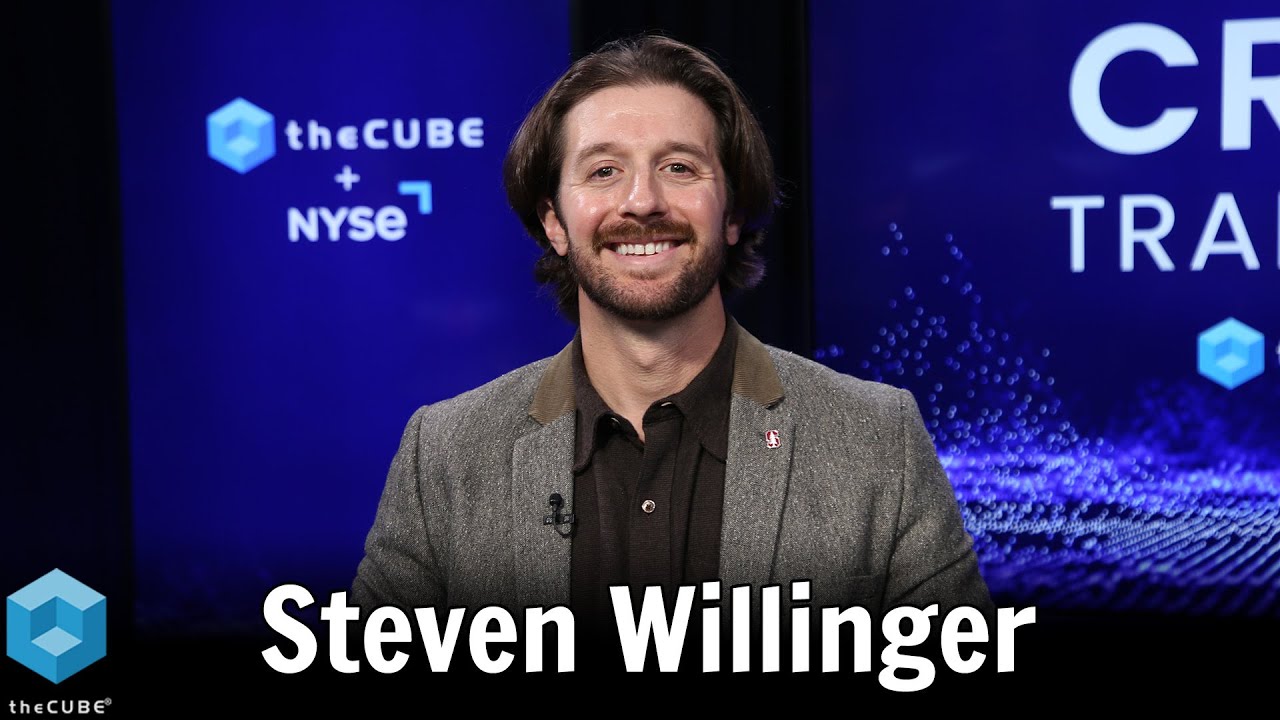
Steven Willinger of Stanford Blockchain Accelerator and Blockchain Builders discusses the "Crypto Trailblazers" series, a virtual event co-hosted by theCUBE and NYSE Wired. This event, in collaboration with the Ethereum Foundation and Stanford University, aims to explore blockchain innovations occurring in Silicon Valley.
In this segment, Willinger examines the evolving blockchain landscape. Drawing from his experience at Coinbase, Willinger addresses the collaborative efforts within the blockchain community that include Stanford University, the University of California Berkeley, and the Ethereum Foundation. The discussion emphasizes the momentum in decentralized finance, the significant shift in regulatory landscapes, and the rise of stablecoins.
Willinger notes that technology and finance-driven initiatives within the blockchain space are progressing, supported by considerable expertise and focused discussions, such as those held during ETHSF. They identify significant industry trends, noting that the forefront is the intersection of blockchain and AI. Hosts from theCUBE also provide additional insights into these promising developments.
#BlockchainBuilders #StanfordBlockchainAccelerator #CryptoTrailblazers #theCUBE #ETHSF #DecentralizedFinance #Stablecoins #AIandBlockchain #CryptoInnovation
Find more SiliconANGLE news and analysis https://siliconangle.com/
Follow theCUBE's wall-to-wall event coverage https://siliconangle.com/events/
Learn about the latest theCUBE events https://www.thecube.net/
00:00 - Intro
00:05 - Exploring the Blockchain Ecosystem: Community, Innovation, and Regulation
02:12 - Entrepreneurship, Impact, and Commercialization in Crypto
04:57 - Changing Paradigms: Business Models and Investments
07:56 - Stanford's Role in Blockchain and AI
10:53 - Innovations in Crypto and AI
13:27 - Infrastructure Opportunities in Blockchain
15:51 - The Challenges and Opportunities of Community-Building
18:10 - Accelerating Innovation: The Intersection of Incubators and Blockchain Initiatives
Forgot Password
Almost there!
We just sent you a verification email. Please verify your account to gain access to
theCUBE + NYSE Wired: Crypto Trailblazers. If you don’t think you received an email check your
spam folder.
Sign in to theCUBE + NYSE Wired: Crypto Trailblazers.
In order to sign in, enter the email address you used to registered for the event. Once completed, you will receive an email with a verification link. Open this link to automatically sign into the site.
Register For theCUBE + NYSE Wired: Crypto Trailblazers
Please fill out the information below. You will recieve an email with a verification link confirming your registration. Click the link to automatically sign into the site.
You’re almost there!
We just sent you a verification email. Please click the verification button in the email. Once your email address is verified, you will have full access to all event content for theCUBE + NYSE Wired: Crypto Trailblazers.
I want my badge and interests to be visible to all attendees.
Checking this box will display your presense on the attendees list, view your profile and allow other attendees to contact you via 1-1 chat. Read the Privacy Policy. At any time, you can choose to disable this preference.
Select your Interests!
add
Upload your photo
Uploading..
OR
Connect via Twitter
Connect via Linkedin
EDIT PASSWORD
Share
Forgot Password
Almost there!
We just sent you a verification email. Please verify your account to gain access to
theCUBE + NYSE Wired: Crypto Trailblazers. If you don’t think you received an email check your
spam folder.
Sign in to theCUBE + NYSE Wired: Crypto Trailblazers.
In order to sign in, enter the email address you used to registered for the event. Once completed, you will receive an email with a verification link. Open this link to automatically sign into the site.
Sign in to gain access to theCUBE + NYSE Wired: Crypto Trailblazers
Please sign in with LinkedIn to continue to theCUBE + NYSE Wired: Crypto Trailblazers. Signing in with LinkedIn ensures a professional environment.
Are you sure you want to remove access rights for this user?
Details
Manage Access
email address
Community Invitation
Ophelia Snyder, 21Shares
Steven Willinger of Stanford Blockchain Accelerator and Blockchain Builders discusses the "Crypto Trailblazers" series, a virtual event co-hosted by theCUBE and NYSE Wired. This event, in collaboration with the Ethereum Foundation and Stanford University, aims to explore blockchain innovations occurring in Silicon Valley.
In this segment, Willinger examines the evolving blockchain landscape. Drawing from his experience at Coinbase, Willinger addresses the collaborative efforts within the blockchain community that include Stanford University, the University of California Berkeley, and the Ethereum Foundation. The discussion emphasizes the momentum in decentralized finance, the significant shift in regulatory landscapes, and the rise of stablecoins.
Willinger notes that technology and finance-driven initiatives within the blockchain space are progressing, supported by considerable expertise and focused discussions, such as those held during ETHSF. They identify significant industry trends, noting that the forefront is the intersection of blockchain and AI. Hosts from theCUBE also provide additional insights into these promising developments.
#BlockchainBuilders #StanfordBlockchainAccelerator #CryptoTrailblazers #theCUBE #ETHSF #DecentralizedFinance #Stablecoins #AIandBlockchain #CryptoInnovation
Find more SiliconANGLE news and analysis https://siliconangle.com/
Follow theCUBE's wall-to-wall event coverage https://siliconangle.com/events/
Learn about the latest theCUBE events https://www.thecube.net/
00:00 - Intro
00:05 - Exploring the Blockchain Ecosystem: Community, Innovation, and Regulation
02:12 - Entrepreneurship, Impact, and Commercialization in Crypto
04:57 - Changing Paradigms: Business Models and Investments
07:56 - Stanford's Role in Blockchain and AI
10:53 - Innovations in Crypto and AI
13:27 - Infrastructure Opportunities in Blockchain
15:51 - The Challenges and Opportunities of Community-Building
18:10 - Accelerating Innovation: The Intersection of Incubators and Blockchain Initiatives
>> Welcome back to theCUBE. I'm Gemma Allen, here at the New York Stock Exchange. This is a significant day, as we mark 10 years of Ethereum as part of our Crypto Trailblazer series. And joining me now is a guest who has been blazing a trail in crypto long before anyone realized just how mainstream this would become. Ophelia Snyder, welcome to theCUBE.
Ophelia Snyder
>> Thank you so much for having me.
Gemma Allen
>> Thanks for coming on. And Ophelia, you were here just last week with John Furrier talking about the recent acquisition by FalconX, which is very exciting, and we're going to get to that. But before we do, tell us a little bit about you and your career journey. I read that you said that you didn't start out to build a crypto company, you started out to fix access to traditional finance. Maybe we can start there.
Ophelia Snyder
>> Yeah, absolutely. So you're right, I didn't set out to build a crypto company. I have a very interesting honor in that I think I'm the only person I know who was brought into crypto by my mom-
Gemma Allen
>> Wow.
Ophelia Snyder
>> ... not the other way around, all the way back in 2013. And my mom completely understood what this space was supposed to stand for. She understood that we were in a geopolitical anomaly and everyone was getting along, but that might not last, that Merck was spending too much money hedging, and the way we moved currency around the world left something to be desired. And so, she looked at me, she was like, "Have you ever heard of a thing called Bitcoin?" I'm like, "No."
Despite the fact that my mom completely understood the point of crypto, she couldn't make an allocation because she just didn't feel comfortable with it, which was really understandable at the time. It required her opening a new bank account, it required her having new infrastructure that she just was never going to do. And my co-founder's mom went through a similar experience in Egypt a few years later, and we realized that no one had really solved this access problem. And so, we set out originally to solve a problem for our moms, which is how can you invest in crypto without needing specialized infrastructure. And we actually didn't start out thinking that was necessarily going to be an ETF, we went to 27 different jurisdictions, and finally landed on building exchange trade products in Switzerland was going to be the best way to provide access at the time, and that was almost eight years ago. We launched our first product on the Swiss market about a year after that, and we've been building ever since.
Gemma Allen
>> That is so interesting. I have never had somebody tell me that they got into crypto on the advice and through the conversations they had with their mom. So as a mom myself, I love that. The other thing that was quite surprising to read, just to, again, the outside ear, is that you actually did begin this journey in Europe, where there's always been a sense of high regulation, traditional institutional environment, heavy guardrails, but you really had a future vision of what was possible within the crypto landscape. Talk to us a little bit about that, especially in light of what's happened here in the US and the recent GENIUS Act and the CLARITY Act and all of the changes that have come so fast in the last while.
Ophelia Snyder
>> So we did start the business in Europe, because we thought it would be, quite frankly, they had a better regulatory regime for building these types of products at the time. And it came from, I think, a desire in Switzerland to be a nexus for digital assets. At the time, they were building Crypto Nation and trying to foster these types of businesses domestically. Prior to building this company, I'd actually never even been to Switzerland. I'm Italian, but somehow I'd missed this one. And I moved to Switzerland having never been there in order to build this company. And it was a really interesting time, because from a regulatory perspective, they actually had regulatory clarity, they both had a product structure that worked and would work well and was generally accepted in the TradFi community, as well as clarity around how that structure was going to intersect with crypto, and that was really unique at the time. And in some respects, the US is finally playing catch up to that as we're rolling out more regulatory infrastructure, more straightforward listing requirements and listing processes to let people bring out more ETFs in the space, as we're seeing that regulatory clarity and what I typically think of as a normalization of crypto companies' relationship with regulators, and we're now seeing that globally, and I actually think it's a very positive tailwind for the space as we look at its ongoing evolution.
Gemma Allen
>> And one thing I know we just talked about a few short minutes ago when we were chatting before we went live, you also talked about normalizing the jargon around crypto, how you categorize assets, how you help explain this industry and this moment in time to, again, other people's moms, I guess. Maybe talk to me a little bit about that. We hear a lot of layer one, layer two, a lot of what seems like very complex language. Tell me how you really break things down.
Ophelia Snyder
>> So I like to take a step back from a lot of technical information that maybe isn't the most relevant to most people that are trying to understand the space. They're incredibly important from a practitioner's perspective, but maybe less so if you're just trying to dip your toes. I usually organize crypto into three categories. There are currencies, like Bitcoin, which are intended to be either reserve assets or a means of exchange in some way. You have commodities, which include things like Ethereum and Solana, which are really primary inputs in the creation of something else, so the deployment of a smart contract, the execution of a smart contract. And then, lastly, you have what I think of as a finished product, so things that are built on top of those networks, which are the ultimate product that maybe a consumer is going to use. So it could be a skin in a video game, it could be a capital markets transaction, it could be a piece of data. Those are the finished products that can exist and are built on top of that, and that's typically where you see a lot of other tokens that have been created, things like Chainlink, for example, that would sit on top of some of these other networks. And I think when you break it down that way, it's much more straightforward, at least from my perspective. It doesn't necessarily matter to most people how technically these things work, because crypto is often everything people don't understand about how the internet works coupled with everything people don't understand about how money works, and that's not really the point. The point is, what is the utility? And I think when you break down the world this way, it's much clearer for people who are just coming into the space. And ultimately, if we want crypto to work, we need to bring many, many, many more people into this sector, and bringing that kind of clarity and transparency is really something 21shares has stood for for a long time.
Gemma Allen
>> So let's talk a little bit about the mechanics of trust, because I think it's a very important part of this story. You have also said that you want to talk and focus on responsible access. What exactly does that mean, especially in a space that's becoming quite hyped, and I guess some folks might seem quite convoluted at this moment in time?
Ophelia Snyder
>> So I think there are two pieces to this. One is making sure that products do what they say on the tin. So if you're buying a product that you expect to track the price of Bitcoin, it needs to do so, and it needs to do so with minimal or no tracking. And that's something that is a relatively new development as we've seen ETFs roll out. So this is something, obviously, we've been offering in the European market for years. We offer an excess of 40 products in the European market, covering all sorts of different underlying assets. But this is something much newer in the US with the rollout of the Bitcoin ETFs, that was only a few years ago. So that's what I mean, is that there is an element of needing to make sure that the products that we're putting people in actually behave the way they're supposed to. The second piece of that is ensuring that people have a clear understanding of what it is they're buying. So do you really have a thesis here? Do you understand what that's going to do in your portfolio? Has this been explained to you in a way that's not full of jargon? And I think once you bring those two pieces together, that's where really you can both increase access, as well as make people both comfortable and excited about allocating in this space.
Gemma Allen
>> So tell me a little bit about the whole space of inclusion, because I know it's been something that you have been very strongly advocating for and I guess one of the original core principles as to why you're so all-in on this industry. It seems as though there are certainly opportunities for everybody to take part in this space. It definitely, from an outside perspective, sounds very democratic. As we see these two worlds collide though, TradFi and DeFi, all of this collision and opportunity, it also seems as though one overrides the other. How do you think about that? How do you think about who's really going to gain from the system/ is it going to be Swiss bankers or is it going to be global gamers?
Ophelia Snyder
>> So I think we're entering a really interesting chapter, and the way I see this is not so much crypto versus TradFi. The next iteration, and it's actually, I think, a vision that both 21shares and FalconX share, is this idea that the next iteration is going to be about convergence. It's going to be about TradFi built on crypto rails, and this ability to actually bring the best of what crypto has to offer, the efficiency, the speed, and ultimately bring that to more TradFi instruments. And so, I don't think it's a question of who wins, is it TradFi or is it crypto, I think it's fundamentally a question of how can we make this a better end-to-end experience for everyone, while bringing more people into the tent and able to actually participate? And ultimately, in the context of Bitcoin especially, if you believe that Bitcoin can be a true reserve asset, we are going to need many, many more people to feel comfortable participating in this space. And so, the more we can do to make that process feel smooth, incite confidence and make people comfortable with this, the better it's going to go and the more likely it is that crypto can actually live up to some of these lofty dreams and its full potential.
Gemma Allen
>> From a global perspective, you've had an interesting career in that it's been transatlantic, Europe, the US. How do you think about the global picture? Where are you seeing interesting activity? What markets are you particularly focused on? Where do you think potentially there might be a missed opportunity right now in the space?
Ophelia Snyder
>> I think crypto is a very unique market in that it's intrinsically global. It's very difficult to regionalize crypto in a lot of ways, it acts very much like a global industry. That being said, I think what we're seeing that I'm really excited about is the normalization of crypto's relationship with regulators on a global basis, and you're seeing steps in essentially every major market at the moment to bring regulatory clarity. And the way I think about regulations is sort of like a layer cake. You have to start with what is it we're regulating, who is going to be in charge of setting those regulations, then you need to determine what actually the rules of the road are going to be, and then lastly, you need to harmonize that with all of the other rules that exist. And I think we are at a wonderful inflection point, where we're finally making real concerted progress on that across virtually every major capital market. And I think that is such a unique moment for an industry, that has struggled for a long time to get that kind of clarity from regulators, and to be essentially treated like other areas of business or other areas of capital markets, and that's the thing I personally am most excited about as we're looking at the next year or two.
Gemma Allen
>> So speaking of the next year or two, big news last week with the FalconX acquisition, tell me a little bit about what's on the roadmap from here, how you're thinking about things, and I guess what the next 12 months looks like for you personally and the team at 21shares.
Ophelia Snyder
>> So we're very excited about the merger with FalconX. It's a very interesting combination, because it really creates a one-stop shop in crypto, bringing together strength in derivatives, strength in trading and strength in asset management in a fully integrated stack. And I think what that enables is immense creativity in terms of the types of products we can offer our customers, how we offer those products. It's going to let us continue to do things faster, better, cheaper, and provide our customers with that experience, while we stay on the bleeding edge of what can be done in terms of product innovation. And it brought together two firms that share a lot of these cultural norms around innovation, around building, around bringing that sort of clarity and transparency to this market. And so, for all of those reasons, it's something we're incredibly excited about. In terms of the team at 21shares, I think this has been a wonderful milestone in the company's trajectory, and I think there's a lot of excitement around what it is we're going to be able to do and build over the coming months and years through this partnership.
Gemma Allen
>> So we're here today marking 10 years of Ethereum, it's obviously a very big and landmark event for the industry generally, and like we spoke about at the beginning, an industry that's been on a narrative cycle and a hype cycle. Tell me a little bit to end about how you think about the industry broadly, Ethereum, the competitive landscape, where you see huge opportunity, where you see challenge. Give me your overarching pieces on this moment in time.
Ophelia Snyder
>> So I think there are a couple of pieces to this. The industry is at a really fascinating inflection point, and I touched on this a little earlier, this idea of normalizing our relationship with regulators is critical. We're also seeing real clarity around utility and use cases, especially for applications in the capital market space, which, given my background, I'm particularly excited about, both in terms of decentralized exchanges, decentralized data, how we're actually going to be able to bring together this convergence of TradFi and crypto, and really bring TradFi onto crypto rails. And I think that is something that as I look forward in the next couple of years as an industry, I'm particularly excited about. The other thing I'm very excited about is we have moved away in a lot of ways from purely building businesses in this space on hype. I think this merger with FalconX is a great example of that, where it's two strong profitable companies coming together and starting to build towards this future of more sustainability in this space, more differentiation in terms of how we are actually building companies in this space. And I think that is something else I'm really excited about as we're starting to see the sector overall mature from a regulatory perspective, from clarity of use cases, as well as from a corporate perspective, and that's something I'm very much watching over the next year.
Gemma Allen
>> Well, Ophelia, it's certainly been an exciting journey for you. We wish you all the best with the new road ahead with FalconX. And thank you so much for giving us your time today and coming on theCUBE.
Ophelia Snyder
>> Thank you so much for having me.
Gemma Allen
>> I'm Gemma Allen, here at the New York Stock Exchange, marking 10 years of Ethereum. This is our Crypto Trailblazer series. Thanks for watching.
>> Welcome back to theCUBE. I'm Gemma Allen, here at the New York Stock Exchange. This is a significant day, as we mark 10 years of Ethereum as part of our Crypto Trailblazer series. And joining me now is a guest who has been blazing a trail in crypto long before anyone realized just how mainstream this would become. Ophelia Snyder, welcome to theCUBE.
Ophelia Snyder
>> Thank you so much for having me.
Gemma Allen
>> Thanks for coming on. And Ophelia, you were here just last week with John Furrier talking about the recent acquisition by FalconX, which is very exciting, and we're going to get to that. But before we do, tell us a little bit about you and your career journey. I read that you said that you didn't start out to build a crypto company, you started out to fix access to traditional finance. Maybe we can start there.
Ophelia Snyder
>> Yeah, absolutely. So you're right, I didn't set out to build a crypto company. I have a very interesting honor in that I think I'm the only person I know who was brought into crypto by my mom-
Gemma Allen
>> Wow.
Ophelia Snyder
>> ... not the other way around, all the way back in 2013. And my mom completely understood what this space was supposed to stand for. She understood that we were in a geopolitical anomaly and everyone was getting along, but that might not last, that Merck was spending too much money hedging, and the way we moved currency around the world left something to be desired. And so, she looked at me, she was like, "Have you ever heard of a thing called Bitcoin?" I'm like, "No."
Despite the fact that my mom completely understood the point of crypto, she couldn't make an allocation because she just didn't feel comfortable with it, which was really understandable at the time. It required her opening a new bank account, it required her having new infrastructure that she just was never going to do. And my co-founder's mom went through a similar experience in Egypt a few years later, and we realized that no one had really solved this access problem. And so, we set out originally to solve a problem for our moms, which is how can you invest in crypto without needing specialized infrastructure. And we actually didn't start out thinking that was necessarily going to be an ETF, we went to 27 different jurisdictions, and finally landed on building exchange trade products in Switzerland was going to be the best way to provide access at the time, and that was almost eight years ago. We launched our first product on the Swiss market about a year after that, and we've been building ever since.
Gemma Allen
>> That is so interesting. I have never had somebody tell me that they got into crypto on the advice and through the conversations they had with their mom. So as a mom myself, I love that. The other thing that was quite surprising to read, just to, again, the outside ear, is that you actually did begin this journey in Europe, where there's always been a sense of high regulation, traditional institutional environment, heavy guardrails, but you really had a future vision of what was possible within the crypto landscape. Talk to us a little bit about that, especially in light of what's happened here in the US and the recent GENIUS Act and the CLARITY Act and all of the changes that have come so fast in the last while.
Ophelia Snyder
>> So we did start the business in Europe, because we thought it would be, quite frankly, they had a better regulatory regime for building these types of products at the time. And it came from, I think, a desire in Switzerland to be a nexus for digital assets. At the time, they were building Crypto Nation and trying to foster these types of businesses domestically. Prior to building this company, I'd actually never even been to Switzerland. I'm Italian, but somehow I'd missed this one. And I moved to Switzerland having never been there in order to build this company. And it was a really interesting time, because from a regulatory perspective, they actually had regulatory clarity, they both had a product structure that worked and would work well and was generally accepted in the TradFi community, as well as clarity around how that structure was going to intersect with crypto, and that was really unique at the time. And in some respects, the US is finally playing catch up to that as we're rolling out more regulatory infrastructure, more straightforward listing requirements and listing processes to let people bring out more ETFs in the space, as we're seeing that regulatory clarity and what I typically think of as a normalization of crypto companies' relationship with regulators, and we're now seeing that globally, and I actually think it's a very positive tailwind for the space as we look at its ongoing evolution.
Gemma Allen
>> And one thing I know we just talked about a few short minutes ago when we were chatting before we went live, you also talked about normalizing the jargon around crypto, how you categorize assets, how you help explain this industry and this moment in time to, again, other people's moms, I guess. Maybe talk to me a little bit about that. We hear a lot of layer one, layer two, a lot of what seems like very complex language. Tell me how you really break things down.
Ophelia Snyder
>> So I like to take a step back from a lot of technical information that maybe isn't the most relevant to most people that are trying to understand the space. They're incredibly important from a practitioner's perspective, but maybe less so if you're just trying to dip your toes. I usually organize crypto into three categories. There are currencies, like Bitcoin, which are intended to be either reserve assets or a means of exchange in some way. You have commodities, which include things like Ethereum and Solana, which are really primary inputs in the creation of something else, so the deployment of a smart contract, the execution of a smart contract. And then, lastly, you have what I think of as a finished product, so things that are built on top of those networks, which are the ultimate product that maybe a consumer is going to use. So it could be a skin in a video game, it could be a capital markets transaction, it could be a piece of data. Those are the finished products that can exist and are built on top of that, and that's typically where you see a lot of other tokens that have been created, things like Chainlink, for example, that would sit on top of some of these other networks. And I think when you break it down that way, it's much more straightforward, at least from my perspective. It doesn't necessarily matter to most people how technically these things work, because crypto is often everything people don't understand about how the internet works coupled with everything people don't understand about how money works, and that's not really the point. The point is, what is the utility? And I think when you break down the world this way, it's much clearer for people who are just coming into the space. And ultimately, if we want crypto to work, we need to bring many, many, many more people into this sector, and bringing that kind of clarity and transparency is really something 21shares has stood for for a long time.
Gemma Allen
>> So let's talk a little bit about the mechanics of trust, because I think it's a very important part of this story. You have also said that you want to talk and focus on responsible access. What exactly does that mean, especially in a space that's becoming quite hyped, and I guess some folks might seem quite convoluted at this moment in time?
Ophelia Snyder
>> So I think there are two pieces to this. One is making sure that products do what they say on the tin. So if you're buying a product that you expect to track the price of Bitcoin, it needs to do so, and it needs to do so with minimal or no tracking. And that's something that is a relatively new development as we've seen ETFs roll out. So this is something, obviously, we've been offering in the European market for years. We offer an excess of 40 products in the European market, covering all sorts of different underlying assets. But this is something much newer in the US with the rollout of the Bitcoin ETFs, that was only a few years ago. So that's what I mean, is that there is an element of needing to make sure that the products that we're putting people in actually behave the way they're supposed to. The second piece of that is ensuring that people have a clear understanding of what it is they're buying. So do you really have a thesis here? Do you understand what that's going to do in your portfolio? Has this been explained to you in a way that's not full of jargon? And I think once you bring those two pieces together, that's where really you can both increase access, as well as make people both comfortable and excited about allocating in this space.
Gemma Allen
>> So tell me a little bit about the whole space of inclusion, because I know it's been something that you have been very strongly advocating for and I guess one of the original core principles as to why you're so all-in on this industry. It seems as though there are certainly opportunities for everybody to take part in this space. It definitely, from an outside perspective, sounds very democratic. As we see these two worlds collide though, TradFi and DeFi, all of this collision and opportunity, it also seems as though one overrides the other. How do you think about that? How do you think about who's really going to gain from the system/ is it going to be Swiss bankers or is it going to be global gamers?
Ophelia Snyder
>> So I think we're entering a really interesting chapter, and the way I see this is not so much crypto versus TradFi. The next iteration, and it's actually, I think, a vision that both 21shares and FalconX share, is this idea that the next iteration is going to be about convergence. It's going to be about TradFi built on crypto rails, and this ability to actually bring the best of what crypto has to offer, the efficiency, the speed, and ultimately bring that to more TradFi instruments. And so, I don't think it's a question of who wins, is it TradFi or is it crypto, I think it's fundamentally a question of how can we make this a better end-to-end experience for everyone, while bringing more people into the tent and able to actually participate? And ultimately, in the context of Bitcoin especially, if you believe that Bitcoin can be a true reserve asset, we are going to need many, many more people to feel comfortable participating in this space. And so, the more we can do to make that process feel smooth, incite confidence and make people comfortable with this, the better it's going to go and the more likely it is that crypto can actually live up to some of these lofty dreams and its full potential.
Gemma Allen
>> From a global perspective, you've had an interesting career in that it's been transatlantic, Europe, the US. How do you think about the global picture? Where are you seeing interesting activity? What markets are you particularly focused on? Where do you think potentially there might be a missed opportunity right now in the space?
Ophelia Snyder
>> I think crypto is a very unique market in that it's intrinsically global. It's very difficult to regionalize crypto in a lot of ways, it acts very much like a global industry. That being said, I think what we're seeing that I'm really excited about is the normalization of crypto's relationship with regulators on a global basis, and you're seeing steps in essentially every major market at the moment to bring regulatory clarity. And the way I think about regulations is sort of like a layer cake. You have to start with what is it we're regulating, who is going to be in charge of setting those regulations, then you need to determine what actually the rules of the road are going to be, and then lastly, you need to harmonize that with all of the other rules that exist. And I think we are at a wonderful inflection point, where we're finally making real concerted progress on that across virtually every major capital market. And I think that is such a unique moment for an industry, that has struggled for a long time to get that kind of clarity from regulators, and to be essentially treated like other areas of business or other areas of capital markets, and that's the thing I personally am most excited about as we're looking at the next year or two.
Gemma Allen
>> So speaking of the next year or two, big news last week with the FalconX acquisition, tell me a little bit about what's on the roadmap from here, how you're thinking about things, and I guess what the next 12 months looks like for you personally and the team at 21shares.
Ophelia Snyder
>> So we're very excited about the merger with FalconX. It's a very interesting combination, because it really creates a one-stop shop in crypto, bringing together strength in derivatives, strength in trading and strength in asset management in a fully integrated stack. And I think what that enables is immense creativity in terms of the types of products we can offer our customers, how we offer those products. It's going to let us continue to do things faster, better, cheaper, and provide our customers with that experience, while we stay on the bleeding edge of what can be done in terms of product innovation. And it brought together two firms that share a lot of these cultural norms around innovation, around building, around bringing that sort of clarity and transparency to this market. And so, for all of those reasons, it's something we're incredibly excited about. In terms of the team at 21shares, I think this has been a wonderful milestone in the company's trajectory, and I think there's a lot of excitement around what it is we're going to be able to do and build over the coming months and years through this partnership.
Gemma Allen
>> So we're here today marking 10 years of Ethereum, it's obviously a very big and landmark event for the industry generally, and like we spoke about at the beginning, an industry that's been on a narrative cycle and a hype cycle. Tell me a little bit to end about how you think about the industry broadly, Ethereum, the competitive landscape, where you see huge opportunity, where you see challenge. Give me your overarching pieces on this moment in time.
Ophelia Snyder
>> So I think there are a couple of pieces to this. The industry is at a really fascinating inflection point, and I touched on this a little earlier, this idea of normalizing our relationship with regulators is critical. We're also seeing real clarity around utility and use cases, especially for applications in the capital market space, which, given my background, I'm particularly excited about, both in terms of decentralized exchanges, decentralized data, how we're actually going to be able to bring together this convergence of TradFi and crypto, and really bring TradFi onto crypto rails. And I think that is something that as I look forward in the next couple of years as an industry, I'm particularly excited about. The other thing I'm very excited about is we have moved away in a lot of ways from purely building businesses in this space on hype. I think this merger with FalconX is a great example of that, where it's two strong profitable companies coming together and starting to build towards this future of more sustainability in this space, more differentiation in terms of how we are actually building companies in this space. And I think that is something else I'm really excited about as we're starting to see the sector overall mature from a regulatory perspective, from clarity of use cases, as well as from a corporate perspective, and that's something I'm very much watching over the next year.
Gemma Allen
>> Well, Ophelia, it's certainly been an exciting journey for you. We wish you all the best with the new road ahead with FalconX. And thank you so much for giving us your time today and coming on theCUBE.
Ophelia Snyder
>> Thank you so much for having me.
Gemma Allen
>> I'm Gemma Allen, here at the New York Stock Exchange, marking 10 years of Ethereum. This is our Crypto Trailblazer series. Thanks for watching.








































 Gemma Allen