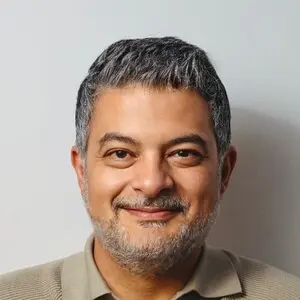
Ali Esfahani of Unconventional AI, chief financial officer, joins John Furrier on theCUBE Research to discuss the company's full-stack approach to artificial intelligence infrastructure at the Bank of America Private Tech Trailblazers Conference. Esfahani explains rapid progress from founding to tape-out and outlines hardware and software co-design, the use of dynamical systems and sparsity, recruitment challenges and fundraising and implications for scalability, energy efficiency and edge deployment in robotics and industrial applications. They state the company answers core science questions and moves into engineering, achieving tape-out within five months with encouraging power numbers and a design that targets roughly 1,000x lower power consumption.
Esfahani emphasizes that sparsity enables scalability and that hardware and software co-design is essential for low-power AI deployments, opening new opportunities for edge computing, semiconductors, chip design, AI chips and robotics. The conversation addresses power efficiency, tape-out velocity and the potential for industrial and edge applications where reduced energy consumption enables novel deployments.
Forgot Password
Almost there!
We just sent you a verification email. Please verify your account to gain access to
Bank of America: Private Tech Trailblazers Conference. If you don’t think you received an email check your
spam folder.
Sign in to Bank of America: Private Tech Trailblazers Conference.
In order to sign in, enter the email address you used to registered for the event. Once completed, you will receive an email with a verification link. Open the link to automatically sign into the site.
Register for Bank of America: Private Tech Trailblazers Conference
Please fill out the information below. You will receive an email with a verification link confirming your registration. Click the link to automatically sign into the site.
You’re almost there!
We just sent you a verification email. Please click the verification button in the email. Once your email address is verified, you will have full access to all event content for Bank of America: Private Tech Trailblazers Conference.
I want my badge and interests to be visible to all attendees.
Checking this box will display your presense on the attendees list, view your profile and allow other attendees to contact you via 1-1 chat. Read the Privacy Policy. At any time, you can choose to disable this preference.
Select your Interests!
add
Upload your photo
Uploading..
OR
Connect via Twitter
Connect via Linkedin
EDIT PASSWORD
Share
Forgot Password
Almost there!
We just sent you a verification email. Please verify your account to gain access to
Bank of America: Private Tech Trailblazers Conference. If you don’t think you received an email check your
spam folder.
Sign in to Bank of America: Private Tech Trailblazers Conference.
In order to sign in, enter the email address you used to registered for the event. Once completed, you will receive an email with a verification link. Open the link to automatically sign into the site.
Sign in to gain access to Bank of America: Private Tech Trailblazers Conference
Please sign in with LinkedIn to continue to Bank of America: Private Tech Trailblazers Conference. Signing in with LinkedIn ensures a professional environment.
Are you sure you want to remove access rights for this user?
Details
Manage Access
email address
Community Invitation
Ali Esfahani, Unconventional AI
Ali Esfahani of Unconventional AI, chief financial officer, joins John Furrier on theCUBE Research to discuss the company's full-stack approach to artificial intelligence infrastructure at the Bank of America Private Tech Trailblazers Conference. Esfahani explains rapid progress from founding to tape-out and outlines hardware and software co-design, the use of dynamical systems and sparsity, recruitment challenges and fundraising and implications for scalability, energy efficiency and edge deployment in robotics and industrial applications. They state the company answers core science questions and moves into engineering, achieving tape-out within five months with encouraging power numbers and a design that targets roughly 1,000x lower power consumption.
Esfahani emphasizes that sparsity enables scalability and that hardware and software co-design is essential for low-power AI deployments, opening new opportunities for edge computing, semiconductors, chip design, AI chips and robotics. The conversation addresses power efficiency, tape-out velocity and the potential for industrial and edge applications where reduced energy consumption enables novel deployments.
In this interview from the Bank of America Private Tech Trailblazers Conference 2026, Ali Esfahani, [un]chief financial officer of Unconventional AI, joins theCUBE's John Furrier to discuss the startup's mission to cut AI power consumption by 1,000x through a radically different approach to chip design. Esfahani details the company's rapid trajectory, from its first anniversary and a cap table backed by more than $540 million in funding to a team that's grown from 14 to 60 employees in under a year. He explains how Unconventional AI taped out custom silicon b...Read more
exploreKeep Exploring
What is Unconventional AI currently doing — its mission, funding, team size, and recent technological progress?add
Can this system be scaled up for hardware implementation on chips, and what does "scale" mean in this context?add
How will AI infrastructure evolve—will it form layers from large data centers to low‑power, containerized “AI factories” or mini data centers at the network edge (near cell towers and homes), and is that a realistic market for your chips?add
How will robotics and edge AI evolve, what are the expected power requirements and deployment strategies for "beefy" edge nodes, and what are the cost and efficiency targets (e.g., low-power chips and delivering human-level intelligence in a rack for ~$20/hour)?add
What is your perspective on AI "doomerism," and are companies in the industry primarily driven by profit or by a mission to change the world?add
>> (INTRO)I'm John Furrier, host of theCUBE. We are here in Palo Alto, California, in the heart of Silicon Valley for the BofA Private Tech Trailblazers. It's a conference where entrepreneurs get together, a lot of investors, a lot of industry participants, really looking at what's going to be the next big thing. Of course, we're here at theCUBE covering it. We have here Ali from, he's the [un]CFO, that's his title, in contract with Naveen Rao's new venture Unconventional AI. Ali, great to have you on as an [un]CFO. I guess my first question is, what are you going to [un]CFO on?
Ali Esfahani
>> I'm not [un]CFOing anything. Basically what that means is I'm responsible for everything that Naveen doesn't want to do. Yeah.
John Furrier
>> And the name's Unconventional AI. Of course, Naveen's a great entrepreneur. We've followed him through past 3 ventures. Always has an eye for the technology and he's usually a couple years ahead, but can race fast. Pun intended, loves to race cars. This world is faster than ever before than the last two ventures. What's the company doing now? Give a quick update as the un-CFO here. A lot of investors, a lot of interest. Certainly he's had some good financing so far early. he's only what, a year and a half in?
Ali Esfahani
>> Not even.
John Furrier
>> Not even.
Ali Esfahani
>> Just had the one-year anniversary of the company last week.
John Furrier
>> Yeah.
Ali Esfahani
>> Yeah.
John Furrier
>> What's it like? How many people do you have? Give some of the stats.
Ali Esfahani
>> Yeah, of course. So company was started last year around this time. He raised about $475 million prior to me joining in January. I joined in January. Since then, we've raised another $70 or so million, maybe closer to $80 now. And we have a lot of great investors on our cap table, and we're very well funded to tackle one of the biggest problems of our time. the team has grown substantially. I was one of the first employees. I think I was number 14. I joined January 5th and we're closer to 60 now and growing very quickly. Hiring for this company is very challenging because it's a full-stack company spanning everything from semiconductors all the way to models, AI models and so on. And we are hiring top talent and all the talents in all those categories are highly sought after and hard to find.
John Furrier
>> Highly competitive.
Ali Esfahani
>> Very competitive, yeah, extremely competitive. But we have, I would like to think, one of the best teams in the industry and one of the only full-stack teams that exists out there. And we're co-designing hardware and software together, and it's been quite exciting. in terms of what we're up to, the goal of the company is quite simple. We're trying to reduce power consumption of AI systems by about 1,000x. And to do that, when we set out here in January, there was a lot of questions we had to answer. And we anticipated that it's going to take us at least 2 to 3 years to figure out the science piece of this. Things have moved at lightning speed. It's kind of crazy. So we've been able to answer the 3 main questions, which was, can you actually do computation with dynamics? The answer— Ended up being yes. And we put out an open source model out there in mid-June that kind of proved that we actually went from having no team in January to taping out a chip in 5 months. So June 1st, we taped out our chip, went to TSMC and came back. We have actual power numbers from that chip and they're extremely encouraging. They're orders of magnitude below what you see with a traditional system that currently exists. With that, we answered the question, is computing with dynamics power efficient? The answer to that is yes. The third big question, which was the biggest question in my mind, is you can build a lot of toy systems and have proof of concepts, but can you scale it? We have discovered, and we've blogged and published on this on sparsity and so on, that the systems are very scalable and composable. With that, I can officially tell you the science piece of this project is over. We have answered the questions we needed to answer and we're on the engineering journey and we've cut the 5-year timeline to products back quite substantially. So we're looking hopefully to do that in less than 3 years.
John Furrier
>> It's incredible and Unconventional, so to speak. Talk about that dynamic because that's just an incredible tape-out length. I mean, you don't hear that. I was talking with OpenAI at the semiconductor executive event. they're using AI to make their chip. Everyone's making chips. So making chips has gotten better, but this is different. You're solving not just making a chip, you're making it with an energy envelope that's never been done before, right? So this is, again, think, we're all using AI and whatever devices we have, edge of the network, the robotics companies I've interviewed here today, they're probably going to run on hardware that's going to be probably much different in about 12 months than they've seen before, but has to run the same software stack. So I want to ask you about the secret sauce. You mentioned the science behind that you guys solved on the technology. What is that technology? You had mentioned it was a certain formula. Explain that.
Ali Esfahani
>> So how we got there, To be frank with you, I've never heard of anyone taping out a chip from no team to a full, kind of fully baked silicon and taped out in 5 months. I've been in the industry for a long time. I give all the credit to the team. And frankly, as you said, it's very different. You're not repeating an architecture that already exists. You're not taking blocks that have been pre-designed and putting it on a chip. You're basically creating everything from scratch and all the credit to the team, I think. And then AI as a second team player here, right? That's accelerated things. We're using AI everywhere we can. So from me as the CFO of the company, I've written 400,000 lines of code myself over the past 9 months or so. Just I developed 3 applications internally. All our team is doing
John Furrier
>> that.That's not a CFO. That's an
Ali Esfahani
>> [un]CFO.That's an [un]CFO. My computer engineering background helped. But, I don't
John Furrier
>> recommend—Waterloo, everyone knows, is a very popular school. That's where you went, Waterloo,
Ali Esfahani
>> right?I went to— my undergrad was computer engineering,
John Furrier
>> Waterloo.Yes. Yeah. Yeah. Tier 1 epic school. Everyone knows that. It's in their classes. Now, how does that translate now? Because, again, I want to get into this operational piece because, if you look at the system, it's an entire system now. It's not just the chip. I wrote a post on this the other day when I came back and heard all the chip guys talking. I'm like, wait, okay, GPU LLM era is over. We're in the entire production delivery of intelligence system.
Ali Esfahani
>> Exactly.
John Furrier
>> Okay. That's what we're in. You agree with that?
Ali Esfahani
>> I agree with that.
John Furrier
>> Explain where you fit into that vector.
Ali Esfahani
>> you're 100% right. If you want to be able to meet demand where it's going to be in a couple of years, the current architectures are unsustainable. You can only expand the energy grid linearly. There's no way we can build energy exponentially. And it's super expensive to do so. So the only way you can do this is if you actually bring down the power consumption of the chip by orders of magnitude. And the current architectures that exist out there that everyone is building on unfortunately don't support that. So this means you have to have better ties between hardware and software to be able to harness the efficiency that you need to. And we're using Dynamical Systems to do that. There's probably other ways of doing it. I haven't seen anything that's able to scale yet. There's a lot of nice science projects out there. The only thing that I've come across that's able to build scalable infrastructure is what we're building here.
John Furrier
>> So first of all, I'm a fan of Naveen. So that's a little bit biased on my side. I can say he's a tier 1 entrepreneur, multi-founder success. His thinking is original. It's usually right. But I'm going to be a skeptic for a second, put my skeptic hat on. Come on, there's no way you could do that. How do you scale? How do you prove the science? And do the scale, prove it to me, show me the numbers. So, okay, assume the science is solved because I believe that. Yeah, we've been following this. On the scale side, how did you guys get to the numbers? What was the— that's a real question now, and I'm kind of skeptical, but I want to hear the answer. What's the numbers? How did you get the proof on the scale? Was it digital twin? Was it deployments? How did you push the envelope on that?
Ali Esfahani
>> So the scale you're talking about is different from mine. The scale— we've proven that we can scale this, that the initial issue that you face with these systems is how they've been researched. It's a highly connected system where each element can influence all the other elements. And to build that in a chip, that requires millions, if not trillions, of wire connections. And you can't really do that. you lose all your efficiency with loss across the wires and so on and so forth. And frankly, I don't even think in 2 dimensions you can really route a trillion wires on a chip. What we are talking about in terms of scale is this concept of sparsity, where you can actually reduce the number of connections from 100% connected to, call it, maybe 2 to 3% connected, and it actually improves the output of the chip, the quality of the output of the chip, and improves learning. So that's the key discovery that we've had in the past year. In the past several months that I think changes everything and gives you the answer to scale. Whether we can scale this and build it, I think from here on is really
John Furrier
>> the—So not physical scale, that's a deployment issue. You were talking about something else.
Ali Esfahani
>> Okay. We were talking about, yeah.
John Furrier
>> At Hot Chips, I was poking around. I like to wander Stanford. What I do on the weekends, hike the Dish and then sneak over to Stanford when Hot Chips is happening. And I walked into a memory talk. And they were talking about the Morphix side of it where you have the layers Old school memory was you had memory and then would come back and write. Now that's multi-step sequences. And it made me think about conversations I've had with Naveen in the past. And since he's not here and you're working close to him as his partner on the business and tech side, explain his philosophy because we've talked before about neural networks. He's highly influenced by biology. He and I have talked about the brain many times. He and I have riffed on this. If you had a brain, it would be different. It wouldn't be a chip with a block diagram and go to an SRAM or HBM and then swap out. That doesn't work that way. So I know this is key part of Unconventional AI to try to emulate where neural networks might go in large-scale systems. And a lot of it's kind of based on neural brain kind of theory. That's my words. Explain this. Am I close? Explain what Naveen and you guys are talking about because I think this is a departure No, no, it is a departure.
Ali Esfahani
>> It sounds very sci-fi when you say it that way. And I think that's— people read that headline or whatever Naveen says and kind of think that we're doing something that has to do with neurons and something. What we're designing is completely physics-based and it's implemented in traditional semiconductor processes. So there's no magic to what we're building on. That said, how do systems work?
John Furrier
>> That's the mechanism though.
Ali Esfahani
>> Yes.
John Furrier
>> Not the concept.
Ali Esfahani
>> Exactly.
John Furrier
>> Explain the concept.
Ali Esfahani
>> The concept. So if you think about how your brain learns, there's no floating point operations, there's no instruction sets, right? How do you learn? You either observe or you try a task and then your brain basically forms these neural pathways, right? And then when you go to repeat that task, essentially you're traversing those pathways to do inference in the human way, right? So these systems essentially work the same way. So when you're doing the training, it learns the weights. Those are the equivalent of forming those neural pathways, right? So you're setting these weights. And then when I go to do inference, I give it a token, which is the equivalent of me poking you on the arm and you pulling your hand back, right? And essentially, it perturbs the system. It uses those weights to kind of figure out the dynamics of the system and the relationship between the elements. And the end state of that system is what we read out, which is the equivalent of you pulling your hand back and that's your output.
John Furrier
>> That's the action. Yes. Yeah. So the neurons fire, so to speak, in the brain analogy, hand hits the fire on the stove.
Ali Esfahani
>> Exactly.
John Furrier
>> I pull off. I don't even have to think about it.
Ali Esfahani
>> I just did it. You just did it.
John Furrier
>> But if I want to think and solve a problem, I might have to tax my brain.
Ali Esfahani
>> Exactly.
John Furrier
>> That's a different—
Ali Esfahani
>> That's a different thing. So you're 100% right. There's two different distinctions here, right? The beautiful thing about this system is it doesn't need memory to do the calculation, right? Because the memory is actually inherent in the state of the system as it evolves over time. Where you do need memory is where you're doing that reasoning task and the retrieval piece of it, right? So that's something that your brain does as well because you have long-term memory and short-term memory and you tap into both of those. And those are both problems that we're solving concurrent to the computational problem piece of it.
John Furrier
>> So you're mapping common sense, how we think.
Ali Esfahani
>> Yeah.
John Furrier
>> And to the physics of semiconductors.
Ali Esfahani
>> That's the goal.
John Furrier
>> That's the goal. Okay, so now you're $400 million in, I'm sure there'll be a lot more capital coming in given the AI infrastructure demand is super high. And I think, the AI factories will be industrial centers of intelligence. —there'll be literally not data centers, there'll be industrial intelligence producing centers. Okay, they're big. Then you're going to have day-to-day operations of our life. Yes. Yeah, we got cell towers in the neighborhood. We got central offices to fit into the homes. Yes. Edge of the network. We got wireless. So I'm anticipating there'll be layers of infrastructure. How do you guys think about that? Is that too far down the road? Is that just conditions of what you'll sell into if you crack the code on the chip, which you have, and then get it into commercial? What's— or is that too fuzzy? No, it's not too fuzzy.
Ali Esfahani
>> You're 100% right. Because right now the limitation is power in terms of where you can put the data center. They're all massive kind of power sucks and they need to be next to a plant now for them to have enough energy and be able to produce intelligence. If you think about something that's 1,000x lower power, you can put it in a container and put it by the cell tower and you can tap into the same power source. And now you have compute closer to your house. So the way I see the world evolving is, by the way, we're going to use all the power we're building. Yeah, of course. And we're going to use all the data centers we're building. So there's no reason for anyone to
John Furrier
>> say—it's not like it's a call to arms to stop producing. We need the data centers.
Ali Esfahani
>> We need the data centers. We need the power infrastructure. And frankly, this is Jevons paradox. When the steam engine came out and you could use more, convert coal more efficiently into power, people thought that consumption of coal would go down. Consumption of coal exploded, right? And consumption of intelligence, if you can reduce the cost, is going to explode. And you're going to have data, mini data centers in your neighborhood, and you're going to be able to tap into your neighborhood power to be able to power that intelligence. I see the future for humanity as very bright. I'm not an AI doomer. I love Naveen for this because he's the same way I am. I think opportunities for humanity and for us are endless.
John Furrier
>> Yeah, and because no one's ever pressure tested what happens when you inject intelligence into things. Yes. right now we're just seeing basically, pre-gaming of AI factories. Yes. We haven't really thought about the Oura Ring or the wearable or my devices, robotics in the homes. Yes. Cars.
Ali Esfahani
>> There's going to be an explosion of robotics, honestly. I think robotics is early. The reason we're not immediately going after the robotics market is because the market is not there yet. But we're ready for when it comes because think about computing at the edge. do you want a traditional chip inside your robot that sucks up a ton of power or do you want a 1,000x more efficient chip?
John Furrier
>> We were having a conversation at Mobile World Congress about this around a bunch of converged thinkers who were thinking about hyperconverged at the edge, which is network convergence, wireless and wireline. And we were kind of— the discussion was, what are the megawatts for a beefy edge? And beefy edge was our word for enough to kind of put a little mini AI node there. Yes. And the general consensus was between 20 and 30 kilowatts— megawatts, not kilowatts, megawatts. Now that would be a beefy edge from a power standpoint, but those are massive numbers. That's still a big edge. And we're talking the edge is in most of these central offices and small little— what used to be telephone closets back in the enterprise. They have enough power you can get four to six kilowatts. This is kind of where I think you guys are going. Yes. With the low power, because it doesn't have to do everything there. It could be a relay. It could do all kinds of new functions because this is, I think, the unknown sleeper story.
Ali Esfahani
>> Yeah.
John Furrier
>> People associate token generation and serving to the big megawatts. Yes. When it could be just doing little neural network-like neuron equivalence inference. Yes. Could be assisting, maybe passing data along.
Ali Esfahani
>> 100%. Our ultimate goal, and Naveen has the math on this, and how it'll work out, but the goal is to be able to put human-level intelligence in one rack and give it to you for $20 an hour. Yeah, yeah.
John Furrier
>> And then also just change the energy equation. If you guys do this, it'll disrupt the energy system. Yeah, fortify the grid, modernize it, make it critical infrastructure, check, I'm all for that. But we're talking about a whole nother energy level economy.
Ali Esfahani
>> Yes. And we need all of that, as I said, I think demand for intelligence is infinite and we need the power to be able to support it.
John Furrier
>> Okay, you're an un-CFO, you're writing 400,000 zillion lines of code, you're raising money, you're operating the company with Naveen. What's the day in the life of an un-CFO? Obviously here you got investors. Yes. And you got plenty of cash on the seed round. Was it a seed round or a— It was a seed round. Yeah. Seed with $400
Ali Esfahani
>> million?No, it's $540
John Furrier
>> million.Oh, that's a pre-seed in infrastructure. Let me go pre-seed. That was a Series D 10 years ago. Yeah. No, but seriously, congratulations. You got plenty of investment and a good mission to do that. Obviously the— on the impact of the energy, but also on the intelligence. What are some of the conversations in your daily life with investors recruiting? What's— take us through a slice of life for you.
Ali Esfahani
>> Every day is different when you're at a company that's trying to tackle the biggest problem in the world. There's a lot of interest, a lot of people that want to talk to us, from investors to partners to— I've been around the world and back like 3 times in the past few months and my schedule for the next few months is literally airport related. So we're having a lot of conversations. Recruiting has been fun. We have a great team. We have a great recruiting team and the pipeline and the funnel keeps growing. And it's just about rolling up your sleeves and getting whatever you need done. Startup. Yeah.
John Furrier
>> You're a— it's technically a seed round. We joke about the money, but that's our seed round.
Ali Esfahani
>> You've got to build a company. Yes, 100%.
John Furrier
>> So talk about the, I don't wanna overamplify this, but recruiting is hard. But when you have engineering culture that Naveen fosters and he has this very specific way to describe his vision. Yes. Hard problems attract A players. Steve Jobs used to say this all the time. Yes. A players attract A players. Talk about that dynamic in this market. 'Cause a lot of people just want the cash. Hey, I want the cash. I'm gonna go work for Meta. And we're seeing that everywhere, at Meta and OpenAI and Anthropic and everybody
Ali Esfahani
>> else.More power to them. We just don't want those people. There's plenty of opportunity for building wealth and capital here. We're tackling the biggest market in the world. So if you're successful and if you believe in our mission, come here, we can do it together. And hopefully as a byproduct, we become wealthy. But our mission is not to make money. I'm not here to make money. I'm here to change the world. I told you before this started. My 13-year-old daughter is the one who convinced me that I have to come here and save the world. And I'm mission-driven and so is Naveen.
John Furrier
>> Well, first of all, you're a CFO, so I'll let you pass on that. I want to make money comment. It is a for-profit venture. It is. So money-making is the scoreboard of the result of the mission, right? That's what you meant, right?
Ali Esfahani
>> No, I meant money. My main goal for being here is not to become— that's going to be a byproduct.
John Furrier
>> Yeah, I just want to make sure I get it because I know what you meant. No, no, no, misinformation— no, we are in a misinformation culture because you look at all the doomers, it's nonsensical. I was watching, I think CNN, I saw an article, I saw Jensen trying not to get manhandled by Anderson Cooper, only he did get flustered. The doomers don't know what they're talking about. There's so much misinformation. Now there's definitely uncertainty, but smart people are working on this. So I am definitely not happy about seeing the doomerism and just the mainstream miscategorization of what's actually happening. It's not like there's a bunch of vegans living in a shared house creating the rules for AI. Now there's some bad behavior. Yes. That's going to get called out. And that's what I think Jensen was talking about. But this is not— what's your take on that? Because I don't think the industry at all, anyone I talk to, no one's a doomer inside the ropes. No one's saying there's no real bad actors. It's just embryonic, it's growing, it's new. And the doomers are on the other side who don't yet know. So I think they're— they don't have the confidence because no one's told them. No one has explained it to them. What's your take on this whole doomerism? Because I think 80% of them just need to be educated.
Ali Esfahani
>> I agree with you 100%. I'm not sure if they can be educated. I think many people may have agendas that are beyond mine and yours, and the frank comment is, humans evolve, and this is the next stage of our evolution in my mind. And if we're going to continue this torch of life, which is, I believe, our only purpose is to pass it on one way or another, and we have been the most efficient form to do that, I think this is the next stage in our evolution to be able to continue the torch of life and pass it on in generations. And we need this technology to be able to survive the universe.
John Furrier
>> I love that attitude because that's kind of our mission at theCUBE. I think what's different about the world we're living in now is it wasn't the old school computer industry where you had a company, you made money, went public. There's a network effect very much. You're crossing institutions, research, capital markets. So what was once kind of like the core kind of influencers of industry, then it used to be technical, but now that spans. So I think the network of leaders coming together, this is a time to step up. I agree. And that's why we exist and do what we do on theCUBE, because we want the information out there. And I think it's not like, oh, Jensen, it's not Jensen, Jensen and the ecosystem, you, Naveen, us, researchers, capital markets. That's the future. Not how many views you got on your blog post.
Ali Esfahani
>> And it's easy to get views spreading false information, right? it's easy to be scared of this, but I don't think it's scary. Yeah. I think it's delightful. It's wonderful. And I think it's going to change all our lives for the better.
John Furrier
>> Network's going to unveil the truth, and we're going to bank on it. Thank you for your time. I know you're super busy. Thank you. Traveling the world and back twice in the past month. Congratulations. Tell Naveen we said hello.
Ali Esfahani
>> Will do. Doing our part.
John Furrier
>> I'm John Furrier, your host of theCUBE. We are in Silicon Valley, Palo Alto, my hometown. Of course, we're now down in New York City for the NYSE Wired program with our theCUBE studio in New York, connecting Silicon Valley to Wall Street. Thanks for watching.









 John Furrier