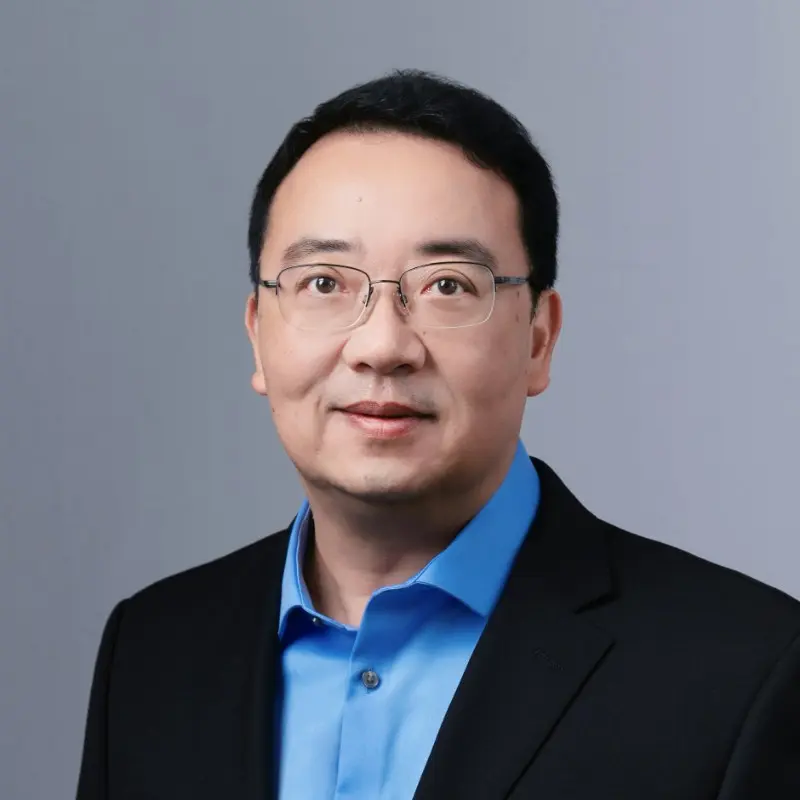
Xin Guo, Solidigm | theCUBE + NYSE Wired: AI Factories - Data Centers of the Future
Forgot Password
Almost there!
We just sent you a verification email. Please verify your account to gain access to
theCUBE + NYSE Wired: The AI Factory - Data Center of the Future. If you don’t think you received an email check your
spam folder.
Sign in to AI Factories - Data Centers of the Future.
In order to sign in, enter the email address you used to registered for the event. Once completed, you will receive an email with a verification link. Open the link to automatically sign into the site.
Register for AI Factories - Data Centers of the Future
Please fill out the information below. You will receive an email with a verification link confirming your registration. Click the link to automatically sign into the site.
You’re almost there!
We just sent you a verification email. Please click the verification button in the email. Once your email address is verified, you will have full access to all event content for AI Factories - Data Centers of the Future.
I want my badge and interests to be visible to all attendees.
Checking this box will display your presense on the attendees list, view your profile and allow other attendees to contact you via 1-1 chat. Read the Privacy Policy. At any time, you can choose to disable this preference.
Select your Interests!
add
Upload your photo
Uploading..
OR
Connect via Twitter
Connect via Linkedin
EDIT PASSWORD
Share
Forgot Password
Almost there!
We just sent you a verification email. Please verify your account to gain access to
theCUBE + NYSE Wired: The AI Factory - Data Center of the Future. If you don’t think you received an email check your
spam folder.
Sign in to AI Factories - Data Centers of the Future.
In order to sign in, enter the email address you used to registered for the event. Once completed, you will receive an email with a verification link. Open the link to automatically sign into the site.
Sign in to gain access to theCUBE + NYSE Wired: The AI Factory - Data Center of the Future
Please sign in with LinkedIn to continue to theCUBE + NYSE Wired: The AI Factory - Data Center of the Future. Signing in with LinkedIn ensures a professional environment.
>> Palo Alto Studio Connection, Silicon Valley and Wall Street. I'm John Furrier my co-host.
Gemma Allen
>> Welcome back to theCUBE Studio here at the New York Stock Exchange. I'm Gemma Allen with NYSE Wired: AI Factories, and one thing we know for sure is memory is having a moment. Joining me now to talk about that is Xin Guo, co-CEO of Solidigm. Welcome, Xin.
Xin Guo
>> Hi, happy to be here and I'm very happy to have the chance to talk to you.
Gemma Allen
>> Well, you are operating in what has become a very interesting space very fast. Storage memory, it's gone from being something that was seen as a back office, back rock component, something that's very front and center of this race for AI, right?
Xin Guo
>> Right.
Gemma Allen
>> You describe it as a seismic shift. Maybe start there, Xin. Talk to us a little bit about what's happening right now and what it means for Solidigm as a company.
Xin Guo
>> Yeah. I think we call it a seismic shift in both architecture and of course of volume, because fundamentally, the infrastructure is changing or need to be changed to meet the current AI-driven demand because simple thinking is previously the infrastructure is built for human direct interaction. There's always a hands-on keyboard, single thread back and forth, but now the infrastructure need to be built for machine interaction. It's the agents talking to the infrastructure. While human is still the initiator, but at the backend, its agents amplify the activity by a hundred times, thousand times. That's why there's a lot of higher demand to the infrastructure.
Gemma Allen
>> And for SSD, does that mean new addressable market more and more and more? Is it a demand game? What is it driving from the perspective of your business metrics?
Xin Guo
>> Yeah, because we think that this is a volume metric expansion multidimensional because there's the LLM model, there's reasoning, agentic AI. And in future, there's physical AI, also multimodal with video processing, for example. So there's expanding on both data richness, complexity, and also persistence because there's a lot more regulation, security reason you have to store all data. So if you think about this data as one pyramid with multiple tiers, the whole thing is expanding because it's AI activities. That's why the demand is so huge and even compared to six months ago, it's many, many fold increase.
Gemma Allen
>> Wow. And I think one thing that has really interested markets like this and analysts around this whole memory space is that suddenly as well, there's a level of predictability on run rate, right?
Xin Guo
>> Yeah.
Gemma Allen
>> There's an understanding of three years from now, we can almost be guaranteed that numbers and demand will continue to grow. That's somewhat unusual in the tech space, correct?
Xin Guo
>> Yeah.
Gemma Allen
>> What does that mean for you and your team? Are you thinking planning three years out, five years out? How are you kind of thinking about that demand internally?
Xin Guo
>> Yeah. So I think we think of this demand we're really at the very beginning of the growth of this demand because let's think about how many people are actually using AI and the activities keep increasing, right? So on our side, we're managing the demand by increasing our production, looking at a faster node transition to the future technology to increase node, but also we're looking at the higher efficiency skills. For example, higher capacity skills because with everything equal, higher capacity per device is probably the single largest lever to crank because you have a certain power envelope floor space by increasing the density of your storage that solve a lot of problem because higher capacity, take an inferencing, take currently the key value cash issue that NVIDIA brought up because you want to store all the contacts so you don't need to spend your GPU part to rebuild all the past knowledge so you can continue work and especially in the complex agentic flow, agents can work in multiple agents working on the same data set and the agent can hand off to next agent during the flow and all that is just driving this key value cache expansion. So more capacity means faster time to first token, minimize latency between tokens and then increasing your throughput and generating new content. That's what the AI economics is and you want to generate new content.
Gemma Allen
>> And higher capacity on SSC, does that mean more reliability, more centralized control? What does it mean in terms of the actual product offering itself?
Xin Guo
>> Yeah, the product is just from the device capacity and the Solidigm way that with a CQ1 terabyte and 122 terabyte. Now this year, we're going to launch 245 terabyte and we'll continue pushing the envelope on that side, but also, we're looking at how do you further optimize the power to improve the power efficiency because every one you save on the storage is the power you can give the GPU to use. Again, that increase your overall infrastructure performance.
Gemma Allen
>> You mentioned NVIDIA, I met some of your team at GTC this year, had some great conversations. I asked one of your team members, what makes you competitive, especially you think about new developments or developments that have been promised for a long time like liquid cooling across the rack, right?
Xin Guo
>> Yeah.
Gemma Allen
>> And they said, "Well, we co-developed that with NVIDIA. So, Solidigm has a pretty strong and pretty innovative co-led partnership strategy." What other sorts of things are you guys working on, working toward, partnering with? What else is happening in the broader ecosystem for you?
Xin Guo
>> For the broader ecosystem, there's multiple vectors on the technology innovation like Lisa now, like you said, the liquid cooling and then we're also looking at the immersion cooling and also how many bits per cell, because we use a unique floating gate technology that has advantage. We could explore five bit per cell to further increase the density. But also, there's other research directions by understanding the whole stack problem because at Solidigm, we have built the industry first. I mean, among the SIC vendors, we're the first to build an AI central lab. Over there, we actually acquired the latest GPU system working with ISV partners. We built a GPU rack, storage rack network attached the storage rack. So we use that to study the AI workload and the way to do that is actually nominal with a nominal fee we rented out to potential customer. So any customer can log in through the standard API to run their whatever they want to do on our system and then from the backend, we can look at, where's the bottleneck? Is the network switch? Is the software layer? Is the hardware layer? So we can optimize, tune the system and then on the customer now they actually know this configuration works for me. I'll just go buy as a reference design.
Gemma Allen
>> Wow.
Xin Guo
>> So there's a lot of new player find that very, very valuable because they don't have hardware department, they don't have software department, they just need to do AI. So what do I buy? So they come to us, try it out and they go buy. That's why we want to see us as moving toward the AI infrastructure company by solving customer issue at the system level.
Gemma Allen
>> Wow, that's so interesting. It's like SSD as a service almost, right?
Xin Guo
>> Yeah.
Gemma Allen
>> Like Amazon type model or whatever you need to.
Xin Guo
>> Continue focusing on this pretty much commoditize SSD itself. It wouldn't solve the AI problem. That's why we build this capability so we can understand where the pain point in the entire stack that we optimize and solve their issue
Gemma Allen
>> So if we look at Solidigm three years ago and Solidigm now, there has certainly been some new developments from the perspective of TAM, right?
Xin Guo
>> Yeah.
Gemma Allen
>> You guys are continually growing that, it seems. We know demand is super high. We've covered that. We hear a lot about different elements and different kind of macro trends across the AI race, right? So we hear about AI on the edge. Obviously, there's a huge race in the data center business, neocloud, hyperscalers. There's all sorts of competitive forces at play here. From a SST perspective, how do you kind of fragment that market approach? Is it one approach fits all, ideally or do you have different market segments and verticals trying to meet new demands all the time?
Xin Guo
>> Interesting. Just yesterday, we had our internal staff meeting. We actually went through our marketing strategy with the different verticals because there's a constraint, right? But we want to keep engaged with all the important verticals, like you said, hyperscaler, neocloud and the key OEMs. So we separate them into verticals and define our strategy and there's no other way to say it, but it's allocation. We have a lot of a strong long-term customer relationship, we want to continue to support them, but we can support all of them. So we decide all the key customers and we want to keep long-term relationship and then we support them with different verticals.
Gemma Allen
>> Wow. So in terms of what's ahead for you and the team, I know you're also in a co-CEO role, right? Maybe it was too big a job for any one man or woman. Can you talk to me a little bit about how you guys divide the company and your time and your, I guess, priorities, how does that play out?
Xin Guo
>> Right. So I'm engineering background. I am a career flash guy. I start from NOR flash device engineering and then NAND and the SSDs. So I was appointed as co-CEO in March. Before that, I was acting co-CEO for a few quarters while running the data center engineering, basically our entire engineering group. So going forward, my focus is really on driving the global business and execution on development, technology and operations. In May, we have a new co-CEO, his name is Richard Chen. He joined us from SK Group. He's very experienced, a long track record in corporate development, finances, business strategy. So he'll be focused on elevating our overall performance, looking at the future growth potential options and maximizing our growth trajectory forward. So we have a very complimentary skill and I think that's the best for the company.
Gemma Allen
>> And for a business as technically sound as this one, I think that's very important too, right? Having the technical leadership combined with the business leadership, you guys can double team it.
Xin Guo
>> Yeah. I think that the team is very happy with the combination. I think so far, we work really well together. I think together, we're going to take the company really to its next phase.
Gemma Allen
>> So, Xin, final couple of questions. What keeps you up at night from the perspective of meeting the demands of this moment? We hear so much about compute constraints, energy constraints, all of the things that affect the macro outputs of this era. From your perspective in the world of SSD, what is the one thing you wish you could fix tomorrow?
Xin Guo
>> It's definitely the amount of supply available that this always on my mind is working very hard of looking at how do we increase production, make investment, increase production, but in the end industry, we've been burned many times. So we also need to calculate the risk, be careful because we don't want to so hotheaded and then spend all the money on CapEx now. So we're constantly doing this calculated risk and staging the CapEx. So we make sure we want to support our customers' need, but not to drive the industry into an oversupply situation.
Gemma Allen
>> And then lastly, when we look five, 10 years out in this industry, hear a lot about quantum computing, all of the potential opportunities that that brings, I think everyone thinks it's five years away every year. From the perspective of your industry and the quantum industry, what are your thoughts there? Is this like an accelerated development process? I imagine we'll still have GPUs will still be part of that side process, right?
Xin Guo
>> Yeah.
Gemma Allen
>> The QPUs. What would SSD mean in the world of QPUs?
Xin Guo
>> Yeah. I think that the quantum computing is going to happen. There's no doubt about that. Whether it's five year or not, it's been always saying it's five years. I think it's getting closer and closer now. And on SSD side, I think our main focus is mostly how to support quantum computing security. So all this post quantum computing security features are being developed and integrated into the product and also how do we work with the software stack to make sure we support the quantum computing. I think that's currently our R&D's focus.
Gemma Allen
>> Well, it's certainly no easy feat. I imagine this world of tech right now is so busy, but also so opportunistic, right?
Xin Guo
>> Especially with AI capability, these things are changing, evolving really, really fast that we have to keep up with it.
Gemma Allen
>> For sure. Well, Xin, thank you so much for coming on theCUBE + NYSE Wired. Great to chat with you.
Xin Guo
>> Yeah, it's great talking to you. Happy to be here.
Gemma Allen
>> I'm Gemma Allen here at theCUBE Studio at the NYSE. This is NYSE Wired: AI Factories. Thanks for watching.
>> Palo Alto Studio Connection, Silicon Valley and Wall Street. I'm John Furrier my co-host.
Gemma Allen
>> Welcome back to theCUBE Studio here at the New York Stock Exchange. I'm Gemma Allen with NYSE Wired: AI Factories, and one thing we know for sure is memory is having a moment. Joining me now to talk about that is Xin Guo, co-CEO of Solidigm. Welcome, Xin.
Xin Guo
>> Hi, happy to be here and I'm very happy to have the chance to talk to you.
Gemma Allen
>> Well, you are operating in what has become a very interesting space very fast. Storage memory, it's gone from being something that was seen as a back office, back rock component, something that's very front and center of this race for AI, right?
Xin Guo
>> Right.
Gemma Allen
>> You describe it as a seismic shift. Maybe start there, Xin. Talk to us a little bit about what's happening right now and what it means for Solidigm as a company.
Xin Guo
>> Yeah. I think we call it a seismic shift in both architecture and of course of volume, because fundamentally, the infrastructure is changing or need to be changed to meet the current AI-driven demand because simple thinking is previously the infrastructure is built for human direct interaction. There's always a hands-on keyboard, single thread back and forth, but now the infrastructure need to be built for machine interaction. It's the agents talking to the infrastructure. While human is still the initiator, but at the backend, its agents amplify the activity by a hundred times, thousand times. That's why there's a lot of higher demand to the infrastructure.
Gemma Allen
>> And for SSD, does that mean new addressable market more and more and more? Is it a demand game? What is it driving from the perspective of your business metrics?
Xin Guo
>> Yeah, because we think that this is a volume metric expansion multidimensional because there's the LLM model, there's reasoning, agentic AI. And in future, there's physical AI, also multimodal with video processing, for example. So there's expanding on both data richness, complexity, and also persistence because there's a lot more regulation, security reason you have to store all data. So if you think about this data as one pyramid with multiple tiers, the whole thing is expanding because it's AI activities. That's why the demand is so huge and even compared to six months ago, it's many, many fold increase.
Gemma Allen
>> Wow. And I think one thing that has really interested markets like this and analysts around this whole memory space is that suddenly as well, there's a level of predictability on run rate, right?
Xin Guo
>> Yeah.
Gemma Allen
>> There's an understanding of three years from now, we can almost be guaranteed that numbers and demand will continue to grow. That's somewhat unusual in the tech space, correct?
Xin Guo
>> Yeah.
Gemma Allen
>> What does that mean for you and your team? Are you thinking planning three years out, five years out? How are you kind of thinking about that demand internally?
Xin Guo
>> Yeah. So I think we think of this demand we're really at the very beginning of the growth of this demand because let's think about how many people are actually using AI and the activities keep increasing, right? So on our side, we're managing the demand by increasing our production, looking at a faster node transition to the future technology to increase node, but also we're looking at the higher efficiency skills. For example, higher capacity skills because with everything equal, higher capacity per device is probably the single largest lever to crank because you have a certain power envelope floor space by increasing the density of your storage that solve a lot of problem because higher capacity, take an inferencing, take currently the key value cash issue that NVIDIA brought up because you want to store all the contacts so you don't need to spend your GPU part to rebuild all the past knowledge so you can continue work and especially in the complex agentic flow, agents can work in multiple agents working on the same data set and the agent can hand off to next agent during the flow and all that is just driving this key value cache expansion. So more capacity means faster time to first token, minimize latency between tokens and then increasing your throughput and generating new content. That's what the AI economics is and you want to generate new content.
Gemma Allen
>> And higher capacity on SSC, does that mean more reliability, more centralized control? What does it mean in terms of the actual product offering itself?
Xin Guo
>> Yeah, the product is just from the device capacity and the Solidigm way that with a CQ1 terabyte and 122 terabyte. Now this year, we're going to launch 245 terabyte and we'll continue pushing the envelope on that side, but also, we're looking at how do you further optimize the power to improve the power efficiency because every one you save on the storage is the power you can give the GPU to use. Again, that increase your overall infrastructure performance.
Gemma Allen
>> You mentioned NVIDIA, I met some of your team at GTC this year, had some great conversations. I asked one of your team members, what makes you competitive, especially you think about new developments or developments that have been promised for a long time like liquid cooling across the rack, right?
Xin Guo
>> Yeah.
Gemma Allen
>> And they said, "Well, we co-developed that with NVIDIA. So, Solidigm has a pretty strong and pretty innovative co-led partnership strategy." What other sorts of things are you guys working on, working toward, partnering with? What else is happening in the broader ecosystem for you?
Xin Guo
>> For the broader ecosystem, there's multiple vectors on the technology innovation like Lisa now, like you said, the liquid cooling and then we're also looking at the immersion cooling and also how many bits per cell, because we use a unique floating gate technology that has advantage. We could explore five bit per cell to further increase the density. But also, there's other research directions by understanding the whole stack problem because at Solidigm, we have built the industry first. I mean, among the SIC vendors, we're the first to build an AI central lab. Over there, we actually acquired the latest GPU system working with ISV partners. We built a GPU rack, storage rack network attached the storage rack. So we use that to study the AI workload and the way to do that is actually nominal with a nominal fee we rented out to potential customer. So any customer can log in through the standard API to run their whatever they want to do on our system and then from the backend, we can look at, where's the bottleneck? Is the network switch? Is the software layer? Is the hardware layer? So we can optimize, tune the system and then on the customer now they actually know this configuration works for me. I'll just go buy as a reference design.
Gemma Allen
>> Wow.
Xin Guo
>> So there's a lot of new player find that very, very valuable because they don't have hardware department, they don't have software department, they just need to do AI. So what do I buy? So they come to us, try it out and they go buy. That's why we want to see us as moving toward the AI infrastructure company by solving customer issue at the system level.
Gemma Allen
>> Wow, that's so interesting. It's like SSD as a service almost, right?
Xin Guo
>> Yeah.
Gemma Allen
>> Like Amazon type model or whatever you need to.
Xin Guo
>> Continue focusing on this pretty much commoditize SSD itself. It wouldn't solve the AI problem. That's why we build this capability so we can understand where the pain point in the entire stack that we optimize and solve their issue
Gemma Allen
>> So if we look at Solidigm three years ago and Solidigm now, there has certainly been some new developments from the perspective of TAM, right?
Xin Guo
>> Yeah.
Gemma Allen
>> You guys are continually growing that, it seems. We know demand is super high. We've covered that. We hear a lot about different elements and different kind of macro trends across the AI race, right? So we hear about AI on the edge. Obviously, there's a huge race in the data center business, neocloud, hyperscalers. There's all sorts of competitive forces at play here. From a SST perspective, how do you kind of fragment that market approach? Is it one approach fits all, ideally or do you have different market segments and verticals trying to meet new demands all the time?
Xin Guo
>> Interesting. Just yesterday, we had our internal staff meeting. We actually went through our marketing strategy with the different verticals because there's a constraint, right? But we want to keep engaged with all the important verticals, like you said, hyperscaler, neocloud and the key OEMs. So we separate them into verticals and define our strategy and there's no other way to say it, but it's allocation. We have a lot of a strong long-term customer relationship, we want to continue to support them, but we can support all of them. So we decide all the key customers and we want to keep long-term relationship and then we support them with different verticals.
Gemma Allen
>> Wow. So in terms of what's ahead for you and the team, I know you're also in a co-CEO role, right? Maybe it was too big a job for any one man or woman. Can you talk to me a little bit about how you guys divide the company and your time and your, I guess, priorities, how does that play out?
Xin Guo
>> Right. So I'm engineering background. I am a career flash guy. I start from NOR flash device engineering and then NAND and the SSDs. So I was appointed as co-CEO in March. Before that, I was acting co-CEO for a few quarters while running the data center engineering, basically our entire engineering group. So going forward, my focus is really on driving the global business and execution on development, technology and operations. In May, we have a new co-CEO, his name is Richard Chen. He joined us from SK Group. He's very experienced, a long track record in corporate development, finances, business strategy. So he'll be focused on elevating our overall performance, looking at the future growth potential options and maximizing our growth trajectory forward. So we have a very complimentary skill and I think that's the best for the company.
Gemma Allen
>> And for a business as technically sound as this one, I think that's very important too, right? Having the technical leadership combined with the business leadership, you guys can double team it.
Xin Guo
>> Yeah. I think that the team is very happy with the combination. I think so far, we work really well together. I think together, we're going to take the company really to its next phase.
Gemma Allen
>> So, Xin, final couple of questions. What keeps you up at night from the perspective of meeting the demands of this moment? We hear so much about compute constraints, energy constraints, all of the things that affect the macro outputs of this era. From your perspective in the world of SSD, what is the one thing you wish you could fix tomorrow?
Xin Guo
>> It's definitely the amount of supply available that this always on my mind is working very hard of looking at how do we increase production, make investment, increase production, but in the end industry, we've been burned many times. So we also need to calculate the risk, be careful because we don't want to so hotheaded and then spend all the money on CapEx now. So we're constantly doing this calculated risk and staging the CapEx. So we make sure we want to support our customers' need, but not to drive the industry into an oversupply situation.
Gemma Allen
>> And then lastly, when we look five, 10 years out in this industry, hear a lot about quantum computing, all of the potential opportunities that that brings, I think everyone thinks it's five years away every year. From the perspective of your industry and the quantum industry, what are your thoughts there? Is this like an accelerated development process? I imagine we'll still have GPUs will still be part of that side process, right?
Xin Guo
>> Yeah.
Gemma Allen
>> The QPUs. What would SSD mean in the world of QPUs?
Xin Guo
>> Yeah. I think that the quantum computing is going to happen. There's no doubt about that. Whether it's five year or not, it's been always saying it's five years. I think it's getting closer and closer now. And on SSD side, I think our main focus is mostly how to support quantum computing security. So all this post quantum computing security features are being developed and integrated into the product and also how do we work with the software stack to make sure we support the quantum computing. I think that's currently our R&D's focus.
Gemma Allen
>> Well, it's certainly no easy feat. I imagine this world of tech right now is so busy, but also so opportunistic, right?
Xin Guo
>> Especially with AI capability, these things are changing, evolving really, really fast that we have to keep up with it.
Gemma Allen
>> For sure. Well, Xin, thank you so much for coming on theCUBE + NYSE Wired. Great to chat with you.
Xin Guo
>> Yeah, it's great talking to you. Happy to be here.
Gemma Allen
>> I'm Gemma Allen here at theCUBE Studio at the NYSE. This is NYSE Wired: AI Factories. Thanks for watching.