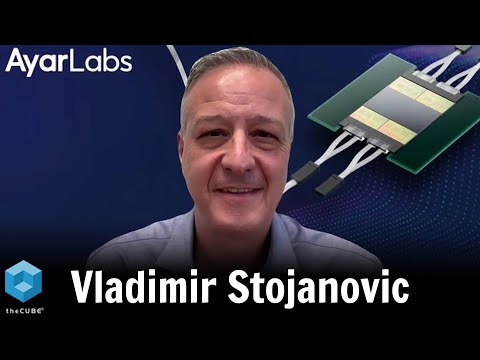
In this conversation from theCUBE + NYSE Wired’s “AI Factories – Data Centers of the Future,” Ayar Labs co-founder and CTO Vladimir Stojanovic joins theCUBE’s John Furrier to unpack how optical I/O is redefining AI-scale infrastructure. Stojanovic explains how Ayar Labs’ co-packaged optical engines (chiplets) attach to AI accelerators, switches and extended memory to deliver ultra-low latency, extreme bandwidth and strong energy efficiency, stitching together thousands of GPUs to operate as one system. He details why the next decade of AI will be won by interconnects: higher radix connectivity, flatter fabrics and fewer network hops to cut queuing delays and prevent expensive GPUs from idling. The discussion also surfaces notable metrics around rising rack densities (from ~30kW to 80kW, 120kW, 180kW – and talk of 600kW) and how in-package optics can help flatten power escalation by enabling many 100kW racks to deliver future-scale compute.
The interview dives into the product and ecosystem foundations enabling volume: Ayar Labs’ optical I/O chiplets in manufacturable form factors, partnerships with TSMC and Alchip to integrate optical engines alongside CoWoS interposers, memory and compute, and the backend test and assembly steps required for high-volume production. Stojanovic traces the journey from early DARPA-backed academic work (MIT, UC Berkeley, CU Boulder) and demonstrations with GlobalFoundries and IBM to today’s scale-up/scale-out convergence – spanning 1 → 8 → 32 → 64 → 256 → 512 → 1,000+ → 10,000 GPUs. He outlines why performance-per-TCO and interactivity are the key axes for AI factories, and shares a near-term execution window of roughly 18–24 months as Ayar Labs drives toward mass production.
Forgot Password
Almost there!
We just sent you a verification email. Please verify your account to gain access to
theCUBE + NYSE Wired: AI Factories - Data Centers of the Future. If you don’t think you received an email check your
spam folder.
Sign in to AI Factories - Data Centers of the Future.
In order to sign in, enter the email address you used to registered for the event. Once completed, you will receive an email with a verification link. Open the link to automatically sign into the site.
Register for AI Factories - Data Centers of the Future
Please fill out the information below. You will receive an email with a verification link confirming your registration. Click the link to automatically sign into the site.
You’re almost there!
We just sent you a verification email. Please click the verification button in the email. Once your email address is verified, you will have full access to all event content for AI Factories - Data Centers of the Future.
I want my badge and interests to be visible to all attendees.
Checking this box will display your presense on the attendees list, view your profile and allow other attendees to contact you via 1-1 chat. Read the Privacy Policy. At any time, you can choose to disable this preference.
Select your Interests!
add
Upload your photo
Uploading..
OR
Connect via Twitter
Connect via Linkedin
EDIT PASSWORD
Share
Forgot Password
Almost there!
We just sent you a verification email. Please verify your account to gain access to
theCUBE + NYSE Wired: AI Factories - Data Centers of the Future. If you don’t think you received an email check your
spam folder.
Sign in to AI Factories - Data Centers of the Future.
In order to sign in, enter the email address you used to registered for the event. Once completed, you will receive an email with a verification link. Open the link to automatically sign into the site.
Sign in to gain access to theCUBE + NYSE Wired: AI Factories - Data Centers of the Future
Please sign in with LinkedIn to continue to theCUBE + NYSE Wired: AI Factories - Data Centers of the Future. Signing in with LinkedIn ensures a professional environment.
Are you sure you want to remove access rights for this user?
Details
Manage Access
email address
Community Invitation
Justin Borgman, Starburst
In this conversation from theCUBE + NYSE Wired’s “AI Factories – Data Centers of the Future,” Ayar Labs co-founder and CTO Vladimir Stojanovic joins theCUBE’s John Furrier to unpack how optical I/O is redefining AI-scale infrastructure. Stojanovic explains how Ayar Labs’ co-packaged optical engines (chiplets) attach to AI accelerators, switches and extended memory to deliver ultra-low latency, extreme bandwidth and strong energy efficiency, stitching together thousands of GPUs to operate as one system. He details why the next decade of AI will be won by interconnects: higher radix connectivity, flatter fabrics and fewer network hops to cut queuing delays and prevent expensive GPUs from idling. The discussion also surfaces notable metrics around rising rack densities (from ~30kW to 80kW, 120kW, 180kW – and talk of 600kW) and how in-package optics can help flatten power escalation by enabling many 100kW racks to deliver future-scale compute.
The interview dives into the product and ecosystem foundations enabling volume: Ayar Labs’ optical I/O chiplets in manufacturable form factors, partnerships with TSMC and Alchip to integrate optical engines alongside CoWoS interposers, memory and compute, and the backend test and assembly steps required for high-volume production. Stojanovic traces the journey from early DARPA-backed academic work (MIT, UC Berkeley, CU Boulder) and demonstrations with GlobalFoundries and IBM to today’s scale-up/scale-out convergence – spanning 1 → 8 → 32 → 64 → 256 → 512 → 1,000+ → 10,000 GPUs. He outlines why performance-per-TCO and interactivity are the key axes for AI factories, and shares a near-term execution window of roughly 18–24 months as Ayar Labs drives toward mass production.
play_circle_outlineImportance of data as the fuel for AI factories, alongside infrastructure and power.
replyShare Clip
play_circle_outlineChallenges of harmonizing disparate data silos within enterprises for effective AI applications.
replyShare Clip
play_circle_outlineShifting Paradigms: Federated Data Strategies and AI Governance in Financial Institutions
replyShare Clip
play_circle_outlineEmpowering Decision-Making: The Shift to Self-Service BI and Conversational Data Interaction for Executive Agents and Sales Processes
replyShare Clip
play_circle_outlineBuilding a Semantic Layer: Integrating Data Sources and Enhancing Digital Representation in Business Contexts
>> Hi, everybody. Welcome back to New York Stock Exchange. My name is Dave Vellante and this is our AI Factories: Data Centers of the Future series. Justin Borgman's back in our studio. Good to see you. CEO of Starburst. Thanks for coming in again, face to face.
Justin Borgman
>> My pleasure. Glad to be back.
Dave Vellante
>> Yeah, so you've got some customer advisory board action going on this week-
Justin Borgman
>> We do. Midtown.
Dave Vellante
>> ... two days in New York, right?
Justin Borgman
>> You got it. Yeah, busy week.
Dave Vellante
>> What'd you say? 20, 25 customers coming in?
Justin Borgman
>> That's right.
Dave Vellante
>> What do you guys do? They just brain dump, brainstorm, show them the road map, get feedback?
Justin Borgman
>> For me, it's one of the best times of the year because it's an opportunity to share with them a little bit of the roadmap of where we're going and really get their feedback firsthand. And our customer advisory boards tend to be individuals who are key decision makers, key influencers within the companies that they work for, and we really value their opinion. So, it has a material impact on how we shape our own product strategy. So, very excited for it.
Dave Vellante
>> So, Jensen was here at the exchange yesterday. Michael Dell, he had his security analyst meeting yesterday. And I heard Jensen on TV this morning. Of course, all the talk is about the AI factories, the infrastructure, the power, the chips, the networking, the storage. Obviously, Dell talks about that. And Dell at his financial analyst meeting talked a lot about the Dell Lakehouse as part of the data strategy. But it was interesting listening to Jensen this morning on TV. He talked about this stack that's emerging, power being a big part of that, energy, of course, but I didn't hear it at all about the data and it just seems to me the data is the fuel for AI factories. And so, I wonder if you could address that, what you're hearing from your customers, how they're getting their data ready to really actually run these AI factories, as Jensen calls them.
Justin Borgman
>> Yeah, I completely agree. It's almost like the early days of computing, talking about the hardware without the software. The hardware's no good without the software. And I think similarly, AI is no good without the data. It really is a data story and it's about bringing the right data to bear, the right context, the right proprietary enterprise data to the equation, so the model can be useful. And I think we're still in those early innings. I think that's why there is so much attention on the lower levels of infrastructure, the power, the silicon, the metal. And gradually, as these use cases become production and people start to see real business value, I think that conversation is going to move up the stack and I think the focus is going to move up the stack.
Dave Vellante
>> I'm curious as to how you see that evolving because we talk a lot about AI in the cloud. A lot of the series that we're doing here with AI Factories is focused on enterprise AI. What that on-prem AI stack looks like. Moving intelligence to the data versus the data into the cloud. As you well know, a lot of institutions, a lot of enterprises, they're not ready for liquid cooling, they're not building necessarily big AI factories, like the CoreWeaves and the Lambdas are doing. As well, I want to put forth the premise and get your reaction. So, even if you could centralize everything into a lake house, and I know your strategy is to leave the data where it is and federated. But even in that instance, if you have marketing data and you have sales data and you have financial data and supply chain data, even if it's all in one place or even accessible via Starburst, there's still silos because that data's not harmonized. And so, it seems like you can bring AI to any one of those silos within the application stack. What are enterprises doing to bring all that together in a harmonized dataset, so they can actually serve up agents? I know it's forward-thinking and we're not there yet, but how do you see that playing out?
Justin Borgman
>> Yeah, I think this is the key challenge for enterprises today is how do I get the right data to bear for my AI applications, the agents that I want to build? Our answer builds on that federated architecture and is really about assembling what we call data products, which are essentially views of your data with metadata and business context built in that you can now pass on to an LLM as part of your chat experience. And that context, that enterprise context is what's going to make all the difference really in terms of bringing these applications to life. And so, we think every enterprise needs to be thinking about how they get access to all the data that's relevant. And to your earlier point, I mean we've always believed that you'll never get it all into one database. We've just never seen that really in history. I mean, that was my experience even at Teradata, which was an early pioneer in this centralization concept, and it never really happened. I just think the laws of physics almost work against it, the natural entropy in the universe. There's always going to be all these different data silos.
Dave Vellante
>> Yeah, you're right. Teradata got it all started. They were really the first converged database infrastructure, and we've seen Oracle take a similar path, but so this week you're meeting with a number of large financial institutions. What do you see them doing in terms of building that on-prem AI capability? You hear, of course everybody's talking about the MIT study. Only 5% of POCs that go into production are actually getting ROI within six months. I mean, I think reading that study was very narrow definition of business value, if you will. But nonetheless, there is a sentiment. People are concerned, how do I get value out of this? So, what are you seeing those large financial institutions doing? Because they tend to be a harbinger of the broader market. Let's start there.
Justin Borgman
>> Yeah, so I think what we're working with them on is how do you create this agentic substrate, if you will? This layer that provides governed access to the data that you're looking for? And doing that in a very controlled way, everything has to be compliant in financial services. I think that's why they are such pioneers in pushing the envelope of how you can build these types of architectures at scale. And so, working with them to leverage obviously our own technology as this substrate where we can connect to the 50,000, 100,000, 200,000 different data sources that they have. They can construct these curated data products. Those data products can be used for analytics and BI, but they can also be used for agents, and that allows you to create useful self-contained agentic experiences.
Dave Vellante
>> I was talking to Michael Dell yesterday. We were asking him about his internal use of AI, and he spoke to this in the security analyst meeting as well. It feels like at companies like Dell, who are probably pretty huge opportunity to cut costs and scale without labor, and my inference in speaking to him was, "Look, we're really just getting started with agents. We're going after opportunities where our datasets are actually solid," as we were talking about before. "But we don't want to..." I call it paving the cow path with process. "We don't want to just take an existing process and automate it. We're doing some of that, but really what we're doing is rethinking our entire processes."
And so, how are you seeing that play out within your leading edge customers? Are they focusing on narrow use cases, maybe smaller NPVs, hitting singles I call it, or are they starting to really look at reformatting, rethinking their entire business processes?
Justin Borgman
>> Yeah, they definitely want to get there. And I will say actually Michael is really an early adopter and pioneer, pushing the envelope, I think within Dell. Dell's been a great partner of ours. They're also a customer of our technology, and it's incredible to see the leadership from him at the top looking to implement these technologies even in the way that they do business. But I would say what we see across customers is two different early use cases. One is for effectively what I'll call an executive agent. Basically, a ChatGPT experience for the C-suite to be able to interact with data as a supplement to the dashboards that they create, right? They've always had dashboards with the KPIs of the business. Now, being able to self-serve and interact with that data in a conversational way is very powerful and it demonstrates value at a level of the organization that then creates enthusiasm and helps galvanize interest around continuing to invest in these technologies. So, that's one pattern we've seen. The other is around very specific business use cases where there's an element of the way that a company is going to market today that they'd like to incorporate agents involved. Maybe that's some aspect of customer support or customer service maybe that is in the sales organization and helping to prepare their sellers or have the right conversations with customers based on what a customer's looking for. And so, those are some early examples that we're seeing.
Dave Vellante
>> And it seems to me there's ROI there. I call self-serve BI, where you can actually interpret the data on your own, you can speak to the dataset that's right, and don't have to go through an analyst or maybe the analyst gets superpowers and could do a lot more in a lot less time. So, that's productivity. And the other support and service piece, I mean, everybody's saying that that's working. And they're able to provide better customer service, they're able to scale without new labor. So, those make a lot of sense to me. What I'm curious about is beyond that, some of the bigger wins. And so, we have this theory that when we went from on-prem software to SaaS, a lot changed, particularly in the IT world. Of course, cloud changed the IT heavy lifting as used to call it, probably still does, but the technical model, the operational model and the business model changed, SaaS. It brought multi-tenant, it brought subscription pricing, consumption pricing. And we feel like the move to agentic, we call it service-as-software, in other words, services that are high-productivity contributors that are delivered through software that are very process-oriented. And our thinking is that the technical, the operational and the business model will change again. The pricing models is going to change and it's not just going to affect IT. It's going to affect the entire organization across all industries. And the theory is that you'll start to see software like marginal economics hit enterprises, not just software companies. And a winner-take-most dynamic could emerge because of learning curve experience. Now, that's going to take the better part of a decade to unfold. Are your leading edge customers thinking about this? Are they paranoid that? Are they diving in? Do you see Jamie Dimon saying, "We're going to own the future"? What are your thoughts on that?
Justin Borgman
>> Yeah, so first of all, I buy into your thesis. I think that's absolutely what I would see as likely to occur. And I think what we see is frankly, the smart companies are paranoid, and I think rightfully so, because this can change everything. I mean, you could be third place in an industry and now become first place in that industry by putting these technologies to use quickly and efficiently. Or you could go from first place to last place or not even exist anymore. So, I think it truly is one of those existential threats. It's the asteroid that got rid of the dinosaurs type of thing. And you have to be thinking with that degree of urgency to reinvent yourself. And in the technology business, that's always been a way of life. We've always had to reinvent ourselves, but I think what you're pointing to is this is now going to be more pervasive than even just the tech sector. Every enterprise is going to have to reinvent itself.
Dave Vellante
>> And to get there, it really does seem like data... I think power, obviously, energy is a constraint. I ultimately don't think GPUs are going to be the constraint. I don't think silicon is going to be the problem. I do think data is going to be a constraint. You guys play a big part of that. So, what has to happen in your view to remove that constraint? Obviously, you're playing a role in terms of federating the data, and that's a starting point. What about that notion of being able to look at an enterprise as a digital representation of a business? And not strings, we've talked about this, that databases understand, but people, places, things and activities, like processes that are maybe part of that representation. Does it need a graph database? Does it need some kind of new technology that's developed to harmonize that? We call it the system of intelligence layer that does that harmonization, that governance, you guys play there, and then feeds the agents. How do you see that progressing?
Justin Borgman
>> Yeah, I think there's a lot more attention and focus both on the customer side, and therefore, also on the vendor side, on creating this semantic layer as it's often known. And I think there's opportunities, and this is an area that we're investing to help automate the creation of that semantic layer to basically do discovery on the datasets that exist and extract that business context, that business metadata to help enrich how to use and understand this data. And every company has to get their house in order as it pertains to this, because again, that is going to be the fuel. Maybe to build on that analogy, it's like you have to refine the raw crude oil to make it useful to go into the engine. And I think that's an important area of focus for a lot of enterprises. And again, I think the ones that are really leaning in, especially a lot of those and financial services here within a mile radius of where we're sitting, they are on getting that agentic substrate, getting that semantic layer, getting that software infrastructure set up for success.
Dave Vellante
>> Yeah, I know I was speaking to JPMC, it was at Snowflake, and my interpretation was, "Yeah, we have our Snowflake analytics up in the cloud," and that's part of it. But when I started to push them on, "Well, what about this semantic layer? What about that harmonization? What about all the governance around that?" They said, "Yeah, we had to build that ourselves." Okay. JPMC can do that. We're hoping is that the industry will come up with solutions that the mainstream enterprises that can't hire 1,000 AI experts like JPMC can, can actually buy solutions. Do you see Starburst as contributing to that layer of the stack directly? Are you investing R&D dollars in that semantic layer? Do you see others? I know we know our friend Chris Lynch is working on that very heavily. I think everybody is where, I mean you saw the announcement from Snowflake, but really, that's just the analytics piece of it. Analytics is tell us what happened, maybe where it happened and maybe a little bit of why it happened, but it's not great at telling us what's going to happen next and what should I do next? What's likely to happen next? And that's the piece that seems to be missing. Where does Starburst play in that? Obviously, data access is critical, being able to query data where it is. Do you see yourselves trying to participate directly in that semantic layer data harmonization, or is that somebody else's role?
Justin Borgman
>> We're providing the tools to do that. Yeah, so we have this concept, we call it data products. That term gets used by a lot of individuals. For us, it's really creating these views of data that can span multiple data sources. And of course, that leverages our federated platform. So, you can stitch together a data product that leverages data from three different data sources all in one, and make that consumable and useful. And so, that's our avenue into helping customers build that semantic layer, make these agents more useful.
Dave Vellante
>> Is that different, Justin, than what you would think of traditionally as a materialized view or is it a similar-
Justin Borgman
>> Yeah, great question. It's similar but different in the sense that you can actually... There's two ways to use Starburst on that. You can materialize a view, in which case, we'll materialize it in Iceberg in a lake by default. We think that's always the best bet. Open standards, we've talked about that on previous sessions. Or you can do a live view and that's part of what also makes Starburst unique, is you can actually query that view, that virtual view, that logical view without having to materialize. So, you have flexibility there. And different use cases will dictate different models.
Dave Vellante
>> But that live view I see is critical to topic that we were just talking about, that digital representation of an enterprise that's organic.
Justin Borgman
>> That's right.
Dave Vellante
>> I've avoided going down the Iceberg rathole, my friend and I think Sanjeev Mohan.
Justin Borgman
>> Yes.
Dave Vellante
>> He said on theCUBE one time, "Can we please stop talking about Iceberg and let's talk about business value?" And that's really where the business value comes in. That live view I think is an enabler to that digital representation of the enterprise. What's the blocker for companies getting there?
Justin Borgman
>> I think they're just not used to it. I think the industry for decades-
Dave Vellante
>> Used to making copies.
Justin Borgman
>> Yeah, exactly. It's been the ETL story for 30, 40 years, so I think it's a different behavior.
Dave Vellante
>> Yeah, yeah. So, bottom line is give up trying to centralize your data and shoving it to one data store, that's never going to work. We can agree on that. Especially you're hearing all these edge use cases popping up. You're seeing all this amazing silicon happening at the edge, and so there's going to be a lot of activity there. I presume you have an edge play, you can query edge-
Justin Borgman
>> We can. We absolutely can.
Dave Vellante
>> Yeah. Yeah. So, how do you see that playing out? Timeframe? Is it when will it be a meaningful source of revenue for you guys? Is it-
Justin Borgman
>> On the edge specifically?
Dave Vellante
>> Yeah.
Justin Borgman
>> Yeah, that's an interesting question. It's a very small part of our business today, but it's interesting to see how that evolves and how bandwidth continues to improve in terms of the ability to query and access that data.
Dave Vellante
>> Well, listen, good luck this week-
Justin Borgman
>> Thank you.
Dave Vellante
>> ... at your customer advisory board. I know those things are really critical to firms like yours, especially now that you've got a really strong foothold, particularly in financial services. I'm sure you're going to learn a lot. It's two days that you're doing this?
Justin Borgman
>> It is. And I'll make a quick plug. In a few weeks we have our Datanova event, which is our big customer event. It's October 22nd and 23rd. If any of your viewers want to tune in, you'll get to hear more about how customers are using these technologies.
Dave Vellante
>> And where is that?
Justin Borgman
>> That's virtual.
Dave Vellante
>> Okay, cool. Awesome. Yeah, you guys have done a bunch of those. Do you see yourself doing a physical customer event at some point?
Justin Borgman
>> Yeah, for sure. For sure.
Dave Vellante
>> Good. We'd like to be there when you do.
Justin Borgman
>> Okay, great. Great.
Dave Vellante
>> All right, Justin. Thanks very much.
Justin Borgman
>> Thank you.
Dave Vellante
>> All right. Thank you for watching. This is Dave Vellante for the entire CUBE team, our AI Factories: Data Center of the Future series. We'll be right back from the New York Stock Exchange, right after this short break.
>> Hi, everybody. Welcome back to New York Stock Exchange. My name is Dave Vellante and this is our AI Factories: Data Centers of the Future series. Justin Borgman's back in our studio. Good to see you. CEO of Starburst. Thanks for coming in again, face to face.
Justin Borgman
>> My pleasure. Glad to be back.
Dave Vellante
>> Yeah, so you've got some customer advisory board action going on this week-
Justin Borgman
>> We do. Midtown.
Dave Vellante
>> ... two days in New York, right?
Justin Borgman
>> You got it. Yeah, busy week.
Dave Vellante
>> What'd you say? 20, 25 customers coming in?
Justin Borgman
>> That's right.
Dave Vellante
>> What do you guys do? They just brain dump, brainstorm, show them the road map, get feedback?
Justin Borgman
>> For me, it's one of the best times of the year because it's an opportunity to share with them a little bit of the roadmap of where we're going and really get their feedback firsthand. And our customer advisory boards tend to be individuals who are key decision makers, key influencers within the companies that they work for, and we really value their opinion. So, it has a material impact on how we shape our own product strategy. So, very excited for it.
Dave Vellante
>> So, Jensen was here at the exchange yesterday. Michael Dell, he had his security analyst meeting yesterday. And I heard Jensen on TV this morning. Of course, all the talk is about the AI factories, the infrastructure, the power, the chips, the networking, the storage. Obviously, Dell talks about that. And Dell at his financial analyst meeting talked a lot about the Dell Lakehouse as part of the data strategy. But it was interesting listening to Jensen this morning on TV. He talked about this stack that's emerging, power being a big part of that, energy, of course, but I didn't hear it at all about the data and it just seems to me the data is the fuel for AI factories. And so, I wonder if you could address that, what you're hearing from your customers, how they're getting their data ready to really actually run these AI factories, as Jensen calls them.
Justin Borgman
>> Yeah, I completely agree. It's almost like the early days of computing, talking about the hardware without the software. The hardware's no good without the software. And I think similarly, AI is no good without the data. It really is a data story and it's about bringing the right data to bear, the right context, the right proprietary enterprise data to the equation, so the model can be useful. And I think we're still in those early innings. I think that's why there is so much attention on the lower levels of infrastructure, the power, the silicon, the metal. And gradually, as these use cases become production and people start to see real business value, I think that conversation is going to move up the stack and I think the focus is going to move up the stack.
Dave Vellante
>> I'm curious as to how you see that evolving because we talk a lot about AI in the cloud. A lot of the series that we're doing here with AI Factories is focused on enterprise AI. What that on-prem AI stack looks like. Moving intelligence to the data versus the data into the cloud. As you well know, a lot of institutions, a lot of enterprises, they're not ready for liquid cooling, they're not building necessarily big AI factories, like the CoreWeaves and the Lambdas are doing. As well, I want to put forth the premise and get your reaction. So, even if you could centralize everything into a lake house, and I know your strategy is to leave the data where it is and federated. But even in that instance, if you have marketing data and you have sales data and you have financial data and supply chain data, even if it's all in one place or even accessible via Starburst, there's still silos because that data's not harmonized. And so, it seems like you can bring AI to any one of those silos within the application stack. What are enterprises doing to bring all that together in a harmonized dataset, so they can actually serve up agents? I know it's forward-thinking and we're not there yet, but how do you see that playing out?
Justin Borgman
>> Yeah, I think this is the key challenge for enterprises today is how do I get the right data to bear for my AI applications, the agents that I want to build? Our answer builds on that federated architecture and is really about assembling what we call data products, which are essentially views of your data with metadata and business context built in that you can now pass on to an LLM as part of your chat experience. And that context, that enterprise context is what's going to make all the difference really in terms of bringing these applications to life. And so, we think every enterprise needs to be thinking about how they get access to all the data that's relevant. And to your earlier point, I mean we've always believed that you'll never get it all into one database. We've just never seen that really in history. I mean, that was my experience even at Teradata, which was an early pioneer in this centralization concept, and it never really happened. I just think the laws of physics almost work against it, the natural entropy in the universe. There's always going to be all these different data silos.
Dave Vellante
>> Yeah, you're right. Teradata got it all started. They were really the first converged database infrastructure, and we've seen Oracle take a similar path, but so this week you're meeting with a number of large financial institutions. What do you see them doing in terms of building that on-prem AI capability? You hear, of course everybody's talking about the MIT study. Only 5% of POCs that go into production are actually getting ROI within six months. I mean, I think reading that study was very narrow definition of business value, if you will. But nonetheless, there is a sentiment. People are concerned, how do I get value out of this? So, what are you seeing those large financial institutions doing? Because they tend to be a harbinger of the broader market. Let's start there.
Justin Borgman
>> Yeah, so I think what we're working with them on is how do you create this agentic substrate, if you will? This layer that provides governed access to the data that you're looking for? And doing that in a very controlled way, everything has to be compliant in financial services. I think that's why they are such pioneers in pushing the envelope of how you can build these types of architectures at scale. And so, working with them to leverage obviously our own technology as this substrate where we can connect to the 50,000, 100,000, 200,000 different data sources that they have. They can construct these curated data products. Those data products can be used for analytics and BI, but they can also be used for agents, and that allows you to create useful self-contained agentic experiences.
Dave Vellante
>> I was talking to Michael Dell yesterday. We were asking him about his internal use of AI, and he spoke to this in the security analyst meeting as well. It feels like at companies like Dell, who are probably pretty huge opportunity to cut costs and scale without labor, and my inference in speaking to him was, "Look, we're really just getting started with agents. We're going after opportunities where our datasets are actually solid," as we were talking about before. "But we don't want to..." I call it paving the cow path with process. "We don't want to just take an existing process and automate it. We're doing some of that, but really what we're doing is rethinking our entire processes."
And so, how are you seeing that play out within your leading edge customers? Are they focusing on narrow use cases, maybe smaller NPVs, hitting singles I call it, or are they starting to really look at reformatting, rethinking their entire business processes?
Justin Borgman
>> Yeah, they definitely want to get there. And I will say actually Michael is really an early adopter and pioneer, pushing the envelope, I think within Dell. Dell's been a great partner of ours. They're also a customer of our technology, and it's incredible to see the leadership from him at the top looking to implement these technologies even in the way that they do business. But I would say what we see across customers is two different early use cases. One is for effectively what I'll call an executive agent. Basically, a ChatGPT experience for the C-suite to be able to interact with data as a supplement to the dashboards that they create, right? They've always had dashboards with the KPIs of the business. Now, being able to self-serve and interact with that data in a conversational way is very powerful and it demonstrates value at a level of the organization that then creates enthusiasm and helps galvanize interest around continuing to invest in these technologies. So, that's one pattern we've seen. The other is around very specific business use cases where there's an element of the way that a company is going to market today that they'd like to incorporate agents involved. Maybe that's some aspect of customer support or customer service maybe that is in the sales organization and helping to prepare their sellers or have the right conversations with customers based on what a customer's looking for. And so, those are some early examples that we're seeing.
Dave Vellante
>> And it seems to me there's ROI there. I call self-serve BI, where you can actually interpret the data on your own, you can speak to the dataset that's right, and don't have to go through an analyst or maybe the analyst gets superpowers and could do a lot more in a lot less time. So, that's productivity. And the other support and service piece, I mean, everybody's saying that that's working. And they're able to provide better customer service, they're able to scale without new labor. So, those make a lot of sense to me. What I'm curious about is beyond that, some of the bigger wins. And so, we have this theory that when we went from on-prem software to SaaS, a lot changed, particularly in the IT world. Of course, cloud changed the IT heavy lifting as used to call it, probably still does, but the technical model, the operational model and the business model changed, SaaS. It brought multi-tenant, it brought subscription pricing, consumption pricing. And we feel like the move to agentic, we call it service-as-software, in other words, services that are high-productivity contributors that are delivered through software that are very process-oriented. And our thinking is that the technical, the operational and the business model will change again. The pricing models is going to change and it's not just going to affect IT. It's going to affect the entire organization across all industries. And the theory is that you'll start to see software like marginal economics hit enterprises, not just software companies. And a winner-take-most dynamic could emerge because of learning curve experience. Now, that's going to take the better part of a decade to unfold. Are your leading edge customers thinking about this? Are they paranoid that? Are they diving in? Do you see Jamie Dimon saying, "We're going to own the future"? What are your thoughts on that?
Justin Borgman
>> Yeah, so first of all, I buy into your thesis. I think that's absolutely what I would see as likely to occur. And I think what we see is frankly, the smart companies are paranoid, and I think rightfully so, because this can change everything. I mean, you could be third place in an industry and now become first place in that industry by putting these technologies to use quickly and efficiently. Or you could go from first place to last place or not even exist anymore. So, I think it truly is one of those existential threats. It's the asteroid that got rid of the dinosaurs type of thing. And you have to be thinking with that degree of urgency to reinvent yourself. And in the technology business, that's always been a way of life. We've always had to reinvent ourselves, but I think what you're pointing to is this is now going to be more pervasive than even just the tech sector. Every enterprise is going to have to reinvent itself.
Dave Vellante
>> And to get there, it really does seem like data... I think power, obviously, energy is a constraint. I ultimately don't think GPUs are going to be the constraint. I don't think silicon is going to be the problem. I do think data is going to be a constraint. You guys play a big part of that. So, what has to happen in your view to remove that constraint? Obviously, you're playing a role in terms of federating the data, and that's a starting point. What about that notion of being able to look at an enterprise as a digital representation of a business? And not strings, we've talked about this, that databases understand, but people, places, things and activities, like processes that are maybe part of that representation. Does it need a graph database? Does it need some kind of new technology that's developed to harmonize that? We call it the system of intelligence layer that does that harmonization, that governance, you guys play there, and then feeds the agents. How do you see that progressing?
Justin Borgman
>> Yeah, I think there's a lot more attention and focus both on the customer side, and therefore, also on the vendor side, on creating this semantic layer as it's often known. And I think there's opportunities, and this is an area that we're investing to help automate the creation of that semantic layer to basically do discovery on the datasets that exist and extract that business context, that business metadata to help enrich how to use and understand this data. And every company has to get their house in order as it pertains to this, because again, that is going to be the fuel. Maybe to build on that analogy, it's like you have to refine the raw crude oil to make it useful to go into the engine. And I think that's an important area of focus for a lot of enterprises. And again, I think the ones that are really leaning in, especially a lot of those and financial services here within a mile radius of where we're sitting, they are on getting that agentic substrate, getting that semantic layer, getting that software infrastructure set up for success.
Dave Vellante
>> Yeah, I know I was speaking to JPMC, it was at Snowflake, and my interpretation was, "Yeah, we have our Snowflake analytics up in the cloud," and that's part of it. But when I started to push them on, "Well, what about this semantic layer? What about that harmonization? What about all the governance around that?" They said, "Yeah, we had to build that ourselves." Okay. JPMC can do that. We're hoping is that the industry will come up with solutions that the mainstream enterprises that can't hire 1,000 AI experts like JPMC can, can actually buy solutions. Do you see Starburst as contributing to that layer of the stack directly? Are you investing R&D dollars in that semantic layer? Do you see others? I know we know our friend Chris Lynch is working on that very heavily. I think everybody is where, I mean you saw the announcement from Snowflake, but really, that's just the analytics piece of it. Analytics is tell us what happened, maybe where it happened and maybe a little bit of why it happened, but it's not great at telling us what's going to happen next and what should I do next? What's likely to happen next? And that's the piece that seems to be missing. Where does Starburst play in that? Obviously, data access is critical, being able to query data where it is. Do you see yourselves trying to participate directly in that semantic layer data harmonization, or is that somebody else's role?
Justin Borgman
>> We're providing the tools to do that. Yeah, so we have this concept, we call it data products. That term gets used by a lot of individuals. For us, it's really creating these views of data that can span multiple data sources. And of course, that leverages our federated platform. So, you can stitch together a data product that leverages data from three different data sources all in one, and make that consumable and useful. And so, that's our avenue into helping customers build that semantic layer, make these agents more useful.
Dave Vellante
>> Is that different, Justin, than what you would think of traditionally as a materialized view or is it a similar-
Justin Borgman
>> Yeah, great question. It's similar but different in the sense that you can actually... There's two ways to use Starburst on that. You can materialize a view, in which case, we'll materialize it in Iceberg in a lake by default. We think that's always the best bet. Open standards, we've talked about that on previous sessions. Or you can do a live view and that's part of what also makes Starburst unique, is you can actually query that view, that virtual view, that logical view without having to materialize. So, you have flexibility there. And different use cases will dictate different models.
Dave Vellante
>> But that live view I see is critical to topic that we were just talking about, that digital representation of an enterprise that's organic.
Justin Borgman
>> That's right.
Dave Vellante
>> I've avoided going down the Iceberg rathole, my friend and I think Sanjeev Mohan.
Justin Borgman
>> Yes.
Dave Vellante
>> He said on theCUBE one time, "Can we please stop talking about Iceberg and let's talk about business value?" And that's really where the business value comes in. That live view I think is an enabler to that digital representation of the enterprise. What's the blocker for companies getting there?
Justin Borgman
>> I think they're just not used to it. I think the industry for decades-
Dave Vellante
>> Used to making copies.
Justin Borgman
>> Yeah, exactly. It's been the ETL story for 30, 40 years, so I think it's a different behavior.
Dave Vellante
>> Yeah, yeah. So, bottom line is give up trying to centralize your data and shoving it to one data store, that's never going to work. We can agree on that. Especially you're hearing all these edge use cases popping up. You're seeing all this amazing silicon happening at the edge, and so there's going to be a lot of activity there. I presume you have an edge play, you can query edge-
Justin Borgman
>> We can. We absolutely can.
Dave Vellante
>> Yeah. Yeah. So, how do you see that playing out? Timeframe? Is it when will it be a meaningful source of revenue for you guys? Is it-
Justin Borgman
>> On the edge specifically?
Dave Vellante
>> Yeah.
Justin Borgman
>> Yeah, that's an interesting question. It's a very small part of our business today, but it's interesting to see how that evolves and how bandwidth continues to improve in terms of the ability to query and access that data.
Dave Vellante
>> Well, listen, good luck this week-
Justin Borgman
>> Thank you.
Dave Vellante
>> ... at your customer advisory board. I know those things are really critical to firms like yours, especially now that you've got a really strong foothold, particularly in financial services. I'm sure you're going to learn a lot. It's two days that you're doing this?
Justin Borgman
>> It is. And I'll make a quick plug. In a few weeks we have our Datanova event, which is our big customer event. It's October 22nd and 23rd. If any of your viewers want to tune in, you'll get to hear more about how customers are using these technologies.
Dave Vellante
>> And where is that?
Justin Borgman
>> That's virtual.
Dave Vellante
>> Okay, cool. Awesome. Yeah, you guys have done a bunch of those. Do you see yourself doing a physical customer event at some point?
Justin Borgman
>> Yeah, for sure. For sure.
Dave Vellante
>> Good. We'd like to be there when you do.
Justin Borgman
>> Okay, great. Great.
Dave Vellante
>> All right, Justin. Thanks very much.
Justin Borgman
>> Thank you.
Dave Vellante
>> All right. Thank you for watching. This is Dave Vellante for the entire CUBE team, our AI Factories: Data Center of the Future series. We'll be right back from the New York Stock Exchange, right after this short break.






























 Dave Vellante