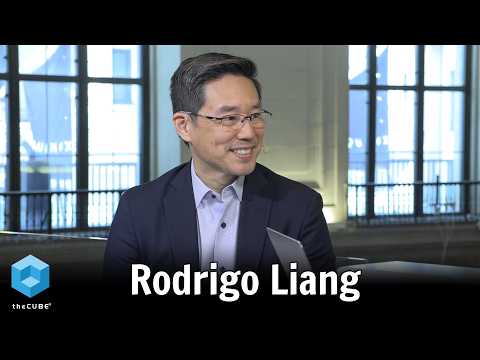
In this installment of the AI Factories interview series, Rodrigo Liang, chief executive officer of SambaNova, joins theCUBE + NYSE Wired's Gemma Allen to discuss a massive trifecta of company milestones. Liang breaks down the launch of the SN50, the company’s fifth-generation chip designed for cloud-scale inference, alongside a strategic multiyear partnership with Intel and a $350 million oversubscribed Series E funding round. He explains how SambaNova is tackling the complexities of agentic AI solutions by delivering ultra-high performance and superior economics for service providers navigating the transition from traditional LLMs to customized, non-batchable AI agents.
The conversation explores the technical breakthroughs enabling SambaNova to outperform legacy architectures, including its unique three-tier memory system and energy-efficient, air-cooled design. Liang highlights the "Goldilocks zone" of AI economics – balancing low-latency user experiences with high-throughput token production – and describes how specialized hardware allows data centers to maximize existing infrastructure without costly retrofits. From powering sovereign clouds to securing private enterprise data, Liang outlines a roadmap for a heterogeneous compute future where specialized AI factories redefine the cost and scale of the modern data center.
Forgot Password
Almost there!
We just sent you a verification email. Please verify your account to gain access to
theCUBE + NYSE Wired: AI Factories - Data Centers of the Future. If you don’t think you received an email check your
spam folder.
Sign in to AI Factories - Data Centers of the Future.
In order to sign in, enter the email address you used to registered for the event. Once completed, you will receive an email with a verification link. Open the link to automatically sign into the site.
Register for AI Factories - Data Centers of the Future
Please fill out the information below. You will receive an email with a verification link confirming your registration. Click the link to automatically sign into the site.
You’re almost there!
We just sent you a verification email. Please click the verification button in the email. Once your email address is verified, you will have full access to all event content for AI Factories - Data Centers of the Future.
I want my badge and interests to be visible to all attendees.
Checking this box will display your presense on the attendees list, view your profile and allow other attendees to contact you via 1-1 chat. Read the Privacy Policy. At any time, you can choose to disable this preference.
Select your Interests!
add
Upload your photo
Uploading..
OR
Connect via Twitter
Connect via Linkedin
EDIT PASSWORD
Share
Forgot Password
Almost there!
We just sent you a verification email. Please verify your account to gain access to
theCUBE + NYSE Wired: AI Factories - Data Centers of the Future. If you don’t think you received an email check your
spam folder.
Sign in to AI Factories - Data Centers of the Future.
In order to sign in, enter the email address you used to registered for the event. Once completed, you will receive an email with a verification link. Open the link to automatically sign into the site.
Sign in to gain access to theCUBE + NYSE Wired: AI Factories - Data Centers of the Future
Please sign in with LinkedIn to continue to theCUBE + NYSE Wired: AI Factories - Data Centers of the Future. Signing in with LinkedIn ensures a professional environment.
Are you sure you want to remove access rights for this user?
Details
Manage Access
email address
Community Invitation
Rodrigo Liang, SambaNova
In this segment from theCUBE + NYSE Wired’s “AI Factories – Data Centers of the Future” series, theCUBE’s Dave Vellante sits down with Rob Biederman, managing partner at Asymmetric Capital, to unpack a disciplined approach to early-stage investing amid AI-scale infrastructure shifts. Biederman explains Asymmetric’s founder-first model: writing $1–$10M checks (often via SAFEs), joining boards as they form and helping operators with go-to-market, operations, finance and strategy (not product/engineering). He shares why the firm avoided 2021’s lofty SaaS multiples in favor of backing proven builders earlier (single-digit pre-money), and highlights portfolio execution such as a cash-efficient LATAM e-commerce company scaling from ~$1-2M to about $50M in revenue. The discussion also explores Asymmetric’s subscale buy-and-build plays (e.g., pool cleaning in San Diego, sleep apnea clinics in Houston), where density, tech-enabled services and platform ops expand margins and enterprise value.
Biederman weighs in on AI economics as enterprises race to “AI factories,” cautioning that not every AI workload creates ROI and that overbuilt compute assumptions could face a reckoning. He argues that winners will prove a clear 10× value equation and avoid scaling go-to-market before product-market fit. Additional insights include early liquidity discipline (returning $0.20 on the dollar before the fund’s third anniversary), portfolio survivability (34 of 35 companies still operating; three positive exits), and guidance to founders: make your value proposition relevant, credible and differentiated. Tune in for candid perspective on how capital efficiency, ownership discipline and anti-thematic sourcing intersect with a world where GPU-dense data centers and AI-scale software are reshaping enterprise infrastructure and economics.
In this installment of the AI Factories interview series, Rodrigo Liang, chief executive officer of SambaNova, joins theCUBE + NYSE Wired's Gemma Allen to discuss a massive trifecta of company milestones. Liang breaks down the launch of the SN50, the company’s fifth-generation chip designed for cloud-scale inference, alongside a strategic multiyear partnership with Intel and a $350 million oversubscribed Series E funding round. He explains how SambaNova is tackling the complexities of agentic AI solutions by delivering ultra-high performance and superior econ...Read more
exploreKeep Exploring
What announcements are you making this week, and specifically, what is the SN50 chip — how does it differ from the SN40L and what types of use cases is it designed for?add
Who are the immediate target customers for this technology — individual developers without rack space, large enterprises/corporations, sovereign nations (sovereign clouds), or cloud providers?add
Why has SambaNova partnered with Intel, and what benefits and capabilities does that partnership provide?add
What are you planning to do with the $350 million Series E raise, and what's next on the company's product/technology roadmap?add
>> Welcome back to theCUBE, coming to you here from our studio at the New York Stock Exchange. This is one of our NYSE Wired programs, AI Factories, and joining me today is the CEO of SambaNova, Rodrigo Liang. Welcome, Rodrigo.
Rodrigo Liang
>> Thank you so much.
Gemma Allen
>> So you're in town because you've got some very big news. You've announced a new chip today, and also a very interesting partnership with Intel.
Rodrigo Liang
>> Yes.
Gemma Allen
>> Let's start there. Unpack it for me.
Rodrigo Liang
>> Yeah. No, really excited. Three announcements today. One, we're announcing SN50, that's our fifth-generation chip, focused on cloud-scale inference, ultra-low power, and so really excited about that. Two, we're announcing a multiyear partnership with Intel. This is something we're excited about, building products together and delivering that to really streamline the AI product market, as well as going to market together for some of the largest accounts that are out there that really are looking for much, much more efficient AI computing. Then third, we are announcing our 350 million-plus oversubscribed round. This is our Series E round, and so this is something that's super exciting for us because it allows us to drive everything that we want to do for the foreseeable future when it comes to building new technology, new infrastructure into the market.
Gemma Allen
>> Wow. Well, that's all pretty major news in one week, right? Most companies would aim to have that news over a decade, so congrats.
Rodrigo Liang
>> Yeah, thank you. We're super excited. All things came together very quickly, and we wanted to share it with you all at the same time.
Gemma Allen
>> Well, let's start with the chip. Let's start with the SN50, which has replaced, or I guess it's an improvement to the SN40L, right?
Rodrigo Liang
>> Right.
Gemma Allen
>> What has fundamentally changed, Rodrigo? I know you've spoken a lot in the past. You've been on the show in our Palo Alto studio, and you've talked about the difference in the inference world versus the training world. Maybe talk me through the types of use cases that this chip is primed for.
Rodrigo Liang
>> Yes. Well, so let's talk about what hasn't changed. So if you think about inference, it's still about high-performance real-time applications, and so you want very, very low latency, very, very high throughput. You still care a lot about power. SN40 was 10 kilowatts. This is also going to be very low power, up to 19 kilowatts, so really, really low-power infrastructure compared to existing infrastructure that's 100, 150 kilowatts per rack. And so those haven't changed, as far as focus on energy efficiency and throughput. What's changed now is people are thinking about agentic solutions, and so what's different when it comes to agentic versus a traditional LLM is today with a large model, all of us can send all of our requests to a single model, and so you can actually batch it together and make it really efficient. But as agents are coming in, everybody wants their own customized versions, so it's really hard to share. Sharing models on infrastructure becomes nearly impossible, because you want an agent, I want an agent. Everybody uses a slightly different agent. And so now you have this problem where, in order to serve this, the economics of the cloud providers is really poor, and so with SN50, now we are delivering a product cloud-scale that allows you to deliver ultra high performance for the end user, but incredible economics for the service provider that has to provide agentic solutions.
Gemma Allen
>> So would you say you have an ideal buyer persona? Is that somebody who's looking for an agentic AI solution end to end? I know you've spoken in the past about sovereign AI, and being able to serve countries and locations that don't have the ability or the CapEx abilities of a hyperscaler, right?
Rodrigo Liang
>> Right.
Gemma Allen
>> Who are your customer profiles? Who is the ideal scenario for the SN50?
Rodrigo Liang
>> Well, the cloud providers are going to be cloud-scale, and so anybody, whether that's a neocloud or a sovereign cloud or even the hyperscale clouds, those are all going to be very, very important targets for us. Because if you think about where they're going, the traffic is hybrid already. Most of these clouds are heterogeneous. They're using GPUs and other technologies to run these applications. And so if you have a technology that runs a particular type of AI, a particular type of model faster than the traditional ones, you should route the traffic over there. And for SambaNova, for these types of agentic models, we're better than anybody else. So that traffic can be routed over here, and that frees up dozens of Nvidia racks or whatever traditional racks you have to run other things, and so that's the model that we see people using. Whether that's a neocloud, whether that's a sovereign cloud or hyperscale cloud, they're starting to use this in a heterogeneous mode and running the traffic that runs best on that technology, and then allowing them to dynamically move those things around.
Gemma Allen
>> And are they like developers who don't necessarily have their own rack space? Are they large corporates, large enterprises? Are they countries? Who exactly is this serving first, I guess, in terms of the most immediate need?
Rodrigo Liang
>> Yeah. Well, we're also seeing two other trends. One is ... and it's a great point that you brought up about sovereign ... many countries want to see their data remain within the country, within the borders. Similar things exist with a lot of businesses. Think about banks and insurance companies, that their data needs to be protected. Some things they can use public models for and share, using, say, ChatGPT. Others they can't, because their data is audited and you can't let it out into the wild. And so our technology becomes a really, really good alternative for people that want to deploy privately securely, because at 10 kilowatts, air-cooled, you can roll it into any existing data center that you have, whether that's a edge data center, that a lot of people are talking about these days, or your own private secure data center that you might have here in the New York Stock Exchange. Wherever you have it, you can actually deploy these air-cooled 10-kilowatt racks, and keep your data private and secure for those types of applications.
Gemma Allen
>> And that is the only cooling format you guys deliver on, right? You don't do liquid cooling or any of the others?
Rodrigo Liang
>> Yep. Because it's so low-power, we haven't actually needed to move over to liquid. We're looking at it as far as when should we start introducing the liquid, but if you look at the racks that exist that use liquid, it's because they're 100, 200 kilowatts per rack, and at 10 kilowatts in SN40 and 19 kilowatts in SN50, they're so low in power that we can use air-cooled. And the beauty of air-cooled is 85% of data centers that exist in the world today are air-cooled, and so that's what already exists. You're not forcing the buyers to come in and retrofit data centers every time they want to buy somewhat of a rack, which many of our customers have talked to us about that. Every time they want to use newest technology, they have to go and do an entire retrofit of the data center, which is really expensive. And so using air-cooled, a standard 19-inch rack, rolling into existing data centers, is a great way for people to get going quickly without having to spend all that money on the data center side itself.
Gemma Allen
>> So you're winning on power and you're winning on per order, per usage. Tell me, it seems as though we all know there's some big, big incumbents in this space, right?
Rodrigo Liang
>> Yeah.
Gemma Allen
>> It can seem, from an outside perspective, like it is a lot to chase these folks down.
Rodrigo Liang
>> Yeah.
Gemma Allen
>> What's the magic? How can you magically create, I guess ... or I'm sure it's nothing magical about this, it's taken years of hard work ... but what is the secret sauce to create something that is 5X on output and 3X less on cost? What is so unique about this?
Rodrigo Liang
>> Well, I think the architecture matters a lot. And so no doubt, like you said, people are using Nvidia GPUs broadly, and so that architecture is 30 years in the making if you look at the Nvidia journey, and they've done a tremendous job securing that infrastructure play with some of most of the largest players in the world. And if you look at that history, it also comes with things that they can't change or it's harder to change, because that's the architecture of that chip. And so SambaNova, being a new grounds of technology, allows us to focus on certain applications, certain types of models, inferencing agentic solutions, and really optimize the architecture for that. And once you start with that basic, which is a very different structure where you're using data flow, you're using three-tier memory, which we can ... I know your audience is very technical and wanting to understand exactly how you use three-tier memory ... where a traditional GPU only really has HBM, we have DDR and HBM and a lot of SRAM. And if you use those technologies in the right way, you're now starting to produce outcomes that are dramatically better. And it's really hard to incrementally improve on legacy architectures, where a grounds-up design allows you the opportunity to do so.
Gemma Allen
>> So let's talk a little bit about underneath the hood of the competitive dynamic. If I'm a sales guy for SambaNova, I am out pitching against companies like Nvidia. I assume that there are a lot of enterprises just sweating the Nvidia asset. They have those chips in place. They need to basically sweat out that CapEx. Talk to me a little bit about the competitive forces. What is the pitch process like? How difficult is it to even, for example, explain to folks that there is a big difference between the inference world versus the training world in terms of what's required from a chip perspective?
Rodrigo Liang
>> Look, a lot of our customers are cloud service providers. They're trying to build token factories. They're trying to provide AI services. They're trying to offer inference services. It's actually not that difficult, because most of the folks are trying to figure out how to actually make better economics on their service, and it's actually pretty simple. You actually have to increase the revenue on the tokens and reduce the cost of your CapEx. That's it, right? And so most people are offering Nvidia-based services, which is normalized across industry today. So the hard part about charging more if you're offering the same thing is differentiation. So with SambaNova, we're able to give you ultra high performance, very, very low latency, across a broad range of very custom agents. Now you're starting to actually bring that into the mix. You can bring SambaNova technology into the mix with what you have with existing infrastructure, and find ways to offer differentiated services. As soon as you're differentiated, you can charge a higher price. Otherwise, it's a commodity. Everyone's serving the same type of tokens, the same type of models. How do you raise your price? And so for service providers, you have to have the differentiation, that secret sauce that they provide, and SambaNova allows you the opportunity to do that. And on this side, whether you already have Nvidia infrastructure, you don't want to actually have to keep adding more, and so what you can do is take what runs on SambaNova better, move it over there. It frees up all these racks for you to reuse, and so then you lower the cost. And if your revenue increases, your cost lowers, now you're starting to do significantly better.
Gemma Allen
>> And what do you hear and see around the speed-versus-cost debate? How are you seeing those market dynamics playing out, right? Obviously it makes sense to sweat assets like it always did, but in the world of AI, especially in the agentic era, speed and performance is absolutely the most important in town. So is cost becoming less of a consideration? What are you hearing?
Rodrigo Liang
>> It's an incredible consideration. We see every day how people are financing these giant gigawatt data centers with all this infrastructure and who's financing behind it, all of that. But you hit it right on the nose, which is we have this chart that shows. On this axis is basically the throughput that a service provider needs to achieve in order to make money. This is basically the performance that the end user wants to see, otherwise they won't use your service. And so if you look at that, there's a Goldilocks zone where the user wants to use your service and the service provider can make money, right? Because if you make it really, really fast for the end user and your batch is really low, the users are happy, but the service provider is not generating enough tokens. If you batch everybody up and you basically make all the users wait, right ... get on this giant bus before we take off ... it's great for the service provider, but the end user's waiting for a long time and they're unhappy. And so really it is that balance between trying to figure out how to get the economics right for the service provider while generating high-performance output for the end user. And more and more, people are expecting real-time, and so you're going to have to solve this problem. But without the right economics, it is really hard to keep dumping more and more money into your infrastructure without recovering a lot of the costs back.
Gemma Allen
>> The Goldilocks zone. I'm going to have to coin that.
Rodrigo Liang
>> Yeah. Yeah, it's really important.
Gemma Allen
>> So talk to me about the partnership with Intel. Have they been a customer? Talk to me about the process, I guess, by which you guys have decided to build this and how this came about, and what the next 18 months or so looks like on the partnership roadmap for these two powerhouses coming together.
Rodrigo Liang
>> Yeah. Well, look, Intel's been on our cap table since 2019, and they were a lead investor for our Series B, so they've been partners with us for a long time. And what's great about this is, as we enter this phase of SambaNova, really what you're starting to see is a certain scale that, as a SambaNova by itself, is hard to achieve. And with Intel, what you now have is reach. You have a huge customer base. Everyone knows who Intel is, and the capital that they can actually provide, the access they can provide. And with SambaNova, our technology being as differentiated as it is today, it really provides a very good entry point, a very good alternative to existing solutions. And so, as we discussed over the years in trying to figure out what are great ways to work together, the timing arrived at a point where we said, "Look, we can really partner around this, use a lot of the assets that Intel has," because an agenetic solution is not just about AI chips. There's CPU, there's networking, there's memory, all these assets that have to come together along with the AI chips, the accelerators. And so, together in this partnership we have with Intel, we're going to optimize the entire stack and really light it up.
Gemma Allen
>> And when you came together with Intel to say, okay, "We can help you solve these problems," are there particular industry verticals, particular low-hanging fruits within, because they have a huge customer base, right? Those guys are pretty much serving pretty much anyone and everyone. So where is the immediate, I guess, requirement or need? Was there one that stood out?
Rodrigo Liang
>> Look, what we hear a lot, and I think most people are talking about this, is the cost structure for these cloud service providers, neoclouds and even the large clouds. They're trying to figure out how to scale along with the demand for AI, and people are building these giant data centers all over the world. People are putting new nuclear power plants in different places to power these data centers. And so the scale that people are trying to support the AI market is outpacing our ability to do so.
And so the opportunity came for us to think about how to drive the efficiency of the scaling. If I can provide you an infrastructure that outperforms the incumbent at a fraction of the power, suddenly there's a new opportunity for most of these players, large or small, to deliver much, much more efficient services, much more differentiated services, and allow them to mix with the existing infrastructure they have without losing all the legacy that you have, and you're building on traditional GPUs and yet offering new things that others potentially don't have, to really create this differentiated offering.
Gemma Allen
>> It certainly creates a whole new dynamic layer to the offering, right? Like, for sure.
Rodrigo Liang
>> Yeah.
Gemma Allen
>> 350 million, Series E. We hear Series E, we think, "Are we going to see you guys ringing the bell here at the NYSE?" I certainly hope so, but tell me what's ahead. It's a big, big round to raise. It's also a very capital-intensive space you're in, right? So 250 million probably was a whole lot more money maybe 10 years ago than it is in this agentic world, but what are you guys working towards? What's coming up, from a product roadmap perspective?
Rodrigo Liang
>> Yeah. No, it's super exciting. Look, the great thing about where we are today is we're delivering technology, hardware, software to suppliers. We don't have to build our own clouds, which you've seen other players in our space that are building chips having to invest in their own clouds. We don't do that. We are super excited by the fact that our technology can go into cloud service providers as CapEx that they spend with SambaNova and allow them to actually make those offerings, and so that's one thing that we're really excited by. The technology's at a place now that we can actually sell it to our customers and have them offer those services in a differentiated way. And so with this round, what we can do is now drive everything we wanted to do on our roadmap, with multiple chips still coming, and still continue to invest aggressively. And with the business starting to come in with a very positive cash flow, it allows us to add that together and then really drive our long-term plans in a very aggressive way.
Gemma Allen
>> Well, we're certainly delighted to have you back here on theCUBE, and we'll be watching on the sidelines, cheering you guys on. Excited to see what the next six months brings. Thanks so much for coming on the show.
Rodrigo Liang
>> Yeah, thank you for having us.
Gemma Allen
>> I'm Gemma Allen, coming to you from theCUBE Studios here at the New York Stock Exchange. This is our AI Factory series, in collaboration with NYSE Wired. Thanks so much for watching.



































 Gemma Allen