In this segment from theCUBE + NYSE Wired’s “AI Factories – Data Centers of the Future” series, theCUBE’s Dave Vellante sits down with Rob Biederman, managing partner at Asymmetric Capital, to unpack a disciplined approach to early-stage investing amid AI-scale infrastructure shifts. Biederman explains Asymmetric’s founder-first model: writing $1–$10M checks (often via SAFEs), joining boards as they form and helping operators with go-to-market, operations, finance and strategy (not product/engineering). He shares why the firm avoided 2021’s lofty SaaS multiples in favor of backing proven builders earlier (single-digit pre-money), and highlights portfolio execution such as a cash-efficient LATAM e-commerce company scaling from ~$1-2M to about $50M in revenue. The discussion also explores Asymmetric’s subscale buy-and-build plays (e.g., pool cleaning in San Diego, sleep apnea clinics in Houston), where density, tech-enabled services and platform ops expand margins and enterprise value.
Biederman weighs in on AI economics as enterprises race to “AI factories,” cautioning that not every AI workload creates ROI and that overbuilt compute assumptions could face a reckoning. He argues that winners will prove a clear 10× value equation and avoid scaling go-to-market before product-market fit. Additional insights include early liquidity discipline (returning $0.20 on the dollar before the fund’s third anniversary), portfolio survivability (34 of 35 companies still operating; three positive exits), and guidance to founders: make your value proposition relevant, credible and differentiated. Tune in for candid perspective on how capital efficiency, ownership discipline and anti-thematic sourcing intersect with a world where GPU-dense data centers and AI-scale software are reshaping enterprise infrastructure and economics.
Forgot Password
Almost there!
We just sent you a verification email. Please verify your account to gain access to
theCUBE + NYSE Wired: AI Factories - Data Centers of the Future. If you don’t think you received an email check your
spam folder.
Sign in to AI Factories - Data Centers of the Future.
In order to sign in, enter the email address you used to registered for the event. Once completed, you will receive an email with a verification link. Open the link to automatically sign into the site.
Register for AI Factories - Data Centers of the Future
Please fill out the information below. You will receive an email with a verification link confirming your registration. Click the link to automatically sign into the site.
You’re almost there!
We just sent you a verification email. Please click the verification button in the email. Once your email address is verified, you will have full access to all event content for AI Factories - Data Centers of the Future.
I want my badge and interests to be visible to all attendees.
Checking this box will display your presense on the attendees list, view your profile and allow other attendees to contact you via 1-1 chat. Read the Privacy Policy. At any time, you can choose to disable this preference.
Select your Interests!
add
Upload your photo
Uploading..
OR
Connect via Twitter
Connect via Linkedin
EDIT PASSWORD
Share
Forgot Password
Almost there!
We just sent you a verification email. Please verify your account to gain access to
theCUBE + NYSE Wired: AI Factories - Data Centers of the Future. If you don’t think you received an email check your
spam folder.
Sign in to AI Factories - Data Centers of the Future.
In order to sign in, enter the email address you used to registered for the event. Once completed, you will receive an email with a verification link. Open the link to automatically sign into the site.
Sign in to gain access to theCUBE + NYSE Wired: AI Factories - Data Centers of the Future
Please sign in with LinkedIn to continue to theCUBE + NYSE Wired: AI Factories - Data Centers of the Future. Signing in with LinkedIn ensures a professional environment.
Are you sure you want to remove access rights for this user?
Details
Manage Access
email address
Community Invitation
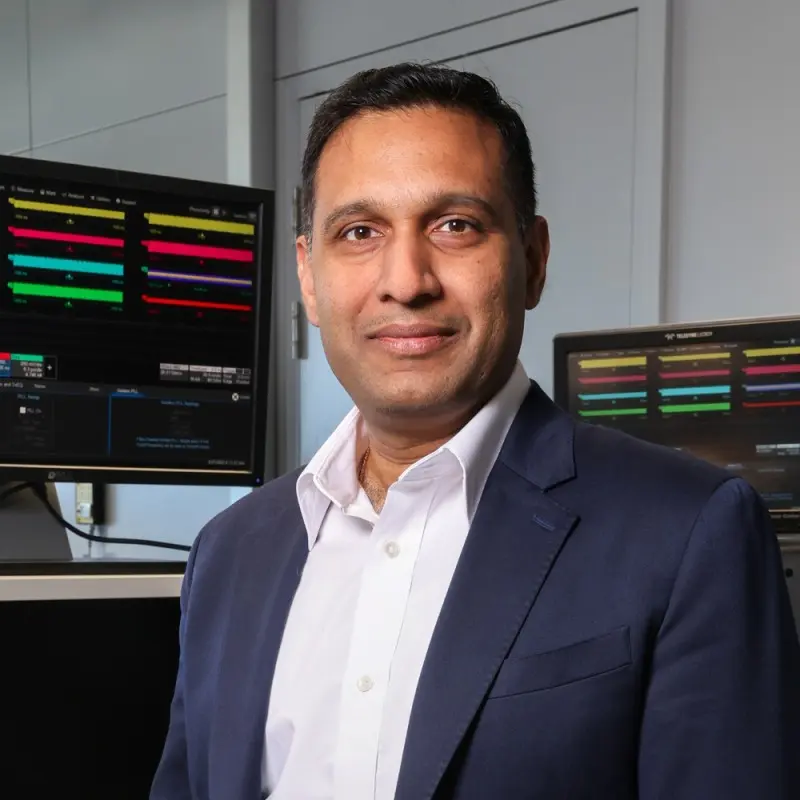
Srujan Linga, Kandou Ai
In this segment from theCUBE + NYSE Wired’s “AI Factories – Data Centers of the Future” series, theCUBE’s Dave Vellante sits down with Rob Biederman, managing partner at Asymmetric Capital, to unpack a disciplined approach to early-stage investing amid AI-scale infrastructure shifts. Biederman explains Asymmetric’s founder-first model: writing $1–$10M checks (often via SAFEs), joining boards as they form and helping operators with go-to-market, operations, finance and strategy (not product/engineering). He shares why the firm avoided 2021’s lofty SaaS multiples in favor of backing proven builders earlier (single-digit pre-money), and highlights portfolio execution such as a cash-efficient LATAM e-commerce company scaling from ~$1-2M to about $50M in revenue. The discussion also explores Asymmetric’s subscale buy-and-build plays (e.g., pool cleaning in San Diego, sleep apnea clinics in Houston), where density, tech-enabled services and platform ops expand margins and enterprise value.
Biederman weighs in on AI economics as enterprises race to “AI factories,” cautioning that not every AI workload creates ROI and that overbuilt compute assumptions could face a reckoning. He argues that winners will prove a clear 10× value equation and avoid scaling go-to-market before product-market fit. Additional insights include early liquidity discipline (returning $0.20 on the dollar before the fund’s third anniversary), portfolio survivability (34 of 35 companies still operating; three positive exits), and guidance to founders: make your value proposition relevant, credible and differentiated. Tune in for candid perspective on how capital efficiency, ownership discipline and anti-thematic sourcing intersect with a world where GPU-dense data centers and AI-scale software are reshaping enterprise infrastructure and economics.
In this interview from theCUBE + NYSE Wired: AI Factories — Data Centers of the Future, Srujan Linga, chief executive officer and co-founder of Kandou AI, joins theCUBE + NYSE Wired's Gemma Allen to discuss how untapped capacity in copper interconnect technology could transform AI system design and dramatically cut the cost of inference. Linga breaks down a critical cost structure hidden inside every AI factory: 60% of data center spend flows to GPUs, and 90% of that GPU cost stems from high-bandwidth memory (HBM) co-packaged directly onto the compute die. Ka...Read more
exploreKeep Exploring
What is Kandou and how does its technology aim to reduce AI infrastructure costs and scale by changing how compute and memory are interconnected?add
How and why did applying MIMO signal-encoding techniques from the speaker’s MIT thesis to copper wireline systems become feasible now — what technical shifts made this possible and rapidly viable in the AI inference era?add
How will the $225 million raised last year be spent?add
Why would enabling memory to be connected across the PCB (rather than co‑packaged with the GPU) reduce GPU costs in data centers, and what currently prevents that approach?add
>> Welcome back to theCUBE studio here at the New York Stock Exchange. I'm Gemma Allen, and this is AI Factories, part of our programming with NYSE Wired. And today we are talking all things AI factories, GPUs, compute, storage. One thing we haven't talked about yet is something far more abstract, but increasingly important, wires. And joining me now is Srujan Linga, CEO and co-founder at Kandou AI. Welcome, Srujan.>> Thank you, Gemma. Thank you for having me.
Gemma Allen
>> So, for those who may not be familiar with Kandou, you are essentially in the copper game, right? It's about building the optimum wire technology for GPUs, for chips to ensure that this inference era is met in all its possibilities. Break it down for me. Give me the 101 on this company.>> Yeah. So, we at Kandou believe that there should be a fundamentally different way of designing AI systems. We believe the age of AI is here, but for AI to truly realize its potential, we need to dramatically cut down costs and increase scale and that's our mission. And when you think about where most of the costs in AI systems are coming from, it is from the GPU. And when you double click the GPU, about 90% of your GPU expense comes from the fact that you have memory, which is high-bandwidth memory, co-packaged with your compute die. Your compute die is only approximately 10% of your GPU costs. And so, the fundamental realization that we have is the reason why the industry is going towards this direction is because from a gen AI standpoint, your models are exponentially increasing in terms of size. Coupled with that, they need to now be trained with a lot of data, which comes from audio, text, video. And now, you're talking about agentic AI, which exponentially increases the memory footprint of your AI models. The whole industry is trying to solve that by putting in more HBM, or high-bandwidth memory, right next to your compute die. And the reason why the industry is going towards that direction is because when you think about copper wires and the connectivity layer that exists between your compute die and memory, those copper wires fundamentally high bandwidth, high-speed copper wires, they don't travel long distance. Because of that, the whole industry is shrinking the compute infrastructure to get on the same die, which increases your cost, reduces your scalability. We, on the other hand, we look at this problem very differently. We come from the background of information theory, and we sit at the intersection of information theory and semiconductors. So, for us, this is a communication theory problem. And when you think about communication theory, the only true limit from a physics standpoint is the Shannon limit, which determines how much capacity that you can have on these corporate lines. And I'll tell you today, we are about 8 to 10 times away from what the Shannon limit of these corporate lines are, and that's what we want to exploit and that's what we want to bring to the industry. This is a fundamental shift in the AI infrastructure space and we are at the forefront of actually getting more capacity out of copper. And if we're able to do it, this is going to transform the whole AI system design and AI cost.
Gemma Allen
>> Well, lots to unpack there, but let's first talk a little bit about you and what brought you to this moment. You have had a very interesting career in mathematics and technology. You were at Goldman, you worked under the Biden administration on the CHIPS Act. Now, you're back founding a company that has a very interesting global presence too. Talk to me a little bit about your own career trajectory. It's certainly not linear, but it's interconnected, right?>> It is interconnected. And I always believe you can only connect the dots looking back. And I'm a technologist by training, I'm an engineer. And interestingly enough, I did my undergrad thesis in MIMO, which is on multiple input, multiple outer wireless systems, which is connected to what we are doing right now at Kandou. So, I started out my journey, as you pointed out at Goldman. I was a quant developer. I used to develop computer algorithms to trade the stock market and options, but I always wanted to be an entrepreneur. And even at Goldman, I started and scaled multiple businesses for the firm. And then, I got invited by the Biden administration to come and help run the CHIPS Act. And that is where I really understood the semiconductor ecosystem. I was involved in the standup of several new fabs in the US. I was also nominated to the AI Task Force where I really understood and helped solve some of these key bottlenecks from AI infrastructure space. And so, that really gave me the inspiration to look at the technology that we have at Kandou and use that to solve some of the key bottlenecks in the AI space. And I'm very excited for what is ahead of us.
Gemma Allen
>> Wow. Well, let's go back to your MIT thesis, right? In terms of MIMO, and now applying that in the world of 2026 as we enter this inference era of AI. What fundamentally shifted to make this possible? How has this suddenly become so viable so quickly? Talk us through the technicalities of that.>> Yes, absolutely. Actually, it has been like at least 20 years in the making, so it's taken a long time to actually get here. My fundamental focus when I did my undergrad thesis was on how you encode your signals for a multiple antenna system, how you use spatial and temporal diversity in these codes to get more bandwidth out of these systems. What has changed now is we now have A, the mathematical framework, which is what we developed at Kandou, to implement these codes in the copper wireline domain. These have been largely successful in the wireless domain. Now, we actually can do it in the copper wireline domain. And B is you really have a need now, you actually have a need to get more bandwidth. You have a need to get lower power and longer distance from copper lines. And the real unifying factor that's driving all of this is AI because when you think about what is needed from an AI infrastructure standpoint, it has never been so important for you to efficiently move data from point A to point B within the data center. And that is really the bottleneck for AI infrastructure. It's not compute. We're not compute-limited. We are memory and interconnect-limited. So, what has changed is we now have the mechanism to not only implement this, but the industry actually is now valuing this.
Gemma Allen
>> So, fast-forward to 2025, you have a relationship with this lab in Switzerland, which is actually where Kandou AI was originally founded from, right?>> Yeah.
Gemma Allen
>> It's a spin out. Based in Switzerland, we hear a lot about American-based technology companies all the time. You guys have really put Europe on the map too from the perspective of the money you've raised and the attention you've gotten. Talk a little bit about that whole ecosystem. Europe versus the US, you guys think very globally. What was it like raising money in Europe? I'm interested to understand the dynamics of that side of the water.>> Yeah, absolutely. So, first is we have a very robust ecosystem in and around EPFL in Lausanne in Switzerland. We have some of the best mathematicians and analog circuit designers coming out of the university, and we are tapping into that ecosystem. Taking a step back, my co-founder and CTO, Amin, he was a professor at EPFL. He was one of the founding fathers of the information theory ecosystem at EPFL. He was also one of the core inventors of what is called as Raptor codes, which are very popular in the wireless domain. So, he comes from a very strong mathematical backdrop, which is at the core of what we are building right now. So, having our base in Switzerland has been very critical for us to attract the right talent because we are not a traditional semiconductor company, we need outside-the-box thinkers who sit at that intersection of information theory and semiconductors. And EPFL and the lab there, inspired by my co-founder, has been very robust in terms of getting us that talent. That's number one. Number two is in terms of the fundraising environment in Europe, I think it's very, very healthy. People do want strong semiconductor companies, innovative companies to come out of Europe and they want a vibrant ecosystem to be built there. But what we are seeing is increasingly semiconductor ecosystem is intertwined globally. What we do in Europe matters here in the US and vice versa. And so, most of our investors are global in nature. Our customers are global in nature. And so, irrespective of where you come from and where you're located, the capital is more, I would say it's more universal. And so, even though we are a Swiss-based company, a lot of our funding comes from the US and we do have robust interest locally as well.
Gemma Allen
>> Some might say that the semiconductor industry is too intertwined globally, right? There's a lot of interesting cyclicality and dependencies there. But from your perspective, in terms of how you think globally, some of your research and development happens in India.>> Correct.
Gemma Allen
>> You obviously have a team here in the US, a team in Switzerland. Give me the global breakdown of how the footprint runs.>> Right, absolutely. So, see, as a global semiconductor company, we have to go where the talent is and the talent and the way the semiconductor system ecosystem has evolved is there are pools of excellence or centers of excellence. So, we have most of our customer-facing roles here in the US because most of our customers are US-based. We have core R&D in Europe because we are born out of the EPFL lab in Switzerland. Then, we have our operations team in Taiwan because most of our manufacturing happens in Taiwan. And then, in India, we have a core R&D team and firmware and software team that is developing there. So, we have a distributed ecosystem based on certain centers of excellence, and that's been very effective for us to draw talent. I think it's very important for you to have a global approach to this because it's very difficult to find all the talent that you need in one place, and so you have to go to where the talent is and try to maximize it.
Gemma Allen
>> Let's talk about the fabless model for a second in terms of what it means, especially from a supply chain perspective, right? We hear a lot in mainstream media about geopolitical challenges, the US-China debacle. I don't know if that's as traumatic as I could call it, but you know where I'm getting to.>> Right.
Gemma Allen
>> Talk about the interdependencies that you see, especially as a model that is completely dedicated to one provider, right?>> Right, right. No, so it is a very fragile ecosystem and you see supply chain disruptions even today that are not yet completely addressed. So, it is a very fragile ecosystem. And one of the core reasons is even more fragile in the AI age is because of our dependency on advanced packaging and what we are doing on the AI infrastructure space with co-packaging. And a lot of that happens in just like very, very concentrated area. And so, one of the key elements of the technology that we bring to the table is to remove the need for some of these critical steps in the ecosystem today, for example, advanced packaging. So, if you have a copper interconnect, which can enable you to connect a lot of memory without the need for co-packaging it and allow you to spread out the design, then you're no longer dependent on advanced packaging as one of the key bottlenecks. So, it is still very fragile and we experience that in our business today. Our customers are experiencing it, our partners are experiencing it, but there are technologies that we are working on today which would help address it, along with the initiatives from the government, which I'm sure will take some time to really come to fruition, but it'll definitely help.
Gemma Allen
>> In other competitive spaces, let's talk a little bit about optics versus copper, right? We hear a lot about light as a solution for the future. I know a lot of big hyperscalers have been evaluating this. What are your thoughts on that debate? Do you think like similar to liquid cooling and in other parts of the ecosystem around data centers, it may be more of a promise than a reality right now? What would that really entail, do you think?>> Look, I think it's an interesting debate to have in terms of optics versus copper. I think that this is not a winner-take-all market. I think that the data center of the future need the best optics technology to work hand in hand with the best copper technology, and that's the way we are going to push the industry forward. I think there are areas and domains within the data center where if you can solve the connectivity problem using copper, then everybody would use copper. The reason why people are migrating to optics is because they think copper is dead and they think we have hit the physical limits of copper. But if you can show the industry a solution of how you can get more bandwidth, lower power and longer distance using copper, then there's nothing that can be the scale, cost, and time to market of copper, and that's where we are focused on. And so, we are exploring partnerships even with optics companies to help optics get to the data center even quicker because one of the biggest challenges in optics is reliability and we can help solve that as well. So, I think the industry is moving in that direction and industry has a tendency to think that it's a winner-take-all dramatic outcome that everybody expects. We have a more subtle view on this. I think it's going to be something where the best copper technology still has a lot of value to the industry.
Gemma Allen
>> So, you guys have raised a big round in Europe last year, $250 million, is that correct?>> $225.
Gemma Allen
>> $225? Okay.>> Yeah.
Gemma Allen
>> What's ahead? Talk to me about the moment you're at right now. Are you pouring that into R&D? Are you continuing to build? Is partnerships and global footprint on the horizon? Where is that money being spent?>> It is being spent all in the tape out of our next-generation chips, and these chips are going to be focused on solving some of the key connectivity bottlenecks and AI data centers. I believe we are at the cusp of a big revolution in the AI connectivity space, and we are coming about it from the copper standpoint and these chips that we are going to tape out are going to help our customers, primarily hyperscalers and others, leverage this infrastructure to fundamentally rethink the system design, which is going to be much more cost-effective, scalable, and also address some of the key bottlenecks that you mentioned earlier, which is try to do it in an air-cooled environment. And so, we want to address some of the key bottlenecks, which is prohibiting and holding back AI infrastructure from being ubiquitous and AI tools from being ubiquitous. So, that's where the money is going to be spent.
Gemma Allen
>> So, I know you brought something with you here, and I'm interested in some of the product marketing that I've seen surrounding Kandou AI, right? Because you guys say that you can reduce inference costs by 12X using these, what look like tiny, tiny, tiny little chips, right?>> Right.
Gemma Allen
>> Talk to me a little about the supply chain and the actual cost efficiencies here. How does that become tangible? Where are those cost savings actually realized?>> Right, right. I think to understand the cost saving, you need to understand how the industry works today. So, today, when you think about your data center, 60% of your cost comes from your GPU, and if you double click that, 90% of that GPU cost comes from the fact that the memory is co-packaged with your compute die. And the reason for that, as I explained, is because the industry does not have a copper pipe, which can allow you to disaggregate the system design across the PCB board, and therefore, it is going down the direction that it is today. However, today, let's say I give you a solution which can enable you to connect memory without sacrificing your power, bandwidth and speed, but enable you to connect memory by spreading it out on the PCB board. You're no longer looking at HBM, which is much more expensive than your traditional memory as a primary solution to address some of these memory bottlenecks, you could use more cost-effective memory systems to address this. That's where most of the cost saving comes from. So, what we are doing is enabling our customers to leverage our connectivity solutions to then spread out the design instead of co-packaging everything on a single die, which is where most of the cost comes from, but yet, do it in a very latency and a cost and power-effective way, which is what is critical for AI systems.
Gemma Allen
>> Wow. So, it's certainly a very interesting time in the space. What I find fascinating about AI factories on this series is that there are so many layers to the stack that have been so abstract for so long that suddenly you're having a moment, right? Storage is a great example too. These are the less-sexy parts of the technology stack that five years ago, no one really thought about unless you had to.>> Correct.
Gemma Allen
>> And now, there's a lot of market opportunity in spaces that perhaps we just didn't understand before. From your perspective, especially from a GTM perspective, as you guys think about your global reach and your opportunity, how do you think about separating the product out? How do you think about the marketing opportunities for this globally, especially competing against some big players, like Samsung or... I won't name them, but who I'm sure have huge, huge marketing budgets and a period of maturity, right? How hard is it to compete against incumbents?>> Right. Well, it is very hard. We are like the NanoDavid going after the Goliaths over here. Literally, we are the NanoDavid designing it in nanometers. So, I think the key differentiation for us is the roots and the DNA where we come from, which is we are very unique because we sit at that intersection between information theory and semiconductors. So, our IP and the technology that we have is very unique in the industry. And so, building products based on that is what draws the customers to us. And we work very closely with our key customers, helping them solve the key bottleneck. So, from a go-to-market standpoint, we are working hand in glove with several of our customers to help them solve the key AI data center bottlenecks that they're facing, and that's really driving the next wave of products for us. We are very focused on the connectivity problem and we are building complete system solutions, which also immunizes us from some of the dependencies that you have from some of the players that you otherwise would normally need to wait for to get to market because you're building systems altogether, it helps us go to market quicker. So, that's another key area of focus for us. And look, I mean, because of the pace of innovation in AI and the core need to solve the energy power and interconnect problem, we are seeing a lot of interest from our customers coming to us to see how they could use the technology that we are developing to help improve their economics, their ROI, and their time to market.
Gemma Allen
>> Well, it's certainly great to hear that inbound opportunities are just coming your way, right? And personally, I love an underdog, so I wish you guys all the best. I'm sure you've got a very bright future and success road ahead at Kandou AI. Thanks for coming on theCUBE.>> Thank you. Thank you for having me.
Gemma Allen
>> I'm Gemma Allen, here at theCUBE studio at the New York Stock Exchange. This is AI Factories, part of our programming with NYSE Wired. Thanks for watching.
































 Gemma Allen