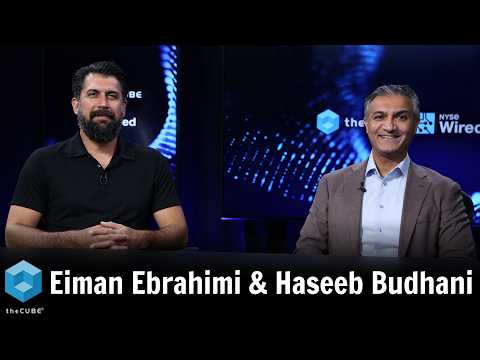
This conversation examines the role of artificial intelligence factories and the growing importance of field-programmable gate array technology for physical and data center AI. Raeeb Soussein of Altera, chief executive, joins theCUBE Research hosts John Furrier and Gabe Olave in the NYSE Wired AI Factory Series to discuss FPGA-driven AI infrastructure, physical AI and company transformation.
Soussein discusses their transition from Marvell to leading Altera, the company's more than 40-year field-programmable gate array heritage and Altera's positioning in today's AI factory conversation. They cover FPGA fundamentals, heterogeneous compute, data movement challenges, physical AI deployments in robotics and edge AI, Hot Chips context and Altera's strategy following Intel's divestiture.
Key takeaways include that FPGAs act as programmable application-specific semiconductors enabling deterministic low-latency data movement and rapid prototyping ahead of costly application-specific integrated circuit development, according to Soussein. They highlight organizational strategies such as collapsing layers, forward-deploying engineers and an outside-in customer focus to accelerate solutions. theCUBE hosts note this approach is critical for AI infrastructure, robotics, edge AI and synchronized sensor processing.
Forgot Password
Almost there!
We just sent you a verification email. Please verify your account to gain access to
theCUBE + NYSE Wired: AI Factories - Data Centers of the Future. If you don’t think you received an email check your
spam folder.
Sign in to AI Factories - Data Centers of the Future.
In order to sign in, enter the email address you used to registered for the event. Once completed, you will receive an email with a verification link. Open the link to automatically sign into the site.
Register for AI Factories - Data Centers of the Future
Please fill out the information below. You will receive an email with a verification link confirming your registration. Click the link to automatically sign into the site.
You’re almost there!
We just sent you a verification email. Please click the verification button in the email. Once your email address is verified, you will have full access to all event content for AI Factories - Data Centers of the Future.
I want my badge and interests to be visible to all attendees.
Checking this box will display your presense on the attendees list, view your profile and allow other attendees to contact you via 1-1 chat. Read the Privacy Policy. At any time, you can choose to disable this preference.
Select your Interests!
add
Upload your photo
Uploading..
OR
Connect via Twitter
Connect via Linkedin
EDIT PASSWORD
Share
Forgot Password
Almost there!
We just sent you a verification email. Please verify your account to gain access to
theCUBE + NYSE Wired: AI Factories - Data Centers of the Future. If you don’t think you received an email check your
spam folder.
Sign in to AI Factories - Data Centers of the Future.
In order to sign in, enter the email address you used to registered for the event. Once completed, you will receive an email with a verification link. Open the link to automatically sign into the site.
Sign in to gain access to theCUBE + NYSE Wired: AI Factories - Data Centers of the Future
Please sign in with LinkedIn to continue to theCUBE + NYSE Wired: AI Factories - Data Centers of the Future. Signing in with LinkedIn ensures a professional environment.
>> Palo Alto Studio Connection, Silicon Valley and Wall Street. I'm John Furrier, co-hosting The Cube here with Gabe Olave, my co-host. Hello, I'm John Furrier with The Cube here in the Palo Alto studios. Of course, we have our NYSE studio connecting Silicon Valley to Wall Street. This is the NYSE WireCube AI Factory Series. Raeeb Soussein is here, CEO of Alterra. Recently taking the helm as the chief executive. Thanks for coming on TheCUBE. Great to see you. Thanks for coming in. Appreciate it.>> Thank you. Thank you for the time today. And I really look forward to our discussion today.>> So you had many entrepreneurial journeys around data and semiconductors at Marvell, president and now CEO of Alterra. There's a lot of history with Alterra. If you look at what's happening in the semiconductor business, it is mainstream and there's a headline every day, more CapEx, more AI infrastructure. You've been at the center of it. And now as the world grows, the demand for mathematics, the demand for data to be processed in an AI way is not your yesterday's general compute that we all know in our PCs. It's kind of moved to a whole nother system. We've been covering it with the AI factories. Talk about the current state of Altera. You're at the helm. Talk about the company, where it's at, what it, where it came from and where is it today?>> Yes. Altera is 40+ years old. Company. It has, you know, history of delivering the programmable solutions throughout the history. We have shipped over 5 billion units over time. So a lot of experience, a lot of expertise. And then it was acquired by Intel 10 years ago, and for the right reason of Intel, they focus it to be more of an x86 accelerator. Which made it focus on certain segments of the market. But when I saw that Intel is deciding to divest this company, I looked at it and I realized that Altera still has the industry-leading fabric. Because in FPGA, fabric is everything. If you have a great fabric, if your end customer can get the highest frequency in your design, if they can use it for the highest utilization, That is the most important part. So then I thought that, hey, it's a perfect opportunity because we are living in a world which is going through a huge transformation and everything pretty much is changing. AI is going to force redesign of every equipment out there and models are changing on a weekly or monthly basis. So I think it's a prime time. This is where FPGAs are designed for. So I looked at it as a huge opportunity. All we have to do is to go and, and, you know, kind of make it independent, put a full focus, you know, 100% pure-play FPGA company, which is independent and which can serve the entire market, invest properly in the portfolio, and really help our customers solve their problem. And that's why I was personally very excited about taking Ultra Private. Team is excited. There's a lot of excitement going on. There are a lot of momentum. We are focused on building a great company which solves customer problem.>> I want to get into the transformation and the culture, but I first want to get out there that a lot of people are learning more about semis every day as we see the mainstreaming of it. FPGA, explain what that is and why it's important, because people are now realizing that the role of architecture in systems. There's a lot of old concepts in computer science and engineering that are now coming in and being refactored, but like reconfigured from a system architecture standpoint that's producing some significant value. And I think FPGA is one of them. Explain what it is and why it's so important right now.>> Yeah, so FPGA is a part of the compute, heterogeneous compute solution. So if you look at the full continuum of the compute, On one hand, it is general-purpose CPUs and then GPUs, and on the other hand, it's a very optimized application-specific semiconductor, which is called ASIC. FPGAs are between them. In other words, FPGA provides an ability to implement the hardware, but it is in a flexible manner, which means even after deploying the product in the field, If you need to change the property of the hardware, you can change. So think of FPGA as a programmable application-specific semiconductor, programmable even after deployment. And that is why FPGA has a unique position in the industry, especially in the industry which is going through the transformation or revolution. And right now, we all know the whole world is going through transformation. What we believe yesterday is completely changing today, right? So in this changing environment and changing market, the role of FPGA is even more important, and I'll give you various reasons for that. First of all, because everybody's trying to optimize the data movement for the AI. So compute is one part, but data movement is the biggest, biggest problem to be solved. And this is where even in data center, FPGAs are a very good companion for the GPU and CPU because FPGAs provide the ability to implement any non-standard data movement protocol or any non-standard data connectivity or even the standard connectivity which is needed for the next generation of the product. But ASIC cycle takes time. It takes 15 to 18 months. So while you are developing your ASIC, you still wanna— don't wanna miss the window of utilizing the best way of your compute. So what you do, you put FPGA connectivity solution, you go through that, and then your ASIC is coming 15 months later, which will swap the FPGA out. But then while you're doing that, while you're designing the next ASIC, you still need another FPGA to catch the next wave of the data movement. This is where it's a beautiful place. You can call it glue logic, or you can call it advanced data movement logic. Whichever way you want to call it, but there is a very defined role of FPGA in a data center. Now things become even more interesting when you go into the physical AI. In a physical AI, you need to gather data from lots and lots of sensors. I mean, just if you look at, let's say, a robot, humanoid robot, there are tons of cameras, there are LiDAR, there are radar, there are force sensors, there is the temperature sensor, pressure sensor. All those type of things. So all of these sensors are streaming data to be processed. Now, these data has different data format, different data interfaces, different latencies. And for brain, for GPU to understand and process it properly, it needs to have a coherent view of the world, what's going on, which means all these data needs to be gathered. Some is coming at 1,000 ticks per second. Some is really 30 frames per second. They all have different format. They need to be timed properly because if they are not timed properly, you will create a perception of the reality which did not even exist. Right? So all these data needs to be digested, needs to be gathered, needs to be cleaned, needs to be putting in the format easy to understand for the GPU, need to be synchronized with each other. And that's all the work which FPGAs are great in doing it and providing it to the—>> So versatility, adaptability. So what you're saying is that the old way was, okay, we have a chip and a change in the software, wait for the next version. What you're saying is the value is that you can actually adjust to the current chip with programmability and then swap out the next version, adjust it so it's more Is that kind of right?>> Is that right? It's getting the right, right solution much faster, number one. But more importantly, a solution which gives you a deterministic, low-latency data movement. That is the key. The key is the determinism, low latency, security, and safety, especially in the physical AI, right? Yeah. So the value is that you should be able to get the data and you should be able to react on it in a very, very deterministic manner. I mean, I give it as a high-level example that GPUs are, you know, GPUs make robots to think, but FPGA makes sure that they act and behave in a timely manner with safety and security.>> Yeah, and all the talk here at Stanford for the Hot Chips event is about disaggregated serving. You're starting to see demand on connectivity and capacity and token sizes. So lots going on in the tech puts you at the front and center of the market. So take us through the culture because, you know, okay, semiconductors, FPGAs are out there. You got customers that are putting them in PCs, devices, data center servers. Now the world is spun to integrated systems, hundreds of models potentially running on robots. A lot of interactions, a lot of networking happening. Moving the data is the key. Talk about how the culture shift has changed at the company. Now you're in the center of the action. Does that change hiring, product strategy, deals? Take us through what the transformation of Alterra is going through right now.>> Very good question, and it's all over the place. So let me, let me explain. So, you know, in a large corporation, many times things are being done through the through the financial analysis, and it takes a long, long, long time to gather information from various groups and various things, and it's a long decision cycle, right? And many times, large companies, when you are in that mode, they get into this mode that, hey, we need to understand exactly what needs to be done, and we will design, and then customer will use it, right? Throughout my semiconductor experience, I have done completely opposite. I believe in work closely with the customer, understand their problem, solve their problem with the engineering way, with the technology, and, and make them create value, make them happy. And if they're happy, they will be— they will give you gifts. And you know what is gift? Is that is your revenue, right? So it's, it's really the whole— in my view, the whole sales process is not trying to, you know, kind of—>> sell them something.>> Sell them something. It's not about misguiding them or tricking them into your thing. It's about understanding the problem and solving their problem. Once you understand their problem, solve their problem, work as a single team, then automatically value is created, and value is created for everybody. So there is no— there is no—>> So on the customer solving problem, which by the way is a true formula everyone knows, if you work on the customer, they'll pay you. But there's also feedback. We're in a highly iterative design process.>> So we work very closely. The culture that I have is work with the customer as a single team. We try to really work as a single team, understand their problem, and get a very fast reaction. So this is another thing which is important and again comes back to the culture where how is your decision process? How fast can you make the decision, right? I believe there are mainly, in a typical business, there are people who create the product, create the technical solution, and there are people who sell and support. So when I came in Alterra, there were many, many groups, and the layers between the customer, actual customer and the actual engineering were several layers, right? That's not a winning solution. So what first thing I did, I collapsed these organizations. So we have sales and support and then we have engineering. In fact, we give direct engineering access to the customer. Now, you know, a lot of people—>> A lot of buzzwords, forward deployed engineers, but that's what you're basically doing.>> That's exactly, because in my mind, engineers need to know what is customer real problem because two things. First, they will design the right thing, or if they have designed the wrong thing in the last cycle, they will learn from that and then correct in the next time, right? So it is very important to understand You have to be on the ground to understand the reality. And that is where I believe this org structure itself matters, because then people have the right ownership and accountability. They know what they are supposed to do. They know their goal is to solve customer problems. It's not just, oh, I created a beautiful product and the customer is wrong, wrong that they don't understand how to—>> Yeah, they're peddling wares, as they say in the old days. Talk about the inside out versus the outside in. People say, oh, we're an inside out organization. We take our process and push it to the customer. You're saying the opposite. You're outside in. You're going to the market.>> I'm saying embrace market, embrace customer problem. Think of it that you are their engineering team. You do not need to think them, them. It's us actually. It's us together. Us and customer are one team. right? And when you think from that point of view, and engineers, they are very logical people. When you think from that point of view, you will come up with a logical answer. You will not really give people runaround, right? And this is the, this is the value you can create by having that environment, that having that mindset that yes, we can, instead of, you know, many times in the past, and I have come into a situation where people are analyzing things for, let's say, 3 months. And I'm saying, folks, amount of time we took to analyze this thing, you would have been done.>> You could have built a solution.>> We would have built a solution and move on. So get things done is our motto. Yes, we can and get things done. Because unless you go with that mindset that yes, you can, you will not be able to do it. If you have doubts about your ability, you have lost half of the battle anyway. Right? Yeah, yeah. So that mindset, that growth mindset that not only yes we can, but also if anybody in the world can do something, we can do. So which means instead of comparing yourself with your last year— hey, last year we did this, so this year we are doing 20% better, so really great— yeah, it's a nice thought, but in my mind, always compare what is the best of the best in the world and how are we comparing with that. And if they can do it, why can't we do it, right? So we should, we should really, you know, keep encouraging ourselves to keep improving every day because it's, in my opinion, it's a continuous improvement.>> Engineers are very logical. And if there's layers between them, it gets lost in translation. That's one. It's obvious. That's an obvious thing. But also engineers like to solve hard problems. And so if you surface the problem, they love it. Now take that to the market today because we are in a problem-solving systems architecture game. It's not about the chip. It's about the system. That's now—>> it's about solution.>> That's the narrative, the solution. So, so take us through some of the things that have changed because I was just looking at some things about concurrency that's being talked about this week at Hot Chips and concurrency and other things coming. Those were papers in the '70s and '80s. There's stuff in computer science. So things are being applied to the new era. So you're starting to see this AI architecture and systems. What are some of the hard problems that you're seeing. And as you look at the market, there's a whole new set of requirements. You can mix and match some science, new software layers, connective tissue, glue layers. There's ways to kind of do it. And we see graphs and different approaches. Google's got Pods, NVIDIA's got Density, Cerebras has got the big wafer. I mean, there's different approaches.>> What's the big hard problem? So in my— that's where I think the reason I say is we are living in the most exciting time. Because, because we are trying to solve a humongous problem. We are trying to solve the problem of how do we bring the intelligence at the most power and cost efficient manner. And that is why, as you talk about, we are talking about papers which were written before, like decades before, and at that time we did not have the right technologies. Now we have right technologies, we can analyze it, we can look into modeling it and and applying it to real— because the problem, the cost is so big and the problem is so big, even applying various specific solutions may create value. I mean, you already have seen in the data center in between training and inference, there are many, many types of solutions. And guess what? Each one of them have their own value add, their own area which they can solve the problem. So, so I really believe in this era where this intelligence is growing at a fast pace and the data has become, I would say, more important than gold, right? Everything minor, even if you do a minor modification, it's a huge value. So it's not a zero-sum game. It's everybody will get benefit out of it as long as we are focused on creating value through technical enhancement and advancement. And this is where I believe, again, FPGAs are in a very unique position. You know why? Because all those new ideas, that you think of, you can use FPGA to implement it and test it and in reality deploy it in production in a very fast manner.>> That's good.>> You do not need to do hundreds of millions of dollar investment to get to— because these days, especially in advanced node, developing an ASIC is several hundred million dollar investment and it takes time. While all these creative minds are coming up with creative ideas, FPGA provides them platform where they can implement these ideas, see the result, and if the result look good, even deploy in mass volume.>> I think the speed is key and also the capabilities with the advancements of all the systems around it. You can get stuff out that actually perform and take those old concepts of science and engineering and apply them and grow them. We're seeing that. On ontologies and data platforms, but didn't have the supercomputing capability. Now you do. It changes the game. Now, one area that I think you guys are going to play well in besides the enterprise, which I think is perfect for Altera, which you just highlighted, but I love the physical AI piece because that expands. And who doesn't love robots? Who doesn't love space? Who doesn't love kind of the science there? But robotics isn't just humanoids running around like we see on the videos. It's manufacturing. It's a lot of other things at the edge. So edge and AI factories and physical AI, our real world is going to be integrated into our lives with intelligence. This will be a big thing. What's your vision on physical AI and how that's going to play out from an intelligence standpoint? Cost, form factor.>> What to tell you? The reason I mean, I was, I was doing great at Marvel. I was president of Marvel and I was in the middle and center of this data infrastructure. The reason I chose, which I chose myself to run Altera, is because the physical AI in my mind is the most exciting part of the next phase of AI expansion. And this is where FPGAs have a very critical role to play. In my opinion, FPGAs are built for that, to solving that problem. I mean, I give example that, hey, if you look at humanoid, if brain, when human being, a brain is the GPU, then the whole nervous system and cerebrum is FPGA.
>> Palo Alto Studio Connection, Silicon Valley and Wall Street. I'm John Furrier, co-hosting The Cube here with Gabe Olave, my co-host. Hello, I'm John Furrier with The Cube here in the Palo Alto studios. Of course, we have our NYSE studio connecting Silicon Valley to Wall Street. This is the NYSE WireCube AI Factory Series. Raeeb Soussein is here, CEO of Alterra. Recently taking the helm as the chief executive. Thanks for coming on TheCUBE. Great to see you. Thanks for coming in. Appreciate it.>> Thank you. Thank you for the time today. And I really look forward to our discussion today.>> So you had many entrepreneurial journeys around data and semiconductors at Marvell, president and now CEO of Alterra. There's a lot of history with Alterra. If you look at what's happening in the semiconductor business, it is mainstream and there's a headline every day, more CapEx, more AI infrastructure. You've been at the center of it. And now as the world grows, the demand for mathematics, the demand for data to be processed in an AI way is not your yesterday's general compute that we all know in our PCs. It's kind of moved to a whole nother system. We've been covering it with the AI factories. Talk about the current state of Altera. You're at the helm. Talk about the company, where it's at, what it, where it came from and where is it today?>> Yes. Altera is 40+ years old. Company. It has, you know, history of delivering the programmable solutions throughout the history. We have shipped over 5 billion units over time. So a lot of experience, a lot of expertise. And then it was acquired by Intel 10 years ago, and for the right reason of Intel, they focus it to be more of an x86 accelerator. Which made it focus on certain segments of the market. But when I saw that Intel is deciding to divest this company, I looked at it and I realized that Altera still has the industry-leading fabric. Because in FPGA, fabric is everything. If you have a great fabric, if your end customer can get the highest frequency in your design, if they can use it for the highest utilization, That is the most important part. So then I thought that, hey, it's a perfect opportunity because we are living in a world which is going through a huge transformation and everything pretty much is changing. AI is going to force redesign of every equipment out there and models are changing on a weekly or monthly basis. So I think it's a prime time. This is where FPGAs are designed for. So I looked at it as a huge opportunity. All we have to do is to go and, and, you know, kind of make it independent, put a full focus, you know, 100% pure-play FPGA company, which is independent and which can serve the entire market, invest properly in the portfolio, and really help our customers solve their problem. And that's why I was personally very excited about taking Ultra Private. Team is excited. There's a lot of excitement going on. There are a lot of momentum. We are focused on building a great company which solves customer problem.>> I want to get into the transformation and the culture, but I first want to get out there that a lot of people are learning more about semis every day as we see the mainstreaming of it. FPGA, explain what that is and why it's important, because people are now realizing that the role of architecture in systems. There's a lot of old concepts in computer science and engineering that are now coming in and being refactored, but like reconfigured from a system architecture standpoint that's producing some significant value. And I think FPGA is one of them. Explain what it is and why it's so important right now.>> Yeah, so FPGA is a part of the compute, heterogeneous compute solution. So if you look at the full continuum of the compute, On one hand, it is general-purpose CPUs and then GPUs, and on the other hand, it's a very optimized application-specific semiconductor, which is called ASIC. FPGAs are between them. In other words, FPGA provides an ability to implement the hardware, but it is in a flexible manner, which means even after deploying the product in the field, If you need to change the property of the hardware, you can change. So think of FPGA as a programmable application-specific semiconductor, programmable even after deployment. And that is why FPGA has a unique position in the industry, especially in the industry which is going through the transformation or revolution. And right now, we all know the whole world is going through transformation. What we believe yesterday is completely changing today, right? So in this changing environment and changing market, the role of FPGA is even more important, and I'll give you various reasons for that. First of all, because everybody's trying to optimize the data movement for the AI. So compute is one part, but data movement is the biggest, biggest problem to be solved. And this is where even in data center, FPGAs are a very good companion for the GPU and CPU because FPGAs provide the ability to implement any non-standard data movement protocol or any non-standard data connectivity or even the standard connectivity which is needed for the next generation of the product. But ASIC cycle takes time. It takes 15 to 18 months. So while you are developing your ASIC, you still wanna— don't wanna miss the window of utilizing the best way of your compute. So what you do, you put FPGA connectivity solution, you go through that, and then your ASIC is coming 15 months later, which will swap the FPGA out. But then while you're doing that, while you're designing the next ASIC, you still need another FPGA to catch the next wave of the data movement. This is where it's a beautiful place. You can call it glue logic, or you can call it advanced data movement logic. Whichever way you want to call it, but there is a very defined role of FPGA in a data center. Now things become even more interesting when you go into the physical AI. In a physical AI, you need to gather data from lots and lots of sensors. I mean, just if you look at, let's say, a robot, humanoid robot, there are tons of cameras, there are LiDAR, there are radar, there are force sensors, there is the temperature sensor, pressure sensor. All those type of things. So all of these sensors are streaming data to be processed. Now, these data has different data format, different data interfaces, different latencies. And for brain, for GPU to understand and process it properly, it needs to have a coherent view of the world, what's going on, which means all these data needs to be gathered. Some is coming at 1,000 ticks per second. Some is really 30 frames per second. They all have different format. They need to be timed properly because if they are not timed properly, you will create a perception of the reality which did not even exist. Right? So all these data needs to be digested, needs to be gathered, needs to be cleaned, needs to be putting in the format easy to understand for the GPU, need to be synchronized with each other. And that's all the work which FPGAs are great in doing it and providing it to the—>> So versatility, adaptability. So what you're saying is that the old way was, okay, we have a chip and a change in the software, wait for the next version. What you're saying is the value is that you can actually adjust to the current chip with programmability and then swap out the next version, adjust it so it's more Is that kind of right?>> Is that right? It's getting the right, right solution much faster, number one. But more importantly, a solution which gives you a deterministic, low-latency data movement. That is the key. The key is the determinism, low latency, security, and safety, especially in the physical AI, right? Yeah. So the value is that you should be able to get the data and you should be able to react on it in a very, very deterministic manner. I mean, I give it as a high-level example that GPUs are, you know, GPUs make robots to think, but FPGA makes sure that they act and behave in a timely manner with safety and security.>> Yeah, and all the talk here at Stanford for the Hot Chips event is about disaggregated serving. You're starting to see demand on connectivity and capacity and token sizes. So lots going on in the tech puts you at the front and center of the market. So take us through the culture because, you know, okay, semiconductors, FPGAs are out there. You got customers that are putting them in PCs, devices, data center servers. Now the world is spun to integrated systems, hundreds of models potentially running on robots. A lot of interactions, a lot of networking happening. Moving the data is the key. Talk about how the culture shift has changed at the company. Now you're in the center of the action. Does that change hiring, product strategy, deals? Take us through what the transformation of Alterra is going through right now.>> Very good question, and it's all over the place. So let me, let me explain. So, you know, in a large corporation, many times things are being done through the through the financial analysis, and it takes a long, long, long time to gather information from various groups and various things, and it's a long decision cycle, right? And many times, large companies, when you are in that mode, they get into this mode that, hey, we need to understand exactly what needs to be done, and we will design, and then customer will use it, right? Throughout my semiconductor experience, I have done completely opposite. I believe in work closely with the customer, understand their problem, solve their problem with the engineering way, with the technology, and, and make them create value, make them happy. And if they're happy, they will be— they will give you gifts. And you know what is gift? Is that is your revenue, right? So it's, it's really the whole— in my view, the whole sales process is not trying to, you know, kind of—>> sell them something.>> Sell them something. It's not about misguiding them or tricking them into your thing. It's about understanding the problem and solving their problem. Once you understand their problem, solve their problem, work as a single team, then automatically value is created, and value is created for everybody. So there is no— there is no—>> So on the customer solving problem, which by the way is a true formula everyone knows, if you work on the customer, they'll pay you. But there's also feedback. We're in a highly iterative design process.>> So we work very closely. The culture that I have is work with the customer as a single team. We try to really work as a single team, understand their problem, and get a very fast reaction. So this is another thing which is important and again comes back to the culture where how is your decision process? How fast can you make the decision, right? I believe there are mainly, in a typical business, there are people who create the product, create the technical solution, and there are people who sell and support. So when I came in Alterra, there were many, many groups, and the layers between the customer, actual customer and the actual engineering were several layers, right? That's not a winning solution. So what first thing I did, I collapsed these organizations. So we have sales and support and then we have engineering. In fact, we give direct engineering access to the customer. Now, you know, a lot of people—>> A lot of buzzwords, forward deployed engineers, but that's what you're basically doing.>> That's exactly, because in my mind, engineers need to know what is customer real problem because two things. First, they will design the right thing, or if they have designed the wrong thing in the last cycle, they will learn from that and then correct in the next time, right? So it is very important to understand You have to be on the ground to understand the reality. And that is where I believe this org structure itself matters, because then people have the right ownership and accountability. They know what they are supposed to do. They know their goal is to solve customer problems. It's not just, oh, I created a beautiful product and the customer is wrong, wrong that they don't understand how to—>> Yeah, they're peddling wares, as they say in the old days. Talk about the inside out versus the outside in. People say, oh, we're an inside out organization. We take our process and push it to the customer. You're saying the opposite. You're outside in. You're going to the market.>> I'm saying embrace market, embrace customer problem. Think of it that you are their engineering team. You do not need to think them, them. It's us actually. It's us together. Us and customer are one team. right? And when you think from that point of view, and engineers, they are very logical people. When you think from that point of view, you will come up with a logical answer. You will not really give people runaround, right? And this is the, this is the value you can create by having that environment, that having that mindset that yes, we can, instead of, you know, many times in the past, and I have come into a situation where people are analyzing things for, let's say, 3 months. And I'm saying, folks, amount of time we took to analyze this thing, you would have been done.>> You could have built a solution.>> We would have built a solution and move on. So get things done is our motto. Yes, we can and get things done. Because unless you go with that mindset that yes, you can, you will not be able to do it. If you have doubts about your ability, you have lost half of the battle anyway. Right? Yeah, yeah. So that mindset, that growth mindset that not only yes we can, but also if anybody in the world can do something, we can do. So which means instead of comparing yourself with your last year— hey, last year we did this, so this year we are doing 20% better, so really great— yeah, it's a nice thought, but in my mind, always compare what is the best of the best in the world and how are we comparing with that. And if they can do it, why can't we do it, right? So we should, we should really, you know, keep encouraging ourselves to keep improving every day because it's, in my opinion, it's a continuous improvement.>> Engineers are very logical. And if there's layers between them, it gets lost in translation. That's one. It's obvious. That's an obvious thing. But also engineers like to solve hard problems. And so if you surface the problem, they love it. Now take that to the market today because we are in a problem-solving systems architecture game. It's not about the chip. It's about the system. That's now—>> it's about solution.>> That's the narrative, the solution. So, so take us through some of the things that have changed because I was just looking at some things about concurrency that's being talked about this week at Hot Chips and concurrency and other things coming. Those were papers in the '70s and '80s. There's stuff in computer science. So things are being applied to the new era. So you're starting to see this AI architecture and systems. What are some of the hard problems that you're seeing. And as you look at the market, there's a whole new set of requirements. You can mix and match some science, new software layers, connective tissue, glue layers. There's ways to kind of do it. And we see graphs and different approaches. Google's got Pods, NVIDIA's got Density, Cerebras has got the big wafer. I mean, there's different approaches.>> What's the big hard problem? So in my— that's where I think the reason I say is we are living in the most exciting time. Because, because we are trying to solve a humongous problem. We are trying to solve the problem of how do we bring the intelligence at the most power and cost efficient manner. And that is why, as you talk about, we are talking about papers which were written before, like decades before, and at that time we did not have the right technologies. Now we have right technologies, we can analyze it, we can look into modeling it and and applying it to real— because the problem, the cost is so big and the problem is so big, even applying various specific solutions may create value. I mean, you already have seen in the data center in between training and inference, there are many, many types of solutions. And guess what? Each one of them have their own value add, their own area which they can solve the problem. So, so I really believe in this era where this intelligence is growing at a fast pace and the data has become, I would say, more important than gold, right? Everything minor, even if you do a minor modification, it's a huge value. So it's not a zero-sum game. It's everybody will get benefit out of it as long as we are focused on creating value through technical enhancement and advancement. And this is where I believe, again, FPGAs are in a very unique position. You know why? Because all those new ideas, that you think of, you can use FPGA to implement it and test it and in reality deploy it in production in a very fast manner.>> That's good.>> You do not need to do hundreds of millions of dollar investment to get to— because these days, especially in advanced node, developing an ASIC is several hundred million dollar investment and it takes time. While all these creative minds are coming up with creative ideas, FPGA provides them platform where they can implement these ideas, see the result, and if the result look good, even deploy in mass volume.>> I think the speed is key and also the capabilities with the advancements of all the systems around it. You can get stuff out that actually perform and take those old concepts of science and engineering and apply them and grow them. We're seeing that. On ontologies and data platforms, but didn't have the supercomputing capability. Now you do. It changes the game. Now, one area that I think you guys are going to play well in besides the enterprise, which I think is perfect for Altera, which you just highlighted, but I love the physical AI piece because that expands. And who doesn't love robots? Who doesn't love space? Who doesn't love kind of the science there? But robotics isn't just humanoids running around like we see on the videos. It's manufacturing. It's a lot of other things at the edge. So edge and AI factories and physical AI, our real world is going to be integrated into our lives with intelligence. This will be a big thing. What's your vision on physical AI and how that's going to play out from an intelligence standpoint? Cost, form factor.>> What to tell you? The reason I mean, I was, I was doing great at Marvel. I was president of Marvel and I was in the middle and center of this data infrastructure. The reason I chose, which I chose myself to run Altera, is because the physical AI in my mind is the most exciting part of the next phase of AI expansion. And this is where FPGAs have a very critical role to play. In my opinion, FPGAs are built for that, to solving that problem. I mean, I give example that, hey, if you look at humanoid, if brain, when human being, a brain is the GPU, then the whole nervous system and cerebrum is FPGA.