Carmen Li, Silicon Data & Compute Exchange | theCUBE + NYSE Wired: Robotics & AI
Infra Leaders
Forgot Password
Almost there!
We just sent you a verification email. Please verify your account to gain access to
theCUBE + NYSE Wired: AI Factories - Data Centers of the Future. If you don’t think you received an email check your
spam folder.
Sign in to AI Factories - Data Centers of the Future.
In order to sign in, enter the email address you used to registered for the event. Once completed, you will receive an email with a verification link. Open the link to automatically sign into the site.
Register for AI Factories - Data Centers of the Future
Please fill out the information below. You will receive an email with a verification link confirming your registration. Click the link to automatically sign into the site.
You’re almost there!
We just sent you a verification email. Please click the verification button in the email. Once your email address is verified, you will have full access to all event content for AI Factories - Data Centers of the Future.
I want my badge and interests to be visible to all attendees.
Checking this box will display your presense on the attendees list, view your profile and allow other attendees to contact you via 1-1 chat. Read the Privacy Policy. At any time, you can choose to disable this preference.
Select your Interests!
add
Upload your photo
Uploading..
OR
Connect via Twitter
Connect via Linkedin
EDIT PASSWORD
Share
Forgot Password
Almost there!
We just sent you a verification email. Please verify your account to gain access to
theCUBE + NYSE Wired: AI Factories - Data Centers of the Future. If you don’t think you received an email check your
spam folder.
Sign in to AI Factories - Data Centers of the Future.
In order to sign in, enter the email address you used to registered for the event. Once completed, you will receive an email with a verification link. Open the link to automatically sign into the site.
Sign in to gain access to theCUBE + NYSE Wired: AI Factories - Data Centers of the Future
Please sign in with LinkedIn to continue to theCUBE + NYSE Wired: AI Factories - Data Centers of the Future. Signing in with LinkedIn ensures a professional environment.
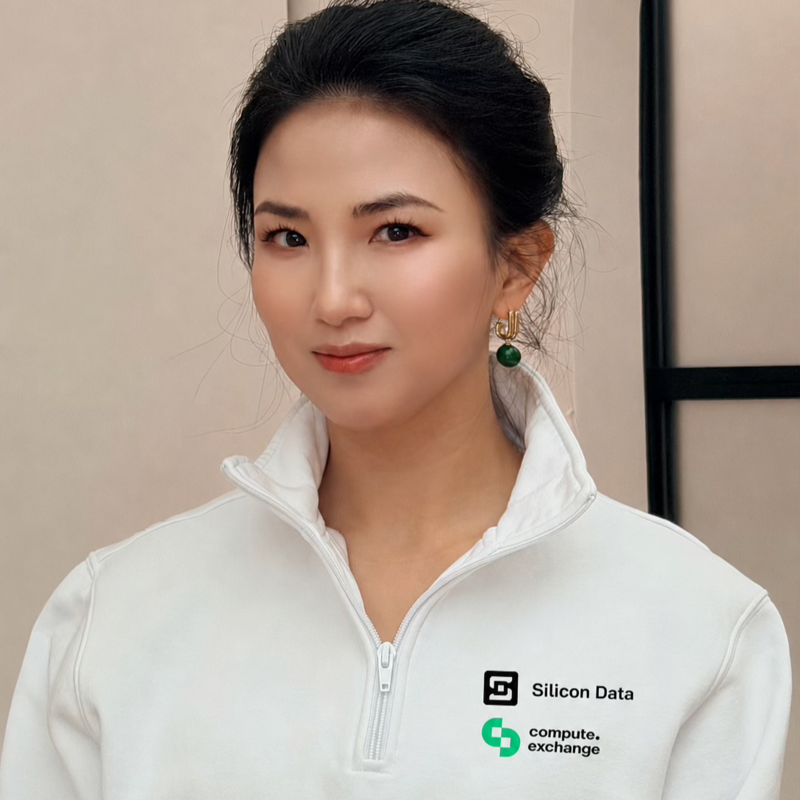
>> Welcome back, I'm John Furrier with Howard Shue, my co -host here, also an AI leader in the industry. This is our third annual theCUBE and the NYSE Wired AI Leaders Summit here in our studios. And of course we have our third annual CUBE party gathering, 180 people coming together, all leaders, talking about the future, what they're working on, sharing their information. As the market continues to grow, the ecosystem is growing as well. Of course, the data really matters, and Carmen Li is here, she's the founder and CEO of Silicon Data and Compute Exchange. Congratulations on all your momentum, great to see you again.
Carmen Li
>> Good to see you again, John, this is great.
John Furrier
>> When you first started on theCUBE, We've been on a full journey together with NYSE Wired, so great to see you. First of all, what's the update? I've been seeing a lot of talks, saw you on Bloomberg recently. A lot of great action. Give us the update.
Carmen Li
>> Yeah, so Compute Exchange, we launched the compute forward packages as well as our refurbished markets two weeks ago. So we see an amazing trend where people start transacting secondary GPU servers, which is great, right? because sometimes you might need the latest and greatest GB300, you might not want the H200, but someone else can use that for different reasons. So we want to see a robust secondary market to really solve the shortage problem that we're facing today for the GPU service.
John Furrier
>> So people need GPUs still as a supply chain problem, you're filling that with your market.
Carmen Li
>> That's right, so through Compute Exchange you can get reserved contracts, forward contracts, which means things happen for the future, as well as secondary transactions, meaning you're looking to get secondary GPUs, which are certified, refurbished by us and our partners.
John Furrier
>> You've also been working on Silicon Data and getting all the data on the pricing.
Carmen Li
>> That's right.
John Furrier
>> But I always ask the question, what's the current price of a GPU?
Carmen Li
>> Exactly.
John Furrier
>> What's the status of pricing, are you seeing any fluctuations, what does the data tell you?
Carmen Li
>> if you ask me, remember last year, everyone was like freaking out, saying, well why do we need the indices, right? The compute price will keep going down forever. And last year the price did come down across all chips. So since January this year, all GPUs, we're talking about A100, H100, B200, all went up between 15 -20 % year to date for on -demand NeoCloud GPUs. Hyperscaler on-demand prices have been pretty stable for A100, H100, but they were high to begin with. So when NeoClouds all went up 15 -20%, if you look at the term structure for all different GPUs, they all elevated, all the curves went up, right? So we see huge robust demand across all different chips globally.
John Furrier
>> So we see production of Vera Rubin. Does that skew the data, or is that just an outlier? Is that tracking, what's with Vera Rubin?
Carmen Li
>> So for the Vera Rubins, most of them are people putting in purchase orders.
John Furrier
>> Hard to get.
Carmen Li
>> Exactly, exactly. So people are not actually receiving them in the quantity we're seeing yet, not because people don't want to.
John Furrier
>> Because they can't get their hands on them.
Carmen Li
>> Exactly.So I would say another two months, potentially, we will start seeing this sort of data coming in. We'll see forward contracts start being placed. But right now, we don't see much data. The GB300, yes, it's selling.
Howie Xu
>> So in the GPU, the price go up and down. That makes a lot of sense. But you also kind of have this exchange. How fungible the GPU is? a GPU in one data center with certain network is totally different when it comes to token economics. So how to think about it?
Carmen Li
>> You're 100 % correct. So that's why Compute Exchange, we're doing forward contracts on specific GPU servers, right? So you ask for, hey, I need 200 B200 nodes in US East with this particular specification. The CPU, this RAM, this disk, you have to define everything, the storages, right? Network storage. Everything. Software stack. Exactly. It's not just a... No, it's not just, hey, I need a H200, right? You have to tell me the specs. Oh, you don't care. Maybe you don't care, right? So then they have more options if you don't care about something. And then what we do is we give you a rubric spec and tell you, hey, here's the things that satisfy what you're looking for. Here's the specs. Here are the benchmark results. Because to your point, those machines might be three years old. The performance might not be the same as the specs. So we tell you the third-party benchmark results based on the performance, throughputs, flops, memory bandwidth, all the things, thermal degradation, and then you make a decision, right? Supposedly, better performing GPU can trade at higher prices, right? I mean, today, you're lucky you get what you're looking for, right? That's your location you're looking for. But most of the time, you look at specs, you pick one, trade cleared, right? That's the way to go.
John Furrier
>> How has been the competition? Because I've been seeing a lot of people coming in, a lot more neoclouds coming in, standing up infrastructure, a lot of build outs going on. Does that impact supply and or is it competition? Are they competition, are they frenemies? How do you view that?
Carmen Li
>> We love all neoclouds. We love all capacity coming in. So Compute Exchange doesn't own anything. We work with everybody and we -
John Furrier
>> You're asset light, you have no assets, right.
Carmen Li
>> We're asset light, so think about like Nasdaq, right? You guys, NYSE, right? NYSE doesn't own any stocks, you work with everybody, right, so similar Compute Exchange, work with everybody all neoclouds. So the way we work is we integrate with them, so inventory tracking, so we know who has what.
John Furrier
>> You're not renting, are you renting GPUs or are you selling?
Carmen Li
>> We have real -time inventory matching, so we know who has what.
John Furrier
>> Okay, exchange.
Carmen Li
>> Exactly, so people, the RFQ comes in, or auction comes in, we'll match with, hey, John has this, or Howard has this, right? Pick one, right? I honestly don't care who they picked, as long as we can satisfy the RFQs, and then you find clients, and that's how we make money. It's a transaction -based fee, right? So to your point, we see, which is amazing, a lot more new clouds coming in. Yeah, I would like to think there's a lot more demand, and supply for the future, but we haven't really seen as much as I thought we could see by now. All these things get just soaked up very quickly thanks to all the open source models, I guess.
John Furrier
>> And the CapEx build out's been massive.
Carmen Li
>> Exactly, globally too, right? Not just here, we were at a RAISE Summit and everything in Europe also sold out.
John Furrier
>> What else is going on in your world? Are there new things on your radar. Obviously, the Vera Rubins are in full production now. We heard that from NVIDIA. Arm has Helios. They got some GPUs now. Now you're starting to see, TensorWave, others come out. Argentum is a hot neocloud we covered recently. CoreWeave, we had the first workload. We launched them here in our studio on June 30th. So everything's hitting this next wave. What's it like?
Carmen Li
>> So we're exploring a few interesting mechanisms for the markets. To your point, today you can reserve GPU at certain prices with some of the names you mentioned. One of the things people are facing is token prices, right? So if you're calling tokens, people assume, which is kind of true, is you can only do on -demand pricing for tokens. Whatever API charges you, you get charged for that. Unlike GPU, you can reserve prices for next year minimum. For tokens, we're exploring ways to do token -forward packages, meaning you can lock in prices for the next year for a given model family. So that's something we're exploring with our clients and our suppliers. So that gives more people an option. sure, you care about GPU, do GPU reserve packages. If you care about token, which probably more people I would like to think care about tokens more than GPU, honestly, you don't care about what GPU is underneath that. You care about tokens and do token forward packages. You're locking token prices ahead of time, probably better for CFOs.
Howie Xu
>> So for instance, Opus 4.8, you reserve that for one year for the price, but one challenge is 4 .8 may be decommissioned in six months, how do you handle those?
Carmen Li
>> So that's why we call it suppliers. So as a supplier, you have to commit to say, hey, I'm going to support this family because for that particular package, you'll be promised support. The term for the forward packages is not that long. We're not running like five-year long packages, like six months to 12 months. So give people enough room to upgrade or change their mind per se.
Howie Xu
>> This is a minor digression, at least for this revolution, the AI revolution, compared to the past enterprise business John and I are so familiar with, is that backward compatibility is not a thing for those AI guys. They don't care, right? When Grok came out with 4.5, they just decommissioned the API from the previous generation so fast. And that never happened when HP, IBM of the world were reigning. They care about the API or the service they provided six years ago. So it's a very different world.
Carmen Li
>> So we do support deprecated models as long as people are using them, as long as our providers can actually support them.
Howie Xu
>> But they don't always do that.
Carmen Li
>> And people still support OSS, people using that for summarization, it's a very good model for that particular task. So for Silicon Data & Compute Exchange, we don't really have a model that is latest, greatest, or deprecated, as long as people are using it, we love to support them.
John Furrier
>> Okay, explain, folks don't know, there's obviously more than NVIDIA out there, you've got AMD, you've got a big showing last week in San Francisco, Intel back in the game, inference is hot, are there other products in there? How do you view that as more exchange for you? Or how do you view that?
Carmen Li
>> We're agnostic, so for Compute Exchange, we had a few deals on AMD, which is amazing. We will actually have an event with a few AMD neoclouds coming up, which we're excited about. Silicon Data have MI300X index that's up and running. The price has been going up as well, just like other GPU indices, right? So we do cover all different design houses. Obviously, now, NVIDIA is still sort of the majority of neocloud backbone, right? But in general, yeah, we work with that.
John Furrier
>> One trend I walked away from AMD last week was that the trend is, oh, a year and a half ago we had 500 GPUs, now we have 5 ,000, then 50 ,000. So you started to see the increase in GPUs.
Carmen Li
>> That's right.
John Furrier
>> As their business and their services start to get adopted. Are there learnings that you have over the past 12 months about the sea change around that kind of growth? Has that changed the dynamics? What have been your key learnings over the past 12 months?
Carmen Li
>> It's been amazing. So I feel like I've been telling people that we can all calculate how much the supply is supposed to be online based on the news and the capital spends, right? How much supply is going to come online for AMD, for NVIDIA, for CoreWeave. But no one, I don't think I can predict the demand side. I don't know how much, what we're going to use next quarter. I don't know when another country is going to take off with AI adoption. So demand side is a big unknown. That translates to your point earlier, why GPU prices are going all over the place? Why it was so volatile? Why prices are going up and down all the time? Because no one can really control the demand side.
Howie Xu
>> Open cloud probably contributed to that.
Carmen Li
>> Some of that, right? Potentially. Maybe people love FP4. I don't think anyone already has support of FP4 quite yet, right? Not today, not right now. But that can be a potential boom for the B200s or GB200s, which will kind of support FP4. So the demand side, I don't know. That's why the prices, it can be all over the place. I think people have a predetermined sort of view, say, hey, all the GPU costs are going to come down, right? maybe, could be, but again, we don't know the demand side. I will argue that even in the US, East Coast, West Coast probably adopting more than other parts of the country. Other parts of the world, maybe not quite yet, right? So that's the adoption will take place.
John Furrier
>> Every day there's a new model and they got the open weights, that's going to change maybe some of the other inventory. I'm sure you got your eye on that too. What are you optimizing for this year? What's new for you? What's your focus these days?
Carmen Li
>> We are very excited for obviously the CME's futures launch on my indices in the fall. We're working with all different natural hedgers. So it's pretty interesting. I'm helping probably a dozen market participants set up their compute desks, so people are actually helping their client to hedge. So think about if your client, if you're a bank, your client can be the hyperscaler or neoclouds, they have a long exposure, they try to help them manage the futures and volatility for their revenues. Or your bank, your client can be the massive AI company, they're going to consume a lot of GPU tokens, so they help them manage the short exposure. So we're helping those banks to hedge their volatility. facility.
John Furrier
>> It was covering the Anthropic rise from zero to 10 billion in revenue. And one of the things I wrote in my post, Howie, was that Jensen says we're bounded by energy. It's the low level of his five -layer cake. But I added a new dimension, finance. And at a lot of these, setting up a credit desk means the financing side of it is bounded. So you have a financial element, not just cost for tokens, which we know in the enterprise is a little bit inflationary right now in terms of the costs. That'll get reined in, that's on the enterprise side, but then on the cloud and neocloud and hyperscaler side, there's a huge financing vehicle. Amazon's taking on debt, so is Google. So financial and energy are the bounding functions.
Carmen Li
>> 100 % so we're talking capital. Obviously, banks' capital is supposed to be cheapest, right? And then you get more expensive capital come in from asset management of the world, right? So people have different risk appetite. they have to manage their risk differently, right? So for us it's all about bringing transparency to people.
John Furrier
>> Like the Moody's rating for GPUs.
Carmen Li
>> Which is interesting you mention that. We start working with the credit rating agencies, right? Because we do server fair price evaluation. So imagine a balance sheet, tons of servers, right? Someone has to evaluate performance as well as valuation for those servers. And they're not all zero, right? It's like if your airplane, aircraft carrier, not all your airplanes are worth zero, by the end of year three, someone will have to come in and do a fair market evaluation, that's what we do as well.
John Furrier
>> Carmen, great to see you, thanks for coming on theCUBE at our third annual, you've been part of us the whole way. Appreciate your time and congratulations, we'll be keeping in touch. Get that data from Silicon Data, we'll put it on SiliconANGLE anytime.
Carmen Li
>> Yep, yep, yep, sounds good, it's great.Thank you for having me.
John Furrier
>> I'm John Furrier, we're here for the third annual AI Leaders' Summit here in Palo Alto, this is theCUBE at NYSE Wired. Of course, the event tonight, the leaders getting together, sharing their knowledge and of course interacting as the ecosystem continues to grow. We're doing our part bringing all the data to you here on theCUBE. Thanks for watching.
>> Welcome back, I'm John Furrier with Howard Shue, my co -host here, also an AI leader in the industry. This is our third annual theCUBE and the NYSE Wired AI Leaders Summit here in our studios. And of course we have our third annual CUBE party gathering, 180 people coming together, all leaders, talking about the future, what they're working on, sharing their information. As the market continues to grow, the ecosystem is growing as well. Of course, the data really matters, and Carmen Li is here, she's the founder and CEO of Silicon Data and Compute Exchange. Congratulations on all your momentum, great to see you again.
Carmen Li
>> Good to see you again, John, this is great.
John Furrier
>> When you first started on theCUBE, We've been on a full journey together with NYSE Wired, so great to see you. First of all, what's the update? I've been seeing a lot of talks, saw you on Bloomberg recently. A lot of great action. Give us the update.
Carmen Li
>> Yeah, so Compute Exchange, we launched the compute forward packages as well as our refurbished markets two weeks ago. So we see an amazing trend where people start transacting secondary GPU servers, which is great, right? because sometimes you might need the latest and greatest GB300, you might not want the H200, but someone else can use that for different reasons. So we want to see a robust secondary market to really solve the shortage problem that we're facing today for the GPU service.
John Furrier
>> So people need GPUs still as a supply chain problem, you're filling that with your market.
Carmen Li
>> That's right, so through Compute Exchange you can get reserved contracts, forward contracts, which means things happen for the future, as well as secondary transactions, meaning you're looking to get secondary GPUs, which are certified, refurbished by us and our partners.
John Furrier
>> You've also been working on Silicon Data and getting all the data on the pricing.
Carmen Li
>> That's right.
John Furrier
>> But I always ask the question, what's the current price of a GPU?
Carmen Li
>> Exactly.
John Furrier
>> What's the status of pricing, are you seeing any fluctuations, what does the data tell you?
Carmen Li
>> if you ask me, remember last year, everyone was like freaking out, saying, well why do we need the indices, right? The compute price will keep going down forever. And last year the price did come down across all chips. So since January this year, all GPUs, we're talking about A100, H100, B200, all went up between 15 -20 % year to date for on -demand NeoCloud GPUs. Hyperscaler on-demand prices have been pretty stable for A100, H100, but they were high to begin with. So when NeoClouds all went up 15 -20%, if you look at the term structure for all different GPUs, they all elevated, all the curves went up, right? So we see huge robust demand across all different chips globally.
John Furrier
>> So we see production of Vera Rubin. Does that skew the data, or is that just an outlier? Is that tracking, what's with Vera Rubin?
Carmen Li
>> So for the Vera Rubins, most of them are people putting in purchase orders.
John Furrier
>> Hard to get.
Carmen Li
>> Exactly, exactly. So people are not actually receiving them in the quantity we're seeing yet, not because people don't want to.
John Furrier
>> Because they can't get their hands on them.
Carmen Li
>> Exactly.So I would say another two months, potentially, we will start seeing this sort of data coming in. We'll see forward contracts start being placed. But right now, we don't see much data. The GB300, yes, it's selling.
Howie Xu
>> So in the GPU, the price go up and down. That makes a lot of sense. But you also kind of have this exchange. How fungible the GPU is? a GPU in one data center with certain network is totally different when it comes to token economics. So how to think about it?
Carmen Li
>> You're 100 % correct. So that's why Compute Exchange, we're doing forward contracts on specific GPU servers, right? So you ask for, hey, I need 200 B200 nodes in US East with this particular specification. The CPU, this RAM, this disk, you have to define everything, the storages, right? Network storage. Everything. Software stack. Exactly. It's not just a... No, it's not just, hey, I need a H200, right? You have to tell me the specs. Oh, you don't care. Maybe you don't care, right? So then they have more options if you don't care about something. And then what we do is we give you a rubric spec and tell you, hey, here's the things that satisfy what you're looking for. Here's the specs. Here are the benchmark results. Because to your point, those machines might be three years old. The performance might not be the same as the specs. So we tell you the third-party benchmark results based on the performance, throughputs, flops, memory bandwidth, all the things, thermal degradation, and then you make a decision, right? Supposedly, better performing GPU can trade at higher prices, right? I mean, today, you're lucky you get what you're looking for, right? That's your location you're looking for. But most of the time, you look at specs, you pick one, trade cleared, right? That's the way to go.
John Furrier
>> How has been the competition? Because I've been seeing a lot of people coming in, a lot more neoclouds coming in, standing up infrastructure, a lot of build outs going on. Does that impact supply and or is it competition? Are they competition, are they frenemies? How do you view that?
Carmen Li
>> We love all neoclouds. We love all capacity coming in. So Compute Exchange doesn't own anything. We work with everybody and we -
John Furrier
>> You're asset light, you have no assets, right.
Carmen Li
>> We're asset light, so think about like Nasdaq, right? You guys, NYSE, right? NYSE doesn't own any stocks, you work with everybody, right, so similar Compute Exchange, work with everybody all neoclouds. So the way we work is we integrate with them, so inventory tracking, so we know who has what.
John Furrier
>> You're not renting, are you renting GPUs or are you selling?
Carmen Li
>> We have real -time inventory matching, so we know who has what.
John Furrier
>> Okay, exchange.
Carmen Li
>> Exactly, so people, the RFQ comes in, or auction comes in, we'll match with, hey, John has this, or Howard has this, right? Pick one, right? I honestly don't care who they picked, as long as we can satisfy the RFQs, and then you find clients, and that's how we make money. It's a transaction -based fee, right? So to your point, we see, which is amazing, a lot more new clouds coming in. Yeah, I would like to think there's a lot more demand, and supply for the future, but we haven't really seen as much as I thought we could see by now. All these things get just soaked up very quickly thanks to all the open source models, I guess.
John Furrier
>> And the CapEx build out's been massive.
Carmen Li
>> Exactly, globally too, right? Not just here, we were at a RAISE Summit and everything in Europe also sold out.
John Furrier
>> What else is going on in your world? Are there new things on your radar. Obviously, the Vera Rubins are in full production now. We heard that from NVIDIA. Arm has Helios. They got some GPUs now. Now you're starting to see, TensorWave, others come out. Argentum is a hot neocloud we covered recently. CoreWeave, we had the first workload. We launched them here in our studio on June 30th. So everything's hitting this next wave. What's it like?
Carmen Li
>> So we're exploring a few interesting mechanisms for the markets. To your point, today you can reserve GPU at certain prices with some of the names you mentioned. One of the things people are facing is token prices, right? So if you're calling tokens, people assume, which is kind of true, is you can only do on -demand pricing for tokens. Whatever API charges you, you get charged for that. Unlike GPU, you can reserve prices for next year minimum. For tokens, we're exploring ways to do token -forward packages, meaning you can lock in prices for the next year for a given model family. So that's something we're exploring with our clients and our suppliers. So that gives more people an option. sure, you care about GPU, do GPU reserve packages. If you care about token, which probably more people I would like to think care about tokens more than GPU, honestly, you don't care about what GPU is underneath that. You care about tokens and do token forward packages. You're locking token prices ahead of time, probably better for CFOs.
Howie Xu
>> So for instance, Opus 4.8, you reserve that for one year for the price, but one challenge is 4 .8 may be decommissioned in six months, how do you handle those?
Carmen Li
>> So that's why we call it suppliers. So as a supplier, you have to commit to say, hey, I'm going to support this family because for that particular package, you'll be promised support. The term for the forward packages is not that long. We're not running like five-year long packages, like six months to 12 months. So give people enough room to upgrade or change their mind per se.
Howie Xu
>> This is a minor digression, at least for this revolution, the AI revolution, compared to the past enterprise business John and I are so familiar with, is that backward compatibility is not a thing for those AI guys. They don't care, right? When Grok came out with 4.5, they just decommissioned the API from the previous generation so fast. And that never happened when HP, IBM of the world were reigning. They care about the API or the service they provided six years ago. So it's a very different world.
Carmen Li
>> So we do support deprecated models as long as people are using them, as long as our providers can actually support them.
Howie Xu
>> But they don't always do that.
Carmen Li
>> And people still support OSS, people using that for summarization, it's a very good model for that particular task. So for Silicon Data & Compute Exchange, we don't really have a model that is latest, greatest, or deprecated, as long as people are using it, we love to support them.
John Furrier
>> Okay, explain, folks don't know, there's obviously more than NVIDIA out there, you've got AMD, you've got a big showing last week in San Francisco, Intel back in the game, inference is hot, are there other products in there? How do you view that as more exchange for you? Or how do you view that?
Carmen Li
>> We're agnostic, so for Compute Exchange, we had a few deals on AMD, which is amazing. We will actually have an event with a few AMD neoclouds coming up, which we're excited about. Silicon Data have MI300X index that's up and running. The price has been going up as well, just like other GPU indices, right? So we do cover all different design houses. Obviously, now, NVIDIA is still sort of the majority of neocloud backbone, right? But in general, yeah, we work with that.
John Furrier
>> One trend I walked away from AMD last week was that the trend is, oh, a year and a half ago we had 500 GPUs, now we have 5 ,000, then 50 ,000. So you started to see the increase in GPUs.
Carmen Li
>> That's right.
John Furrier
>> As their business and their services start to get adopted. Are there learnings that you have over the past 12 months about the sea change around that kind of growth? Has that changed the dynamics? What have been your key learnings over the past 12 months?
Carmen Li
>> It's been amazing. So I feel like I've been telling people that we can all calculate how much the supply is supposed to be online based on the news and the capital spends, right? How much supply is going to come online for AMD, for NVIDIA, for CoreWeave. But no one, I don't think I can predict the demand side. I don't know how much, what we're going to use next quarter. I don't know when another country is going to take off with AI adoption. So demand side is a big unknown. That translates to your point earlier, why GPU prices are going all over the place? Why it was so volatile? Why prices are going up and down all the time? Because no one can really control the demand side.
Howie Xu
>> Open cloud probably contributed to that.
Carmen Li
>> Some of that, right? Potentially. Maybe people love FP4. I don't think anyone already has support of FP4 quite yet, right? Not today, not right now. But that can be a potential boom for the B200s or GB200s, which will kind of support FP4. So the demand side, I don't know. That's why the prices, it can be all over the place. I think people have a predetermined sort of view, say, hey, all the GPU costs are going to come down, right? maybe, could be, but again, we don't know the demand side. I will argue that even in the US, East Coast, West Coast probably adopting more than other parts of the country. Other parts of the world, maybe not quite yet, right? So that's the adoption will take place.
John Furrier
>> Every day there's a new model and they got the open weights, that's going to change maybe some of the other inventory. I'm sure you got your eye on that too. What are you optimizing for this year? What's new for you? What's your focus these days?
Carmen Li
>> We are very excited for obviously the CME's futures launch on my indices in the fall. We're working with all different natural hedgers. So it's pretty interesting. I'm helping probably a dozen market participants set up their compute desks, so people are actually helping their client to hedge. So think about if your client, if you're a bank, your client can be the hyperscaler or neoclouds, they have a long exposure, they try to help them manage the futures and volatility for their revenues. Or your bank, your client can be the massive AI company, they're going to consume a lot of GPU tokens, so they help them manage the short exposure. So we're helping those banks to hedge their volatility. facility.
John Furrier
>> It was covering the Anthropic rise from zero to 10 billion in revenue. And one of the things I wrote in my post, Howie, was that Jensen says we're bounded by energy. It's the low level of his five -layer cake. But I added a new dimension, finance. And at a lot of these, setting up a credit desk means the financing side of it is bounded. So you have a financial element, not just cost for tokens, which we know in the enterprise is a little bit inflationary right now in terms of the costs. That'll get reined in, that's on the enterprise side, but then on the cloud and neocloud and hyperscaler side, there's a huge financing vehicle. Amazon's taking on debt, so is Google. So financial and energy are the bounding functions.
Carmen Li
>> 100 % so we're talking capital. Obviously, banks' capital is supposed to be cheapest, right? And then you get more expensive capital come in from asset management of the world, right? So people have different risk appetite. they have to manage their risk differently, right? So for us it's all about bringing transparency to people.
John Furrier
>> Like the Moody's rating for GPUs.
Carmen Li
>> Which is interesting you mention that. We start working with the credit rating agencies, right? Because we do server fair price evaluation. So imagine a balance sheet, tons of servers, right? Someone has to evaluate performance as well as valuation for those servers. And they're not all zero, right? It's like if your airplane, aircraft carrier, not all your airplanes are worth zero, by the end of year three, someone will have to come in and do a fair market evaluation, that's what we do as well.
John Furrier
>> Carmen, great to see you, thanks for coming on theCUBE at our third annual, you've been part of us the whole way. Appreciate your time and congratulations, we'll be keeping in touch. Get that data from Silicon Data, we'll put it on SiliconANGLE anytime.
Carmen Li
>> Yep, yep, yep, sounds good, it's great.Thank you for having me.
John Furrier
>> I'm John Furrier, we're here for the third annual AI Leaders' Summit here in Palo Alto, this is theCUBE at NYSE Wired. Of course, the event tonight, the leaders getting together, sharing their knowledge and of course interacting as the ecosystem continues to grow. We're doing our part bringing all the data to you here on theCUBE. Thanks for watching.