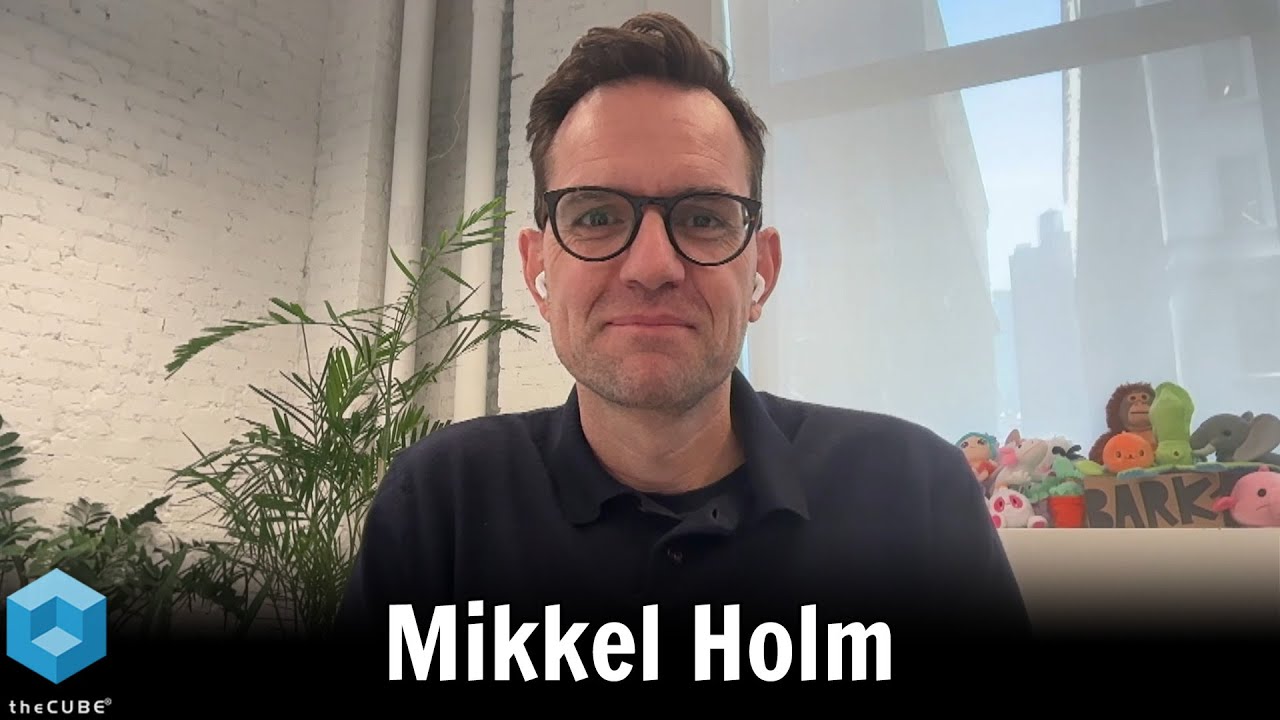
Mikkel Holm, the chief AI and innovation officer at BARK, joins John Furrier of theCUBE to explore the transformative journey of artificial intelligence at BARK during the AI Agent Conference 2025. In this session, Holm discusses how AI reshapes operational and creative processes across the organization.
Holm brings a unique blend of creativity and technical insight to their role, championing AI integration from product design to customer engagement at BARK. Hosted by Furrier of theCUBE, this discussion uncovers key topics such as the challenges of change management, the importance of domain expertise, and the innovative use of AI to enhance both internal processes and customer experiences at BARK.
Key takeaways from the conversation include Holm’s approach to AI as a tool for augmenting team capabilities rather than replacing jobs, emphasizing the orchestration of human intelligence and AI tools. Holm notes the key to success lies in continual experimentation and adapting rapidly to new technologies, leveraging both automation and creative innovation to remain competitive in the evolving marketplace.
Forgot Password
Almost there!
We just sent you a verification email. Please verify your account to gain access to
theCUBE + NYSE Wired: AI Agent Conference. If you don’t think you received an email check your
spam folder.
Sign in to theCUBE + NYSE Wired: AI Agent Conference.
In order to sign in, enter the email address you used to registered for the event. Once completed, you will receive an email with a verification link. Open this link to automatically sign into the site.
Register For theCUBE + NYSE Wired: AI Agent Conference
Please fill out the information below. You will recieve an email with a verification link confirming your registration. Click the link to automatically sign into the site.
You’re almost there!
We just sent you a verification email. Please click the verification button in the email. Once your email address is verified, you will have full access to all event content for theCUBE + NYSE Wired: AI Agent Conference.
I want my badge and interests to be visible to all attendees.
Checking this box will display your presense on the attendees list, view your profile and allow other attendees to contact you via 1-1 chat. Read the Privacy Policy. At any time, you can choose to disable this preference.
Select your Interests!
add
Upload your photo
Uploading..
OR
Connect via Twitter
Connect via Linkedin
EDIT PASSWORD
Share
Forgot Password
Almost there!
We just sent you a verification email. Please verify your account to gain access to
theCUBE + NYSE Wired: AI Agent Conference. If you don’t think you received an email check your
spam folder.
Sign in to theCUBE + NYSE Wired: AI Agent Conference.
In order to sign in, enter the email address you used to registered for the event. Once completed, you will receive an email with a verification link. Open this link to automatically sign into the site.
Sign in to gain access to theCUBE + NYSE Wired: AI Agent Conference
Please sign in with LinkedIn to continue to theCUBE + NYSE Wired: AI Agent Conference. Signing in with LinkedIn ensures a professional environment.
Are you sure you want to remove access rights for this user?
Details
Manage Access
email address
Community Invitation
Sean Neville, Catena Labs
Mikkel Holm, the chief AI and innovation officer at BARK, joins John Furrier of theCUBE to explore the transformative journey of artificial intelligence at BARK during the AI Agent Conference 2025. In this session, Holm discusses how AI reshapes operational and creative processes across the organization.
Holm brings a unique blend of creativity and technical insight to their role, championing AI integration from product design to customer engagement at BARK. Hosted by Furrier of theCUBE, this discussion uncovers key topics such as the challenges of change management, the importance of domain expertise, and the innovative use of AI to enhance both internal processes and customer experiences at BARK.
Key takeaways from the conversation include Holm’s approach to AI as a tool for augmenting team capabilities rather than replacing jobs, emphasizing the orchestration of human intelligence and AI tools. Holm notes the key to success lies in continual experimentation and adapting rapidly to new technologies, leveraging both automation and creative innovation to remain competitive in the evolving marketplace.
In this interview from the theCUBE + NYSE Wired: AI Agent Conference in New York City, Sean Neville, co-founder and chief executive officer of Catena Labs, joins theCUBE + NYSE Wired's Gemma Allen to discuss building the financial rails that will allow AI agents to safely transact in the global economy. Drawing on his experience co-founding Circle and authoring foundational digital currency frameworks, Neville outlines Catena Labs' vision: a banking platform purpose-built for AI actors. He introduces "Know Your Agent" (KYA) — a compliance framework designed t...Read more
exploreKeep Exploring
What is Catena Labs and what is the company's mission or focus?add
How should financial services safely onboard and verify automated agents/bots — what does "Know Your Agent" (KYA) mean in practice (including whether it requires persona-level identification), and how can banks verify, monitor, and control good bots while keeping bad actors out?add
What does "know your agent" mean, and how could agent identity and verification work in theory and practice (e.g., persona-level identities, autonomous agent IDs, and the role of KYC/KYB and standards-based approaches)?add
Yes — the excerpt is answering a question about payments and underlying tech for AI agents. A neutral phrasing of the question:
How do you expect AI agents to transact with each other (e.g., will they use stablecoins or other payment methods), and what technologies or standards are you building on?add
>> Welcome to a very special episode of theCUBE and NYSE Wired. We are here at the Agentic Studio at the AI Agent Conference in Midtown Manhattan. We are talking all things builders, breakers, and buyers for this next wave of technology. We are now going to have a conversation about bots for banks. Joining me is Sean Neville, CEO and founder of Catena Labs. Welcome, Sean.
Sean Neville
>> Thank you. It's a pleasure to be here.
Gemma Allen
>> So banks for bots, bots for banks. Talk to me a little bit about Catena Labs. I want to get to your story. I know you've had a fascinating background, but first, break this company down for me.
Sean Neville
>> Yeah, so our conviction is that in the future, it's not the case that most financial transactions will be executed by AI actors, but we'll want all transactions to be executed by AI actors. And so we're focused on making that safe, making it possible, but making it safe, making it possible to govern AIs that are touching money in alignment with human business values and intent. And so it effectively amounts to being a new kind of banking platform that is purpose built for AI actors.
Gemma Allen
>> Wow. And Sean, when it comes to business models like this, where, from the outset, it seems a little bit crazy, there's probably a lot of skepticism. This also isn't your first rodeo, right? You were the co-founder of Circle, a company that has really been on some trajectory in the last 10, 12 years or so. Talk to me a little bit about, I guess, your background and what brought you to this moment you're in right now. Did you not want to just retire and go live in Florida or somewhere equally warm?
Sean Neville
>> 10 to 12 years in crypto is like 120 years in other years. So yeah, actually some similar patterns that are playing out now compared to what we saw in the early days of crypto. Although I think what's happening in AI is accelerated, it's happening much faster. But similarly, when we started with this vision with Circle of democratizing access to global finance and making money move, just like any other kind of data moves on the internet, which is almost instantly, practically no fees, with no borders, there was also a lot of skepticism about how to make that safe, how to encode it in public policy, how to get the United States government to recognize that the United States dollar can travel on internet rails or blockchain rails. And it took years of education and pushing. And in some cases, our approach, at the time, you could even argue was something that made us a little bit slower than others in the space because we were deliberately going in the front door and trying to educate regulators about how to do this safely with this vision of what ultimately would unlock a great deal of prosperity for those who could plug in. It did take a while. When I wrote the SEC white paper, it was 2017. And then at that time, we imagined it might take 10 years for that to be encoded in public policy. It took about seven because we got the GENIUS Act last year, but we're not done. There's a lot more to do. I think similarly with AI, there's a lot of skepticism, for good reason. And there's also a lot of excitement that if we get this right, it may unlock a kind of prosperity the world has never seen before. So it's very sort of a similar cycle and I couldn't not do this.
Gemma Allen
>> Well, I really want to get to that prosperity. I want to understand exactly how you envision this will in some way democratize access to finance for everybody. But first, in terms of this company, we're at a point where we hear a lot about the adoption of AI and enterprise, whether or not folks are actually realizing value, whether the right guardrails are in place or whether people are even using AI with the proper productivity and efficiency levels. And a lot of the conversations in enterprise, especially in the more regulated spaces like banking, come back of course to governance, compliance, what it really means to ensure that we have a human in the loop, et cetera. This company and this theory is really based on a certain premise, that things are going to be like A-OK in every other part of the enterprise for this to work. Talk a little bit about how you would see this product and this actually becoming like a live workflow.
Sean Neville
>> Yeah.
Gemma Allen
>> Break it down for me against that context.
Sean Neville
>> Yeah, I would say one of the issues with financial services today is that all bots are bad. So all automated workflows are things to be risk fenced away from the financial activity. And there's reasons for that. What we think we need is the inverse. Let's keep the bad actors out, but make it possible for the good bots, the good automated systems to participate. Whether it's participating in payment flows, whether it's participating in treasury management, foreign exchange, yield generation, whatever it may be, make it possible for the good bots to be KYA'd effectively so that we know your agent, just like we KYC individuals today, KYB in business is onboarding into a bank. Make it possible for these actors to be verified, linked back to a legal entity such as a business, and then monitored and controlled in a way that we can always audit and look back and understand why they did the things that they did. And that's the path of getting it right and making it safe and possible. As opposed to say, surfacing an existing API to an automated workflow without those controls, which is much more dangerous.
Gemma Allen
>> So we talk about know your agent. Are we talking about persona level? Could you maybe give me a little bit more on exactly what that would look like in theory?
Sean Neville
>> Yeah. I think years from now, maybe it's possible for agents to prove their own autonomous ID or whatever it may be, but for now, agents can actually apply for a bank account. Businesses and humans, individuals can apply for bank account. And so the step now is still KYB, KYC for those who are able to onboard into a bank account and then prove verifiably that the agents that operate on their behalf are truly operating on their behalf. We'd like that to be standards-based, so not something that Catena or any other company owns, but in the same way that if you and I go to Amazon, we don't have to wonder, is this really Amazon? Do we have to trust Amazon to tell us it's Amazon? We don't have to think about those things because we have web standards that we didn't even think about now that say, yes, our browser understands that this is amazon.com and not an imposter. And those are standards that Microsoft doesn't own, Google doesn't own them, Apple doesn't own them. And we would love to see a space where there are these horizontal standards based on agentic identity verification. We have some of these primitives now, but we'd like to see a standard approach so that agent operators and developers are not implementing 20 different walled gardens trying to make it work.
Gemma Allen
>> I guess we hear a lot about that sometimes in terms of the invited web, whether or not we ever reach a place or we'd have what would be termed an invited web where standards would be just like, again, unanimous across the board and folks could partake in various ways. But back to bad bots for a second, I want to get your take on this. So you're obviously building a technology and at a very, very fascinating time in a space that's also like, in some ways, I guess paralyzed by fear, because that is happening in regulated industries right now. The Mythos released by Anthropic and all of the hype around that, the headlines, the conversations of Jamie Dimon apparently coming into work extra early the next day or whatever. What are your thoughts? From where you're building, what are you seeing? And how close are these risks, do you think?
Sean Neville
>> Yeah. I think there are multiple things that are true at the same time and they can seem conflicting. Everything from, anecdotally, a lot of people who are experimenting with AI, they're using a free chatbot and it can't get their cookie recipe correctly, why would they ever trust it with money, to businesses that are struggling with how do they structure these new workflows and what does that mean in terms of building a team? What does it mean for jobs? With Mythos, what does this mean for security? I like to think that if we get it right, we have the controls in place so that we can get it right and it's aligned with what we want to happen, then it will unlock a great degree of prosperity, the likes of which we've truly never seen. We have effectively reinvented the computer over the last few months, and this computer is a better computer than any computer we've had. But I think the analogy isn't even so much, to me, isn't even so much to the internet or to the microchip. It's almost like unlocking literacy for the world. It's sort of like we've given people a new way to engage and that is dangerous, and there will be side effects that are not the outcomes that we want to see, but that doesn't mean that we won't also see the good outcomes and the positive outcomes. And that's what we're trying to march toward and we're trying to do it quickly.
Gemma Allen
>> Yeah. When you talk about prosperity for everybody, which is a wonderful theory and ideology, and I think especially that type of conversation and dialogue is needed now more than ever before because there's so much fear as to what this underclass of the future of AI will look like. Give me like a before and after that you would love to envision. Do you see a world where everybody could invest a certain amount of their income and have an agent invested for them, and be just as clever and productive with that small amount of money even as a large hedge fund is today? What do you envision?
Sean Neville
>> So I think those use cases are almost the obvious ones to talk about. There are people today who can raise money for their business idea more easily than others can because of the opportunities that they're afforded or the geo jurisdiction in which they live, or whatever it may be. And I think democratizing access to capital means breaking down some of those borders in the same way that's already happened with, say, content on the internet. Although that also has not gone quite as well in some cases as we had hoped when I was young and we were building the early versions of the web. It is true that you don't have to ask anyone for permission for your voice to be heard. You can write what you want and express it on the internet. Today, that isn't yet true with finance and the economy, and we would like to see that kind of access happen. It's one of the reasons we started Circle in the first place is to make that kind of access to the global financial system possible for more people. But I think the thing that's even more interesting, not more interesting, that's sort of further down the line is the new kinds of businesses that will be unlocked if we get this right. Things that don't exist today at all, new opportunities. The new kinds of jobs and businesses that will be created as we start to bring this intelligence online. Again, if we get this right. And I don't want to sound like ... I think particularly in the West, there's kind of two extremes, there's the Doomer extreme and there's Zoomer extreme, and this is either going to destroy everything, or you sound like a snake oil salesman or something. And the reality is definitely vacillating in the middle, and we're trying to curate and cultivate it so that we can get there. But when we were building web standards, we couldn't possibly have imagined all the things that would come about because of the web. And yet there was the sense that it was going to unlock a new kind of generational access to data and content and new business opportunities that we had not seen before. And this is that, but times 10. So I think it's the most amazing thing that's happened in my career.
Gemma Allen
>> So talk to me a little about the tech, about what's happening under the hood here. There are some payments companies that are certainly promising agentic. We see it from Stripe and Visa. Do you see kind of a world of a mass sea of partnerships, or how horizontal versus vertical are you building right now? And give me a sense as well of what you're building on.
Sean Neville
>> Yeah, this is one of those cases too where stablecoins do come, and I hate that word, stablecoin, but dollars online do come into the fold because they represent programmable money. And it turns out it's a pretty good fit for certain kinds of commerce executed by AI actors. That doesn't mean it's exclusively stablecoins that they'll be using. Also, it can use a credit card just fine, even if it settles in stablecoins. But there is a mix of technologies that these actors need to be able to use. And I think what I would hope to see is an emerging standard set of protocols that even competitors can plug into. Again, the same way that they plug into SSL or HTTPS, in e-commerce doesn't really exist yet. My agent can't really easily find your agent and just start a conversation, let alone start paying one another. And so these emerging standards, I think, will probably start off in closed fashion first, and that's kind of where we are now. It's actually quite fragmented in the early days, but ultimately we'd like to see that evolve into something that's a shared set of standards that we can all build. So a lot of our work, to answer the question, a lot of our work is in trying to coalesce these fragmented pieces so that we can ultimately rely on a single sort of shared understanding of how to do these things.
Gemma Allen
>> And in this moment, Sean, right now for something that is so futuristic but has a lot of promise, what are the conversations like with potential dev partners? What has the reaction been?
Sean Neville
>> I think it's intense interest in the space, but the reality I would say today, as we're sitting here today, is very early. There are not a lot of AI actors that are truly transacting at scale. I think we see automated systems paying for access for resources. We see AI actors paying out to humans in some cases. They may be paying for access to an API, maybe on the other side of that is another agent, but there's not really agents paying agents yet. And so a lot of the discussion is around how to begin to step in that direction, but in a controlled fashion. The enterprise version I think of as sort of an access management exercise inside your company. If I have a marketing agent and a software agent, what are they each allowed to do? What we're thinking about is more across the span of enterprise boundaries, how do these companies begin to interact safely in a controlled fashion?
Gemma Allen
>> So for this to be possible, are we talking synthetic data, digital twin? What would actually be needed to make this?
Sean Neville
>> So it's really, it's changed. So I think the answer to that was different six months ago than it is today because there had been in the past this idea that what an agent is, no one can agree on what an agent is. But what an agent is loosely something that was anthropomorphized, that lived in the cloud, that was like your digital twin. And there are still some scenarios like that. But with the way it has gone lately, really since December and January of this year with things like first Anthropic's models and then OpenClaw, and so on, is that what an agent is a thing that partly resides on your own systems and has access to your Excel worksheets alongside other things that are in the cloud. And so it's actually shifted and it's expanded the control surface. So the control surface isn't so much something in the cloud that runs a policy engine, it's something that needs to span everything that that agent touches, all the resources local and remote that the agent has access to.
Gemma Allen
>> Wow. Well, Sean, as much as I was baffled to learn that you're back and you didn't decide to just retire and live out your years somewhere warm, I'm certainly fascinated by this company and could talk to you forever, but I'm getting a hard nod here from the production crew. So thanks so much for chatting. I wish you all the best.
Sean Neville
>> Yeah, It was a pleasure. Thank you.
Gemma Allen
>> I'm Gemma Allen here at the Agentic Studio at the AI Agent Conference as part of our program with NYSE Wired in theCUBE. Stay tuned.


















 Gemma Allen