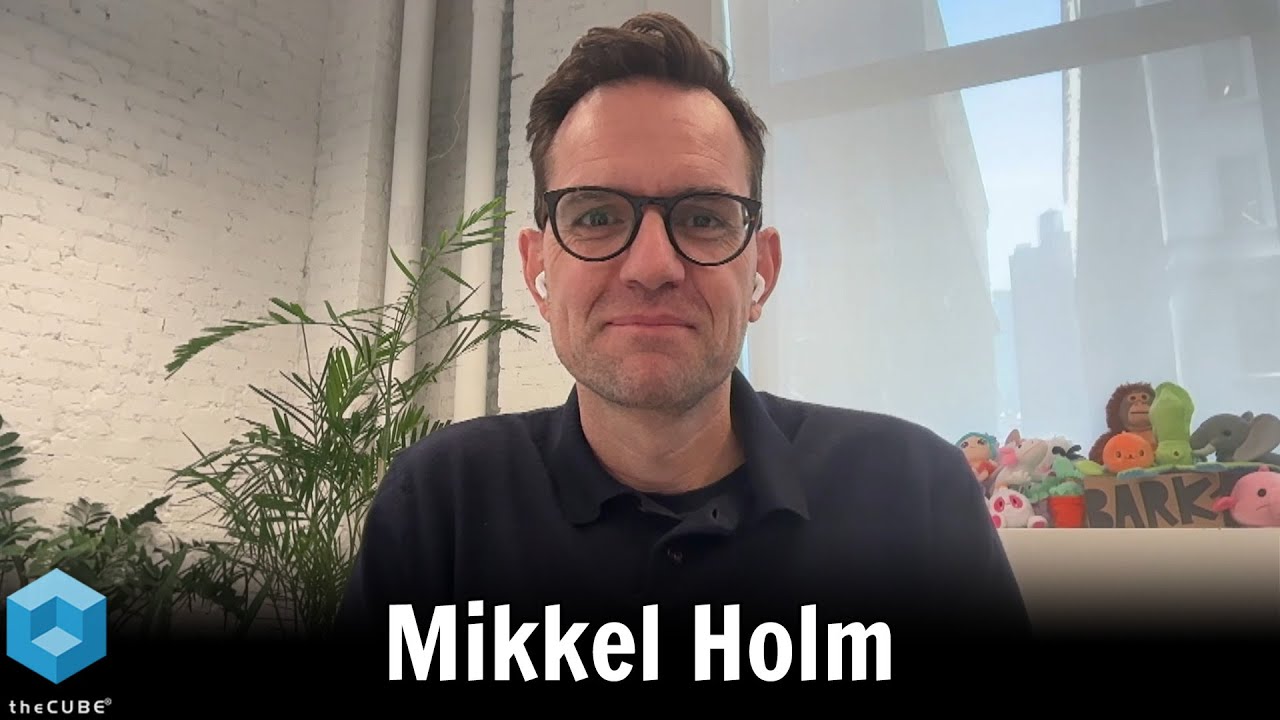
Mikkel Holm, the chief AI and innovation officer at BARK, joins John Furrier of theCUBE to explore the transformative journey of artificial intelligence at BARK during the AI Agent Conference 2025. In this session, Holm discusses how AI reshapes operational and creative processes across the organization.
Holm brings a unique blend of creativity and technical insight to their role, championing AI integration from product design to customer engagement at BARK. Hosted by Furrier of theCUBE, this discussion uncovers key topics such as the challenges of change management, the importance of domain expertise, and the innovative use of AI to enhance both internal processes and customer experiences at BARK.
Key takeaways from the conversation include Holm’s approach to AI as a tool for augmenting team capabilities rather than replacing jobs, emphasizing the orchestration of human intelligence and AI tools. Holm notes the key to success lies in continual experimentation and adapting rapidly to new technologies, leveraging both automation and creative innovation to remain competitive in the evolving marketplace.
Forgot Password
Almost there!
We just sent you a verification email. Please verify your account to gain access to
theCUBE + NYSE Wired: AI Agent Conference. If you don’t think you received an email check your
spam folder.
Sign in to theCUBE + NYSE Wired: AI Agent Conference.
In order to sign in, enter the email address you used to registered for the event. Once completed, you will receive an email with a verification link. Open this link to automatically sign into the site.
Register For theCUBE + NYSE Wired: AI Agent Conference
Please fill out the information below. You will recieve an email with a verification link confirming your registration. Click the link to automatically sign into the site.
You’re almost there!
We just sent you a verification email. Please click the verification button in the email. Once your email address is verified, you will have full access to all event content for theCUBE + NYSE Wired: AI Agent Conference.
I want my badge and interests to be visible to all attendees.
Checking this box will display your presense on the attendees list, view your profile and allow other attendees to contact you via 1-1 chat. Read the Privacy Policy. At any time, you can choose to disable this preference.
Select your Interests!
add
Upload your photo
Uploading..
OR
Connect via Twitter
Connect via Linkedin
EDIT PASSWORD
Share
Forgot Password
Almost there!
We just sent you a verification email. Please verify your account to gain access to
theCUBE + NYSE Wired: AI Agent Conference. If you don’t think you received an email check your
spam folder.
Sign in to theCUBE + NYSE Wired: AI Agent Conference.
In order to sign in, enter the email address you used to registered for the event. Once completed, you will receive an email with a verification link. Open this link to automatically sign into the site.
Sign in to gain access to theCUBE + NYSE Wired: AI Agent Conference
Please sign in with LinkedIn to continue to theCUBE + NYSE Wired: AI Agent Conference. Signing in with LinkedIn ensures a professional environment.
Are you sure you want to remove access rights for this user?
Details
Manage Access
email address
Community Invitation
Steve Hasker, Thomson Reuter & Vanessa Liu, Appen
Mikkel Holm, the chief AI and innovation officer at BARK, joins John Furrier of theCUBE to explore the transformative journey of artificial intelligence at BARK during the AI Agent Conference 2025. In this session, Holm discusses how AI reshapes operational and creative processes across the organization.
Holm brings a unique blend of creativity and technical insight to their role, championing AI integration from product design to customer engagement at BARK. Hosted by Furrier of theCUBE, this discussion uncovers key topics such as the challenges of change management, the importance of domain expertise, and the innovative use of AI to enhance both internal processes and customer experiences at BARK.
Key takeaways from the conversation include Holm’s approach to AI as a tool for augmenting team capabilities rather than replacing jobs, emphasizing the orchestration of human intelligence and AI tools. Holm notes the key to success lies in continual experimentation and adapting rapidly to new technologies, leveraging both automation and creative innovation to remain competitive in the evolving marketplace.
In this interview from theCUBE + NYSE Wired: AI Agent Conference 2026 in New York, Steve Hasker, president and chief executive officer of Thomson Reuters, joins Vanessa Liu, chair of Appen, to talk with theCUBE + NYSE Wired's Gemma Allen about the human-in-the-loop imperative as agentic AI moves into professional and enterprise workflows. Hasker explains how Thomson Reuters serves "fiduciary-grade" AI to lawyers, tax preparers and auditors — professions where accuracy is non-negotiable and a licensed professional must always carry accountability for the work ...Read more
exploreKeep Exploring
Can AI assume the responsibilities, rights, and liabilities of regulated professionals (such as attorneys or CPAs), and how can AI be made reliable and accurate enough for use in those professions?add
How does Appen view and handle content labeling, evaluation, and training for AI, and what role do humans play in that process (where does human involvement begin and end)?add
What will the company spend the $10 billion in "dry powder" (to be deployed by 2027) on?add
What advice do you have for startups and early founders, and how can a tech startup with a compelling product or idea get in touch with you?add
>> Welcome to a very special episode of theCUBE and NYSE Wired coming to you from the Agentic Studio here at the AI Agent Conference in New York. And we are talking all things builders, breakers and bots rewiring the world of tech and the world as we know it. Joining me now is Steve Hasker, CEO of Thomson Reuters and Vanessa Liu, non-executive chair at Appen. Welcome folks.
Vanessa Liu
>> Thank you.
Gemma Allen
>> So lots to talk about in the world of AI and agentic, but maybe just to start, let's level set. Both of your companies prospectively have had somewhat of a market moment, specifically on the thesis that we will always have humans in the loop, right? In fact, humans might even be somewhat of our most. Let's start there. Steve, I'll open up with you.
Steve Hasker
>> Yeah, thanks, Gemma. So we, at Thomson Reuters, we serve fiduciary grade AI. So we're serving AI and agents, platforms and agents to professions like lawyers, tax preparers, auditors who have to be right. And so we combine content, expertise, data privacy and protection, and a whole series of customer service and support to ensure that our products don't hallucinate and are more accurate than perhaps a general purpose. And that gives a qualified attorney or a practicing accountant the confidence that they can sit in front of their client or in front of a judge or the SEC or the IRS and present those results and know that they're accurate. And we think to your question that a machine cannot and should not assume that, for example, the rights of a practicing attorney or a practicing CPA. So there always needs to be someone to take accountability and essentially to take the liabilities associated with that professional advice and that work product.
Gemma Allen
>> And what about you, Vanessa? I mean, at Appen, talk to me a little bit how you see the whole content labeling, eval, training, and where humans enter that fold and where I guess they exit that fold.
Vanessa Liu
>> It's actually so critical for frontier models. If you just take a look at what they have had to do over the last years, it has been being able to get as much human data out there as possible to make themselves as expert grade, making them just basically reflect nuances in the world. But we all know that a lot of that data is in our heads. And so there is still so much data to be gathered out there. So we at Appen, which we are both on the board, we're very, very bullish about the fact that there's so much data to be captured in order to make AI really usable for all companies out there.
Gemma Allen
>> So Thomson Reuters is a company that's over 175 years old, right? At the moment, it's somewhat of a market darling. I mean, I looked at the stock earlier when I was prepping for this and I was thinking, "Wow, I wish I'd bought." You guys are doing well. And you, Steve, have really been quite public in saying that you are all in an AI. You said you've got 10 billion in dry powder, you're going to deploy between now and 2027. I mean, cheeky question, but let's start with, what are you going to spend it on? Let's start there.
Steve Hasker
>> Yeah. So Gemma, we've had what I think is a balanced and sort of disciplined rigorous capital allocation approach, but we entered this sort of new era of agentic AI with some confidence in that we have the dry powder to be able to react as the market shifts and change. We've deployed already about $2.5 billion in acquisitions, very much focused on what we call our big three, which is serving law firms, tax accounting firms, corporations, and we'll continue on that path. I think to have a fortress balance sheet in this environment, while things are changing so quickly, is a tremendous asset and what I'm very thankful for.
Gemma Allen
>> Vanessa, you've just sold your company's Sugarwork. So you've already seen, I guess, the buy and exit side of this era.
Steve Hasker
>> Yes.
Gemma Allen
>> Talk to me a little about the lessons. I mean, what has that whole process been like, and what do you think companies are in the acquisition side of this house they're really due diligencing for in a world that feels very ambiguous?
Vanessa Liu
>> Well, I think just to give everybody a background on what Sugarwork does, we capture tacit institutional undocumented knowledge for companies. And so think about what is in people's heads walking around in a company. You have your systems data, you have your documents, but what is in most employees' heads is not typically and regularly extracted. That's what we do at Sugarwork. And I think this is about being in the right place at the right time. When we first started the business four years ago, this was pre ChatGPT coming out, but what we thought and saw from a demographic trends perspective is that there are so many baby boomers and Gen X'ers now retiring, leaving basically companies in droves. And if you look at the demographic shifts, it's not like there are more workers coming into the workforce that they're actually fewer. So that was actually what we bet on. We exited because we saw that this data is actually incredibly important for companies to be able to take advantage of AI. So just like you need to train an employee when they come into an organization. Even if they're rock stars, you need to make sure you onboard them well. Same thing when it comes to AI agents, you have to give them the business context so that they are going to be able to run well. So we happen to be in the right place at the right time. And I think that right now, things are moving so quickly. Data is really the proprietary moat. I think like Steve is seeing that in Thomson Reuters. We are seeing that at Appen and certainly seeing that as Sugarwork as well.
Gemma Allen
>> Because you mentioned market entrants, people exiting the workforce, I mean, we're at a very interesting time too from the perspective of the labor force, right? And there are some, I would say, competing narratives around us. Some, AI is going to replace humans. Others, AI is going to make humans more productive. We heard Jensen Huang this here say smart companies aren't going to do more with less. They're going to do more with more. So talk to me a little bit about how you guys as two seasoned leaders in a very successful enter point of your career, think about that. Maybe I'll start with either of you.
Steve Hasker
>> Yeah. I mean, I could talk about the professions that we serve. So as I said, lawyers, tax and accounting professionals, auditors. If I start with the tax and accounting and audit, there is an acute talent shortage in that profession. So over the last 10 to 15 years, the number of returns has gone up, the complexity of those returns has gone up and the same for audits. And yet the number of college graduates who want to come in and become CPAs has declined markedly. So there's a huge gap in terms of performing that work and candidly creating a functioning economy, because they're essential to that. And so we think the technology has an enormous role to play. Now, if you then go across the legal profession, I challenge you to find a lawyer that doesn't feel overworked or at least hasn't felt overworked during and after the pandemic. And so I think the first thing that the technology needs to do is to restore some work-life balance to that profession. I think though, beyond that, we'll see the tools I think are ahead of the change management within firms and within a general counsel's office. So it's really too early to answer your question from a legal profession, but it may well be that law firms can handle a lot more matters with fewer people. But the flip side of that is that AI itself will bring, I think, a tremendous surge of demand for legal counsel and a surge in litigations and in transactions. And so it's not, I think, a clear narrative to say that there will be a dislocation in the labor market for those professions. I think it's a bit more nuanced than that.
Gemma Allen
>> And Vanessa, when we talk about maybe the opportunity that AI might give us a bit of a breather, right? It might help make our lives easier. One thing I heard last week when Altman was talking about the release of Codex, he said, "This technology does more in an hour than I did in weeks, but I've never been busier." And some folks, especially in the dev community, really I think are living that. They're saying, "I'm up all night because I'm doing so much." It's almost like a form of sorcery. What are your thoughts? How do you think about it? Do you think it's going to make people even more crazed?
Vanessa Liu
>> I think that there is so much excitement right now around AI and because it's unleashing creativity for people who might not have had the tools to be able to build in the past and now they can. And so I think that is what we're seeing quite a lot of. I don't think it's very sustainable to be working all of the time, but I think about what Steve just said. If you think about when ATMs came into the foray, into banks, I think there were so many people touting the demise of the bank teller position. And actually, in fact, after ATMs came into the market, there are more bank tellers being hired. Why? Because they were spending more time developing customers and customer relationships and growing the businesses for banks. That is what I do see already happening in the mid-market where a lot of my work is done, at least on the Sugarwork side. There's this one med tech company we had been serving who were the salesperson. Literally, I remember going to his desk and I asked him, "What are these pile of papers that were neatly bound on the desk?" And he said, "Well, each one represents a seven-figure opportunity, but I just don't have the time to close it. And I don't have the time to talk to our product development team about what they need to do so I could capture that revenue."
And so I think about those types of companies and what AI can do. You can really help them automate those mundane, repetitive tasks, which just takes up so much time so that they can unleash so much more opportunity gains. And so that's what I see a lot of. Now, I think that salesperson, if we were to arm them with like, "Oh, you could do X, Y, and Z all with just a wave of a wand." He would probably be working all the time for the first few weeks, but we would see that taper off, like realizing this is just a new tool that could really just help you do your work that much better.
Gemma Allen
>> When we think about business owners that are still living out of filing cabinets, right? There's more of them I think sometimes than the technology industry realizes. One interesting niche is actually law firms, right? I think we know big law, but there are a lot of mid-cap, smaller cap law firms that have really never benefited from the wave of cloud growth and SaaS growth the way others have, similar with like even some credit unions, like another great example, right? How do you think about that, Steve, from the perspective of competition, products like Harvey, large orchestrated products? Do you think this is your chance to really like help these smaller businesses rise?
Steve Hasker
>> Yeah, I do. I mean, one of the things we've seen, Gemma, is typically, if I went back 5 or 10 years, when we introduced a new research product for lawyers or upgraded tax calculation engine for the tax and accounting profession, it was the very, very largest firms with the biggest tech budgets, with the most sophisticated procurement, CTOs and so forth that would adopt first, and then it would sort of trickle down. Now, what we see with a product like CoCounsel, which is our legal assistant and our tax and accounting assistant is there will be a sole lawyer who says, "I need that. When can I sign up? Can I use it this afternoon because I'm in front of a judge tomorrow morning? And I need its help now." And so I think these agents and this agentic technology is so much more accessible to firms of all sizes. Will it level the playing field between the global large law firms and the next tier? I don't know, but you can certainly find managing partners of the next tier firms who plan for it to do exactly that. And so I think it's going to be a very interesting next five or so years, certainly the professions that we serve.
Gemma Allen
>> When we think about an agent as a co-companion working alongside a lawyer or somebody in the financial industry, we also think about this debate as to whether or not there will come a time where you have it working alongside you, it's learning from you, it's iterating, and then suddenly it's training and iterating itself, right? That is, especially when you think about the world of eval, an argument that's arising right now. Vanessa, what are your thoughts? Do you think that's a possibility? And how far away are we from that being a risk or an opportunity, depending how you look at it?
Vanessa Liu
>> I think we're already seeing improvements that AI is making on its own tasks. That's already here. Now, the question is whether or not it's going to be deployed at that at a very complex level. Are we going to be able to achieve super intelligence is probably like one of the questions. And I think so much of this is always going to be very tough when there is a lot of like proprietary, not just data, but know how that is out there that you need to have so that you can steer properly. I actually don't think that we will be able to get there ever to say like we have enough so that we can just let it go for very, very complex tasks. I think for some very basic things, I think like just in terms of my own deployments, in terms of my own personal use cases, being able to get AI to train on data that I've given it, I see it self-improving now already.
Gemma Allen
>> Many of the folks attending here today and the audience for this event are builders, right? They're sometimes first time founders or companies that are in stealth and they're here to make connections, grow their business. What advice do you have for them? Final question, how does a tech startup with a great product, a great idea, reach both of you?
Steve Hasker
>> That one's for you, Vanessa.
Vanessa Liu
>> Well, people could always find me on LinkedIn, but I think like most importantly, just in terms of advice for startups and founders out there, just be relentlessly focused on that pain point you're solving for. I see so many great products out there, but whenever I ask, "Well, what are you trying to solve for?" They actually don't have an answer. Be relentless about that. At the end of the day, AI is here to basically take away tasks. And so you have to ask, what is that going to do then for the end user?
Gemma Allen
>> And Steve, Thomson Reuters, I mean, what a huge industry name, right? So many companies I'm sure would love the opportunity to pitch to a company like that, or even maybe one day be acquired by a company like that. What advice do you have? Any key takeaway to this audience?
Steve Hasker
>> Yeah. A number of years ago, we formed Thomson Reuters Ventures for exactly this reason, and it was less about creating a huge venture fund and more about opening our aperture to everything that's going on in serving professionals of different shapes and different flavors. And that's been very successful in meeting that goal. I think similar to Vanessa, I think the advice for founders would be relentlessly focused on solving a customer problem and crystal clear on what that is and have 100% focus on that. And then with your other 80% focus, build a competitive moat, because I do think that accessing a frontier model and building a cool agent on top of it is something I think will become more and more common. The question then for someone like us as an acquirer is, how is this advantaged, both in terms of the customer need that it meets, but also in terms of the competitive landscape?
Gemma Allen
>> The word of agentic is all about the moat. Vanessa Liu, Steve Hasker, thank you so much for coming on theCUBE at NYSE Wired.
Vanessa Liu
>> Thank you, Gemma.
Gemma Allen
>> I'm Gemma Allen coming to you from the Agentic Studio here at the AI Agent Conference. We are talking all things bots and the future of tech. Thanks for watching.




















 Gemma Allen