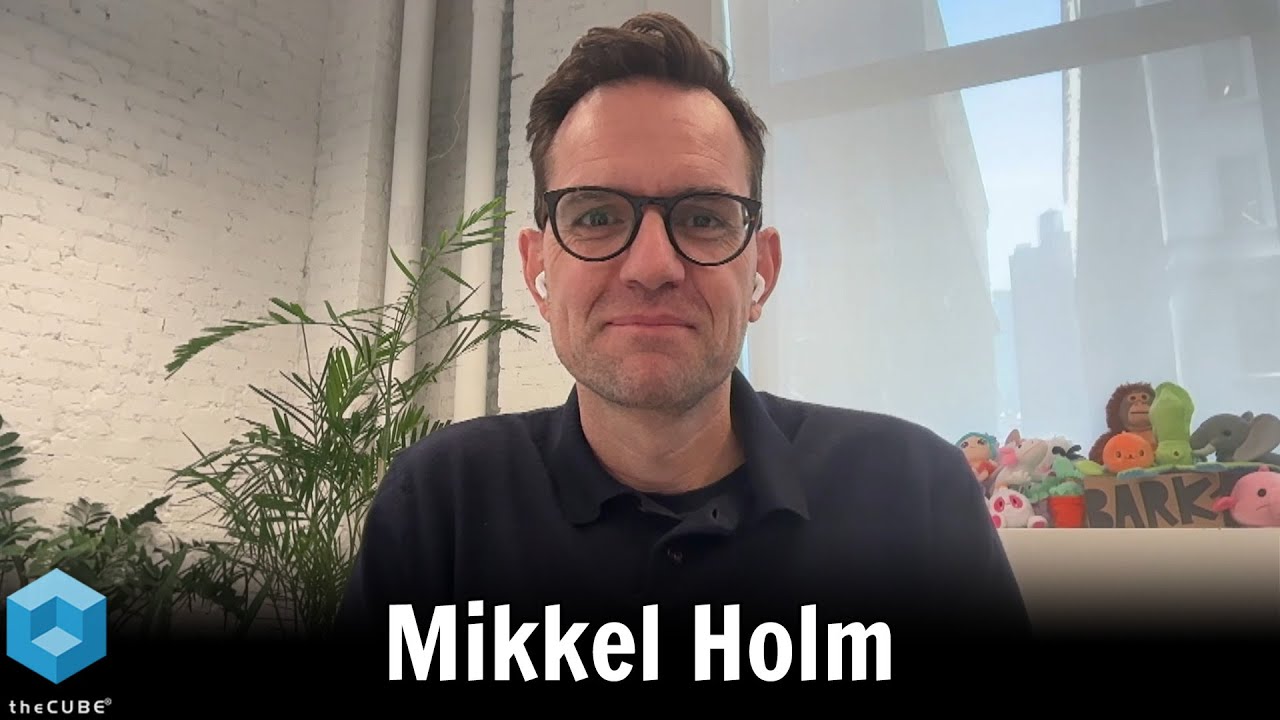
Mikkel Holm, the chief AI and innovation officer at BARK, joins John Furrier of theCUBE to explore the transformative journey of artificial intelligence at BARK during the AI Agent Conference 2025. In this session, Holm discusses how AI reshapes operational and creative processes across the organization.
Holm brings a unique blend of creativity and technical insight to their role, championing AI integration from product design to customer engagement at BARK. Hosted by Furrier of theCUBE, this discussion uncovers key topics such as the challenges of change management, the importance of domain expertise, and the innovative use of AI to enhance both internal processes and customer experiences at BARK.
Key takeaways from the conversation include Holm’s approach to AI as a tool for augmenting team capabilities rather than replacing jobs, emphasizing the orchestration of human intelligence and AI tools. Holm notes the key to success lies in continual experimentation and adapting rapidly to new technologies, leveraging both automation and creative innovation to remain competitive in the evolving marketplace.
Forgot Password
Almost there!
We just sent you a verification email. Please verify your account to gain access to
theCUBE + NYSE Wired: AI Agent Conference. If you don’t think you received an email check your
spam folder.
Sign in to theCUBE + NYSE Wired: AI Agent Conference.
In order to sign in, enter the email address you used to registered for the event. Once completed, you will receive an email with a verification link. Open this link to automatically sign into the site.
Register For theCUBE + NYSE Wired: AI Agent Conference
Please fill out the information below. You will recieve an email with a verification link confirming your registration. Click the link to automatically sign into the site.
You’re almost there!
We just sent you a verification email. Please click the verification button in the email. Once your email address is verified, you will have full access to all event content for theCUBE + NYSE Wired: AI Agent Conference.
I want my badge and interests to be visible to all attendees.
Checking this box will display your presense on the attendees list, view your profile and allow other attendees to contact you via 1-1 chat. Read the Privacy Policy. At any time, you can choose to disable this preference.
Select your Interests!
add
Upload your photo
Uploading..
OR
Connect via Twitter
Connect via Linkedin
EDIT PASSWORD
Share
Forgot Password
Almost there!
We just sent you a verification email. Please verify your account to gain access to
theCUBE + NYSE Wired: AI Agent Conference. If you don’t think you received an email check your
spam folder.
Sign in to theCUBE + NYSE Wired: AI Agent Conference.
In order to sign in, enter the email address you used to registered for the event. Once completed, you will receive an email with a verification link. Open this link to automatically sign into the site.
Sign in to gain access to theCUBE + NYSE Wired: AI Agent Conference
Please sign in with LinkedIn to continue to theCUBE + NYSE Wired: AI Agent Conference. Signing in with LinkedIn ensures a professional environment.
Are you sure you want to remove access rights for this user?
Details
Manage Access
email address
Community Invitation
Woodson Martin, OutSystems
Mikkel Holm, the chief AI and innovation officer at BARK, joins John Furrier of theCUBE to explore the transformative journey of artificial intelligence at BARK during the AI Agent Conference 2025. In this session, Holm discusses how AI reshapes operational and creative processes across the organization.
Holm brings a unique blend of creativity and technical insight to their role, championing AI integration from product design to customer engagement at BARK. Hosted by Furrier of theCUBE, this discussion uncovers key topics such as the challenges of change management, the importance of domain expertise, and the innovative use of AI to enhance both internal processes and customer experiences at BARK.
Key takeaways from the conversation include Holm’s approach to AI as a tool for augmenting team capabilities rather than replacing jobs, emphasizing the orchestration of human intelligence and AI tools. Holm notes the key to success lies in continual experimentation and adapting rapidly to new technologies, leveraging both automation and creative innovation to remain competitive in the evolving marketplace.
In this interview from the theCUBE + NYSE Wired AI Agent Conference, Woodson Martin, chief executive officer of OutSystems, joins theCUBE + NYSE Wired's Gemma Allen to discuss how enterprises are navigating the shift from legacy infrastructure to production-grade agentic systems. One year into the role after 18 years at Salesforce, Martin describes how OutSystems has repositioned itself from a low-code platform into a full agentic systems platform — giving large, highly regulated organizations a governed layer to build, deploy and orchestrate AI agents at sca...Read more
exploreKeep Exploring
Possible neutral questions the excerpt answers:
1. Is your tagline "low code is dead, long live agent code"?
2. One year into your role as CEO (after 18 years at Salesforce and succeeding the founder), what has surprised you?add
How quickly are organizations able to build and deploy custom software and agentic systems today compared with the past, and what is driving that change?add
How do you approach modernizing legacy enterprise systems (e.g., COBOL, AS/400, Lotus Notes), including data migration and regulatory/trust concerns, and what role do your agentic systems and partner network play in that process?add
Why are organizations increasingly adopting a platform layer (e.g., OutSystems) for building AI/agentic systems that lets them hot-swap backend models at runtime while maintaining sovereignty, cost control, vendor leverage, governance, and evaluation?add
>> Welcome back to theCUBE and NYSC Wired here at the Agentic Studio at the AI Agent Conference in Midtown Manhattan. Where we're talking all things agents on this next wave of tech. Joining me now is Woodson Martin, CEO of OutSystems. Welcome, Woodson.
Woodson Martin
>> Thanks, Gemma. Great to be with you.
Gemma Allen
>> I think, broadly speaking, your tagline is "low code is dead, long live agent code", correct?
Woodson Martin
>> Well, that's not exactly our tagline. But, yeah, no, we're making a big shift in the company strategy because our customers are making a big shift in their strategy. Today, the question is, how are we building the agentic future? And our customers, thousands around the world, lots of large, highly regulated organizations operating across national boundaries all over the world are saying, "How do we take the investments that we've built over the last decades, and IT infrastructure to automate our business, and how do we take advantage of this agentic systems revolution today?" Our platform is an agentic systems platform, and we're helping customers make that transformation. Excited. Talking tomorrow at one of the sessions here with Kevin Hearn from Axos Bank, about how we're really making a big difference together in the banking industry and getting agents deployed.
Gemma Allen
>> Well, your customers are making a shift, but you've also made a pretty big shift, right? You're one year as CEO of this company, 18 years at Salesforce before this. And this company was led by its founder up until this point. A lot happening at a very interesting intersection point. Tell me, one year in, what surprised you?
Woodson Martin
>> It's an amazing time. You're right. So much is changing in the whole world. And what surprised me most is the passion that customers, many of whom have been with the company for many, many years, have for the platform and the technology that's made them successful in the era of automation. And now leaning in with our agent workbench and with our Mentor AI coding agent to build the next version of their future on OutSystems. It's just exciting, the passion and the customer base.
Gemma Allen
>> Well, let's talk a little bit about the state of play for some of these customers, right? Because we all talk about this broad, opportunistic, philosophical, almost future where agents are everywhere. Every company is agentic and everyone's a technologist in some form. But we also know that a lot of industries have been somewhat challenged by legacy business applications. There's been a lot of old code moving around systems for a very long time. Talk a little bit about what you're seeing, how this era has suddenly revolutionized a challenge that was so longstanding.
Woodson Martin
>> Yeah, you bet. There's so much to talk about here. Customers, the whole world, the market is incredibly excited about the potential of an AI-centric future. Customers of ours will talk about Axos Bank because Kevin and I are on stage talking about this tomorrow a little bit, is modernizing legacy systems in the bank using our agentic tools to help accelerate the delivery of not just a modernized application infrastructure, but of agentic systems modernizing these legacy technologies that existed in the bank for many years. And this is just an example of what we're seeing in companies around the world. Insurance providers who are modernizing AS400 technology for their claims management services. It turns out AI is pretty good at helping to reason over the old code, turn it into, using our Mentor coding agent, turning that into a brand new modern cloud architecture and building out and automating the construction of the agents that then take over a lot of the drudgery that was the work in those archaic systems. It's an exciting pattern that we're seeing, and it's fun to be a part of it.
Gemma Allen
>> Typical customer like Axos Bank, for example, this is really like CAD for apps, right? You can go in, you design an application, you build it in a studio format. And then you guys, the technology deployment partner, can create this, bring this to life, right? Talk a little bit about the time from end to end as to how quickly things are happening at this moment and right now.
Woodson Martin
>> Yeah, sure. For the last 20 years, we accelerated dramatically the speed at which large complex organizations could build truly custom software to run their business. But that acceleration has dramatically increased over the course of the last, literally, 18 months, as we've introduced new Agentic technology to speed up every part of that process today. So, yes, our customers historically would go into an IDE and a studio and craft the end user experience they wanted of those applications, the data structures they wanted for those applications, the workflows in those applications. Today, they do that through a conversational interface. In Mentor, our own coding agent, or they can do it through their favorite coding agent, Claude Code, Codex. And simply use the services as MCP services of our platform to construct and build out those applications and then run them on our modern cloud infrastructure and AI platform. And that gives these organizations an incredible amount of control, governance, security, things that are very difficult for them to achieve at scale across a wide portfolio of applications and agentic systems in their business without a platform underneath.
Gemma Allen
>> Wow.
Woodson Martin
>> That's really the game we're playing today is that agentic systems platform, a layer of governance, of security, of trust that makes it possible for these large, highly regulated enterprises to turn over so much of this workload in their companies to AI and to AI agents.
Gemma Allen
>> You mentioned Claude Code. And a few weeks ago there was some interesting response from the market around Cobalt, and the fact that Claude Code can suddenly solve for Cobalt challenges in a lot of large banks and institutions that have been running that technology since I was a child. You probably do. Talk to me a little about the other things that you're seeing that are fundamentally changing, like structured data. How are folks feeding data into these pipelines to build these applications? Where is this magic wand happening at the enterprise level?
Woodson Martin
>> Yeah. Modernization of legacy systems, certainly Cobalt, AS400, Lotus Notes. We did a launch of our own agentic systems engineering capabilities on the 31st of March. And in that, we demonstrated taking a legacy Lotus Notes purchasing application from its 20-year-old legacy state into a modernized agentic system on our platform live in a demo on stage, in the span of 15 minutes. Now, it's a little more complicated when you then have to also move tons of data. You talked about, how do we ingest data into these new modern systems? The reality is, for these large regulated enterprise, there's a process behind these types of modernizations. And our 20-year history of helping organizations manage these large complex projects and these transformations now accelerated because we can build and deliver the technology so much faster come into play here. And we have a network of hundreds of partners around the world, more than 900,000 developers in the OutSystems community who are expert in how to do and run these kinds of complex projects. And that makes a big difference to a bank, an insurance company, a government institution where they have trust is the currency of the work that they do. Those trusted relationships with their customers, they have to very carefully tread into this new agentic world. And that's where they need a trusted partner with some proven background in these kind of complex projects, but taking advantage of these latest technologies to deliver them much faster.
Gemma Allen
>> Talk to me about where these data and apps live and breathe. Are you seeing more and more companies develop on-prem? What are you seeing this kind of... Again, maybe might surprise some folks, especially when you think about building for AI.
Woodson Martin
>> For decades, OutSystems has supported a hybrid deployment model for the technologies that our customers build. And that's becoming increasingly important in a world where, frankly, international trust is eroding. A lot of our customers are asking whether they... Thinking a lot about their digital sovereignty. Thinking about who are the companies providing them the technology and what level of trust do they need in those organizations? This is a very important time for a company like ours to be investing in this kind of sovereign strategy. We've just, for example, shipped a new cloud... Sorry, self-managed deployment model for our cloud infrastructure that allows you to take the runtime of an application you build in our cloud, or a set of agents or an agentic system you build in our cloud, and deploy that on any infrastructure that you manage on your own, anywhere around the world. That could be your own private cloud, your own account on a service like Amazon or Azure, or it can be running on your own on-premise infrastructure. We've even got customers running these systems on ships transiting the world today. Always have supported that kind of hybrid model, but we're seeing an increased focus on digital sovereignty for sure.
Gemma Allen
>> Okay. And I guess sovereign AI is huge, especially for governments and for public sector outlets as well, who have been somewhat hamstrung too from the perspective of legacy applications moving to the future. They didn't benefit from cloud the way private industry did, to a large degree, right? What are you seeing there? Talk to me about some interesting use cases even you've solved for in the public sector space.
Woodson Martin
>> Yeah, you bet. Some very interesting ones. We've got a public sector customer in the Netherlands today, run a housing organization who's building agentic systems for matching individuals who are seeking public or subsidized housing with the right opportunities in that market. And really pulling together the private and the public sector work today, powered by agentic systems to help place people in housing. Housing is a huge issue, of course, as we know.
Gemma Allen
>> Of course.
Woodson Martin
>> In literally every jurisdiction around the world today. And so we're excited about the potential of these technologies to help in the public sector. And we're seeing a lot of exciting momentum there. I think one of the other things that's just really important is we think about public sector, we think about digital sovereignty, we think about how important it is to maintain flexibility when it comes to the AI technology that we're adopting in the enterprise. These concerns, which are really concerns about control and independence, are also married now with a lot of concerns about cost. I manage P&L in the business I run. My inference costs for AI today are growing at a 50% month-over-month clip.
Gemma Allen
>> Wow.
Woodson Martin
>> Right? Now, you take that and you deploy that idea at businesses all over the world, and suddenly people are asking some serious questions about what's the shape of my P&L downstream if I look a few years down the road? It's easy at a conference like this with the wild enthusiasm we see about the potential of AI to really do all kinds of workloads in the enterprise to think it could be 30 to 40% of my P&L, maybe more. It's actually going to inference costs in the future. In that world, how do I, as the CIO or the CEO or the CFO of these organizations, how do I maintain control and independence when so much of my operations are based on the work of these models? If I'm deeply embedded with OpenAI or I'm deeply embedded with Anthropic, and those in my systems that I have built, these agentic systems are tied deeply to those model executions, what leverage do I have in the future over my own P&L? And for these reasons, the reasons of sovereignty, the reasons of cost control, of leverage and vendor negotiations over time, we're seeing an increasing focus that organizations need a platform. They need a layer where they can build and invest in their own vision for AI systems, but they can hot swap the models on the backend at the time they build with effective governance and evals of those systems to ensure that the model they're replacing works just as well as the new one. But also, to be able to do that kind of substitution at runtime, so that these systems can constantly take advantage of the lowest cost model from the lowest cost provider. Taking advantage of the best negotiated terms without having to rebuild the fundamental systems on which they're operating. And this is why platforms like OutSystems, as a very important layer for your agentic systems, engineering is such an important part of the agentic future for our customers.
Gemma Allen
>> Because you went there, I'm going to have to go there too, right? When we talk about cost and we talk about, especially cost gauging futuristically, one argument is that these open weight models that exist in other parts of the world that we won't name right here and around right now, are also an attractive pricing alternative, right?
Woodson Martin
>> Absolutely.
Gemma Allen
>> Do you see a future where this geopolitical barriers are broken down and pricing becomes somewhat more of a globalization led approach?
Woodson Martin
>> This is all part of the same story in my mind. Absolutely. We see our customers today turning to lower cost, open weight, small language models for a lot of the jobs they're automating through the agentic workflows they're building on our platform. Once you've run a model or an agentic workflow 100,000 times, and you capture all the traces from every decision made by an agent, every decision overridden by a human in the loop, and you capture all that and you reason over that as data that you can use to train your own models. And you find that you can actually take very low cost open weight models, train those up on this same data of your own and substitute for the cost of the expensive frontier models that you use to build the first version of that agent. If you've got a platform like OutSystems in place, you can hot swap that model when you're ready without breaking the system that you've built, and literally run those things in parallel as often as you need to prove to yourself through the evals infrastructure you've built on our platform, that everything works just fine. And you can drive and control your own P&L expense as you take advantage of the lowest cost models. But we're seeing the potential for distillation of these models down to billion parameter models that can do most of the jobs that customers are using these complex systems for today. You don't need a trillion parameter model if a billion parameter model can do it at a fraction of the cost. And that's the kind of potential power platforms like OutSystems give to CIOs and CFOs around the world as they invest in agentic systems.
Gemma Allen
>> Well, I guess in the world we've talked so much over the last 10, 15, 20 years about vendor lock. We're now talking about token lock, right? And agility and price predictability is more important than ever before. Woodson, thank you so much for coming on the show. Great chatting to you.
Woodson Martin
>> Gemma, it's great to be here. Thank you so much.
Gemma Allen
>> I'm Gemma Allen, here at the Agentic Studio at the AI Agent Conference in Midtown Manhattan with theCUBE and NYSC Wired. Thanks for watching.


















 Gemma Allen