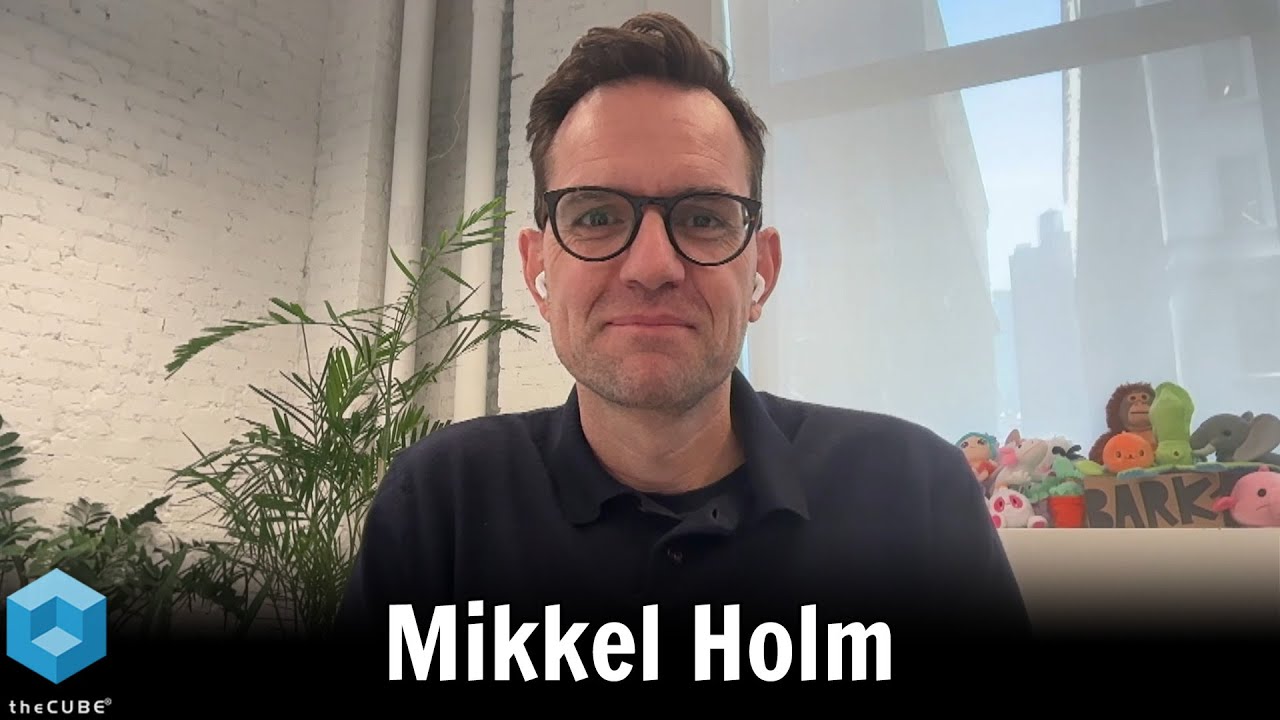
Mikkel Holm, the chief AI and innovation officer at BARK, joins John Furrier of theCUBE to explore the transformative journey of artificial intelligence at BARK during the AI Agent Conference 2025. In this session, Holm discusses how AI reshapes operational and creative processes across the organization.
Holm brings a unique blend of creativity and technical insight to their role, championing AI integration from product design to customer engagement at BARK. Hosted by Furrier of theCUBE, this discussion uncovers key topics such as the challenges of change management, the importance of domain expertise, and the innovative use of AI to enhance both internal processes and customer experiences at BARK.
Key takeaways from the conversation include Holm’s approach to AI as a tool for augmenting team capabilities rather than replacing jobs, emphasizing the orchestration of human intelligence and AI tools. Holm notes the key to success lies in continual experimentation and adapting rapidly to new technologies, leveraging both automation and creative innovation to remain competitive in the evolving marketplace.
Forgot Password
Almost there!
We just sent you a verification email. Please verify your account to gain access to
theCUBE + NYSE Wired: AI Agent Conference. If you don’t think you received an email check your
spam folder.
Sign in to theCUBE + NYSE Wired: AI Agent Conference.
In order to sign in, enter the email address you used to registered for the event. Once completed, you will receive an email with a verification link. Open this link to automatically sign into the site.
Register For theCUBE + NYSE Wired: AI Agent Conference
Please fill out the information below. You will recieve an email with a verification link confirming your registration. Click the link to automatically sign into the site.
You’re almost there!
We just sent you a verification email. Please click the verification button in the email. Once your email address is verified, you will have full access to all event content for theCUBE + NYSE Wired: AI Agent Conference.
I want my badge and interests to be visible to all attendees.
Checking this box will display your presense on the attendees list, view your profile and allow other attendees to contact you via 1-1 chat. Read the Privacy Policy. At any time, you can choose to disable this preference.
Select your Interests!
add
Upload your photo
Uploading..
OR
Connect via Twitter
Connect via Linkedin
EDIT PASSWORD
Share
Forgot Password
Almost there!
We just sent you a verification email. Please verify your account to gain access to
theCUBE + NYSE Wired: AI Agent Conference. If you don’t think you received an email check your
spam folder.
Sign in to theCUBE + NYSE Wired: AI Agent Conference.
In order to sign in, enter the email address you used to registered for the event. Once completed, you will receive an email with a verification link. Open this link to automatically sign into the site.
Sign in to gain access to theCUBE + NYSE Wired: AI Agent Conference
Please sign in with LinkedIn to continue to theCUBE + NYSE Wired: AI Agent Conference. Signing in with LinkedIn ensures a professional environment.
Are you sure you want to remove access rights for this user?
Details
Manage Access
email address
Community Invitation
Ariel Shulman, Bright Data
Mikkel Holm, the chief AI and innovation officer at BARK, joins John Furrier of theCUBE to explore the transformative journey of artificial intelligence at BARK during the AI Agent Conference 2025. In this session, Holm discusses how AI reshapes operational and creative processes across the organization.
Holm brings a unique blend of creativity and technical insight to their role, championing AI integration from product design to customer engagement at BARK. Hosted by Furrier of theCUBE, this discussion uncovers key topics such as the challenges of change management, the importance of domain expertise, and the innovative use of AI to enhance both internal processes and customer experiences at BARK.
Key takeaways from the conversation include Holm’s approach to AI as a tool for augmenting team capabilities rather than replacing jobs, emphasizing the orchestration of human intelligence and AI tools. Holm notes the key to success lies in continual experimentation and adapting rapidly to new technologies, leveraging both automation and creative innovation to remain competitive in the evolving marketplace.
In this interview from the AI Agent Conference, Ariel Shulman, chief product officer of Bright Data, joins theCUBE + NYSE Wired's Gemma Allen to discuss how the rise of agentic AI is transforming web data infrastructure and Bright Data's evolution from proxy provider to real-time AI data platform. Shulman traces the company's 15-year journey from supplying IP proxy pipes to collecting, unlocking and structuring publicly available web data at scale. He details Bright Data's landmark legal victories against both Meta and Twitter — outright wins that established...Read more
exploreKeep Exploring
How has Bright Data's product offering evolved over time—from providing proxies to structuring web data—and how does the recently released MCP protocol fit into its transition into the AI era?add
How has the emergence of ChatGPT and agentic chatbots changed Bright Data's business and the speed and requirements for web scraping/data collection?add
What is MCP, how does it help developers integrate with Bright Data's web-data tools, and what does Bright Data's "success-based" billing model mean in practice?add
>> Welcome to a very special episode of The Cube and MYSC Wired coming to you from the Agentic Studio here at the Hilton Manhattan. We are covering the AI agent conference and all things builders, breakers, and buyers for this next wave of AI and technology. Joining me now is Ariel Shulman, chief product officer at Bright Data. Welcome, Ariel.
Ariel Shulman
>> Hello. Thanks for having me.
Gemma Allen
>> So let's talk a little bit first about Bright Data broadly, right? The business you've been in for quite a while, which I feel is changing quite rapidly, like all other parts of the tech ecosystem at this mad moment.
Ariel Shulman
>> Correct.
Gemma Allen
>> You have recently released an MCP protocol to make this available and to continue this trajectory into the AI era. Talk to me a little bit about first, I guess, the trajectory from a product perspective. I think a lot has changed in a short space of time. Maybe cover that.
Ariel Shulman
>> Okay. So we started out a while back, almost 15 years ago, as a proxy company, providing IP addresses, basically proxies, which are essentially pipes. And over time kind of went up the technology stack, so to speak, to improve the capabilities to not only offer a pipe, but also to unlock websites, and to collect that data, and then later to structure it, so to convert it from a webpage into a JSON file or a CSV file, something that computers can work with. And we've been doing that at very large scales for a long time for the traditional scraping industry. So that would be e-commerce applications, for example, people collecting prices. All of this is, of course, publicly available web data. Flight information, weather information, financial information, stuff that's available on the internet we collect at scale and we make that available in a machine friendly format for our enterprise customers. That has been the Bright Data of, let's say, up until about two years ago.
Gemma Allen
>> Okay. And I mean, you guys have had a lot of interesting media of late. You've taken on Meta, you've won that case, right? So in terms of what's happening in this space broadly, it has certainly been a very interesting time around what exactly it means to scrape the internet in this world of what was traditional web search, and now this LLM model. Maybe talk to me a little bit about the world of LLMs, like how this has fundamentally shifted the business model you envisioned 14 years ago.
Ariel Shulman
>> Let's do that, but with your permission, can we talk about Meta for a second?
Gemma Allen
>> Absolutely. I'd love to hear it.
Ariel Shulman
>> Okay. So this was a very interesting period where basically we got sued by both Meta and by Twitter. It wasn't even X at the time. And we invested a lot of money in those lawsuits in defense. And I'm very happy, we were all very happy that we actually won both lawsuits. And I mean won, there was no compromise. There was no settlements or anything like that. Outright won. And these now are used as precedents in a lot of the trials or legal proceedings that are happening in the tech space. So basically, the judges in both cases were very clear that if the information is publicly available, that is to say it's not behind a login, or a paywall, or anything like that, it can be collected. And as I said, this is a very important precedent for the industry.
Gemma Allen
>> Wow. Okay. So I guess, really, your view and your company's view is that if it's publicly available, it's fair game, right?
Ariel Shulman
>> Yes.
Gemma Allen
>> It is very much the kind of almost first amendment of the web in terms of availability of data.
Ariel Shulman
>> Correct. Yes.
Gemma Allen
>> And I guess when we think about what's happening now in your space and how customers and consumers and possibly agentic browsers are going to be trawling the web, returning results to individuals, to companies to help grow in this agentic era. How that's happening is changing pretty fundamentally though, right? We're no longer looking at Google. We're no longer searching and doing our own analysis. We're in a world where agents are going to do that for us.
Ariel Shulman
>> Absolutely.
Gemma Allen
>> How is it changing what you're building?
Ariel Shulman
>> That's a great question. So the way things are changing is basically as follows. As you correctly said, people were essentially using their brains to browse the internet, to find the correct link, to understand what pages mean, et cetera. And the tipping point here was kind of the appearance of ChatGPT, where we finally had a researcher that could read huge amounts of information on our behalf, and analyze it, and give us a summary. That was very, very useful. So all of those agents need a lot of information to get trained on and some of the things that we do Bright Data is to supply them with these large amounts of information. It can be video, text, audio to train those models. So the impact that this had on our business was that the fundamentals of scraping allowed us to have access to this publicly available web data. But when you're working in this agentic era, a lot of this is time sensitive. Think about yourself sitting in front of a chatbot asking a question, and then it says, "Searching the web..." In your head, a clock starts ticking, and you're impatient. We all are. So responses, whereas maybe potentially it was okay to give back an answer in 10 or 15 seconds two or three years ago, because a lot of that information was collected for offline analysis, this is no longer the case. Our output right now is the input for those engines, for those chatbots, and therefore it needs to be very, very fast. So whatever we did earlier, we now do at 10X speed. So a lot of the pages we will scrape at under one second, median time of 500 milliseconds. And this is critical for the user experience of those chatbots because, as I said, our answer is the starting point for those chatbots to formulate a friendly response for the user.
Gemma Allen
>> Wow. Okay. And let's talk for a second about what's happening right now broadly in the world of agentic commerce, right? So there are a couple of possible scenarios emerging, we believe. One is agentic browsers. That is a possibility, right? Certainly in the next near midterm. What would that mean for a company like Bright Data? Or, for example, situations whereby LLMs like Anthropic might begin to create their own kind of web index. What sort of, I guess, competitive challenges are you prepping for? What keeps you up at night in the space you're in?
Ariel Shulman
>> Oh, many things keep me up at night, but I would split this into two. When you, let's say, are trying to build some kind of an e-commerce index, for example, there are essentially two parts to this. One is the part of the information that's fairly static. So imagine, for example, this table, its size, its dimension, its weight, its color. These things are fairly static, but its price and its stock availability are highly dynamic. It can be in stock in one minute and out of stock the next. So these are two different types of data that these tools need to have at their disposal to present you with a meaningful answer. So yes, we provide huge amounts of e-commerce data, entire websites basically available as kind of a CSV file. You can imagine it as a huge table. We're talking about terabytes of data. And that is, I would say, the static index that those LLMs are using to say if you need something that's brown and light, they will try to use that fairly static information to isolate the products that you need. But in order to give you the full picture, they need to go in real time, online, in order to check whether those prices are still valid and if those products are still in stock. Because if they present you with the wrong information, for example, you see that the product was $29.99 when it was indexed two weeks ago, and now it's $49.99, your experience as a consumer is very bad. You see it on the chatbot at price X, you go to buy it on the retailer price and it's suddenly more expensive.
Gemma Allen
>> For sure.
Ariel Shulman
>> You lose trust with the chatbot or the tool that you're using. So again, you have the kind of static information, very big files of attributes, and then you have price and availability, which are highly dynamic.
Gemma Allen
>> So we now have a situation where we have a number of devs, even vibe coders, who are building agents, building wrappers for LLMs to sell through to customers. That whole agentic era is fast, fast happening. In this space you're in, when you think about how you continue to engage with them, I guess that MCP protocol is a very smart way to do that, right? It's a way to ensure that there is an access point to your technology to build that into the tech. Similar, I suppose in some respects to what you guys did originally with residential IPs and SVKs, et cetera. So it's the next wave of that technology evolving.
Ariel Shulman
>> Absolutely. MCP is a wonderful thing. We like to think of it as kind of a USB cable that allows people to plug into our tools, or allows them to plug their agent into our tools, and then they can get all the benefits that we talked about. One of the things that we're seeing is kind of some naiveness on the part of people who are building these tools.
Gemma Allen
>> Interesting.
Ariel Shulman
>> Because when they start building the tools, everything works. And in my talk earlier today, I said that web scraping is a bit like quantum mechanics, but in reverse. What do I mean by that? In quantum physics or quantum mechanics, when you go to the subatomic level, all the rules change. All the physics goes completely haywire. In web scraping, it's exactly the opposite. What you have working in your office, and with maybe friends and family, works fine. When you cross a certain threshold, things go crazy. You start getting blocked, you start getting fake data. It's very, very difficult to either overcome or even understand that you have a problem. And so many of these builders, because vibe coating is so sexy, so tempting, it's so satisfying, right? I have an idea. In two hours, wow, I have something working. You kind of do, but it's not scalable. It's not going to work as a real product. So what happens is that, very quickly, many of those builders discover Bright Data, they discover the MCP, they connect it, and then they can get all the benefits of the infrastructure that we built and the unlocking capabilities.
Gemma Allen
>> I've heard you guys say publicly that you have a success-based billing model, right?
Ariel Shulman
>> Correct.
Gemma Allen
>> Can you maybe talk to us a little about what that exactly means?
Ariel Shulman
>> Yeah. I mean, collecting web data is tricky, and especially at scale, but the customer experience that we want to give to our customers is basically to make all of that noise go away. And for example, they can send us an API call for a specific URL and they say, "We want that in this format."
A lot happens under the hood. There are proxies, there are browsers, there's fingerprints, there's a lot happening under the hood. In many cases... Not in many cases, in some cases, the first attempt might fail. And then we'll try again, maybe from a different IP address, or with a different fingerprint, or something like that. And we will eventually be able to access the web data and deliver it to the customer. We see no reason to trouble the customer with all the inner workings of the system. So it's much easier to plan, to budget, knowing that Bright Data is responsible for doing everything, all the dirty work that they don't even understand. And trust me, there's a lot there. And they will just get an answer and it will be at a fixed cost because it's only success based.
Gemma Allen
>> Okay, great. And lastly, I mean, it's obviously a fascinating time, very interesting intersection point you added as a company. What's ahead? What does the next six months look like for you and the team at Bright Data?
Ariel Shulman
>> Okay. So as we get more and more into the agentic era, we need to be much more economical in terms of tokens. It's something that people are very sensitive to. That means that there's a lot of processing that we can do on our side and to present the agents with answers, A, faster, but also in much more economical format. For example, if someone asks us using some kind of an e-commerce API, "Give me the price of this product on these five different sites." We can combine that into six numbers and a part number, something that's very, very small, and that's something that agents appreciate and need because the spending right now is insane. It's very easy to run up a bill. Do you know Hannah Fry?
Gemma Allen
>> I do, yeah.
Ariel Shulman
>> Okay. So Hannah Fry had a YouTube video just a couple of days ago where she used an AI agent to buy paperclips.
Gemma Allen
>> Oh, wow.
Ariel Shulman
>> She asked the paper agent to find the best price for paperclips. It cost $100 in tokens.
Gemma Allen
>> Wow.
Ariel Shulman
>> Yeah. So that was a really nice example of how -
Gemma Allen
>> That's a great story.
Ariel Shulman
>> Yeah. So you can go and watch the video. So we need to be careful about that because all of these things at scale, the economics need to work for everyone. And if we are too wasteful, it just basically flows back to our customers and we can be more effective.
Gemma Allen
>> So we certainly need increasing synthesis all the time, especially on the aggregate. So Ariel Shulman, thank you so much for coming to the Agentic Studio here today.
Ariel Shulman
>> Thank you. It was a pleasure.
Gemma Allen
>> I'm Gemma Allen live here at the Agentic Studio in the Hilton Manhattan. We are covering the AI Agent Conference with The Cube and NYSC wired. Thanks for watching.


















 Gemma Allen