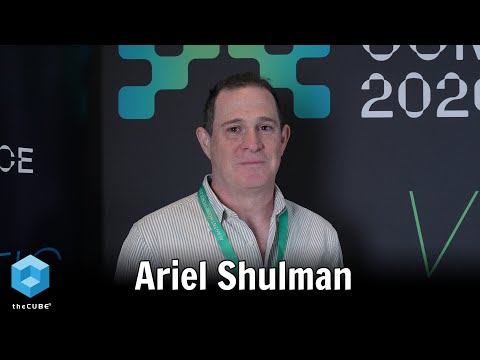
Ariel Shulman of Bright Data discusses agentic artificial intelligence, AI, at the AI Agent Conference 2026 during the theCUBE and NYSE Wired Mixture of Experts session. Shulman outlines Bright Data's evolution from a proxy provider to a large-scale enterprise web data platform that structures public internet information for enterprise use. They explain how Bright Data supplies text, audio and video datasets to train and feed large language models, LLMs, and agents and how the newly released MCP protocol enables faster integrated access for builders. The theCUBE Research segment is hosted by Gemma Allen of theCUBE.
Key takeaways include Bright Data's legal victories in disputes with Meta and Twitter, which Shulman says reinforce the permissibility of collecting publicly available web data. They emphasize subsecond scraping performance to support real-time agent responses. Shulman describes MCP as a "USB cable" for connecting agents to Bright Data's platform. They highlight success-based billing and token-efficient synthesis as cost-control strategies that preserve user trust and enable scalable agentic commerce. The segment covers product strategy, data collection and web scraping for enterprise builders and AI developers seeking real-time web data and integrated agent workflows.
Forgot Password
Almost there!
We just sent you a verification email. Please verify your account to gain access to
theCUBE + NYSE Wired: AI Agent Conference. If you don’t think you received an email check your
spam folder.
Sign in to theCUBE + NYSE Wired: AI Agent Conference.
In order to sign in, enter the email address you used to registered for the event. Once completed, you will receive an email with a verification link. Open this link to automatically sign into the site.
Register For theCUBE + NYSE Wired: AI Agent Conference
Please fill out the information below. You will recieve an email with a verification link confirming your registration. Click the link to automatically sign into the site.
You’re almost there!
We just sent you a verification email. Please click the verification button in the email. Once your email address is verified, you will have full access to all event content for theCUBE + NYSE Wired: AI Agent Conference.
I want my badge and interests to be visible to all attendees.
Checking this box will display your presense on the attendees list, view your profile and allow other attendees to contact you via 1-1 chat. Read the Privacy Policy. At any time, you can choose to disable this preference.
Select your Interests!
add
Upload your photo
Uploading..
OR
Connect via Twitter
Connect via Linkedin
EDIT PASSWORD
Share
Forgot Password
Almost there!
We just sent you a verification email. Please verify your account to gain access to
theCUBE + NYSE Wired: AI Agent Conference. If you don’t think you received an email check your
spam folder.
Sign in to theCUBE + NYSE Wired: AI Agent Conference.
In order to sign in, enter the email address you used to registered for the event. Once completed, you will receive an email with a verification link. Open this link to automatically sign into the site.
Sign in to gain access to theCUBE + NYSE Wired: AI Agent Conference
Please sign in with LinkedIn to continue to theCUBE + NYSE Wired: AI Agent Conference. Signing in with LinkedIn ensures a professional environment.
Are you sure you want to remove access rights for this user?
Details
Manage Access
email address
Community Invitation
Barr Moses, Monte Carlo
Ariel Shulman of Bright Data discusses agentic artificial intelligence, AI, at the AI Agent Conference 2026 during the theCUBE and NYSE Wired Mixture of Experts session. Shulman outlines Bright Data's evolution from a proxy provider to a large-scale enterprise web data platform that structures public internet information for enterprise use. They explain how Bright Data supplies text, audio and video datasets to train and feed large language models, LLMs, and agents and how the newly released MCP protocol enables faster integrated access for builders. The theCUBE Research segment is hosted by Gemma Allen of theCUBE.
Key takeaways include Bright Data's legal victories in disputes with Meta and Twitter, which Shulman says reinforce the permissibility of collecting publicly available web data. They emphasize subsecond scraping performance to support real-time agent responses. Shulman describes MCP as a "USB cable" for connecting agents to Bright Data's platform. They highlight success-based billing and token-efficient synthesis as cost-control strategies that preserve user trust and enable scalable agentic commerce. The segment covers product strategy, data collection and web scraping for enterprise builders and AI developers seeking real-time web data and integrated agent workflows.
In this interview from the theCUBE + NYSE Wired: AI Agent Conference in New York City, Barr Moses, co-founder and chief executive officer of Monte Carlo, joins theCUBE + NYSE Wired's Gemma Allen to discuss the critical gap between piloting AI agents and deploying them in production. Moses explains that while pilots allow nearly any configuration to run unchecked, the leap to production demands a fundamentally different standard of reliability and trust. She breaks down four core failure points enterprises must watch — data context, agent behavior, performance...Read more
exploreKeep Exploring
What is Monte Carlo's mission regarding trusted AI, and what challenges do enterprises face when moving AI agents from pilot projects into production?add
What are you building to monitor, troubleshoot, and remediate the growing fleet of autonomous agents, and how do manual (human-in-the-loop) and autonomous approaches fit on that spectrum?add
Who is the typical buyer for this product — which roles or teams are you selling to?add
>> I'm Gemma Allen with theCUBE x NYSE Wired and today we are at the Agentic Studio here at the AI Agent Conference in New York. We're talking all things agentic, bots, builders, buyers, and breakers, this next wave of tech. We talk about agents, but we don't often talk about who's actually watching and monitoring these agents, and to answer that question and tell me about what's happening in her space, joining me now is CEO and co-founder of Monte Carlo, Barr Moses. Welcome, Barr.>> Thank you so much.
Gemma Allen
>> So agents, we know that they're an opportunity, a potential liability, people are very divided on them. You have created a company which is really set up to ensure that they remain intact, efficient, productive, maximize opportunity, right? Talk to me about it.>> Yeah, 100%. So at Monte Carlo, our mission is to help enable enterprises' adoption of trusted AI. Now what does that mean? Let's unpack that. The word trust is a very loaded word. How can we trust humans, let alone trust AI and data when data is sort of the heart and soul of AI oftentimes? And so at Monte Carlo, we're very fortunate to work with hundreds of enterprises who are deploying AI agents in production and want to make sure that we can actually trust those agents. So what we're seeing, and we actually did this survey with couple hundreds of AI builders, we're seeing that there's big sort of gap between having agents in pilots and having agents in production. And so in pilots, in pilot mode, anything goes. You can build any agent you like and run it in any form that you like. But when you actually want to push that agent into production, making sure that those agents are reliable, that they're as good as human beings or better is actually incredibly hard and when you think about sort of the ROI that AI agents are supposed to bring to you, right? So let's take a couple examples. AI agents in customer service realm, for example. They should be as good as humans or even better. How do we make sure that that's the case? Or AI agents that are supposed to empower salespeople to help drive increased sales or increase revenue for organizations. How do we make sure that agents aren't going rogue and hallucinating various recommendations? Or in various decisions that agents have to make, how do we make sure that they actually follow the right process for reasoning or for decision making? All of these things can go wrong and they do in production.
Gemma Allen
>> Well, talk to me about that wedge then, that wedge from a pilot or proof of concept to an actual live deployment scenario. What does go wrong and where does it go wrong and why?>> Yeah, great question. So we're seeing that there's sort of four kind of big things that can go wrong or four things that you really want to keep an eye on. The first sort of underlying all of them is the recognition that AI agents don't operate in silo. They're oftentime drawing on different tools, using different data, and actually sort of operating on behalf of numbers of teams. And so there's sort of kind of four core things that you need to look at. The first is making sure that agents have the right context, meaning they're using the right data and the right input and that data is accurate and on time and fresh. The second thing that can go wrong that you need to look at is the behavior of the agent. So I'll give you an example. An agent can first look at the customer data to understand what Gemma wants and then make a recommendation for Gemma on what food she should eat today or what flight she should take today. Sometimes agents will mix that. They'll first make the recommendation and then they'll go look at the data. Surely that can produce a good outcome. And so actually making sure that the agent behavior and agent decision making makes sense is an important thing to look at. The third thing that actually is a very common culprit of issues is agent performance. And so what I mean by that is sort of looking at token count or looking at latency. Oftentimes one agent can sort of blow up your bill very quickly, and so making sure that you have an eye on that. Or even worse, if your agent is slow to give a response to user, that can significantly hamper the result or the ROI of that agent. And then the fourth thing that you need to look at, all three of these can be perfect. You can have the right context and the right decision making, the right behavior and the right performance, but the agent can still hallucinate. And so you also want to look at the output of the agent and make sure that you can connect whether the output actually makes sense with what you were asking for it. And I'll give you a couple examples of where this has really gone wrong. Recently there's a car maker, a car dealer where a user convinced the online chatbot to sell the car for $1. And so I don't know how the user did that-
Gemma Allen
>> Lucky user.>> Exactly. I don't know how the user did that, but ultimately the company is responsible for that. And so when you think about more and more companies having customer-facing agents, they need to make sure that they can trust those in production.
Gemma Allen
>> So when we think about the risks of that, and that car example is actually a good one, right, was that a user, was that another agent, do we know for sure? How do you think about a world where agents are corresponding and engaging with agents, and what does that mean around observability? How does that change the trajectory and the product roadmap for your company and what it is exactly that you're planning and tracking for?>> Yeah, great question. So first I'll say, I think we are in a very unique moment in time where humans are consuming and making more decisions than agents are. I think that's going to flip in the near future. So I think in the near future, agents are actually going to make way more decisions and take way more action than human beings are. And so the first thing for any of us, companies building AI solutions, we need to build our product to fit in a world where agents are consuming our products, and that's a huge difference. Imagine that, a world where there's so many agents acting on our behalf and working on our behalf and interacting with our product on our behalf. It's a very dramatic world from where we are, dramatic departure from where we are today. And so that's the first thing. I'm pretty confident that's coming because I think there's this Cambrian explosion of agents, and I think every single enterprise will have more and more agents. That's the first thing. The second thing to your question around who's accountable at the end of the day, I think that's a wonderful question, and I think when humans make a mistake, you can hold them accountable. But when agents make mistakes, who are you holding accountable? Is it the agent, the user? So I'll give you this example from the news. There was, I think this was maybe Air Canada, some airline, where the agent, the chatbot, sold an airline ticket for a heavily discounted price, way more than what they wanted. And they actually clawed that back and they said, "This is the agents, that's not us." And the user took them to court and sued them, and the decision of the court was that the company is at fault and that the company's accountable for the agent decisions, and actually court held this company, the airline company, accountable and not the user. Now this is just one case, there are not very many, but I think that's sort of a sign for what's to come. Us human beings, whoever built the agent is accountable for that agent. So we need to make sure that we have the right tools and the right sophistication to be able to manage them. Now to your question, what are we building in order to do that, I'll start by saying, I don't think we should take the assumption that we can manually or in a very way that relies on human beings to do that, because with this explosion of agents, we need to have a fleet of agents at our fingertip to monitor those agents and to observe them. And so at Monte Carlo, we actually have the full breadth of people actually helping to build specific agents that allow you to monitor those agents, troubleshoot the agents, remediate the issue once you identify it, and actually put things in place to prevent it. And then we also have the other side of the spectrum where you really have sort of this autonomous or semi-autonomous flow where you have agents doing all of those things, monitoring, troubleshooting, and remediating issues, and escalating to people as needed, and I think companies today are on the full spectrum of that. Whether they're open to having a human in the loop or human in the lead all the way to autonomous systems, I think everyone is on different places on the spectrum. We help you wherever you are, whether you want it more manually or more autonomous.
Gemma Allen
>> And who is your typical buyer? Are we talking CISOs? Are we talking practitioners for specific spaces that are running workflows with agents? Who are you truly selling into at this point? And I'm sure there's going to be a convergence across the board when we think about the future of this, but right now.>> Yeah. Great question. Right now, the people building, managing, and responsible for agents are the folks who are buying us. So think AI engineers, heads of AI, chief data and AI officers, CTOs, anyone who's responsible for the agent in production and responsible for the output of the agent but also the input of the agent. So actually Monte Carlo is the only product on the market today that allows you to monitor both the input and the output.
Gemma Allen
>> Okay, and last question. When you are having these conversations with new potential customers, what does the deployment process look like? Say I'm building on, I don't know, SAP Joule, for example, because I know you're ex SAP and I want to deploy Monte Carlo to monitor a fleet of agents. How quickly does this happen? How plug and play is this layer of what you offer?>> Yeah. How fast are you? How fast can you move? Well, we'll typically beat the typical enterprise in time to value. So our philosophy is that we should always move faster than the customer. I think the days of waiting weeks or months for value are no longer the case. And so in Monte Carlo we actually deploy AI internally to help customers know what to monitor, what to set up. So we have our own agentic workflow that does all of the onboarding for you. So actually you need to know very little about your estate or your system. Oftentimes folks that we work with will inherit databases or inherit agents that they didn't even build. They'll inherit systems that they maybe weren't responsible for. And so you actually, we have agents that help you get deployed and we have agents that help you understand what you need to monitor and it can help set that up for you. So we walk the walk ourselves internally as well and obviously customers see value from that because they can get started very quickly. I think time to value is one of the most important things. No one has time to wait in an AI-first world.
Gemma Allen
>> Well, it's certainly a race against the clock, that's for sure. Barr Moses, fascinating company at a fascinating time. Thanks so much for coming on theCube.>> Yeah, thanks for having me.
Gemma Allen
>> I'm Gemma Allen coming to you from the Agentic Studio here at the AI Conference in New York. We are talking all things agentic. Thanks for watching.





















 Gemma Allen