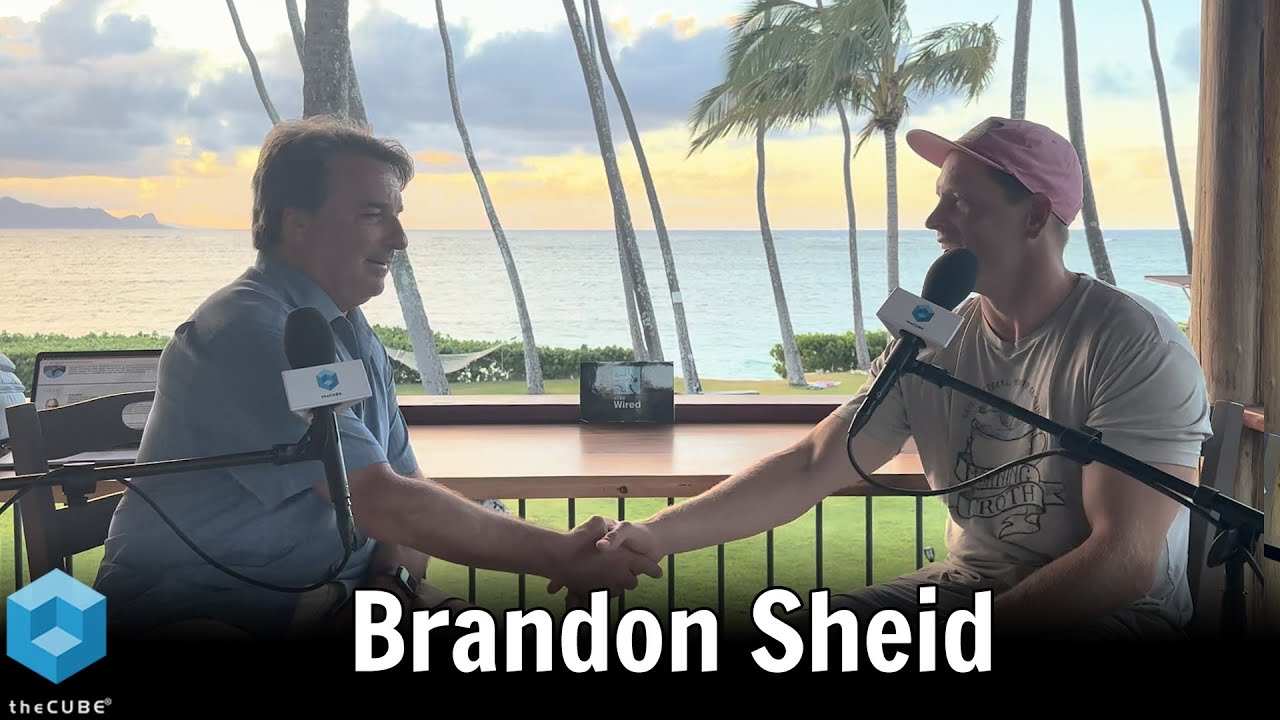
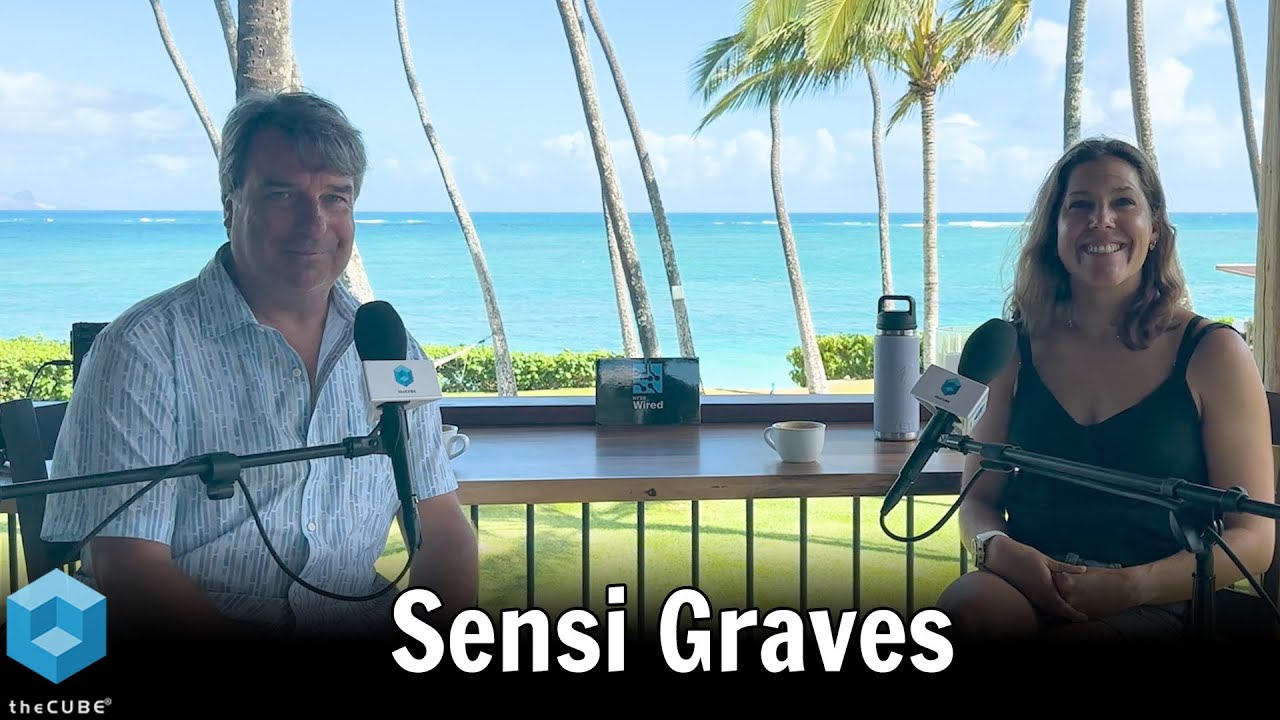
Daphne De Jong of Ven discusses a groundbreaking initiative, Earth Force, with John Furrier at the ACTAI Global event in Maui. This event, known for bringing together diverse industry experts, connects thinkers, entrepreneurs and kitesurfing enthusiasts to facilitate dialogue around innovative solutions that merge technology, adrenaline and impact.
In this video, De Jong shares expertise and insights, focusing on transformative approaches to tackling climate change through Earth Force. With a rich history at Google X and involvement in groundbreaking projects, De Jong brings a unique perspective based on experiences in technology and adventurous pursuits. John Furrier, co-founder and co-CEO of SiliconANGLE Media, and theCUBE Research hosts guide the discussion.
The talk explores the launch of Earth Force, aimed at addressing climate issues via a symbiotic model of for-profit and non-profit collaboration. De Jong emphasizes the need to harness advances in computing and artificial intelligence for environmental solutions across global sectors, including policy-making and community engagement. The video captures significant takeaways related to the urgency in carbon management and collaborative innovation to drive impactful change.
Forgot Password
Almost there!
We just sent you a verification email. Please verify your account to gain access to
theCUBE + NYSE Wired: Actai Maui. If you don’t think you received an email check your
spam folder.
In order to sign in, enter the email address you used to registered for the event. Once completed, you will receive an email with a verification link. Open this link to automatically sign into the site.
Register For theCUBE + NYSE Wired: Actai Maui
Please fill out the information below. You will recieve an email with a verification link confirming your registration. Click the link to automatically sign into the site.
You’re almost there!
We just sent you a verification email. Please click the verification button in the email. Once your email address is verified, you will have full access to all event content for theCUBE + NYSE Wired: Actai Maui.
I want my badge and interests to be visible to all attendees.
Checking this box will display your presense on the attendees list, view your profile and allow other attendees to contact you via 1-1 chat. Read the Privacy Policy. At any time, you can choose to disable this preference.
Select your Interests!
add
Upload your photo
Uploading..
OR
Connect via Twitter
Connect via Linkedin
EDIT PASSWORD
Share
Forgot Password
Almost there!
We just sent you a verification email. Please verify your account to gain access to
theCUBE + NYSE Wired: Actai Maui. If you don’t think you received an email check your
spam folder.
In order to sign in, enter the email address you used to registered for the event. Once completed, you will receive an email with a verification link. Open this link to automatically sign into the site.
Sign in to gain access to theCUBE + NYSE Wired: Actai Maui
Please sign in with LinkedIn to continue to theCUBE + NYSE Wired: Actai Maui. Signing in with LinkedIn ensures a professional environment.
>> Hello, I'm John Furrier here with theCUBE Podcast. We are in Maui for the Global ACTAI Global Event, a mixture of great experts and community members from all kinds of diverse backgrounds. You've got investors, you've got inventors, you've got entrepreneurs, you've got industry participants. Of course, back on theCUBE, CUBE alumni Daphne's back. You stand out in the crowd, one because your the first one out with the kite every day. We're very impressed with that. And of course, we've had many conversations about your many endeavors. Great to have you here. Not too shabby?
Daphne de Jong
>> Not too shabby.>> Not too shabby, yeah. Kitesurfing and tech go together because it's all the same thing. It's hard, you struggle, you break through, you go to the next level. You plateau, you struggle, you go to the next level. You build a trajectory of economies of scale. It's all fun. And the community is also very tight. You've got to help each other.
Daphne de Jong
>> Yeah.>> So it's very much symbionic with tech. So I'm super psyched to be here for my first time. I've known Bill for 20 years, so now that I have more time and the kids are out of the house, it's fun to be here.
Daphne de Jong
>> I'm so excited. You're becoming a kitesurfer.>> I'm newbie, but learning. We'll see. But I see the ROI. It's a water sport. I love the water, and it's just a lot of fun. And endorphins popping, reminds me of skiing, snow skiing, which I love, or wakeboarding or skiing. So to me, I can see myself. I'm definitely committed, addicted, like Brian Bauman, he's addicted. So let's talk about your experience here this week. Obviously, the kitesurfing was super fun. How did you think about the vibes? Seemed very robust, very active, a lot of participation, a lot of talks. What's your takeaway?
Daphne de Jong
>> Yeah. I think I have a theory about this too, which is I heard yesterday that the majority of this group are advanced kiters. What that means is they're very well-trained in adjusting, to your point, to weather, the product, the gear, the conditions. And I think that if you bring that group together, that creates a bunch of magic and that we can welcome new people in that group. But ultimately, the people that were invited I think are so different, and also when it comes to age, background, what we're working on. So we have such interesting conversations. And I didn't know I was going to learn from somebody doing something completely different, like this different. So I gained a lot of great new connections and friendships.>> Yeah, it's a zoom out moment. You can zoom in, you can zoom out. And I had just dots connecting. It's just a good time to reflect. It's like a retreat. It's like a tech retreat. It feeds the brain, feeds the body, feeds the soul. All that kind of comes together. Now I really want to get into what you're working on. I know you have... We talked last time, you had a variety of things going on. You have something really exciting going on now. So please explain, because first of all, I love the name. Explain the name and what the project is and what's going on.
Daphne de Jong
>> Yeah. We founded and launched three days ago Earth Force. And what we do is we work on the highest leverage solutions when it comes to the climate issues that we all cost. And the team we brought together is quite magical. We pitched this at Google about five years ago, or Google X. For many reasons it couldn't necessarily move forward because of the shareholders of the mother company. We still work->> This is when you were at Google X?
Daphne de Jong
>> Yes. And we still work on that same proposal, that same overview of information and ideas that we have with some of the same people. And then, we welcome amazing other people such as advisors to the previous US president and things like that. And I can explain more, but ultimately climate change, we see it being divided, the solutions in four different pillars: carbon reduction, carbon sequestration, culture and policy, for which all of those we're many years behind, between 25 and 75 years. And then, there's climate intervention, and that was very much focused on->> Explain that. You mentioned this in your talk when you actually benchmarked the behind the curve we are. Go through the numbers again. There was the four pillars and what's the number of how far behind we are.
Daphne de Jong
>> Yep So when it comes to carbon reduction, we're about 25 years behind, carbon sequestration, about 50 years, policy and culture, 75 years. And in order to buy ourselves more time, we might have to start thinking about climate intervention.>> Did they even have policy 75 years ago?
Daphne de Jong
>> Good question. We did. We did. But there's been a lot of pushback. And what I mean by that is it's not so much 75 years ago, but to get ourselves on track, it might take another 75 years based on the latest predictions with the IPCC reports, et cetera.>> So how long ago at Google X was that prediction? I think you mentioned Sergey and Larry and the whole exec team was involved.
Daphne de Jong
>> About five years ago.>> About five years ago. Okay. So lot's changed.
Daphne de Jong
>> Yeah.>> Tell me about what you're excited about, because there's an acceleration right now in the market. You talked to NVIDIA's CEO, Jensen Huang, accelerated computing. It's basically supercomputing democratized.
Daphne de Jong
>> Yeah.>> We're seeing a lot of projects that were moonshots on paper, didn't have the compute, they didn't have some of the AI software. So you had this kind of dream. You had smart people laying out things that we could do, but the blocker was just we needed more horsepower. And yet, it's coming and you've got energy on the other side, which does impact climate change. So these are threaded things.
Daphne de Jong
>> Yeah.>> Take us through your thought.
Daphne de Jong
>> Which is why my other company is on energy. So yeah, I hear you. I think that it's a good point that the timing is right for this. And just to conclude, in order to validate a lot of this work, you need to understand where we're at today. And there's a lot of research papers. There are scientists that do incredible work. Some of them have lost their position. We also are looking to work with those institutions and then also some technology companies to provide that simulation of what we're currently are in and sort of what issues we've caused. And when we benchmark where we're at, we can figure out what priorities we tie to potential proposals. Which is part of what is the next step, which we call the solutions engine, which is very similar to the process at Google X.>> All right, so take us through the project. What's the roadmap? Where are you now? You said you just launched.
Daphne de Jong
>> Yeah.>> Launched as in what? You've got the team, things are moving. What are some of the mechanics? What are some of the tactics and strategies you guys are executing against?
Daphne de Jong
>> Launch could also mean very boring things, which is administration and actually incorporating and finding the right sponsors. So we have an incredible fiscal sponsor for our non-for-profit benefit corporation. There's a for-profit element to it. And the next steps are to get back to the team, we have a very amazing team, hire specific full-time positions for two verticals, which is that solutions engine that I mentioned where we have to collaborate with international institutions that we've already had plenty conversations with. And the second part of that is building a team that can build financial instruments in the long term to make sure this is economically viable. And that's a bit similar to what we talked about yesterday here at ICTEI.>> This is one of the things, again, this community, and I've been seeing it on the rest of the past couple of years, but this year in particular has been hardcore, is that the idea of tech money and impact are coming together. Cetopia was a great venture. They had a little lunch yesterday. There are things you can do without foreclosing the for-profit objective. So you have this for-profit initiative, but also there's also money from non-profit folks who do care about it, but there's no vehicle for that.
Daphne de Jong
>> Yeah.>> So you don't have to give up building businesses to go be a philanthropist basically.
Daphne de Jong
>> Yeah.>> And so, you're seeing the philanthropy side and the impact side recognize, "Hey, I just sidecar the entrepreneurs and I'll come along for the ride." So you're going to hit a beachhead, just get a little bit wider, get me some beachhead. So they're seeing a lot of strategies. Take us through, because I love this hybrid non-profit vision. Susan McCormick I've learned has done some amazing things.
Daphne de Jong
>> She helped us.>> You see some of the capital structures with OpenAI, you see Patagonia, all these companies. You can have mission over profit, but not like killing the profit objective.
Daphne de Jong
>> Exactly. And in this case, it's very much mission-oriented because we see it as a time bomb that's ticking. And so, we can accept non-for-profit funding under a fiscal sponsorship, the 501c. We can also then use that to purchase assets or to work with the folks that work on the for-profit side. And so, it's a very natural collaboration. The for-profit side could then also go back to the non-for-profit side. It's very important because some of the projects I worked on at Google X that I saw there. And in general, I think what's challenging is if you work with scientific researchers, you cannot always make a company out of scientific research. And sometimes you can, but when you start, that story might not be clear. And so, getting the right funding from the right people at the right time is so important to actually solve the problem, which ultimately should maintain the goal.>> Yeah. You and I have a similar passion for that. And I think I was talking with some folks from the four global organization that Elliott Donnelly is the chairman of, and Renee is the president. You can have breakthroughs and have joint mission. But what's interesting about the world we're in now is that with AI and some of the large-scale systems that are emerging, you can get a position and then quickly get that second answer. We can all relate to the ChatGPT probably where you type in a prompt you kind of go deeper quickly.
Daphne de Jong
>> Yeah.>> You're seeing a lot of momentum. So this is where the alignment works. So a scientist could be like, "Oh yeah, I've got this breakthrough. I don't know how to commercialize that in a vacuum. But that could contribute to something over here." That creates momentum.
Daphne de Jong
>> Yep.>> And I think that's where that synergy is. What's your thoughts on that? Do you agree? And how do you make that work better? Or how do you share, how do you educate people or enlighten them that this is actually real?
Daphne de Jong
>> I think it's actually very complex, because specifically in the climate sciences, I think scientists, they are very focused on very specific outcomes, which is very important. But then, there isn't always a, "So what?" There isn't always an engineering team that follows up and works on a solution. There is no collaboration with policy makers. So it's sort of ends up becoming an amazing article, but then how do you fix the problem? I think that always remains a challenge. And so, that's where we're trying to close that gap. And then secondly, we're using technology to benchmark the situation and then also optimize what solutions we should deploy when and where, and what are the highest leverage solutions. So some of them could be how do you change the direction of a heat wave or how do you refreeze the layer of ice on top of the Antarctic ice sheets? And it's very, you have to think very big.>> And you need large-scale data sets. You need massive computing. If you want to index the biosphere for instance, that was ungettable years ago. Now...
Daphne de Jong
>> We could.>> Now you could. I saw some Google folks working on that.
Daphne de Jong
>> Yeah.>> And by the way, they're nerds.
Daphne de Jong
>> Yeah.>> They're not like climate tree huggers.
Daphne de Jong
>> Yeah. Exactly.>> Maybe that's a bad way to say it.
Daphne de Jong
>> No, no.>> But there's a whole world like, "Hey." But they don't have the tech-savvy. So I think that comes together.
Daphne de Jong
>> No, no, I actually like that you say that, because I think we need more people with real skill sets in this problem space who can really solve things. And what we did is we also brought together entrepreneurs and investors and scientists. So it's not just scientists and engineers, but it's actually people who build companies, who use that same mindset and mentality, and are able to pivot but still get very focused on the problem space.>> Public-private partnerships, huge opportunity, the sidecar benefits, charity benefits, these SBCs. You can be an entrepreneur and have all the fun of creating value and monetizing it while having impact.
Daphne de Jong
>> Yeah.>> I've never seen that before in my career, where you don't have to give up anything just to kind of have your antenna up and be like, "Okay, let's work together. Sidecar, we'll go along for the ride."
Daphne de Jong
>> And actually, I think we have a responsibility to do that because you can.>> I agree.
Daphne de Jong
>> And I think she actually did an amazing job there advocating that and working with different companies to see if they can get to model.>> She gave a talk and she said, "The money's up, but the performance is down on philanthropy and impact in general." And that's counterintuitive. It's like, wait, it should go up.
Daphne de Jong
>> Well, you have to track performance. And what I've seen in that space is there's very little portfolio management or data-driven solutions. And that's what we're trying to change.>> So I have to ask this. We've had many chats before, both here on theCUBE but also off-camera.
Daphne de Jong
>> On the beach.>> On the beach, hanging out. So Google X, you did a stint there. Well you did a stint with Amazon with the drones, which is just, the delivery thing's cool, the drone delivery, which didn't work. But Google X, but also SpaceX. So what I'm intrigued by is Earth Force, I think of Space Force. And I think, and I'm not joking, this is a serious question. Earth Force could be like a Space Force for the Earth.
Daphne de Jong
>> That's what we want. That's why we called it.>> What dos that mean? What is the North Star? Because is that like a government entity?
Daphne de Jong
>> No.>> Is it like a group of people? Because Space Force has a mission. There's tech and people behind it, like SpaceX gets stuff into space, can protect space.
Daphne de Jong
>> Yeah. So that's why it's called Force, right?>> Yeah.
Daphne de Jong
>> And that's why it was called Space Force. And it's very much focused on defending a specific group of people or a country. And in our case, it is we want to defend our Earth basically. And that's sort of why we call it that way. And to your point, it's very similar. There is a mission, there's incredible people behind it. The difference however, is it's not dependent on government funding. And I think that's the crucial difference.>> Yeah, I think that's going to make it work. All right, so if you're watching, we need you for Earth Force. How do people sign up? You need more soldiers, so to speak, tech soldiers, tech athletes, winners. Obviously, a force means it constitutes a group. What are you looking for? I know it's getting off the ground, but in your vision, how do you see it unfolding?
Daphne de Jong
>> Yeah. We need partnerships with the right organizations more than anything. And I'll talk about it in a second. What we don't need is necessarily just more people. It needs to be the right people in the right positions. We want to learn about other countries, other projects that are kicked off so that we can incorporate those in our benchmarking efforts and also understand when they will execute and where, so that we still know what that gap is. When it comes to the organization we want to work with, it is the compute providers, it's the technology platforms, but it's also universities that are working on modeling in particular for some of these problems such as stratospheric aerosol injection, for example. We found some incredible scientists that we're working with and want to keep doing that. And again, our mission is to not receive pushback, but to collaborate with specific governments.>> Daphne, I know you've got a lot going on, you've got like 10 cores and processing going on in the world. In the physical AI world, the digital twins are hot, physical and digital coming together. You've got synthetic data. You mentioned that. It's one of the comments. There's all kinds of data challenges. When you look at the opportunity to apply technology to the problem, the physical is the world. Is there a digital twin version? Do you see, is there an opportunity to leverage the new AI, the new big super clusters? How do you think about that space? How do you frame it and how do you-
Daphne de Jong
>> Well, some companies are doing that and I'm very happy they are. Actually, NVIDIA did an amazing job trying to do that for our own planet. What we want to do is create a dynamic solution where it's not anymore a timestamp, but it's like, "this is what we simulate, this is what we've learned. And by the way, if this solution gets implemented, that curve should change." And so, we will then change with that graph, with that data that we have. We should optimize what proposals will come forward. And so, that's quite new. It's not, "Oh, we know about this one issue. Let's find 10 solutions for it." No. We have to keep learning.>> You've got to be focused.
Daphne de Jong
>> Keep adjusting.>> Focused execution is key. Criteria of what to work on is probably the biggest problem, right?
Daphne de Jong
>> Yeah, absolutely. Well, what's the highest leverage at each point in time in different parts of the world? If I do a project in India, is there going to be an impact here in Maui? I don't know. So that's something we need to figure out.>> We did a couple interviews in Palo Alto, and one specifically in the NYSC CCUBE Studios, there at the Wired group there. And an entrepreneur was building a robotics thing for life sciences. He was growing cells basically. And he built a machine and he had his software. Turns out he's actually doing extremely well. It's called Opentrons. And he actually didn't know, but he actually created a machine that because it was open source software, the plug-in of the software allowed him to do that. But what happened was, unbeknownst to him, there were other communities building in chemistry wet labs stuff too. And turns out because he was using open source software, they could just plug into his machine.
Daphne de Jong
>> Yep. Love it.>> And so, it's kind of like that scene in the Matrix where he's like, "Hey, teach me how to fly a helicopter. Upload judo." So you have this software system now, where if you make breakthroughs, the ability to integrate in other breakthroughs, other communities, do you see a vision for that, where I could see you working on a project you're trying to collect, but someone could be out there working on something in academia?
Daphne de Jong
>> Yeah.>> How do you see that picture? Obviously, open source is critical, you have to have standards. But is that something that you think about?
Daphne de Jong
>> We want to know about it because that's exactly what we try to do, which is we don't want to reinvent the wheel. That's not the goal. The goal is to work on the stuff that nobody's working on that we think is quite urgent. And basically, to create that blueprint so that you're ready to deploy those solutions when specific countries and the world is ready for them. Because some of them are quite big, and so you want to know what research is being done in all different countries on those topics, and what the potential negative impact is of that work. And so, that open source code is very important.>> How do people contact you if they see this video? How do you engage? How do you want to be engaged with input? Because it's almost like if you open the flood gates, you might get too much.
Daphne de Jong
>> No.>> But what's some of the criteria? What's the requirements? What are some of the things that you look for?
Daphne de Jong
>> Yeah. So we are still creating that sort of intake form, but otherwise they can send me an email and I'm happy to link that. We're already having a lot of conversations with chairs of universities, et cetera, individual researchers. The good thing is through the network that we built over the years between our team, we have access to a lot of those people today. But yeah, they can engage us through my email, and otherwise we're working on what that requirement list looks like.>> Well, I appreciate you coming on kicking off the morning here. I know you've got to grab a flight back. I know you were recently in Greenland. So talk about your latest trip, because when you flew in you had a little endeavor up there in Greenland. And wasn't as productive, but the weather didn't work out for you. But tell me about that trip.
Daphne de Jong
>> I've been obsessed by the Arctics for a long time, for many reasons. I think they're sort of an indicator of what's happening in the rest of the world. And I just really wanted to snow kite across Greenland. So I went there and snow kited, not fully across Greenland, but we got to a pretty good spot. And some days it was eight degrees Celsius, which is pretty crazy when you think about you expect it to be minus 30. And so, quite frankly, it encouraged me much more to do what we're doing today.>> So you have primary data that this is a bit of a problem?
Daphne de Jong
>> Yeah, yeah, exactly. It's hard to get data from those very remote locations.>> That must have really screwed up the conditions for kite.
Daphne de Jong
>> Yeah.>> Kites, what do you call it?
Daphne de Jong
>> Kites skiing, snow kiting.>> Snow kiting.
Daphne de Jong
>> But it's more like ice kiting at this point because of those conditions.>> Actually, that I can survive. I'm a hockey player. No, but this is a problem.
Daphne de Jong
>> Yeah, it's a problem. And something else that's not related to climate that I've really thought it was a great learning experience is it's the first place I've been in where you look around and nothing looks different. There's no reference. There's no trees. There's no plain. There's nothing, no mountain. And you're really forced to think about all different scenarios and also sometimes go inward. And that's a very interesting experience.>> It's a compass probably. "Where am I? Am I upside down?"
Daphne de Jong
>> Yeah, yeah, yeah,>> "Is the world spinning?"
Daphne de Jong
>> You need your GPS. Yeah, it's very interesting.>> Daphne, great to see you. I really enjoyed the week. It was great. Provocative conversations, very intellectually stimulating. A lot of physical energy with kitesurfing. You're a pro. I'm like Snoopy. I'm the Q pod here. We are here at the Global Event. This is a group of people in the ACTAI community. It's a really targeted trust network, really doing great things. They think about impacting society, they think about technology, and like to have fun. I'm John Furrier with theCUBE. Thanks for watching.
>> Hello, I'm John Furrier here with theCUBE Podcast. We are in Maui for the Global ACTAI Global Event, a mixture of great experts and community members from all kinds of diverse backgrounds. You've got investors, you've got inventors, you've got entrepreneurs, you've got industry participants. Of course, back on theCUBE, CUBE alumni Daphne's back. You stand out in the crowd, one because your the first one out with the kite every day. We're very impressed with that. And of course, we've had many conversations about your many endeavors. Great to have you here. Not too shabby?
Daphne de Jong
>> Not too shabby.>> Not too shabby, yeah. Kitesurfing and tech go together because it's all the same thing. It's hard, you struggle, you break through, you go to the next level. You plateau, you struggle, you go to the next level. You build a trajectory of economies of scale. It's all fun. And the community is also very tight. You've got to help each other.
Daphne de Jong
>> Yeah.>> So it's very much symbionic with tech. So I'm super psyched to be here for my first time. I've known Bill for 20 years, so now that I have more time and the kids are out of the house, it's fun to be here.
Daphne de Jong
>> I'm so excited. You're becoming a kitesurfer.>> I'm newbie, but learning. We'll see. But I see the ROI. It's a water sport. I love the water, and it's just a lot of fun. And endorphins popping, reminds me of skiing, snow skiing, which I love, or wakeboarding or skiing. So to me, I can see myself. I'm definitely committed, addicted, like Brian Bauman, he's addicted. So let's talk about your experience here this week. Obviously, the kitesurfing was super fun. How did you think about the vibes? Seemed very robust, very active, a lot of participation, a lot of talks. What's your takeaway?
Daphne de Jong
>> Yeah. I think I have a theory about this too, which is I heard yesterday that the majority of this group are advanced kiters. What that means is they're very well-trained in adjusting, to your point, to weather, the product, the gear, the conditions. And I think that if you bring that group together, that creates a bunch of magic and that we can welcome new people in that group. But ultimately, the people that were invited I think are so different, and also when it comes to age, background, what we're working on. So we have such interesting conversations. And I didn't know I was going to learn from somebody doing something completely different, like this different. So I gained a lot of great new connections and friendships.>> Yeah, it's a zoom out moment. You can zoom in, you can zoom out. And I had just dots connecting. It's just a good time to reflect. It's like a retreat. It's like a tech retreat. It feeds the brain, feeds the body, feeds the soul. All that kind of comes together. Now I really want to get into what you're working on. I know you have... We talked last time, you had a variety of things going on. You have something really exciting going on now. So please explain, because first of all, I love the name. Explain the name and what the project is and what's going on.
Daphne de Jong
>> Yeah. We founded and launched three days ago Earth Force. And what we do is we work on the highest leverage solutions when it comes to the climate issues that we all cost. And the team we brought together is quite magical. We pitched this at Google about five years ago, or Google X. For many reasons it couldn't necessarily move forward because of the shareholders of the mother company. We still work->> This is when you were at Google X?
Daphne de Jong
>> Yes. And we still work on that same proposal, that same overview of information and ideas that we have with some of the same people. And then, we welcome amazing other people such as advisors to the previous US president and things like that. And I can explain more, but ultimately climate change, we see it being divided, the solutions in four different pillars: carbon reduction, carbon sequestration, culture and policy, for which all of those we're many years behind, between 25 and 75 years. And then, there's climate intervention, and that was very much focused on->> Explain that. You mentioned this in your talk when you actually benchmarked the behind the curve we are. Go through the numbers again. There was the four pillars and what's the number of how far behind we are.
Daphne de Jong
>> Yep So when it comes to carbon reduction, we're about 25 years behind, carbon sequestration, about 50 years, policy and culture, 75 years. And in order to buy ourselves more time, we might have to start thinking about climate intervention.>> Did they even have policy 75 years ago?
Daphne de Jong
>> Good question. We did. We did. But there's been a lot of pushback. And what I mean by that is it's not so much 75 years ago, but to get ourselves on track, it might take another 75 years based on the latest predictions with the IPCC reports, et cetera.>> So how long ago at Google X was that prediction? I think you mentioned Sergey and Larry and the whole exec team was involved.
Daphne de Jong
>> About five years ago.>> About five years ago. Okay. So lot's changed.
Daphne de Jong
>> Yeah.>> Tell me about what you're excited about, because there's an acceleration right now in the market. You talked to NVIDIA's CEO, Jensen Huang, accelerated computing. It's basically supercomputing democratized.
Daphne de Jong
>> Yeah.>> We're seeing a lot of projects that were moonshots on paper, didn't have the compute, they didn't have some of the AI software. So you had this kind of dream. You had smart people laying out things that we could do, but the blocker was just we needed more horsepower. And yet, it's coming and you've got energy on the other side, which does impact climate change. So these are threaded things.
Daphne de Jong
>> Yeah.>> Take us through your thought.
Daphne de Jong
>> Which is why my other company is on energy. So yeah, I hear you. I think that it's a good point that the timing is right for this. And just to conclude, in order to validate a lot of this work, you need to understand where we're at today. And there's a lot of research papers. There are scientists that do incredible work. Some of them have lost their position. We also are looking to work with those institutions and then also some technology companies to provide that simulation of what we're currently are in and sort of what issues we've caused. And when we benchmark where we're at, we can figure out what priorities we tie to potential proposals. Which is part of what is the next step, which we call the solutions engine, which is very similar to the process at Google X.>> All right, so take us through the project. What's the roadmap? Where are you now? You said you just launched.
Daphne de Jong
>> Yeah.>> Launched as in what? You've got the team, things are moving. What are some of the mechanics? What are some of the tactics and strategies you guys are executing against?
Daphne de Jong
>> Launch could also mean very boring things, which is administration and actually incorporating and finding the right sponsors. So we have an incredible fiscal sponsor for our non-for-profit benefit corporation. There's a for-profit element to it. And the next steps are to get back to the team, we have a very amazing team, hire specific full-time positions for two verticals, which is that solutions engine that I mentioned where we have to collaborate with international institutions that we've already had plenty conversations with. And the second part of that is building a team that can build financial instruments in the long term to make sure this is economically viable. And that's a bit similar to what we talked about yesterday here at ICTEI.>> This is one of the things, again, this community, and I've been seeing it on the rest of the past couple of years, but this year in particular has been hardcore, is that the idea of tech money and impact are coming together. Cetopia was a great venture. They had a little lunch yesterday. There are things you can do without foreclosing the for-profit objective. So you have this for-profit initiative, but also there's also money from non-profit folks who do care about it, but there's no vehicle for that.
Daphne de Jong
>> Yeah.>> So you don't have to give up building businesses to go be a philanthropist basically.
Daphne de Jong
>> Yeah.>> And so, you're seeing the philanthropy side and the impact side recognize, "Hey, I just sidecar the entrepreneurs and I'll come along for the ride." So you're going to hit a beachhead, just get a little bit wider, get me some beachhead. So they're seeing a lot of strategies. Take us through, because I love this hybrid non-profit vision. Susan McCormick I've learned has done some amazing things.
Daphne de Jong
>> She helped us.>> You see some of the capital structures with OpenAI, you see Patagonia, all these companies. You can have mission over profit, but not like killing the profit objective.
Daphne de Jong
>> Exactly. And in this case, it's very much mission-oriented because we see it as a time bomb that's ticking. And so, we can accept non-for-profit funding under a fiscal sponsorship, the 501c. We can also then use that to purchase assets or to work with the folks that work on the for-profit side. And so, it's a very natural collaboration. The for-profit side could then also go back to the non-for-profit side. It's very important because some of the projects I worked on at Google X that I saw there. And in general, I think what's challenging is if you work with scientific researchers, you cannot always make a company out of scientific research. And sometimes you can, but when you start, that story might not be clear. And so, getting the right funding from the right people at the right time is so important to actually solve the problem, which ultimately should maintain the goal.>> Yeah. You and I have a similar passion for that. And I think I was talking with some folks from the four global organization that Elliott Donnelly is the chairman of, and Renee is the president. You can have breakthroughs and have joint mission. But what's interesting about the world we're in now is that with AI and some of the large-scale systems that are emerging, you can get a position and then quickly get that second answer. We can all relate to the ChatGPT probably where you type in a prompt you kind of go deeper quickly.
Daphne de Jong
>> Yeah.>> You're seeing a lot of momentum. So this is where the alignment works. So a scientist could be like, "Oh yeah, I've got this breakthrough. I don't know how to commercialize that in a vacuum. But that could contribute to something over here." That creates momentum.
Daphne de Jong
>> Yep.>> And I think that's where that synergy is. What's your thoughts on that? Do you agree? And how do you make that work better? Or how do you share, how do you educate people or enlighten them that this is actually real?
Daphne de Jong
>> I think it's actually very complex, because specifically in the climate sciences, I think scientists, they are very focused on very specific outcomes, which is very important. But then, there isn't always a, "So what?" There isn't always an engineering team that follows up and works on a solution. There is no collaboration with policy makers. So it's sort of ends up becoming an amazing article, but then how do you fix the problem? I think that always remains a challenge. And so, that's where we're trying to close that gap. And then secondly, we're using technology to benchmark the situation and then also optimize what solutions we should deploy when and where, and what are the highest leverage solutions. So some of them could be how do you change the direction of a heat wave or how do you refreeze the layer of ice on top of the Antarctic ice sheets? And it's very, you have to think very big.>> And you need large-scale data sets. You need massive computing. If you want to index the biosphere for instance, that was ungettable years ago. Now...
Daphne de Jong
>> We could.>> Now you could. I saw some Google folks working on that.
Daphne de Jong
>> Yeah.>> And by the way, they're nerds.
Daphne de Jong
>> Yeah.>> They're not like climate tree huggers.
Daphne de Jong
>> Yeah. Exactly.>> Maybe that's a bad way to say it.
Daphne de Jong
>> No, no.>> But there's a whole world like, "Hey." But they don't have the tech-savvy. So I think that comes together.
Daphne de Jong
>> No, no, I actually like that you say that, because I think we need more people with real skill sets in this problem space who can really solve things. And what we did is we also brought together entrepreneurs and investors and scientists. So it's not just scientists and engineers, but it's actually people who build companies, who use that same mindset and mentality, and are able to pivot but still get very focused on the problem space.>> Public-private partnerships, huge opportunity, the sidecar benefits, charity benefits, these SBCs. You can be an entrepreneur and have all the fun of creating value and monetizing it while having impact.
Daphne de Jong
>> Yeah.>> I've never seen that before in my career, where you don't have to give up anything just to kind of have your antenna up and be like, "Okay, let's work together. Sidecar, we'll go along for the ride."
Daphne de Jong
>> And actually, I think we have a responsibility to do that because you can.>> I agree.
Daphne de Jong
>> And I think she actually did an amazing job there advocating that and working with different companies to see if they can get to model.>> She gave a talk and she said, "The money's up, but the performance is down on philanthropy and impact in general." And that's counterintuitive. It's like, wait, it should go up.
Daphne de Jong
>> Well, you have to track performance. And what I've seen in that space is there's very little portfolio management or data-driven solutions. And that's what we're trying to change.>> So I have to ask this. We've had many chats before, both here on theCUBE but also off-camera.
Daphne de Jong
>> On the beach.>> On the beach, hanging out. So Google X, you did a stint there. Well you did a stint with Amazon with the drones, which is just, the delivery thing's cool, the drone delivery, which didn't work. But Google X, but also SpaceX. So what I'm intrigued by is Earth Force, I think of Space Force. And I think, and I'm not joking, this is a serious question. Earth Force could be like a Space Force for the Earth.
Daphne de Jong
>> That's what we want. That's why we called it.>> What dos that mean? What is the North Star? Because is that like a government entity?
Daphne de Jong
>> No.>> Is it like a group of people? Because Space Force has a mission. There's tech and people behind it, like SpaceX gets stuff into space, can protect space.
Daphne de Jong
>> Yeah. So that's why it's called Force, right?>> Yeah.
Daphne de Jong
>> And that's why it was called Space Force. And it's very much focused on defending a specific group of people or a country. And in our case, it is we want to defend our Earth basically. And that's sort of why we call it that way. And to your point, it's very similar. There is a mission, there's incredible people behind it. The difference however, is it's not dependent on government funding. And I think that's the crucial difference.>> Yeah, I think that's going to make it work. All right, so if you're watching, we need you for Earth Force. How do people sign up? You need more soldiers, so to speak, tech soldiers, tech athletes, winners. Obviously, a force means it constitutes a group. What are you looking for? I know it's getting off the ground, but in your vision, how do you see it unfolding?
Daphne de Jong
>> Yeah. We need partnerships with the right organizations more than anything. And I'll talk about it in a second. What we don't need is necessarily just more people. It needs to be the right people in the right positions. We want to learn about other countries, other projects that are kicked off so that we can incorporate those in our benchmarking efforts and also understand when they will execute and where, so that we still know what that gap is. When it comes to the organization we want to work with, it is the compute providers, it's the technology platforms, but it's also universities that are working on modeling in particular for some of these problems such as stratospheric aerosol injection, for example. We found some incredible scientists that we're working with and want to keep doing that. And again, our mission is to not receive pushback, but to collaborate with specific governments.>> Daphne, I know you've got a lot going on, you've got like 10 cores and processing going on in the world. In the physical AI world, the digital twins are hot, physical and digital coming together. You've got synthetic data. You mentioned that. It's one of the comments. There's all kinds of data challenges. When you look at the opportunity to apply technology to the problem, the physical is the world. Is there a digital twin version? Do you see, is there an opportunity to leverage the new AI, the new big super clusters? How do you think about that space? How do you frame it and how do you-
Daphne de Jong
>> Well, some companies are doing that and I'm very happy they are. Actually, NVIDIA did an amazing job trying to do that for our own planet. What we want to do is create a dynamic solution where it's not anymore a timestamp, but it's like, "this is what we simulate, this is what we've learned. And by the way, if this solution gets implemented, that curve should change." And so, we will then change with that graph, with that data that we have. We should optimize what proposals will come forward. And so, that's quite new. It's not, "Oh, we know about this one issue. Let's find 10 solutions for it." No. We have to keep learning.>> You've got to be focused.
Daphne de Jong
>> Keep adjusting.>> Focused execution is key. Criteria of what to work on is probably the biggest problem, right?
Daphne de Jong
>> Yeah, absolutely. Well, what's the highest leverage at each point in time in different parts of the world? If I do a project in India, is there going to be an impact here in Maui? I don't know. So that's something we need to figure out.>> We did a couple interviews in Palo Alto, and one specifically in the NYSC CCUBE Studios, there at the Wired group there. And an entrepreneur was building a robotics thing for life sciences. He was growing cells basically. And he built a machine and he had his software. Turns out he's actually doing extremely well. It's called Opentrons. And he actually didn't know, but he actually created a machine that because it was open source software, the plug-in of the software allowed him to do that. But what happened was, unbeknownst to him, there were other communities building in chemistry wet labs stuff too. And turns out because he was using open source software, they could just plug into his machine.
Daphne de Jong
>> Yep. Love it.>> And so, it's kind of like that scene in the Matrix where he's like, "Hey, teach me how to fly a helicopter. Upload judo." So you have this software system now, where if you make breakthroughs, the ability to integrate in other breakthroughs, other communities, do you see a vision for that, where I could see you working on a project you're trying to collect, but someone could be out there working on something in academia?
Daphne de Jong
>> Yeah.>> How do you see that picture? Obviously, open source is critical, you have to have standards. But is that something that you think about?
Daphne de Jong
>> We want to know about it because that's exactly what we try to do, which is we don't want to reinvent the wheel. That's not the goal. The goal is to work on the stuff that nobody's working on that we think is quite urgent. And basically, to create that blueprint so that you're ready to deploy those solutions when specific countries and the world is ready for them. Because some of them are quite big, and so you want to know what research is being done in all different countries on those topics, and what the potential negative impact is of that work. And so, that open source code is very important.>> How do people contact you if they see this video? How do you engage? How do you want to be engaged with input? Because it's almost like if you open the flood gates, you might get too much.
Daphne de Jong
>> No.>> But what's some of the criteria? What's the requirements? What are some of the things that you look for?
Daphne de Jong
>> Yeah. So we are still creating that sort of intake form, but otherwise they can send me an email and I'm happy to link that. We're already having a lot of conversations with chairs of universities, et cetera, individual researchers. The good thing is through the network that we built over the years between our team, we have access to a lot of those people today. But yeah, they can engage us through my email, and otherwise we're working on what that requirement list looks like.>> Well, I appreciate you coming on kicking off the morning here. I know you've got to grab a flight back. I know you were recently in Greenland. So talk about your latest trip, because when you flew in you had a little endeavor up there in Greenland. And wasn't as productive, but the weather didn't work out for you. But tell me about that trip.
Daphne de Jong
>> I've been obsessed by the Arctics for a long time, for many reasons. I think they're sort of an indicator of what's happening in the rest of the world. And I just really wanted to snow kite across Greenland. So I went there and snow kited, not fully across Greenland, but we got to a pretty good spot. And some days it was eight degrees Celsius, which is pretty crazy when you think about you expect it to be minus 30. And so, quite frankly, it encouraged me much more to do what we're doing today.>> So you have primary data that this is a bit of a problem?
Daphne de Jong
>> Yeah, yeah, exactly. It's hard to get data from those very remote locations.>> That must have really screwed up the conditions for kite.
Daphne de Jong
>> Yeah.>> Kites, what do you call it?
Daphne de Jong
>> Kites skiing, snow kiting.>> Snow kiting.
Daphne de Jong
>> But it's more like ice kiting at this point because of those conditions.>> Actually, that I can survive. I'm a hockey player. No, but this is a problem.
Daphne de Jong
>> Yeah, it's a problem. And something else that's not related to climate that I've really thought it was a great learning experience is it's the first place I've been in where you look around and nothing looks different. There's no reference. There's no trees. There's no plain. There's nothing, no mountain. And you're really forced to think about all different scenarios and also sometimes go inward. And that's a very interesting experience.>> It's a compass probably. "Where am I? Am I upside down?"
Daphne de Jong
>> Yeah, yeah, yeah,>> "Is the world spinning?"
Daphne de Jong
>> You need your GPS. Yeah, it's very interesting.>> Daphne, great to see you. I really enjoyed the week. It was great. Provocative conversations, very intellectually stimulating. A lot of physical energy with kitesurfing. You're a pro. I'm like Snoopy. I'm the Q pod here. We are here at the Global Event. This is a group of people in the ACTAI community. It's a really targeted trust network, really doing great things. They think about impacting society, they think about technology, and like to have fun. I'm John Furrier with theCUBE. Thanks for watching.