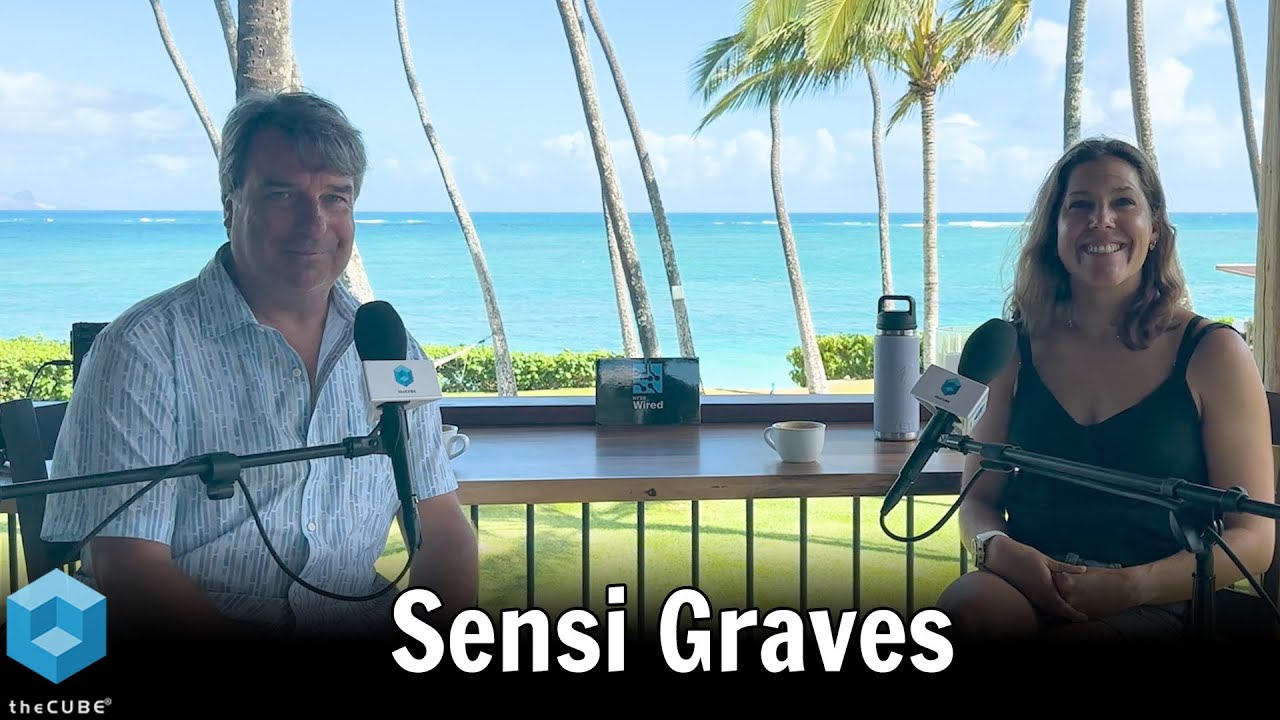
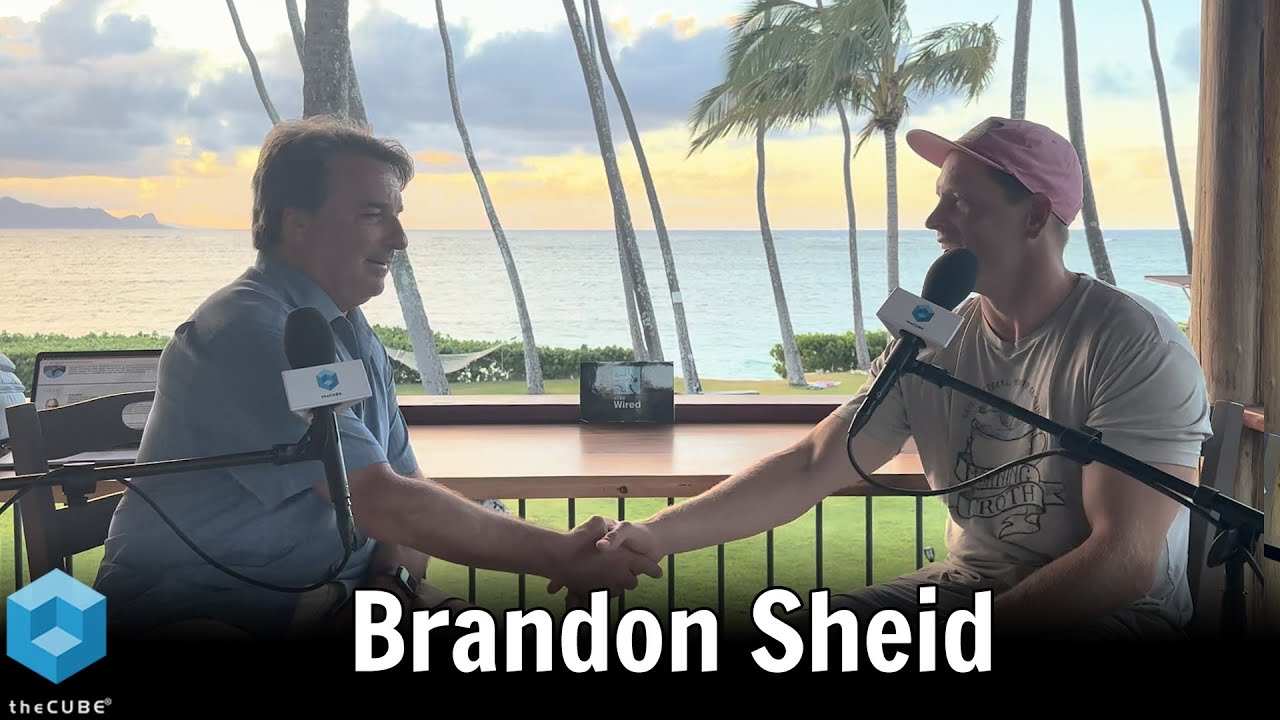
Join us for an insightful discussion featuring Bill Tai, chairman of ACTAI Global, as he shares experiences and insights at ACTAI Global’s renowned annual gathering in Maui. Tai, a prominent investor and philanthropist, reflects on the evolution and impact of this unique convergence of athletes, conservationists, technologists, artists and innovators, highlighting the event’s vibrant atmosphere.
In this session, hosted by John Furrier of SiliconANGLE Media Inc., we dive deep into the eclectic environment of ACTAI Global. Tai details the journey and intricacies of bringing together a diverse community of experts and enthusiasts. Highlighting the roots of ACTAI Global in kite-surfing and technology, the discussion explores how this intersection fosters an environment ripe for innovation and collaboration.
Key takeaways from the conversation include the transformative impact of new technologies such as artificial intelligence and cryptocurrency, as explained by Tai. They underscore the cyclical nature of innovation and how new technological waves present monumental opportunities for growth and impact. Tai discusses the importance of adaptability and highlights efforts in environmental conservation and economic empowerment initiated by ACTAI Global, reflecting a vision of harmonizing entrepreneurial success with positive societal impact.
Forgot Password
Almost there!
We just sent you a verification email. Please verify your account to gain access to
theCUBE + NYSE Wired: Actai Maui. If you don’t think you received an email check your
spam folder.
In order to sign in, enter the email address you used to registered for the event. Once completed, you will receive an email with a verification link. Open this link to automatically sign into the site.
Register For theCUBE + NYSE Wired: Actai Maui
Please fill out the information below. You will recieve an email with a verification link confirming your registration. Click the link to automatically sign into the site.
You’re almost there!
We just sent you a verification email. Please click the verification button in the email. Once your email address is verified, you will have full access to all event content for theCUBE + NYSE Wired: Actai Maui.
I want my badge and interests to be visible to all attendees.
Checking this box will display your presense on the attendees list, view your profile and allow other attendees to contact you via 1-1 chat. Read the Privacy Policy. At any time, you can choose to disable this preference.
Select your Interests!
add
Upload your photo
Uploading..
OR
Connect via Twitter
Connect via Linkedin
EDIT PASSWORD
Share
Forgot Password
Almost there!
We just sent you a verification email. Please verify your account to gain access to
theCUBE + NYSE Wired: Actai Maui. If you don’t think you received an email check your
spam folder.
In order to sign in, enter the email address you used to registered for the event. Once completed, you will receive an email with a verification link. Open this link to automatically sign into the site.
Sign in to gain access to theCUBE + NYSE Wired: Actai Maui
Please sign in with LinkedIn to continue to theCUBE + NYSE Wired: Actai Maui. Signing in with LinkedIn ensures a professional environment.
Are you sure you want to remove access rights for this user?
Details
Manage Access
email address
Community Invitation
Bill Tai, ACTAI Global
Join us for an insightful discussion featuring Bill Tai, chairman of ACTAI Global, as he shares experiences and insights at ACTAI Global’s renowned annual gathering in Maui. Tai, a prominent investor and philanthropist, reflects on the evolution and impact of this unique convergence of athletes, conservationists, technologists, artists and innovators, highlighting the event’s vibrant atmosphere.
In this session, hosted by John Furrier of SiliconANGLE Media Inc., we dive deep into the eclectic environment of ACTAI Global. Tai details the journey and intricacies of bringing together a diverse community of experts and enthusiasts. Highlighting the roots of ACTAI Global in kite-surfing and technology, the discussion explores how this intersection fosters an environment ripe for innovation and collaboration.
Key takeaways from the conversation include the transformative impact of new technologies such as artificial intelligence and cryptocurrency, as explained by Tai. They underscore the cyclical nature of innovation and how new technological waves present monumental opportunities for growth and impact. Tai discusses the importance of adaptability and highlights efforts in environmental conservation and economic empowerment initiated by ACTAI Global, reflecting a vision of harmonizing entrepreneurial success with positive societal impact.
>> Hello, welcome to theCUBE podcast. We are here at ACTAI Global. We are in Maui for the annual Maui trip that Bill Tai has been putting on for a long, long time. Bill Tai is here joining me again. CUBE alumni, he's a philanthropist, investor, overall good guy. Bill, great to see you again.
Bill Tai
>> Thank you for coming out.>> Thank you for having me. First time in 20 years, first time at ACTAI. Now that I have time, it's been great to embed in the community.
Bill Tai
>> I know you've been following our journey for quite a long time, so it's just really awesome to have you here in person to see what it's like and why all the people that come to this are so excited.>> Thank you so much and appreciate what you do for the community and the world. Canva was launched in ACTAI, a startup you backed. First checks in, really a company that came together in your community and a variety of others and the people is just a diverse group of experts and colleagues just coming together. It's really fantastic opportunity for people to share and you got a lot of great stuff. So first I have to ask you one, how do you think it all went? We're here, a beautiful backdrop, a lot of kite-surfing pros are here, a lot of pro tips, the world champions, a lot of athletes. You got the conservationists, you got the innovators, the tech innovators, the artists. How do you feel it went?
Bill Tai
>> Well, first of all, it went great, but it's hard for it not to go well when you've got a backdrop like this, warm winds and beautiful sun and a lot of great people.>> It's very retreat vibe. People are really cool. They're laid down. You got talks in the morning and then around lunch comes in and everyone goes out and does kite-surfing, so you've got the endorphins pumping. People are feeling good, they're getting active. And then, the engagement after at dinners just a really good vibe. What's your takeaway this year? What's your walkaway? Obviously, a lot of conversations, very dynamic, a lot of propensity, people coming together.
Bill Tai
>> Well, you let off with your question describing the kind of people that are here and just as a reminder, the acronym ACTAI is Athletes, Conservationists, Technologists, Artists and Innovators. And there's a long circuitous story as to how it became that melding of all those different kinds of folks. But our roots are basically tech people with a bunch of athletes around the sport of kite-surfing. It has expanded since then to Olympic athletes of all kinds in different sports at some of our other gatherings. But Maui has a special place because it's kind of one of the birthplaces of kite-boarding as a sport. And because it's a short hop direct flight from California, it's a place where a lot of tech people come to hang and learn the sport. And that, for whatever reason, became the confluence that became what is now ACTAI Maui of originally technologists, building tech companies and intermingling with kite-boarding pros and world champions, which you know how that happened, I don't know, but it's just great.>> I remember when you first got the URL KiteVC and then all those, all your handles. The confluence of tech and kiting has been quite remarkable in the sense of the parallels. Brian Baumann from NYC Wired, he's here. He and I were talking about how the mainstreaming of some of this technology, like AI, like crypto, things you've been involved in, impact and tech and money coming together. You've been on this wave. I was also explaining to a friend, "Why is it so popular at ACTAI?" I go, "Well, Bill's like the Milky Way. It's like the star clusters are all coming around Bill." You're like the gravity and you've been doing it and it circulates around the efforts because people are learning, they're growing, they're sharing. Startups get started, ideas are generated, again, just the collaboration magical. And this is the un-conference vibe. It's also a very cool, it feels like you're the hallways all the time at a conference where all the action is. Everyone always says that's where the fun is, in the hallways.
Bill Tai
>> Well, I do tell people all the time that in the word fund there are three important letters, F-U-N, fun. So in every fund there is the word fun and I like to keep it that way or highlight that element in any case. And I think a lot of this has to do actually with kind of open source stuff. And back in the '80s when I first came out to Silicon Valley, in part it was because I was in search of the Homebrew Computer Club, which operated from, I think it was around 1979 to about 1987, and that was a place where these young people that nobody knew who they were yet, Steve Jobs, Steve Wozniak, Bill Gates, Paul Allen, the folks that started Sun, Alan Shugart that started Seagate, Nolan Bushnell, they all would hang out to share information on this new set of industries around home computers and things like that. And like kite-boarding, that technology, that set of technologies in every new wave of technology moves so fast that you can't learn about it quick enough by reading. You have to basically get in there and talk to people that are doing it. And I think part of the magic is in terms of the intersection of kite-boarding people and athletes and tech people are that they're wired the same. They're intellectually curious, people that want to drive innovation and they learn by talking to each other and learning by doing as opposed to reading.>> It is very inspirational what you do. And I was reflecting last night at dinner and then through the evening around kind of historical perspective. And I know you've seen many ways, you're kind of historian as well, you always talk about the stories, how they all kind of relate. John Markoff wrote a book about 20 years ago called What the Dormouse Said and it was a book about the computer revolution. You reference a lot to the historical aspect, the Homebrew Club and whatnot. At that time, geeks couldn't get their hands on computing power. Stanford, but all these resources were there, so you had the underground hacker community bonded together. You mentioned hacker culture. Do you see parallels now with AI and some of the things going on with supercomputing, the role of Nvidia, the chips are getting better? You're starting to see a democratization of supercomputing?
Bill Tai
>> Sure.>> And the confluence of say AI for instance coming in, you almost have the same kind of vibe. It's not the similar where there was a Cold War funding tech and the government with DARPA during those days and then all the geeks were, "That's where the action is." They go right through where the computing power is, and that kind of created that new thinking.
Bill Tai
>> Sure.>> Is there a parallel now with AI? I know it's a little bit different scene. Impacts more in there. There's also thinking around how societies impact. Is there an equivalent kind of vibe today that kind of matches because I think there is an underground hacker movement going on, but it's different.
Bill Tai
>> Oh, absolutely. Absolutely, there is. So if you look back at that, of course there have been several ways of compute technology and if you go back to the days of mainframes and then minicomputers with terminals and then workstations and then PCs and then now, these things, the level of computational power has gone up by 10 to a 100, maybe a 1000X per generation, and they've become much more distributed. And I think I read stories about a young Bill Gates as a teenager crawling through the window at a university to hack around on the PDP-11 or some other PDP machine, it might be the 11, I don't remember.>> PDP-8, might've been PDP-8 or something like that, one of those machines.
Bill Tai
>> Yeah. That was not my generation machine.>> It ran but. It didn't have BASIC at the time.
Bill Tai
>> Yeah, and I think there's a certain kind of person that gets empowered and unlocked when they have a keyboard attached to a computer that can do things for them at speeds hundreds of times faster than they could do themselves. And I think those are the kind of people that are drawn to these kinds of things, independent of the generation of technology. And I think as I look at what's happened with first the build out of the internet and then ultimately, the overbuild of the internet that caused I think such excess capacity for a while that the pricing model dropped to a point where people just wanted to get anybody on. And so in the world of web 2.0, post the internet crash in kind of 2000-ish, out of that wreckage came a generation of companies like Facebook where somebody literally could code something up in a dorm room because the compute technology at their fingertips was massive and free relative to the data of computation at the time. And I think now we have the same thing happening in AI where there is an arms race. We're in a world now, where there's the Magnificent Seven kind of company that has such enormous cashflow and balance sheet capability that they're able to put tens and tens of billions per year into building out infrastructure to arm themselves with the large language models and they cannot afford to not be in the race and they have the cashflow. So it's all going to get built, independent of whether they can generate a profit on it. And I think because of that build, I don't know if we're going to have excess there. We might, we might not, but we might. And I think because there's so much capacity being built and there's so much innovation at the edges on the expression layer, there's a lot of companies that are taking the LLMs and iterating. And a lot of that's happening not just in America, but China too with DeepSeek and Magnus.ai. So I think as that wave of technology draws a lot of incredible human resource to make it better, faster, cheaper, you're already seeing it. You're getting these things out there that allow any person to be competitive as a coder, the vibe coder.>> Exactly.
Bill Tai
>> It's mind-blowing what's happening.>> They get bigger, the smaller get bigger and the middle are kind of like an innovator's dilemma. And if you think about the computer revolution, the innovation that came after that, the hackers, kind of the Homebrew Club, what happened after was massive. If you think about what's coming now from an innovation standpoint, because this wave seems to be bigger than all of them combined, a lot of people that have been around say, "Hey, this is the biggest we've seen, and there's multiple sets coming in," to use the wave analogy, it's interesting because now you have fresh eyes, literally speaking young folk, the next generation coming in, and then you have the senior systems thinkers as well. A lot of the people contributing right now are systems folks. And I've heard the expression on theCUBE when I talk to some of the big B2B companies, it feels like the '90s. I've heard that multiple times. And the '90s was when OSI came out, remember the old proprietary shift to their
Bill Tai
>> Networks, yeah, the network layers.>> So just now open source is booming, the DeepSeeks are happening, these kinds of innovations, it feels like this is, we're about to explode on the scene with massive innovation that we've never seen before. So I have to ask you, there's always new brands that emerge in these ways. Like whoever heard of Airbnb or Dropbox, they came out of nowhere. Where do you think the innovation new brands will come from?
Bill Tai
>> That is the question.>> You got your ear to the ground, come on, share, what's the secret? What's just... Any nugget.
Bill Tai
>> Yeah. Well, so I guess if you think about what happens when you have this explosion of resource, like I described, when the internet got overbuilt, it unlocks a whole generation of people that didn't have to spend any time on the infrastructure. When I was younger and entered my first startup, which was with the CEO of Fairchild, who had left to start LSI Logic, in that era to start a company, you had to build a fab, to then design your chips and express your chips and sell them. With the advent of things like TSMC, you unlocked all of this productive capacity because the people didn't have to work on buying machines and building a building. They could just use software to express the chip and run it somewhere else. The internet was like that too. If you think about what happened in the '90s as, Yahoo and Google got going to start their companies, they had to build their own data centers. But then a little bit later, you had companies like Facebook that were able to start without that because companies like Amazon had made their infrastructure open to all. So we're in this point now where the AI infrastructure is getting built, many of them offer it to customers. And when you talk to young people, and we have them on this trip, coming out of Berkeley and Stanford, they don't even have to waste any cycles on thinking about how to build the infrastructure, it's all about the high value expression layer. So when web 2.0 came out, it was a gigantic wave of market value creation because it automated a lot of things that it made time and distance irrelevant. And now I think the AI related stuff is going to just suck away, not distance and time, but all the time that you spend during the day doing things that you won't have to do anymore. So when you unlock that incremental bandwidth and allow them to apply it to new things, I think the level of innovation is just going to go up. And when you see the ability of these young people to just, on-the-fly, on this trip specifically we had a young person from Stanford and a young person from Berkeley and in between knowing that they were going to be put on a panel and being on the panel, they coded up products.>> Exactly. It's like oxygen.
Bill Tai
>> Yes. Yeah.>> It's interesting you mentioned DMC in your first startup. You also, in the talk, you talked a little bit about, it's a little nuanced, but I remember it 'cause it jumped out at me, you talked about scale. You build things for scale. Let's talk about scale because now we're in a world where you don't have to wait eight years to see something come to fruition because the time-to-value is accelerated. So you accelerated compute, we also got accelerated development. So the notion of scale becomes a huge important factor because now time and distance has been reduced, so speed. And there was a tattoo, someone was commenting, Helena, was telling me about a tattoo she admired, "Slow is the new fast." Slow is fast. So is there a speed game where if you go too fast, you can't get around the corner, you go off the rails? What's your view on scale? Because scale also with open is a competitive advantage. It's like not a lock spec, but the old-school version of lock spec was proprietary, hook the customer. Now, they call it sticky, but scale seems to be a factor that if you don't have scale, you're going to be kind of behind. Seems like things go up faster, companies hit escape velocity much faster now than they have before because of the tooling and the ability-
Bill Tai
>> And because of the size of market.>> Talk about scale, talk about scale, the importance of scale.
Bill Tai
>> Yeah, so as a backdrop to what you're talking about, I think the other incredibly bigger, the incredible difference between what used to happen in the '90s and 2000s and now is that each generation of technology is touching an audience that has permeated world society more and more and more. I can remember in the early days of my career, if you had a product that hit 10 million units in a year, that was a home run because the microcomputer base was not that big. And a million units of a microcomputer was a big deal. And now, products can launch and hit a billion users in two or three weeks like, I think it might even be bigger than that, ChatGPT. But you can find scale if you have product-market fit at three orders, four orders of magnitude bigger in a 10th of the time. And so the scale happens naturally if you've got the right product and virality built into it. And if you've got four or five companies that have similar products, as you said, because the market's so big, you don't quite saturate it, but you hit this escape velocity so fast that the power law takes effect and the winner wins really big and the other guys may have great products, but they say small. And I think when I coach my companies that are software related companies, I tell them that really if you think about what works to make a company win, you have to find a universal problem to solve, deliver a solution that is only three things, low friction, replicable, scalable. If you have all three of those in a row, you have a Canva, you have a Zoom, you might have, and if you don't->> Repeatability too.
Bill Tai
>> Yes, that's it, replicate, how do you solve that problem, get it used, and then replicate horizontally, but then also go deep so that you can go from nil, like When Zoom, which was already a public company going to COVID, but the infrastructure had been built for 30 million meetings a day, when COVID really hit, they had to accelerate and get more data center capacity at a time where you couldn't fly. So luckily Oracle stepped in and it was a drive away, but they went from 30 million meetings a day to 200 million meetings a day in a month to 300 million meetings a day the next month to 600 million meetings a day in the next month. That kind of scaling it was not possible 20 years ago, but it is today.>> Let's shift gears a little bit to something that you've been doing for quite a while that I think is going mainstream and that's impact. I've never seen in my career of 30-plus years ever technology, entrepreneurship and innovation and money and impact in line. I feel like the stars are aligned on the fact that you could do good and have sidecar type things, whether it's philanthropy or impact investing 'cause remember, climate change is right adjacent to data centers, nuclear reactors and things of that nature. So you have now these synergies where money, entrepreneurship, innovation and impact are coming together. Three different cultures, by the way, coming together in one and again, combined with scale and the new infrastructure, new architectures out there with AI and decentralization, it's actually a perfect, it feels like a perfect storm. What's your opinion on this? What's your view of that you don't have to give up being an entrepreneur to make something good, and it's very little incremental cost and mindshare to just sidecar a benefit. Share your thoughts on it. I know you've been doing a lot of this and there's some examples here this weekend where literally you lift a pinky and you got impact.
Bill Tai
>> Yeah, so there's a couple of vectors that I'm going to talk about that are confluence as to why we do what we do. And I'm going to let this jet go by first.>> The best kite-surfing spots are right near the airport.
Bill Tai
>> They are because yeah, you need wind so that the planes can decelerate into the wind. So I had a company that I founded in the '90s go public in year 2000. And after it went public, I took some time off and I kind of semi-retired, did start a couple of companies in that window, but->> You weren't clipping coupons, you started companies.
Bill Tai
>> No, I have too much bottled up energy to sit around. But during that period, I started to work with some nonprofits to try to, I was like, "Hey, I got a little bit of balance sheet. I might as well try to do some things that are good around conservation because we are in these beautiful spots and we want to protect them." And I think the root of protecting places is giving people enough economic oomph that they don't have to worry about, and they don't just destroy the environment to live. And what I found a lot of the non-profits at the time, because they didn't have the commercial culture that I had been growing up with in the tech business, they weren't really well run in my opinion. Their ability to impact was kind of limited and so I shifted gears towards how do I do something that is a little bit more active conservation or active charity where they're run in a way that does what I just described, solve a problem, replicate, scale, not raise money, fuel overhead, raise money, fuel overhead.>> The treadmill of raising money seems to be that efficiency of that old model of...
Bill Tai
>> Exactly. Exactly. And then that's one vector. So how do you change the model of something like conservation to make it active instead of just set up fundraising machines that have to use their money to raise more money. And so the other vector is that as I think about technology in general, the other thing that was starting to happen was it was becoming very apparent that because of the rapidity of technology penetrating society on any given wave, things were happening so fast, the side effects were not caught until too late. So technology has always been this double-edged sword, right? You work on it because you think you're going to do something great, but it has all this offshoot stuff that->> It's someone else's problem, not mine.
Bill Tai
>> Yeah. And look at what happened with Facebook. In the beginning where of course they just wanted to connect people and sure enough, it became.>> And Analytica emerges.
Bill Tai
>> Exactly, a repository for data to maybe->> It broke democracy.
Bill Tai
>> Yeah, Brexit and the election, it just had effects that people didn't anticipate because humans are creative in many ways.>> And money can blind you.
Bill Tai
>> Yeah, yeah.>> They were getting rich.
Bill Tai
>> Yes. Yeah. So I thought there has to be a way to try to tie the thought of how do you make doing good more like tech where you can apply, solve a problem, replicate scale to efforts that are good, make them somewhat commercially viable so that they can self-generate capital. And that always, of course, is a function of people. And so our community was a natural fertilizer bed for that kind of thought. And we started to brainstorm, well, what do we do? And we turned our group into a nonprofit and we support environmental conservation and economic empowerment through entrepreneurship to try to get people that are good at solving problems in a replicable, scalable way to apply their energy to solving these kinds of things.>> We did an NYSE Wired program, Brian Baumann and myself on crypto trailblazers and my favorite quote on that series, I forget who said it, but it just really knocked me off my chair. It was, "Its capitalism done right" Think about it.
Bill Tai
>> Sure.>> What's wrong with capitalism?
Bill Tai
>> Nothing. Totally agree.>> It's all great if its instrumented. So you could actually-
Bill Tai
>> Yeah. If it's got the right guardrails.>> If you've got transparency and you've got instrumentation, you can kind of reign in the chaos. What did Andy Grove say? "Let chaos reign, then rein in the chaos," That's what you're kind of getting at like people just don't-
Bill Tai
>> Yeah. You have to define are the values and culture of the operators that are implementing and wielding the double-edged technology sword. And that also feeds into what are the values under which we try to drive everyone in our community to try to align with. And if you look on our website, which needs to be, even though we're a tech organization, I think because we've never marketed anything, our website is something that->> We'll do the website tomorrow.
Bill Tai
>> We need to do that.>> A little brain power here.
Bill Tai
>> Probably young people here can vibe-code it and talk to ChatGPT and give me a website. Anyway. But I think if you think about the values that are on our site, the people in our group stand for something greater than themselves. That's one. Two is leave people in places better off and three, use your power to empower others. And I think the group of us that cook that up or distilled that out of what was happening, we wanted to reinforce that under the thesis that hey, if all capitalism ran under those three things, how good would this world be?>> Yeah, very good. And you guys just did a project, if you don't mind sharing a little token, a little reef saving. Also, there's some projects that you've been waiting eight years to kind of come to fruition. It's kind of happening here in realtime as we speak. It's going on in-house.
Bill Tai
>> Well, so we have a very full calendar. We do a snow kiting trip in Switzerland, January. We were in->> Can't let that get in the way of things.
Bill Tai
>> But everywhere, so we did a gathering in the Philippines on an island in the Philippines in February. We're here on Maui in May, June in Greece, September in the Hamptons, December in Australia. Every time we go somewhere, we make a donation or do something along the lines of our IRS nonprofit charter, which is to support environmental conservation or something around economic empowerment. And so in the case of say like the Philippines, we were doing a coral restoration project that we fund periodically every few years to see what's happened to that coral that we funded. Here, we have been supporting Maui reefs and everybody has probably heard about the Lahaina fires, which took out an entire town. There's a lot of waste that was generated, all these burned buildings and toxic stuff, that when it rains, that material leeches into the ground and sometimes pops up through these little water ports into the ocean. So this scientist, Jon Stammers, he wanted to map the underground, the seafloor around the island to see where was this stuff coming up to try to figure out the source point, so that any of that toxic waste wouldn't be placed in places where it could leach in the ocean. And so we helped fund this project where he had these flying fish, a company in Brisbane, flying fish robots that would map the bottom of the ocean and detect the water and they'd measure the water quality. Anyway, so like magic, on this trip, these amazing coders and entrepreneurs, they cooked up a way to do a funding of a charity very quickly. So they basically launched a coin, a coin that was tied to the Maui Reef Organization, launched it about two hours ago and the commission as the coin transacts, there's a little commission that goes into a liquidity pool. I think the last I looked it was about $75,000. So in a couple of hours->> That's a real-world asset-
Bill Tai
>> Yeah. So where->> Saving a coral reef.
Bill Tai
>> Yes. And we're going to try to take that and do exactly what I said about companies that work, solve a problem, replicate, scale. I don't know if it's going to happen, but I think the team is now trying to figure out can they do what they just did a little tighter, a little better, a little bigger every time they launch and do it for hundreds and hundreds of charities around the world that are working on these, what seem to be niche problems that no one else is working on that won't get done unless there's a little bit of funding for them.>> This is why I love that Milky Way example because it's the constellation of these stars coming together randomly around the gravity of the mission, mission over money, but you can still make money.
Bill Tai
>> Sure.>> It seems to be the vibe. We're in a beautiful place. Kites are already getting going here in Maui. What's on your roster? You mentioned some of the trips. It seems like this was a huge success here from my standpoint. Again, my first time, it's not a lot to compare to.
Bill Tai
>> I'm just excited to see you getting out on the water and learning.>> All right. Give me some pro tips. Since you're on camera, we'll put you on the spot. Pro tips for kiting for folks watching that are wanting to learn.
Bill Tai
>> First of all, never never fight with the kite. So I think kite-boarding is all about being one with the elements and everything's got to be light. What you're really trying to do is you're trying to be part of the wind. And if you're having to fight it, something's wrong and it's not terribly wrong, but you're probably just not in the right place and you don't want to force stuff. You want to just put yourself in a place. It's kind of zen-like.>> Yeah.
Bill Tai
>> If you are doing it exactly right, it is effortless and you just are part of the wind and it carries you. So one, never try too hard on that. It's about being efficient, not working too hard, just like life and just like investing and just like surfing. In surfing, if you go at the right time and you're watching the forces and waiting for your entry point, all you have to do is paddle once and the wave carries you. So I think a lot of people that are kiting, they're like, "I'm going to make it happen." And they hold the bar like it's a steering wheel, and they're all over the place where really it's just a very light touch and you're just kind of redirecting the forces that you've got on the ends of those lines that are amplifying that force and->> The wind is the market.
Bill Tai
>> That's it. That's it. No, there's a lot of analogies.>> We had Brandon on who is a pro kite-surfer, he has a great journey, told a great story about his personal journey as well. But he's a pro kite-surfer. He's like, "It's a flow state."
Bill Tai
>> It is.>> And we use that term a lot in tech too. Get that flow state, get in the zone, whatever you want to call it. That flow state vibe is kind of the nirvana.
Bill Tai
>> I'll tell you, it's a lot better than just working hard. And so I think there's a couple of phrases that I like to use. One is there's this phrase, I'd rather be lucky than smart. And I tell people, being smart is putting yourself in the path of luck because if you do that, it's effortless. Well, it's not completely effortless, but I see a lot of my peers from many years ago who have just been struggling. They're very successful, but they grind it out for 12 hours a day. And nobody thinks I work, but I do, but I just work in a very different way.>> And the vibe here is very much like that too. It's like the propensity, serendipity is the word everyone uses. Oh, it's very serendipity, but there is a precursor to serendipity. That's propensity.
Bill Tai
>> Well, yes->> You got to have the conditions. My father had an expression, if you hang around the barber shop long enough, you'll get a haircut. And in a way that's innovation happens in these magical moments of randomness, but yet if the conditions are good...
Bill Tai
>> Well, there's another quote I use, which is Woody Allen and they attribute this to Woody Allen. So I don't know if he actually said it, but Woody Allen says 80% of life is just showing up. But I would add to that, it's showing up at the right place at the right time. So just like surfing, right? If you're out on the water and there's these waves coming in different sets, there's a thousand ways to just wear yourself out. And if you're too far in front of the wave, you paddle really hard and being early is exactly like being wrong. And then by the time the wave comes, you're exhausted and you see some kid going by because he paddled once at the right time.>> How many founders have you met that said, "I had that idea early?"
Bill Tai
>> Oh, all the time.>> All the time.
Bill Tai
>> I suffered from that. The first couple of decades in my career, I've learned that I have to, when I think of something, I have to wait about eight years and then it starts to happen.>> It's the Bill Tai clock.
Bill Tai
>> It is. And you know what, that's exactly what happened with these young folks that did the Maui reef thing. So eight years ago, I launched an NFT when I funded CryptoKitties that we auctioned off to support ocean elders in an ocean conservation project around turtles. And that money, by the way, went to Captain Paul Watson who parked his ship off the coast of Antigua and Antigua because it's not that vibrant an economy, people will actually catch the sea turtles as they're laying their eggs and cut them up and eat them. And so Captain Paul Watson put his ship on the shore and had volunteers come and walk the beaches 24x7 for six weeks to prevent the sea turtles from getting killed and to allow the little babies to actually make it to the ocean. And so the ability for us to use a digital asset to fund that, it was called Operation Gyro, landmark, but it wasn't replicable and scalable yet. So all I had to do was->> Was wait.
Bill Tai
>> ... wait eight years.>> It's happening now.
Bill Tai
>> And here we are.>> Well, a lot of the work too is a template, become templates for others and this is the whole open source, stand on the shoulders of others. That's the theme you know very well. This next generation is here. It's super inspiring. Bill, appreciate everything that you do. Thank you so much for having me here.
Bill Tai
>> Thank you, John.>> All right, theCUBE here. NYC Wired bringing all the action here in Maui for ACTAI Global. Thanks for watching.
>> Hello, welcome to theCUBE podcast. We are here at ACTAI Global. We are in Maui for the annual Maui trip that Bill Tai has been putting on for a long, long time. Bill Tai is here joining me again. CUBE alumni, he's a philanthropist, investor, overall good guy. Bill, great to see you again.
Bill Tai
>> Thank you for coming out.>> Thank you for having me. First time in 20 years, first time at ACTAI. Now that I have time, it's been great to embed in the community.
Bill Tai
>> I know you've been following our journey for quite a long time, so it's just really awesome to have you here in person to see what it's like and why all the people that come to this are so excited.>> Thank you so much and appreciate what you do for the community and the world. Canva was launched in ACTAI, a startup you backed. First checks in, really a company that came together in your community and a variety of others and the people is just a diverse group of experts and colleagues just coming together. It's really fantastic opportunity for people to share and you got a lot of great stuff. So first I have to ask you one, how do you think it all went? We're here, a beautiful backdrop, a lot of kite-surfing pros are here, a lot of pro tips, the world champions, a lot of athletes. You got the conservationists, you got the innovators, the tech innovators, the artists. How do you feel it went?
Bill Tai
>> Well, first of all, it went great, but it's hard for it not to go well when you've got a backdrop like this, warm winds and beautiful sun and a lot of great people.>> It's very retreat vibe. People are really cool. They're laid down. You got talks in the morning and then around lunch comes in and everyone goes out and does kite-surfing, so you've got the endorphins pumping. People are feeling good, they're getting active. And then, the engagement after at dinners just a really good vibe. What's your takeaway this year? What's your walkaway? Obviously, a lot of conversations, very dynamic, a lot of propensity, people coming together.
Bill Tai
>> Well, you let off with your question describing the kind of people that are here and just as a reminder, the acronym ACTAI is Athletes, Conservationists, Technologists, Artists and Innovators. And there's a long circuitous story as to how it became that melding of all those different kinds of folks. But our roots are basically tech people with a bunch of athletes around the sport of kite-surfing. It has expanded since then to Olympic athletes of all kinds in different sports at some of our other gatherings. But Maui has a special place because it's kind of one of the birthplaces of kite-boarding as a sport. And because it's a short hop direct flight from California, it's a place where a lot of tech people come to hang and learn the sport. And that, for whatever reason, became the confluence that became what is now ACTAI Maui of originally technologists, building tech companies and intermingling with kite-boarding pros and world champions, which you know how that happened, I don't know, but it's just great.>> I remember when you first got the URL KiteVC and then all those, all your handles. The confluence of tech and kiting has been quite remarkable in the sense of the parallels. Brian Baumann from NYC Wired, he's here. He and I were talking about how the mainstreaming of some of this technology, like AI, like crypto, things you've been involved in, impact and tech and money coming together. You've been on this wave. I was also explaining to a friend, "Why is it so popular at ACTAI?" I go, "Well, Bill's like the Milky Way. It's like the star clusters are all coming around Bill." You're like the gravity and you've been doing it and it circulates around the efforts because people are learning, they're growing, they're sharing. Startups get started, ideas are generated, again, just the collaboration magical. And this is the un-conference vibe. It's also a very cool, it feels like you're the hallways all the time at a conference where all the action is. Everyone always says that's where the fun is, in the hallways.
Bill Tai
>> Well, I do tell people all the time that in the word fund there are three important letters, F-U-N, fun. So in every fund there is the word fun and I like to keep it that way or highlight that element in any case. And I think a lot of this has to do actually with kind of open source stuff. And back in the '80s when I first came out to Silicon Valley, in part it was because I was in search of the Homebrew Computer Club, which operated from, I think it was around 1979 to about 1987, and that was a place where these young people that nobody knew who they were yet, Steve Jobs, Steve Wozniak, Bill Gates, Paul Allen, the folks that started Sun, Alan Shugart that started Seagate, Nolan Bushnell, they all would hang out to share information on this new set of industries around home computers and things like that. And like kite-boarding, that technology, that set of technologies in every new wave of technology moves so fast that you can't learn about it quick enough by reading. You have to basically get in there and talk to people that are doing it. And I think part of the magic is in terms of the intersection of kite-boarding people and athletes and tech people are that they're wired the same. They're intellectually curious, people that want to drive innovation and they learn by talking to each other and learning by doing as opposed to reading.>> It is very inspirational what you do. And I was reflecting last night at dinner and then through the evening around kind of historical perspective. And I know you've seen many ways, you're kind of historian as well, you always talk about the stories, how they all kind of relate. John Markoff wrote a book about 20 years ago called What the Dormouse Said and it was a book about the computer revolution. You reference a lot to the historical aspect, the Homebrew Club and whatnot. At that time, geeks couldn't get their hands on computing power. Stanford, but all these resources were there, so you had the underground hacker community bonded together. You mentioned hacker culture. Do you see parallels now with AI and some of the things going on with supercomputing, the role of Nvidia, the chips are getting better? You're starting to see a democratization of supercomputing?
Bill Tai
>> Sure.>> And the confluence of say AI for instance coming in, you almost have the same kind of vibe. It's not the similar where there was a Cold War funding tech and the government with DARPA during those days and then all the geeks were, "That's where the action is." They go right through where the computing power is, and that kind of created that new thinking.
Bill Tai
>> Sure.>> Is there a parallel now with AI? I know it's a little bit different scene. Impacts more in there. There's also thinking around how societies impact. Is there an equivalent kind of vibe today that kind of matches because I think there is an underground hacker movement going on, but it's different.
Bill Tai
>> Oh, absolutely. Absolutely, there is. So if you look back at that, of course there have been several ways of compute technology and if you go back to the days of mainframes and then minicomputers with terminals and then workstations and then PCs and then now, these things, the level of computational power has gone up by 10 to a 100, maybe a 1000X per generation, and they've become much more distributed. And I think I read stories about a young Bill Gates as a teenager crawling through the window at a university to hack around on the PDP-11 or some other PDP machine, it might be the 11, I don't remember.>> PDP-8, might've been PDP-8 or something like that, one of those machines.
Bill Tai
>> Yeah. That was not my generation machine.>> It ran but. It didn't have BASIC at the time.
Bill Tai
>> Yeah, and I think there's a certain kind of person that gets empowered and unlocked when they have a keyboard attached to a computer that can do things for them at speeds hundreds of times faster than they could do themselves. And I think those are the kind of people that are drawn to these kinds of things, independent of the generation of technology. And I think as I look at what's happened with first the build out of the internet and then ultimately, the overbuild of the internet that caused I think such excess capacity for a while that the pricing model dropped to a point where people just wanted to get anybody on. And so in the world of web 2.0, post the internet crash in kind of 2000-ish, out of that wreckage came a generation of companies like Facebook where somebody literally could code something up in a dorm room because the compute technology at their fingertips was massive and free relative to the data of computation at the time. And I think now we have the same thing happening in AI where there is an arms race. We're in a world now, where there's the Magnificent Seven kind of company that has such enormous cashflow and balance sheet capability that they're able to put tens and tens of billions per year into building out infrastructure to arm themselves with the large language models and they cannot afford to not be in the race and they have the cashflow. So it's all going to get built, independent of whether they can generate a profit on it. And I think because of that build, I don't know if we're going to have excess there. We might, we might not, but we might. And I think because there's so much capacity being built and there's so much innovation at the edges on the expression layer, there's a lot of companies that are taking the LLMs and iterating. And a lot of that's happening not just in America, but China too with DeepSeek and Magnus.ai. So I think as that wave of technology draws a lot of incredible human resource to make it better, faster, cheaper, you're already seeing it. You're getting these things out there that allow any person to be competitive as a coder, the vibe coder.>> Exactly.
Bill Tai
>> It's mind-blowing what's happening.>> They get bigger, the smaller get bigger and the middle are kind of like an innovator's dilemma. And if you think about the computer revolution, the innovation that came after that, the hackers, kind of the Homebrew Club, what happened after was massive. If you think about what's coming now from an innovation standpoint, because this wave seems to be bigger than all of them combined, a lot of people that have been around say, "Hey, this is the biggest we've seen, and there's multiple sets coming in," to use the wave analogy, it's interesting because now you have fresh eyes, literally speaking young folk, the next generation coming in, and then you have the senior systems thinkers as well. A lot of the people contributing right now are systems folks. And I've heard the expression on theCUBE when I talk to some of the big B2B companies, it feels like the '90s. I've heard that multiple times. And the '90s was when OSI came out, remember the old proprietary shift to their
Bill Tai
>> Networks, yeah, the network layers.>> So just now open source is booming, the DeepSeeks are happening, these kinds of innovations, it feels like this is, we're about to explode on the scene with massive innovation that we've never seen before. So I have to ask you, there's always new brands that emerge in these ways. Like whoever heard of Airbnb or Dropbox, they came out of nowhere. Where do you think the innovation new brands will come from?
Bill Tai
>> That is the question.>> You got your ear to the ground, come on, share, what's the secret? What's just... Any nugget.
Bill Tai
>> Yeah. Well, so I guess if you think about what happens when you have this explosion of resource, like I described, when the internet got overbuilt, it unlocks a whole generation of people that didn't have to spend any time on the infrastructure. When I was younger and entered my first startup, which was with the CEO of Fairchild, who had left to start LSI Logic, in that era to start a company, you had to build a fab, to then design your chips and express your chips and sell them. With the advent of things like TSMC, you unlocked all of this productive capacity because the people didn't have to work on buying machines and building a building. They could just use software to express the chip and run it somewhere else. The internet was like that too. If you think about what happened in the '90s as, Yahoo and Google got going to start their companies, they had to build their own data centers. But then a little bit later, you had companies like Facebook that were able to start without that because companies like Amazon had made their infrastructure open to all. So we're in this point now where the AI infrastructure is getting built, many of them offer it to customers. And when you talk to young people, and we have them on this trip, coming out of Berkeley and Stanford, they don't even have to waste any cycles on thinking about how to build the infrastructure, it's all about the high value expression layer. So when web 2.0 came out, it was a gigantic wave of market value creation because it automated a lot of things that it made time and distance irrelevant. And now I think the AI related stuff is going to just suck away, not distance and time, but all the time that you spend during the day doing things that you won't have to do anymore. So when you unlock that incremental bandwidth and allow them to apply it to new things, I think the level of innovation is just going to go up. And when you see the ability of these young people to just, on-the-fly, on this trip specifically we had a young person from Stanford and a young person from Berkeley and in between knowing that they were going to be put on a panel and being on the panel, they coded up products.>> Exactly. It's like oxygen.
Bill Tai
>> Yes. Yeah.>> It's interesting you mentioned DMC in your first startup. You also, in the talk, you talked a little bit about, it's a little nuanced, but I remember it 'cause it jumped out at me, you talked about scale. You build things for scale. Let's talk about scale because now we're in a world where you don't have to wait eight years to see something come to fruition because the time-to-value is accelerated. So you accelerated compute, we also got accelerated development. So the notion of scale becomes a huge important factor because now time and distance has been reduced, so speed. And there was a tattoo, someone was commenting, Helena, was telling me about a tattoo she admired, "Slow is the new fast." Slow is fast. So is there a speed game where if you go too fast, you can't get around the corner, you go off the rails? What's your view on scale? Because scale also with open is a competitive advantage. It's like not a lock spec, but the old-school version of lock spec was proprietary, hook the customer. Now, they call it sticky, but scale seems to be a factor that if you don't have scale, you're going to be kind of behind. Seems like things go up faster, companies hit escape velocity much faster now than they have before because of the tooling and the ability-
Bill Tai
>> And because of the size of market.>> Talk about scale, talk about scale, the importance of scale.
Bill Tai
>> Yeah, so as a backdrop to what you're talking about, I think the other incredibly bigger, the incredible difference between what used to happen in the '90s and 2000s and now is that each generation of technology is touching an audience that has permeated world society more and more and more. I can remember in the early days of my career, if you had a product that hit 10 million units in a year, that was a home run because the microcomputer base was not that big. And a million units of a microcomputer was a big deal. And now, products can launch and hit a billion users in two or three weeks like, I think it might even be bigger than that, ChatGPT. But you can find scale if you have product-market fit at three orders, four orders of magnitude bigger in a 10th of the time. And so the scale happens naturally if you've got the right product and virality built into it. And if you've got four or five companies that have similar products, as you said, because the market's so big, you don't quite saturate it, but you hit this escape velocity so fast that the power law takes effect and the winner wins really big and the other guys may have great products, but they say small. And I think when I coach my companies that are software related companies, I tell them that really if you think about what works to make a company win, you have to find a universal problem to solve, deliver a solution that is only three things, low friction, replicable, scalable. If you have all three of those in a row, you have a Canva, you have a Zoom, you might have, and if you don't->> Repeatability too.
Bill Tai
>> Yes, that's it, replicate, how do you solve that problem, get it used, and then replicate horizontally, but then also go deep so that you can go from nil, like When Zoom, which was already a public company going to COVID, but the infrastructure had been built for 30 million meetings a day, when COVID really hit, they had to accelerate and get more data center capacity at a time where you couldn't fly. So luckily Oracle stepped in and it was a drive away, but they went from 30 million meetings a day to 200 million meetings a day in a month to 300 million meetings a day the next month to 600 million meetings a day in the next month. That kind of scaling it was not possible 20 years ago, but it is today.>> Let's shift gears a little bit to something that you've been doing for quite a while that I think is going mainstream and that's impact. I've never seen in my career of 30-plus years ever technology, entrepreneurship and innovation and money and impact in line. I feel like the stars are aligned on the fact that you could do good and have sidecar type things, whether it's philanthropy or impact investing 'cause remember, climate change is right adjacent to data centers, nuclear reactors and things of that nature. So you have now these synergies where money, entrepreneurship, innovation and impact are coming together. Three different cultures, by the way, coming together in one and again, combined with scale and the new infrastructure, new architectures out there with AI and decentralization, it's actually a perfect, it feels like a perfect storm. What's your opinion on this? What's your view of that you don't have to give up being an entrepreneur to make something good, and it's very little incremental cost and mindshare to just sidecar a benefit. Share your thoughts on it. I know you've been doing a lot of this and there's some examples here this weekend where literally you lift a pinky and you got impact.
Bill Tai
>> Yeah, so there's a couple of vectors that I'm going to talk about that are confluence as to why we do what we do. And I'm going to let this jet go by first.>> The best kite-surfing spots are right near the airport.
Bill Tai
>> They are because yeah, you need wind so that the planes can decelerate into the wind. So I had a company that I founded in the '90s go public in year 2000. And after it went public, I took some time off and I kind of semi-retired, did start a couple of companies in that window, but->> You weren't clipping coupons, you started companies.
Bill Tai
>> No, I have too much bottled up energy to sit around. But during that period, I started to work with some nonprofits to try to, I was like, "Hey, I got a little bit of balance sheet. I might as well try to do some things that are good around conservation because we are in these beautiful spots and we want to protect them." And I think the root of protecting places is giving people enough economic oomph that they don't have to worry about, and they don't just destroy the environment to live. And what I found a lot of the non-profits at the time, because they didn't have the commercial culture that I had been growing up with in the tech business, they weren't really well run in my opinion. Their ability to impact was kind of limited and so I shifted gears towards how do I do something that is a little bit more active conservation or active charity where they're run in a way that does what I just described, solve a problem, replicate, scale, not raise money, fuel overhead, raise money, fuel overhead.>> The treadmill of raising money seems to be that efficiency of that old model of...
Bill Tai
>> Exactly. Exactly. And then that's one vector. So how do you change the model of something like conservation to make it active instead of just set up fundraising machines that have to use their money to raise more money. And so the other vector is that as I think about technology in general, the other thing that was starting to happen was it was becoming very apparent that because of the rapidity of technology penetrating society on any given wave, things were happening so fast, the side effects were not caught until too late. So technology has always been this double-edged sword, right? You work on it because you think you're going to do something great, but it has all this offshoot stuff that->> It's someone else's problem, not mine.
Bill Tai
>> Yeah. And look at what happened with Facebook. In the beginning where of course they just wanted to connect people and sure enough, it became.>> And Analytica emerges.
Bill Tai
>> Exactly, a repository for data to maybe->> It broke democracy.
Bill Tai
>> Yeah, Brexit and the election, it just had effects that people didn't anticipate because humans are creative in many ways.>> And money can blind you.
Bill Tai
>> Yeah, yeah.>> They were getting rich.
Bill Tai
>> Yes. Yeah. So I thought there has to be a way to try to tie the thought of how do you make doing good more like tech where you can apply, solve a problem, replicate scale to efforts that are good, make them somewhat commercially viable so that they can self-generate capital. And that always, of course, is a function of people. And so our community was a natural fertilizer bed for that kind of thought. And we started to brainstorm, well, what do we do? And we turned our group into a nonprofit and we support environmental conservation and economic empowerment through entrepreneurship to try to get people that are good at solving problems in a replicable, scalable way to apply their energy to solving these kinds of things.>> We did an NYSE Wired program, Brian Baumann and myself on crypto trailblazers and my favorite quote on that series, I forget who said it, but it just really knocked me off my chair. It was, "Its capitalism done right" Think about it.
Bill Tai
>> Sure.>> What's wrong with capitalism?
Bill Tai
>> Nothing. Totally agree.>> It's all great if its instrumented. So you could actually-
Bill Tai
>> Yeah. If it's got the right guardrails.>> If you've got transparency and you've got instrumentation, you can kind of reign in the chaos. What did Andy Grove say? "Let chaos reign, then rein in the chaos," That's what you're kind of getting at like people just don't-
Bill Tai
>> Yeah. You have to define are the values and culture of the operators that are implementing and wielding the double-edged technology sword. And that also feeds into what are the values under which we try to drive everyone in our community to try to align with. And if you look on our website, which needs to be, even though we're a tech organization, I think because we've never marketed anything, our website is something that->> We'll do the website tomorrow.
Bill Tai
>> We need to do that.>> A little brain power here.
Bill Tai
>> Probably young people here can vibe-code it and talk to ChatGPT and give me a website. Anyway. But I think if you think about the values that are on our site, the people in our group stand for something greater than themselves. That's one. Two is leave people in places better off and three, use your power to empower others. And I think the group of us that cook that up or distilled that out of what was happening, we wanted to reinforce that under the thesis that hey, if all capitalism ran under those three things, how good would this world be?>> Yeah, very good. And you guys just did a project, if you don't mind sharing a little token, a little reef saving. Also, there's some projects that you've been waiting eight years to kind of come to fruition. It's kind of happening here in realtime as we speak. It's going on in-house.
Bill Tai
>> Well, so we have a very full calendar. We do a snow kiting trip in Switzerland, January. We were in->> Can't let that get in the way of things.
Bill Tai
>> But everywhere, so we did a gathering in the Philippines on an island in the Philippines in February. We're here on Maui in May, June in Greece, September in the Hamptons, December in Australia. Every time we go somewhere, we make a donation or do something along the lines of our IRS nonprofit charter, which is to support environmental conservation or something around economic empowerment. And so in the case of say like the Philippines, we were doing a coral restoration project that we fund periodically every few years to see what's happened to that coral that we funded. Here, we have been supporting Maui reefs and everybody has probably heard about the Lahaina fires, which took out an entire town. There's a lot of waste that was generated, all these burned buildings and toxic stuff, that when it rains, that material leeches into the ground and sometimes pops up through these little water ports into the ocean. So this scientist, Jon Stammers, he wanted to map the underground, the seafloor around the island to see where was this stuff coming up to try to figure out the source point, so that any of that toxic waste wouldn't be placed in places where it could leach in the ocean. And so we helped fund this project where he had these flying fish, a company in Brisbane, flying fish robots that would map the bottom of the ocean and detect the water and they'd measure the water quality. Anyway, so like magic, on this trip, these amazing coders and entrepreneurs, they cooked up a way to do a funding of a charity very quickly. So they basically launched a coin, a coin that was tied to the Maui Reef Organization, launched it about two hours ago and the commission as the coin transacts, there's a little commission that goes into a liquidity pool. I think the last I looked it was about $75,000. So in a couple of hours->> That's a real-world asset-
Bill Tai
>> Yeah. So where->> Saving a coral reef.
Bill Tai
>> Yes. And we're going to try to take that and do exactly what I said about companies that work, solve a problem, replicate, scale. I don't know if it's going to happen, but I think the team is now trying to figure out can they do what they just did a little tighter, a little better, a little bigger every time they launch and do it for hundreds and hundreds of charities around the world that are working on these, what seem to be niche problems that no one else is working on that won't get done unless there's a little bit of funding for them.>> This is why I love that Milky Way example because it's the constellation of these stars coming together randomly around the gravity of the mission, mission over money, but you can still make money.
Bill Tai
>> Sure.>> It seems to be the vibe. We're in a beautiful place. Kites are already getting going here in Maui. What's on your roster? You mentioned some of the trips. It seems like this was a huge success here from my standpoint. Again, my first time, it's not a lot to compare to.
Bill Tai
>> I'm just excited to see you getting out on the water and learning.>> All right. Give me some pro tips. Since you're on camera, we'll put you on the spot. Pro tips for kiting for folks watching that are wanting to learn.
Bill Tai
>> First of all, never never fight with the kite. So I think kite-boarding is all about being one with the elements and everything's got to be light. What you're really trying to do is you're trying to be part of the wind. And if you're having to fight it, something's wrong and it's not terribly wrong, but you're probably just not in the right place and you don't want to force stuff. You want to just put yourself in a place. It's kind of zen-like.>> Yeah.
Bill Tai
>> If you are doing it exactly right, it is effortless and you just are part of the wind and it carries you. So one, never try too hard on that. It's about being efficient, not working too hard, just like life and just like investing and just like surfing. In surfing, if you go at the right time and you're watching the forces and waiting for your entry point, all you have to do is paddle once and the wave carries you. So I think a lot of people that are kiting, they're like, "I'm going to make it happen." And they hold the bar like it's a steering wheel, and they're all over the place where really it's just a very light touch and you're just kind of redirecting the forces that you've got on the ends of those lines that are amplifying that force and->> The wind is the market.
Bill Tai
>> That's it. That's it. No, there's a lot of analogies.>> We had Brandon on who is a pro kite-surfer, he has a great journey, told a great story about his personal journey as well. But he's a pro kite-surfer. He's like, "It's a flow state."
Bill Tai
>> It is.>> And we use that term a lot in tech too. Get that flow state, get in the zone, whatever you want to call it. That flow state vibe is kind of the nirvana.
Bill Tai
>> I'll tell you, it's a lot better than just working hard. And so I think there's a couple of phrases that I like to use. One is there's this phrase, I'd rather be lucky than smart. And I tell people, being smart is putting yourself in the path of luck because if you do that, it's effortless. Well, it's not completely effortless, but I see a lot of my peers from many years ago who have just been struggling. They're very successful, but they grind it out for 12 hours a day. And nobody thinks I work, but I do, but I just work in a very different way.>> And the vibe here is very much like that too. It's like the propensity, serendipity is the word everyone uses. Oh, it's very serendipity, but there is a precursor to serendipity. That's propensity.
Bill Tai
>> Well, yes->> You got to have the conditions. My father had an expression, if you hang around the barber shop long enough, you'll get a haircut. And in a way that's innovation happens in these magical moments of randomness, but yet if the conditions are good...
Bill Tai
>> Well, there's another quote I use, which is Woody Allen and they attribute this to Woody Allen. So I don't know if he actually said it, but Woody Allen says 80% of life is just showing up. But I would add to that, it's showing up at the right place at the right time. So just like surfing, right? If you're out on the water and there's these waves coming in different sets, there's a thousand ways to just wear yourself out. And if you're too far in front of the wave, you paddle really hard and being early is exactly like being wrong. And then by the time the wave comes, you're exhausted and you see some kid going by because he paddled once at the right time.>> How many founders have you met that said, "I had that idea early?"
Bill Tai
>> Oh, all the time.>> All the time.
Bill Tai
>> I suffered from that. The first couple of decades in my career, I've learned that I have to, when I think of something, I have to wait about eight years and then it starts to happen.>> It's the Bill Tai clock.
Bill Tai
>> It is. And you know what, that's exactly what happened with these young folks that did the Maui reef thing. So eight years ago, I launched an NFT when I funded CryptoKitties that we auctioned off to support ocean elders in an ocean conservation project around turtles. And that money, by the way, went to Captain Paul Watson who parked his ship off the coast of Antigua and Antigua because it's not that vibrant an economy, people will actually catch the sea turtles as they're laying their eggs and cut them up and eat them. And so Captain Paul Watson put his ship on the shore and had volunteers come and walk the beaches 24x7 for six weeks to prevent the sea turtles from getting killed and to allow the little babies to actually make it to the ocean. And so the ability for us to use a digital asset to fund that, it was called Operation Gyro, landmark, but it wasn't replicable and scalable yet. So all I had to do was->> Was wait.
Bill Tai
>> ... wait eight years.>> It's happening now.
Bill Tai
>> And here we are.>> Well, a lot of the work too is a template, become templates for others and this is the whole open source, stand on the shoulders of others. That's the theme you know very well. This next generation is here. It's super inspiring. Bill, appreciate everything that you do. Thank you so much for having me here.
Bill Tai
>> Thank you, John.>> All right, theCUBE here. NYC Wired bringing all the action here in Maui for ACTAI Global. Thanks for watching.