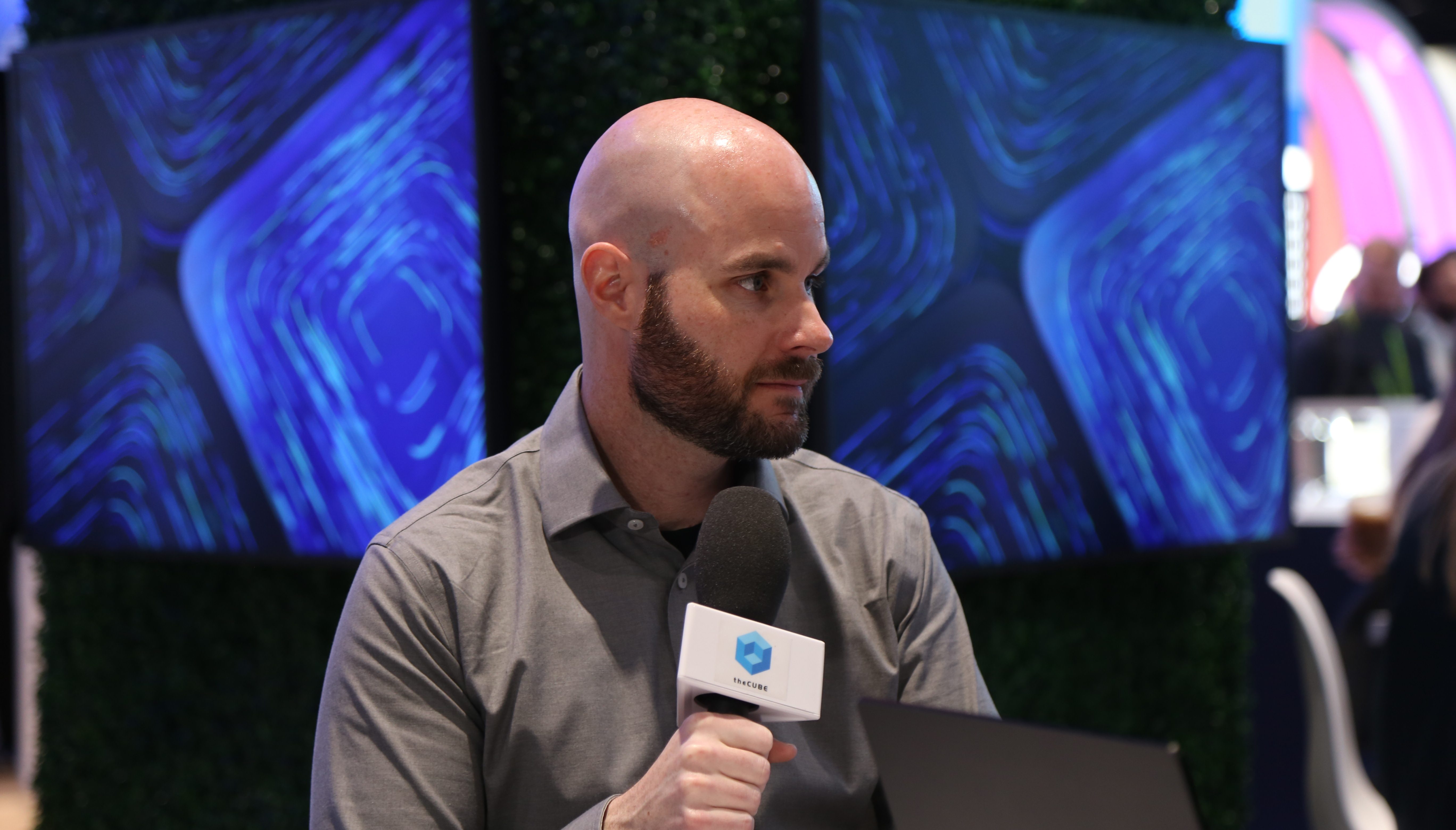
Gemma Allen of theCUBE Research conducts a conversation with Josh Perkins of AHEAD at NVIDIA GTC 2026 to examine AHEAD’s role as a full‑stack engineering partner for enterprise artificial intelligence, hereafter AI. Perkins outlines the "factory behind the factory" concept and the Foundry integration approach, including a liquid‑cooled 10 MW Chicagoland build, and explains how AHEAD supports data readiness, software development life cycle, hereafter SDLC, modernization and deployment strategies across regulated industries. They emphasize making AI consumable and composable for developers and operators and describe how data and trust function as foundational elements for enterprise AI adoption.
Key takeaways include AHEAD’s emphasis on rapid prototyping over long programs, workforce scaling and immediate hiring to support accelerated enterprise AI adoption. Perkins observes that NVIDIA’s software ecosystem, including Compute Unified Device Architecture, hereafter CUDA, remains a performance differentiator as inference and heterogeneous architectures evolve. They advocate prioritizing data readiness, robust governance and trust frameworks and composable architectures to accelerate deployment in regulated sectors while modernizing SDLC and engineering toolchains.
Forgot Password
Almost there!
We just sent you a verification email. Please verify your account to gain access to
NVIDIA GTC 2026. If you don’t think you received an email check your
spam folder.
In order to sign in, enter the email address you used to registered for the event. Once completed, you will receive an email with a verification link. Open the link to automatically sign into the site.
Register for NVIDIA GTC 2026
Please fill out the information below. You will receive an email with a verification link confirming your registration. Click the link to automatically sign into the site.
You’re almost there!
We just sent you a verification email. Please click the verification button in the email. Once your email address is verified, you will have full access to all event content for NVIDIA GTC 2026.
I want my badge and interests to be visible to all attendees.
Checking this box will display your presense on the attendees list, view your profile and allow other attendees to contact you via 1-1 chat. Read the Privacy Policy. At any time, you can choose to disable this preference.
Select your Interests!
add
Upload your photo
Uploading..
OR
Connect via Twitter
Connect via Linkedin
EDIT PASSWORD
Share
Forgot Password
Almost there!
We just sent you a verification email. Please verify your account to gain access to
NVIDIA GTC 2026. If you don’t think you received an email check your
spam folder.
In order to sign in, enter the email address you used to registered for the event. Once completed, you will receive an email with a verification link. Open the link to automatically sign into the site.
Sign in to gain access to NVIDIA GTC 2026
Please sign in with LinkedIn to continue to NVIDIA GTC 2026. Signing in with LinkedIn ensures a professional environment.
Are you sure you want to remove access rights for this user?
Details
Manage Access
email address
Community Invitation
Josh Perkins, AHEAD
Gemma Allen of theCUBE Research conducts a conversation with Josh Perkins of AHEAD at NVIDIA GTC 2026 to examine AHEAD’s role as a full‑stack engineering partner for enterprise artificial intelligence, hereafter AI. Perkins outlines the "factory behind the factory" concept and the Foundry integration approach, including a liquid‑cooled 10 MW Chicagoland build, and explains how AHEAD supports data readiness, software development life cycle, hereafter SDLC, modernization and deployment strategies across regulated industries. They emphasize making AI consumable and composable for developers and operators and describe how data and trust function as foundational elements for enterprise AI adoption.
Key takeaways include AHEAD’s emphasis on rapid prototyping over long programs, workforce scaling and immediate hiring to support accelerated enterprise AI adoption. Perkins observes that NVIDIA’s software ecosystem, including Compute Unified Device Architecture, hereafter CUDA, remains a performance differentiator as inference and heterogeneous architectures evolve. They advocate prioritizing data readiness, robust governance and trust frameworks and composable architectures to accelerate deployment in regulated sectors while modernizing SDLC and engineering toolchains.
In this interview from NVIDIA GTC 2026 in San Jose, Josh Perkins, vice president of emerging technologies at AHEAD, joins theCUBE + NYSE Wired's Gemma Allen to discuss how AHEAD is building the physical and logical infrastructure that turns AI factory ambitions into enterprise reality. Perkins explains why assembling GPU clusters is only half the challenge — making them consumable, secure and operationalized for developers is what separates a rack of silicon from a production-grade AI platform. He details AHEAD's Foundry ecosystem, a growing network of integr...Read more
exploreKeep Exploring
What is AHEAD, and what services does the company provide?add
How are recent advances in AI (including NVIDIA's new releases) affecting organizations like AHEAD — what challenges and opportunities do they create, and how are those organizations responding (e.g., staffing, client support, application and data readiness)?add
Why was an integrated, 100% liquid-cooled, 10‑megawatt "Foundry" data center established outside Chicago?add
What are your plans for expanding and scaling your AI teams and business in the near term?add
>> Welcome to theCUBE. We are here live on the ground at NVIDIA GTC 2026 in San Jose, here at the AHEAD Booth. And joining me now is VP of Emerging Technologies at AHEAD, Josh Perkins. Josh, welcome.
Josh Perkins
>> Thank you so much for having us. We're super excited. Day one at GTC.
Gemma Allen
>> What energy, right? It's palpable. So Josh, for those who may not be familiar with AHEAD, fill me in. What is it exactly that you guys do?
Josh Perkins
>> Well, we aim to be really a full stack engineering partner for NVIDIA at this point, right? Amongst many other kind of OEMs in our ecosystem. But the goal is, we aim to be able to help customers from the kind of strategy around their technology, through helping them actually engineer and implement that tech across their space, and in many circumstances, even operate it for them in those scenarios. Very enterprise focused, and increasingly very vertically focused, in terms of what we're doing in the industry.
Gemma Allen
>> So AI factories, bit of a buzz term. We hear it a lot. You guys say publicly that you are the factory behind AI factories.
Josh Perkins
>> Right.
Gemma Allen
>> What exactly does that mean?
Josh Perkins
>> Well, we think that the AI factory metaphor is really sound, and that the idea of data in and tokens out, obviously being really, really critical. But where we think it kind of maybe falls short, and the reason that we're saying it in that way, is because it still needs to be built. It still needs to be integrated in a way that it's actually consumable for our enterprise clients. And that is both on the physical integration end, but equally importantly on the logical end. So it's okay that we're putting all of the pieces together and building them in an appropriate way, but then, how do we actually make the developer capable of using that? How do we secure it? How do we operationalize that platform? So it's not just about the tokens, it's about the consumability and composability of that whole piece. And so, when we say the factory behind the factory, we actually mean physical sites. Our Foundry ecosystem aims to be able to do this at large scale for our enterprise customers globally, but we also mean helping them all along the path of becoming an AI native organization.
Gemma Allen
>> So I want to talk about the Foundry system, but before we get there, paint the picture for me. It's Monday morning next week. Everyone's back to work. AHEAD has 2,400 engineers on site across the Fortune 500 all over the country. What exactly do you expect will happen from the perspective of being an elite partner from NVIDIA? Some interesting announcements today.
Josh Perkins
>> For sure.
Gemma Allen
>> Are any of them, like NemoClaw, was that a surprise to you guys? Do you expect a lot of questions, enthusiasm, maybe a little bit of fear next week?
Josh Perkins
>> I think it's a very interesting time at the moment, right? So it's a healthy dose of what's changing, and are we kind of comfortable, frankly, with the pace of play that's going on in the organizations that we serve? But it's also a huge opportunity. And I'd say the excitement that we're seeing generally far outweighs the fear of ultimately what's going on in this space. And so I'd expect, right, for one, Monday, our call volume to be increased through this process. And we're continuously hiring more and more AI engineering staff, because we recognize that again, the challenge isn't going to be the desire to acquire the factories. It's going to be how the heck do they put them to use. And so, we need to be able to have more people and support more clients ultimately in the, how are we building at the application layer? How are we creating data readiness below that? Because like Jensen said, that's the underpinning of trust through the ecosystem, and frankly, the primary ingredient in any AI factory. And so, we just look at this and say every time that NVIDIA releases something new, it creates a whole new opportunity stream for AHEAD. So we're really, really excited about that.
Gemma Allen
>> Well, it seems as though there's a lot of mixed narratives right now around what's actually happening on the ground in enterprises, right? Whether or not AI value is being utilized or even realized. There's certainly two separate narratives emerging. One that's moving at the speed of sound, everything is great, we're going full agentic. And other is that there's a lot of line of business applications that are still legacy based. We had that interesting situation a few weeks ago with IBM and Cobalt, right? Which if anything, revealed that there is still a lot...
Josh Perkins
>> A lot of old code.
Gemma Allen
>> A lot of old code around. So talk to me about what you're actually seeing. We're talking about, no one can get enough chips. When they get these chips, are they actually able to utilize them to maximum advantage?
Josh Perkins
>> Well, I think it's also important to recognize that the industry is going through waves of this transformation. And so it's hard, because not every customer, not every organization is hitting it at the same stride. And to us, it's kind of followed where the culture of the organization's been for the last few years, has dictated progress around this space. So those large enterprises that have had a culture of experimentation, the ability to apply human capital to it and deep engineering, are always going to be the first ones that make major strides in AI. And so that's why we've seen, once you get past the CSPs and the neo cloud providers, which still represent a substantial amount of the actual buy side of a lot of this, and you start getting into capital markets providers, global banking, payments, processing, biopharma, these organizations were already in good states to prepare and to be able to leverage and use these tools. And so for us, it's probably going to take a long time for that to distill down into all organizations, across every vertical and every industry, but that doesn't mean we're not going to see major advancements and major strides in ones that were already good at machine learning, good at traditional AI. This is just an accelerator for them and a revamping of their entire business models. And for a lot of those clients, which makes up almost 70% of AHEAD's business, it's an existential narrative at this point. It's literally like, what's changing in our business and how are we going to respond to that? And so I would say, the two things that we see right now absolutely are everyone is a candidate for rethinking their SDLC with AI, and it's the biggest, stronger motivator and indicator of progress in those spaces. So the better that they get at using the coding tools, the better that every point in the SDLC gets accelerated individually, but in similar velocities across AI, the more they get out of the whole process and the faster they move. The other piece of this is that, as people's literacy around these tools continues to improve, the types of use cases and the risk profile that the organizations are willing to take on has also improved. And so the side effect of that is, it takes a long time to get to use case one. It takes slightly less to get to use cases two and three, and meaningfully less to get to use case 50 to N. And so, for our customers that we started this years ago, three, four years ago, they now look at this as a material impact to their revenue, to their FTEs, not in the sense that they want to reduce their headcount, but they view it as a scaling mechanism, one whereby they can not necessarily grow the org in terms of headcount, but materially grow the org in terms of profitability and revenue generation.
Gemma Allen
>> Okay. Let's talk about some of the teams of this week, right? And let's start with data centers and the Foundry system. You guys have stood up your own integrated 10 megawatt data center outside Chicago, if I'm correct, liquid cooled 100%.
Josh Perkins
>> Yes.
Gemma Allen
>> Talk to me about the why, the decision to do that.
Josh Perkins
>> Sure. Well, Foundry, which is what we call our integration capabilities across AHEAD, is a series of sites that specialize in different components around what we think of in terms of physical integration and logical integration components. And this is applied to where homogeneity is not really the end state for the customer. These are large enterprises looking at global footprints, that want to be able to design things that are very much fit for purpose for them, or adopt heterogeneous OEM ecosystems as part of their overall play because of previous corporate standards. And so, Foundry in the Chicagoland area is now three sites. The third site opens at the end of this month, actually, and that whole site is predicated on direct to chip liquid cooling. And this was started early last year because of where we saw Grace Blackwell and ultimately Vera Rubin heading, and ultimately just the thermal requirements that we were starting to see based on densities in the data center for our largest clients. And so, we wanted to make sure that we could not only build kind of what they're currently doing, but support them through the test build and performance benchmarking and deeper levels of integration, as the entirety of the ecosystem ultimately trends in that direction.
Gemma Allen
>> And do you envision that you'll continue to scale and grow this ecosystem out with more and more data centers?
Josh Perkins
>> 100%. And so, these aren't necessarily data centers in the sense that we're operating them for the client. This is where we build the stuff that goes in those data centers, that they ultimately operate or work with co-location on.
Gemma Allen
>> Filling the pipe.
Josh Perkins
>> Yeah. So we're actually building the architecture behind that ends up getting deployed with those clients on a global footprint. And so, 10 megawatts for that particular site is just the starting point for what we see expanding into that particular location, but that gives us a good amount of throughput to be able to test, build and certify these builds with NVIDIA and our other OEM partners, Dell, Super Micro and others, and Cisco, to ultimately allow them to continue to scale their AI factory aspirations into these accounts, but to do it in a very mixed way. And ultimately, Foundry is also scaling internationally. So the idea here is, while Chicagoland will be kind of maintained as our core home, and we're at 350,000-plus square feet now in that campus, ultimately, this will extend into the UK and EMEA and eventually into Asia Pacific, to make sure that we can continue to really support our domestic clients that have global footprints, and ultimately want to be able to address these needs in a very consistent way, especially as AI becomes a mission-critical component of their organization.
Gemma Allen
>> Absolutely. And we have the whole sovereign debate too, right? Which is so fundamental for the future, especially geographically. So, inference, I want to talk a little bit about that. It's, again, a big, big team. There is certainly a viewpoint that perhaps the inference economy will make this whole ecosystem easier to deploy, right? It will create a level of simplification that training models just basically couldn't enable.
Josh Perkins
>> Sure.
Gemma Allen
>> We meet a lot of competitors in the space. I mean, NVIDIA is such a huge incumbent. It's almost hard to really even rate. But who think that perhaps inference will be an opportunity for them to play some sort of market catch up, right? What are your thoughts?
Josh Perkins
>> Well, I think that one, NVIDIA's not playing from a scared position. And ultimately, I think that Jensen has been prescient enough to understand that the same consistent GPU architecture may not ultimately translate to inference in the same way that it has absolutely excelled and dominated in training. And I think you saw that today.
Gemma Allen
>> Yeah.
Josh Perkins
>> I think the first kind of notion of that was really what we saw with the acquisitional activity with Grok at the end of 2025, and the continued focus on low precision, high, high throughput inference with the GPU architecture. There's a lot of people doing really cool things in this space, so not taking anything away from that. And ultimately, people will want to be able to look at choice and understand. But the software layer, frankly, is what will dictate the moat around the hardware layer.
Gemma Allen
>> For sure.
Josh Perkins
>> And to us, we still haven't seen anything that does as good a job truly accelerating a workload as what NVIDIA's built with CUDA. And as long as that stays the case and people have a complicated time getting those same types of performance out of mixed architecture, NVIDIA will play a major role in the future of their kind of applications and workloads.
Gemma Allen
>> So we're all in on the NVIDIA share price.
Josh Perkins
>> All in. Yeah.
Gemma Allen
>> Okay, so talk to me a little bit what you're seeing across industries. You guys work across a broad range of players, right? And especially as a VP of emergent technologies, are you seeing any interesting patterns emerging in specific spaces? Are there industries you feel are like leading in anyone's space?
Josh Perkins
>> Well, I think that we spend a lot of time between financial services, healthcare, life sciences, energy and utilities. So think like really large, very regulated organizations. And I think the big thing that we're seeing is that the progress that they want to make ultimately, typically outpaces their ability to make that progress based on the data that they have, the sensitivity and the requirements. But I think many of them also think that they have to stay kind of ahead of the regulatory ecosystem in order to make like really unique or novel progress in the space. And so for us, I think our financial services customers are making, probably, progress the fastest of the group. Particularly, we're seeing major transformation in the high frequency trading and investment banking hedge fund space. Again, I think this is, if you look at OpenClaw and you're trying to get it to plan your finances, it's a great leveler, right? In terms of what the average retail investor can do. And I don't think any of these firms want to just give up the current edge. But we see major advancements in our healthcare space. It's really incredible. I mean, obviously, way more altruistic in nature, in terms of what they're trying to do. But it seems more apparent every day that we're going to see the concepts around patient experience and what you get delivered through the core providers ultimately change faster than anyone would believe. So I think, I'm an eternal optimist. I think it's kind of a requirement in my role, but we're really excited, and I think the momentum is just palpable at the moment.
Gemma Allen
>> So, last question before we close, but tell me about the speed at which things are moving. As an SI who works across OEM, ODM, Fortune 500s, I imagine that right now, things are just moving at a pace that's unprecedented in your career. What does it mean, though, for you guys tactically, as you keep a pace with this?
Josh Perkins
>> Well, I think the number one thing that it means is less PowerPoints and more demos, right?
Gemma Allen
>> Well, I love that, actually.
Josh Perkins
>> Our customers really want to see how real something can be, and how quick we can make it real for them. And ultimately, these technologies, particularly on the coding side and the agentic side, allow us to do things with fewer people in very novel ways, very quickly. And that means typically that we can get to the know faster for our clients, which means not every experiment in AI is going to produce the intended value that everyone walks into it with. So we need to be able to measure what good looks like at every point through that process, but we need to be able to get to the determination of like, is the effort there? Is the feasibility of what we're doing aligned to what you're trying to accomplish? But how quickly can we get to that point, and how quickly can we take things that show incredible progress or promise and get them into production? So this is not, to me, a space where we're looking at long milestone projects or programs measured in months and years. It's about getting use cases and muscle memory built in weeks and days. And so for us, I think we've been building our organization effectively the last 15 to 20 years, kind of for this moment, always kind of in mind. And I think we're just super excited because it feels like a lot of the thought process that we've been putting in all is now kind of converging at the right time, and right in the middle of enterprises starting to actually take it seriously and adopt, we're building out the teams faster than we've ever built. So I think for us, like I said, I'm an optimist, but I don't think I've ever been more bullish on something in my entire career. I don't think we've ever worked harder or faster than we have in my entire career. But we see nothing but incredible upside if we just do the right things and make sure that we're working on the right types of use cases and workloads.
Gemma Allen
>> Well, Josh, your enthusiasm is infectious. Tell me, for the rest of this week and the rest of this year, what is ahead for the team at AHEAD?
Josh Perkins
>> Well, what's ahead for us is just continued expansion of the groups. We are continuing to build out the full stack engineering side of our teams in AI. This means continuing to bolster our ranks of everything from consulting to low level data science and engineering roles, and apply them in really unique ways. So I'd say the biggest things are really working to get more young people out of schools and into applied work, which is, I know, maybe the opposite of what we're hearing in other spaces, but we think that the fervor and energy coming out of some of these folks that are already way more AI native by design, earlier exposure to tools, has been an absolute just boost to the rest of our engineering organization. And I think the rest of this year is all about continuing to scale wider in our current account base and expanding more globally.
Gemma Allen
>> Well, you heard it here on theCUBE. AHEAD is hiring, so check out the job page. Josh, thanks so much for joining me. Great conversation.
Josh Perkins
>> Thank you for having us. Thank you very much.
Gemma Allen
>> I'm Gemma Allen, live at theCUBE, here at NVIDIA GTC 2026. Energy is incredible here on the floor. Stay tuned.