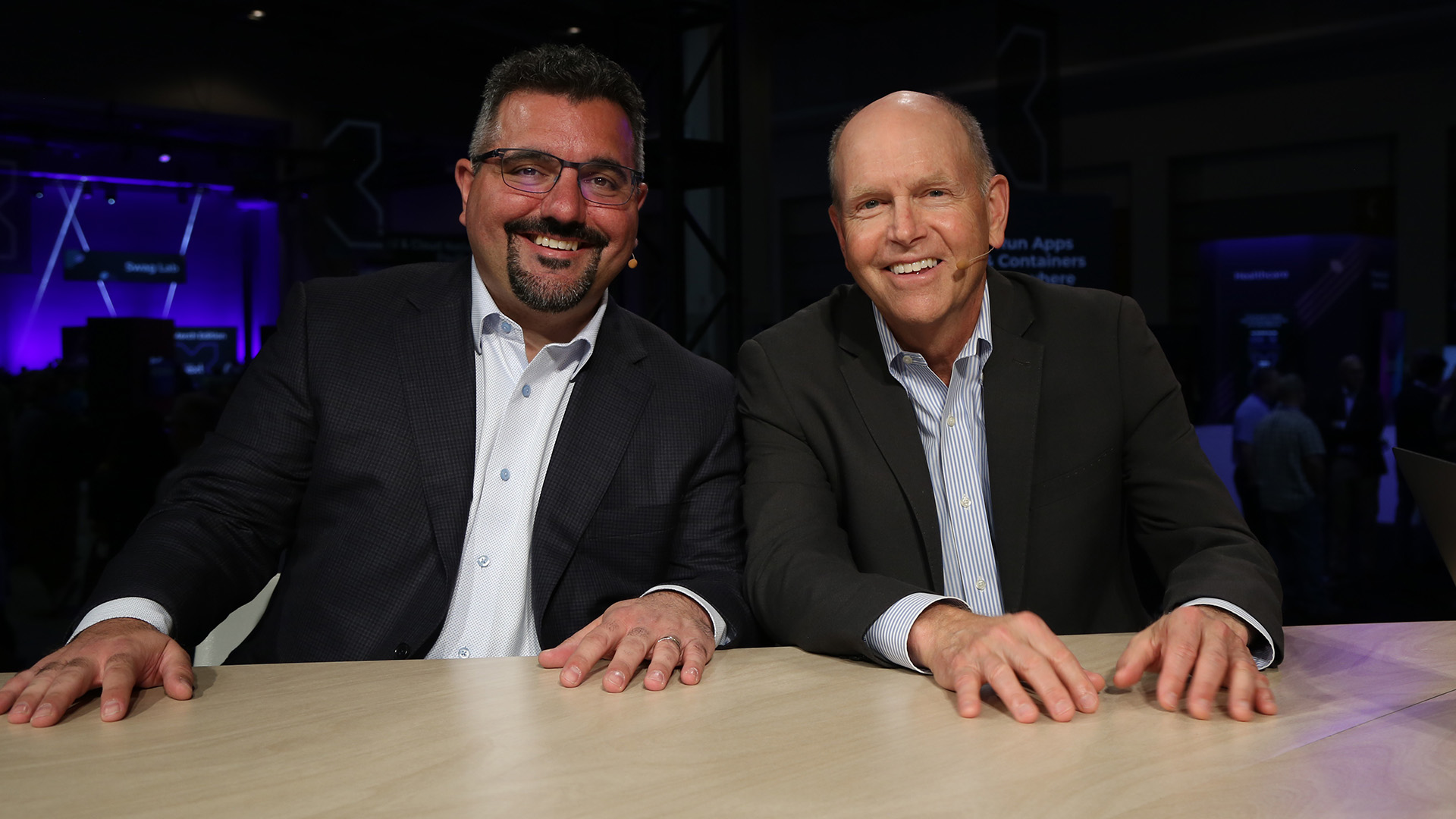
Lee Caswell, senior vice president of product and solutions marketing at Nutanix, and Anthony Cinelli, senior director for global PowerFlex sales at Dell Technologies, join theCUBE’s John Furrier and Bob Laliberte at Nutanix .NEXT to discuss the power of partnership in modern IT infrastructure. The conversation explores how Nutanix and Dell are collaborating to deliver flexible, software-defined platforms that scale with customer needs.
Caswell highlights Nutanix’s investment in platform enhancements and its alignment with Dell’s PowerFlex to offer greater choice and operational efficiency. Cinelli shares how Dell’s integrated solutions and supply chain strength support multi-cloud adoption at enterprise scale.
Caswell and Cinelli emphasize the importance of modular architectures, customer control and AI readiness in today’s infrastructure strategies. The interview underscores how joint innovation is reshaping expectations for adaptability and speed in hybrid environments.
Forgot Password
Almost there!
We just sent you a verification email. Please verify your account to gain access to
Nutanix .NEXT 2025. If you don’t think you received an email check your
spam folder.
In order to sign in, enter the email address you used to registered for the event. Once completed, you will receive an email with a verification link. Open this link to automatically sign into the site.
Register For Nutanix .NEXT 2025
Please fill out the information below. You will recieve an email with a verification link confirming your registration. Click the link to automatically sign into the site.
You’re almost there!
We just sent you a verification email. Please click the verification button in the email. Once your email address is verified, you will have full access to all event content for Nutanix .NEXT 2025.
I want my badge and interests to be visible to all attendees.
Checking this box will display your presense on the attendees list, view your profile and allow other attendees to contact you via 1-1 chat. Read the Privacy Policy. At any time, you can choose to disable this preference.
Select your Interests!
add
Upload your photo
Uploading..
OR
Connect via Twitter
Connect via Linkedin
EDIT PASSWORD
Share
Forgot Password
Almost there!
We just sent you a verification email. Please verify your account to gain access to
Nutanix .NEXT 2025. If you don’t think you received an email check your
spam folder.
In order to sign in, enter the email address you used to registered for the event. Once completed, you will receive an email with a verification link. Open this link to automatically sign into the site.
Sign in to gain access to Nutanix .NEXT 2025
Please sign in with LinkedIn to continue to Nutanix .NEXT 2025. Signing in with LinkedIn ensures a professional environment.
Are you sure you want to remove access rights for this user?
Details
Manage Access
email address
Community Invitation
Lee Caswell, Nutanix & Anthony Cinelli, Dell Technologies
Lee Caswell, senior vice president of product and solutions marketing at Nutanix, and Anthony Cinelli, senior director for global PowerFlex sales at Dell Technologies, join theCUBE’s John Furrier and Bob Laliberte at Nutanix .NEXT to discuss the power of partnership in modern IT infrastructure. The conversation explores how Nutanix and Dell are collaborating to deliver flexible, software-defined platforms that scale with customer needs.
Caswell highlights Nutanix’s investment in platform enhancements and its alignment with Dell’s PowerFlex to offer greater choice and operational efficiency. Cinelli shares how Dell’s integrated solutions and supply chain strength support multi-cloud adoption at enterprise scale.
Caswell and Cinelli emphasize the importance of modular architectures, customer control and AI readiness in today’s infrastructure strategies. The interview underscores how joint innovation is reshaping expectations for adaptability and speed in hybrid environments.
Lee Caswell, Nutanix & Anthony Cinelli, Dell Technologies
Lee Caswell
SVP, Product & Solutions MarketingNutanix
Anthony Cinelli
Global SalesDell Technologies
Lee Caswell, senior vice president of product and solutions marketing at Nutanix, and Anthony Cinelli, senior director for global PowerFlex sales at Dell Technologies, join theCUBE’s John Furrier and Bob Laliberte at Nutanix .NEXT to discuss the power of partnership in modern IT infrastructure. The conversation explores how Nutanix and Dell are collaborating to deliver flexible, software-defined platforms that scale with customer needs.
Caswell highlights Nutanix’s investment in platform enhancements and its alignment with Dell’s PowerFlex to offer gre...Read more
exploreKeep Exploring
What is the significance of the platform approach in terms of server-based, software-defined architectures and the expanding ecosystem for Nutanix?add
What is Dell's position on partnering with Nutanix in the hypervisor world to provide customers with more flexibility and choice in their stack?add
What is the current trend in customer interaction and expectation in the technology industry, specifically in terms of providing outcomes rather than just products?add
What are the topics discussed at a recent meeting or event involving GPUs and new models in the tech industry?add
Lee Caswell, Nutanix & Anthony Cinelli, Dell Technologies
search
>> Welcome back, everyone. Live here in Washington
DC with Nutanix NEXT 2025. I'm John Furrier host of
theCUBE, with Bob Laliberte, Paul Nashawaty out getting briefings. CUBE analyst at theCUBE Research. Lee Caswell is here, senior
vice president, CUBE alumni, also SVP of products and
solutions at Nutanix. Anthony Cinelli, or AC as he's known, senior director of global sales at Dell Technologies. Gentlemen, thank you
for coming on theCUBE. Lee, great to see you as always.
Lee Caswell
>> As always.
- Handsome, smiling, full of knowledge. AC, great to have you on.
Anthony Cinelli
>> Absolutely. Pumped to be here. Maybe next time I'll get
the handsome compliment. >> We're just getting to know
you. We'll see how you do here. Well, Dell Tech World's going
to be pretty phenomenal. I'm looking forward to your event. Your event here is flying, even day one the buzz is
strong, the vibes are great. The platform story is not new, but it is definitely
flying high right now. So, congratulations to you
and Rajiv and the team. Great job. So, awesome stuff.
Now, let's get into it.
Lee Caswell
>> Yeah, let's go.
- This joint engineering ecosystem I call it, is developing where it's
not yesterday's ecosystem. There's a lot more to the
platforms than just having some support, some support for the product. There's a lot of integrations. AI's built in, platform's got features. Talk about the modern era we're in. You're seeing massive growth
here in your ecosystem. What does it mean? Take us through and how does Nutanix leverage this? Was it by design? Was there a specific
plan? What's it all about?
Lee Caswell
>> The platform approach is really something really, when you think about it. The idea that you give choice, that's what a platform is about, and that you're moving towards
server-based, software- defined architectures. We've been talking about that for years. But the opportunity to make
it real, to use the power of server-based as an underlying
hardware architecture. And now, going forward, the ecosystem for Nutanix is exploding. I was saying two years
ago we had basically 30 companies, then we
moved to 55 companies, now 85 sponsors here. And of course, with Dell, we've been working over a
decade now bringing joint technologies, the latest of which is Dell with PowerFlex, right? >> Yeah. And Dell, you guys
play, obviously, horizontally. Huge customer install base. Customers aren't giving up their gear, they're building on
top of it and around it and new stuff coming in. Your relationships have to scan.
AI factory, big part of it. They're like an operating
model in the factory too. We had Kevin Deierling on earlier with NVIDIA, with Tark and Maynard. Nutanix looking like they're going to break out in a big way. What's your position on this? How are you guys flexing in here?
Anthony Cinelli
>> Yeah, so a few things. And first, when we think about
the software-defined vision, and by the way, Lee and I are OGs of the
software-defined vision. I think we've both been in
this world since, I don't know, the mid-20-teens. And at its core it was always
about enabling a tremendous amount of flexibility for customers. And one of the things we've
always leaned into very heavily with our PowerFlex
platform is it provides all that flexibility with a
tremendous open ecosystem, just providing customers
enormous amounts of choice. And let's face it, recently, customers have really
been leaning into the idea of wanting choice more than
ever in parts of the stack where they maybe haven't
thought about choice before. And the reality is that part of the stack today is the hypervisor. And I think credit to Nutanix and Dell for saying, "Hey,
how can we maybe work together to bring some of our capabilities together to just help meet the market where it is? " Which is customers
looking for more choice and flexibility than ever before. And Nutanix had some fabulous foresight to really do some things in
the hypervisor world that introduced simplicity of operations and automation at scale on a very proven hypervisor platform. And the ability to partner that
now with PowerFlex allows us to unlock a tremendous amount
of capability in a part of the market that really didn't
have access to that before.
Bob Laliberte
>> Yeah, and it also
provides a great opportunity to modernize as well. So, it's not only just
hypervisor to hypervisor, but also, that future
path as well to be able to modernize those apps and move on to a Kubernetes
platform as well.
Lee Caswell
>> Yeah, the idea that we're trying to get the infrastructure out of the way, so developers can actually get to work. And the fact that containers we see as being complementary to VMs. I think one of the things that really caught people a
little bit by surprise was Nutanix working with external storage. They're like, "Wait a
minute, how does that work? " For years we've been replacing external storage was the idea. I think it's just a real maturity of the vision from Nutanix is that, hey, now we're moving past HCI, which is... Not past it, but from the sense that market adoption is
happening at double-digit rates. But we're watching that customers
at large scale want to go and manage both external
storage and HCI together. And that's really a maturity and it's in part driven by the disruption happening
in the virtualization space. The largest customers
are coming saying, "Hey, how can I get access to
Nutanix value more quickly? " And we're looking and
saying, "Hey, partnering with Dell on PowerFlex is
one way to make that happen." >> Yeah, and the hyperscale
showed up in the cloud. The on-prem growth of AI
factories is one trend. You guys are OGs of software-defined. I have to ask the question because now the capabilities
of infrastructure demand is up. What is different now in the environment? Because I won't say software- defined hasn't grown up fully. Maybe the timing was an issue. What's it about this
culture now that software- defined's working and scaling? Is it the fact that the infrastructure has blown up in terms of capabilities? Has it been like the new architecture? Is there a reason why now,
more than ever, software- defined's rising fast, super
fast? It's been around, but-
Lee Caswell
>> Well, here's two things I'll offer up and then hand it over to AC here. So, one is we're taking
advantage of the fact that, by my calculations, there's
over 27,000 servers sold a day. So, new hardware is coming to new servers. Customers upgrade servers more quickly. And it turns out, you get new servers faster
than you get storage systems. So, storage systems and HCI built on servers gives you access to the latest CPUs, GPUs,
the latest NVMe devices. That's one thing. The other one is that there are not enough
specialists out there to run a different AI
stack for a data lake and a different AI stack
for data ingest as well as processing, as well as archiving. You're running out of people, so you have to basically consolidate. We have a long history of consolidating. We started with storage and compute. Now, we're taking
Kubernetes as well as VMs and the hybrid multi-cloud world. All of that means you can get a lot of leverage from your existing teams.
Anthony Cinelli
>> Yeah, absolutely. I think
maybe to add on to that, data. It's the first slide in every
presentation, "Data's growing by X amount every year. " And that's a reality and especially when we think about where this new partnership
between PowerFlex and Nutanix is most incremental
to the market, it's really around helping address those
at-scale, larger customers who when they think about
their storage environment, they need scale-out architecture because the reality of
trying to solve for that with a scale-up traditional
array, they need to manage tens, dozens in some cases several
hundred of these arrays. That's just not feasible.
So, the superpower that PowerFlex brings to
the table is introducing that true scale-out architecture that enables massive amounts
of simplicity and consolidation and increased utilization,
which drives down cost. And now, it also provides
that flexibility to say, "Hey, I'm running one hypervisor today, but now with no disruption whatsoever, with no new infrastructure,
hardware investment, I can now just go deploy
a modern hypervisor with tremendous amounts of automation and simplicity that, oh, by
the way, also gives me an on- ramp to container orchestration as well. "
So, there's so much about this that is all about meeting
customers with where they are and what they're asking
for, that's why there's just so much excitement around the service. >> The demand is high.
- Totally.
Bob Laliberte
>> Yeah, the demand is high. I was going to say also the other piece that you were talking about
scaling, it's also the fact that organizations have fewer and fewer resources to
manage an increasingly large and distributed environment.
Lee Caswell
>> Yeah, that's right.
- So, having that platform, having that common storage platform that you can deploy at multiple locations, having the operating system enable you to do it a lot more efficiently. And so, a little bit of
principle of least astonishment, you can spin up resources in the cloud, you can spin up resources in
the data center or at the edge, and it all has the same
common look and feel.
Lee Caswell
>> Kind of runs back to
the theme of the show.
Anthony Cinelli
>> Exactly.
- Run anything anywhere, right? I mean it couldn't be
more simple than that, except the actual implementation of that is actually pretty complex.
Anthony Cinelli
>> Correct. - So, making
containers work the same as VMs and we have a joint vision here. I think that data will be
more distributed over time. If you believe that, then
all of a sudden this idea of managing at scale, fleet management, whether it's Kubernetes,
whether it's VMs, across files, blocks, and objects, man, this becomes a really interesting solve. >> And the demand for the
customers, they're re-architecting for the AI factories, for the new distributed computing environment, that's hybrid cloud. However far we're back, it's now standard. So, hybrid cloud is a done
deal. That bet came in.
Anthony Cinelli
>> And there's something Lee called out that I do want to highlight. There's engineering, there's hard work that went into effectively
making this invisible and seamless for customers. And I want to be really clear, this isn't just a marketing partnership, a marketing announcement. There is a tremendous amount
of engineering integration that went into making the
Nutanix experience with PowerFlex effectively seamless and
invisible for customers. And for customers that want
to learn more about that, certainly reach out, we'd
love to talk about it, but there's a tremendous
work that was delivered by the teams enabling this. >> That's a great point, AC, because I was trying to get
at my first question about the modern ecosystem. Relationships are more
engineering-oriented. Integration's big. You guys have a lot of activity over the past year together. Talk specifically about what you guys are actually delivering here and going forward, because
you're going into a market where it's faster build-out,
scale up and scale out. Storage is playing a different role. Servers are playing a different role. The combination of chips and the substrate around it,
this is where the demand is. All the customers are
re-architecting for this. So, what's the relationship? Give us some taste of the
activity and accomplishments.
Anthony Cinelli
>> Yeah, I think that one of
the things I'll maybe make a claim around is that when it comes to consuming Nutanix solutions and Nutanix platform outcomes,
Dell is best positioned to meet the customer wherever they are with whatever they're looking for. And the beauty of this is, yes, we have this very exciting announcement with our new PowerFlex
integration that's now available for customers to run and
buy, but we also have our XE and XE Plus offerings, which allows us to bring those integrated
outcomes directly to customers with that HCI implementation
for those customers that feel that's most appropriate for them. And in all those models,
we have the full power of Dell's supply chains. So, whether that's different
server form factors, different silicon suppliers, diversity. You name it, we have the ability to solve across such a
wide spectrum of workloads to enable customers to
say, "Hey, we got you. Go focus on your business problem. We'll take care of the infrastructure." >> Yeah. You're going to appreciate this comment. John Roese, the CTO of Dell and I were chatting the
other day at RSA, came by to do a flyby to check
out the security industry.
Anthony Cinelli
>> Nice. - And we've been
talking about our AI lab we're working on, and he's got
the same ethos as Debo who came on earlier, the
chief AI officer for Nutanix. In Nutanix, at Nutanix and on
Nutanix is their philosophy. In Nutanix, how to make AI
work on all three areas? John Roese, the same thing. He was telling me that him
and Michael Dell were talking about, I shouldn't say
this on live camera, maybe-
Anthony Cinelli
>> I guess I will.
Bob Laliberte
>> I guess I will.
- Responsibility for... How about those Celtics? >> Okay, so what he said was that they're looking at the configurations of servers using AI inside Dell to help customers figure
out what they need for a workload with algorithms. That's like a build to workload order. Now, if you remember the Dell history, that was one of the Dell's things. So, this is kind of where it's going. To your point, the configurations for the workload isn't just
another platform feature. The platform has to be ready for that. I've kind of tied together
the platform with Dell. What does this mean for the customer? Does that make their life easier? What does that mean for you
guys on the software side? How do you guys make the partnership... Rationalize that thought because this is a new
best practice, actually.
Lee Caswell
>> Yeah, just in terms of how the products integrate
first, we'll start there, right? If you initiate a snapshot now, you initiate it from the Prism
interface, well, that's new, and it's executed in the
data path on PowerFlex. Oh, so now I got basically where you would want that to be executed. So, you got this
integration. That was part of the joint engineering
that we have between how do these products work together? Also, by the way, we're
bringing things like VM- centric replication and DR. That's different than LUN-based. So, all of a sudden I can get
not quite to the application, but pretty darn close. So, I started looking at the application and infrastructure folks
are starting to think, "Hey, listen, that might be a faster path to make the application users
more friendly to this, right? I'll give you a story. My
daughter's a data scientist, just really proud of her, but she doesn't know
anything about what we do. She just wants to go get the
latest application deployed. We are helping now say
whether it's AI, databases, analytics, we're going to bring the same enterprise
value we've always brought, resiliency, day two
operations, security, privacy- >> Scale. Scale.
Lee Caswell
>> And scale-
- Scale's a killer.
Lee Caswell
>> Now, you can go and
basically do that at the speed that the developers need. >> Yeah, and I think
this is the relationship of the new ecosystem where
it's not a Barney dealer, a marketing dealer or co-sell dealer. Well, those are great too,
but the customer wants that abstracted away. They just want faster infrastructure.
Lee Caswell
>> Yeah.
- Yeah. And the reality, to your point of earlier, this is hard work. It made me think of the duck analogy. On the surface, it's nice and calm, but underneath, the feet
are going like crazy. I mean, it's a lot of work
to integrate these solutions to provide something to the
users, to the operations teams that's simple and easy to use, right? You're abstracting all that complexity. And then, you're delivering something that is ostensibly much
easier, much more efficient for organizations to scale, to deploy, to be more agile with as well.
Anthony Cinelli
>> Yeah, yeah, yeah.
- It's one attribute to the modularity of the Nutanix architecture also, right? I mean, Nutanix was
architected at the time that the hypervisor was already
completed, basically, right? So, it was operated and
innovated separately, and that gave us a choice
of hypervisor up front, big value across our joint customers. And now, we can start looking
at, it doesn't even have to have a hypervisor going forward. That's we announced. >> I love the example of your daughter because one of the things
we're seeing on theCUBE is the platform engineering world and the infrastructure
world is intersecting with predictive analytics,
operational data. They're two different tribes. If you blend them together, you get OpenStack. That's the joke.
Lee Caswell
>> And about 300 people.
- And nothing gets done. No, but there's a synergy, it's almost like a DMZ layer between them.
Lee Caswell
>> Exactly. - So, you're
starting to see those cultures, because platform engineers
are operating at scale. DevOps. Now, you've got data side
building up very, very fast. So, this ability to be agile, but yet scale fast, what
do you guys view that? Because this is a real customer situation inside the customer base. Who leads the project? Who
leads? The scale leads? So, what's enabling what? There's a Venn diagram at some point where analytics meets platform. This is a key intersection.
Anthony Cinelli
>> Maybe, the way I'll frame
that is the days of trying to tell a customer about
a product are gone. They don't have time for it. To Lee's point, they don't
have the people for it. The last thing anyone
wants is another product. They want to hear about outcomes. They want to say, "Here's
my business challenge. Here's my problem. Here's
what I'm trying to achieve. How do you get me there? " And duck analogy, I
don't care about the feet, I want to provide... And look, I think that's
something we're very, very heavily leaning into in all aspects of our business at Dell. Whether that's the AI factory
concept, which is, "Hey, let us deliver that
end-to-end AI outcome for you. " Whether that's this idea
of providing open ecosystem, modular software-defined
infrastructure that, oh, by the way, you deploy this
Nutanix platform on it, you spin up a VM, the storage is automatically created a map to it. You don't do anything.
You take a snapshot. Done at the hypervisor layer. Nothing to do with storage integration. Yet, you still get that benefit of independent resource scale, independent resource
patching, and life-cycling. So, again, it's how do we
deliver these true multi- cloud outcomes in the
data center without going to the customer and say, "Oh, here's why my widget does
a little bit better this or that than someone else's widget. " They just don't care anymore. >> And the role of storage is changing too, and the configuration of
these market architectures. So, it's more relevant
if anything than that. So, choice drives everything.
Lee Caswell
>> Yes. And when you get to AI, all of a sudden it gets even bigger. Choice of GPUs. Now, I
need a choice of an LLM. How do I get access choice
of the new NEM models, right? NEMO models? The agentic cycle? We're working to make
sure this is accessible to both of our joint customers. >> Guys, I really appreciate the time. Congratulations, great
relationship with Dell.
Anthony Cinelli
>> Great to be here.
- . >> Love the new ecosystem
leader, Lee. Great to see you. Okay, more CUBE coverage here. CEO of Nutanix coming up next.
We're going to talk to Dr. Rajiv coming up because
now we know he's got a PhD.
Lee Caswell
>> He does.
- Ask him about all the cool platforms. Remember, only three things
to remember, platform, platform, platform.
Anthony Cinelli
>> And platform.
- Platform. >> We'll be right back.








 Bob Laliberte