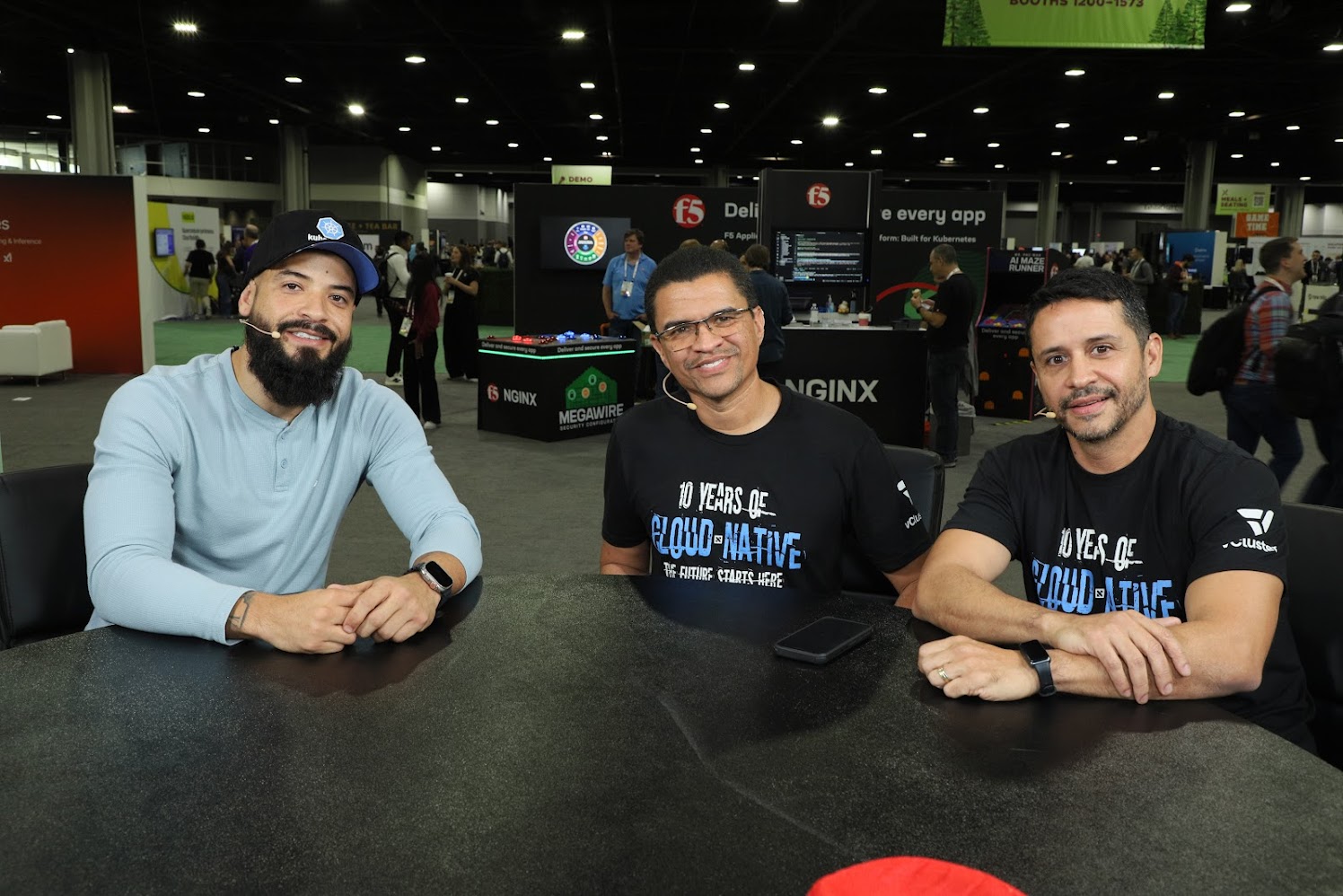
In this KubeCon + CloudNativeCon North America 2025 segment, Gustavo Fiuza, DevOps engineer at Banco de Brasil, and Welton Danyel Felipe, IT manager at Banco de Brasil, join theCUBE’s Rob Strechay, with colleague Rodrigo Ramalho helping bridge the conversation, to share how a 200-year-old bank is modernizing on Kubernetes. They walk through Banco de Brasil’s hybrid multi-cloud journey, explaining why they extended from on-premises environments to public cloud and chose OpenShift to reduce the time and effort required to meet strict regulatory and governance demands while managing growing infrastructure complexity.
They also discuss how standardized delivery processes and GitHub-based workflows are helping teams ship more applications faster, with better reliability and scalability for end customers. Looking ahead, the group details how Banco de Brasil is rolling out AI bots and broader AI initiatives across both customer-facing and internal use cases, and shares candid lessons about the cultural transformation needed to move a highly regulated institution into a cloud-native, AI-ready future.
Forgot Password
Almost there!
We just sent you a verification email. Please verify your account to gain access to
KubeCon + CloudNativeCon NA 2025. If you don’t think you received an email check your
spam folder.
In order to sign in, enter the email address you used to registered for the event. Once completed, you will receive an email with a verification link. Open the link to automatically sign into the site.
Register for KubeCon + CloudNativeCon NA 2025
Please fill out the information below. You will receive an email with a verification link confirming your registration. Click the link to automatically sign into the site.
You’re almost there!
We just sent you a verification email. Please click the verification button in the email. Once your email address is verified, you will have full access to all event content for KubeCon + CloudNativeCon NA 2025.
I want my badge and interests to be visible to all attendees.
Checking this box will display your presense on the attendees list, view your profile and allow other attendees to contact you via 1-1 chat. Read the Privacy Policy. At any time, you can choose to disable this preference.
Select your Interests!
add
Upload your photo
Uploading..
OR
Connect via Twitter
Connect via Linkedin
EDIT PASSWORD
Share
Forgot Password
Almost there!
We just sent you a verification email. Please verify your account to gain access to
KubeCon + CloudNativeCon NA 2025. If you don’t think you received an email check your
spam folder.
In order to sign in, enter the email address you used to registered for the event. Once completed, you will receive an email with a verification link. Open the link to automatically sign into the site.
Sign in to gain access to KubeCon + CloudNativeCon NA 2025
Please sign in with LinkedIn to continue to KubeCon + CloudNativeCon NA 2025. Signing in with LinkedIn ensures a professional environment.
Are you sure you want to remove access rights for this user?
Details
Manage Access
email address
Community Invitation
Gustavo Fiuza & Welton Danyel Felipe, Banco de Brasil & Rodrigo Ramalho, Red Hat
In this KubeCon + CloudNativeCon North America 2025 segment, Gustavo Fiuza, DevOps engineer at Banco de Brasil, and Welton Danyel Felipe, IT manager at Banco de Brasil, join theCUBE’s Rob Strechay, with colleague Rodrigo Ramalho helping bridge the conversation, to share how a 200-year-old bank is modernizing on Kubernetes. They walk through Banco de Brasil’s hybrid multi-cloud journey, explaining why they extended from on-premises environments to public cloud and chose OpenShift to reduce the time and effort required to meet strict regulatory and governance demands while managing growing infrastructure complexity.
They also discuss how standardized delivery processes and GitHub-based workflows are helping teams ship more applications faster, with better reliability and scalability for end customers. Looking ahead, the group details how Banco de Brasil is rolling out AI bots and broader AI initiatives across both customer-facing and internal use cases, and shares candid lessons about the cultural transformation needed to move a highly regulated institution into a cloud-native, AI-ready future.
Gustavo Fiuza & Welton Danyel Felipe, Banco de Brasil & Rodrigo Ramalho, Red Hat
Gustavo Fiuza
DevOps EngineerBanco do Brasil
Rodrigo Ramalho
Red Hat Principal Solutions ArchitectRed Hat
Welton Danyel Felipe
System AnalystBanco de Brasil
In this KubeCon + CloudNativeCon North America 2025 segment, Gustavo Fiuza, DevOps engineer at Banco de Brasil, and Welton Danyel Felipe, IT manager at Banco de Brasil, join theCUBE’s Rob Strechay, with colleague Rodrigo Ramalho helping bridge the conversation, to share how a 200-year-old bank is modernizing on Kubernetes. They walk through Banco de Brasil’s hybrid multi-cloud journey, explaining why they extended from on-premises environments to public cloud and chose OpenShift to reduce the time and effort required to meet strict regulatory and governance d...Read more
exploreKeep Exploring
What event is being discussed, and who are the guests mentioned?add
What factors influenced the bank's decision to adopt OpenShift as part of their shift from an on-premises environment to a hybrid multi-cloud environment?add
What upcoming event is being referenced in relation to a multilingual segment?add
Gustavo Fiuza & Welton Danyel Felipe, Banco de Brasil & Rodrigo Ramalho, Red Hat
search
Rob Strechay
>> Hello, and welcome back to KubeCon CloudNativeCon North America 2025. I'm Rob Strechay and we're here unpacking so much of what's going on. It's such a great conference, very international, a lot of people using Kubernetes around the world. And I'm so excited to have our next guests on all the way from Brazil. Thank you.>> Yeah.
Rob Strechay
>> From Brasilia. Very nice. Great, great city. Been there. It's fantastic. So we have Gustavo from Banco de Brasil who's a DevOps engineer. Welcome. And we have Welton from Banco de Brasil who's the IT manager. Welcome on board as well as we have Rodrigo who's going to help me because their English is way better than my Portuguese, so I apologize in advance. So thank you for coming on board, everybody. One of the things that we've seen is that hybrid multi-cloud is really a thing and people are trying to do this more. We understand that you really are looking at how to do that within your infrastructure for the bank. Can you kind of tell us a little bit about what you're doing in a hybrid multi-cloud?>> Okay. I really speak in Portuguese to express better. .>> Well, the bank has several applications in this environment. It starts to grow in a lot. Before they have just the on-prem environment and this necessary to growth and scale was big so they need to scale to the cloud providers and using on-prem and on public cloud also their solutions.
Rob Strechay
>> Because the bank is regulated, how did governance and reliability play a role in this movement from going on-prem to a hybrid multi-cloud environment?>> .
Rob Strechay
>> Yes, the bank has environment that's very restricted by all the regulations that they have. So they started to develop applications and their need to deliver more applications in a reduced time was challenging and they started to analyze different options in the market. So OpenShift is one of these technologies. So in the end of the all comparison that they had on the time, they choose OpenShift because OpenShift reduce the time and the effort that they need to implement all these regulatory stuff in their environment.
Rob Strechay
>> Very good. So also one of the big things with going to this environment, it sounds very complex, but how did you make it operationally efficient?
Rob Strechay
>> .>> Yeah. They have several challenges adopting it, but in the end of this cloud journey, they analyze different solutions and they end up choosing a technology that allows them to implement that and grow this environment without so much complexity.
Rob Strechay
>> Great. So when you look at the bank and innovation, how is this helping you bring more innovation to the bank now and more innovation and maybe AI down the path as well?
Rob Strechay
>> .>> Right now they are implementing several AI capabilities. The end users of the bank, it's already facing with some AI bots and technologies and they are improving these to implement AI in all the areas that they have, including not only just customer-facing problems but also internally exactly to improve this time-to-market that they have.
Rob Strechay
>> Have you seen any business results out of doing this or how has it gone as you've rolled this out?
Rob Strechay
>> .>> Yeah. They already seeing their product is more reliable right now and reliable and what? . It's more reliable and it's scaling better in their infrastructure.
Rob Strechay
>> When you look at the scale, has it helped you bring more applications faster as well and more reliably?
Rob Strechay
>> .>> Yeah. They already are delivering value to the customers, like it's scaling this application. It's not scaling, but as working on that platform, they can deliver more applications in a short time because they have all these delivery process, standardizing, GitHubs process and et cetera. So they could using all that to deliver more applications and more value to the customer in the end.
Rob Strechay
>> Great. What lessons have you learned going through this that you would want to share with others who are going down this path? You can both.>> .
Rob Strechay
>> Yeah. The main benefit of that or the main challenge, it's like the cultural change inside. And so because they have a 200 century company and to convince that, that they need to adapt and grow into this new era of cloud native and AI right now coming, they have to change that and transform the company that 200's before into the next company of the 200 next years as well.
Rob Strechay
>> That is great. That is great. Obrigado.
Rob Strechay
>> Denada. I thank you too.
Rob Strechay
>> Thank you. Thank you for coming on board. I really appreciate this and thank you. It's great to hear your story and the story of the bank. So thank you for coming on board today and thank you for the translation as well. Thank you.>> Yeah, I do my best here. Thank you all.
Rob Strechay
>> Yes, you did fantastic.>> opportunity.
Rob Strechay
>> Thank you. And thank you for watching this segment, which, hey, we're doing it in every language now and we are coming to you and I can't wait for my friends in Brazil to watch this segment and tell me how bad my Portuguese is again. So I really appreciate you watching us from KubeCon CloudNativeCon North America 2025. We'll be back with more, so stay tuned.>> Nice.

















 Rob Strechay