We just sent you a verification email. Please verify your account to gain access to
KubeCon + CloudNativeCon NA 2024. If you don’t think you received an email check your
spam folder.
In order to sign in, enter the email address you used to registered for the event. Once completed, you will receive an email with a verification link. Open this link to automatically sign into the site.
Register For KubeCon + CloudNativeCon NA 2024
Please fill out the information below. You will recieve an email with a verification link confirming your registration. Click the link to automatically sign into the site.
You’re almost there!
We just sent you a verification email. Please click the verification button in the email. Once your email address is verified, you will have full access to all event content for KubeCon + CloudNativeCon NA 2024.
I want my badge and interests to be visible to all attendees.
Checking this box will display your presense on the attendees list, view your profile and allow other attendees to contact you via 1-1 chat. Read the Privacy Policy. At any time, you can choose to disable this preference.
Select your Interests!
add
Upload your photo
Uploading..
OR
Connect via Twitter
Connect via Linkedin
EDIT PASSWORD
Share
Forgot Password
Almost there!
We just sent you a verification email. Please verify your account to gain access to
KubeCon + CloudNativeCon NA 2024. If you don’t think you received an email check your
spam folder.
In order to sign in, enter the email address you used to registered for the event. Once completed, you will receive an email with a verification link. Open this link to automatically sign into the site.
Sign in to gain access to KubeCon + CloudNativeCon NA 2024
Please sign in with LinkedIn to continue to KubeCon + CloudNativeCon NA 2024. Signing in with LinkedIn ensures a professional environment.
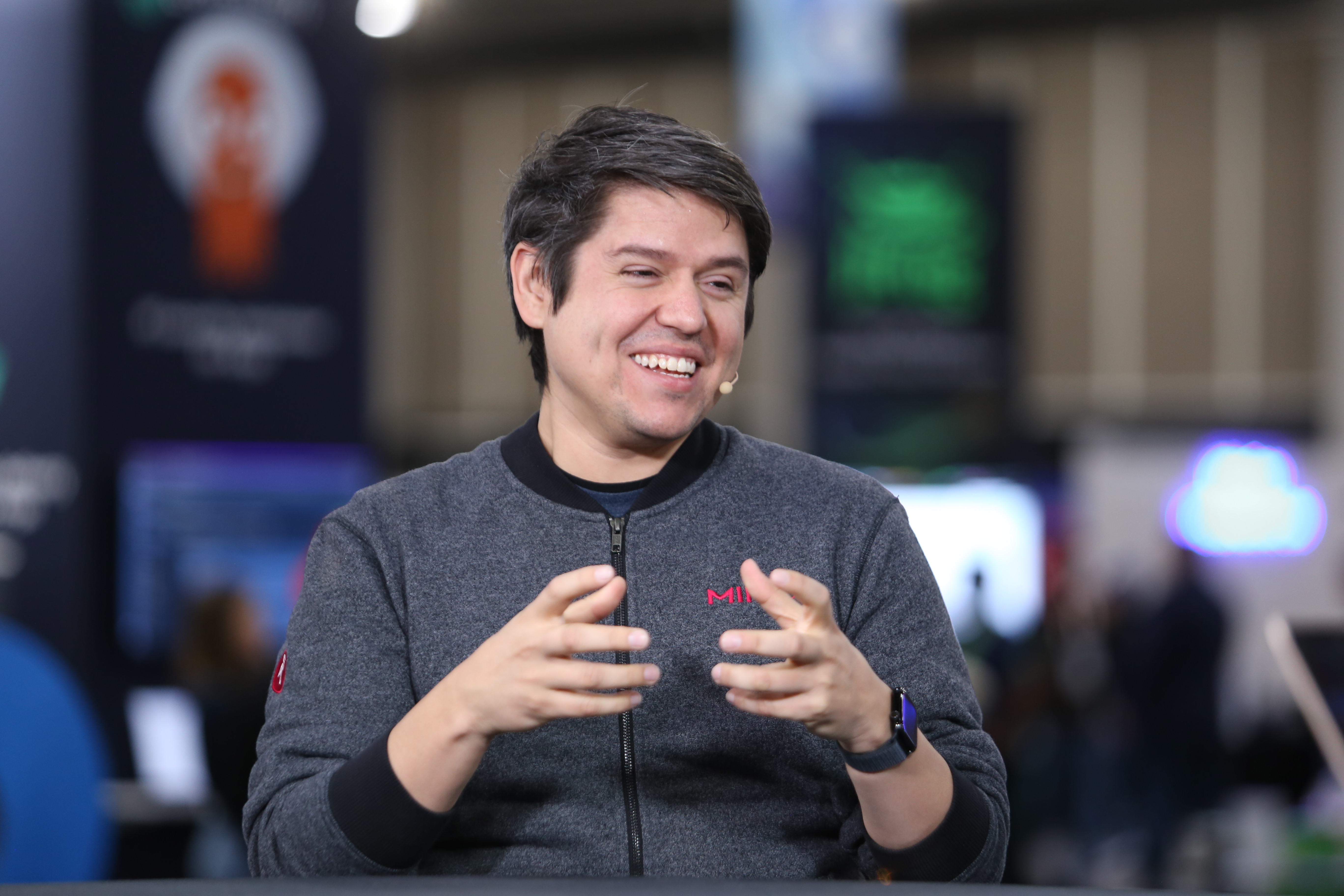
In Salt Lake City, Utah, Daniel discusses MinIO's new AI Store, offering AI tools to analyze data sets and organize files. The Prompting Object API allows developers to interact with data using GPUs on-premise. The new enterprise operator for Kubernetes simplifies managing stateful workloads at scale.
Daniel predicts a rise in zettabyte-scale customers in the next five to seven years, driven by the value that AI brings to stored data. MinIO aims to make AI infrastructure more accessible, especially for industries like Pharma and Biotech, by providing...Read more
exploreKeep Exploring
What new stage is MinIO introducing this week?add
What is the main advantage of introducing prompt AI into the AI Store?add
What trend have we seen over the past 12 months in relation to cloud usage and repatriation?add
>> Good afternoon, cloud community, and welcome back to Salt Lake City, Utah. We are midway through day two of our three days of coverage here on theCUBE. My name's Savannah Peterson with my right-hand man, Rob Strechay. Are you excited about this next interview?
Rob Strechay
>> I am very excited. I love talking about data because it is the fuel for AI. And I think you can't do anything with AI if you don't have the right data in the right place at the right scale.
Savannah Peterson
>> Yeah. And scale is definitely what we're going to be talking about next with one of our favorite guests, returning CUBE VIP. The MinIO VIP himself. Daniel, thank you so much for coming to hang out with us today.>> Thank you for having me. I love coming here.
Savannah Peterson
>> I know. Like I said, when I see you, no matter where we are on the show floor, I see your smile and I immediately feel better. I feel great energy.>> That's great. That's great.
Savannah Peterson
>> So thank you for that. It is a launch week for you. Very big launch week. You're looking pretty rested under the circumstances, I got to say.>> It's probably the lighting.
Savannah Peterson
>> That also helps all of us, for the most part, or doesn't, depending on the day. But what has it been like? We're going to dive into all the many things you announced and the things that you personally were helping on to build. How has it been so far, the reception here, the action at the booth? Tell me about it.>> It's an entirely new stage for MinIO that we are introducing this week, the AI Store. And the reception of everyone is, "Wow, what you guys had in store," they didn't see it coming. Because people associate MinIO with rock solid data store that scales at massive scale. And now we just make it a little bit better by actually introducing AI tools. That's why we are calling it AI Store. We introduced a bunch of new things. Mainly, now you can actually talk to your data. You can prompt the data that you're putting on your buckets. We also may introduced mechanisms so you can actually organize your data sets. Traditionally, data sets is just files in a folder. Now we can actually turn that into a data set that people can be like, "What is this data about?" And we can actually visualize that and organize it in MinIO in the AI Store. Also our model registry, and along with other exciting features as well.
Rob Strechay
>> Yeah. And what is interesting is you talk about going directly to the objects. Explain that for people, because I think people look at it and they go, "Oh, do I need to vectorize things and other stuff?" This is helping people get to AI faster. Using AI to get to AI.>> That is correct. And that's why we're introducing the Prompting Object API. And this is something so that developers can immediately be like, "Okay, I put an object. Now I want to prompt the object." And people, if they are going through the vectorization mechanism, building rack, they need to build all this expertise. Not the case with AI Store. With AI Store, give me some GPUs. And this is meant to run on-premise, on your own infrastructure. Give me some GPUs, deploy the AI Store. And now you can actually ask things. Okay, what's going on in this file? And we can be like, "Okay, there's some personally identifiable information, or there is a picture of two cats hanging out." So now you can actually even ask for the data to be structured in .JSON. So you can automate all of this with your applications. Because the value of AI is pretty much in the applications you do with it. It's all about the data that you have, but then what you do with the data and how you mix it with the AI. That's where you actually derive the true value of AI at this stage.
Savannah Peterson
>> Let's talk a little bit about some of the very specific features. I know within that AI Store there's a few different prongs of offerings that you've personally helped develop. Can you break down some of those for us?>> Yeah. So in terms of AI, the main exciting features I think that we're introducing on this age... sorry.
Savannah Peterson
>> No, don't apologize. You're a human. We're humans. This is how they know that we're not AI.
Rob Strechay
>> And we know you're excited so-
Savannah Peterson
>> It's literally how they know that we're not AI.
Rob Strechay
>> This could be generated.
Rob Strechay
>> Yeah.
Rob Strechay
>> Yeah. So from all the things that we're introducing in these new products, the things that excites me the most are pretty much the new operator. We are interested in new enterprise operator. And this is kubeware, after all. So that's why we had it ready in time.
Rob Strechay
>> Yeah. So it's a Kubernetes operator there, from that perspective. So yeah, talk about that, because we are a KubeCon.>> Yeah. The new operator is a new enterprise operator because Kubernetes is great for running things at scale, and everyone knows that. But of course, stateful workloads, it's always been one of those things that are kind of elaborate to run on Kubernetes. People are always struggling. Like, "I don't want my database to go down. I don't want-"
Savannah Peterson
>> Elaborate was a really generous way of just putting that, by the way. Yes. Yeah.>> Yeah. No, yeah, it's always tough. So we took it upon ourselves into, like, "Okay, how can you manage stateful infrastructure on Kubernetes at scale without actually having downtime?" Because you often need to have not only the traditional upgrades, but what if I need to expand my storage? What if I need to decommission all hardware? What if I need to change configurations massively? So we are trying to make our new operator actually be more proactive into actually how we hot load the data, hot load updates. So when you actually say, "I just want to apply this change," it's just like a tiny hiccup. Like a sub-millisecond hiccup and then everything just keeps working. So your end users won't even tell the difference. So this is why we took as priority. Because traditionally people running Kubernetes, they're afraid of it. They're afraid of the complexity. But Kubernetes is not complex. It just lets you do so much stuff. The complexity comes into the constraints that we are having imposed upon ourselves with how we actually run our software.
Savannah Peterson
>> I think you're the only person I've ever heard say, "Kubernetes is not complex." But I think you're right in the exact sense that the platform itself is not. It's the optionality that comes along with that and the things that people can do with it that becomes complex. I love the way you just phrased that, actually. We're talking about very serious scale here. And as we're ramping up operations, it's one thing to change things or update things when it's a much smaller data set. When we're talking about hundreds, thousands exabytes, this is a lot of data. How long have you been working on this? How did you, especially as a builder, have the confidence that it was going to work at this scale? Because this is no joke.>> No, it's no joke.
Savannah Peterson
>> This is not a prototype or MVP.>> No. And this has been interesting because the age of AI came here and suddenly the exabyte customers started popping up left. And we were like, "Wow." And then all these modern networking. 400 gigabit networking is here now. And so when you're running things at this massive speed, at massive scale, problems that you've never seen before start popping up. Small scale customers will never see these logs or these race conditions happening at large scale, but now that we're only seeing them at this massive scale it makes you really wonder, wow. Okay, we're going to fix this and see things going. But I was asking this at the company. How long do you guys think before we see the first zetta scale customer? Because years ago exabyte was like, "Wow, that's a lot of data."
Rob Strechay
>> Yeah.
Savannah Peterson
>> Right.>> But now it's like way more people are actually starting to store that much data. So that will be my next question. I don't know. Five, seven years? I could be so wrong. I hope I'm wrong. Imagine working in two years and we're like, "Zetta customer," or something like that.
Rob Strechay
>> But again, what are some of the use cases that are driving that, do you think? It's got to be AI and bringing all of their data together and things of that nature.
Rob Strechay
>> It's definitely the AI, because now people realize there's actually all this value in the data that I was not storing. I should store it. And now I don't need to go and devise complicated algorithms to analyze it. I can just leverage AI immediately and be like, "Okay, go look. Read through all these logs. Go through. Read all these files. Find me what I'm looking for." And AI can actually do it in an automated fashion. No training, just language. That's the beauty of it. So simple and straightforward. That's why actually people are now rushing like, "Okay, now I need the data. Now I need to actually really embrace every single piece of data I can because now it can actually derive value very quickly."
Savannah Peterson
>> I think you just brought up one of everyone's favorite buzzwords, AI. AI is really driving the scale of all this data. And I think, is your prediction five to seven years?>> I don't know.
Savannah Peterson
>> Should we put you on the record for that? Because now I'm kind of curious.>> I wish in five years we can be like zetta scale. Zetta scale might be common. It's really reminiscent. When I was a kid, a gigabyte was unthink of, right?
Savannah Peterson
>> Right.>> And now it's like, "Oh, that's too little data."
Rob Strechay
>> Yeah.>> So now we're like, petabyte is becoming very ubiquitous. People are always like, "10 petabyte deployment," "20 petabyte deployment," "200 petabyte deployment." But then that's very close to exa. So that's why I'm wondering, okay, when will we see the zettabyte? And just common, day-to-day consumers, enterprises that are just sorting decent amounts of data. It's just around the corner, in my opinion. Around the corner, five years of course. Not that immediate, but might be coming soon.
Savannah Peterson
>> I know. Well, we'll have to see. We're going to have this soundbite forever, and as soon as it comes you'll have to let us know.>> Yes, yes. I'll be like, "Remember the recording."
Savannah Peterson
>> Yeah.
Rob Strechay
>> I think you hit on a really good topic. And I think that AI-to-object, the technology, the prompt-to-object technology that you have in there. Because you have a lot of companies, say in biotech and pharmaceuticals, where they actually have to curate the data. And I know you're doing something in there as well around data sets and helping people actually create that, what you talked about earlier. How do you see that? Is that where you're seeing? Because it's using gen AI to maybe do other AI and things of that nature. Is that a lot of it as well?>> There's two things that I'd say here. The main advantage of us introducing prompt AI into the AI Store is that all these enterprises, pharmaceuticals, and people that they don't really know. They're like, "I'm a pharmaceutical. I'm here to make people healthier but I don't know anything about running AI infrastructure." But now with the AI Store, it's so easy. Just buy some GPUs, deploy AI Store, you're in business. Now you can actually start talking to your data. We did this because precisely we want to shorten the gap of people embracing AI on their own. And then when the companies start realizing, okay, this is easy. I can do this. I can handle this. Now our leaders actually start bringing even more data, because maybe our models might not be as sophisticated. We have this crazy demo. You should stop by our booth. We have this X-ray. And we can ask, like, "Do you see something wrong?" And the model says, "There looks to be some cancer here in the top right."
But then pharmaceuticals have access to some other data that we've never seen before, no one has ever been trained on. So now they'll be encouraged. They'll be like, "Okay, I can do this. It's not that hard of a deal."
Savannah Peterson
>> Rob, you just brought up a really great use case, Pharma, biotech. I'm curious, Daniel... and you guys at MinIO, for those who don't know, you have a broad range of customers across everything from government, to the largest companies in the world, to some very interesting stuff. Are there any use cases or applications of the toolkit you just released that you think are going to be really interesting maybe by vertical or hypothetical situations you've been building for?>> Well, not hypothetical situations. But the biggest trend that we've seen over the past 12 months is people repatriating from the cloud to on-premise. And Kubernetes is allowing that. So people are getting very comfortable, but then we're going to make it even more comfortable. Right now, everyone who wants to leverage AI needs to still go to the cloud to a SaaS service. So they need to take their data out. So we are trying to say, "Okay, let's keep giving them tools to empower them to run things themselves." So if they're leaving the cloud, Kubernetes makes it trivial to just run all your applications today. And running all your search infrastructure is also very trivial with Kubernetes. So we want to make it... okay, now doing the AI part should also be easy. Not like dark science. It should be simple. I got some hardware that I know I need. Now I put the software that will use it and I don't have to do anything else. Kubernetes will automatically allocate the things to the right machine. When we come online everything will be interconnected. And that's the magic that Kubernetes already gives you. And this is pretty much what we're trying to give back to the people. We're going to give them that assurance. You can come back to on-premise and everything will be fine. You can do this. It's not that hard.
Savannah Peterson
>> Love that.
Rob Strechay
>> You hit on a really good topic around ease of use and things like that. And there's like 50%, over 50% of the people who are here raised their hand and said, "This is our first KubeCon," cloud-native con in yesterday's keynote. One of the things that I've seen is that, as this evolution, you see less YAML on stage which, again, I look at it. And some people love the YAML, some people don't. But you guys went and actually, you basically rewrote your UI to help people simplify at this scale. Talk about that a little bit.>> Sure. And that's a great question, because we invested a lot of time and energy into bringing a consumer-grade experience to the enterprise. What do I mean by that? Traditionally, the enterprise has to deal with a lot of data and complexity. And enterprise UIs, I cannot lie, I've been using it forever. They are usually ugly and consistent. And then people are like, "I don't like this but I know how to do things." So then we went above and beyond to actually simplify the experience. We introduced a brand new UI into the AI Store so you don't have to actually look at YAML ever. I don't want you having to understand YAML and aligning spaces and anything. I want you to ask me what you want. Do you want some storage? Here. You want a model registry? Here you go. You want to deploy a prompt object? Here you go. Oh, you want two copies of that? I'll do that for you. So we want to keep it simple. Everything driven through UI, because UI usually is less intimidating to users. YAML, you can quickly get lost. And don't get me wrong, YAML is a great improvement over our previous technologies like JSON or an XML, but people still are intimidated by it. So people look for ways to get rid of YAML. And only a well-thought-out design or user interface design that minimizes the amount of clicks can actually achieve that. I like this analogy from early 2000s when people were just buying the server box, putting it in a data center, connecting it, and then deploying the web service and running traffic. And then people started building all these technologies to simplify that and putting them behind a web UI with virtualization and everything else. And then people were like, "Okay, we can do this." And then the cloud started actually developing. That's why it landed in 2006 with AWS. But it was only through the UI. AWS didn't ask you to write the XML. They were, "We'll give you a UI." And people were like, "I want a BM." Boom. Happens. So that experience is now actually coming to Kubernetes. A lot of companies are bringing that. Even us, we want to bring that. Of course we're not in the business of running computer or any other workloads. We are in the business of storage. But we want storage infrastructure experience to be as easy as pie.
Savannah Peterson
>> As easy as pie. Now you've got me hungry and excited about the feature set.
Rob Strechay
>> It's just after lunch, too.
Savannah Peterson
>> I know. That robust one.
Rob Strechay
>> Yeah.>> There's always room for this dessert.
Savannah Peterson
>> Yeah.
Rob Strechay
>> There's always room for this dessert. Very good, very good.
Savannah Peterson
>> We know Rob likes his cookies.
Rob Strechay
>> I do. Not crumbly.
Savannah Peterson
>> Okay. Okay, so this is huge announcement. And I'm sure you're still recovering from this, probably quite literally, physically, but also very excited to see it out in the wild. What are you going to tackle next that you can tell us about?>> I think what we want to tackle next is we're just getting started on the AI features. Right now, with the AI model registry, the data set registry, the prompt object, we're just giving a preview of, these are things that you can start doing to today that we know you immediately need. So what gets me excited is all these other AI capabilities that we're cooking, bringing into the object store, because we definitely want to help people leverage the data. That's our business. Our business is data, helping you store the data and do something valuable with it. So that's pretty much what excites us about the future.
Savannah Peterson
>> All right. I'm going to ask you a question I've asked you before, and it shouldn't be too much of a surprise. It's building on that a little bit.>> Yeah.
Savannah Peterson
>> But since we have you on every show and we absolutely love it, what do you hope to be able to say when we're at KubeCon London that you can't yet say today?
Rob Strechay
>> At KubeCon London I hope to see people super pumped about being able to talk with their data. I want them complaining about, this answer was not good enough. It was great but not good enough because now I'm bringing all these crazy scenarios that you guys never thought of. And you need to improve your models. So we'll work hard on doing that. So that's what I want to hear and tell you in London. People blew us out of the water with their questions and requests. So that's what I'm looking forward to tell you in London.
Savannah Peterson
>> Great. Well, we can't wait to talk about it over there. Daniel, thank you so much for taking time, and congrats on such an exciting announcement from MinIO this week.>> Thank you very much.
Savannah Peterson
>> Rob, always a treat.
Rob Strechay
>> Always.
Savannah Peterson
>> Just like a cookie.
Rob Strechay
>> Always a dessert.
Savannah Peterson
>> Always. Always a dessert. And thank all of you for tuning in for our three days of live coverage here in Salt Lake City, Utah. We're at KubeCon North America. My name's Savannah Peterson. You're watching theCUBE, the leading source for enterprise tech news.