We just sent you a verification email. Please verify your account to gain access to
KubeCon + CloudNativeCon NA 2024. If you don’t think you received an email check your
spam folder.
In order to sign in, enter the email address you used to registered for the event. Once completed, you will receive an email with a verification link. Open this link to automatically sign into the site.
Register For KubeCon + CloudNativeCon NA 2024
Please fill out the information below. You will recieve an email with a verification link confirming your registration. Click the link to automatically sign into the site.
You’re almost there!
We just sent you a verification email. Please click the verification button in the email. Once your email address is verified, you will have full access to all event content for KubeCon + CloudNativeCon NA 2024.
I want my badge and interests to be visible to all attendees.
Checking this box will display your presense on the attendees list, view your profile and allow other attendees to contact you via 1-1 chat. Read the Privacy Policy. At any time, you can choose to disable this preference.
Select your Interests!
add
Upload your photo
Uploading..
OR
Connect via Twitter
Connect via Linkedin
EDIT PASSWORD
Share
Forgot Password
Almost there!
We just sent you a verification email. Please verify your account to gain access to
KubeCon + CloudNativeCon NA 2024. If you don’t think you received an email check your
spam folder.
In order to sign in, enter the email address you used to registered for the event. Once completed, you will receive an email with a verification link. Open this link to automatically sign into the site.
Sign in to gain access to KubeCon + CloudNativeCon NA 2024
Please sign in with LinkedIn to continue to KubeCon + CloudNativeCon NA 2024. Signing in with LinkedIn ensures a professional environment.
Sr. Manager, OpenShift Product Management & Distinguished EngineerRed Hat
The Cloud Native community discussed Kubernetes and Cloud Native technologies in Salt Lake City, Utah, focusing on OpenShift Virtualization features such as memory over subscriptions, memory hotplugs, static IP preservation, and storage live migration for user experience improvement. Security in virtualization, compliance standards, and regulatory requirements were also talked about. User-defined networks and migration tools like GenAI and ConveyorAI were mentioned to enhance customer control and simplify migration to OpenShift Virtualization. Trends in appli...Read more
exploreKeep Exploring
Question: What was the timeline and progression of the KubeVirt project from its inception to 2024?add
What are customers asking for help with in terms of OpenShift Virtualization?add
What were some of the key developments in security this year, particularly in terms of compliance standards, regulatory assignments, and different vertical markets?add
What is the bread and butter of OpenShift and the largest use case that is solved for customers?add
>> Good afternoon, Cloud Native community, and welcome back to Salt Lake City, Utah. My name is Savannah Peterson. Delighted to be joined with Rob Strechay for another power packed week with the open source community. It's already been really good. I'm excited for our next guest too.
Rob Strechay
>> I am too. And I think, again, this is a topic that as Kubernetes evolves and as Cloud Native evolves, it's pretty critical to bring things together. And this is one of the key places I think that bringing workloads and as we build apps, that this next topic is really core to that happening.
Savannah Peterson
>> Yes, absolutely. And on that note, Xu and Mike, welcome.
Mike Barrett
>> Thank you.
Ju Lim
>> Thanks.
Mike Barrett
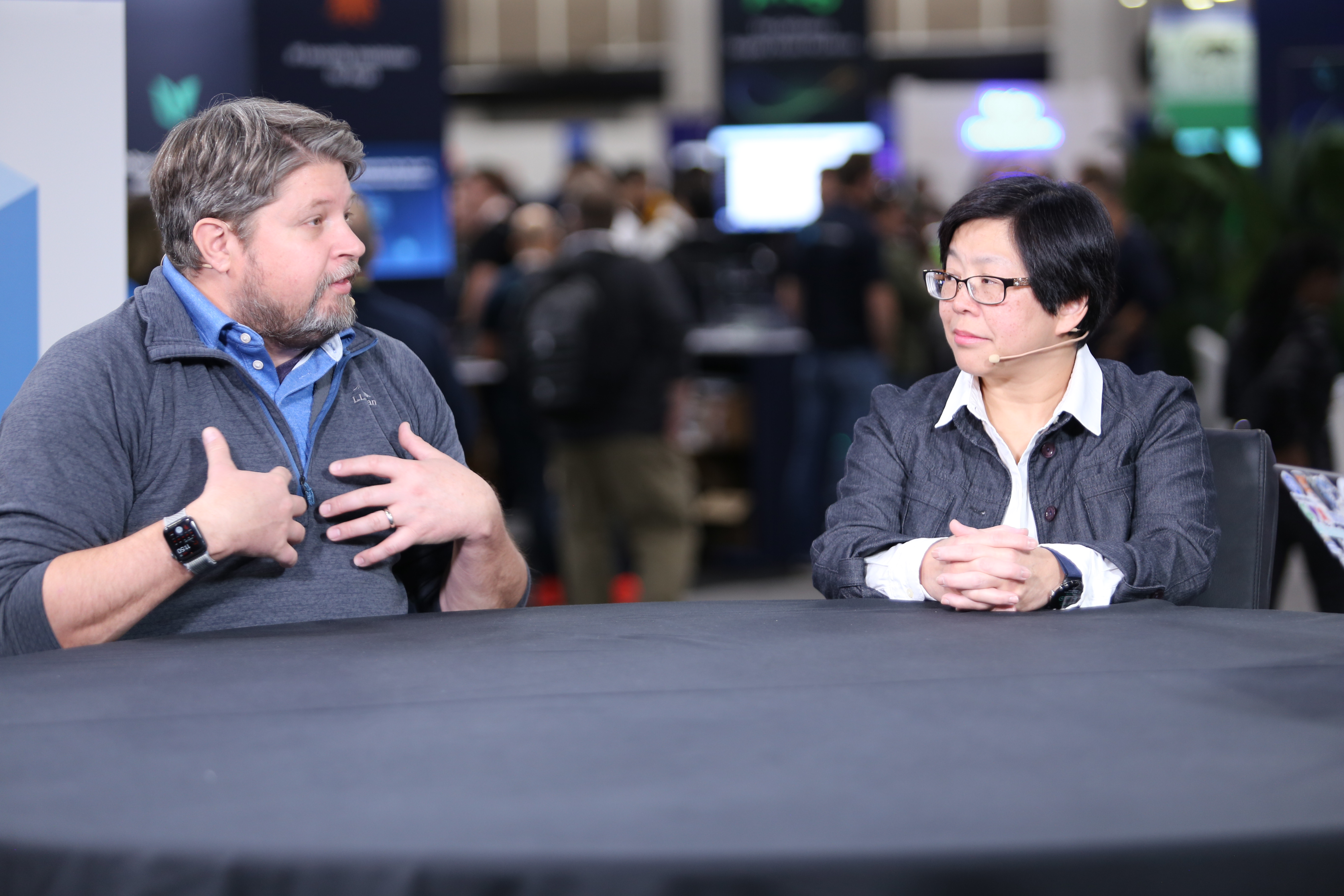
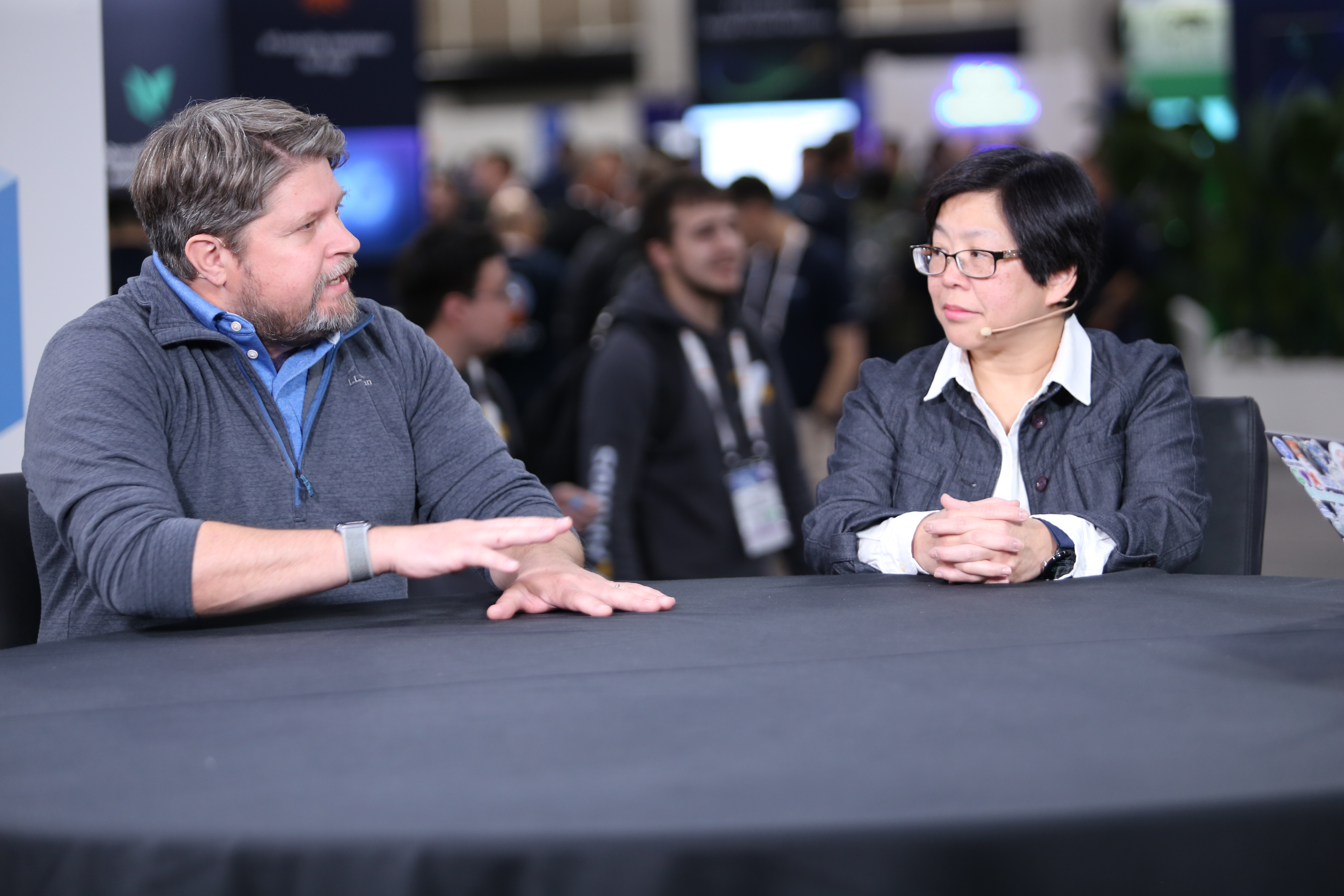
>> Welcome. Great to see you back, Mike. First time, very excited to have you with us. Mike, I know you were at the Commons keynote yesterday. So many events, you've already had a busy week and here we are on day one. Very impressive. Give us a little overview of what you were talking about.So day zero events, Commons, we have a couple hundred people that normally come with the co-located one with CubeCon. And yesterday was all about AI, virtualization security and how those workloads are transforming the platform in new ways. So it was great to see a lot of customers show up and a lot of interest.
Rob Strechay
>> And I think one of those topics is kind of where I was going with this, which is virtualization. You guys have already announced OpenShift Virtualization and it comes out for the upstream, which is KubeVirt. Tell us a little bit more about where you're seeing this playing and how it's really disrupting things from a cloud perspective.
Mike Barrett
>> It's really been an interesting journey, because... So, the KubeVirt project itself I think came out around 2016, and then we GA the technology and our product in 2020. From 2020 to about 2023, it was literally just modernization. And when I say modernization, a lot of people think that I'm talking about moving VMs to containers. Totally not talking about that. It's working with a VM as if it is a container. So declarative nature, GitOps with the config files, not baking in the IP address, allowing the VM to move across the cluster without being tied to a certain area, like all these Cloud Native patterns being applied to a virtual machine. That's where we were. And then, almost overnight, in 2023 into the, I remember it was March of 2024, the customer base just wanted to migrate. They didn't want to talk about modernization. They wanted to talk about getting off their legacy virtualization platform as quickly as possible. It changed everything we were doing at the beginning of the year. It really made us focus on putting features into the product. Can you think of some of the features we put in around this time to help accelerate that?
Ju Lim
>> Oh yeah. Recently we added a whole bunch of features for OpenShift virtualization, things like memory over subscriptions. So you can have higher density for your workloads or VM workloads in particular. We also have memory hotplugs, so you can have vertical scaling. We've also done also on the migration front, some good work around static IP preservation and drive letters. So if you're migrating from say, windows, it's a great onboarding to get onto OpenShift virtualization. And even from a storage perspective, we've done things like storage, live migration for actually moving between storage classes. So if you want to offer different storage tiers, you'd be able to do that very easily. So those are just some of the neat things that we've introduced recently.
Mike Barrett
>> Yeah, explosive. I mean, I was on stage in May with SiriusXM talking about their migration journey and what they went through and how they were successful moving forward.
Savannah Peterson
>> That's an exciting customer
Mike Barrett
>> Example.
Savannah Peterson
>> Any other exciting customer examples like that you want to share right now since you just brought up?
Mike Barrett
>> Yeah, it was in Paris at the last ScoopCon talking about Kuvert and their use of the solution. So yeah, lots of big names out there. Lots of success.
Savannah Peterson
>> That's exciting. You mentioned, well, a lot of exciting features that you all have added, but I'm curious, I can imagine people are asking you all for a lot, you have a lot of conversations given the scale and scope and industries that you touch, how do you prioritize what you're building right now, particularly in this modernization phase that you're talking about?
Ju Lim
>> Well, that's a really good question. A lot of it's going to be dependent on what we are hearing from our customers right now. A lot of them are feeling that disruption in the industry especially. And so, where they're asking for help is to actually, believe it or not, to simplify that experience, because they're coming from another vendor, where it offers a different experience, has a lot of bells and whistles on it. So they're looking for similar type features on OpenShift Virtualization, or actually just smoothening it out, so that it's a better user experience, if you will. Also, the migration tooling to simplify how you actually migrate. We're also looking to offer this on the hybrid cloud, obviously. So today we offer OpenShift Virtualization on bare metal, on AWS. We also recently added it to our managed Red Hat OpenShift on AWS service. But we're looking to roll this out on more platforms and the other major cloud providers, and so on. We're looking at networking. I can go on all day long, but probably we're running out of time.
Savannah Peterson
>> This is fascinating. No, no, not at all. I mean, hang out there just for a second, because you were on a roll. So continue to tell me what you're evaluating. Because I mean, you've got to be evaluating everything. Your Red Hat, you could almost build infinite things. So that focus and prioritization has got to be a real struggle.
Ju Lim
>> I think a lot of it is focusing on the key use cases that customers are looking to solve. I think expanding into new use cases, new markets. Some of the areas we're looking at are even smaller footprints, like Edge or Robo-type situations, where they have very small footprints or smaller locations, or maybe they might have smaller budgets as well. So things like two node control plane type clusters for actually offering the ability to run OpenShift virtualization on it. So we go all the way from the very largest scales ,all the way to the smallest scales for the smallest remote retail or point of sales type locations, if you will. So those are just some examples.
Rob Strechay
>> And I think, again, some of these also tie into things like security, right? Because security has to be at the heart of this. To your point, if they're coming from another platform where they've had decades of building up that ecosystem around that, and security has to be top of mind when you're looking at this as well.
Mike Barrett
>> So security, along with virtualization, it can't always be about virtualization. Security really exploded this year in terms of compliance standards, regulatory assignments, and different vertical markets. And especially out of Europe, we just saw an explosion of, I don't even know what to call them, but there's a lot of them out there, and they want to see isolation and new places in the platform. So typically we would isolate in Kubernetes at the namespace or at the cluster boundary. So we had to make that very inexpensive and automated for people to make that choice between a cluster boundary or a namespace boundary. Then we opened the door to furthering the isolation down to the network level for the first time. So giving people their own cider ranges. I don't know if you want to talk at all about the user-defined networks that we're putting in.
Ju Lim
>> Yeah. We just introduced user-defined networks in our recent release. And so, this is the notion of actually building greater isolation to be able to enable, say tenants to actually even have overlapping IPs or cyber ranges, so that it's separated, but dedicated let's say to a particular tenant. So these are some of the new things that we're doing, not just for OpenShift Virtualization, but greater freedom and flexibility and control for customers, obviously.
Rob Strechay
>> And this helps across different industries. And one of the ones you were looking for is Dora, not the Explorer, but the EU regulation, because it's one of my favorite ones. It talks about a lot of the compliance and how you have to be able to be recoverable, and things of that nature. That has to play a lot into where you guys focus from a product perspective, because it's not just about virtualization, it's the security, but it's also people modernizing their apps and wanting to modernize their apps. What are you seeing people doing differently this year? Because you talked about it where in March, "Hey, I want to get off this platform, maybe somebody's pricing model changed," or something like that, and they felt the impetus to go. What are you seeing from an app modernization thing? Because that really was the core of where you guys were at.
Mike Barrett
>> Right. And so, ATMOD is what we abbreviate it to, is the bread and butter of OpenShift. It is by far the largest use case that we solve for our customers. And it could be something as simple as putting a strangler pattern around an existing large monolith to give somebody a new customer experience with that technology, hit that new API, have that new experience pulling from sort of a legacy solution. That was very popular this year. I would say event-driven, API topologies, like fragmenting out and having a lot of different pieces that are allowed to innovate at different rates, and then come together at a deployment. Very popular. We have a lot of people moving from legacy Java to lightweight Java, like Orkes, just a lot of those traditional patterns are where we help most of our customers use the platform. I don't know if you want to talk about the migration toolkit at all, that was pretty special this year.
Ju Lim
>> Yeah. So there's some neat things we're doing. For example, GenAI is really hot within the conveyor community, which is around tooling that's focused for migration. There's some neat innovations that's going on. For example, there's a project called ConveyorAI, or CAI, and this is something where it's AI enabled to actually help you with looking at your source code and actually figuring out how best to modernize it. And taking the combination of LLMs and actually taking some of the conveyor source data to actually do some static code analysis, to actually provide some guidance on sort of past experience, and applying it with that specialized knowledge from the RAG and all the wonderful things that the AI world brings, to actually help guide that solution, and actually streamline and automate it. So these are just some examples, but obviously we're taking a lot of the Conveyor investments that we're making and bringing that into our migration tooling. So we have things that the application containers, VM level, so everything to sort of make it easier for customers to migrate and take advantage of our platform, obviously.
Rob Strechay
>> So by migrate, kind of explain what you mean that there, because I mean that's a big term, right?
Ju Lim
>> It's a very big term. It's anywhere from analyzing, assessing, figuring out whether it's a right fit or not, all the way to actually providing tooling, to actually guide you to actually migrate, or even doing move to Cube as an example. So like I said, it covers a whole gamut.
Mike Barrett
>> An example might be to interrogate a JAR file, look at the Java class that are being called, and then see if that is going to work in Orkes, for example, without you needing to do anything.
Rob Strechay
>> Yeah, you're not just talking about the instance or the container, or the VM for that matter. You're looking all the way into the application to help people understand, using some of the up top, I'm losing my brain here, but-
Savannah Peterson
>> Right altitude. .
Rob Strechay
>> Right altitude, right altitude
Savannah Peterson
>> It's a little less oxygen. There's an oxygen bar actually around the corner if you need to hit it up at lunchtime.
Rob Strechay
>> upstream. Upstream is what I meant.
Savannah Peterson
>> Okay. Upstream.
Rob Strechay
>> I guess talk to how you're working with some of these Upstream communities, because Red Hat's, I think one of the, I didn't look this morning, second most or first most PRs contributing back into the community. How does that work with all of this as well?
Mike Barrett
>> So we're Upstream first, and that's a lot of work, because our engineers almost have to carry two job responsibilities. They have to go into the Upstream community, they have to work in that community, be a successful maintainer, and then also come back to us and bring that code in, and make sure it's enterprise ready, make sure it's ready to be CD patched, kept up to date. It fits our integration with our larger ecosystem of partners, and all of our data center integrations. So it's almost like we're asking them to do two jobs. We don't pay them twice.
Savannah Peterson
>> Okay. It's a big week for you. You're probably having a lot of conversations about, everyone's excited about tooling. What gets you most excited? Well, I'm going to have a couple questions about this, but what gets you most excited about where we're going? It feels like a bit of an inflection point. 10 years of Kubernetes, AI adoption. I mean, AI actually probably catalyzing a significant amount of Kubernetes adoption. So many things going on right now. I feel like tech is cool again, nerds are cool again. So what do you think we're going to see in, I mean, we're always cool, obviously. You over there giggling. What do you hope we're going to see in the next few years? Doesn't need to be next year specifically, but what do you think we're going to see that's going to be radically interesting across the board?
Mike Barrett
>> Yeah. Well, I think right now is a really good time to ask that question and look at what we're doing in the platform. A platform is completely worthless without workloads. You don't build a platform to have no workloads in it. And so, when you start putting workloads in the platform, it's got this weird relationship, where the workloads will force the platform to evolve and do new things. And so, when you're sitting there thinking, "Should the platform do this?"
Before you go and put the money down to do that engineering work. When you take a step back and when you time travel into the future, and you look back on that, as the time has washed over you on whether or not that was a good choice, it becomes an obvious choice. It's like, how could we have not have seen that this had to be done in the platform when we were questioning it, right? And as we go into 2025, we're experiencing a lot of that with the new AI workloads. So the AI workloads are bringing in a tremendous amount of innovation in the platform, because they're not simple web-based apps. They're not like these vertically scalable horizontally things. They're batch HPC, they're specialized hardware devices. There's a gambit of things they bring in. I don't know if you want to talk about some of the projects that it's causing.
Ju Lim
>> Yeah, I know to Mike's point, AI's really hot. GenAI is also really hot.
Rob Strechay
>> I hadn't heard that yet today.
Ju Lim
>> I know.
Savannah Peterson
>> What's that acronym mean?
Ju Lim
>> In the keynote, they talked a lot about GenAI, and I know last year and going forward, we're invested heavily also in GenAI. We've got something we released last year, or announced, I should say. Still on its way to being released. It's Lightspeed throughout the Red Hat portfolio. So we've done also from an OpenShift perspective, we've recently introduced Lightspeed and Tech Preview with some great capabilities, including supporting our own granite models. So obviously open source and it works really well in disconnected environments. So we're looking forward to hearing more and more customers adopt that. So that's one example. But some of the other areas that we're doing work on the upstream are things like dynamic resource allocation, or DRAQ. I mean, these are taking advantage of GPUs or making sure our core APIs are aligned with the AI ML workloads of tomorrow. And so, these are just some examples and there's obviously more that's going on, and beyond just sort of the higher level Kubernetes abstractions, we're also having to do all that hardware enablement to make sure that it's compatible all the way up our stack. And we're able to leverage and expose the features through all of the components that we have. Notwithstanding, we also have to worry about security. That's our bread and butter, if you will. We've got to make sure that those workloads are isolated or not going to impact some other tenant, for example. So a lot of interesting innovations that we're driving in that space, and we'll continue to do so going forward.
Savannah Peterson
>> What an exciting time. Wow. Okay. One last question for you, because we were talking about it before we went live. When we're in London for CubeCon, what do you hope to be able to say then that you can't yet say today?
Ju Lim
>> That's a good question.
Mike Barrett
>> Yeah, I think it'll probably be related to, we made an acquisition recently. You may have heard the other day. It'll probably be related to bringing in a very end-to-end experience on how to bring smaller, large language models into your data center to touch your most intimate data you don't want to show anybody, and having a huge movement and experience around that, as you sell it to your customers. And I think that'll be a big thing next year.
Savannah Peterson
>> Love that.
Rob Strechay
>> Yeah, I loved that acquisition, by the way. And if people haven't seen it, there was a great discussion. I got to be on the analyst review of it yesterday morning, which was fantastic about, because we see that as well, small language models and things coming, and going to the edge, which you were talking about and disconnected too. But what do you hope to see in the next six months here?
Ju Lim
>> I think it's a lot of what we're seeing today, but I think what you're going to see is a lot of smaller models out there. I think we're going to start to see more of it at the edge. A lot of what we're talking about is more on the core. It's really large. It requires a lot of GPUs, but we're starting to also hear about people saying, "Hey, I want to start doing it, fine-tuning at the edge." On really, really constrained devices, let's just say. And some of them in obscure regions of the world, let's just say. But I think a lot of what we see will just be sort of exploding in a lot of different segments, a lot of different industries, and I think it's just really exciting times that we live in today.
Savannah Peterson
>> It really is. What a fabulous note to conclude this on. Xu, you rocked it your first time. You better not be nervous when we have you on next show. You've used your nervous past, because that was too good. So many great soundbites and my pleasure to have you on the show again as well. Rob, always a joy. I'm excited about the future.
Rob Strechay
>> I am too.
Savannah Peterson
>> Yeah, and I hope all of you are excited about the future, wherever you might be tuning into our fabulous three days of coverage here in Salt Lake City, Utah. My name's Savannah Peterson. You're watching theCUBE, the leading source for enterprise tech news.