We just sent you a verification email. Please verify your account to gain access to
KubeCon + CloudNativeCon NA 2024. If you don’t think you received an email check your
spam folder.
In order to sign in, enter the email address you used to registered for the event. Once completed, you will receive an email with a verification link. Open this link to automatically sign into the site.
Register For KubeCon + CloudNativeCon NA 2024
Please fill out the information below. You will recieve an email with a verification link confirming your registration. Click the link to automatically sign into the site.
You’re almost there!
We just sent you a verification email. Please click the verification button in the email. Once your email address is verified, you will have full access to all event content for KubeCon + CloudNativeCon NA 2024.
I want my badge and interests to be visible to all attendees.
Checking this box will display your presense on the attendees list, view your profile and allow other attendees to contact you via 1-1 chat. Read the Privacy Policy. At any time, you can choose to disable this preference.
Select your Interests!
add
Upload your photo
Uploading..
OR
Connect via Twitter
Connect via Linkedin
EDIT PASSWORD
Share
Forgot Password
Almost there!
We just sent you a verification email. Please verify your account to gain access to
KubeCon + CloudNativeCon NA 2024. If you don’t think you received an email check your
spam folder.
In order to sign in, enter the email address you used to registered for the event. Once completed, you will receive an email with a verification link. Open this link to automatically sign into the site.
Sign in to gain access to KubeCon + CloudNativeCon NA 2024
Please sign in with LinkedIn to continue to KubeCon + CloudNativeCon NA 2024. Signing in with LinkedIn ensures a professional environment.
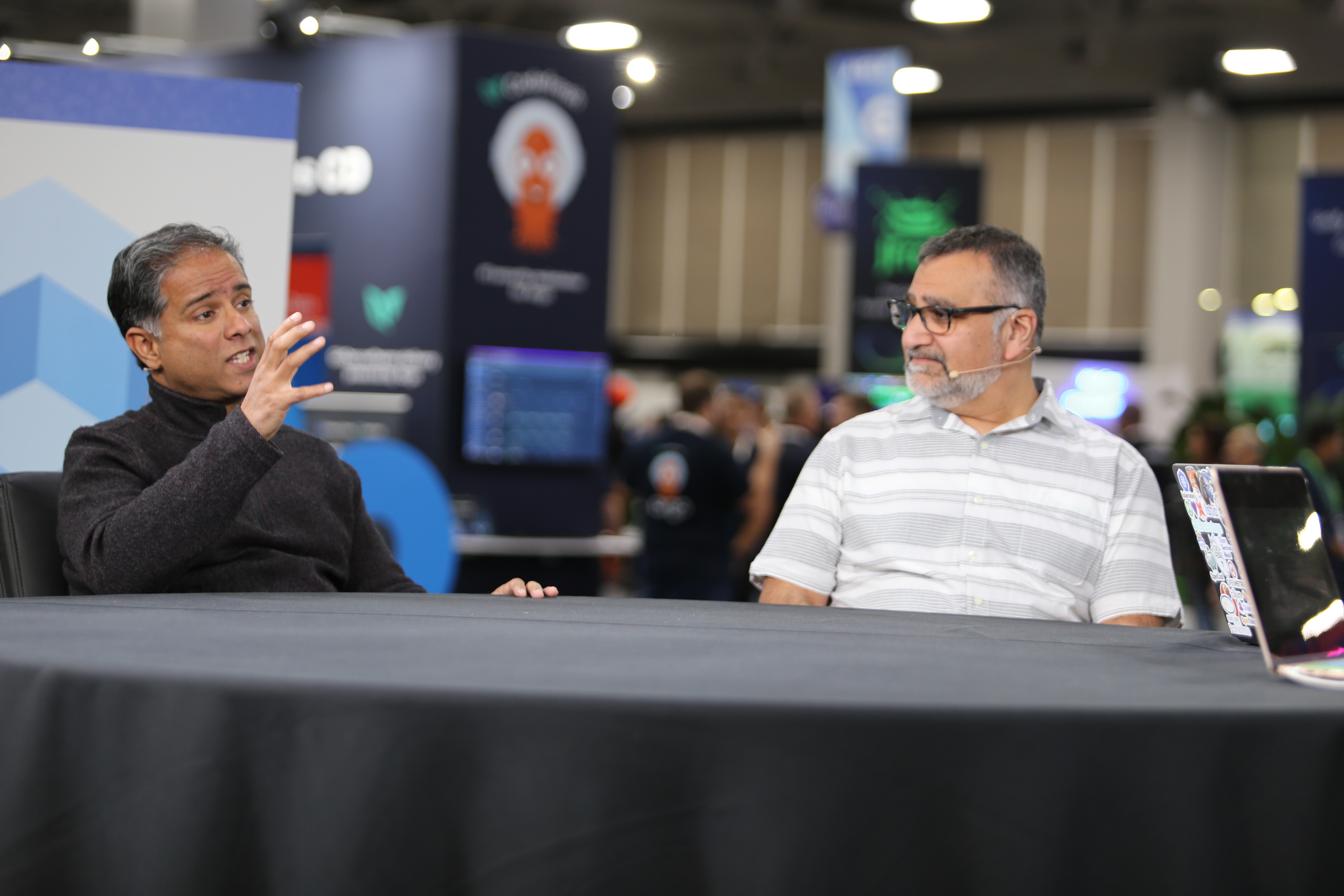
Venkat Ramakrishnan, Pure Storage & Ameer Dixit, T-mobile
Venkat Ramakrishnan
President and COONeuBird AI
Ameer Dixit
Platform ArchitectT-mobile
Savannah Peterson and Rob Strechay discuss the importance of data in AI in Salt Lake City, Utah. Portworx has supported AI workloads since 2017, aiding customers with autonomous cars and machine vision. The platform has adapted to meet cloud-native data needs, resonating well with customers like T-Mobile. Ameer from T-Mobile highlights their partnership with Portworx since 2017, providing self-service and reliability for developers. Portworx has brought performance gains, especially with their shift to bare metal. Collaboration between Portworx and customers ...Read more
exploreKeep Exploring
What has Portworx evolved into and how has it benefited their customers?add
What approach do you take when working with customers, and how do you collaborate with them to meet their needs?add
What virtualization platform are customers choosing as the standard for modernizing their infrastructure, and how are you supporting them with Kubernetes-based virtualization?add
What updates will be shared regarding the adoption of a modern virtualization platform and customer journeys related to generative AI and machine learning applications at the inference level?add
Venkat Ramakrishnan, Pure Storage & Ameer Dixit, T-mobile
search
Savannah Peterson
>> Good afternoon, nerd fam, and welcome back to Salt Lake City, Utah. We are here coming to the back end of day two of our three days of coverage on theCUBE. My name's Savannah Peterson, here with you guessed it, Rob Strechay.
Rob Strechay
>> Glad to be here with you.
Savannah Peterson
>> Yeah?
Rob Strechay
>> Yeah. This is great. Again, data feeds AI. You can't do AI without data. It's going to be distributed, more inference everywhere, the complexity of it. But it's not just GenAI, and I think that's a big piece of it, and I can't wait to get into this.
Savannah Peterson
>> You've actually said less about that this week than I expected, now that you mention it.
Rob Strechay
>> I'm ecstatic about that.
Savannah Peterson
>> Yeah, me too.
Rob Strechay
>> .
Savannah Peterson
>> Well, we've got people who like to talk about real stories here with us. Venkat, welcome back. Thank you for spending time with us.>> Glad to be here.
Savannah Peterson
>> We love having you, and Ameer so lovely that you could join us today as well.>> Thank you. Great to be here.
Savannah Peterson
>> Yeah, this is a fun one. I got to start where we left off last time we saw each other, Venkat, because we were starting the foundational chorus for our future rap song. DBaaS for the masses, how have things->> DBaaS for the masses.
Savannah Peterson
>> Yeah.
Rob Strechay
>> Get the beat box.
Savannah Peterson
>> We just got to get one of the production boys going with the beat, guys. We got to get a little beat going from you guys. Where are we at now compared to when we talked last time?
Rob Strechay
>> That's great. Yeah, I think we are, I think, in one of the most interesting times in the history of tech. Actually, the history of mankind, I would say. I mean, because I think where... Or personkind to be.
Rob Strechay
>> Yeah.
Savannah Peterson
>> Oh, bless you for that.
Savannah Peterson
>> Thank you.
Savannah Peterson
>> You get a cookie.>> I think where we have been is that obviously we started off from this machine-centric world, did a little bit of app-centric stuff with Kubernetes and Cloud-native. But where we are seeing now is that a lot of the enterprise workloads and everything we look around us, there is a generous amount of AI coming in. I mean, but this is not something that's overnight. I mean, these kinds of technologies, they become overnight sensations, but they take long time to develop. And Portworx has always actually back-ended AI workloads even all the way back to 2017. We have helped our customers build autonomous cars, machine vision, and most of the large language models and supervised and unsupervised machine learning models actually run on Kubernetes. They started running on Kubernetes long time ago. But what we see now is this huge outgrowth in all of these models coming out and a lot of research and a lot of development that has been going on for many years are actually now out there for people to take advantage of. We are in very interesting times and we have evolved Portworx to become more of a platform where it's your one-stop shop for all of your cloud-native data needs. We go from, we are no longer just storage, we are no longer just data protection, we're no longer just DBaaS for all, we are a Portworx platform for all of your cloud-native data needs. And it's resonating a lot with our customers because it helps them take them along with their journey. They start-off, but the product evolves with their needs and they're able to turn on features that they need and they continue to take advantage of the investment they have made. It's been great. The show has been amazing and we have had some great conversations. Super happy to share with all of you here.
Savannah Peterson
>> Yeah, love it. And so exciting. Speaking of customers enjoying the tools, I suspect that's why you brought Ameer from T-Mobile. How long have you two been working together? Give me a little lay of the land.
Savannah Peterson
>> Well, we've been in partners with Portworx since the beginning of the Kubernetes journey at T-Mobile.
Savannah Peterson
>> Oh, awesome. How long has that journey been, just out of curiosity?
Savannah Peterson
>> 2017, '18. Yeah, right in there.>> 2017, yeah.
Savannah Peterson
>> Your Ogs.>> Yes.
Savannah Peterson
>> You were on the early adoption train. Nice.>> For sure, yeah.
Savannah Peterson
>> And so, when you were evaluating who to go on that journey with you, how did you know that they were the chosen one? I know there's a lot of love here, so how did you know they were the one?
Savannah Peterson
>> Back with that history, there was less choices. We still did evaluation, but it was a very smaller landscape and a very clear winner.
Savannah Peterson
>> And still a very clear winner in the space.
Rob Strechay
>> Yeah, mm-hmm.
Rob Strechay
>> And again, when you look at it, I mean, T-Mobile, you're a service provider, you have a lot of different applications and application needs. You're getting into AI. You have customer-facing apps, you have internal-facing apps, and you're really handling the platform engineering piece of it. Your customers are actually the developers who are actually building these.>> That's right.
Rob Strechay
>> Talk about how Portworx is enabling you, from a data management perspective, to really service those developers in a better way.
Savannah Peterson
>> Sure, sure. I think we have reasonable scale, a couple hundred clusters, tens of thousands of nodes.
Savannah Peterson
>> It's a humble way of putting it.
Rob Strechay
>> A few.>> Yeah, and far more application teams than I can know independently. Really, it's getting out of their way. It's giving an ability to have self-service, it's ability for them to trust and not have to interact with us, an ability for us to do maintenance and upkeep and not impact them at all. I's a bit of, "Hey, I apply my manifest, I have my storage and I don't need to talk to anybody else," so that's the velocity that we try to provide for our developers.
Rob Strechay
>> And that scalability has to be a key factor. People talk about cloud scale, I mean, telco cloud scale is a whole nother set, and it's not only just the scalability, but it's the reliability that has to be there as well. Talk to how you've seen that evolve as well and where you see that going and what it means to your developers.
Savannah Peterson
>> Sure. Sure. Back in the day, I was a storage admin and we've all had that dreaded data unavailable and the pain that comes with that. And when I started working with Kubernetes, I had a lot of nerves. How good is the storage going to be here? And it's been very, very good for us. We, in the early days, had R3 replicas again, because we didn't... Building trust. How reliable is it going to be? We've been able to step down to R2's and been very happy with data uptime and performance as well.
Rob Strechay
>> And that's cost savings right there. There's ROI that you've been able to build and that has to not only help, your boss must be happy about that, but it helps also with folks that are developing on top of that to know that you have that reliability there. And again, they don't have to focus on any of that.
Savannah Peterson
>> Right, right.
Rob Strechay
>> Is a big piece of what you try to provide based on Portworx is making it basically transparent to them and it's like, "Hey, we have this covered. You don't have to worry, just go and develop.">> Yeah, for sure. We have storage classes. We have a very small amount of documentation and it works for this very large user base. So, been happy with that, and performance as well. In the beginning, much more stateless apps in Kubernetes and definitely not the case anymore. And we do have some busy storage workloads and again, happy with their performance and I'm not fighting too many battles with that.
Savannah Peterson
>> Fighting less battles is something that we all enjoy. I'm curious, Venkat, because obviously to collaborate well, what is the feedback loop like as you're continuing to build new products and features with customers like Ameer?>> Yes, that's a great question. I always tell our customers, consider us as an extension of your team, that we are your partners, not just vendors. We partner with them like Ameer and his team and the T-Mobile team, we partnered with them at the beginning of their cloud-native Kubernetes journey. And to a large extent, a lot of things we have built, I have to give a lot of credit to our customers and partners who kind of guided us in what their use case is and how we can better serve their use case. Some of the stuff we have built are co-created along with our customers, which is great because we look at it and we see how does this apply to the broader market? Can we take this and help other customers? And absolutely, many of the stuff we have built, we have been able to deploy in many of our global 2000 customers. If you look at the announcements we have made in the KubeCon. I mean, we have actually done a couple of great announcements. One is we're extending our platform to support vector databases in large language models and make it... This is the next thing we are going to use in the next Kube is kind of GPT anywhere stack. You can go build your generative AI stack, your machine stack anywhere because Portworx is a multi-cloud platform. You can build your models in your data center, you can deploy your models in the cloud closer to your applications and users. I mean, Portworx enables that, and we made that announcement. We have also extended our platform to be even more enterprise-ready, to be more self-service developer friendly with all the security controls. I mean, one of the most important things for enterprises today along with velocity and developer productivity is security and governance, so we added that into a platform, which is part of the other announcement we made. And these two, we have been working closely with our customers, maturing how they should look like, how they're going to surface and use it. So look at the feedback loop there. The third thing, which is we've been intently listening to our customers, and there's this big trend about how do you modernize your virtualization platform. Because of all the market pressures around the Broadcom acquisition and how customers are looking for alternatives, and again, listening to our customers, we heard loud and clear that they are choosing Kubernetes as the standard for modernizing their infrastructure. They are coming from one legacy platform, and they don't want to generally go to another legacy platform because this is an 10 year, 15 year investment they make and they want to modernize their deployment. Our customers came back and said, "How do you support VMs and Kubernetes with Kubework?" We are announcing support for modern virtualization, Kubernetes-based virtualization. We're working with the likes of Red Hat and Brancher and supporting their virtualization platforms, and that's another support we announced today. Again, working closely with our customers, we have now customers in production, going to production in thousands of VMs and modernizing their virtualization architecture as well. This is the process of co-creating, working with them, working with Ameer and team. They were one of the first ones to tell us, "Hey, VMs are coming to our Kubernetes platform. Are you ready?" The whole metal as a service that Ameer spoke about. We started there and now we see that as a major trend and we're ready to support not just the customers, the industry as well.
Savannah Peterson
>> Love that.
Rob Strechay
>> And that must play really well, again, with that simplification and really making developers more productive because, again, I am assuming you're serving this up to them. They go in and choose what storage type they need and they're off and running.>> Correct.
Rob Strechay
>> And they can then just start to develop. And we were talking beforehand and you said, "I actually have to think a little bit more as a developer about what apps they're building." Talk to that a little bit.>> Sure, sure. Yeah, I mean that's a partnership as well. The more that I can understand the best coding paradigms along with my infrastructure role, the more we can work together to deal with all the complexity that comes at a large scale, and that's kind of inherent in Kubernetes. I was going to mention, we've also been really happy. We run Kubernetes in a virtualized environment, unfortunately, with challenges with virtualization lately, and we've now moved to bare metal, and that is going to be a much larger part of our platform, and Portworx runs on both. We have the same feature set, we have the same user experience regardless of platform, and it's a very nice feature to have for us.
Rob Strechay
>> Whoever's supplying, and you don't have to go into that, but they're using the upstream as the KubeVirt project. It's been around since about 2016 now, so we're almost getting it 10 years of that being developed and stuff like that. But it really started to take off in 2018, and funny enough, in the last year. I don't know what happened in the last year that changed that. Talk to that is do you have your developers are loving the flexibility that Portworx is providing because it doesn't matter if it's a container or a VM that they're trying to protect, they just go in to the portal and be able to protect it and pick their storage classes.>> Yes, and I think the good thing is they haven't had to get into that space too much because we've had a good track record of performance and availability, and so they trust our recommendations and the platform that we have, and it is just maybe one less thing to worry about, which frees us both up.
Rob Strechay
>> Oh, that's great. I think the bare metal thing, we're hearing that a lot more, not surprisingly. Have you seen any performance gains? Have you seen this work really well with your partnership with Portworx and how they're going?>> As far as benchmarking, I don't think we've had anything to necessarily get really good numerical comparison. But I'll admit the first time I set it up and you're seeing Kubernetes calling a storage array and you're seeing real know LUNs provision and then show up in Kubernetes, it was kind of like, "Well, that is cool. It's neat," and it is not as much configuration as I thought it would be and reliability has been good as well.
Savannah Peterson
>> I can see why you picked the right partner early on and they've been able to grow with you throughout the evolution of this. No surprise there.>> Absolutely, yeah,>> Yeah.
Savannah Peterson
>> And it's got to feel good for you to hear, I bet.>> I feel great hearing it.
Savannah Peterson
>> Okay, gentlemen, this segment has flown by, but I have one final question for both of you. Venkat, you might know where I'm going with this, so I'm going to bring it to you first. When we have you both on theCUBE again to talk about the next evolution of your partnership, let's call it in London at KubeCon, what do you hope to be able to say then that you can't say today? I'll let you think about it for a second, Ameer, don't worry.>> Okay. All right.
Savannah Peterson
>> I'm going to Venkat. He's got that grin. He's got this.>> I mean, the possibility is endless. But definitely what I think I'll be giving you an update on, our rapid adoption of the modern virtualization platform, and I'm looking forward to share with you some of the interesting customer journeys, potentially with Ameer and team and others as well. I think it's a significant industry change shift that's happening. I think you're going to see a lot more of how organizations are getting to more and more building their own generative AI, especially around inference. Because I think the training is going to be done by the large cloud providers and all the big companies, but there's a ton of GenAI applications and machine learning applications at the inference level, and we're going to empower and enable them to move faster to improve their experience. See, if you look at this, this is a journey of digital experience. The whole community's cloud native was how do you deliver digital experience faster? AI augments it, accelerates it, and kind of brings in natural language interface to all of our interactions. I'm looking forward to sharing some of that with you all. And then, how Portworx as a platform, as a service, is powering this in all the clouds, so absolutely.
Savannah Peterson
>> We can't wait. We can add that into the lyrics of our song.>> Absolutely.
Savannah Peterson
>> We'll be building it up.
Rob Strechay
>> How would we start the next segment with actually a cloud native rap that we compose.
Savannah Peterson
>> I feel like we need to.>> Yeah, that's good.
Savannah Peterson
>> I know. I think we're committing to that, Venkat.
Rob Strechay
>> We can make that work.
Savannah Peterson
>> I love that. I think that would be great. Anderson on our production team can play a million instruments, so we can pull him into this. We've got a whole thing going on. Ameer, what about you? What do you hope's changed in the next six months?
Rob Strechay
>> Sure. I would love to see our platform to continue to grow as it is at a fast clip and be able to really unlock more application freedom on Kubernetes, more VMs running there, and just to see this platform grow and become almost the total majority of our infrastructure. That'd be great.
Rob Strechay
>> I want to hear you say it's helping you get inference out to the towers and how you're providing that to customers, but that's more on your developer's self, but I think it-
Rob Strechay
>> It sounds good.>> Yeah, that's an important thing to note, that this team supports thousands of developers and they are developing applications all the way from their enterprise back office apps to 5G apps, core call processing apps and SIM apps like eSIMs and all of that. This platform powers a ton of different applications all the way from the towers to back office. It's very powerful.
Rob Strechay
>> That's right. Flexibility is awesome, and scalability.>> I mean, the majority of our applications run within Kubernetes now, and just the efficiency we're getting compared to architectures before is pretty amazing.
Rob Strechay
>> It's awesome.
Savannah Peterson
>> We love to hear it. Thank you both so much for coming to hang out with us.>> Thank you.
Savannah Peterson
>> This is fun as always. Your smiles are contagious too because we need that energy in the afternoon.
Rob Strechay
>> Absolutely.
Savannah Peterson
>> It's just wonderful. We really appreciate it. Rob, thank you as always, a joy.
Rob Strechay
>> Always.
Savannah Peterson
>> Always a joy. I thank all of you for tuning in, our fabulous community, wherever you might be today. We're here in Salt Lake City, Utah, coming to the conclusion of day two of KubeCon North America. My name's Savannah Peterson. You're watching theCUBE, the leading source for enterprise tech news.