We just sent you a verification email. Please verify your account to gain access to
KubeCon + CloudNativeCon NA 2024. If you don’t think you received an email check your
spam folder.
In order to sign in, enter the email address you used to registered for the event. Once completed, you will receive an email with a verification link. Open this link to automatically sign into the site.
Register For KubeCon + CloudNativeCon NA 2024
Please fill out the information below. You will recieve an email with a verification link confirming your registration. Click the link to automatically sign into the site.
You’re almost there!
We just sent you a verification email. Please click the verification button in the email. Once your email address is verified, you will have full access to all event content for KubeCon + CloudNativeCon NA 2024.
I want my badge and interests to be visible to all attendees.
Checking this box will display your presense on the attendees list, view your profile and allow other attendees to contact you via 1-1 chat. Read the Privacy Policy. At any time, you can choose to disable this preference.
Select your Interests!
add
Upload your photo
Uploading..
OR
Connect via Twitter
Connect via Linkedin
EDIT PASSWORD
Share
Forgot Password
Almost there!
We just sent you a verification email. Please verify your account to gain access to
KubeCon + CloudNativeCon NA 2024. If you don’t think you received an email check your
spam folder.
In order to sign in, enter the email address you used to registered for the event. Once completed, you will receive an email with a verification link. Open this link to automatically sign into the site.
Sign in to gain access to KubeCon + CloudNativeCon NA 2024
Please sign in with LinkedIn to continue to KubeCon + CloudNativeCon NA 2024. Signing in with LinkedIn ensures a professional environment.
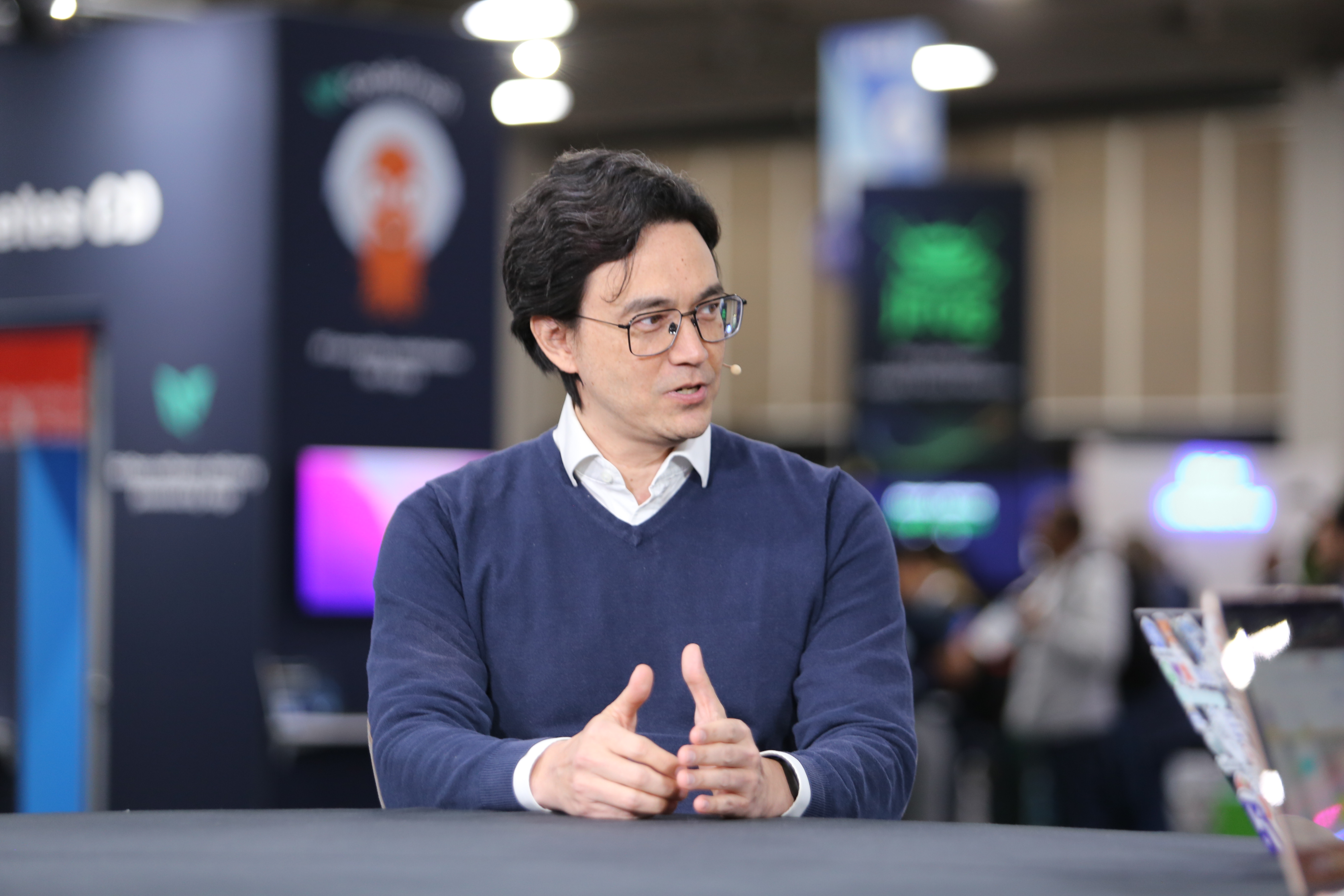
The last day of KubeCon North America in Salt Lake City was filled with energy and excitement. Jay, a newcomer, is impressed by discussions on new technologies and multi-cloud strategies. He highlights Akamai's acquisition of Linode leading to the Akamai Connected Cloud. Jay explains the importance of Kubernetes for edge services and introduces the Akamai app platform for easier Kubernetes deployment. He mentions Akamai's contribution to CNCF projects and emphasizes simplicity and customization in application deployment. Jay touches on sustainability and effi...Read more
exploreKeep Exploring
What is the goal of providing developers or platform engineers with a quick way to get started with Kubernetes on Akamai and other associated upstream projects?add
What is the reason behind Akamai's decision to contribute to the Kubernetes community?add
What work is Akamai currently doing in the open source space and what partnerships do they hope to announce soon?add
What event are they covering on The Cube and who is the host?add
>> Good afternoon and welcome back for the last time to Salt Lake City, Utah. We're here at the very end of day three of our three days of coverage at KubeCon North America. My name's Savannah Peterson, joined by the ultimate rock star after that swag segment, Rob Strechay. Rob, we have had so much fun this week.
Rob Strechay
>> This has been great. I think again, some of the major themes that have been going on have really played out. Especially today with community, a lot of the excitement that's going on, a lot of multi-cloud and how to make things simpler is playing out. I think again, that really leads well into this last segment where we're going to bring it home strong.
Savannah Peterson
>> We're going to bring it home so strong. Jay, thank you so much for taking time during the busy week to come hang out with us.>> Well, thank you so much for having me. I'm excited to be on the last session.
Rob Strechay
>> You're bringing it home-
Savannah Peterson
>> Yeah, we save the best for last, Jay.
Rob Strechay
>> Best for last. Exactly.
Savannah Peterson
>> And you go after the deaf and heart of hearing working groups, so no pressure. It was pretty inspiring.>> I know. It was. I was extremely inspiring.
Savannah Peterson
>> You really got to bring the heat for us today, Jay. This is your first KubeCon, North America->> It is.
Savannah Peterson
>> How has the week been?>> The week has been absolutely amazing. I think the amount of energy at this KubeCon has been great. The amount of conversations that you've had around new technologies, everybody's excited about how to make things better. I've just had so many deep conversations that I'm going to leave here with thousands of ideas on what to do next.
Rob Strechay
>> Yeah.
Savannah Peterson
>> I love that. I want to hear some of those as we get farther into this interview. Multi-cloud is having a moment. It's been a conversation that we've had countless times on the desk this week. It's interesting, because I will say it was not necessarily as much of a conversation at the last few KubeCons. How do play into that? That's probably got to feel good for you.
Rob Strechay
>> Yeah, it does feel good. I think if we take a look back at how people approach cloud, at first it was one cloud. We're going to go all in into one cloud. We want to train everybody on one cloud. Then people thought about concentration risk and they said, "Oh, well, we need at least another cloud." What we saw then was they would take a particular architecture or particular application and just duplicate that into another cloud. Now, as people sort of think about the ways that they're tying these platforms together and people are adopting more cloud-native ways of deploying these applications, they see that they have an opportunity to take services, specific services and find the best price performance per service across each of those clouds. So now we have sort of a more complex problem that we need to be able to solve in order to make sure that people have an opportunity to build the best applications that they can.
Rob Strechay
>> For those who aren't aware, you guys were on the main stage today. You're making some pledges and donations. Go into that and help people understand Akamai fits into this whole community.>> Absolutely. Three years ago we made an acquisition of Linode and launched Akamai Connected Cloud, so we've integrated Linode onto the Akamai backbone. You get all the great performance that you have from the Akamai network, and now with this new cloud computing capability. As we move forward, what we want to do is to try to get compute closer to those end users. Just like Akamai did with content, with our CDN, and getting content closer to those users, we want to do the same with compute in order to create new possibilities and new capabilities. Now, a requirement for that is really the Kubernetes platform, because it allows you to have these services that you can actually move to the edge. Today it's kind of difficult to manage that, as I mentioned, across multiple clouds. One of the things that we announced this morning was the Akamai app platform. And that allows developers or platform engineers to get quickly started not just with Kubernetes on Akamai, but also with the other associated upstream projects, which are really required to make a platform that is usable by developers. It's super exciting to be able to get people to get quickly started with Argo or with key management, secrets management, everything you need for your developers, and everything needed to take away that toil from those developers and automate as much of that as possible with these golden paths in order to get those things set up quickly. Really what we want to do is make sure that we, in the words of Alan Kay, "Keep the simple things simple, but make sure the complex things are possible." So while we do provide those golden paths, we also want to make sure that they can customize that for the requirements of their applications and for their organization. Another thing that we announced actually early this year, but we're still excited about, is a million dollars worth of funding for the CNCF projects. We want to make sure that while we're using the capabilities of Kubernetes for our customers that we're giving back to the community as well.
Savannah Peterson
>> That's a huge contribution and a huge deal. I'm curious because... First of all, you said quite a few things that we're going to have to unpack, but I'm going to go in reverse order. Million dollars, not a small sum of money. Why now?>> Look, Akamai, previously we're really not known as a cloud company first of all, and we're really not known as an open source organization. This year we upgraded our membership from silver to gold and we really want to make sure that we continue to do more and more with CNCF. As Akamai expands to this vision of distributed cloud and knowing that we really need this community to help us get there, that they're going to be able to help us solve problems that we can't solve on our own, realizing that all of us are smarter than any one of us, it's important to give back, and it's important to make sure that we are providing a space for that and that we can be a part of the conversation and be a part of this community.
Savannah Peterson
>> I love that. That culture of collaboration that you just hit on is so cool. And I really do feel, Rob and I have been talking about it all week, the open source community has always been very collaborative, but it feels particularly collaborative right now as we skateboard off this on ramp of Kubernetes and AI adoption really just intersecting, so the timing of all of this is super cool. You talk about these golden pathways, I like that visual by the way. It took me immediately to Wizard of Oz and I thought, "Oh, that's kind of fun. I hadn't really thought about it like that." What are some of the use cases and customer applications that you're seeing out in the wild currently and that you also think will benefit from the announcements this week?>> Look, the app platform as example, so Kyverno, it's a great project, being able to apply security to Kubernetes. Now they announced a new Kyverno certification. Imagine me as a developer trying to set up a platform, a Kubernetes platform, but also realizing not only do I have to know how to install Kubernetes and go and get configured on that and possibly get certified on that, now maybe I need to go learn Argo and get certified on that. And now maybe I need to go and learn Kyverno and go get certified on that, and understand how to set up the security. That could take me months, even as a team in order to make sure that I've got something that's enterprise ready, that's production ready, that gives me everything I need to run my applications for a multi-tenant team. What the app platform does is, it automates a lot of that. So you can with a few clicks, so within 20 minutes, have all of that deployed and ready to run and ready to work with and to play with. Along with that it comes with pre-configured Kyverno, so it actually has a lot of those policies already implemented for you, so you do not have to do the work. Again, it allows you to get started very, very quickly, but again, with that sort of ability to customize when you have to and when you need to.
Rob Strechay
>> I think that's been one of the things that we've been talking about, is really how to make things simple. From the app platform perspective, how many of the upstream projects can you actually bring down or is there a subset or is it like you said, just all of them or how does that work?>> There are a lot of projects. Certainly we don't support all of them at the moment, but we're going to onboard as many as we can over time. Right now we have a little over a dozen of the upstream projects. We're trying to focus of course on the most popular ones that need that basis for implementation. But we have the ones you would think about needing for any sort of application, secrets management, key management, security, your service mesh, all of that stuff can be pre-installed.
Rob Strechay
>> How do you see the workloads? Like you said, you're newer to being a hyperscaler. How do you see the workloads and how do they differ from workloads that people are maybe taking to Google, AWS or Azure?>> I think one of the things that we see when people are using Akamai is they want to make sure that their workloads are in fact portable across clouds, so they are very concerned about lock-in to a certain particular ecosystem. That's one of the things we definitely wanted to avoid with the app platform. While we provide a highly opinionated implementation, we want to make sure that they can configure it as well. And you can actually export that as well, so you can take that Helm chart and actually go anywhere and run that same thing. We want to give you that capability, but we also want to make sure we continue to give that portability and we are really supporting an open network in the true sense of the word.
Rob Strechay
>> Because you have that network backbone and you have a lot of this and you have the expertise and the CDN's side of the house, do you see that organizations are looking at you guys in a new wave maybe for inference. Where I need this to be close to my customers, I need it to be quick. Maybe not as much on the training side where I'm going to maybe a GPU crazy... We had some of the other guys on earlier in the week round, that they got hundreds of thousands and millions of GPUs. How do you see that playing out? Because that would seem like a perfect...>> You're absolutely right.
Savannah Peterson
>> That's good question, Rob.>> Yeah, I think when people think of Akamai, the first thing they probably think of is CDN's, and they think of that aspect and over the past 10 years adding security then on top of that. But always more from a different perspective than some of the hyperscalers, because we're edge in rather than data center out. We're going to use that heritage, we're going to use that capability we've developed over the past 25 years to continue to grow those edge capabilities with things like compute. So instead of being just a content delivery network, why couldn't we actually create a compute delivery network and get as close to the users or to the device or to the autonomous vehicle, whatever it is you're trying to speak with at the edge, get as close to that as possible. What we see is this new era of more affinity computing. Whether it's a user, whether it's a specific type of processor, whether it's your data, where does that process need to run in order to be the most effective?
Savannah Peterson
>> You brought up something that... I happen to be a big edge fan here, so you're speaking my language, but in case folks aren't familiar, why is it so important to get that as close to the end user or to the device or to the car?>> For a number of reasons. The first one is latency. By being able to get this at the access edge where Akamai has these points of presence, you can actually reduce it to single digit millisecond latency to those users in those locations-
Savannah Peterson
>> That's insanely fast.>> Today we have like 4,100 edge points of presence. We don't have all of those enabled with compute yet, but over time we're going to be able to enable hundreds of those locations to get as close to the users as possible. So one of them is latency. The other reason you might want to do that is for regulatory purposes, perhaps data has to stay in a certain location. Let's say you're doing an AI inference model. Let's say it's a healthcare related AI inference model. How can I make sure that that is going to stay as private as possible? How are we going to make sure that stays in a particular geography inside of a country or even in a metro area? There are all sorts of capabilities like that. Another one that you might want to look at are things like sustainability. Perhaps I want this to run not necessarily in the closest to the user, but the most sustainable location, the one with the least amount of carbon emissions. I could choose to do that. What if I wanted to be able to run that where it has the least amount of cost, it can choose to actually move those workloads around the globe based on the needs of my organization?
Savannah Peterson
>> Go for it.
Rob Strechay
>> I'm sorry.
Savannah Peterson
>> We're both excited. That's all that matters, clearly.
Rob Strechay
>> I think again, I love that you brought up the sustainability angle because of the fact that's-
Savannah Peterson
>> Yeah, that's where I was going to go....
Rob Strechay
>> it's a big thing. We were chatting about it before we got up here, there's only so much power. What are you seeing from people when you have those... You're out of Singapore. We know that's a very constrained power from the government runs all of that. We're seeing that Virginia has no more power for data centers at this point. We're hearing about Three Mile Island being turned up by the Microsoft guys again and Constellation. How do you see that conversation with people around sustainability and how is that driving some of their choices with it?
Savannah Peterson
>> It's interesting, because in any conversation around sustainability also ends up being a conversation around cost efficiency as well, because they really are trying to maximize what they can get with while having also the least amount of impact. Having a sustainability agenda is also having a cost efficiency agenda. From what I've seen, I think AI is probably the perfect poster child for a lot of wasteful spending, in terms of... Couldn't agree with you more there. Just in terms of developers always wanting the fastest GPUs, even if they're not fully utilizing those GPUs.
Savannah Peterson
>> Or even a fraction of utilization, frankly.
Savannah Peterson
>> Exactly. And while there's a lot of work being done to try to slice those up in order to get greater efficiency, there are also a lot of GPUs at the high end that aren't being used, which are lower cost and allows individuals to have very great efficiency. We did a quick study around particular GPUs that we have found for stable diffusion image gen AI model. By picking the right GPU, you could actually decrease the cost by 80% and therefore also have a more efficient capability there as well, and you end up saving money. It's appropriate to look at your cost spend. It's appropriate to look at sustainability of an organization through that financial lens as well. It's extremely important.
Savannah Peterson
>> You just hit the nail on the head there. The reality is by designing a more sustainable system. You're going to not only be better for the planet, but save money and probably make your team a lot happier because you're not just sitting there with resources that aren't utilized.
Savannah Peterson
>> Again, speaking about AI specifically, I think in 2023, everybody was just throwing as much money as they could at it. 2024 has really been all about operationalizing that. I think 2025, they're going to be focusing on how they can efficiently run that at scale.
Savannah Peterson
>> I think you nailed it on the head. We're going to have to have you on as an analyst sometimes today. You've certainly got your finger on the pulse. I love it. Speaking of 2025, I got one more question for you. When we're hanging out in London, what do you hope to be able to say then that you can't yet say today?>> Look, at Akamai we're doing a lot, especially in the open source space at the moment. We're working on a few partnerships that we hope to be able to actually announce in a few weeks.
Savannah Peterson
>> Exiting.>> But we'll be able to talk about more in London. It's around partnerships around new ways of computing. Looking at, it was a really interesting thing around somebody... It was yesterday during the keynote, people were talking about being a hype ostrich, like if you're burying your head in the sand and are trying to hide from the hype rather than getting ahead of it. In London we'll be able to talk about how Akamai is trying to get ahead of some of that hype.
Savannah Peterson
>> Okay. Hype ostrich is a vibe. Someone needs to meme that at this point. That's like a space saver, Rob.
Rob Strechay
>> I know. Oh, definitely. I could see that outfit coming out.
Savannah Peterson
>> Oh, Jay, thank you so much for sharing your insights with us. What a brilliant close to the day. I really appreciated your time.>> Great. Thank you again so much for the time.
Savannah Peterson
>> Yeah, absolutely. Rob, thanks for being just the best all week.
Rob Strechay
>> This has been fun. It's been great. It was a great wrap up here. I think again, just bringing it home strong and a great vibe. Great .
Savannah Peterson
>> I feel that sadness in my heart because it's all over now.
Rob Strechay
>> Yeah, I'm looking forward to London.
Savannah Peterson
>> I am looking forward to London too. We're all going to have to have some fun in London.
Rob Strechay
>> On April Fool's day, no less.
Savannah Peterson
>> I know, but it's not a joke that will be there. And neither-
Rob Strechay
>> Exactly.
Savannah Peterson
>> And it's no joke that the content is going to be absolutely outstanding in London, folks. Thank you for tuning in to all of our coverage here on The Cube. 30 segments from Salt Lake City, Utah here at KubeCon North America. Big thank you to our fabulous production team, Anderson, Coney, Christian, Tony. Also to the sales squad here, we've got Frank, we've got Mike. And to the whole gang back at home doing pre-records. There's a lot of stuff that goes on behind the scenes that y'all don't see that I am very grateful for. Not to mention they have to listen to my voice all day, which in itself deserves a trophy. My name's Savannah Peterson. Thanks for tuning in to our fabulous coverage here of KubeCon North America 2024. You're watching The Cube, the leading source for enterprise tech news.