We just sent you a verification email. Please verify your account to gain access to
KubeCon + CloudNativeCon NA 2024. If you don’t think you received an email check your
spam folder.
In order to sign in, enter the email address you used to registered for the event. Once completed, you will receive an email with a verification link. Open this link to automatically sign into the site.
Register For KubeCon + CloudNativeCon NA 2024
Please fill out the information below. You will recieve an email with a verification link confirming your registration. Click the link to automatically sign into the site.
You’re almost there!
We just sent you a verification email. Please click the verification button in the email. Once your email address is verified, you will have full access to all event content for KubeCon + CloudNativeCon NA 2024.
I want my badge and interests to be visible to all attendees.
Checking this box will display your presense on the attendees list, view your profile and allow other attendees to contact you via 1-1 chat. Read the Privacy Policy. At any time, you can choose to disable this preference.
Select your Interests!
add
Upload your photo
Uploading..
OR
Connect via Twitter
Connect via Linkedin
EDIT PASSWORD
Share
Forgot Password
Almost there!
We just sent you a verification email. Please verify your account to gain access to
KubeCon + CloudNativeCon NA 2024. If you don’t think you received an email check your
spam folder.
In order to sign in, enter the email address you used to registered for the event. Once completed, you will receive an email with a verification link. Open this link to automatically sign into the site.
Sign in to gain access to KubeCon + CloudNativeCon NA 2024
Please sign in with LinkedIn to continue to KubeCon + CloudNativeCon NA 2024. Signing in with LinkedIn ensures a professional environment.
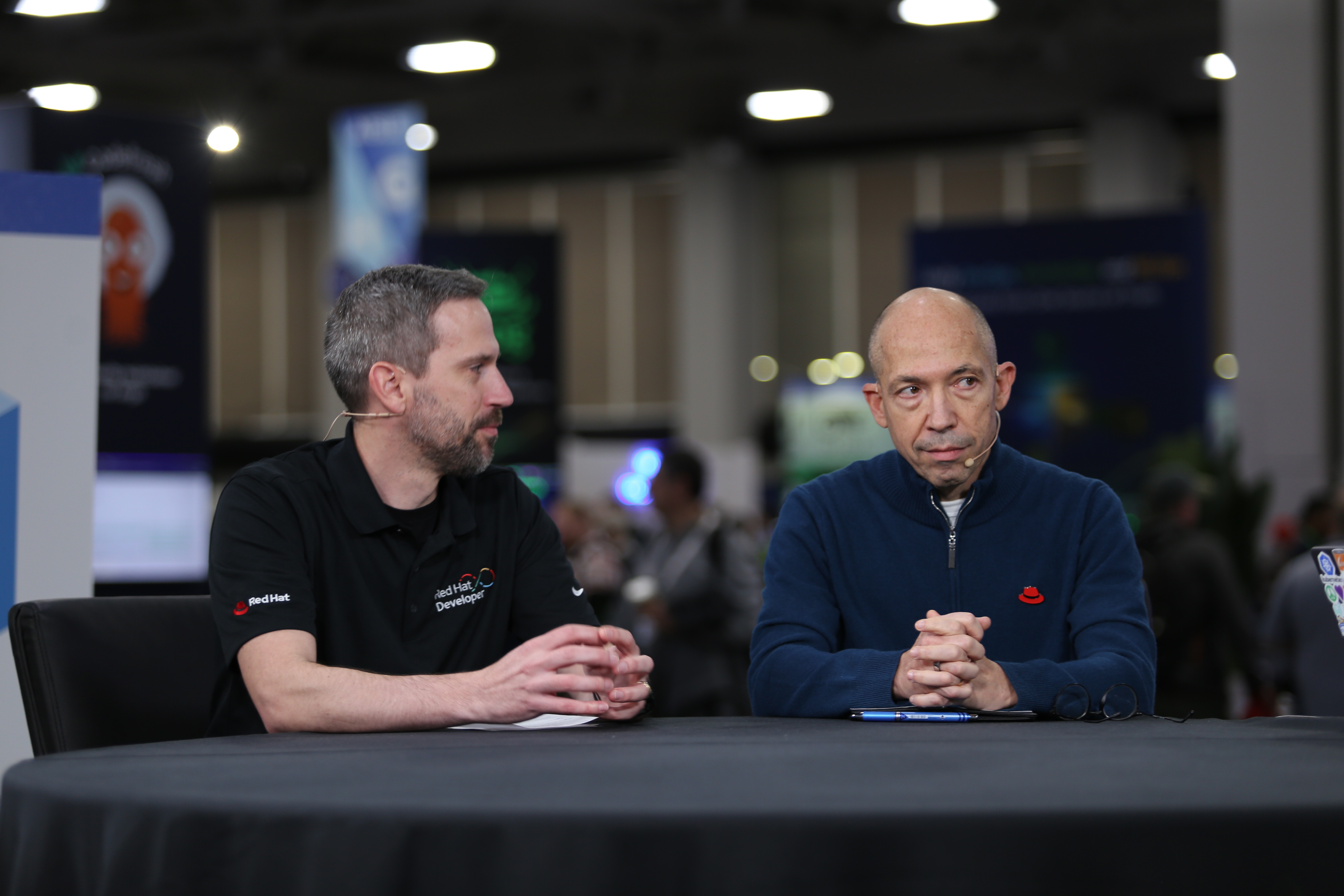
Sr. Director, Developer Marketing & StrategyRed Hat
Kevin Dubois
Sr. Principal Developer AdvocateRed Hat
TheCUBE is covering developments in Kubernetes at KubeCon North America. Advancements in AI, security, connectivity, and developer productivity have been discussed. Tools like Podman Desktop, Podman AI Lab, and Developer Hub are available for developers. RailAI and Granite models have been introduced for using AI models, along with advancements in legal compliance. OpenShift AI and Java integration tools like Quarkus make it easier to incorporate AI into projects. Backstage and Red Hat Trusted Software Supply Chain help secure projects from software supply ch...Read more
exploreKeep Exploring
What is the Red Hat Trusted Software Supply Chain and how does it work?add
What is the challenge of connectivity and management in multi-cloud environments, and how does the concept of interconnectivity management help address this issue?add
What are the predictions regarding AI and organization in London's use of technology?add
>> A good afternoon nerd fam, and welcome back to Salt Lake City, Utah, where we are halfway through day two of our three days of coverage here on theCUBE at KubeCon North America. Very exciting show so far. My name is Savannah Peterson, joined by the one and only Rob Strache. Rob, today's flying by.>> Today is. I'm on a Rocky Mountain High. It's awesome.
Savannah Peterson
>> You have been on a little bit of a Rocky Mountain High this trip.>> And I think, again, this continues to roll with things that's really important for people out that haven't maybe engaged with Kubernetes. Again, with 50% of the people being new, their first KubeCon, this next topic is, I think one of the, if they check nothing else out, they should be checking out where this came from and how this all because it will make their life so much easier.
Savannah Peterson
>> Yeah. Speaking of making our lives easier, our two next guests make our lives easier on the desk every time. Kevin and Ignacio, thank you so much for coming to hang out with us again.>> Our pleasure. Thank you so much for having us.
Savannah Peterson
>> It's always a little bit of a party when we get to hang out. And I selfishly really look forward to these segments, so thank you for taking the time. I love that we get to focus on the developers for the next few minutes. What's been going on since the last time I saw you guys? Let's start there and then talk about what's going on now.>> Okay. Maybe I can start. Last time we talked mainly we were putting all the focus on developer productivity. You remember that?
Savannah Peterson
>> Right. Of course.>> The inner loop, the outer loop. Now we have evolved AI, security, connectivity, everything now is connected. So we are starting to move the conversation within developers because Podman Desktop, we have now Podman Desktop, that was the starting point for that conversation. And now Podman Desktop have Podman Desktop AI Lab. That is how to test your models, the LLMs inside your own machine. So that is evolving. At the same time we have developer hub that is also evolving. That is how you enable new developers to come. Then security, the last time we talked, we still don't have the product in GA. You remember that?
Savannah Peterson
>> I do.>> Now product is in full GA. So we have customers already, and then we are starting to talk about connectivity, with Connectivity Link because the new world is more and more multi-cloud, multi-service so you need to have all those apps connected across clouds, across services. So those four areas is what basically we're talking about here at the booth that is, it's not only productivity, but is what is coming next, what is critical for developers.
Savannah Peterson
>> Yeah. And I think the main goal also is make sure developers are happy with everything. And making it relatively easy for them to use because it's really fascinating. You walk through all different stands and the different projects, like holy moly, there's so many projects, it's overwhelming and there's a lot of really cool projects for developers too, but how do you actually use those. So we're trying to make opinionated choices, bring some of those projects together to actually be able to use them without being experts in security, or expert in AI or expert in platform engineering. Yeah.>> Yeah, I think that's why I'm always excited to talk to you guys because for me, it's how do you give the infrastructure people the stuff, the kit to make their top off their stack, put the icing on the cake so that they can interface with their customers, which are the developers. And now more and more the data scientists and data engineers who are doing the AI. How have you seen it evolve, especially with AI coming into the picture in the past year?
Savannah Peterson
>> Honestly has been a bit of a mess in the sense that it's a bit overwhelming. Do you remember that we were talking about the cognitive love last time we talked?
Savannah Peterson
>> Yes, we were.>> Yeah. 75% of developers are struggling with the cognitive love.
Savannah Peterson
>> I use that fact all the time. Thank you by the way, for giving me that.>> And this was before the whole AI explosion.
Savannah Peterson
>> Exactly.
Savannah Peterson
>> I know. This was back in Amsterdam. I think we were talking about that.>> And this was without AI. So I was like, okay. And now what we are talking, this is our recent pictures is guys hugging face. You need to start looking into hugging face. Do you know how many models do you have in hugging face?>> Thousands.>> Over a million
Savannah Peterson
>> I was going to say, I was going to guess a million models.>> Over a million models.
Savannah Peterson
>> I was going to say multi-100,000.>> Exactly. Over a million models.
Savannah Peterson
>> That is wild. Can you believe that's happened that fast? It's a sidebar. That's insane.
Savannah Peterson
>> And you are a developer and what do you do? How you are going to pick the right model? How you are going to pick the right version of that model?
Savannah Peterson
>> That's impossible.>> Exactly.>> And how do you use it?
Savannah Peterson
>> Yeah.
Savannah Peterson
>> You couldn't even read and understand what each one of those models were all at once over the course of a year probably. That's insane to think about that.>> Not to talk the cost of those models, of using those models, not to talk about if that model is legally usable in your country, in your region, or not.
Savannah Peterson
>> Great point.>> Can you trace the information that is part of that model? So the level of complexity is evolving like no one.
Savannah Peterson
>> So how do you see what you guys are providing to customers and the communities providing to customers really breaking down that complexity? Again, talked about Podman and Podman Desktop. Love that it runs on a Mac. Love all of that. But you also have InstructLab and other pieces of tech that help break down that complexity.>> Right, yeah, exactly. Because there's not just one type of developer. So we need to meet data scientists, which are also developers. We have platform engineers that are developers. We have the classic application developers. So that's why we're investing in different areas. On the one hand, okay, how do we provide a platform for these data scientists to be productive? How do they, because okay, they know how to train this data and create these models, but then how do you operationalize them? So we have OpenShift AI and everything that goes around that. Then we have the traditional application developer that's like, "Yeah, you need to use this model." Okay, cool. How? So a lot of developers, they want to play around with models but don't know. Do we go to Chat GPT? And it's like, no, because we don't know what it's trained on necessarily. A lot of organizations say, "You cannot use those kinds of models. Here's a model that you can use." Where do we run this? We'd like to run it on our local machine because we developers, we like to do everything local. So we have for example, Podman AI lab where you can just run a model on your local machine. Then InstructLab, which is really interesting to train models without being deep experts into these technologies. So it spans the whole spectrum. Even for Java developers, we're investing in Quarkus as a Java stack where you have really smooth integration with LangChain4j. Into models and integrating AI into really traditional Java application. So really try to cover a lot of ground.
Savannah Peterson
>> If you recall also since the last time we talked, we have also RailAI, we introduce RailAI at Summits.
Savannah Peterson
>> Yeah.
Savannah Peterson
>> That is you put together, you have RailAI, you put together the Granite models, you put together the InstructLab in order to do the fine-tuning on those models, and then you put all the drivers and infrastructure that you need. So that is the whole package. It's a great starting package for people that don't know how to start, which are the right models, RailAI is the solution for that. And we present that at Summit and we have great adoption on that. So we expect. And also Granite with IBM, we are investing a lot on Granite models. It's giving us a grade of infrastructure. There is another concept that is critical that is indemnification. You need to start learning that your model is traceable. So the data where you are reading that model, you know where that is coming from. So the indemnification also because remember that the legal team in your organization needs to know where are you obtaining that information? That information needs to be traceable. So all those concepts is what right now we are teaching to developers in order to say, "Guys, here are all the pieces of the puzzle. Please ensure that you are aware about all the consequences of picking a model. Please remember that maybe that model that you are using is not the right one because of course or because of legal issues." So these are new things for developers are critical.>> And for people who might've been sleeping under a rock, the Granite models are actually something that was open sourced by IBM.>> Correct.>> With the help and people part of the Watsonx family of stuff and things like that.
Savannah Peterson
>> Yeah, that's a good point, Rob.>> Yeah. And I think this continues to help, I would say again, move things forward. And there's also the Java side and Langchain and other stuff that you guys are working with as well to make easy as part of that. Because there's also OpenShift AI and which has been there a little bit longer than the RailAI stuff. But very similar for people who are in the Kubernetes space as well. And I think that opinionated stack is key because like you said, a good on-ramp, Podman AI, which I will check out now, is one of those things that you need a starting point. And you need it because really how do you get to productivity and how do you get to faster moving? That's a great starting spot. But then based on Backstage, you got Developer Hub as well, which is again one of my favorite things. So tell us where's Developer Hub at these days, and what are the communities been? We were talking, you said it was packed. Great day zero, Backstage day. Give us a little insight into that.>> You can start.>> Yeah, so we've seen adoption of Backstage explode. So there's how many thousand?>> 3000 enterprises.>> He has the numbers always.>> Yeah, 3000 enterprises adopting Backstage.
Savannah Peterson
>> That's a lot.>> Yeah. And over 20,000 developers already using Developer Hub.
Savannah Peterson
>> Developer Hub.>> Wow.>> Yes.>> And remember that this was year in January this year.
Savannah Peterson
>> I was, yeah, that is impressive.>> We are talking about less than a year, over 20,000 developers already using Developer Hub.
Savannah Peterson
>> Talk about validation on the project.>> Right. Yeah. It really addresses a pain point for a lot of organizations.
Savannah Peterson
>> Yeah. That's a community saying, "Hi, thank you."
Savannah Peterson
>> Yeah, exactly.
Savannah Peterson
>> Yeah.>> And again, at Backstage Con, we have some great customers. That was amazing. There was some testimony for American Airlines that there was a question from the audience, "Why are you doing this?" "Because it's saving us millions. Millions. Just to adopt the process that we are following, took us sometime ago, five years to implement, now it's taking us seven months to implement the legal changes in American Airlines." He was at the stage and I was like, "We can finish the event now."
Savannah Peterson
>> I was just going to say, and that's a wrap folks.>> Okay. We need to say nothing else. All yours. Thank you so much. Yeah. But again, this is the moment when you see the real adoption of customers.
Savannah Peterson
>> The real adoption and the real realization of ROI. Shoot, you can't argue with saying, we're saving millions of dollars and we're a brand that people know all around the world.>> He was like, "Guys, five years to seven months. That's the gap of using versus not using the product. In order to implement the legislation changes-"
Savannah Peterson
>> That's so tangible.>> Yeah.
Savannah Peterson
>> And just magnanimous. I want to call out something that we haven't talked, well, you touched on it a little bit earlier, Ignacio, but on security. I have some interesting data here in my notes. The only reason I'm staring at my computer. 742% annual increase in software supply chain attack. That is cray and very shocking. I know you mentioned security. How are you helping on the security side? Because that's a massive potential risk.>> Exactly. Yeah. And that ties in really nicely to the Backstage story as well, because as a developer, security is always like an afterthought. Maybe after there's been an audit or you know->> That's what shift left's about, right?>> Yes, exactly.>> It is your fault.>> Yeah, it is. But so for developers to really bring that to the foreground, you need to again become expert in all these different security. There's a lot of really cool projects with SIG Solar and Gwok, but yeah, again, cognitive overload to learn all those things. So with Backstage, it's really interesting because you can create templates. So if you want to start a new project, you can integrate in that template, an opinionated pipeline that does all your different, creates the software bill of materials, signs it, makes sure it verifies it. Once you deploy, that attestation that it is from you does the same with the container image. You got your scanning built into that pipeline. So this whole kind of supply chain, signing the different tasks of your pipeline, making sure that you were the one that actually built this artifact and this container image. So having that in a pipeline already built in so that when I create a new project that's already there. I just need to commit my code and it goes through that and stops the pipeline. Obviously if there is an issue, I can go back quickly without waiting for X amount of months. So that's something that we're working on.>> And there is another tool, not only the signer but also the analyzer. You have a tool that analyzes how risky is the code, how risky are the dependencies that you are taking in order to build your app. So it gives you, you can live with that. That is a bit of red. So having the capacity to analyze your pipeline is also critical. Not only having the capacity to sign that you are doing the right things, but where are those sources coming from? And that is the Red Hat Trusted Software Supply Chain that the game was in earlier stages, the last we talked, now we have GA. And now I think that in the next months we are going to see a bit of the same as we were seeing for Developer Hub. That is customers getting that, installing that and starting to see the benefit of that. But again, we are starting on that. GA has been recently announced. We have the first customers coming. We will see much more about those in the upcoming months.>> And another thing that you have in preview that I think again has been a theme throughout all of today and this week in general, is really the whole multi-cloud. And with connectivity link, it helped people understand what connectivity link's about and how that helps people with this multi-cloud environments.>> Right yeah, yeah. Because another piece of the puzzle, we started with Kubernetes and cloud environments. We're going all into one environment because that's what we know. And now we see a lot of organizations that either are going back on-prem with certain workloads, or they want to be on-prem, but they need bursts of GPUs from the cloud or they want to use different clouds together. How do you do that?
Savannah Peterson
>> How do you do that? How do you connect all of that?>> Exactly. So there are different solutions, but they're mostly deeper in the infrastructure. You have to be really network experts, know all this stuff. So what we're working on is a higher level interconnectivity component where it's more for the developers to say, "Hey, I want to run this here, I want to run that. We connect it together." It's like API management, but beyond that. It's interconnectivity management because we can also do things that we could do in API management in terms of rate limiting, making sure somebody has authentication and authorization by different personas or by different components. Yeah. So that's the exciting next thing that we're working on.>> Yeah, we have service interconnect that is the next frontier on that. Still, again, early stages, we don't even have GA on that, but we are starting to collect the impact. And you mentioned a lot about the community that is collecting the feedback from the community about what they need. We are in that stage. And for shooting London, we will see more about that.
Savannah Peterson
>> Well, that leads me to my final two questions. First of all, you're very good at always bringing us a little treat and a little prop. I'll hold this up for the camera there.>> I promised you that book in the last time we saw each other in Paris.
Savannah Peterson
>> You did, you did. I know. No, which is great. Remind the audience what they can learn in here.
Savannah Peterson
>> Well, basically it's a book about the developer portal Backstage and what you can solve with that. So I think that developer portals are the hub for being sure that you do things right as a developer. And we call it, you remember that we talk about it, the platform engineer concept. That is who is the developer developer inside the company? Who is bringing that infrastructure so the developer doesn't need to reinvent the wheel every time a new developer join the company, where do I start? How I can become productive? What are the best practices? Where do I have the documentation? What are the right tools to use? All of that is what a developer portal is created for. So in the book, you can learn all about that. You can learn about the best practices, you can learn how to create the right documentation, how to use the right tools. That is the objective of the book. We are giving that for free in our website in developers.redhat.com, but obviously we have a printed copy here that, by the way, we have the authors here, so we are signing the books. So yeah, it's a great way. You know that we are trying to explain to developers how they should do things and this is a great way to start with that.>> Awesome.
Savannah Peterson
>> Absolutely. All right, you teased this out and thank you for holding true on your promise.>> My pleasure.
Savannah Peterson
>> You're very good. You got a sharp memory that way. It's not lost on me. You teased this out a second ago, but I'm going to ask it directly so we can use it for the sound bite to sizzle and tease London. What do you hope to be able to say when we're over there that you can't yet say today? Kevin, I'll start with you.
Savannah Peterson
>> I think we're going to see more interesting things around AI because, well, that's the hot topic right now.
Savannah Peterson
>> Bold prediction.
Savannah Peterson
>> I know. Crazy, right?
Savannah Peterson
>> You're going out of the box with that one.>> But I think that is going to change is right now I think that in London we will be much better organized in the sense that right now, honestly, it's a bit mess. In the sense that it's too much the complexity, there are too many options. I think that for London, we will come with a much more clear. These are the right, not the right, but what we recommend as the models to use. This is for this use case. That is for that use case. We will have a much more curated way to explain you should combine these different pieces for these topics, you should combine these other pieces. Because right now we are in the face of that. We are in the face of even agreeing ourselves, which has the right tools to use for what? When do you use this Granite model versus that Granite model? And what is the difference for an insurance company? I think that right now we are still painting all the pieces of the puzzle in London. I will bring you much clearer puzzles.
Savannah Peterson
>> Love this.>> With the pieces. Much clearer for insurance. Take that. I strongly, you can reinvent the wheel yourself, but take that piece of the puzzle.
Savannah Peterson
>> But start with our puzzle piece.
Savannah Peterson
>> I recommend you to start with the puzzle. If you don't want to study one million different models in hugging face.
Savannah Peterson
>> Thought of that, our cognitive low conversation overwhelms me especially at this altitude. Oh my goodness. Wow. Okay. Kevin, Ignacio, time has gone by so fast. This was rad. Thank you. So fun as always. So educational. Can't wait to see you both again in London and have fun. And maybe we can do a puzzle together.>> Oh, there you go.>> I'll bring you a puzzle next time.
Savannah Peterson
>> Yes. That'll be our next fun adventure. Rob, thank you so much as always. And thank all of you for tuning into our fantastic three days of coverage here at KubeCon North America in Salt Lake City, Utah. My name's Savannah Peterson. You're watching theCUBE, the leading source for enterprise tech news.