We just sent you a verification email. Please verify your account to gain access to
KubeCon + CloudNativeCon EU 2025. If you don’t think you received an email check your
spam folder.
In order to sign in, enter the email address you used to registered for the event. Once completed, you will receive an email with a verification link. Open this link to automatically sign into the site.
Register For KubeCon + CloudNativeCon EU 2025
Please fill out the information below. You will recieve an email with a verification link confirming your registration. Click the link to automatically sign into the site.
You’re almost there!
We just sent you a verification email. Please click the verification button in the email. Once your email address is verified, you will have full access to all event content for KubeCon + CloudNativeCon EU 2025.
I want my badge and interests to be visible to all attendees.
Checking this box will display your presense on the attendees list, view your profile and allow other attendees to contact you via 1-1 chat. Read the Privacy Policy. At any time, you can choose to disable this preference.
Select your Interests!
add
Upload your photo
Uploading..
OR
Connect via Twitter
Connect via Linkedin
EDIT PASSWORD
Share
Forgot Password
Almost there!
We just sent you a verification email. Please verify your account to gain access to
KubeCon + CloudNativeCon EU 2025. If you don’t think you received an email check your
spam folder.
In order to sign in, enter the email address you used to registered for the event. Once completed, you will receive an email with a verification link. Open this link to automatically sign into the site.
Sign in to gain access to KubeCon + CloudNativeCon EU 2025
Please sign in with LinkedIn to continue to KubeCon + CloudNativeCon EU 2025. Signing in with LinkedIn ensures a professional environment.
Senior Director, OpenShift & Security Product ManagementRed Hat
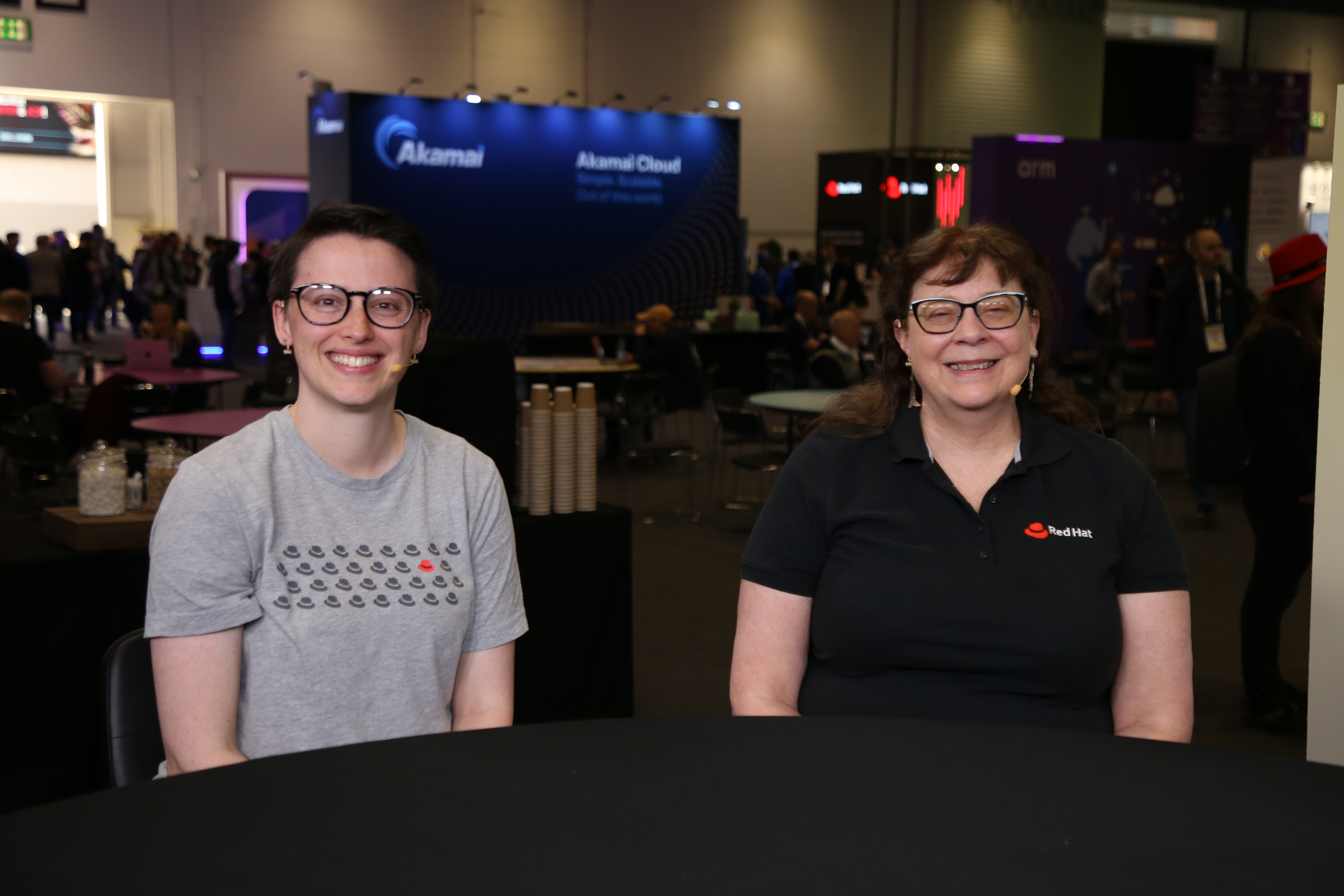
Join Harriet Lawrence of Red Hat, platform engineering manager, and Kirsten Newcomer, Red Hat's director of product management, for an exploration of transformative discussions from the KubeCon + CloudNativeCon EU 2025 in London. This video presents critical insights shared at the event, showcasing thought leadership across the cloud-native landscape.
In this session, Lawrence and Newcomer, esteemed experts from Red Hat, provide their perspectives on developments within the open-source community. Hosted by theCUBE Research, the conversation explores ...Read more
exploreKeep Exploring
What are some positive aspects of the community and energy at the conference being discussed?add
What event did we have yesterday specifically for OpenShift Commons, and which customers were in attendance?add
What are some of the challenges that customers face in platform engineering adoption?add
>> Good morning Cloud Native community, and welcome back to sunny London, England. We're here kicking off day one of KubeCon + CloudNativeCon. Very excited to be here. My name's Savannah Peterson with Rob Strechay. This is how we met.
Rob Strechay
>> It is.
Savannah Peterson
>> We met as KubeCon co-analysts.
Rob Strechay
>> I was on theCUBE for Amsterdam, joining this part of my life's journey from that perspective. And this community is just fantastic. And I think that it's one of the reasons, the energy, just the inclusiveness and just how everybody's working together on open source just makes me so happy.
Savannah Peterson
>> You just brought up a really good point. I think it's the most inclusive conference that we go to.
Rob Strechay
>> I think it is.
Savannah Peterson
>> I love that. And speaking of being inclusive, we have two of the coolest humans here at the entire show over to my right, Harriet Lawrence and Kirsten Newcomer. Thank you so much for taking the time.
Kirsten Newcomer
>> Our pleasure.
Savannah Peterson
>> Your energy and your smiles are quite contagious in the best possible way. I know there's a lot going on at Red Hat. We always have conversations with y'all at these events. Break it down. Give us the news. How is it being here with our community? I know you've already had a few days on the ground probably interacting with everyone. Kirsten, I'll start with you.
Kirsten Newcomer
>> Sure. So we had OpenShift Commons yesterday, as you know, which was really a terrific event, great turnout. We had five customers, I believe, so ABB, Adobe.
Savannah Peterson
>> Nice.
Kirsten Newcomer
>> We had Wells Fargo. Really great. And I know-
Savannah Peterson
>> Casual brands.
Kirsten Newcomer
>> Yeah, right. And I'm missing a few, and I'm going to get dinged for not remembering them all. But it was really awesome.
Savannah Peterson
>> It's okay. You still get a gold star in my book.
Kirsten Newcomer
>> Okay. So we had a great day. Lots of good conversations. And looking forward to the rest of KubeCon.
Savannah Peterson
>> I know, it's going to be so fun. Harriet, tell me a little bit about those conversations. I can imagine getting to chat with the community is really invigorating for you.
Harriet Lawrence
>> Yes, absolutely. I spent half my time at Commons yesterday and half my time at ArgoCon. The Argo community is just incredible. It's getting bigger every year and everyone's so enthusiastic. It's just wonderful to see. And to have so many customers come up and just want to chat about what they're up to and the new stuff that's coming up in the different communities, it's so nice.
Savannah Peterson
>> Yeah, it is nice.
Rob Strechay
>> Yeah, I actually jumped in for a little bit-
Savannah Peterson
>> I was going to say, you said hello....
Rob Strechay
>> into the day yesterday, and I was going around through a lot of the different days. I didn't go to Commons because it was oversold.
Savannah Peterson
>> Yes, it was. So cool.
Rob Strechay
>> I let people who really could get more out of it go and get that. So I gave-
Savannah Peterson
>> How generous of you.
Rob Strechay
>> Well, I mean I think again, it's about all these ... But there's just so much going on, like you were talking about. And I think there's a lot of things that are coming to OpenShift that we see here. You're contributing, there's just ... What are some of the things that are going on with GitOps, Service Mesh and some of the other different, I guess you could say projects that are going on that are ... Service Mesh seems like it's having a moment right now. And in the community it kind of had been talked about a lot, but now it seems like it's actually being implemented a lot more. What are you seeing out of that?
Harriet Lawrence
>> Yeah, it's definitely increasing in popularity. And I'm so glad that people are finding it because it can be such a powerful tool. And I think that as customers get more mature in their kind of application delivery and how their developers want to be interacting with their applications, they're finding things like Service Mesh where they can fine-grain control how they're deploying, where they're deploying to be so valuable. And even Argo interacts with Service Mesh in Argo Rollouts. So you can do blue-green deploys and canary deploys. So it's more like advanced, really specific deployments using Service Mesh. And it's just so cool to have them all interact together.
Kirsten Newcomer
>> And we were able to, our Service Mesh V3, which just got released and in March, early March, is really Istio-native now. We're really excited about that. So much easier to keep up with the community, to stay connected, to benefit from everything the community's doing, including Ambient Mesh, which is coming.
Savannah Peterson
>> That's exciting.
Kirsten Newcomer
>> That is.
Savannah Peterson
>> Red Hat's one of the most community-focused companies out there. Obviously we're here with the open-source community. So this is a true community celebration. But I'm really curious, so when you're innovating and you're coming up with these feature sets and building out the platform for your solutions, what is the feedback loop like with the community? How often are both of you say talking to your users?
Kirsten Newcomer
>> We talk to users, customers quite a lot. So Commons is just one example. There's also a Red Hat Summit of course coming in May, Boston this year, but-
Rob Strechay
>> I'll see you there.
Kirsten Newcomer
>> Great. I will be there.
Savannah Peterson
>> I was going to say, I know who's excited about that.
Rob Strechay
>> For me, that's home time as well.
Kirsten Newcomer
>> Yep, me as well. But there's also just regular engagements. And whether they're virtual ... And I will say, even pre-pandemic ... Well, we've probably had more in-person calls pre-pandemic, but post we're doing a combination of in-person and virtual. And there's a lot of discussion. I think one of the interesting angles with the community and our customers, some of our customers also participate in the community directly, contribute code, some don't. So we are their voice into the community. And one of the things that I find is always appreciated, love to hear what you think, is when we bring customer requests to the community with specific details.
Savannah Peterson
>> Oh, cool. So it's truly the full flywheel and holistic loop. Go ahead, Harriet. Yeah.
Harriet Lawrence
>> Yeah, we definitely see that in GitOps. We have a couple of customers that we work really closely together who are just passionate about the product as well as what they're up to, which is really nice to see. So one of the ones forward, we had that relationship first where they would feed back their requirements to us. But gradually they've gotten more involved in the community and now they're contributing. They're doing talks at ArgoCon. They're-
Savannah Peterson
>> Cool.
Harriet Lawrence
>> Yeah, it's lovely.
Savannah Peterson
>> I love to hear that, when you're teaching other folks how to be more engaging and more involved and immersed. Man, it's how we just build better together without waste and a whole bunch of stuff. This is an interesting space to have a platform engineering conversation. Things have evolved a lot since we've been here, even since you and I started covering KubeCon together. What are the challenges? What's that evolution look like? Harriet, I'm going to start with you. I saw you just go, "Oof." There's a little bit going on there. Yeah.
Harriet Lawrence
>> It's a big area. Yeah. I think it depends on the stage that you're at, what the challenges are. So we still see a lot of our customers at the beginning of their adoption. They're still new to platform engineering. But you see folks right at the other end who are right at the front edge. They're doing lots of really exciting stuff in platform engineering. They've had platform engineering teams for years. They're very involved in it. So I think depending on where you are, it's a bit different. At the start, you're still trying to get an understanding of what you have today and what platform engineering can bring for you, and how that change from purely development over to DevSecOps, a style of doing things can make such a difference. And then once you're a bit more involved and getting into all the different communities and kind of leveling up your community usage, you see really specific problems coming in, like how do we manage scaling of our platform team? How do we help our developers the best that we can and give them enough access to do their jobs while also maintaining our organizational restrictions and our regulatory compliance and all that kind of stuff?
Savannah Peterson
>> Yeah. Well, and you get to have a lot of conversations. I overheard you talking before we went live with folks of very different scale and size of company, of project, of a lot of different things. Are the conversations that you're having similar across the board, or do you notice a difference in say challenge depending on their size? Kirsten, I'm going to go to you on that one. Harriet gave you the ...
Harriet Lawrence
>> Yeah.
Savannah Peterson
>> I saw it.
Kirsten Newcomer
>> So I'd say there is a difference depending on size. And one of the things that we often talk about with waves of change in the industry, like this happened with the adoption of containers and Kube and the importance of that. And now we're seeing with AI-enabled apps similar. You need to think about not just the tools but the people in the process as well. And so in a smaller company, folks can talk to each other, like stakeholders in different teams-
Savannah Peterson
>> It's a great point actually....
Kirsten Newcomer
>> are much more easily connected. So I think it's easier to do DevSecOps. They also have less legacy code typically. And it's just easier to make those transitions. In a big company you have folks who have been in established roles for a long period of time. They're used to managing things the way they manage them. The idea of shifting security left ... Yes, sorry, security's a big part of what I think about all the time.
Savannah Peterson
>> You don't need to apologize. If you're not thinking about security you're not building sanely right now.
Kirsten Newcomer
>> Right, right.
Savannah Peterson
>> So it's crazy. Don't sell yourself short.
Kirsten Newcomer
>> But it's hard to really understand that shift left, whether you're a developer who's like, "Oh, I'm just used to being told what to do and they get in my way." Or you're a security team who's used to having a certain control. And the idea of how do we collaborate to move faster, to do better, that's still a challenge, especially more so in a big company. I think that's ... Yeah.
Rob Strechay
>> I love how you brought-
Savannah Peterson
>> Conversational silos. That's a great point. Yeah.
Rob Strechay
>> I was going to say, I think, again, when you talked about the collaboration, to me-
Savannah Peterson
>> It's a great point....
Rob Strechay
>> shift left, I had this epiphany about three weeks ago-
Savannah Peterson
>> Tell us....
Rob Strechay
>> and I go, "It's not really about shift left, it's about the collaboration." It's kind of meet in the middle-
Savannah Peterson
>> It is. You're right....
Rob Strechay
>> and things like that. And I think a lot of what is actually helping to enable that, and I'm interested to get your feedback on where OpenShift is going with this, is really around GenAI. To me there's skills gaps, there's people who may be newer to the community, newer to certain tools. And GenAI is one of those things that's good at answering that or helping build Helm charts or what have you, coding different pieces. What are you seeing with GenAI and its impact, especially within OpenShift?
Kirsten Newcomer
>> Well, so we are working on OpenShift Lightspeed, it's still in beta. We're hoping to GA later this year. So as you say, part of the thinking there is having that ... I mean, everybody's dealing with chat bots. The challenge is making them strong and have good information so that they can give you the right information back. Certainly being able to talk to a bot that can generate YAML for you is a win. Like network policies is a challenge for Kube customers. Why not let's see if that can be done via bot and then just test it. I also, for security policies that can be automated, let's do those with a bot. Let's talk to GenAI and get some help defining those as well. And be interested to hear what you're seeing.
Harriet Lawrence
>> Yeah, I think a lot of the more applicable use cases in the pipelines, GitOps, CICD area is around deploying the models rather than using GenAI. So the existing products that we've got, like Tecton and Argo, they're seeing a lot of use for building the models, deploying the models, especially out to edge locations and stuff like that. Whereas we haven't seen the evolution of GenAI in the products themselves yet. So that could be coming. A little bit of a preview.
Rob Strechay
>> Yeah, when you talk about that, because I mean a lot of data right now that's being used for GenAI is on-prem and in big way. And to me it is about the pipelines, so where Service Mesh and other things come in. What are you seeing from these deployments around servicing GenAI and building that out on Kubernetes? Is that really a lot of the use cases people are pushing in on?
Harriet Lawrence
>> I think a lot of our customers are still early in their-
Savannah Peterson
>> I was going to say....
Harriet Lawrence
>> journey there. They're really interested. They want to know more. They want to see what's out there and try stuff out. But kind of larger scale production deployments are still taking time.
Kirsten Newcomer
>> Yeah. And I think as we talked earlier about different size companies, like there are industries where a certain type of, it might be more predictive AI than GenAI, has been in use for some time-
Savannah Peterson
>> That's a very good point....
Kirsten Newcomer
>> like fraud detection in the financial industry, for example. And so we're seeing, there's all this talk and hotness about GenAI, but I think predictive AI is equally important. I think what's kind of interesting is you have an opportunity with some of these for greenfield app development. And it's always easier to adopt newer technology that is really better suited for that environment. So one of our investments at Red Hat is to extend our existing pipeline investment to ensure it supports the AI developer, right? That we can store models, deploy models. RAG is a big thing. One of the things when you talk about data being stored on premises, not everyone is going to want that data moved off premises. So how do I really supplement a model that I may deploy by talking back to an on-premise dataset? And that's where something like the networking security is really important. But also we're investing in confidential computing, protecting data and use for those sorts of cases as well. And we're hearing different things from our customers about who's going to run on-premises versus in the cloud. It's a mix.
Savannah Peterson
>> Let's sit there for a second because I do think it's an interesting thing. We're obviously at CloudNativeCon. But people are ... And this is what we've been seeing. Everyone needs to meet the data where it is, meet the workload where it's best run, whether that's at the edge, on-prem. So this is what you're also saying, we're not just crazy thinking this?
Kirsten Newcomer
>> Right. No, absolutely. Yeah, absolutely. And I think data sovereignty starts to come up as well. Big time.
Savannah Peterson
>> Right. Very important point.
Kirsten Newcomer
>> Yeah. And it's always, to a certain extent, ever since GDPR, it's been present, right? Germany says all German data must stay, citizen data must stay in Germany. So if you're a global company, multinational company, you're already having to manage data in different locations. So what are the connections? What are the feeders between those and maybe something that runs in a cloud? And how do you ensure that that data is protected? And this again is one of the reasons that we really see an opportunity for confidential computing, which I really prefer to talk about is protecting data and use in memory. Because for so many people, confidential computing is, "What? Could you say more?" And it gets really technical really fast. I just want them to take away it's about protecting data and use.
Savannah Peterson
>> Perfect. Can you go through the entire glossary of terms that we use and please make them all that easy because that would be great for our lexicon. I'm here for it. Kirsten, next time you need a new job, hit me up. We'll come up with a dictionary for all of this. All right, I have one last question for both of you. Since we have the luxury and privilege of getting to hang out with you often at these shows, what do you hope to be able to say when we're in Amsterdam next year that you can't yet say today?
Harriet Lawrence
>> Oh my. Well, I'm a little bit biased on the GitOps side, but I hope to say that everyone is loving the 3.0 release, because we're cutting a new major version-
Savannah Peterson
>> Awesome....
Harriet Lawrence
>> as our next release. And that's just so exciting. And there are a couple of really big features coming up just after the 3.0 release. So I hope that we're seeing really good use and that everyone's really excited.
Savannah Peterson
>> I love that. Maybe we can have a customer story together on the show in Amsterdam too.
Harriet Lawrence
>> .
Savannah Peterson
>> Planting that seed right now. I love that. What about you, Kirsten?
Kirsten Newcomer
>> I think more in-depth on customer adoption of confidential computing, how we can help with data sovereignty. And the other thing we're spending time on that we'll be talking about more, and I'm sure in May and beyond, is post-quantum cryptography.
Rob Strechay
>> Wow. There you go.
Savannah Peterson
>> Yes. Talk about closing with a bang. I am perhaps our biggest quantum nerd at theCUBE, so I really look forward to talking to you about that. That's going to be super awesome. Oh my goodness, I wish we had more time. Harriet, Kirsten, thank you so much-
Kirsten Newcomer
>> Thank you....
Savannah Peterson
>> for coming to hang out with us. This is such a joy. Rob, always a joy with you.
Rob Strechay
>> Always a joy.
Savannah Peterson
>> Nothing but joy here on the news desk this week. And hopefully you're having a joy-filled day wherever you might be around this beautiful rock. We're here in London, England at KubeCon CloudNativeCon. My name's Savannah Peterson. You're watching theCUBE, the leading source for enterprise tech news.