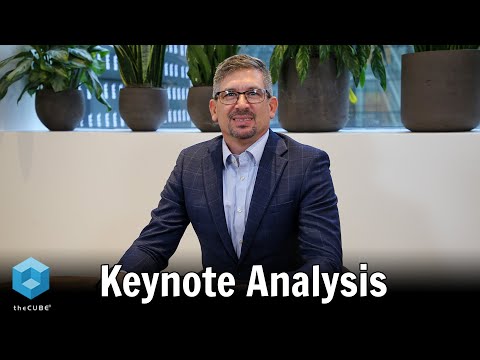
Join us as theCUBE’s Paul Nashawaty engages in an insightful discussion with Rishi Singh of Capgemini Financial Services during the Kong API Summit 2025. Explore the complexities and opportunities presented by modernizing application environments and harmonizing APIs in the era of artificial intelligence (AI).
In this engaging video, Singh shares their expertise on cloud-native practices and their critical role in digital transformation. Both Singh and Nashawaty delve into how enterprises navigate the challenges of legacy systems in the journey toward modernization, spotlighting the importance of APIs in enabling seamless integrations and the adoption of agentic AI. This conversation, filmed at the event, reflects the depth of experience brought by Capgemini, a leader in application services, and insights from theCUBE Research.
Key takeaways from the discussion emphasize the imperative of rationalizing middleware architectures and the need to align AI investments with well-defined service frameworks, as Singh argues. They highlight how Capgemini's proven capabilities help bridge skill gaps in today’s fast-paced tech landscape. Nashawaty of theCUBE Research also shares data-driven insights on the evolving trends in IT budgets toward AI-based projects.
Forgot Password
Almost there!
We just sent you a verification email. Please verify your account to gain access to
Kong API Summit '25. If you don’t think you received an email check your
spam folder.
In order to sign in, enter the email address you used to registered for the event. Once completed, you will receive an email with a verification link. Open the link to automatically sign into the site.
Register for Kong API Summit 2025
Please fill out the information below. You will receive an email with a verification link confirming your registration. Click the link to automatically sign into the site.
You’re almost there!
We just sent you a verification email. Please click the verification button in the email. Once your email address is verified, you will have full access to all event content for Kong API Summit 2025.
I want my badge and interests to be visible to all attendees.
Checking this box will display your presense on the attendees list, view your profile and allow other attendees to contact you via 1-1 chat. Read the Privacy Policy. At any time, you can choose to disable this preference.
Select your Interests!
add
Upload your photo
Uploading..
OR
Connect via Twitter
Connect via Linkedin
EDIT PASSWORD
Share
Forgot Password
Almost there!
We just sent you a verification email. Please verify your account to gain access to
Kong API Summit '25. If you don’t think you received an email check your
spam folder.
In order to sign in, enter the email address you used to registered for the event. Once completed, you will receive an email with a verification link. Open the link to automatically sign into the site.
Sign in to gain access to Kong API Summit '25
Please sign in with LinkedIn to continue to Kong API Summit '25. Signing in with LinkedIn ensures a professional environment.
Are you sure you want to remove access rights for this user?
Details
Manage Access
email address
Community Invitation
Rishi Singh, Capgemini Financial Services
Join us as theCUBE’s Paul Nashawaty engages in an insightful discussion with Rishi Singh of Capgemini Financial Services during the Kong API Summit 2025. Explore the complexities and opportunities presented by modernizing application environments and harmonizing APIs in the era of artificial intelligence (AI).
In this engaging video, Singh shares their expertise on cloud-native practices and their critical role in digital transformation. Both Singh and Nashawaty delve into how enterprises navigate the challenges of legacy systems in the journey toward modernization, spotlighting the importance of APIs in enabling seamless integrations and the adoption of agentic AI. This conversation, filmed at the event, reflects the depth of experience brought by Capgemini, a leader in application services, and insights from theCUBE Research.
Key takeaways from the discussion emphasize the imperative of rationalizing middleware architectures and the need to align AI investments with well-defined service frameworks, as Singh argues. They highlight how Capgemini's proven capabilities help bridge skill gaps in today’s fast-paced tech landscape. Nashawaty of theCUBE Research also shares data-driven insights on the evolving trends in IT budgets toward AI-based projects.
Vice President & Head of Cloud and Custom Applications Practice, North AmericasCapgemini
In this Kong API Summit ’25 interview, Rishi Singh, who leads the cloud-native practice at Capgemini Financial Services (Chicago), joins theCUBE Research’s Paul Nashawaty to unpack what it really takes to modernize heritage middleware and prepare for agentic AI. Singh explains why enterprises must first rationalize federated stacks across tools like MuleSoft, DataPower/IBM API Connect, WSO2 and Apigee, and build a well-structured API layer before layering AI on top. The discussion dives into emerging agent frameworks and protocols – MCP, A2A and LangChain age...Read more
exploreKeep Exploring
What is the role of Rishi at Capgemini?add
What is your experience at the summit and your role at Capgemini?add
What is the relationship between Capgem's certified Kong professionals and their ability to support organizations in various stages of modernization?add
>> Hello and welcome back to Kong API Summit 2025. My name is Paul Nashawaty. I'm a practice lead and principal analyst at theCUBE Research, focused on application development and application modernization, and everything that has to do with developers and application, and monetization. And today, I'm coming to you live from the show floor of the event. I'm joined by Rishi. Rishi, how are you doing?
Rishi Singh
>> I'm doing absolutely fabulous, Paul. It's like the second day for the summit and I'm enjoying it so far. Yeah.
Paul Nashawaty
>> Great. Great to have you on theCUBE. Why don't you tell the audience a little bit about yourself, a little bit about Capgemini?
Rishi Singh
>> Yeah, so I lead the cloud-native practice, and then it was delivery for all of the private services based out of Chicago. Yeah.
Paul Nashawaty
>> Nice. Yeah. I mean, well, this is the best place to be at, that all the stuff that's happening here is around cloud native development and such. I liked our discussion we were having before we got on the long live here. We were talking about the growth of environments and how organizations are moving. In my practice, I focus on past, present, future, how applications are modernizing and such, and I look at heritage applications and those heritage applications. Sometimes people call them legacy, but sometimes people don't like those words. So, in the cloud world, we like to use that heritage world to harmonize. But one of the things I like to talk about is Capgem has over 200 certified Kong professionals. That's a lot. So, you act as a service provider or service delivery partner for your organizations working in these spaces. So, regardless of where organizations are in their own journey, whether if they're early starting their modernization or if they're fully mature, you have them covered. Is that true?
Rishi Singh
>> That's true, and I think, as I said, and it's good that you call them as heritage and not legacy, because a lot of them, they still have their most critical workloads running on those, right?
Paul Nashawaty
>> Oh, yeah.
Rishi Singh
>> Whether you call it MuleSoft or you call it DataPower, or now the most, I would say advanced version of DataPower, which is the IBM APIC, right? So, a lot of them, they are trying to modernize that whole space. And now with AI coming into the fold and the agentic AI, so they want to get that whole middleware layer correct, because anything which they can even want to do in terms of agentic AI, the underlying API should be, it should be very well-structured and well-formed, and well-defined. So, they're just trying to address that space. And so, that's more of a, I would say, newer use case for agentic AI. But a lot of them, they're still trying to solve the traditional problems with all of their legacy integration. And I will use the word legacy.
Paul Nashawaty
>> No, it's fair. It's a fair point. I mean, there's a lot of times these organizations are truly trying to get off their legacy environments, because of a variety of different reasons. But a lot of times these organizations will run into skill gap issues, skill challenges. Their current staff doesn't have the ability to move, because they just don't know it. They have to up level and move faster. I see that's where Capgem can come in. Capgem can come in, you're well versed in Kong, you're well versed in these APIs. You can harmonize the connectivity, especially when you think about some of the tech stack that was announced here, like the MCP servers, the agents, the machine-to-machine connectivity. That's important. And would you agree that's what your client's looking for?
Rishi Singh
>> Yeah, so I think all of these standards, whether you call it MCP or A to A, or even the Lang chain agent model, these are important. And these are, I would say the basis of the whole agentic AI. Even though I believe that the MCP protocol itself, while it is open source and there's a lot of traction in terms of how you can use it, it's not production there yet. There's a lot of security gaps or vulnerabilities around this. But yeah, I think that's where all of our clients, they're trying to see how they can make use of these agentic workflows. So, I would say know this MCP, A to A, all of these protocols, they are still there. And I see there'll be a lot more, I would say specifications coming for data privacy, which will evolve over a period of time. But to build all of this, I think all you need is underlying part of all of this is APIs. So, I think that's where I would say in order to get to an agentic AI, you certainly need a very well-formed and well-defined API layer.
Paul Nashawaty
>> Yeah, I agree with you. I think that you have to harmonize them, the APIs in order to have the connectivity to the data sources behind it. But from your vantage point, what do you see as the largest challenge enterprises run into from your perspective?
Rishi Singh
>> So, I would say before they can even think of agentic AI, I would say they still have to do a lot of, I would say a combination of modernizing their entire middleware stack. And that could be anywhere from rationalizing a set of old-school ESPs, like the likes of DataPower web methods. And then, they have a bunch of these, what you've termed as the heritage ones, so likes of IBM APIC, or MuleSoft, or even in some cases, even WSO2 or Apigee. So, they're using all of this in a very federated way. So, they need to rationalize all of that and have a very standard middleware layer. And on top of that, they need to also rationalize the set of services, right? Because right now, if you go to any large enterprise and you say, "Do you have a catalog which can define all of your business capabilities? And what are the underlying services they're running on?" I think 90% answer would be no. So, I believe they should certainly invest in rationalizing all of that, because the moment you bring in agentic AI, that problem is going to compound, because AI, if it doesn't have the right mapping to your actual services, it might go haywire.
Paul Nashawaty
>> Yeah, I hear you. And that's one of the things that, that's why a lot of organizations are a little bit shy just starting and going in a direction, because they're not sure if that's the right direction.
Rishi Singh
>> Exactly.
Paul Nashawaty
>> But your organization, you've created accelerators built on top of comp, right? Specifically around modernization, right?
Rishi Singh
>> Yep.
Paul Nashawaty
>> What measurements do you put in place to provide this?
Rishi Singh
>> That's a good question. Well, I can talk a lot about technical measurements, but I believe there are a lot of business KPIs which we try to tell based on the actual problem which you're trying to solve. So, whether it is a time to market or time to launch new features, new product, or just basically it could be as good as being able to do releases every two weeks. So, I think it's a combination of all of that. But I would say depending upon, for an insurance company, it'll be how good is their overall claims handling thing, or how good is their overall premium audit? And what goes underneath a premium audit system or a claims handling system is where if you modernize your underlying core systems, who does that, is all the technical KPIs. But I think from business perspective, it's basically how much agility you have in your business. And then, business agility could be, again, broken up based on the domain you are in. But I would say those would be the actual business KPIs we try to stick to whenever we are trying to do any of these large scale things.
Paul Nashawaty
>> I think that's smart. I think those KPIs make sense. What advice would you give the audience around people that are reluctant to get started, even though they know they need to? I mean, what we're finding in our research, we're finding that 25% of IT budget is allocated to AI-based projects, but yet those AI-based projects are undefined. They don't know what to do with it. And so, it's this use it or lose it. But then there's also some, an edict down from either the board or the CEO, or the company itself saying, "Hey, you need to move in this direction."
So, CIOs are sitting there going, "I need to figure out what to do." How do you advise somebody on that?
Rishi Singh
>> I would say it'll be a mix of first trying to get your core building blocks straight, which as I said, trying to standardize your set of services, the actual business capabilities, trying to standardize your core middleware integration architecture. And then, I would say start small. I think if you, I'll just give a few example, which can comes up. Like for an insurance company, it could be as simple as how can I reduce my overall premium audit leakage, right? I'm just bringing it. So, just take that business flow and see how can you possibly, where all you need virtual actors, whether it is on the business side or all on the IT side. And if you have to orchestrate that entire workflow and automate it, what are the different possibilities at is part of time? And that could be a combination of making use of any of these agent-based frameworks, trying to interact with a lot of LLMs and then try to identify the correct LLM for the purpose. And then, of course, trying to have the right set of guardrails wherever you need a human in the loop to identify the efficacy of the actual output given by the AI. Just try it as one simple business use case and then see whether the investment, which you have done in your underlying services business capabilities, whether those are good enough. And I think once you are able to prove out that one business use case with a set of say, two, three, four, five, six, maximum 10 agents, then you know that, okay, you have picked out all of the basics for making an agentic workflow. Then you can think of, "Okay, now I need to scale." But I believe there is a lot more before you can achieve that. Like I just said, the MCP protocol itself has a lot of security vulnerabilities in it. So, nothing is, in my view, currently is ready yet for production. And this space is going to evolve. Right now you can make use of MCP along with third-party tools to address the vulnerability gap, and you can still come up with actual workflows, which is production-ready, but they have to invest time in doing that.
Paul Nashawaty
>> Of course, of course. And this is also coming from a place where of experience. Capgem won the strategic partnership award of Excellence, Partnership of Excellence at Kong API Partner Awards recently. That's really cool. But if I think about looking forward, everything you just said, how do you see Capgem and Kong, really the partnership evolving to meet the needs of the enterprises, and then next wave of digital and AI focus environments?
Rishi Singh
>> So I think that's exactly was everything yesterday's what we discussed. But just to double-click on that, we are currently seeing three kinds of engagements. One is migration from all of these heritage, legacy is based into Kong. The second is they want basically just green field feature development, which is a bunch of custom cloud native apps, where API becomes the core basis. And the third is basically more, I would say, reducing the role of technical depth. So, now, and the fourth, if I have to add one more, which so far we haven't seen, but I think we foresee that that's where clients will come in, and some of the clients who are trying to be the frontrunners in that. They're trying to embrace the whole agentic AI workflow. So, that piece so far has not come up yet, but we are trying to build capabilities and accelerators in all of these four areas. So, the one for which we got awarded was actually for the first use case, where we are able to accelerate moving up from heritage tools onto Kong. And that whole thing is all gen AI enabled. It's not as agentic yet, it's gen AI enabled.
Paul Nashawaty
>> Yeah.
Rishi Singh
>> Same thing you're doing for your regular green field development and also for your tech debt. In fact, we have developed something, at least the tech debt part. And then, the fourth use case basically is mostly to realize the agentic workflow. We are working together with them. We are trying to understand what is their AI gateway capability, how are they handling this whole LLM proxy layer? What are the ways in which they're trying to address the actual security vulnerability of MCP servers? And then we are trying to see, okay, how we can leverage that just to build on top of the eventing and the API gateway as one unified platform. So, yeah.
Paul Nashawaty
>> Yeah. Rishi, this has been great. It sounds like you have a plan. You have a method to the madness of trying to put it all this together. Rishi, thank you for being on theCUBE today. This has been great. Your insights have really been impactful. I think it really is powerful to help the organizations get going. So, thank you for being on.
Rishi Singh
>> Thank you. Thank you for having me, and it was nice. And enjoy the rest of your conference. Thank you.
Paul Nashawaty
>> Thank you. You too. You too. I am Paul Nashawaty and I'm coming to you live from the show floor at Kong API Summit 2025, on theCUBE, your leading source for tech news.