We just sent you a verification email. Please verify your account to gain access to
Informatica World 2024. If you don’t think you received an email check your
spam folder.
In order to sign in, enter the email address you used to registered for the event. Once completed, you will receive an email with a verification link. Open this link to automatically sign into the site.
Register For Informatica World 2024
Please fill out the information below. You will recieve an email with a verification link confirming your registration. Click the link to automatically sign into the site.
You’re almost there!
We just sent you a verification email. Please click the verification button in the email. Once your email address is verified, you will have full access to all event content for Informatica World 2024.
I want my badge and interests to be visible to all attendees.
Checking this box will display your presense on the attendees list, view your profile and allow other attendees to contact you via 1-1 chat. Read the Privacy Policy. At any time, you can choose to disable this preference.
Select your Interests!
add
Upload your photo
Uploading..
OR
Connect via Twitter
Connect via Linkedin
EDIT PASSWORD
Share
Forgot Password
Almost there!
We just sent you a verification email. Please verify your account to gain access to
Informatica World 2024. If you don’t think you received an email check your
spam folder.
In order to sign in, enter the email address you used to registered for the event. Once completed, you will receive an email with a verification link. Open this link to automatically sign into the site.
Sign in to gain access to Informatica World 2024
Please sign in with LinkedIn to continue to Informatica World 2024. Signing in with LinkedIn ensures a professional environment.
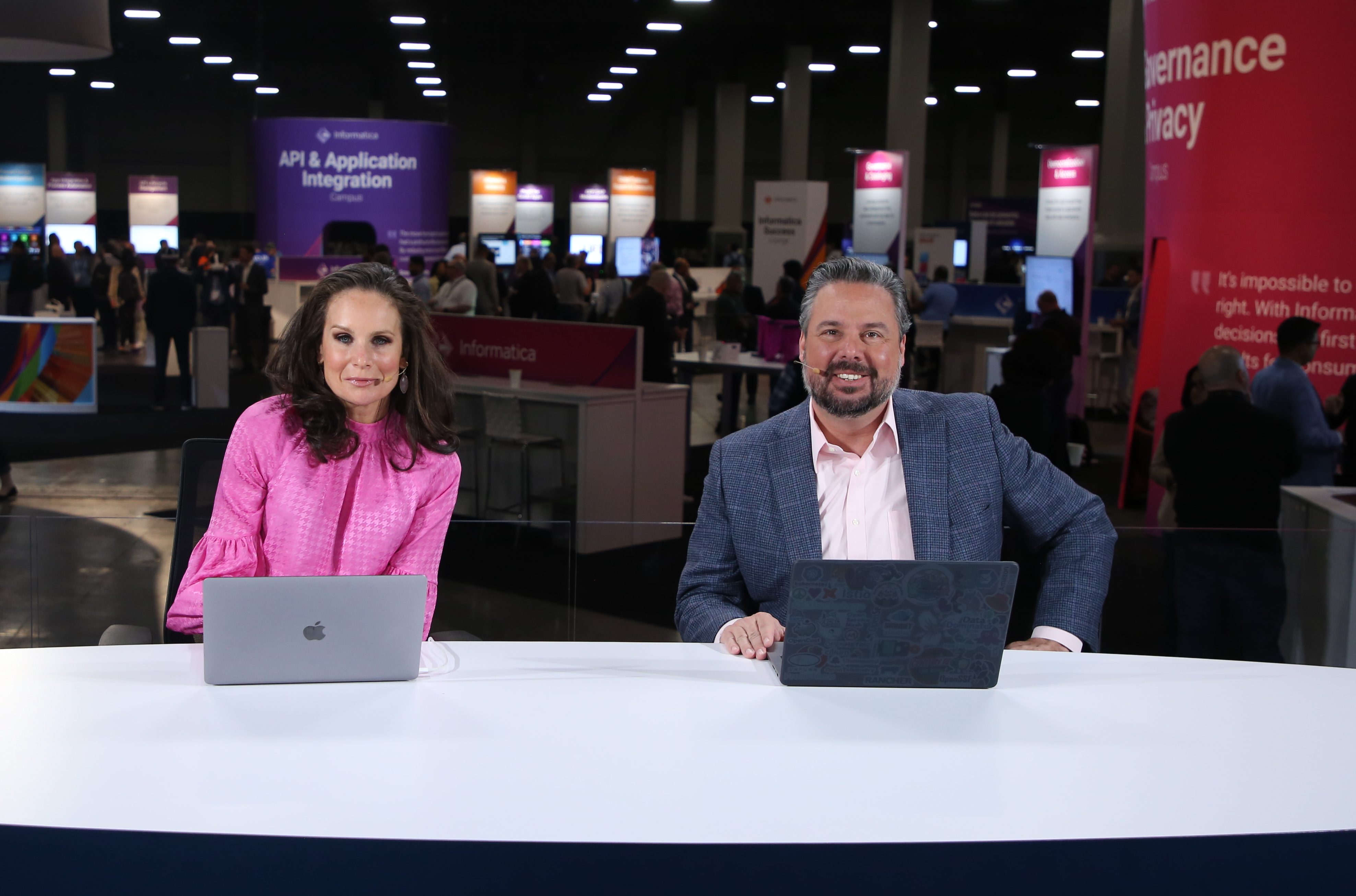
>> Hello everyone and welcome back to theCube's live coverage of Informatica World. We are kicking off day two of three days wall-to-wall coverage. I'm your host, Rebecca Knight, sitting alongside my co-host and analyst, Rob Strechay. Rob, we're both fresh from the keynote. Lots of big announcements, refinements, new innovations, a coming-out party for CLAIRE GPT. What struck you? Let's start with from the beginning. What are your high-level observations?>> Well, I like how they really combined a lot of demos and showing how CLAIRE GPT worked, how you could really easily get to a RAG infrastructure for AI using their designer and being able to actually just take out doing the fictitious claims processing, take out a manual step, put a vector database in, and your LLM in there to do some AI. And I really liked the fact that they talked about a lot of the guardrails in governance and how the rubber meets the road of AI.
Rebecca Knight
>> Yeah, I mean, and to back up, CLAIRE GPT is ChatGPT for enterprise data.>> Correct. Yeah. It's there being a purpose-built version of ChatGPT that goes in and is able to go through. And it not only is actually like you would normally do with the prompting of GPT, but it really has human in the loop. And I think Gaurav actually talked about, and we'll have him on I believe tomorrow, and talked about how it goes through and gives you these steps. And gives you the steps to understand are you doing it right, so you can say, "Yeah, I want to do that," really helping take the toil out of data wrangling.
Rebecca Knight
>> Yes, exactly. I can't hear data wrangling without picturing the lasso and the cowboy hat, but exactly. And I think that that's something you bring up a lot and I really appreciate you bringing it up, because it is such a big part of our day-to-day existence with work is that we are inundated with data and having to think through and remember all these checklists and steps. And the fact that this era of gen AI that we are living in, but really is just beginning, is going to have a massive impact on this cognitive load and the problems that we have with our jobs.>> Absolutely. And I think, again, it was really interesting. They kicked it off with Royal Caribbean being on stage and talking to how they're using this data to really grow their entire revenue. And I think, again, they leaned in. You talk about a company that was hit hard during the pandemic and all of this, and how they've come back and really providing and focusing on better customer experiences through data. And I think being able to get to AI faster, how you do that without having to have all these expertise, I think that was the simplicity message that they tied throughout was fantastic. I thought that was really key to how you do it ethically, within compliance, making sure that you're getting ahead of regulation,. But get there.
Rebecca Knight
>> I could not agree more because I think that's something that's really come out at Informatica World is the importance of engaging business. And in having Royal Caribbean on the main stage talking about the four Cs, clarity, connecting the dots, and he made this really brilliant analogy about looking through the microscope and the telescope. And because it really is this fine balance of making sure you are looking at the details but not getting too caught up in the weeds and looking forward, looking ahead. Another C is change management, and fourth is continuous learning. And these are all really sort of big-picture leadership stuff that we're talking about. Of course it's the technology too, but it is all of the steps involved in really making fundamental shifts in how companies do business. And I think, as you said, this can't get lost in the fact that this is all to the end of trying to improve the customer experience and build loyalty. That's what all these organizations are trying to do here.>> And I think, again, it's how you build these 360 apps that they talk about, and really not just customer 360, but processes and how you're injecting the data and how you understand your data products. Tying it back to MDM, which is the master data management, which is their bread and butter, where they started. But also looking at the acquisition of Privatar and how they're bringing that back in and how they're really looking at building out. And I have to say, not only did they go deep into the tech, to put it mildly, I think what they also did that I would say is very rare, and worth going back and taking a look at, is they talked about their roadmap and where they're going. And leaning in for basically a 30-year-old company that's been doing data. And George Gilbert and I talked about this when we talked to Gaurav a couple of months ago, that really they are doing things that other companies like Databricks and Snowflake and others out there, DBT Labs, are trying to catch up to. They've been doing it for 30 years. And I think there is that history with it, but it's not stale. And I think that, again, bringing CLAIRE GPT and being able to have co-pilots that assist you in building these things out and building out these processes and what we call data products and data apps. I thought it was really good. I thought injecting the demos in to show how easy it was and I loved them talking about, "Hey, we got to show it to believe it" kind of thing. And I think that's so true.
Rebecca Knight
>> I agree. And I think that in doing these demos, showing the increased functionality, showing how easy it is, how simple it is, for people even necessarily without the data science background. I think that that is a very powerful. And also the sneak peek about the roadmap, which as you rightly pointed out, not a lot of companies do let people behind the curtain, but do you think it will lead to this massive increase in productivity that Informatica has suggested?>> I think that they are really putting the tools in the hands of the data engineers that really simplifies it so that they can answer better questions for the businesses. And I think one of the things, for instance, that when Gaurav gave his CLAIRE GPT example and he went into the data lineage, that's hard. That is super hard to go forwards and backwards from the business logic or the business metadata all the way through to the actual data and the lineage. Because they sit on top there and they have the catalog features and it's very robust already, doing it in there across different data silos I think can help accelerate those organizations that are looking to really hone in on, "I got to get a handle on all this data. I have these data silos. I don't know which vector database to use." That cognitive load that we always talk about. I see a lot of pieces in here of the platform that really can help with that.
Rebecca Knight
>> Well, speaking of Lineage, another guest speaker at the keynote was the Chief Data Officer at Takeda Pharmaceuticals, and she came out and she really was talking with Amit Walia, the CEO, about the role of the Chief Data Officer and how much it has really transformed in recent years. And she talked precisely about that. It's about figuring out the lineage. She talked about MVPs being important, engaging the business, and really improving data literacy across the organization because that kind of knowledge, that kind of skillset, is just so increasingly important. And it is up to the Chief Data Officer to make sure everyone is literate.>> Yeah, I thought it definitely was a good juxtaposition between the two customers that were on stage and where they were in their life cycles, because obviously Takeda is way further down. AI has been used in pharmaceuticals for years, traditional AI. So again, when she talked about how many different products and how many different models they're using, it totally made sense. And I think to that point, when you're a Chief Data Officer for a company that... Pharmaceuticals, yes, they make a product, but at the end of the day, data science is at the core of pharmaceuticals. All of the discovery, the drugs, looking at the results of doing to make sure that you can meet FDA regulations and get something launched, data is at the heart of what they're doing there. And I think being able to make it simplified. She talked about all the different data silos, all the different ways they used to do data wrangling, and how they've really used IDMC to really bring the cloud platform, to bring that together in one place.
Rebecca Knight
>> And also cut down the number of vendors, which was I think a very important point. And obviously, Informatica is one.>> Well, Informatica likes that a lot. That's for sure. Again, I liked the pitch for a 30% discount on Caribbean cruises -
Rebecca Knight
>> I'll take that.>> But I also liked the fact that they're talking about how they're using it, and there's a lot of customers here. They rattled off a number of them, but also a lot of the partners. And we're talking to a number of them over today and tomorrow, a lot of the global system integrators that actually have practices with that. And I also liked where it got to where you see that they're leaning into things with Microsoft. Not just Azure GPT and things of that nature, which helps keep it secure and private, the data, but also that they're leaning in with Scott Guthrie. Microsoft Build is going on the same week. There's a lot of people I know at that. It's a busy week all around.
Rebecca Knight
>> It is indeed. It is indeed.>> But Scott Guthrie getting on with the meet and really talking through the relationship and why Fabric and Informatica play really well together. And I think that's critical because, again, it gives Microsoft an advantage in where they're partnered with Informatica who's been doing this forever.
Rebecca Knight
>> Well, we have so much to dig into over the next two days. So much fun to have you on the desk with me. Stay tuned for more of theCUBE's live coverage of Informatica World. I'm Rebecca Knight Rob Strechay. You are watching theCUBE, the leader in tech enterprise news and analysis.
>> Hello everyone and welcome back to theCube's live coverage of Informatica World. We are kicking off day two of three days wall-to-wall coverage. I'm your host, Rebecca Knight, sitting alongside my co-host and analyst, Rob Strechay. Rob, we're both fresh from the keynote. Lots of big announcements, refinements, new innovations, a coming-out party for CLAIRE GPT. What struck you? Let's start with from the beginning. What are your high-level observations?>> Well, I like how they really combined a lot of demos and showing how CLAIRE GPT worked, how you could really easily get to a RAG infrastructure for AI using their designer and being able to actually just take out doing the fictitious claims processing, take out a manual step, put a vector database in, and your LLM in there to do some AI. And I really liked the fact that they talked about a lot of the guardrails in governance and how the rubber meets the road of AI.
Rebecca Knight
>> Yeah, I mean, and to back up, CLAIRE GPT is ChatGPT for enterprise data.>> Correct. Yeah. It's there being a purpose-built version of ChatGPT that goes in and is able to go through. And it not only is actually like you would normally do with the prompting of GPT, but it really has human in the loop. And I think Gaurav actually talked about, and we'll have him on I believe tomorrow, and talked about how it goes through and gives you these steps. And gives you the steps to understand are you doing it right, so you can say, "Yeah, I want to do that," really helping take the toil out of data wrangling.
Rebecca Knight
>> Yes, exactly. I can't hear data wrangling without picturing the lasso and the cowboy hat, but exactly. And I think that that's something you bring up a lot and I really appreciate you bringing it up, because it is such a big part of our day-to-day existence with work is that we are inundated with data and having to think through and remember all these checklists and steps. And the fact that this era of gen AI that we are living in, but really is just beginning, is going to have a massive impact on this cognitive load and the problems that we have with our jobs.>> Absolutely. And I think, again, it was really interesting. They kicked it off with Royal Caribbean being on stage and talking to how they're using this data to really grow their entire revenue. And I think, again, they leaned in. You talk about a company that was hit hard during the pandemic and all of this, and how they've come back and really providing and focusing on better customer experiences through data. And I think being able to get to AI faster, how you do that without having to have all these expertise, I think that was the simplicity message that they tied throughout was fantastic. I thought that was really key to how you do it ethically, within compliance, making sure that you're getting ahead of regulation,. But get there.
Rebecca Knight
>> I could not agree more because I think that's something that's really come out at Informatica World is the importance of engaging business. And in having Royal Caribbean on the main stage talking about the four Cs, clarity, connecting the dots, and he made this really brilliant analogy about looking through the microscope and the telescope. And because it really is this fine balance of making sure you are looking at the details but not getting too caught up in the weeds and looking forward, looking ahead. Another C is change management, and fourth is continuous learning. And these are all really sort of big-picture leadership stuff that we're talking about. Of course it's the technology too, but it is all of the steps involved in really making fundamental shifts in how companies do business. And I think, as you said, this can't get lost in the fact that this is all to the end of trying to improve the customer experience and build loyalty. That's what all these organizations are trying to do here.>> And I think, again, it's how you build these 360 apps that they talk about, and really not just customer 360, but processes and how you're injecting the data and how you understand your data products. Tying it back to MDM, which is the master data management, which is their bread and butter, where they started. But also looking at the acquisition of Privatar and how they're bringing that back in and how they're really looking at building out. And I have to say, not only did they go deep into the tech, to put it mildly, I think what they also did that I would say is very rare, and worth going back and taking a look at, is they talked about their roadmap and where they're going. And leaning in for basically a 30-year-old company that's been doing data. And George Gilbert and I talked about this when we talked to Gaurav a couple of months ago, that really they are doing things that other companies like Databricks and Snowflake and others out there, DBT Labs, are trying to catch up to. They've been doing it for 30 years. And I think there is that history with it, but it's not stale. And I think that, again, bringing CLAIRE GPT and being able to have co-pilots that assist you in building these things out and building out these processes and what we call data products and data apps. I thought it was really good. I thought injecting the demos in to show how easy it was and I loved them talking about, "Hey, we got to show it to believe it" kind of thing. And I think that's so true.
Rebecca Knight
>> I agree. And I think that in doing these demos, showing the increased functionality, showing how easy it is, how simple it is, for people even necessarily without the data science background. I think that that is a very powerful. And also the sneak peek about the roadmap, which as you rightly pointed out, not a lot of companies do let people behind the curtain, but do you think it will lead to this massive increase in productivity that Informatica has suggested?>> I think that they are really putting the tools in the hands of the data engineers that really simplifies it so that they can answer better questions for the businesses. And I think one of the things, for instance, that when Gaurav gave his CLAIRE GPT example and he went into the data lineage, that's hard. That is super hard to go forwards and backwards from the business logic or the business metadata all the way through to the actual data and the lineage. Because they sit on top there and they have the catalog features and it's very robust already, doing it in there across different data silos I think can help accelerate those organizations that are looking to really hone in on, "I got to get a handle on all this data. I have these data silos. I don't know which vector database to use." That cognitive load that we always talk about. I see a lot of pieces in here of the platform that really can help with that.
Rebecca Knight
>> Well, speaking of Lineage, another guest speaker at the keynote was the Chief Data Officer at Takeda Pharmaceuticals, and she came out and she really was talking with Amit Walia, the CEO, about the role of the Chief Data Officer and how much it has really transformed in recent years. And she talked precisely about that. It's about figuring out the lineage. She talked about MVPs being important, engaging the business, and really improving data literacy across the organization because that kind of knowledge, that kind of skillset, is just so increasingly important. And it is up to the Chief Data Officer to make sure everyone is literate.>> Yeah, I thought it definitely was a good juxtaposition between the two customers that were on stage and where they were in their life cycles, because obviously Takeda is way further down. AI has been used in pharmaceuticals for years, traditional AI. So again, when she talked about how many different products and how many different models they're using, it totally made sense. And I think to that point, when you're a Chief Data Officer for a company that... Pharmaceuticals, yes, they make a product, but at the end of the day, data science is at the core of pharmaceuticals. All of the discovery, the drugs, looking at the results of doing to make sure that you can meet FDA regulations and get something launched, data is at the heart of what they're doing there. And I think being able to make it simplified. She talked about all the different data silos, all the different ways they used to do data wrangling, and how they've really used IDMC to really bring the cloud platform, to bring that together in one place.
Rebecca Knight
>> And also cut down the number of vendors, which was I think a very important point. And obviously, Informatica is one.>> Well, Informatica likes that a lot. That's for sure. Again, I liked the pitch for a 30% discount on Caribbean cruises -
Rebecca Knight
>> I'll take that.>> But I also liked the fact that they're talking about how they're using it, and there's a lot of customers here. They rattled off a number of them, but also a lot of the partners. And we're talking to a number of them over today and tomorrow, a lot of the global system integrators that actually have practices with that. And I also liked where it got to where you see that they're leaning into things with Microsoft. Not just Azure GPT and things of that nature, which helps keep it secure and private, the data, but also that they're leaning in with Scott Guthrie. Microsoft Build is going on the same week. There's a lot of people I know at that. It's a busy week all around.
Rebecca Knight
>> It is indeed. It is indeed.>> But Scott Guthrie getting on with the meet and really talking through the relationship and why Fabric and Informatica play really well together. And I think that's critical because, again, it gives Microsoft an advantage in where they're partnered with Informatica who's been doing this forever.
Rebecca Knight
>> Well, we have so much to dig into over the next two days. So much fun to have you on the desk with me. Stay tuned for more of theCUBE's live coverage of Informatica World. I'm Rebecca Knight Rob Strechay. You are watching theCUBE, the leader in tech enterprise news and analysis.