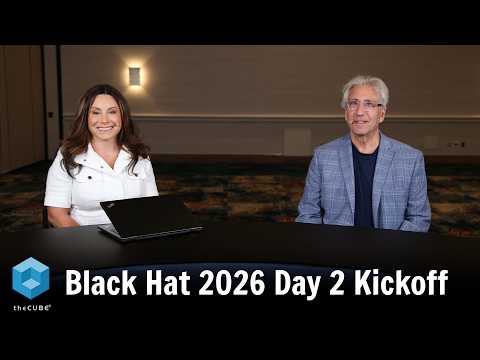
At Black Hat 2026, Krista Case of theCUBE Research hosts a focused conversation with Rika Nakazawa of EigenQ and Robin Braun of HPE about post-quantum cryptography, retrofit PCIe solutions and regulatory timelines. Nakazawa describes EigenQ's applied research, retrofit PCIe offerings and academic grounding; they outline practical retrofit approaches to protect enterprise infrastructure. Braun, vice president of artificial intelligence business development, hybrid cloud, outlines HPE's channel integration, practical deployment strategies and server integration options; they emphasize partnership models for quantum-ready infrastructure.
Case moderates a discussion that highlights the acceleration of compliance timelines and the impracticality of wholesale rip-and-replace strategies. Nakazawa notes mandates are moving toward a January 2027 target and recommends prioritizing retrofit and procurement roadmaps. Braun recommends partnering with channel providers such as TD SYNNEX and focusing on incremental server upgrades and practitioner education to reduce confusion about quantum risk. Participants stress the importance of clear remediation roadmaps, vendor and channel collaboration and integration with hybrid cloud and AI workflows to achieve quantum security.
This conversation provides actionable guidance for security leaders, IT architects and compliance teams planning for PQC migration and quantum risk mitigation.
Forgot Password
Almost there!
We just sent you a verification email. Please verify your account to gain access to
Black Hat USA 2026. If you don’t think you received an email check your
spam folder.
In order to sign in, enter the email address you used to registered for the event. Once completed, you will receive an email with a verification link. Open the link to automatically sign into the site.
Register for Black Hat USA 2026
Please fill out the information below. You will receive an email with a verification link confirming your registration. Click the link to automatically sign into the site.
You’re almost there!
We just sent you a verification email. Please click the verification button in the email. Once your email address is verified, you will have full access to all event content for Black Hat USA 2026.
I want my badge and interests to be visible to all attendees.
Checking this box will display your presense on the attendees list, view your profile and allow other attendees to contact you via 1-1 chat. Read the Privacy Policy. At any time, you can choose to disable this preference.
Select your Interests!
add
Upload your photo
Uploading..
OR
Connect via Twitter
Connect via Linkedin
EDIT PASSWORD
Share
Forgot Password
Almost there!
We just sent you a verification email. Please verify your account to gain access to
Black Hat USA 2026. If you don’t think you received an email check your
spam folder.
In order to sign in, enter the email address you used to registered for the event. Once completed, you will receive an email with a verification link. Open the link to automatically sign into the site.
Sign in to gain access to Black Hat USA 2026
Please sign in with LinkedIn to continue to Black Hat USA 2026. Signing in with LinkedIn ensures a professional environment.
Are you sure you want to remove access rights for this user?
Details
Manage Access
email address
Community Invitation
Rika Nakazawa, EigenQ & Robin Braun, HPE
At Black Hat 2026, Krista Case of theCUBE Research hosts a focused conversation with Rika Nakazawa of EigenQ and Robin Braun of HPE about post-quantum cryptography, retrofit PCIe solutions and regulatory timelines. Nakazawa describes EigenQ's applied research, retrofit PCIe offerings and academic grounding; they outline practical retrofit approaches to protect enterprise infrastructure. Braun, vice president of artificial intelligence business development, hybrid cloud, outlines HPE's channel integration, practical deployment strategies and server integration options; they emphasize partnership models for quantum-ready infrastructure.
Case moderates a discussion that highlights the acceleration of compliance timelines and the impracticality of wholesale rip-and-replace strategies. Nakazawa notes mandates are moving toward a January 2027 target and recommends prioritizing retrofit and procurement roadmaps. Braun recommends partnering with channel providers such as TD SYNNEX and focusing on incremental server upgrades and practitioner education to reduce confusion about quantum risk. Participants stress the importance of clear remediation roadmaps, vendor and channel collaboration and integration with hybrid cloud and AI workflows to achieve quantum security.
This conversation provides actionable guidance for security leaders, IT architects and compliance teams planning for PQC migration and quantum risk mitigation.
In this interview from Black Hat 2026, Rika Nakazawa, chief growth officer at EigenQ, and Robin Braun, vice president of AI business development at Hewlett Packard Enterprise, join theCUBE's Krista Case to discuss how enterprises can prepare for the transition to post-quantum cryptography. Nakazawa explains that quantum-readiness deadlines keep moving earlier, from a once-distant 2040 target to a looming January 2027 U.S. mandate, driven by "harvest now, decrypt later" threats. She notes that most organizations cannot rip and replace their infrastructure on s...Read more
exploreKeep Exploring
By when do organizations need to be quantum‑safe, and how can they prepare their systems now given shifting deadlines, the "harvest now, decrypt later" threat, and the long remediation timelines?add
What best practices should organizations follow to successfully transition to quantum-safe security (preparing for quantum threats) while minimizing disruption to their existing infrastructure?add
>> Welcome back to theCUBE, live here from Black Hat 2026. I'm Krista Case, and we're continuing the conversation around, post-quantum cryptography and how organizations are beginning to plan for how they'll introduce quantum-resistant cryptography into their enterprise environments. Joining me today is Rika Nakazawa, Chief Growth Officer with EigenQ. Rika, thank you so much for joining us.
Rika Nakazawa
>> Thank you very much for having me. Excited to be here.
Krista Case
>> Absolutely. And Robin Braun, VP of AI Business Development with HPE. Robin, welcome back to theCUBE. Great to see you again.
Robin Braun
>> Always great to be with you.
Krista Case
>> Thank you so much. So Rika, I'll jump right in with you. What have you seen change recently? Is preparing for post-quantum cryptography something that's really becoming more important to customers as they think about prioritizing their security investments?
Rika Nakazawa
>> Yeah. Thank you for that immediate jumping right in question. So one of the things that we've observed is, as my former colleague from my NTT days said, that he was at a forum recently that was hosted by, for example, the Department of Homeland Security, and the date by which organizations need to be quantum safe or quantum resilient or quantum ready has been moving left of what was previously center. So that center might have been 2040, 2035, then 2030, then 2029, as Google and Microsoft announced. And now there is a mandate for January 2027, for example, in the US. And so there is this growing anxiety around where cryptography and cybersecurity is going to intersect with quantum because it's been the harvest now, decrypt later fear. But it's also now around how do systems today get ready when it takes time? There's a lag time for systems to be ready in terms of being remediated. But how do they get ready today? And so that's something that we've been seeing and we believe— I was talking to an analyst yesterday and they said, not seeing a lot of quantum on the show floor here at Black Hat 2026, but 2027, that is going to change.
Krista Case
>> Absolutely. I couldn't agree more, Rika. And as you're working with customers, what are you seeing in terms of some of the best practices that they need to follow in order to make this transformation successfully?
Rika Nakazawa
>> So for us, our go-to-market motion is with channel, and that's why having Robin in this conversation is fantastic because working with HPE and what we've been able to announce, especially around HPE Discover, has been really setting the stage from a pioneering leadership position of how HPE is wanting to be able to address the needs of customers in defense, national security, critical infrastructure, as well as some of the regulated industries of healthcare and financial services. And there, one part is education because you say the word quantum in a room and you'll have a million different ideas of what that means. But when it comes back down to the quantum security piece, it's really about being able to do this in a frictionless and seamless way for the customer. And so for us and vis-à-vis the great partners like HPE, it's about being able to have this retrofit solution because there's this daunting task of rip and replace or wait for systems to be ready. And that's one of the first things that we've been able to bring forward in terms of some of our applied research to be able to produce these PCIe systems that are going to be something that we can retrofit together with HPE and our partners like TD SYNNEX in the distribution channel.
Krista Case
>> It is really important because naturally it isn't practical, to your point, Rika, that customers will rip and replace their server infrastructure. And so Robin, maybe you can comment a little bit about what you're hearing from the HPE side of things. Are they thinking about preparing for this? And what are some of the steps that you would recommend customers take?
Robin Braun
>> Well, HPE has been looking at quantum for a while. We are one of the founding members of the Quantum Scaling Alliance. And so there's a lot of things that come out of our HPE Labs and continuing to be very aware of the technology and the security. One of the reasons we love the partnership with EigenQ is looking at how do we take all of this discussion all of this activity and be able to make it more practical for the people who now suddenly have these regulatory requirements that they weren't necessarily anticipating. And how can you bring that down? And what I love about what they've been able to do is nobody can rip and replace their entire estate over the next 6 months or 9 months. that's just not practical. However, what can they start to do as they look at retrofitting? What can they start to do as they're planning their next purchases to be able to include the EigenQ as an option in the HPE server where you're not interrupting performance, it still has line speed capabilities, you have the flexibility of the different, whichever kind of CPU set you're wanting to work with, but that you can be ready, that you can adhere to these requirements, you can achieve the type of compliance you're looking for. And so we're really thrilled to be working with EigenQ and TD SYNNEX to be able to bring that to market.
Krista Case
>> Absolutely. And I think that will help because oftentimes you've seen these quantum transitions have taken many years. Right. And obviously we don't have that amount of time here. So I think that will really help with that.
Rika Nakazawa
>> And I would also mention that there's an opportunity for us to cut through the FUD, the fear, uncertainty and doubt, because one of the misconceptions is that, oh well, we just need to adopt these algorithms and we'll be fine. And we have PhDs in our staff, and our chairman and founder of EigenQ still teaches at the University of Waterloo on quantum. And our CEO, who I think you spoke with earlier, José, just got his PhD in quantum security. I'm doing a PhD in quantum AI right now as well. So for us, it's really about being able to anchor some of the ways that we can share how some of the current systems may not be sufficient because of other bad actor resources that are going to be out there. And so, I'm sorry, this is a shameless plug.
Krista Case
>> I was going to ask. Please share.
Rika Nakazawa
>> So, this just came out in 2025, co-written by our chairman and founder, Dr. Jesse Van Griensven Thé, and then José Rosas-Bustos, and Mark Pecen, who's our chairman of our— vice chairman of our board, is this Quantum Proofing the Economy: Protecting the Economy Against the Cyber Quantum Apocalypse.
Krista Case
>> Yes.
Rika Nakazawa
>> And it's a pretty hefty book. So basically, EigenQ is bringing forward in partnership with HPE, really about being able to, from a science-backed and evidence-based way of saying, look, this is the potential reality of what's going to happen when we talk about a quantum apocalypse and what might you need to do through the entire value chain from the software through the hardware and the stack. Key considerations around that. And so we're very much about— we're a very mission-driven organization to be able to make sure that people are aware of what new risks are coming based on what we see in the applied research.
Krista Case
>> And I can certainly tell the passion and really being grounded in the research, Rika. And when I hear quantum apocalypse, I get a lot of FUD, right? But, for our practitioners that are listening today and watching, what is maybe one or two practical pieces of advice that you would give them?
Rika Nakazawa
>> So, one is to definitely better understand these mandates. So, for example, there's going to be more and more of these mandates or executive orders, we believe, will be coming out, not just in the US, but as we're thinking about industry and the global footprint that a lot of industries have, and HPE being an incredible global organization around this together with TD SYNNEX, is just to, as a practitioner, get smarter around what are some of these risks and not to be dismayed by the word quantum and really understand that, for example, when I joined NVIDIA in 2006, GPUs were not something that people thought were necessarily a part of the classical compute infrastructure system. But look at the role that GPUs play today. And also to think about this technology of quantum is, yes, you tend to think that you have to have a PhD, but that's not the case because one of the original technological inventions, as it was, fire is one of the oldest inventions around. But can most people explain to you how fire works? No. But you need to understand where the utility is, how to use it. And so practitioner, that's one thing is just to really jump in to better understand what are the risks And then number 2 is to understand what are some of the things that are near-term that can happen today, and then figuring out a roadmap of being able to prepare for how the infrastructure is going to evolve and being able to work with partners that can come in and be able to provide some of the insights and understandings and certainly the solutions around where things are going to be going. Because I can tell you, GPUs back in 2006, to where we are now, it's not going to take 20 years for quantum technologies to have that much of an impact as well in the world of AI and other technologies. Technological advances around the digital domains.
Krista Case
>> Absolutely. And when you frame it like that, it's very evident. Rika, Robin, thank you so much for joining. This is really insightful. We appreciate it.
Rika Nakazawa
>> Thank you very much for having us, and thank you to theCUBE.
Krista Case
>> Yes, and thank you so much for tuning in. Stick around, we'll be right back in just a couple minutes with more of our coverage from Black Hat 2026.















 Krista Case