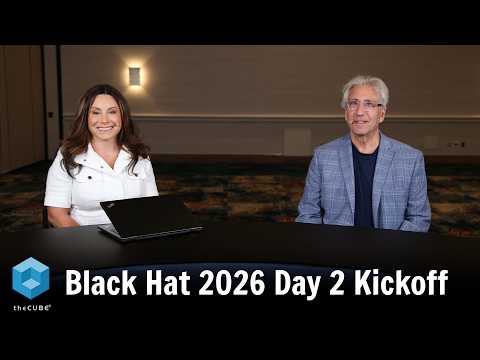
Krista Case of theCUBE Research leads a concise recap of two days of live coverage at Black Hat 2026. TheCUBE team hosts the conversation and Case draws on their expertise in cyber resilience and security to review evolving chief information security officer responsibilities, hereafter CISO; enterprise artificial intelligence, referred to as AI, and governance; the convergence of identity, observability and governance; and the operational implications of agentic AI for security teams.
Key takeaways, identified by Case and theCUBE analysts, include that CISOs must balance traditional risk management and enabling safe enterprise AI adoption and that resilience beyond prevention and detection serves as a primary success metric. The discussion emphasizes embedding security as a business function, establishing runtime governance, validating trusted recovery states and prioritizing identity and agent governance as AI systems gain operational access.
Forgot Password
Almost there!
We just sent you a verification email. Please verify your account to gain access to
Black Hat USA 2026. If you don’t think you received an email check your
spam folder.
In order to sign in, enter the email address you used to registered for the event. Once completed, you will receive an email with a verification link. Open the link to automatically sign into the site.
Register for Black Hat USA 2026
Please fill out the information below. You will receive an email with a verification link confirming your registration. Click the link to automatically sign into the site.
You’re almost there!
We just sent you a verification email. Please click the verification button in the email. Once your email address is verified, you will have full access to all event content for Black Hat USA 2026.
I want my badge and interests to be visible to all attendees.
Checking this box will display your presense on the attendees list, view your profile and allow other attendees to contact you via 1-1 chat. Read the Privacy Policy. At any time, you can choose to disable this preference.
Select your Interests!
add
Upload your photo
Uploading..
OR
Connect via Twitter
Connect via Linkedin
EDIT PASSWORD
Share
Forgot Password
Almost there!
We just sent you a verification email. Please verify your account to gain access to
Black Hat USA 2026. If you don’t think you received an email check your
spam folder.
In order to sign in, enter the email address you used to registered for the event. Once completed, you will receive an email with a verification link. Open the link to automatically sign into the site.
Sign in to gain access to Black Hat USA 2026
Please sign in with LinkedIn to continue to Black Hat USA 2026. Signing in with LinkedIn ensures a professional environment.
Are you sure you want to remove access rights for this user?
Details
Manage Access
email address
Community Invitation
Day 2 Wrap
Krista Case of theCUBE Research leads a concise recap of two days of live coverage at Black Hat 2026. TheCUBE team hosts the conversation and Case draws on their expertise in cyber resilience and security to review evolving chief information security officer responsibilities, hereafter CISO; enterprise artificial intelligence, referred to as AI, and governance; the convergence of identity, observability and governance; and the operational implications of agentic AI for security teams.
Key takeaways, identified by Case and theCUBE analysts, include that CISOs must balance traditional risk management and enabling safe enterprise AI adoption and that resilience beyond prevention and detection serves as a primary success metric. The discussion emphasizes embedding security as a business function, establishing runtime governance, validating trusted recovery states and prioritizing identity and agent governance as AI systems gain operational access.
Principal Analyst and Practice Lead for Cyber Resilience and SecuritytheCUBE Research
Jon Oltsik
Principal Analyst in ResidencetheCUBE Research
In this wrap-up segment from Black Hat USA 2026, theCUBE's Krista Case breaks down the top themes from two days of coverage at Mandalay Bay in Las Vegas, distilling how artificial intelligence is reshaping cybersecurity strategy, resilience planning and the role of the chief information security officer. Case explains how AI is redefining CISO responsibilities, pushing security leaders to partner more closely with engineering, legal, compliance and business teams as they help enterprises adopt AI responsibly. She also highlights resilience as an emerging meas...Read more
exploreKeep Exploring
How is the role of the CISO changing as enterprises adopt AI?add
How is AI driving convergence in the security stack, and why will identity, observability, and governance—particularly for AI agents—be critical?add
>> Welcome back to theCUBE. We are wrapping up two days of live coverage here at Black Hat 2026. It's been a fantastic week for us here at the Mandalay Bay in Las Vegas. We had a number of very wide-ranging conversations across all areas of the security stack, and we also talked a lot about people and processes and the way that they're being protected and how the role of both security and resilience leaders is beginning to change in this world of both adversarial AI and enterprise usage of AI. We wanted to take a couple minutes now and just break down some of the common themes that we've heard across the last few days. The first overall theme that we've heard is that the role of the CISO is changing. We're seeing that AI is actually beginning to change what's expected of security leaders. From the CISO perspective, they're responsible for managing risk, and they're also responsible for helping the business to safely roll out enterprise AI. They're helping to shape the governance and resilience capabilities and the operational guardrails that are being put in place to make sure that enterprises are adopting AI responsibly. And so what we're seeing is that means that the CISO is working closely with a broad range of roles. So they're working with engineering, legal, compliance, and business leaders far more than ever before. And really security is becoming embedded as a business function.
Krista Case
>> The second theme that we heard is that resilience is becoming a critical measure of success. So prevention, detection, these capabilities remain foundational, especially as adversaries are able to move more quickly at a greater scale and speed than ever before. However, it is more likely than not, it is practically speaking inevitable, unfortunately, that any even mature security organization might experience some disruption at some point in time. So, the conversation is becoming, do we understand what our minimal viable operations look like? And do we have confidence that we're able to recover them quickly and confidently to that trusted state? So, again, this recovery, it's beyond sort of just speed. You typically think about things like, recovery times and things of that nature. But it's also about really validating, again, that trusted data and systems are in place and also that we're able to restore these business services holistically to that trusted state.
Krista Case
>> The third theme that we have heard this week at Black Hat is the fact that AI is beginning to drive some convergence in the security stack. So I was just talking about resilience. And increasingly we're seeing that there's this continuum from security through resilience, but even within security itself, we're seeing that things like identity and observability and governance become increasinglyconnected
Krista Case
>> and that we have this increasingly interconnected stack that has interdependencies on each other. AI agents and kind of the identity piece of it is going to be incredibly critical as kind of a tip of the spear of this stack because AI agents are going to require not only access to data, but they're also going to need to take action with that data and potentially access enterprise systems. So they're going to need that kind of visibility and governance as a critical piece of that stack.
Krista Case
>> The fourth theme that we're seeing and the final overall theme that I would say that I've heard over the last few days is the fact that security is becoming much more operational than it's ever been before.
Krista Case
>> So we're really talking about things like execution. Are we enabling our security leaders to do things like prioritize their level of risk? Do we have a sense of what it actually means in terms of the concrete steps to establish that governance at runtime as enterprises are starting to move AI into production? What are the concrete steps to be able to test and validate the fact that we can recover that trusted business state that we were just talking about a few minutes ago? And then finally, do security teams have enough business and operational context to be able to be those operational actors within the enterprise. So just to wrap it up, there's plenty of discussion around some of these new and interesting point tools that are being introduced to address some of these challenges, but really I think the big takeaway is that for security practitioners, again, they need to really make sure that they're collaborating across the business and with these different stakeholders. And that as they consider how their roles are evolving and the tools and processes that they need to be able to do their jobs moving forward, that they are able to have those healthy conversations with their vendors around, not only how are these capabilities developed, but also, how do we tie that back to, doing my job and where my job is going to head in this agentic AI era. We wanted to thank you all for joining us across our two days of coverage here at Black Hat 2026.
Krista Case
>> It's really been a pleasure. And make sure you stay tuned with theCUBE because we certainly have plenty more content to comethrough the end of the year and beyond
Krista Case
>> covering all things cybersecurity and cyber resilience. It's really a hot market. There's a lot of energy and we're looking forward to bringing those stories to you. So thank you so much. Thank you.