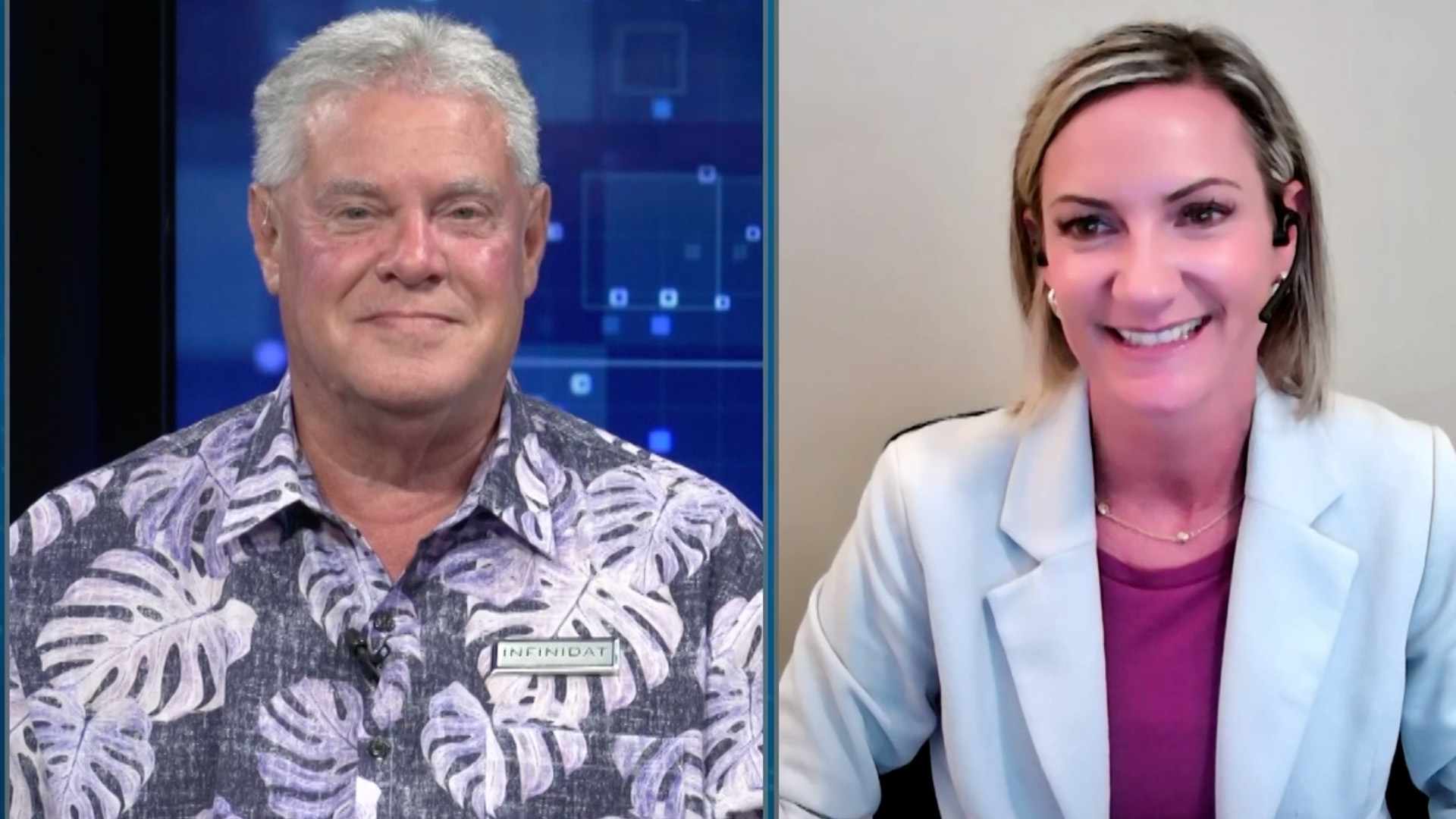
Eric Herzog, chief marketing officer of Infinidat Ltd., and Danielle Goode Coady, vice president of marketing at Index Engines Inc., join theCUBE’s Christophe Bertrand at the Data Protection & AI Summit to discuss how their companies are collaborating to reimagine cyber resilience. The conversation unpacks the strategic alliance between Infinidat and Index Engines, highlighting their shared commitment to a recovery-first approach.
The dialogue explores how InfiniSafe and VMware integrations are streamlining ransomware detection and recovery. Herzog shares how Infinidat’s infrastructure is optimized for rapid response, while Goode Coady emphasizes the role of AI in detecting sophisticated attacks before they cause damage. Together, they offer insight into how a modern cyber framework can combine storage and security at scale.
With decades of expertise between them, Herzog and Goode Coady spotlight how joint innovation is making enterprise-level cyber resilience faster, smarter and more adaptive. Their discussion reflects the broader shift toward intelligent data protection strategies as AI adoption accelerates across industries.
Forgot Password
Almost there!
We just sent you a verification email. Please verify your account to gain access to
Index Engines on Cyber Resiliency. If you don’t think you received an email check your
spam folder.
In order to sign in, enter the email address you used to registered for the event. Once completed, you will receive an email with a verification link. Open this link to automatically sign into the site.
Register For Index Engines on Cyber Resiliency
Please fill out the information below. You will recieve an email with a verification link confirming your registration. Click the link to automatically sign into the site.
You’re almost there!
We just sent you a verification email. Please click the verification button in the email. Once your email address is verified, you will have full access to all event content for Index Engines on Cyber Resiliency.
I want my badge and interests to be visible to all attendees.
Checking this box will display your presense on the attendees list, view your profile and allow other attendees to contact you via 1-1 chat. Read the Privacy Policy. At any time, you can choose to disable this preference.
Select your Interests!
add
Upload your photo
Uploading..
OR
Connect via Twitter
Connect via Linkedin
EDIT PASSWORD
Share
Forgot Password
Almost there!
We just sent you a verification email. Please verify your account to gain access to
Index Engines on Cyber Resiliency. If you don’t think you received an email check your
spam folder.
In order to sign in, enter the email address you used to registered for the event. Once completed, you will receive an email with a verification link. Open this link to automatically sign into the site.
Sign in to gain access to Index Engines on Cyber Resiliency
Please sign in with LinkedIn to continue to Index Engines on Cyber Resiliency. Signing in with LinkedIn ensures a professional environment.
Are you sure you want to remove access rights for this user?
Details
Manage Access
email address
Community Invitation
Eric Herzog, Infinidat & Danielle Goode, Index Engines | Data Protection & AI Summit
Eric Herzog, chief marketing officer of Infinidat Ltd., and Danielle Goode Coady, vice president of marketing at Index Engines Inc., join theCUBE’s Christophe Bertrand at the Data Protection & AI Summit to discuss how their companies are collaborating to reimagine cyber resilience. The conversation unpacks the strategic alliance between Infinidat and Index Engines, highlighting their shared commitment to a recovery-first approach.
The dialogue explores how InfiniSafe and VMware integrations are streamlining ransomware detection and recovery. Herzog shares how Infinidat’s infrastructure is optimized for rapid response, while Goode Coady emphasizes the role of AI in detecting sophisticated attacks before they cause damage. Together, they offer insight into how a modern cyber framework can combine storage and security at scale.
With decades of expertise between them, Herzog and Goode Coady spotlight how joint innovation is making enterprise-level cyber resilience faster, smarter and more adaptive. Their discussion reflects the broader shift toward intelligent data protection strategies as AI adoption accelerates across industries.
play_circle_outlineExploring Cybersecurity at the Data Protection and AI Summit: Insights from Danielle Goode on Index Engines and Data Protection Tools
replyShare Clip
play_circle_outlineTransforming Cybersecurity: Index Engines and Infinidat Partnership for Ransomware Recovery and a Recovery-First Mindset
replyShare Clip
play_circle_outlineAI's dual role: enhancing cyber threats and empowering data protection strategies.
replyShare Clip
play_circle_outlineCyberSense Research Lab's role in analyzing and detonate ransomware variants for training AI.
replyShare Clip
play_circle_outlinePortion of discussions around investing in AI technology for ongoing threat analysis.
replyShare Clip
play_circle_outlineFuture challenges of AI in data protection and strategies to keep pace with evolving threats.
Eric Herzog, Infinidat & Danielle Goode, Index Engines | Data Protection & AI Summit
Eric Herzog
CMOInfinidat
Danielle Goode Coady
VP of MarketingIndex Engines
Christophe Bertrand
Principal AnalystSiliconANGLE & theCUBE
HOST
Eric Herzog, chief marketing officer of Infinidat Ltd., and Danielle Goode Coady, vice president of marketing at Index Engines Inc., join theCUBE’s Christophe Bertrand at the Data Protection & AI Summit to discuss how their companies are collaborating to reimagine cyber resilience. The conversation unpacks the strategic alliance between Infinidat and Index Engines, highlighting their shared commitment to a recovery-first approach.
The dialogue explores how InfiniSafe and VMware integrations are streamlining ransomware detection and recovery. Herzog sha...Read more
Eric Herzog, Infinidat & Danielle Goode, Index Engines | Data Protection & AI Summit
search
Christophe Bertrand
>> Hello everyone and welcome
back to the Data Protection and AI Summit. My name is Christophe Bertrand, principal analyst with theCUBE Research. This is a very special session. I have two partners
in, well, not in crime, actually fighting crime
together, cyber crime precisely. We have Danielle Goode from Index Engines and Eric Herzog from Infinidat. So Danielle, tell us about yourself. Tell us what you do and
tell us about Index Engines.
Danielle Goode Coady
>> Yeah, thank you so much.
It's nice to be here. So with Index Engines, I'm VP of marketing and it's been a great ride. So far we know that cyber
attacks are inevitable and I come from a long
history of data protection and knowing that the traditional tools
today don't always work and aren't always enough. Partnering with Infinidat
on this, to your point, fighting cyber crime has been really, really engaging and special.
Christophe Bertrand
>> Thank you. And Eric, I
think we know you well, but maybe a quick
introduction again for people who may not know you and
your legendary shirts.
Eric Herzog
>> Well, thank you. I'm Eric Herzog. I'm the CMO of Infinidat. Prior to that, I was the CMO
of the IBM Storage Division, and prior to that senior VP at EMC. I've done nothing but storage
for almost 40 years now. And I'm telling you,
storage is cool. I love it.
Christophe Bertrand
>> I could not agree more. It turns out that Danielle and I know quite a bit about
storage too from the past, so it feels like a family
reunion in many ways. So Danielle, I'd like for you to tell us more about this partnership and what Index Engines
is doing with Infinidat and why did you come
together in this partnership?
Danielle Goode Coady
>> Yeah, storage is very cool. And the other thing that's also
very cool is data integrity. So we've come together with
a recovery-first mindset, and it's an interesting
solution coming together because it's not only
purpose-built for ransomware and recovery, it's built with a purpose. So we're really focused on
redefining what cyber recovery is and what cyber resilience can
be for organizations on how to re-engage trust from
their stakeholders. So working with Eric and the team at Infinidat,
we have the InfiniSafe line of products through storage,
validating their snapshots and that data integrity
that is so important so that when a ransomware does happen, because it's going to happen, it's not a matter of if but when. But when a ransomware attack
does happen, the data is clean, validated, and can be
recovered without malinfection or reinfection of the
entire infrastructure.
Christophe Bertrand
>> Absolutely. We're talking 99.99% here. So this is very, very compelling. Eric, let's talk about
your storage perspective, maybe also touch upon VMware environments because I think that's
a big topic as well.
Eric Herzog
>> Well, we've been working
with Index Engines now for a couple of years, and it was ready to go on
snapshots, volumes, databases, files, but it didn't yet
work in VMware environments. And despite the travails of what's gone on with VMware in the last couple of years, they still are ubiquitous. And our focus is the Global Fortune 500. So that's who we sell to. 28% of the Fortune 50 buy from Infinidat. So we are already working
with Index Engines. We talked to them about here's what we think we need for VMware. We've been very tight
in the VMware community. We're now also tight, by the
way in the container community, but we've had a longstanding relationship and 90% of our customers use VMware. So we talked to the team at Index Engines. Here's what we need. Here's how it works. And so then their development
team talked to our guys, got it together, and we
announced the product for VMware environments. We've announced it a couple of years ago, but adding VMware environments, we announced roughly a year ago now, and it's been very successful. So we have enjoyed the
partnership very well, and Index Engines is an
outstanding team to work with and it complements the rest of what our InfiniSafe technology does. There's really six parts
to what is InfiniSafe, and we have the one part
that we do with them, but then the other five parts that we do. So all this works together, and we really think that CISOs who don't include
enterprise storage as part of the comprehensive
cybersecurity strategy are opening themselves them up to a wide attack. They've just gone on holiday and they left every window,
every door not just unlocked but wide open. And by the way, they post on social media, they're on vacation, and by the way, there's a big giant sign in front of their house. And by the way, on all the
highways close to their house, they took out billboards
saying, "Steal my stuff. " So when you integrate enterprise
cyber storage, resilience and recovery into a comprehensive
cybersecurity strategy, you are protecting that valuable data. And as you know well from
your past, Christophe, 90% of mission-critical and business
critical data in the global Fortune 1000 is sitting on
their enterprise storage. You got to protect it, not
just worry about the network and the servers and obviously
the edge is important, but you got to bring it all together. It's a team sport fighting cyber crime.
Christophe Bertrand
>> Exactly. And the reason why
you are both here today is because we're going to be
talking about the intersection of data protection and AI. That's really the topic for the summit, and it's really two
sides of the same coin. So let me explain. First of
all, from a market standpoint, I see three major trends
sort of converging and really changing how, or morphing how this market is looking and how the technology is evolving. Number one, cyber
resilience is a hot topic. Cyber crime is rampant. We've talked about that in
the past in other summits. Data management is starting to converge because of compliance requirements
and storage, et cetera. And of course, AI and AI is really two aspects
that we'll cover today. AI is what I'd like to call
AI as a friend and AI as a foe because a lot of these attacks now that we're seeing are powered by AI. And clearly there is a need
to be able to in return, in a sense to scale, to be able
to handle all those attacks that themselves are being scaled up by AI. So very interesting relations here. And then of course, AI is also
a feature set in many ways. It's a capability that you want
to build into your solution so that the people using
it, the Fortune 500 or 2000, all of those
enterprises well have the ability to scale as well because they don't have the ability to necessarily have all
the people and the experts. So that's what we're talking
about with this partnership. It is really far-reaching. It is about much more
than cyber resilience. It's about the ability
for you as an organization to build a safe AI infrastructure and leverage AI in doing so to
be smart about protecting it. So let's talk about recovery because it's really about
being driven by intelligence. Danielle, what are the
hot topics you'd like to bring up on the recovery side? Because it's not about backup,
it's really about recovery.
Danielle Goode Coady
>> It is, it starts with protection and it starts with the defenses. So that can't go away. We still need the
protection angle of this, but when an attack does happen, how will an organization recover? How will they minimize that impact? And I think that's really
where our partnership shines. One of the things that we offer Infinidat is our CyberSense Research Lab. And what we do is we
collect over 3000 ransomware variants every single day. We detonate them in our lab, and it's an AI patented process. So while storage is cool,
data integrity is cool and most organizations
now know that AI is cool, how good is your AI
trained is the biggest, biggest thing to ask your vendor. If they're doing AI, how
highly trained is it? Because we have a patent
on our AI process. And I think that's really
important to mention in this conversation because it's a
very highly trained AI process. And one of the things for ransomware and recovery is knowing
what can be recovered and what cannot. And that's what our AI ML
engine and process offers.
Christophe Bertrand
>> Right. And because detection
really is only the first step when you think about it and the fun part or not so much fun is what
happens next when well, maybe you've detected
something, action needs to be taken, you need to recover. Well, isn't this where you come in, Eric, with your solution?
Eric Herzog
>> Well, yeah. We have a whole
process that complements. So we for example, can
interface with data center- wide cybersecurity packages SIEM and SOAR. So let's say for sake of argument, Microsoft Sentinel sees an attack, it'll automatically ping us. We will then right away take a snapshot. And then with our integration with InfiniSafe Cyber
Detection, which we've done with Index Engines, we can then place potential
candidates into a fenced forensic environment for recovery, so we can scan those snapshots. Now, obviously you can
also use Index Engines and our cyber defense capability, our cyber detection
capability, you can use that on a regular basis
to scan also, if you will, like an early warning system. Once you found a known good
copy, that's where we shine, whether it be in a backup repository or whether it be in primary storage. So for example, we put our
money where our mouth is. We're the small guy fighting
against the gorillas, right? So we guarantee recovery, SLA in writing to our accounts on primary
storage of one minute or less. So in this example, we would go ahead, put it in the fenced forensic environment, use InfiniSafe Cyber Detection, which leverages the
Index Engines technology, scan that snapshot. When you get our own good copy, and it could be four petabytes,
10 petabytes, 15 petabytes. We guarantee recovery
in one minute or less. We do the same thing on the backup side. We do backup repositories
work with Veeam, Commvault, Veritas, IBM Protect, you name it. We work with them and
we guarantee recovery in 20 minutes or less. And in fact, in a webinar we do, just to give you real world illustration, and I'm old world, I'm
almost 70 years old. So if you can't demo your software live, your software's no good. That's how we do it. So we demo it live. Obviously, it's recorded now, but at the time in that
webinar it was live. We recovered four petabytes on
an InfiniBox in four seconds. We then on the backup side, we use Commvault this
time, but we use Veeam. We used IBM Protect and
similar ones. We took a 25. 5 petabyte backup repository
and recovered it in 12 minutes. Just no one can do that. So we partner up Index Engines,
helps us with the scanning with InfiniSafe Cyber Detection. Then we take that with our capability of doing incredible rapid recovery to get their business
up and running again. It's all about the recovery. That's next generation data protection. The old world, as Danielle already pointed out, yeah, that's just backup. Well, that's kind of way old school. I mean that's even older
than me now I think about it. And that's pretty old. So you got to make sure you do the modern thing. And that modern thing is
rapid recovery, being able to scan the data sets before you recover. Again, the last thing you
want to do is get reinfected. That does you no good, waste time and time is money, especially with the global enterprise
accounts that we deal with.
Christophe Bertrand
>> Right. And the reason
why this is important is that we have research at
theCUBE Research on cyber resiliency that shows that
it takes multiple days. Many respondents have told
us it takes multiple days to get back on track with
what they have today. And therefore this combination
that leverages AI again here as a friend against the
AI as a foe, the attack, in combination with
this extremely scalable and fast storage-based
recovery that changes the game. Instead of days, you have a shot at minutes at scale. As I like to say, everything's fun and game until you add at scale
at the end of the sentence. Well, at scale. And that's
really the name of the game. We know that there's going to be a lot of data in the future, only more data. That's the only statistic
we have on the future. And therefore protecting
your domain is going to be absolutely critical. So what we have here also
is another best practice that I'd like to maybe point
out that AI is empowering here to protect the data
infrastructure, which is the fact that you kind of want to run your analysis before the problem happens or try to catch it as quickly as you can and as widely as you can. So we talked about 99. 99% of the actual ransomware packets or attacks being detectable. What type of investment, Danielle, do you make in the AI technology itself to keep analyzing all the
new threats that keep coming? How do you do this? Do you
have maybe metrics on that?
Danielle Goode Coady
>> Yeah, that is one of
our unique identifiers. And without giving away a
lot of the secret sauce, the CyberSense Research Lab is something that should really be talked
about a lot more about how we do detonate the
ransomware variants in our lab and how we continuously
update the AI models to stay ahead of those new threats. And we actually morph the
variants that we know that what the cyber criminals are going to do, we stay ahead of those. And there's a lot of conversation
around partial encryption, shadow encryption, and then also we offer
that self-learning AI and self-healing methodology
within the AI lab to make sure that we're staying ahead of it. So there's a massive
investment behind the scenes to make sure that our
AI is highly trained. And it's a fascinating process
when we talk about data protection and AI and cyber
resiliency and cybersecurity because it enters into protecting today, but also for the future in that friend versus foe conversation that you've introduced here. What we're ultimately trying to do is make sure customers are protected, make sure organizations are
protected from these cyber criminals and keep the business running. So that's the investment that we're making and working with really, really strong partners like
Infinidat with InfiniSafe. It really just expands the accessibility.
Christophe Bertrand
>> Right. And the other thing
is with this combination, one of the best practices is to be able to more continuously
test your environment, which is something that is very hard to do unless you have extremely
fast storage to be able to do that and very scalable. So it's one thing to detect and very important clearly,
it's another to recover, we just talked about that. But what if you never had to recover because you're constantly
in recovery mode in a sense? Eric, can you tell us about
some best practices you've observed from some of your customers?
Eric Herzog
>> Sure. So we have really two use cases for InfiniSafe Cyber Detection. First of all, which
we've already described, you've had an attack, you put it in fenced forensic environment, which you can create with our
technology, and then you scan and then you find a known good copy. But that's ex post facto,
right? It's after the fact. So we suggest to our customers that they practice just
the way they practice disaster recovery. So what we suggest is that they come up with a scan timeframe, whether
they should scan once a week, whether they should scan
once every three days. And then what they do is they
decide what they want to scan. We only charge for what they do scan. So for sake of argument, if
we have a customer with one of our 17 petabyte arrays, and that's 17 petabytes in a single rack and they only want to scan a
petabyte, we only charge them for that petabyte of scanning. The rest of an InfiniSafe, by the way, is at absolutely no charge. So we suggest whether it's
once a week, once a month, but on a regular basis because then what you have
is just the way you have SIEM and SOAR packages in
the overall data center, being an early warning system or a security operation center. In this case, you have an early warning system on the storage side. You can then if you find
something in Index Engines. And what we do with cyber
protection has a great GUI and the capability of sending information the opposite direction. So the way our automated cyber
protection works with SIEM and SOAR sending us data,
once we detect something, we can send the data the other way and say, "By the way, the
storage array 12, array 5, array 3 sees something
or doesn't see something. " So that's a real advantage
is not just doing it after the fact, but also using
it at its own early warning system on the storage site. So those are the two real use cases where we use Index Engines with our InfiniSafe Cyber
Detection capabilities.
Christophe Bertrand
>> And just to confirm,
Eric, this is at scale. I mean, we're talking about petabytes of data potentially not just
a laptop here, laptop there. This is real serious enterprise scale.
Eric Herzog
>> Yeah, I mean, when I
talked about the recovery that we did, we recovered four
petabytes in four seconds. That could have been six
petabytes, it could have been 10. On the data protection side,
the traditional backup side, that was a 25. 5 petabyte Commvault
repository. Well, guess what? We've done it with Veeam
and IBM Protect as well. It all works the same. The idea here is for large enterprises because that's who we serve. Our average customer
has over 20 petabytes. We have several customers with over a hundred petabytes
just of our storage. And as you know well from
the surveys you guys do at theCUBE, it's very
common in the enterprise to have two storage vendors. So just us at a hundred
petabytes in certain accounts, just imagine they've got storage
from someone else as well. So it's really important at scale. As you said, it's hard to do at scale. And again, we guarantee A, both that our snapshots are indeed immutable. As you know well, some of
the other storage companies have back doors. We don't. Sometimes that could
be unfortunate, but we don't. So we guarantee A, that
it's truly immutable, and B, we then guarantee
the recovery, RTO, recovery time objective one minute or less on primary storage and 20 minutes or less when it's a
data backup repository.
Christophe Bertrand
>> Right. And the point here, you could not do this in a
sense without this combination of technologies, and
that's really the message. Without the AI, this is actually powering or fueling the Index Engines' engine, as the name indicates. You could not be in that
posture, in that position, nor alert other parts of the organization. So I think this is very key and very important to again, reaffirm. Danielle, I'm curious about what you think the future
looks like from your standpoint with these language models
evolving with the evolution of AI itself becoming more pervasive across the infrastructure. Do you think that people are
thinking about data protection as a first step, or are they just running around building models and not protecting the infrastructure? Are you going to be able to keep pace and how are you going to be
able to keep pace with the constant attacks and really
the innovation coming from those cyber attackers? What's your take?
Danielle Goode Coady
>> It's an interesting conversation. So I think there's a lot of
people that are new to AI that are still trying to figure it out. And I think that this
summit is a perfect example of why more conversations
like this need to be had. And that being said, going
back to your last conversation around telemetry and insights, telemetry and insights that you're going
to gain from that pre-attack, if you will, or the
everyday daily practicing of this is going to be just
as important in using AI and ML for data protection
or to protect the business. So it doesn't become just
a data protection practice, it becomes a protect
your business practice. And what we're doing to
make sure that we stay ahead of this in the large language
models is that self-learning and making sure that our
innovation in the CyberSense Research Lab and then
with the organization and with Infinidat is just
constantly staying ahead of the morphing and making sure that we have
the top talent that's needed to make sure that we can protect and recover when needed for
these large enterprises. So I mean, I've never seen a better
product market fit coming from a marketing person. So it's exciting to be in this industry. It's sad also in that given
that friend versus foe, but knowing that we're
the good guys on this side of the fence, it's about
maintaining business continuity and serving the customer
and the community. So it feels good to be doing something
in the corporate world and with high technology that we're fighting the
cyber crime together.
Christophe Bertrand
>> Yes, it's clearly a great partnership. So I think Eric, I'd like
to get your take on maybe what you would consider a
best practice considering obviously a lot of people
are behind, they're behind in detection, they're behind in their ability to recover. What would be a best practice
from your standpoint as maybe IT professionals and maybe some security
professionals are watching this? And let's also ask the question, are AI professionals really
understanding all the stuff that needs to happen behind the scenes for the infrastructure for them to be able to keep doing what they're doing? What's your view and
are there best practices that maybe you've observed or you'd like to instill in our viewers?
Eric Herzog
>> So a couple angles. First
of all, as I said earlier, you've got to, at the
security teams, the CISO, if you don't have a
CISO, it may be the CIO or the CTO who's got security
underneath him or her. You've got to make sure that enterprise storage
data protection is part of a comprehensive
cyber security strategy. Second thing you have to
realize that with the ubiquity of AI workloads now, so we
talked about AI embedded into cyber detection with our
partner Index Engines, but also as you do more
and more AI workloads and you automate it
more, you're leaving it with less management. So the Oracle guy isn't managing it. The SQL guys aren't looking at it. The Mongo guys aren't looking at it. The guys who's managing your VMware data stores, they're not looking at it anymore. You let AI do all that work,
not necessarily on the IT side, but on the application side. So you need to make sure
that as you move to AI, you're protecting those workloads. I mean, AI in some instances is supplementing some human, and
if that human goes on vacation or sick, what do you do? You make sure you can cover it. So the AI workloads need to be protected. The more and more ubiquitous
they get, the more important it is that those workloads get next generation data protection,
including the capability of leveraging AI technology
such as our partnership with Index Engines and Infinidat with what we call InfiniSafe Cyber Detection of how you're constantly doing it. And the last thing, a
ransomware or malware attack or any cyber threat is a disaster. So since most big companies
practice for the fire, the flood, the hurricane,
the volcano, the earthquake, they should be practicing
for malware and ransomware. If they check it once
a quarter, a disaster, if they do it once a month, but they should just be
part of the checklist. Okay, great. We tested
in case there's a fire or some other natural disaster. Now let's figure out,
we've had a cyber attack and walk through all
the phases to recover.
Christophe Bertrand
>> And I think you forgot
geopolitical problems because guess where a lot of
the attacks are coming from and where they might be
coming from even more in the next few weeks
and months as we know, and other dangers held there. One final question, a bonus
question for both of you. Now we talked about AI and the AI powered attacks. What about AI being attacked at its core with prompt injections? Is that something that maybe
at Index Engines you guys are thinking about or working
on already without divulging anything too secret? What's your take on this?
Danielle Goode Coady
>> Absolutely. Of course. We're setting the standard or we're trying to set the
standard in cyber resilience, and it's definitely on the roadmap.
Christophe Bertrand
>> Excellent. I'm sure
we'll talk more about that. And Eric, what's your view
on those prompt injections and what's the risk from your standpoint? Is that recoverable?
Eric Herzog
>> Well, again, AI workloads are now complementing humans, not
replace them, complementing them. So again, you have to make sure that AI is doing the right job. If an employee is sick, they
can't come to work, you got to get the right person to fill in. So anytime the LLM or the SLM or anything in that AI
food chain is compromised, then all you did is put
someone who doesn't know how to do accounting in accounting. That's what you just did. So you can't do that at the enterprise level. You've got to make sure that
whatever you're using from all of the software around
the AI workload is safe. And right now, if they
are injecting, guess what? The AI software, which is doing other things
in software is no longer safe. So you've got to make sure
you cover that as well.
Christophe Bertrand
>> And you're right, in many ways, it's like any other workload. It cannot be an afterthought. Data protection and cyber resilience and really data compliance and management has a
very natural consequence. All of these have to be built
in from the design point. So that's why this
partnership is so important. That's why we're very pleased to have both of you here at the summit and we'll talk more about each of your solutions individually
in the next few sessions. Danielle, thank you so
much for joining us.
Danielle Goode Coady
>> Thank you both so much. I appreciate it.
Christophe Bertrand
>> Eric, a pleasure again.
Eric Herzog
>> Thank you. Love being on
theCUBE. We love theCUBE.
Christophe Bertrand
>> And thank you to our viewers
for joining this session, the Data Protection and AI Summit. My name is Christophe Bertrand, principal analyst at theCUBE Research. Thank you for your time and
stay tuned. There's more coming.