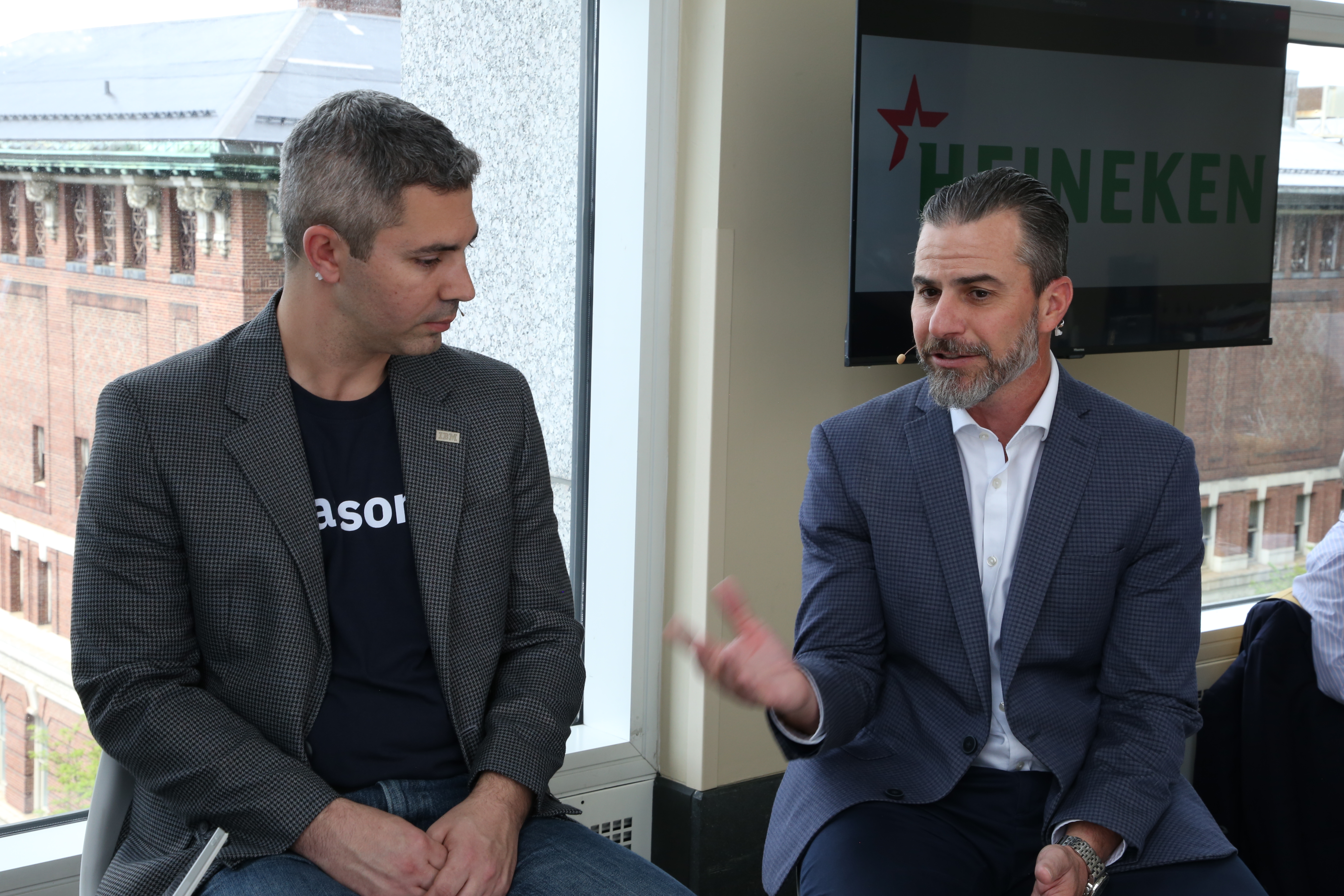
Scott Brokaw, vice president of product and data integration at IBM Corp., and Ed Calvesbert, vice president of product management for IBM watsonx.data at IBM Corp., join theCUBE’s Dave Vellante at IBM Think 2025 to discuss the evolution of modern data integration. The session highlights how IBM is enabling more accurate, open and simplified data experiences through its latest technologies.
Brokaw shares how hybrid cloud strategies are helping organizations manage both structured and unstructured data more effectively. Calvesbert explains how generative AI and open file formats are transforming data workflows and enabling greater flexibility in data architectures.
Together, they emphasize the importance of metadata management, open standards and simplicity as guiding principles for today’s enterprise data platforms. The conversation outlines how IBM is shaping a more accessible and efficient approach to enterprise data.
Forgot Password
Almost there!
We just sent you a verification email. Please verify your account to gain access to
IBM Think 2025. If you don’t think you received an email check your
spam folder.
In order to sign in, enter the email address you used to registered for the event. Once completed, you will receive an email with a verification link. Open this link to automatically sign into the site.
Register For IBM Think 2025
Please fill out the information below. You will recieve an email with a verification link confirming your registration. Click the link to automatically sign into the site.
You’re almost there!
We just sent you a verification email. Please click the verification button in the email. Once your email address is verified, you will have full access to all event content for IBM Think 2025.
I want my badge and interests to be visible to all attendees.
Checking this box will display your presense on the attendees list, view your profile and allow other attendees to contact you via 1-1 chat. Read the Privacy Policy. At any time, you can choose to disable this preference.
Select your Interests!
add
Upload your photo
Uploading..
OR
Connect via Twitter
Connect via Linkedin
EDIT PASSWORD
Share
Forgot Password
Almost there!
We just sent you a verification email. Please verify your account to gain access to
IBM Think 2025. If you don’t think you received an email check your
spam folder.
In order to sign in, enter the email address you used to registered for the event. Once completed, you will receive an email with a verification link. Open this link to automatically sign into the site.
Sign in to gain access to IBM Think 2025
Please sign in with LinkedIn to continue to IBM Think 2025. Signing in with LinkedIn ensures a professional environment.
Are you sure you want to remove access rights for this user?
Details
Manage Access
email address
Community Invitation
Scott Brokaw & Ed Calvesbert, IBM
Scott Brokaw, vice president of product and data integration at IBM Corp., and Ed Calvesbert, vice president of product management for IBM watsonx.data at IBM Corp., join theCUBE’s Dave Vellante at IBM Think 2025 to discuss the evolution of modern data integration. The session highlights how IBM is enabling more accurate, open and simplified data experiences through its latest technologies.
Brokaw shares how hybrid cloud strategies are helping organizations manage both structured and unstructured data more effectively. Calvesbert explains how generative AI and open file formats are transforming data workflows and enabling greater flexibility in data architectures.
Together, they emphasize the importance of metadata management, open standards and simplicity as guiding principles for today’s enterprise data platforms. The conversation outlines how IBM is shaping a more accessible and efficient approach to enterprise data.
Scott Brokaw, vice president of product and data integration at IBM Corp., and Ed Calvesbert, vice president of product management for IBM watsonx.data at IBM Corp., join theCUBE’s Dave Vellante at IBM Think 2025 to discuss the evolution of modern data integration. The session highlights how IBM is enabling more accurate, open and simplified data experiences through its latest technologies.
Brokaw shares how hybrid cloud strategies are helping organizations manage both structured and unstructured data more effectively. Calvesbert explains how generativ...Read more
exploreKeep Exploring
What are the components of a solid lakehouse architecture for combining unstructured data with structured data?add
What is emerging as a control point in addition to metadata management?add
What is IBM's approach to hybrid cloud and how does it differentiate from other cloud providers?add
What are the key components and layers of a company's data infrastructure that need to be considered in order to have thousands of agents interact with data autonomously?add
What gives confidence in the lakehouse architecture?add
>> Hi everyone. Welcome back to Boston. We're at IBM Think 2025. My name is Dave Vellante, and we're wrapping up our coverage of IBM Think 2025. It's been a lot of talk about data and agents to moving from experimentation into scale. Super excited to have Scott Brokaw here. He's the vice president of product data integration at IBM. And Ed Calvesbert, who's the vice president of product management for IBM watsonx.data. Gentlemen, welcome to theCUBE.
Ed Calvesbert
>> It's great to be here.
Dave Vellante
>> How's it going? How was the show for you?
Ed Calvesbert
>> It's been great. Lots of good client interest. Lots of good sessions. Data's the center. Can't complain.
Dave Vellante
>> So what's new this week? Kick it off. I mean, you've got watsonx, you've got data integration release, some new products. Tell us about those. How does it help advance and play into the vision that we heard Arvin lay out.
Scott Brokaw
>> Arvin talked about 99% of the data is not utilized by most enterprises, and the reason that is, is because most enterprises aren't using unstructured data. So our opinion is that structured data is not the only thing you should worry about. You should worry about how you combine unstructured data with structured data. Nothing's better to do that than watsonx.data in our lakehouse.
Dave Vellante
>> So you've got the lakehouse charter. Tell us, how does that fit in to, let's call it just generally the data stack? Explain that to us.
Ed Calvesbert
>> Yeah. So it's built on a solid lakehouse architecture and what is that? Commodity cloud object storage, open table formats, open metadata catalogs, and then in our opinion, a variety of fit for purpose query engines. So you've got open source query engines like Presto, like Spark. You've got commercial query engines that support Iceberg like DB2 warehouse in the TISA, Redshift. Snowflake supports Iceberg. So you've created this whole ecosystem, that's sharing the same data, accessing it at the same time, completely changing the data management paradigm. That's on the structured side. Of course, Gen.AI is the workload that we're all enabling. So you got to bring in unstructured data, you got to bring in a vector store. We've done that with watsonx.data, with Milvus, and really like Scott mentioned, where it comes together, when you're managing unstructured and structured data together, two things happen. Number one, you get better accuracy. So it's not just semantic search, it's not just document Q&A using the vector retrieval. It's also doing text to SQL, and it's combining the answer of both. So you get a lot better accuracy, which means you can do more use cases. It's not just about information retrieval now. It's analytical. It's operational. That's the next generation of agents and apps. That's number one. Number two, you unlock all that unstructured data for traditional lakehouse workloads, business intelligence, data engineering, machine learning. So really unlocking the most important data that enterprise have in unstructured data, or at least the most underutilized.
Dave Vellante
>> Irrespective of Gen.AI, the industry has changed so much. I remember in 2022, I'm at the Snowflake Summit and Benoît Dageville said, who here has heard of Iceberg? And I put my hand up. I think Tony Bear was there. He put his hand up, Sanjeev M.A., a couple of analysts, a couple of some practitioners, but it was like 10 hands went up in a sea of thousands and thousands of people. Everything has changed with open table formats. And you got to give Databricks credit for this. The state-of-the-art of cloud was separating compute from storage. And then now we're talking about any data or any engine can access any data. So separating data from any compute, and that's what open table formats have done. So the premise that we're operating on is the point of control is shifting from the database up to the governance catalog, which by the way is becoming open with things like Polaris and Unity, and the value shifting further up the stack with intelligent applications that are enabled by you guys.
Scott Brokaw
>> Absolutely.
Dave Vellante
>> So let's talk about that premise and let's get into the whole open data format. First of all, is it a viable premise? Is that what you guys see?
Scott Brokaw
>> Yeah. Open file formats, they're on unlock. So as we think about what they allow, they're allowing different applications to be accessing the data no matter where it is. We're not locked into a particular database format anymore. We can build applications no matter where the data's stored. And it gives us a flexibility as well. How we think about moving applications from one place to another. How expensive is it for our customers to actually rewrite these applications across the different data stores? The paradigm shifts that we've had. Now with open file formats, we're kind of standardizing on a single one that allows clients to focus on the application building versus the data storage itself.
Ed Calvesbert
>> I'd say there's another control point emerging, which is simplicity. Okay. So absolutely, technically the metadata management is emerging as a control point, but really how you bring it all together for clients, and that's what we're doing between watsonx.data, watsonx.data integration, watsonx.data intelligence, really delivering all of that in a way that's highly consumable for clients and they say simple is better than free. If you can deliver something fast and simple, you're creating a lot of value and you're creating a lot of barriers to changing. Because if the alternative is more complicated and more difficult to work with, whereas missing components, it means you got to bring in another vendor. Simple is the control point.
Dave Vellante
>> Okay. I want to push you on that because I could counter, "Hey, you want simple? Put everything into Snowflake and use Horizon." Simple. Why?
Ed Calvesbert
>> Not simple, but closed and limited.
Dave Vellante
>> Okay. So it's not just about simplicity. So it's the balance of simple and open. So can you achieve a comparable simplicity and openness? That's the question at the table.
Ed Calvesbert
>> That's what we're building.
Dave Vellante
>> Well, if you can do that, then buy IBM stock. No, but that is the holy grail. Okay. So let's talk about how you achieve that. Because when you talk to customers and you say, "You all in an iceberg. Yes, we're definitely doing iceberg. How are you going to govern it? I'm not sure. Well, we got Unity, we have Polaris, maybe it's Calibra, maybe it's Informatica, maybe it's IBM, maybe it's Elation. We have all these choices. We are still trying to figure that out." How do you guys respond?
Scott Brokaw
>> That's what we've been talking about this week, I think. Is how we're evolving, what's next idea, to be more than just a lakehouse. Now we're talking about our entire data management practice. How do we help clients with data intelligence capabilities around catalog, data quality, lineage, building data products? How do we help with the data integration story of this? The plumbing of our data infrastructure, not just ingestion, but transformation, enrichment, looking at how we're going to ultimately build repeatable, scalable pipelines that feed lakehouses and everything else across our architectures. So when we believe of watsonx.data, it's starting to elevate how we think about managing data management for our clients.
Dave Vellante
>> How does it fit into hybrid? Because the big missing piece of the cloud data warehouse is os on-prem. There's a lot of data. So when I talk to a lot of these banks and insurance companies, they're all building on-prem AI stacks. They're DIY because they don't really have the tooling that sits in the cloud. They're even sometimes bringing in silicon vendors because they have more money than they know what to do with. But anyway, how do you guys answer that? Because this is a fundamental part of your strategy/
Ed Calvesbert
>> Fundamental. And if you believe that hybrid cloud is current reality and future reality, you should definitely buy IBM stock, because we are hybrid by-
Dave Vellante
>> And by the way, we're not giving stock advice. This is, we're just talking. We're just having a chat. Okay. Do your own research. Disclaimer.
Ed Calvesbert
>> We're hybrid by design. When you ask a cloud provider, say a cloud lakehouse provider that has Spark as their main engine, "Hey, I've got data on-prem, what do I do?" They say, "Just do it on yourself with open source." That's not our answer. We run everywhere in the cloud, on-premises, in your own cloud account, if you want kind of a more controlled environment than fully managed SaaS. So we're hybrid by design. We think the future is hybrid by design. Our entire software stack is built hybrid by design, so we're able to bring the same capability. It doesn't matter how you're consuming it across multiple clouds or on on-premises. And eventually, we're starting to become the only game in town because a lot of people started cloud-native and are definitely not going on-prem. A lot of other players started on-premises and are now completely moving to cloud and end-of-servicing their on-premise environments. We are hybrid by design. That's never going to change.
Dave Vellante
>> It's interesting. Go ahead, please.
Scott Brokaw
>> Data workloads belong where data actually is. Why are you going to move data just to be able to do transformation or processing or analytics? We should be pushing those functions ultimately to where the data resides. Not only is it because egress costs are really high, but locality costs data, prominence costs, being able to actually run where the data is, it should be in every client's first order of purge.
Dave Vellante
>> I agree. I mean, move as much data as you need to, but no more, to paraphrase Einstein. Now, I don't recall ever being big on the whole repatriation narrative, big on hybrid, but people would whisper, "Dave as an analyst, you should go look at that repatriation trend." And I have and I'm like, "No, really not that excited. There's a little bit of smattering." But the notion of bringing intelligence and AI to the data is real. I personally think that replaces the repatriation narrative because it's a real trend. For the reasons, Scott, that you just mentioned, what are you seeing in that regard?
Scott Brokaw
>> Absolutely. I mean, clients are hybrid. If you think about it. It's not just multi-cloud and with different hyperscalers, they have data on-premises still as well. So being able to meet them where they are and not have to force a centralization strategy where it's too big to fail, this is really, really key to how we can help clients be successful with data. They're struggling with enough to be data-driven. Why should they focus on having to centralize all their data in one place in order to be successful?
Dave Vellante
>> So in 2021, we're coming out of COVID and we were getting ready for AWS re:Invent, and John and Furrier and I were working on a piece preview and we came up with this term. It was kind of a tongue-in-cheek, but the whole idea was we noticed that the ecosystem was multi-cloud, of course, but multi-cloud was more like a different experience across clouds. And we said what really is going to happen is you're going to have an abstraction layer that hides the underlying primitives of those individual clouds, but is secure, is governed and dramatically simplifies the developer experience. And that's what super-cloud was. So essentially, and we said it's going to span multiple clouds, and somebody said, "Well, you just discovered multi-cloud." And we're like, "What multi-cloud should have been?" So I think what you guys are doing is what we call super-cloud and what multi-cloud should have been, I want to test that. Is that experience for the user, for the developer across all those estates actually identical or even substantially similar? Do you hide all that complexity?
Ed Calvesbert
>> We had a good amount of it. I think the data and the workload still need to go where they belong, and that's a decision that the client makes and we help advise them on that decision, but we're going one step further. Self-managed, which really when we talk about on-premises, when we talk about hyper-cloud, really what we mean is self-managed. We are providing now some of our software and some of our infrastructure as fully managed on-prem. So in the case of the lakehouse space, which we're talking about, our storage team has released a product called Ceph as a service. So on-premises cloud object storage, fully managed. So you roll it in, you plug it in, and that's it. So it's lights out operations delivering a fully managed, same experience you're going to get SaaS on a hyper-scaler, but you have it in your own data center and you're benefiting from the data locality and from all the other attributes.
Scott Brokaw
>> And there's one technology that enables us to be so confident that we can do this. Do you know what that is?
Dave Vellante
>> Red Hat?
Scott Brokaw
>> Red Hat, absolutely. No other vendor can talk about running in that way across their software stack, whether it's in any hyperscaler, that's how we're able to actually pull up.
Dave Vellante
>> Well, unless they go all in on OpenShift, which you could because it's open.
Scott Brokaw
>> We are.
Ed Calvesbert
>> We'd be happy to do that. And now with HashiCorp, we're just moving up the stack more.
Dave Vellante
>> Explain the HashiCorp fit and how that moves you further up the stack.
Ed Calvesbert
>> I don't know if it's up the stack or down the stack, but it's all the same idea. It's all the same idea that it's as a service, it's lights out operation. In the case of HashiCorp, you've got infrastructure as code. So that's also moving us towards the developers and a lot of where the silent buyers and decision makers are in enterprise these days, the developers. So we're providing them the tools to really accelerate the process of taking their software and deploying it wherever it is, on cloud or on-premises seamlessly. That's the point there.
Dave Vellante
>> Yeah. Again, that's the vision of Super-Cloud. You're hiding all that complexity. You're using things like OpenShift to span multiple estates, including on-prem. All right. How about frontline use cases? How are customers kind of stitching together, know watsonx.data into existing warehouses, lakehouses, what are we seeing for those frontline really tangible use cases?
Ed Calvesbert
>> Yeah. So we just gave a couple of spotlight talks and we had just great clients joining us there, and I'll give you a great example. We had USAA talking about how USAA, the insurance company.
Dave Vellante
>> Yeah. We had them on.
Ed Calvesbert
>> Yeah. Fantastic. Ramnik?
Dave Vellante
>> Great. Yes. Awesome case study.
Ed Calvesbert
>> Incredible. So you know that story. It's a very document-intensive business industry. Policy documents, claims documents, police reports. It is very heterogeneous in terms of the document intensity that really makes it work. Being able to incorporate all of that unstructured data with Gen.AI and also extracting the entities and values in those documents and putting it into a structured repository like Iceberg, and then being able to recombine that, it opens up whole new levels of automation for them and lights out client experience for their clients. So no longer having to submit claims when something happens because they know something happened. They have a sensor, they have satellite imagery, they have enough information, all of it unstructured data, which completely automates the process. So really it's a win-win for the clients and for the company who's achieving greater productivity.
Dave Vellante
>> You talk about the value that you guys want to deliver, where you fit into the ecosystem? You've got Delta, you've got Hudi, you got Iceberg, you guys are all in on Iceberg and I think it's the right call. How do you guys add value across those estates?
Ed Calvesbert
>> Yeah. Let me just clarify the Iceberg point. We're all in on open. So we are investing in Iceberg and we think that that's the standard for the future. There's a whole community of partners and competitors and clients that are making contributions to the standard. We think that's heading in the right direction. But if you have Delta Lake and you like Delta Lake, we support it because we support the owner open interface, we support the Unity catalog open interface, and we support the Delta Lake standard within our Lakehouse stack. So really we're about open providing the customer choice, and really taking that open source in a direction that balances the interests of not just vendors, but also vendors and users. And if you look at open source projects and who contributes to those projects, you're looking for a healthy project that has that broad diversity, but that's not where we're adding value. Where we're really adding value is in the integrated data fabric capabilities that are available out of the box to that lakehouse architecture that accelerates time to value and gives you all that you need in one solution.
Dave Vellante
>> And you would say the same statements that you made for Unity to Polaris, is that right?
Ed Calvesbert
>> I mean, Polaris is Iceberg rest interface. So as long as it's an open interface, we support it.
Dave Vellante
>> Okay. I mean, I always say it's the technical metadata that you really get there. If you choose to go there, that's fine. It'd be interesting to see if Snowflake will take components of its high-value Horizon IP and open source that, I hope they do.
Ed Calvesbert
>> We'll find that in a couple of weeks. I'm sure.
Dave Vellante
>> It maybe threatens their moat, but customers I think would love it. I mean partners would love it too.
Scott Brokaw
>> But that's the key. Technical metadata is not the only thing that matters. How we can actually stitch together technical metadata and business metadata, that's how we start to get better discovery of data. That's how we understand what's actually out there, that we can start to bring in data quality statistics as well, look at lineage for how a data set was actually created. These are some of the surrounding capabilities of data fabric architecture that allow clients to actually benefit from some of those open file formats and data storage.
Dave Vellante
>> So what's your governance strategy? Are you trying to be the Uber governance piece of it with read-write capabilities or how should we think about your governance strategy?
Scott Brokaw
>> Well, I think when you think about data governance, you have to establish first there's people, process and technology. And a lot of organizations struggle with the people and process even before they get to the technology. So how we start with just building a culture of who's a data steward in your organization, who actually cares about the particular domains that care about a data set? You need to start by that foundation. Otherwise, you can't actually build a data governance discipline. A lot of people think about data governance and they think like a cop looking to say, "Hey, you can't access a particular data set." They underappreciate the ability that data governance can actually be an enabler. It can allow your companies to be more data-driven. It can allow them to actually see what's actually happening across the enterprise, and unlock more insights.
Ed Calvesbert
>> I think if it was ever a nice to have, it's going to be now because the agents are not going to work without it. If you're going to have thousands and thousands of more users, which are these age agentic apps, and those age agentic apps are going to use a large language model to understand the tools that are available to them to reason when am I going to use this tool versus that tool? That tool needs to be richly described, it has to have real semantic meaning in the context of that company or that problem you're trying to solve, that's data governance, that's data quality. We use LLMs, do semantic enrichment. So you can go from a data asset to an agentic tool through MCP or however other you want to make that accessible with all of the decorated and enriched metadata that agent's going to need to reason plus the data protection that you're going to need in order to have thousands of agents interacting with your data autonomously.
Dave Vellante
>> When I think of the stack, how it's evolved and where company positions are solidified, you take the cloud infrastructure layer. AWS, done a good job there. Snowflake, great, good for them with the cloud data warehouse, they really popularized that. Give some props to BigQuery, but Snowflake, nice job. Public offering, wonderful. Databricks, great job on the ML data science side. Okay. Now you start to move up the stack and you think about the semantic layer, what we call harmonization layer, really high value piece of real estate. Nobody owns that yet. That's a piece of your IP that you're going after. The governance layer we talked about, it's opening up. So maybe that's not where the value is. It's certainly control points, keep going up and now you talk about agents. You made a statement, Ed, these agents aren't going to work unless they have good governance and good data, and that agent control framework is another high value piece of real estate that is kind of white space. Nobody really owns that. It seems like you're going after white space and the high value areas that nobody really owns yet.
Scott Brokaw
>> Well actually, well, if you think about how many tools you just listed off.
Dave Vellante
>> Yeah, a lot. And it's complicated.
Scott Brokaw
>> A lot of our clients have a combination of those tools.
Dave Vellante
>> It's not as bad as security, but it's pretty bad.
Scott Brokaw
>> But the problem is no one's stitching them together and that's what a fabric architecture is trying to do. It's allowing you to bring the data architectures that you have, make them work within the system, but then expose them to whether it's agents, whether it's consumers, start to connect the data ultimately to those use cases.
Dave Vellante
>> We use the term legacy as a pejorative in the industry, but there are historical tools and companies that have done, I can think of a TIBCO or maybe a Boomi is doing integration, but it's legacy integration. Do you guys envision sort of a new modern version of the problem they were solving back then, but solving it in an AI context, an agenda context? Is that the right way to think about it?
Scott Brokaw
>> So with our watsonx.data integration offering that we announced this week, we're seeing three prevailing trends in market. The first is around authoring experiences. Clients no longer want to have to pick an authoring experience just based off of the tool. So we have low code tools, we have high code tools, we have no code and AI kind of agent-led tools. Why can't we have the optionality, the ability for clients to be able to go across any entry point but still have it be an easily maintainable pipeline at the end, no matter where you start? The second big trend, how we think about different styles of integration, whether it's batch, bulk, ETL, ELT, thinking about streaming in real time, thinking about replication. How can we allow clients to have a business case drive the technology decision versus the tool that they have drive the technology decision. The third is adaptability. How can we allow clients to adjust to the different data management architecture changes that happen? We went from the warehouses to big data and Hadoop to cloud data warehouses and now the lakehouse, the medallion architectures that are here. Open file formats like we talked about, every single phase of that has required our teams to basically rebuild our data pipelines. So why can't we design a pipeline once and start to run it anywhere? That's what we're trying to solve for with watsonx and data integration.
Dave Vellante
>> You guys are data guys. You just mentioned a number of data promise categories that my view failed to live up to the vision, to the promise. I mean, I'm a data person too, but you think about data warehouses, okay, nice. But we never really got where we wanted to get. Hadoop definitely never got democratized. Too complicated. The promise of AI and agentic is really exciting. I'm reticent to dive in the way we did for big data, but do you think this time we're going to get it right thanks to AI and agentic magic? Go ahead. What gives you confidence?
Ed Calvesbert
>> So I think what gives me confidence is the fundamentals of the lakehouse architecture, starts there. Commodity cloud object storage, I think it's $23 per terabyte per month on every hyperscaler. It's a commodity. You can't get better cheaper storage than commodity cloud object storage. That's why I call it commodity. Then you've got the open data formats and the open table formats, which really what that enables in addition to the interoperability is that the client owns their own data and what's better than the client owning their own data? That means that it sets the incentives in the right direction. Then you've got, in our opinion, what should be multiple fit-for-purpose query engines. Okay. So we're not saying everything's got to go this way or that way. We're saying, "Hey, there's a broad range of tools here. Best tool for the job."
Dave Vellante
>> You bring your best engine.
Ed Calvesbert
>> And that's going to drive innovation and competition and fit-for-purpose, which really best tool for the right job at the right price. And then you've got these higher levels coming up that are starting to build on this really solid foundation, which I think is the starting point. And then the imperative, the competitive advantage imperative, the sense of urgency that clients have to figure out how Gen.AI is going to transform their business. This is going to make the difference between winners and losers in almost every industry. So you have this combination of really solid technology foundations that are now becoming quite mainstream and this high sense of urgency, which is driving investment, innovation, business transformation. You combine the two, I think we're going to be living in a different world in two or three years.
Scott Brokaw
>> And I think enterprise AI would be successful on one condition. And if we start from the data, we believe that enterprise AI is a data problem. It's nothing else. So if we think about how we can start that data foundation, that's how we're actually going to unlock more value with AI.
Dave Vellante
>> Yeah, I agree. And what it means is this world of intelligent apps, we call them intelligent data apps because of what you just said, Scott, and we're super excited about it. We're super excited about the position that IBM's in, really looking forward to tracking the progress. Question for both of you. Last question. What do you want to be able to say 12 months from now at IBM Think 2026 that you can't say today? Scott, you first, and Ed bring us home.
Scott Brokaw
>> I want to say that we have really made it easier for clients, the ability to bring unstructured data and structured data together. This is the chart that we set on this week and we're in a really good spot now with what we're launching and I can't wait to see clients actually get their hands on it.
Dave Vellante
>> Ed, your final thoughts?
Ed Calvesbert
>> I'm most excited about what clients are doing and we've already seen some incredible early success stories, but that's going to be 10 X, 100 X. We're going to have more clients doing more incredible things like the USAA story and others. It's going to transform technology. It's going to transform business across many, many different sectors. We can't even imagine the solutions that are going to be created. And on top of that, you've got the ecosystem. If you've seen at the event, IBM's never been more ecosystem forward and the quality of the partners that are coming in, even competitors that are participating in the ecosystem, that's going to be so beautiful.
Dave Vellante
>> That's a great point you're making about, it's hard for us to predict actually what it's going to be. You look back on the world of SaaS that was enabled by cloud and we saw human capital management, we saw CRM, we saw ITSM, your favorite SaaS emerge out of that. It's going to be really fun to watch what services emerge that are now in software as a result of AI and agentic. Guys, thanks very much for coming to theCUBE.
Scott Brokaw
>> Absolutely. Thanks for having us.
Dave Vellante
>> Really appreciate it.
Ed Calvesbert
>> Enjoyed it.
Dave Vellante
>> Great conversation, and best of luck.
Ed Calvesbert
>> Thank you.
Scott Brokaw
>> Thank you.
Dave Vellante
>> All right. That wraps up our coverage from IBM Think 2025. This is Dave Vellante. Go to thecube.net for all the on-demand videos, siliconangle.com for all the news and thecuberesearch.com for all the deep dives. And check out thecubeai.com, that's our rag-based chatbot, interact, talk to theCUBE, and we'll see you next time. Thanks for watching.





 Dave Vellante