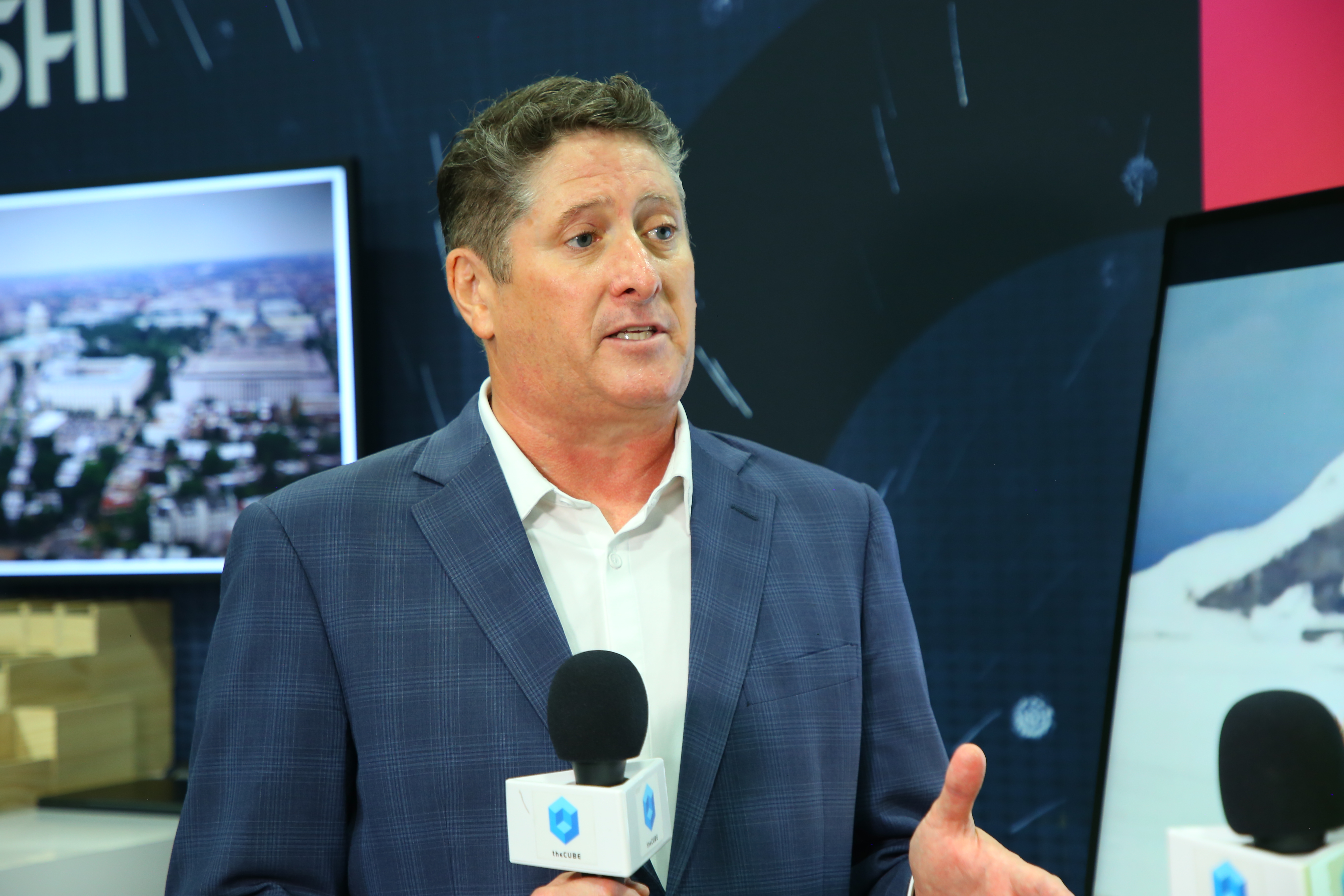
In this NVIDIA GTC Washington, D.C. segment, Jack Hogan of SHI joins theCUBE’s Savannah Peterson from the SHI booth to unpack how SHI, HPE and ISV partners rapidly stood up practical AI for the Town of Vail, Colorado. Hogan walks through SHI’s Imagine–Experiment–Adopt methodology and four prioritized use cases: accelerating ADA Section 508 compliance with Kamiwaza ARIA (transforming legacy PDFs, images and archives – completed “in a weekend”), deploying a conversational digital civic ambassador for visitors and residents, enabling early wildfire detection by restoring low-light camera feeds with ProHawk and analyzing video with Vaidio, and digitizing decades of deed-restriction records (some on microfiche) into a searchable knowledge base. He also details how SHI acts as the full-stack integrator across partners including HPE, Kamiwaza, Vaidio, ProHawk and Blackshark to deliver outcomes for state and local government.
The discussion places these real-world wins in the broader GTC context: AI moving from demos to national-scale impact. Themes include agentic AI for automated remediation (e.g., web accessibility), scaling seasonal city operations (2,400 residents to ~50,000 in peak season), vision AI for public safety and mobility, and standing up municipal AI on an enterprise-grade platform (HPE’s Private Cloud for AI with Unleash AI partners). Hogan previews SHI’s expanding smart city strategy across municipalities, counties and utilities – spotlighting how integrators connect data, models and applications to deliver measurable civic outcomes quickly.
Forgot Password
Almost there!
We just sent you a verification email. Please verify your account to gain access to
HPE Unleash AI Momentum Series. If you don’t think you received an email check your
spam folder.
In order to sign in, enter the email address you used to registered for the event. Once completed, you will receive an email with a verification link. Open the link to automatically sign into the site.
Register for Unleash AI 2025 Momentum Series
Please fill out the information below. You will receive an email with a verification link confirming your registration. Click the link to automatically sign into the site.
You’re almost there!
We just sent you a verification email. Please click the verification button in the email. Once your email address is verified, you will have full access to all event content for Unleash AI 2025 Momentum Series.
I want my badge and interests to be visible to all attendees.
Checking this box will display your presense on the attendees list, view your profile and allow other attendees to contact you via 1-1 chat. Read the Privacy Policy. At any time, you can choose to disable this preference.
Select your Interests!
add
Upload your photo
Uploading..
OR
Connect via Twitter
Connect via Linkedin
EDIT PASSWORD
Share
Forgot Password
Almost there!
We just sent you a verification email. Please verify your account to gain access to
HPE Unleash AI Momentum Series. If you don’t think you received an email check your
spam folder.
In order to sign in, enter the email address you used to registered for the event. Once completed, you will receive an email with a verification link. Open the link to automatically sign into the site.
Sign in to gain access to HPE Unleash AI Momentum Series
Please sign in with LinkedIn to continue to HPE Unleash AI Momentum Series. Signing in with LinkedIn ensures a professional environment.
Are you sure you want to remove access rights for this user?
Details
Manage Access
email address
Community Invitation
Jack Hogan, SHI
In this episode of HPE’s “Unleash AI Momentum,” Robin Braun, vice president of AI Business Development at HPE, joins theCUBE’s Rob Strechay to unpack the strategy behind the Unleash AI partner program. Braun details how HPE is addressing the critical transition from AI pilots to production-ready enterprise deployments by combining HPE Private Cloud AI with a curated ecosystem of vetted ISV partners. The conversation emphasizes the necessity of governance, security and scale, highlighting how organizations can achieve tangible outcomes behind their own firewalls. Braun also explains the value of Unleash AI hands-on labs, which enable customers to test solutions and validate workflows on their proprietary data without the friction of a full proof-of-concept.
The discussion further explores the practical application of these technologies across diverse industries, citing use cases such as automating digital accessibility with Kamiwaza and deploying agentic smart city solutions. Braun addresses the growing complexity of global regulations, including the EU AI Act and GDPR, and explains how a sovereign AI architecture helps enterprises navigate data residency and compliance challenges. Looking forward, Braun and Strechay discuss the evolution of vertical AI solutions in sectors like manufacturing and retail, as well as the shift toward agentic workflows where AI moves beyond generating insights to executing complex, autonomous business tasks.
>> Good afternoon, CUBE community, and welcome back to beautiful Washington D.C. We're here at NVIDIA GTC with exclusive coverage coming to you right now from the SHI booth. I'm here with my new friend Jack. Jack, thank you so much for being on the show.
Jack Hogan
>> Thanks for having me. It's great to be here today. It's an amazing show, a lot of energy. It's great to have you guys here as well.
Savannah Peterson
>> Yeah, thank you. Lots of energy. Speaking of big announcements, lots of exciting stuff going on for you all. Tell me a little bit about what's going on behind us.
Jack Hogan
>> Well, what we have here is really a digital AI ambassador, our digital civic ambassador for the town of Vail, Colorado. We got involved with the town of Vail where we were able to apply some practical AI solutions to solve some big city challenges in a town that really only has 2,400 people, but applies that in the times where they scale up to almost 50,000 in their peak season. So AI is a great answer for that because it helps automate so many things.
Savannah Peterson
>> Yes. So talk to me about this origin story. You worked with HPE on this, and this all happened very fast, correct?
Jack Hogan
>> It did. Yeah. So we got together with HPE and their Unleash AI partners at the HPE Discover Conference back in June. We talked about those different use cases that we could apply to a town like Vail, Colorado, who was showing interest in learning a little bit more. So SHI was brought in as really that core integrator, bringing everyone together to ideate, move through a process that SHI has, our Imagine, Experiment, and Adopt process. We started by really doing briefings in that imagination phase to open up the town of Vail, their different civic leaders, to what was possible, what are the solutions that something like a ProHawk or a Vaidio or a Kamiwaza, what can they actually provide, and how can a large OEM like HPE become really a core platform to run on. So we took them through that imagination phase, and they were very interested. They decided to do a two-day workshop with us. We brought in all the different department heads of the different areas of the town, and in that, we were able to identify 20 use cases that we put a rank order of priority and found the ones that were the most impactful. So what we announced yesterday was the top four of those solutions that SHI helped integrate and deliver with the partnerships of HPE, Kamiwaza, Vaidio, ProHawk, and Blackshark. These are all the solutions that we use to create these outcomes.
Savannah Peterson
>> That's really exciting. I can only imagine what that meeting was like, talking to a very diverse group of people with a unique and complex problem that many vacation towns and resort towns have. Talk to me about what those four use cases were and what you've been able to achieve successfully quite quickly.
Jack Hogan
>> Well, what was great about the way we approach this is, what are we trying to actually solve from a business point of view, or in this case, a civic point of view? So we brought together those different leaders who were not technologists. They're not data scientists. They really don't even know what AI is possible of, but we use that workshop to identify the four top use cases. The first and most important for them is, there's a looming deadline of April next year, that the federal government has a mandate called the 508 compliance requirement under the American Disabilities Act to ensure that all civic information is compliant for those that have hearing or vision challenges. It's a big problem for nearly every city that's out there because they have these websites that have these archives of information, PDFs, images that don't have the proper alt text. They don't have the proper descriptors to allow for that compliant ability to have all that information consumed. So the Kamiwaza ARIA solution was the perfect answer for that. The town of Vail had budgeted three years and a couple million dollars to ultimately solve this problem. They knew it was going to be a while. Despite the fact that looming deadline was starting in April, they had to have a plan in place. Well, not only did we allow them to have a plan, we solved the problem in literally a weekend using an agent.
Savannah Peterson
>> That's so impressive.
Jack Hogan
>> Well, this is what the power of AI is possible doing. You can use an agentic browser to go and analyze all of the content that they have, identify those that didn't have the compliant alt tags for images, put AI to actually describe what were in those images, what's in the PDFs, and now all of a sudden they have a compliant civic website that now is a basis for information. So that first use case led to a second use case, which is what you see here, is the prototype character we have, which will be in their visitor centers and their library, to be able to provide information in a conversational, non-threatening way to visitors and residents of the town. So that digital AI civic ambassador really allows that to manifest the information the town of Vail wants to be able to have accessible to everyone. And then the other two were very different type of use cases. One, we had the head of the fire department prevention there, and we talked to them about the different camera feeds they had around the town, to be able to use that, to use a system with ProHawk to do restoration of that video in low-light scenarios, and even older cameras, and bring that to a level that you can now start doing video analysis through AI, through the Vaidio solution, to identify the early stages of a wildfire. You can imagine the impact of a wildfire out of town like Vail, Colorado. It was something that really blew their mind and is an amazing solution, because what it's now solving for is the loss of life. You can't put a dollar on that ROI.
Savannah Peterson
>> I mean, as a Californian, you're speaking my language. So we would love to see these types of solutions rolled out across the country. I'm sure that technology could work beyond Vail. It doesn't have to be.
Jack Hogan
>> Absolutely. Well, so vision solutions can be used in so many other places. Parking challenges, traffic analysis, that ability to look at license plates and identify how many out-of-towners you have, there's a lot of applications you can do in the vision AI space. But another application of using vision to read content was the fourth use case, which was their deed restrictions. In the town of Vail, they have a challenge of having affordable housing while also having the subdivision of properties and the subdivision of buildings. So there is archives that go back decades, that some are even on microfiche, that have handwritten notes on them, that have images that are really hard to discern what they're really doing. Well, we applied, in that case, the Kamiwaza solution again to be able to read through that content. Now, there is an archive that they can do an instantaneous search for any property they have. They know exactly what the requirements are in that. So it saved them a tremendous amount of time. Those sort of document archival tools are required and needed in even the big metropolises of the world. Imagine the archives that some of the largest cities in the US have. We're just applying AI to be able to read those documents, catalog them, tag them, and be able to make them more accessible for their citizens. Really, it does scale well beyond a town the size of Vail.
Savannah Peterson
>> Yeah, absolutely. So where do you hope to bring this next? What city is your dream city?
Jack Hogan
>> All of them. But no, I think we are right now embarking on our smart city strategy. We're taking this out to all of the major municipalities. You think of the applications of AI, even for counties and states, the municipal, utility providers. All of these become ways for us to take a platform like the Kamiwaza platform, like these Unleash AI partners, and of course run it on a simple-to-operate system like HPE. So we'll be following that up really across all of the nation, selling that full-stack solution. SHI is really taking that full-stack all the way above the container by bringing in key ISVs and doing the full integration on a wonderful platform like the private cloud for AI that HPE sells.
Savannah Peterson
>> I love to hear it, Jack. What a fantastic story. Such an exciting time. Congratulations on the announcement, and thanks for sharing all the deets with us.
Jack Hogan
>> Well, thank you very much for the opportunity. We're excited about what AI can do for the world, especially in that state and local government area.
Savannah Peterson
>> I can't wait to follow the story and see what happens next.
Jack Hogan
>> Awesome.
Savannah Peterson
>> Thank all of you for tuning into our exclusive coverage here at NVIDIA GTC in Washington D.C. My name is Savannah Peterson. You're watching theCUBE, the leading source for enterprise tech news.
>> Good afternoon, CUBE community, and welcome back to beautiful Washington D.C. We're here at NVIDIA GTC with exclusive coverage coming to you right now from the SHI booth. I'm here with my new friend Jack. Jack, thank you so much for being on the show.
Jack Hogan
>> Thanks for having me. It's great to be here today. It's an amazing show, a lot of energy. It's great to have you guys here as well.
Savannah Peterson
>> Yeah, thank you. Lots of energy. Speaking of big announcements, lots of exciting stuff going on for you all. Tell me a little bit about what's going on behind us.
Jack Hogan
>> Well, what we have here is really a digital AI ambassador, our digital civic ambassador for the town of Vail, Colorado. We got involved with the town of Vail where we were able to apply some practical AI solutions to solve some big city challenges in a town that really only has 2,400 people, but applies that in the times where they scale up to almost 50,000 in their peak season. So AI is a great answer for that because it helps automate so many things.
Savannah Peterson
>> Yes. So talk to me about this origin story. You worked with HPE on this, and this all happened very fast, correct?
Jack Hogan
>> It did. Yeah. So we got together with HPE and their Unleash AI partners at the HPE Discover Conference back in June. We talked about those different use cases that we could apply to a town like Vail, Colorado, who was showing interest in learning a little bit more. So SHI was brought in as really that core integrator, bringing everyone together to ideate, move through a process that SHI has, our Imagine, Experiment, and Adopt process. We started by really doing briefings in that imagination phase to open up the town of Vail, their different civic leaders, to what was possible, what are the solutions that something like a ProHawk or a Vaidio or a Kamiwaza, what can they actually provide, and how can a large OEM like HPE become really a core platform to run on. So we took them through that imagination phase, and they were very interested. They decided to do a two-day workshop with us. We brought in all the different department heads of the different areas of the town, and in that, we were able to identify 20 use cases that we put a rank order of priority and found the ones that were the most impactful. So what we announced yesterday was the top four of those solutions that SHI helped integrate and deliver with the partnerships of HPE, Kamiwaza, Vaidio, ProHawk, and Blackshark. These are all the solutions that we use to create these outcomes.
Savannah Peterson
>> That's really exciting. I can only imagine what that meeting was like, talking to a very diverse group of people with a unique and complex problem that many vacation towns and resort towns have. Talk to me about what those four use cases were and what you've been able to achieve successfully quite quickly.
Jack Hogan
>> Well, what was great about the way we approach this is, what are we trying to actually solve from a business point of view, or in this case, a civic point of view? So we brought together those different leaders who were not technologists. They're not data scientists. They really don't even know what AI is possible of, but we use that workshop to identify the four top use cases. The first and most important for them is, there's a looming deadline of April next year, that the federal government has a mandate called the 508 compliance requirement under the American Disabilities Act to ensure that all civic information is compliant for those that have hearing or vision challenges. It's a big problem for nearly every city that's out there because they have these websites that have these archives of information, PDFs, images that don't have the proper alt text. They don't have the proper descriptors to allow for that compliant ability to have all that information consumed. So the Kamiwaza ARIA solution was the perfect answer for that. The town of Vail had budgeted three years and a couple million dollars to ultimately solve this problem. They knew it was going to be a while. Despite the fact that looming deadline was starting in April, they had to have a plan in place. Well, not only did we allow them to have a plan, we solved the problem in literally a weekend using an agent.
Savannah Peterson
>> That's so impressive.
Jack Hogan
>> Well, this is what the power of AI is possible doing. You can use an agentic browser to go and analyze all of the content that they have, identify those that didn't have the compliant alt tags for images, put AI to actually describe what were in those images, what's in the PDFs, and now all of a sudden they have a compliant civic website that now is a basis for information. So that first use case led to a second use case, which is what you see here, is the prototype character we have, which will be in their visitor centers and their library, to be able to provide information in a conversational, non-threatening way to visitors and residents of the town. So that digital AI civic ambassador really allows that to manifest the information the town of Vail wants to be able to have accessible to everyone. And then the other two were very different type of use cases. One, we had the head of the fire department prevention there, and we talked to them about the different camera feeds they had around the town, to be able to use that, to use a system with ProHawk to do restoration of that video in low-light scenarios, and even older cameras, and bring that to a level that you can now start doing video analysis through AI, through the Vaidio solution, to identify the early stages of a wildfire. You can imagine the impact of a wildfire out of town like Vail, Colorado. It was something that really blew their mind and is an amazing solution, because what it's now solving for is the loss of life. You can't put a dollar on that ROI.
Savannah Peterson
>> I mean, as a Californian, you're speaking my language. So we would love to see these types of solutions rolled out across the country. I'm sure that technology could work beyond Vail. It doesn't have to be.
Jack Hogan
>> Absolutely. Well, so vision solutions can be used in so many other places. Parking challenges, traffic analysis, that ability to look at license plates and identify how many out-of-towners you have, there's a lot of applications you can do in the vision AI space. But another application of using vision to read content was the fourth use case, which was their deed restrictions. In the town of Vail, they have a challenge of having affordable housing while also having the subdivision of properties and the subdivision of buildings. So there is archives that go back decades, that some are even on microfiche, that have handwritten notes on them, that have images that are really hard to discern what they're really doing. Well, we applied, in that case, the Kamiwaza solution again to be able to read through that content. Now, there is an archive that they can do an instantaneous search for any property they have. They know exactly what the requirements are in that. So it saved them a tremendous amount of time. Those sort of document archival tools are required and needed in even the big metropolises of the world. Imagine the archives that some of the largest cities in the US have. We're just applying AI to be able to read those documents, catalog them, tag them, and be able to make them more accessible for their citizens. Really, it does scale well beyond a town the size of Vail.
Savannah Peterson
>> Yeah, absolutely. So where do you hope to bring this next? What city is your dream city?
Jack Hogan
>> All of them. But no, I think we are right now embarking on our smart city strategy. We're taking this out to all of the major municipalities. You think of the applications of AI, even for counties and states, the municipal, utility providers. All of these become ways for us to take a platform like the Kamiwaza platform, like these Unleash AI partners, and of course run it on a simple-to-operate system like HPE. So we'll be following that up really across all of the nation, selling that full-stack solution. SHI is really taking that full-stack all the way above the container by bringing in key ISVs and doing the full integration on a wonderful platform like the private cloud for AI that HPE sells.
Savannah Peterson
>> I love to hear it, Jack. What a fantastic story. Such an exciting time. Congratulations on the announcement, and thanks for sharing all the deets with us.
Jack Hogan
>> Well, thank you very much for the opportunity. We're excited about what AI can do for the world, especially in that state and local government area.
Savannah Peterson
>> I can't wait to follow the story and see what happens next.
Jack Hogan
>> Awesome.
Savannah Peterson
>> Thank all of you for tuning into our exclusive coverage here at NVIDIA GTC in Washington D.C. My name is Savannah Peterson. You're watching theCUBE, the leading source for enterprise tech news.





 Savannah Peterson