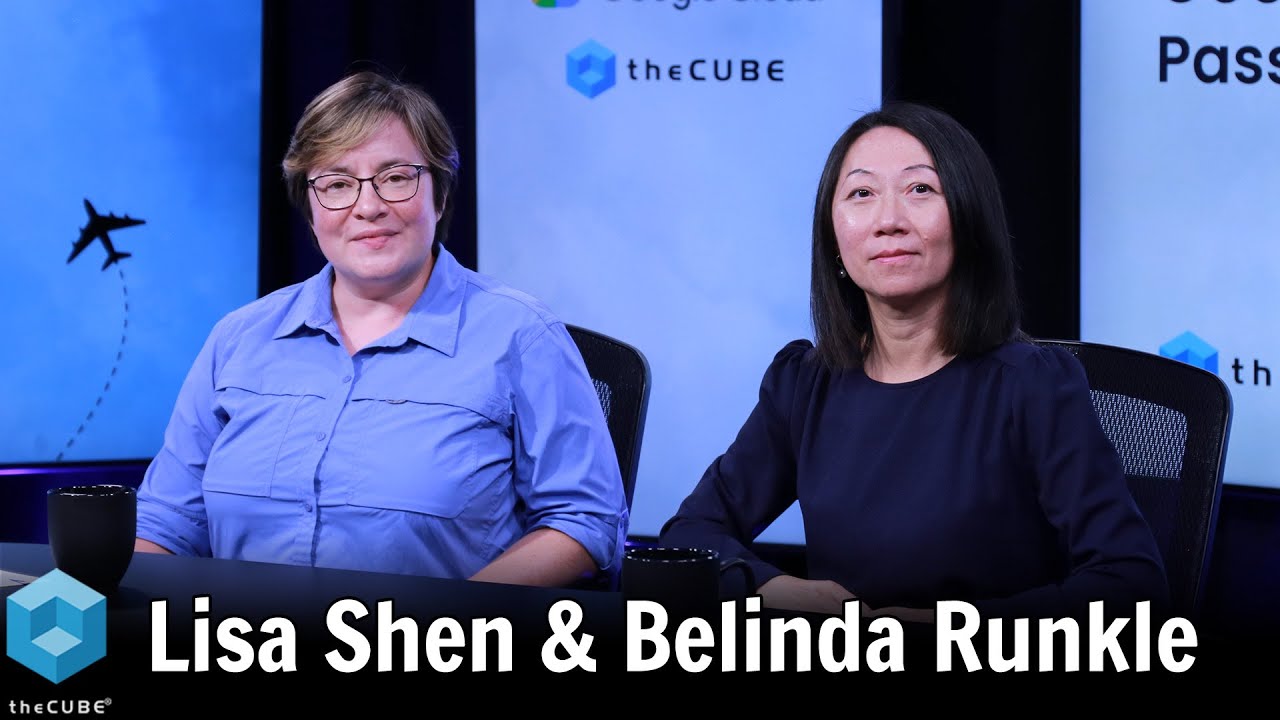
In this episode of Google Cloud: Passport to Containers, theCUBE Research’s Savannah Peterson interviews Gari Singh, product manager of Google Cloud at Google, and Spencer Bischof, product manager of GKE at Google, to explore the evolution and impact of containers and Kubernetes.
The discussion highlights how containers streamline application deployment by packaging dependencies, enhancing scalability and improving resilience. Singh and Bischof break down the benefits of Kubernetes adoption, the role of Google Cloud’s tools — such as Kubernetes Engine, Cloud Run and Cloud Build — and how different industries, particularly retail, are leveraging these technologies for agility and efficiency.
They also discuss the future of Kubernetes, including its intersection with AI and automation, making container management more intuitive and powerful. Singh and Bischof give valuable insights into why businesses should embrace containers and how Google Cloud supports their journey.
Forgot Password
Almost there!
We just sent you a verification email. Please verify your account to gain access to
Google Cloud: Passport to Containers. If you don’t think you received an email check your
spam folder.
In order to sign in, enter the email address you used to registered for the event. Once completed, you will receive an email with a verification link. Open this link to automatically sign into the site.
Register For Google Cloud: Passport to Containers
Please fill out the information below. You will recieve an email with a verification link confirming your registration. Click the link to automatically sign into the site.
You’re almost there!
We just sent you a verification email. Please click the verification button in the email. Once your email address is verified, you will have full access to all event content for Google Cloud: Passport to Containers.
I want my badge and interests to be visible to all attendees.
Checking this box will display your presense on the attendees list, view your profile and allow other attendees to contact you via 1-1 chat. Read the Privacy Policy. At any time, you can choose to disable this preference.
Select your Interests!
add
Upload your photo
Uploading..
OR
Connect via Twitter
Connect via Linkedin
EDIT PASSWORD
Share
Forgot Password
Almost there!
We just sent you a verification email. Please verify your account to gain access to
Google Cloud: Passport to Containers. If you don’t think you received an email check your
spam folder.
In order to sign in, enter the email address you used to registered for the event. Once completed, you will receive an email with a verification link. Open this link to automatically sign into the site.
Sign in to gain access to Google Cloud: Passport to Containers
Please sign in with LinkedIn to continue to Google Cloud: Passport to Containers. Signing in with LinkedIn ensures a professional environment.
Are you sure you want to remove access rights for this user?
Details
Manage Access
email address
Community Invitation
Container Essentials
In this episode of Google Cloud: Passport to Containers, theCUBE Research’s Savannah Peterson interviews Gari Singh, product manager of Google Cloud at Google, and Spencer Bischof, product manager of GKE at Google, to explore the evolution and impact of containers and Kubernetes.
In this episode of Google Cloud: Passport to Containers, theCUBE Research’s Savannah Peterson interviews Gari Singh, product manager of Google Cloud at Google, and Spencer Bischof, product manager of GKE at Google, to explore the evolution and impact of containers and Kubernetes.
The discussion highlights how containers streamline application deployment by packaging dependencies, enhancing scalability and improving resilience. Singh and Bischof break down the benefits of Kubernetes adoption, the role of Google Cloud’s tools — such as Kubernetes Engine...Read more
>> Welcome back to our exciting new series with the Google Cloud team, Passport to Containers. We are so pumped to be working on a twelve-part series for you this year with some of the best and brightest over there on the Google team. My name's Savannah Peterson, you're watching theCUBE. And today I am joined by Gary and Spencer. Thank you both so much for coming to hang out.
Spencer Bischof
>> Thanks for having us.
Savannah Peterson
>> Thanks for bringing me over to Boston. This is a great little adventure for me, honestly.
Gari Singh
>> And we gave you the nice cold weather. It's good.
Savannah Peterson
>> Yeah. Yeah, you did. I know the T-shirt that I'm wearing from you guys isn't exactly thick enough for this particular Bostonian winter weather, but it is cool enough that I had to wear it obviously. You two are a part of the very successful pioneering team that's helping a lot of different companies and projects adopt containers. You get to see them across their container journey and probably their maturation through some of your tools, and then on to GKE. For folks who are just beginning, because as we know, there's still a massive market opportunity in the containerized worlds, what's a container? Spencer, I'm going to start with you.
Spencer Bischof
>> Oh, boy. Okay. I think to explain something where we are now, it's easy to explain from the past. So traditionally in the past, we'd have things like large servers, then it matured, started virtualizing those machines because no one has all the space to have one single server. And a couple of folks at Google, Red Hat and others said, "What happens if we made something smaller, compact, and we could stuff thousands of these containers, mini servers into a virtual environment?" That's what a container is.
Savannah Peterson
>> Perfect definition. Thank you, Spencer. And I'm going to keep coming to you as the dictionary source for this.
Spencer Bischof
>> That works. Oh, boy.
Savannah Peterson
>> There you go. Little baby servers. So, Gary, what do people use containers for? What are some of the best use cases?
Gari Singh
>> I think the most obvious use cases where people started out was really on development. Imagine, and I'll go to my old world of Java for example, was a great one, but to Spencer's point on containers, imagine you wanted to use Java, I don't even know what version of Java people are on now. I'm old. But Java 8 and someone wants to use Java 11. And maybe your servers don't have it on there and you got to install this version or that version. You're like, "Oh, you can't use this version because our build only has this in it." If you start thinking about source containers from that development perspective, you can package up your entire app and all its dependencies independent of the host operating system. So I think that's when Docker... Containers have been around for a long time, but Docker popularized them by making them a lot easier to use. So I think it started out on the development side, and then on the deployment side, obviously for things, anything like... The easiest one is like stateless applications. You package up any web application, a web server, Nginx, a go application, you just want to package it up, it's lightweight, and you want to run multiple of them that can scale up and down. So I think those are the easiest use cases to start with. But obviously we have everything from running ML workloads today to stateful... Exactly. But if you want to get started, web servers, simple apps, API servers.
Savannah Peterson
>> Yeah. So containers equivocally give people an agility and a future-proofing tact that isn't as say, language-dependent, that you're talking about there.
Gari Singh
>> Correct.
Savannah Peterson
>> So how does this translate for someone who's interacting with one of these companies? So let's say I was with someone who's not leveraging containers versus someone who is leveraging containers. What might that experience be like for the end customer? Is that going to be slower potentially, more likely to fail?
Spencer Bischof
>> That's fair. If you could articulate it pretty simply for your own customers, ultimately you should notice the difference. For them, it's all going to be about agility. "I want this new feature faster. I want this shiny widget. I want this new button." And the resiliency too is much higher, because a container goes down, you have 10, 100, 1000s, tens of thousands of other applications where it can easily just say, "No problem, I'm going to redirect you here. Your experience will be exactly the same." So ultimately for users, it's much more easy to consume. Same thing for your end customers, whether you're shopping or things like that.
Savannah Peterson
>> Yeah. When I think of containers, I like how you describe them as little mini packages. I think of them as Legos. It's kind of like you have different Lego blocks and then depending on what you need to build that day or however you need to spin that up, you can modify that in a way that wasn't easier. Gary, talk to me about some of the tools. Google Kubernetes Engine obviously popular, but that's not all that you all are offering, and then there's different junctures across the adoption journey that people have. So let's say I am hearing from my team that we need to start scaling containers, or we know Kubernetes is obviously going to be our platform for the future here, how do you get people on-ramped and convince them to make the investment and allocate that budget?
Gari Singh
>> Yeah, I think where we've used to try is to try to show people where, especially in the... Maybe for their newer or ad tech or whatever, to show them how they can really speed up all of their DevOps activities, et cetera. So I think if you can get people on a quick developer-like environment, and of course we integrate with all the tools, but we've got the full lifecycle of everything like Cloud Build where we can build containers. We've got Cloud Run. Cloud Run is just our serverless for quickly getting up and spinning. Because the first time somebody experiences it, they're used to running, we won't use Java, Node myapp.js, and it spins up on their laptop, HTTP localhost 8080.
So you kind of want to be able to give people that kind of experience, but you don't want them to have this latency or whatever. So if you can just say, "Quick deploy." And we've got the full integrated suite, whether it be cloud workstations to Cloud Build and deploy. You know you can have your app up and running in maybe 15, 20 seconds as opposed to maybe one, and then instantaneous operate it. And I think people will start to see that there's this level of agility that they get in there and then you can take them slowly to the next stage of, "Well, maybe this will be a little bit easier for production because I don't have to worry so much about every scale capability." Because we can easily create more replicas of it and other things like that. So I think that's kind of the kind of key journey, but that's where we try to get people who are especially, maybe have older technology or whatever, start with kind of where you're going. Your new stuff. I don't know that people use, what's the word? I don't know the word I'm looking for. But yeah, I guess just your newer or your newer type stuff.
Savannah Peterson
>> Well, I think anytime you're adopting a new technology, I was talking about this a lot lately as we see Agentic AI and a lot of different things happening. Across teams, there's a skill-up, and sometimes there's a bit of a fatigue there where why am I learning this new skill? Why do we have to change how it's always been done? Sometimes that's an obvious evolution, but I think in some cases, it's not always. So what are some of the conversations or maybe I think about it as myths sometimes that people have going into this process that you help guide them through? Spencer, I'll ask you.
Spencer Bischof
>> Sure. I think rightly so, but at the same time, no, the complexity is there. It's a lot.
Savannah Peterson
>> Number one thing that people say about this in Kubernetes, it's all about decreasing that complexity.
Spencer Bischof
>> A hundred percent. So there is a wall of learning there, but the goal is we try really hard at Google to say, "How do we make it as simple as possible?" Let's just start out with the container, build it out there, and then make it step by step by step for how you do networking, do systems, you can do storage. Each way along the process to say, "These look like big walls, we promise you they're not. Just take five minutes and learn it." And so it's a common myth of complexity. It can be, but as long as you have the right steps to get there, that should go away. Same thing is actually resilient. As long as you follow the core principles of it, you'll be fine. Just deploy multiple zones and it'll stay up.
Savannah Peterson
>> I want to dig in there a little bit because, and I know from looking at a lot of different data, from having conversations with customers, the complexity is the biggest fear or challenge when it comes to Kubernetes. Obviously y'all being Google where Kubernetes came out of, you probably have a slightly different lens on that, but what's the advantage of someone coming to work with you on this journey versus coming to work with someone else beyond the obvious, this came out of Google? But you were just talking about, how quickly does someone matriculate through all those steps usually? What's that like?
Spencer Bischof
>> It depends on the customer, but say even if you are a, let's start from the bare middle, you're a computer science student or even someone trying to spin up a site. You know what it means. To Gary's point, cloud run. You just want to get started with Kubernetes, something that's based on Kubernetes, go start there. Now you're not necessarily sure how you want to spin up a GKE cluster. We have complete walkthroughs and guides. Just follow the best practice built in using something like Autopilot. You don't need to worry about understanding how the networking works, because the complexity of the systems, complexity of the storage. That is a lot of stuff to pick up. Just deploy it and run.
Savannah Peterson
>> Well, and I think that's why people get overwhelmed, which is why we're kind of having this conversation is what I've heard from folks is, "Oh, we want to go down this journey, but every time it just feels like a lot to learn and adopt and shift with legacy systems and other stuff." But you're making it sound easy, Spencer.
Spencer Bischof
>> We try to. We try to.
Savannah Peterson
>> Yeah.
Gari Singh
>> Exactly. It should be.
Savannah Peterson
>> Have you noticed, just out of curiosity, have you noticed any verticals or industries that seem to be getting on the train a little bit faster, getting on the Acela versus the slower train if you will?
Gari Singh
>> I'll take that.
Savannah Peterson
>> Yeah, go for it Gary.
Gari Singh
>> I think there were a few of traditional industries. I mean obviously all of the startup digital native types, the Snaps of the world and all.
Savannah Peterson
>> Techdots tech quickly. We tend to talk to technologists quickly, but I'm curious about across the because it's going to change the landscape.
Gari Singh
>> I think we've seen a lot in retail and e-commerce.
Savannah Peterson
>> Okay, interesting.
Gari Singh
>> Which makes sense because a lot of them obviously... Which makes a lot of sense because they all have to deal with events like Black Friday, Cyber Monday. And so as sort of move to cloud happens, they move to cloud for this sort of capacity and now they start to look and say, "Well look, how much infrastructure do you want to rebuild and build out?" I mean one thing about Kubernetes per se that people miss is it's actually, I like to think of it as yes, you can run containers on it and that's great and it's a container orchestrator, but it's also a fantastic orchestrator of compute, and this is where I think sometimes people-
Savannah Peterson
>> That's a really good point, Gary. I'm super glad you just said that. Keep going.
Gari Singh
>> Which is where people forget about this because then you got to come up and you don't want to apply data center principles to the cloud. And so I think when people started to say, "Hey, we're going to rebuild our apps. We know that certain parts of our app are going to scale," and retail just has that notion that they're going to have sales, flash sales, Black Friday, Cyber Monday. So them and I think the other industry that may be more tech savvy or whatever, but has been gaming. Because again, imagine Pokemon Go is our probably overused or famous example, but you can explain it to a kid, I think our boss Bobby would say, "Hey, what do you guys do?" "Well when you run Pokemon Go, it runs on our stuff," and that's how they get a million users and it helps them get to scale.
Savannah Peterson
>> I don't even think I knew that, just by talking to Bobby all the time. That's great. Oh, I love that.
Gari Singh
>> I saw that in this thing. I was like, "Oh, I know a good customer that we can sort of put in there." But yeah, I think retail has definitely been in there. We are seeing a move of, so I'd say retail is probably the biggest one, but-
Savannah Peterson
>> So this is interesting. Correct me if I'm going down a rabbit hole, I shouldn't go down by all means. But when thinking about, I love that retail example. I used to work for a 3-D printing, e-commerce marketplace and platform. When you have a lot of SKUs, when you have a lot of things and you need to have agility within those, that multiplies the many things that can go wrong and particularly if it's for a short window of time or something like that. So it's like you can toggle things a lot faster and with more confidence equivocally as a result of that. That's pretty cool. I mean it makes sense for Pokemon Go too because it's all so real time. Do containers help people and create experiences that are much more real-time? Do they feel more real-time?
Gari Singh
>> Sure just because of the fact that you can, I think the scaling in that capability. Also the fact that I think people can break down some of their applications. I mean there was the buzzword of what decade are we in, but the last decade, Micro-
Savannah Peterson
>> Who's counting Gary?
Gari Singh
>> Yeah, I forget. There's a lot of them. There's a lot of them.
Savannah Peterson
>> After a certain number we just stopped.
Gari Singh
>> Exactly, and they're kind of the same. You just have to remember. That actually is the same. But we had SLA, service-oriented architecture, then microservices architecture. Break down these sort of monoliths. So I think that when you look at that, those really help to help scale those pieces. Different components can come up. You can definitely have faster iterations on deployments. All this happens. You know how I have to build a VM image and reimage a machine and all those things were just process. And sometimes it was literally just build process that could take forever. But now imagine you move to the ultimate where you are using go or something. If you can get to there, those things compile in, whatever, five seconds or 10 seconds, lightweight compiler goes up in there and you're up and running and you have a new component. You could literally deploy it in, I don't know, as fast as you could write the code basically I would say.
Savannah Peterson
>> A minute if you're speedy. Yeah, which is really cool. That is one of the fun things when you do talk to people who are starting to have that moment of wow when it comes to containers and they realize, "Oh my God, I was able to do this and I spun up this cluster and now it's all happening and then now I can go do this and this is going to be great." Once you get over that, there's that initial up curve of oh, this is different. And then bam.
Spencer Bischof
>> Drop straight down. You're like, "Oh, now I can write feature after feature versus having to set up each individual thing over time," which is just painful and slow.
Savannah Peterson
>> It is slow slow.
Spencer Bischof
>> You don't want to do that.
Savannah Peterson
>> It's kind of all the stuff we were talking about before we even started filming this segment is when it's processed to death like that, you don't get to have the same fun nor can you be as responsive or innovative. I mean it cramps that whole style. What is something that you wish people knew about containers or even working with you guys that they might not already know?
Spencer Bischof
>> Gary, you want to take that one?
Savannah Peterson
>> I'm going to make you both answer this.
Gari Singh
>> I'll answer it. It may not be a direct answer to that question, but I was thinking of something as you sort of said in there. I wish that we spent... So a lot of times I think that people say, sure, there are some complexities and differences in how you have to think about things and not running from the data center to sort of Kubernetes. And maybe I should write a book on this. We were talking about this earlier.
Savannah Peterson
>> Yes, let's go Gary, you heard it here first folks.
Gari Singh
>> How do you map Kubernetes and containers to what people are doing today? When people who are on the VMs and this other world. I don't actually feel like they're two different worlds, but I think we make it out to be two different worlds. And I think that that always makes it scary for people because then they're like, "I don't change." Or we're speaking one language over here and they're like, but here's how I do it today. And if you can't map terminology or map process or stuff, then people are like, "Oh, well that's what you did," but now you don't do that. Here's how you would do this. Or my compute orchestration is the same thing. All right, so you're going to come up here, you want load balancing, so you're going to build a bunch of VMs, you're going to figure out how to scale those VMs horizontally. You're going to build a build process, you're going to put a load balancer in front of them, you're going to do this, you're going to do that. You're like, okay, but imagine now that you package your thing up and pretty much we can containerize mostly anything except legacy COT stuff. And now you're just going to say, "Hey, I want this many replicas of it. I want to have a load balancer." You're orchestrating all of that and we're handling all that for you. You want three zones, here's where your node pools are. Or you could have built it all yourself, and I think if you start to explain to people these building block pieces of how what you would've traditionally done can map into this world, things would be, I think there'd be a better mutual understanding and people might be less scared and less-
Savannah Peterson
>> Yeah. Less apprehensive.
Gari Singh
>> Less apprehensive.
Savannah Peterson
>> About the evolution of that. I think you just brought up an absolutely outstanding point, Gary. I think it's that fear. And it's not like ignorance, it's just the education hasn't had the opportunity to happen in certain instances for people to understand this isn't something, it's not all of a sudden speaking in Japanese and writing in characters and doing something completely different than you've been doing as a native English speaker. It's not, but it is a new way of thinking about how you build and deploy and what you're able to do. I'm so glad you brought that up. All right, Spencer, now that you've had time.
Spencer Bischof
>> I stalled for you.
Savannah Peterson
>> That's a really great point.
Spencer Bischof
>> I think for me, I always go back to principles because that's kind what builds foundations of everything. So something I really admire with folks like Don, Tim, Kelsey all working together to actually originate this. The way I always try to educate people is it's more about not just resiliency, but how do you get to where you are to where want to be. The whole product is based on that one simple idea. You declare something, it creates it and that's it. There's no other craziness with that. And so riffing off Gary's saying, if you have a way where you could translate these terms so there's less blockers, less way people actually want to get entry to it, I think the floodgates will open entirely.
Savannah Peterson
>> How do we do that?
Spencer Bischof
>> We need Gary to write a book.
Gari Singh
>> I think we're-
Savannah Peterson
>> I mean this conversation I think is starting that though, but I think you're absolutely right. I mean because from my experience, I've been in the container world for about six years now, and so not quite as OG as some of you, but also not an amateur. And one of the things that I've noticed to your exact point is there's this, it's people kind of get up to the edge of the cliff, but they're not willing to jump off and know that their parachute's going to deploy and it's going to be the most beautiful experience of their life if they're just willing to get there. And Kubernetes adoption, there's still like 80% of the market that's going to be ramping to scale. You're obviously very poised for that. So what do we do? What do you find in those conversations when you have these conversations with folks? Gary, I'll bring it back to you. How do you turn that dial for them and make them realize that this is actually going to make everything in their environment better?
Gari Singh
>> Yeah, I think the good news is we don't have as much trouble. My stupid quote of the week is, or the year is now, you know how there's an expression, nobody ever got fired for choosing IBM.
Savannah Peterson
>> Right, right, right.
Gari Singh
>> I feel like now we're at least at the point where you wouldn't get fired for choosing Kubernetes. Which is kind of the same thing 20 years ago you wouldn't get fired for choosing J2EE. Those were kind of your sort of core platforms. So I think that's the good news there. And then I think it's really digging in and just finding what that right starting project or whatever is. I think the pressure that some people have now is... And sometimes you have to say, "Look, we're not going to do this right away, but you really should be on a path." Because sometimes people literally just have a lift and shift that they have to get done. I'm not bad-mouthing anybody, but we know there's a certain place that has a licensing issue, that's forcing people to say, "I got to move from here to there." Maybe they don't have time to listen to my spiel about how the mapping and that. But as they're on that move, how do you future proof? How do you start to think about where do you go next? I think those are the main sort of conversations that we need to have. I think it shouldn't be an or conversation. It should be an eventually conversation. Here's where we're going and here's where you're going to sort of go. Inventory your apps. And I think we have a lot, we talk a lot about this stuff. We've done some of this stuff in studies like Dora and we talk about at modernization. I just think sometimes we like to bifurcate things too much and say, "You're either doing this or you're doing that." I think if you show that, look, there's a continuum and you should start to get on that continuum and some things may never come and have a holistic conversation, and this may be a sales problem. I think it's a whole problem.
Savannah Peterson
>> I love it though. You're right on.
Gari Singh
>> It is just, I think that's how you sort of get people there and help them sort of paint that picture, consulting, I guess.
Savannah Peterson
>> Yeah. Well, it's consulting, but what you're talking about is education, and right now a lot of these teams are dealing with a couple evolutions, not just the container journey, but we're talking about AI. There's a foundational shift happening at the core infrastructure level, and when you're selecting your tech, your tools, your approach, your partners, we're talking about multi-million-dollar decisions, maybe even more depending on the size and scope of the company to where I think that's exactly, I mean it's imperative. You got to write the book now, Gary is basically what I'm saying. Long story short, I'll write mine about interviewing you, you write one about this. Because I think that's the problem is people don't talk across the fence sometimes and even early in the Kubernetes days, it was like Docker, Kubernetes, there's all these different things happening. Well, what's going to become the platform? I don't even feel like we really got to this ubiquitous decision with Kubernetes until about 18 months ago where it really felt like at scale everyone had agreed that this is the tool we're going to use and this is what's going to happen next.
Gari Singh
>> Agreed. That's true.
Savannah Peterson
>> Which is kind of cool.
Gari Singh
>> Ironically we, should not because we'll do enough sessions on AI. Not ironically, but I also think that the AI thing with Kubernetes is kind of interesting, and I think I may have said this the last time we talked or whatever, but I think it's interesting to say if you need a new platform. Obviously if you can use turnkey things like whatever, Vertex or the other clouds have their sort of turnkey things. But if you want to have your own platform, you're already running apps on here. Again, AI and running GPUs and all this stuff scaling up. It's all about orchestrating compute.
Savannah Peterson
>> And I love it. That brings it right back to your original point that you started saying earlier, Kubernetes is good for compute. Everyone's obsessed with one part of compute right now, which is chip manufacturers in particular, which is lovely that we're having a nice nerdy moment for all of us in silicon land. But on the flip side, to your exact point, there's so many other things that go into optimizing how we process workloads and how we run things that... Yeah, exactly, kubernetes is a tool on that front as well.
Gari Singh
>> And I think I was going to say, I think sometimes you could have run into this situation, I think where AI came. So there's been a few challenges, a few people who have tried to say, "Build the next Kubernetes or the next better thing." And we got to give full credit to the folks who originally created Kubernetes and this sort of extensible model to it. And I think the AI thing is a great... Even stateful applications were a great example, how we extended it to do storage. Because what you end up finding is you're going to write some new thing, but you're still going to have to do all this other stuff. That stuff doesn't go away. So I think the fact that Kubernetes is extensible is like, well, look, you still needed to spin up the compute that runs the GPU that does this. You still need to schedule something somewhere. Are you going to rewrite all of that and be as good as what Kubernetes had? Or what if we could just extend Kubernetes? So you looked at things like... And then maybe it didn't do as well for GPUs or other hardware. So there's things like DRA, dynamic resource allocation, basically a way of adding non-CPU, we basically hard-coded CPUs and memory and GPUs in there, but now I would say I want to take her out network and other types of hardware that's in there. We need a way to plug that in and consider that in the scheduling and orchestration of the compute. So I think that became, oh, we'll just extend Kubernetes to do this. And I think now all of a sudden you're like, "Well, you need an AI platform." It has become the platform. I just don't think there's a, not just because we work on it, I think that it's proven that it's the platform for at least everything we can think of right now.
Savannah Peterson
>> I agree with you for the record. As someone who talks to a lot of different people, I really love the way... I'm going to start saying that now moving forward is everything we can think of right now or everything we're doing right now. It's a great hedge if anything happens. Do agree Spencer?
Spencer Bischof
>> Like background?
Savannah Peterson
>> Well, I mean do you find that there's a educational on ramp with folks for understanding it's not just one specific thing or just a platform, but that it really optimizes your entire endeavor?
Spencer Bischof
>> It does. No, it doesn't. And Gary is saying too, education is a huge community. How do we get them move forward with everything they need to know and benefit? They have all the various knobs you can use whoever you want, whether you have storage plugins, you have network plugins, GPUs, TPUs, everything we're building across the board. You can plug and play with any piece of technology you want. There's not many pieces of open source software out there where you can do that, where you say, "I want to run Java, I want to run, Go." I want to go build the next big AWS site, whatever it is, or the next big Google. All that is possible because of all the knobs you can interplay across the board. I can't think of many things where that's possible outside of maybe Linux. That's just not a thing.
Savannah Peterson
>> Well, that's another outstanding point though, is that interoperability or not by playing in this sandbox, you're not stuffing yourself in a silo. And I think that's actually one of the huge things that we're all seeing right now as these legacy systems come to a juncture where we're adopting exponentially more data, exponentially more processing depending on what it is. Like I said, we won't go too far down the AI rabbit hole, but the point is we're all thinking about it right now, and to be able to toggle and keep those favorite things that you liked but also have the institutional structure. I mean most open source endeavors aren't coming out of the nest of some of the smartest in the world like we're talking about here at Google. And that's one of the things that I've always found really interesting about the project itself is behind it you have this incredible fucking partner who can really be your ally across the board when you're scaling or wherever you are in the journey. Where do most people find you in their journey? Are they just getting started? Have they already gone down the Kubernetes rabbit hole and they're realizing they need to ramp?
Spencer Bischof
>> It's all spectrum. So funny thing is I have a customer earlier this week where same concept they only set with Kubernetes. Great, day one, let's set you on something easy like autopilot and you can just run and go and give you all the basic training, follow the tutorials, no problem. Gary knows as well as I do, you have the opposite side of customer. It's like, I want you to build this cap tomorrow, so like a Kubernetes enhancement proposal for adding something to the new Alpha API for the new open source community. So you have entirely different ranges where it's I'm a day one person or I trust you to go build this, can you go build this cool thing for me? It's like, of course. That's what we do.
Savannah Peterson
>> Yeah, I had a feeling it might be a spectrum. One of the things I want anyone listening to take away from this is you're not behind yet. We're beyond the early adoption, very iterative part, so we know these things work, but you haven't missed the boat. Everyone can still come on the boat, come learn, come get on the airplane with us and go on to this next journey. What do you think is going to happen next? Now, this is just for a little bit of fun. Let's say I always like to think about it a year from now, so beginning of 2026, how do you think this conversation will have evolved?
Spencer Bischof
>> I think when we have two really clear ways and you see that a lot with 1.32, we're doing fantastic things with stateful apps. So think of an e-commerce site and they have to store that data. It's becoming much more resilient and that's fantastic. Flip side, we all see the writing of the wall where everything's changing the world of AI is here. And not to break the point too much where the shirt and everything says, but as the world develops more this idea of a large language model, LLMs, the whole idea is going to be we're doing training, but how do we bring this to more people? How do we bring this information to them with things like inferencing, so serving those LLMs, the ability to have the whole world of access to this huge plethora of information that companies have spent billions of dollars trying train these models.
Savannah Peterson
>> Oh yeah. Inference is what makes AI real, period, full stop. It's not the GP, it's not all of that. In terms of the experience, in terms of how humans are going to interact with it. It's all about the inference.
Spencer Bischof
>> Make it ease, make it tangible so anyone can consume it and have a question of what's the weather today?
Savannah Peterson
>> So you think there'll be more ubiquity around this that we'll see a little more saturation in the market in a good way.
Spencer Bischof
>> Yes, in good way.
Savannah Peterson
>> With you guys leading it, I'm sure. What do you think, Gary, a year from now?
Gari Singh
>> What I think and what I hope, I guess, I'll say, so I hope.
Savannah Peterson
>> Yes, let's have both.
Gari Singh
>> I think and I hope that they're the same. Yes, but it might be hopeful. I will take a little bit of an AI spin to it. So I think a couple of things are happening. There's a lot of people still moving to the cloud. I do think that we will see more adoption of Kubernetes, but where I think things can go... Because Kubernetes is declarative in a way, yes, it uses YAML, yet another markup language, which in theory is human readable, if you're a human who likes to read YAML. But literally says deployment, like replicas. You kind of get the picture in there. But where am I going with this right now? Now imagine that you can just say if we get smart enough with, and our infrastructure is already starting to, at least on the Google side, we've got things like autopilot. We're even making scaling of compute even easier with other technologies that we have. So you don't have to so much worry about it. You can kind of just tell us that I want to run this, and we'll figure out the right type of compute and we'll handle the scaling and the fast scaling. So now I'll take it even further back. Why not just be able to analyze your applications for you in AI? Or even you can just kind of tell us, declare prompt-wise or whatever, and then we can figure out and start to optimize over time. And I think that's where I think people will start to see a lot of benefit. They can more easily get started, just have your code. We already have things like buildpacks that figure out what language to build a more optimal container for you right. Now you say, "Hey, I want to deploy this and it needs blah, blah, blah." YAML is just a back-end thing. So I think we can use JNI for the generative parts there, and then we're already starting to... We capture things like the metrics and what code you're running and do things like autoscaling, we can start to.. I don't think we'll get to full autonomic yet, but I think that we can start to get to the point where you can more quickly get your stuff up and running, and then we'll have tools that are built in there that are going to assess what you're actually running and tell you how to run it better. And then in 2027, we come back and you're like, "Hey, these guys were pretty smart what they were telling us, we're just going to not let AI take over the world, but we're going to start letting the AI make some of these sort of scaling decisions for us, optimize inside." So I think that we're on the cusp of that, which is if you think about it, that's close to what we have with Borg internally in Google. So I think that's where it'll start to go because I think once it's decided that that's the infrastructure and that people like the API as being most standard thing, we never got a standard cloud API. So Kubernetes API became that standard thing, so that's what you care, that your artifacts are portable, and now can we more easily generate this stuff and then sort of monitor what's going on and make those sort of decisions. That's where I think, and we are working on some of that stuff, and even Open Source did a lot of work on that, a lot of tools that are out there. So that's where I think things will go. You'll be able to just say, "I want to do this and we'll do it."
Savannah Peterson
>> I think it's cool. One of the facts, I think this was at one of my first Kipcons that I heard this, is that developers only get to spend 27% of their time writing code on average, and that's 73% of time fixing, debugging, admin, whatever. There's so many other things. When I think about all of this, one of the things that's always made me really excited about containers is we're going to get some of that time back. And to your point, they'll be able to self-heal or deploy or to do things, or even using NLP to be able to command or declare what you want to build next or have the system do is... Think about even if we had another 10% or 20% of that brain capacity to be creating or to be building or to making that Pokemon Go game even more fun or whatever that might be, or customizing that retail experience for someone. Future's pretty bright.
Spencer Bischof
>> It's going to be a good place. We'll have a lot of fun.
Gari Singh
>> It is. I always say, I guess when I was using... I was coming up trying to come up with something clever for a sales presentation or whatever, I used to say, "Run workloads not infrastructure." So now I think you can say maybe you can go further back more build your workloads. Again, I think that's where people want to spend the time. What is the value to your business? And I think sometimes people oversell the cost and all the rest of this stuff. You kind of set a sense of these metrics that maybe aren't always achievable right away, so then people are like, "Oh, I didn't achieve this." You're like, "No, you actually did achieve a lot. You got more code written, you got more apps. Maybe your apps scaled better so that you were able to handle this event. There was less stuff."
There's a lot of these benefits that I think sometimes are, they're valued, but they're hard to value in a cost basis, and I think everybody initially will try to boil everything down to... Probably going way off tangent-
Spencer Bischof
>> I'm loving it Gary, don't stop.
Gari Singh
>> The cost is success. I'm like, that's not the real, yes, that will be success but-
Savannah Peterson
>> It's a factor.
Gari Singh
>> It's a factor, but the real success is what was your, and productivity is a terrible term, but you just got more done and more done that was important to your business and the IT part or the compute. That's just should be the means to the end, and I think that's what I always try to tell people about Kubernetes or whatever it may be, or wherever the next thing may be. You shouldn't have to care, and yes, I get it that yes, Gary's not idealistic. I know that there's some problems. Sometimes you got to go tweak this parameter and tweak that.
Savannah Peterson
>> That's with anything, though.
Gari Singh
>> But did you have to build your own custom kernel, your own VM, your own this? There's a whole bunch of other stuff that you got out.
Savannah Peterson
>> You don't have to reinvent the wheel every single time you want to do something new is what you're saying. Which I think is actually really critical, and as you're talking about this, this would actually be a fun thing to do together for one of these. Maybe we could visualize some of those benefits. We could work together on that, because I think you're really onto something because when we talk about particularly tooling and platforms and software, we're always looking at spend and costs and even a lot of the data we look at. How much are the C-suite going to spend on X, Y, or Z this year, and then that kind of determines some of our content sometimes. The reality is it's not just that at all, actually. Success is not just fiscal. There's so much more to even develop a morale and their experience. If you're able to do more, if you're feeling awesome rather than having to fix things or having to be repetitive in your actions or whatever that might be. It could also be lower downtime or maybe your customer NPS goes up because the whole experience on your site or with your product is better. It would be neat to map one of these out for even do a little survey with some of your customers to understand all the different value adds so that people can really look at that pie and say, "Wow, okay, yeah, I could save money here over the long term and it is more agile." But beyond that, look at all this other stuff. Look at how this experience around technology has gotten better and how much quicker speed could even be, time to deployment can be one of those metrics or whatever that might be. Okay, so we have our work cut out for us for the next show.
Spencer Bischof
>> It's all teed up. We'll be fine.
Gari Singh
>> Do you have anything you can draw?
Savannah Peterson
>> Okay. We'll talk about it after I close this segment, but I'm actually one of our, I've recently embraced the illustrations.
Gari Singh
>> Excellent. I was setting you up.
Savannah Peterson
>> I appreciate that, Gary. That's so nice. We'll have to draw for you all next time, folks. Spencer, Gary, thank you so much for coming to hang out today.
Gari Singh
>> Yeah, yeah. Thanks for having us. Always fun.
Savannah Peterson
>> Always fun and insightful and I really hope that for all of you listening, wherever you might be that you feel a little more confident in your ability to adopt or approach or scale up this technology. That you also understand you're not already behind, there are so many opportunities in the applications for containers, for Kubernetes, for optimizing the platforms and the foundation for whatever it is you might be building right now. And obviously that Google is an outstanding partner with a ton of resources. We're going to keep these videos coming for you all of 2025, our Google Cloud Passport to Containers series. Very excited for that. My name's Savannah Peterson, coming to you from Boston, Massachusetts. You're watching theCUBE, the leading source for enterprise tech news.