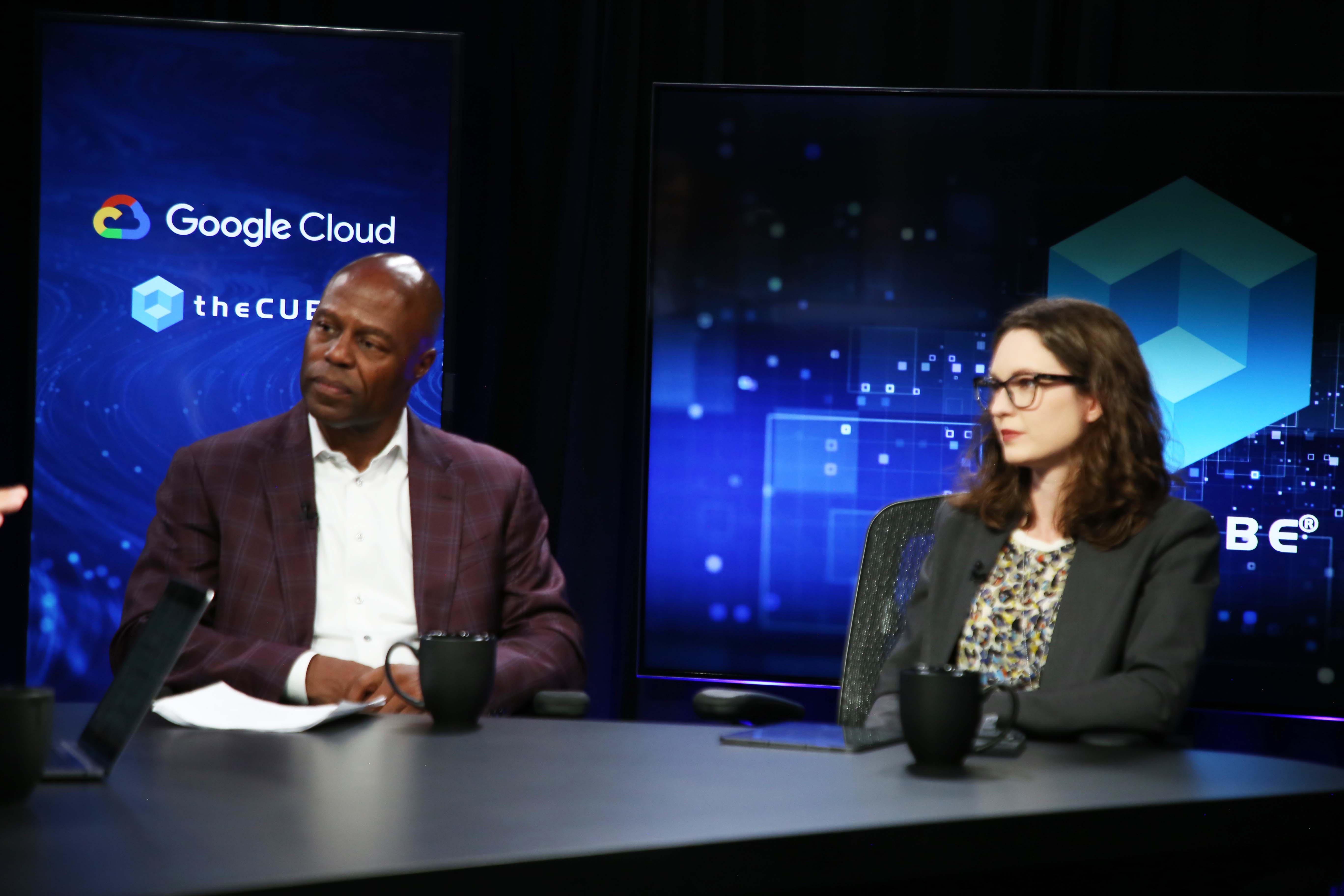
What do you get when Google Cloud teams up with McKinsey? In this Google Cloud Partner AI Series interview, theCUBE Research’s John Furrier talks with Jim Anderson, VP of North America partner ecosystem and channels at Google Cloud, and Jessica Lamb, partner at QuantumBlack AI by McKinsey & Co., about how this collaboration is reshaping industries with AI, from smarter healthcare to faster digital transformation.
Anderson shares how Google Cloud’s AI stack and secure data platforms are helping companies move fast and stay safe. Lamb explains why real impact comes from top-down AI adoption and how agentic AI is pushing boundaries in sectors such as life sciences, where data and decisions go hand in hand.
This isn’t theory, it’s execution at scale. With McKinsey’s strategy playbook and Google’s tech muscle, the partnership is creating serious momentum. From multimodal AI to workflow intelligence, this conversation gives a clear look at how two giants are helping enterprises rethink what’s possible.
Forgot Password
Almost there!
We just sent you a verification email. Please verify your account to gain access to
Google Cloud Partner AI Series. If you don’t think you received an email check your
spam folder.
In order to sign in, enter the email address you used to registered for the event. Once completed, you will receive an email with a verification link. Open this link to automatically sign into the site.
Register For Google Cloud Partner AI Series
Please fill out the information below. You will recieve an email with a verification link confirming your registration. Click the link to automatically sign into the site.
You’re almost there!
We just sent you a verification email. Please click the verification button in the email. Once your email address is verified, you will have full access to all event content for Google Cloud Partner AI Series.
I want my badge and interests to be visible to all attendees.
Checking this box will display your presense on the attendees list, view your profile and allow other attendees to contact you via 1-1 chat. Read the Privacy Policy. At any time, you can choose to disable this preference.
Select your Interests!
add
Upload your photo
Uploading..
OR
Connect via Twitter
Connect via Linkedin
EDIT PASSWORD
Share
Forgot Password
Almost there!
We just sent you a verification email. Please verify your account to gain access to
Google Cloud Partner AI Series. If you don’t think you received an email check your
spam folder.
In order to sign in, enter the email address you used to registered for the event. Once completed, you will receive an email with a verification link. Open this link to automatically sign into the site.
Sign in to gain access to Google Cloud Partner AI Series
Please sign in with LinkedIn to continue to Google Cloud Partner AI Series. Signing in with LinkedIn ensures a professional environment.
Are you sure you want to remove access rights for this user?
Details
Manage Access
email address
Community Invitation
Jim Anderson, Google Cloud & Jessica Lamb, McKinsey
What do you get when Google Cloud teams up with McKinsey? In this Google Cloud Partner AI Series interview, theCUBE Research’s John Furrier talks with Jim Anderson, VP of North America partner ecosystem and channels at Google Cloud, and Jessica Lamb, partner at QuantumBlack AI by McKinsey & Co., about how this collaboration is reshaping industries with AI, from smarter healthcare to faster digital transformation.
Anderson shares how Google Cloud’s AI stack and secure data platforms are helping companies move fast and stay safe. Lamb explains why real impact comes from top-down AI adoption and how agentic AI is pushing boundaries in sectors such as life sciences, where data and decisions go hand in hand.
This isn’t theory, it’s execution at scale. With McKinsey’s strategy playbook and Google’s tech muscle, the partnership is creating serious momentum. From multimodal AI to workflow intelligence, this conversation gives a clear look at how two giants are helping enterprises rethink what’s possible.
Jim Anderson, Google Cloud & Jessica Lamb, McKinsey
Jessica Lamb
PartnerQuantumBlack, AI by McKinsey
Jim Anderson
Vice President, NA Partner Ecosystem & ChannelsGoogle Cloud
What do you get when Google Cloud teams up with McKinsey? In this Google Cloud Partner AI Series interview, theCUBE Research’s John Furrier talks with Jim Anderson, VP of North America partner ecosystem and channels at Google Cloud, and Jessica Lamb, partner at QuantumBlack AI by McKinsey & Co., about how this collaboration is reshaping industries with AI, from smarter healthcare to faster digital transformation.
Anderson shares how Google Cloud’s AI stack and secure data platforms are helping companies move fast and stay safe. Lamb explains why real i...Read more
exploreKeep Exploring
What is the discussion about the partnership "Unlocking the Value" and the trends in the market related to unlocking value and innovation?add
What is the significance of the partnership between QuantumBlack and McKinsey in terms of solving customer problems with AI technology?add
What is QuantumBlack and how does it relate to the healthcare life sciences industry?add
What is Google's goal in providing a full AI stack and data platform in a secure way, specifically focusing on security in healthcare?add
What is a huge discussion point when it comes to operating leverage?add
What are some plans for integrating core AI into the healthcare system and collaborating with partners like McKinsey for a broader impact on customer use cases?add
Jim Anderson, Google Cloud & Jessica Lamb, McKinsey
search
>> Hello and welcome to theCUBE here at our Palo Alto Studios. I'm John Furrier, host of theCUBE. Today we're spotlighting the strategic partnership between Google Cloud and McKinsey. Got two great guests, Jim Anderson, VP of North American Partner Ecosystem Channels for Google Cloud, and Jessica Lamb, partner at QuantumBlack AI by McKinsey. That's the AI division. Jessica, thanks for coming in. Jim, great to see you again.
Jim Anderson
>> Great to see you, John. .>> The partnership Unlocking the Value. The word "unlocking" has been the word of the year. Unlock. The unlock. It's being used, "the unlock" is now like a verb, right? Unlocking value, unlocking innovation. McKinsey, you guys have got a lot of press of using gen AI in your own operations as well as obviously the customer practice. You guys have a great teams, well-known, Google Cloud, off Google Next, now Google I/O. The goodness is hitting the scenes. Let's set the context, the power, the partnership, the trends in the market. You guys are moving faster with customers. They have a mandate, the board level down to the platform levels. Okay. It's going to meet in the middle. We're seeing that top-down business transformation. Okay. The logic, business logic, is in the organizations, the data is in the organizations. You got cloud, you've got on-prem, you've got the Edge exploding in value. That's distributed computing. Welcome to Google Cloud.
Jim Anderson
>> Exactly.>> Welcome to the customer's infrastructure, all being kind of repaved over. In some cases new roads, so to speak, are emerging. New paths, new usage patterns, model efficiencies are all topics we've been talking about on theCUBE. With all this comes new opportunities.
Jim Anderson
>> Exactly.>> What's the current state of the customer right now besides the psychology of, "I got to do more with not a lot of CapEx and OpEx management." There's a lot of CFOs in the mix now. What's some of the market trends?
Jim Anderson
>> Well, I think when you look at market trends from a technology standpoint, multimodal is key. Understanding text data, imaging, and combining that. AI agents, we'll talk about that. That's key. AI assist, helping customers transcribe, just for a customer experience improvement. AI-assisted customer experience, I think that's a big area that's across all segments right now. And we can't forget about security, which is non-negotiable, right? You combine that with the fact that if you look at patient-centric focus along with the proliferation of data and the fact that all the hospitals are looking for payer's efficiency, combining all that is really the focus and that's why the partnership is so important from our standpoint, because we're bringing the domain expertise, the process knowledge, the fact that McKinsey understands the opportunity and challenges with our core AI stack to really solve customer problems in ways we can never do before.>> Jessica, talk about QuantumBlack and real quick, I want to get that out so people understand what that division means for McKinsey, but also in healthcare and life sciences, which you're in, is the, I would say, second-hottest area behind financial services, but that's where all the compute value is. Starting to see the unlocking of innovation and value creation and value extraction with AI in healthcare life sciences mainly because they can get the supercomputing capabilities for the data that they have and the services and the products that they use, whether it's robotics, seeing hot robotics market right now.
Jessica Lamb
>> Absolutely.>> And so obviously just in general, operations, I mean, healthcare, you mentioned hospital, that's an IoT farm basically. There's a ton of action going on there. So you got to run, you got to provide the services. Talk about QuantumBlack and then we'll get to some of the healthcare life sciences.
Jessica Lamb
>> Absolutely. So QuantumBlack is basically McKinsey's AI arm. So think about anytime we're working with organizations doing AI, that's coming out of our QuantumBlack group. They're actually a company we acquired about 10 years ago now. Got started in AI and Formula One, now think of them as a AI center of excellence across all of our different industries. And so we've got about 1200 technologists in QuantumBlack, and so that really allows us to bring exactly what Jim was talking about in terms of bringing together both the domain expertise, we have about 16 domains that we are dedicated to across the healthcare ecosystem where we have really deep expertise, and then you combine that with our 1200 technologists deep in AI and QuantumBlack, and then when you combine that with the infrastructure and technology that Google brings, it really covers the full waterfront that ->> It's interesting about what you're talking about, having technologists os key, because we've been on this IT transformation for quite some time. Digital transformation, some call it. Now it's business transformation, because now the technology transformation's hitting a tipping point and kind of going next level where you've got new capabilities, new uses, I mentioned that, but now the business logic is in the domain expertise. You mentioned that being a domain expert means that's a human, and the data.
Jessica Lamb
>> Exactly.>> Okay. That's a key area that will be the app layer. It's going to be the hottest area, we think, next year. Agents are already kind of bumping into that trend. You're seeing agents will connect into we call the top of the stack. What's that mean from a client standpoint, Jessica, as you deal with these on a daily basis?
Jessica Lamb
>> I mean the biggest thing there with the data is you have to understand how to make it usable. Healthcare has some of the most data available. In fact, every healthcare organization has a ton of data. You're kind of getting it from all of these different sources, like you mentioned. But figuring out how to use it well to solve the business problems, not just to build a cool model or predict something here or there, but really to get under how the industry works and use that data in the right way to solve the problem that you need in a kind of safe and responsible way. That's how it all goes together.>> I think that's an important point, Jessica, because we wrote a post a year ago that went viral. It was a little bit more about the financial services, but it was pretty much in line with what you're saying is that the post was why Jamie Dimon is Sam Altman's new competitor. And the post was provocative, but the point was is that OpenAI trained on petabytes, maybe not even an exabyte of data, but yet some of these companies are sitting on up to a exabyte of data that's locked. So there's some stats that go around, let's say 90% I think might've been IBM or one of the research firms said around 90% of enterprise data is locked because it's not yet in the models. So, okay, the comparison is Jamie Dimon is JPMorgan Chase. So we look at these life sciences companies, they have tons of data, so what are they going to do? So they're going to spend hundreds of millions of dollars on CapEx to train?
Jim Anderson
>> Probably not. No. Okay. But I think that's where->> Not unlimited capital. Then you got nuclear power plants to power everything?
Jim Anderson
>> Yeah. Well, yeah, we'll need a lot of power out there. But I think that's what's being highlighted here, is that you need a platform to really take advantage of the digital disruption that's happening in the industry. Our goal at Google is to provide a full AI stack. We're kind of unique in the industry with that, provide a robust data platform so that we can leverage that data, and then do it in a secure way. So security in healthcare is non-negotiable. And so we sort of focus on that with regards to our strategy and vision around AI, really driving on some of the things that I talked about earlier around multimodal technology, AI assist technology, agents, and those types of things.>> Talk about the power of the partnership. Obviously, because in healthcare the trends are clear. You mentioned the data sizes are massive, the partnership strategy. Not all partnerships are created equal. You have technologists who probably have a high bar anyway to deal with.
Jessica Lamb
>> Thank you.>> And it's McKinsey, so it's a high bar either way. They're doing the real work. There's systems architecture going on, it's a systems game right now. This is what everyone was talking about. What's your perspective on your partnership with Google? How's that enabling you guys to be faster, more effective? What are some of the things you're seeing in healthcare?
Jessica Lamb
>> Yeah, I think it is really that bringing together of the various perspectives. We obviously have the technologists, we have the domain expertise, but Google really brings that kind of broader understanding of the data, the infrastructure, and that technology backbone that is, I think, critical and allows us to bring those pieces all together to our clients instead of doing it piecemeal. We can bring the strategy or we can build out a great use case or do a domain transformation, but it all needs to work in the environment and be able to be maintained over time in order to really get the impact from it.>> It's like the classic line, "Strategy without execution-"
Jessica Lamb
>> Nothing.>> ... "is nothing, but operations becomes the execution piece."
Jessica Lamb
>> Absolutely.>> This is where you're now focused on, a lot of operational aspects. There's also the cliche of outcome focus. Actually you can be outcome-focused and work backwards because you've got end-to-end workflows and the data in these environments that might have brittle enterprise systems, might want new systems, so you've got abstraction opportunities with AI. So take us through how that works for customers, because a lot of customers a little bit scared, I won't say everyone is, but if they're leaning in, they're taking either a pragmatic approach because of security and other reasons, they want to make sure they get it right, they don't have the big build-outs because they're not a public model, they want to leverage them all day long to steal off Gemini and use Vertex. What does that mean for a customer? Take us through the operation side and how the outcome focus now can be realized.
Jessica Lamb
>> Well, and I think part of it, you have to think about where the industry is, right? So healthcare historically has been behind on AI. What that means though is that there's tons of opportunity. So it depends on who you ask, but we're talking about somewhere between $260 to 460 billion in unlocked opportunity across the healthcare industry in the US. And so those are huge numbers. I think generative AI in particular has really been a catalyst in the healthcare industry because it's made AI feel more personable. People understand it, it's just more accessible. And so that has really helped to enable I think a broader conversation around AI in the industry. And in fact, on the generative AI front, we run a survey just kind of keeping track of how much people are really doing in healthcare. And the latest we saw from a few months ago is actually 85% of healthcare organizations are doing something with generative AI. 85% of healthcare organizations don't do anything, right? So to be doing something on the technology front, doing something in generative AI, and a good number of that being stuff that's already in production, I think that's where we're seeing people get comfortable, and so this is where we're getting to some of the unlock, people being able to really think about the value and drive to those businesses.>> The productivity is the time savings, whether you're going in for a scan and getting the results there versus a day later, the value experience as the patients-
Jessica Lamb
>> A hundred percent.>> ... is up. These are the key metrics. By the way-
Jessica Lamb
>> Physician experience, as well. And nurse experience. This is an industry where people are under a lot of pressure. And so anything that we can do to alleviate some of that administrative burden on ->> Yeah. That comes up a lot, just the basic blocking and tackling of the slog of paperwork, reports, compliance-
Jim Anderson
>> Yeah, yeah. Compliance, yes.>> It's a nightmare.
Jim Anderson
>> Automating some of those tasks so the doctors and nurses can focus on more high-value work and those types of things will be critical as we move forward .>> How's the partnership been with you guys? What's the areas of focus? What are you guys optimizing for? Is it the search? Is it the outcomes? What are some of the tech that you guys are -
Jim Anderson
>> Well, first, I'm excited about the partnership and I think it's a perfect match. As I talk about the concept from our CEO of turning research into reality, there's no better partner to turn research into reality. We're both committed to that as two organizations. So our goal is to make sure people can take advantage of this technology with the minimal risk and actually shorten that time to value. The value that we see with McKinsey is that we are working with them on the frontiers of technology. And like I said, they have 1200 technologists. We get to work with them, share them the latest and greatest technology, and they can take it and actually drive the outcomes with our customers and actually solve some of those hard problems. So we think it's that combination that reduces the risk of customers moving to this technology.>> Jessica, not to pull a McKinsey on you, but operating leverage is a huge discussion point in services right now. You're seeing services getting the scale of the value of the services and the productivity and the costs of reduced efficiencies, you mentioned some of those. The Google platform was one of the hottest things that came out of Google Next, which was ... give me a platform, but don't ... make it workable.
Jim Anderson
>> Yes.>> Talk about the relationship, the power of the Google partnership for the platform. Is it easy to work with? What are some experience? Can you share a story and things around the relationship with Google and the platform, how that's translated the value for you and your clients?
Jessica Lamb
>> We've been able to bring it in in a number of situations. One that I am particularly excited about is actually provider directory. So if you think about when you go, you need to go find a doctor, no one has specialist X on speed dial, and so normally you would just go to your health insurer's website and try to navigate through that->> Nightmare.
Jessica Lamb
>> Exactly. Nightmare. If you think about what you can do with current technology and what you can do when you bring different pieces together, you have the ease and the understanding of using Google search to actually be able to navigate something like that in a much more intuitive way. And then when you combine that with those terabytes of data that I was talking about, we actually have a source of truth to make sure that that data is correct. And so what that means is that the process becomes much more seamless for an individual person at the point when they need care to be able to go in, find what they need, access it, get the care that they need, and move on with their life, as opposed to being stuck ->> And on the other side of the coin too is the operations of the healthcare providers, just little things like having good notes so you can get reimbursements. These are things that I've heard in interviews where it's like, yeah, well, there's all kinds of bureaucracy, but we didn't fill out the right form, therefore it's not a scheduled visit, doesn't get co-p- ... all kinds of stuff we can relate to as humans. We've been there. Why am I being charged? I thought it was a co-pay. It was. It should have been. So this is where the AI shines. Can you share examples of other things where you've seen, obviously, there's the patient care, there's the operations of the actual providers. You got two sides of the marketplace there happening. Where's the key inefficiencies of people want to look at implementing gen AI, where's the hot start zones? Where do you go and innovate?
Jim Anderson
>> It's great. Well, first it's a lot of opportunity, I would say, out there. When I look at the marketplace, what I'm seeing right now is first the focus in on the customer experience. And that starts with, we have examples where we're working with McKinsey to leverage our technology to actually do transcribing between nurses and doctors. What does that mean, right? It means, one, we get a higher fidelity of data for which we can operate more efficiently, and second, it reduces the time associated with that so that they can go focus on other things. At the same time, there are complex processes associated with it, like RCM, that we're now leveraging the agentic capabilities to really address that complex task in an automated way. And what's that going to do? Once again, drive efficiency at the organization. So I see a lot of emerging use cases out there with regards to technology that are happening today, leveraging McKinsey's domain expertise and our technology and going from there.>> Okay. Jessica, you are in the agentic agent era?
Jessica Lamb
>> Absolutely.>> And it's the agents of agents as multi-step processes is what ... healthcare has tons of that, a lot of process. Process is good actually for agents.
Jessica Lamb
>> Exactly.>> Eat it up. What's the current state of the agent market as you see it today? Are people putting their toe in the water? Is it picking certain use cases?
Jessica Lamb
>> I think people are putting their toe in the water. I think there's a little bit of nervousness, especially given some previous rounds of maybe automation that didn't exactly play out the way the healthcare industry had hoped years ago. And so there's a little bit of nervousness around this space, but what we're seeing and what agentic AI really helps with is this ability to look at broader workflows and processes. I think to date a lot of what's been done in the healthcare industry is individual use cases or there's a lot of individual point solutions, and those are great, but they only provide incremental value. And where we're really going to get to the unlock in healthcare is when we think a bit broader. Whole domains, whole workflows. And the agentic kind of workflow, agentic systems, allow you to tackle those workflows more holistically, which I think will be really the unlock that we've been waiting for in healthcare.>> I love healthcare. I mean, I've always covered healthcare on theCUBE. It's looking angle mainly on the ransomware side. Very robust market because they didn't have the revenue and they didn't have the right systems. But now the old expression, "Follow the money." You look at revenue cycle management, for instance. A loan checks the box.
Jim Anderson
>> Right.
Jessica Lamb
>> Completely.>> So you got money savings and then revenue opportunities by new services. We're seeing already some signs of new types of services come out that, hmm, might not have passed the ROI test before or not enough budget. Can you guys share a story around revenue cycle management on one side and then patient products, where this personalization or not some broad mechanism to say, "Oh, well we only cover these things or other services"?
Jessica Lamb
>> Revenue cycle management is a great one for illustrating that point of thinking more holistically, right? Because revenue cycle management has been inundated with point solutions and there is individual use cases like, say, using generative AI to generate an appeal letter. That's great, you can do that. You can do that today and it has some incremental time savings for folks. Where you really get the unlock is when you think about that whole revenue cycle management process from beginning to end and you think about all the places where you could have agents actually working through that workflow piece by piece and then getting an outcome so much faster to the individual so they're not waiting to hear about their bill, they're not worried about what they're going to be responsible for. You can actually get to that quicker and more efficiently. And that's I think where everyone wins.>> The point solutions, Jim, is a good one because we're seeing the trend now in this platform or platforms era where you can actually take best of breed, or even both, point solutions and best of breed, some would even argue, we said this at RSA, security conference, best of breed isn't best of breed. It was in a silo. Or if you have a solution that has some best of breed and other point solutions to round out your portfolio is also not a good solution. So you're starting to see the pressure of the platform. So I'm sure your technologists at McKinsey are doing a little McKinsey on McKinsey saying, "Hey, do we have all the right things in the platform?" Talk about that dynamic because this is where you're providing a platform, you're also building a platform to go to the customers. Talk about that role, because it's a lot of work involved.
Jim Anderson
>> Well, I think that's the key, right? We're trying to simplify some of the complexity with regards to leveraging this technology with our customers. So our goal is to provide that platform, to provide a level of consistency for API calls, stuff like that, so you don't have to re-event your connectors every time, and sort of go from there. And that's going to just speed up the adoption of technology. And as we've talked about before, once you start using it, you discover other ways in which it can become beneficial to you type of thing and go from there. I think they're just building on some of that capability and go from there, leveraging, I like to say, our foundation technologies and go from there. I don't know what you -
Jessica Lamb
>> I think that's exactly right. We're able to bring that domain expertise, think through the bigger picture, what is the series of agents that you need, and then we can also build out those really complex individual agents, but they need somewhere to operate, they need somewhere to live and be monitored, they need somewhere that you can actually access them and understand what's going on and deploy them. And that's where I think the kind of Google platform comes in.>> Just on the QuantumBlack AI practice, you guys are well known, McKinsey, obviously, strategy, world-class, everyone knows that. Now you're into the co-creation game. Kind of the same but a little bit more next level, you go a little deeper. Talk about some of the things you guys do, because I think this is where we're seeing a lot of the action. We want to get a beachhead, lock in on some core competencies, get those nailed down, and then sequence into other more broader positions, not try to boil the ocean over as they say. What are you guys working on? Can you share some of the things you do with customers and QuantumBlack?
Jessica Lamb
>> Yeah, and in QuantumBlack, we actually do both individual work with clients. Usually if they're bringing in QuantumBlack, it's for their most complex use cases or if they're looking to get started, say, in agentic AI, can we build out what the first agentic system or two look like and then work ourselves out of a job so that they can take it from there, use all the Google tools, and be ready to go? But we also have QuantumBlack Labs, which is actually where we build out horizontal platforms for ourselves and others, trying to find where are those gaps in the market and making sure that we are kind of filling them with technology that might be missing out there.>> I have to ask you, because you mentioned trying to work yourself out of a job. I love that because that seems to be the AI trend for the chief AI officers. They all have three jobs now, a fourth, -
Jim Anderson
>> Keep adding more.
Jessica Lamb
>> Exactly.
Jim Anderson
>> That's what we do. Yeah.>> I talked to one chief AI, was like, "Yeah, I have a fourth job now. I'm the chief AI officer, but I hope to be out of that soon." It made sense. He said, "No, I want to be out of a job because I want to infuse it everywhere. I don't want to be a central point, a control point. I want to be an enabler."
Change management is a word you guys are used to. How important is that now? Because there's a lot of psychology words like guardrail, safety, security, resilience, we talked about in our last interview. There's a lot of change management going on in parallel. And luckily there's numbers you can show that can be quantified, so that's a good thing. Is-
Jessica Lamb
>> But it's so often overlooked. People think about the model, they think about the data, they think about what is it going to take to solve the problem, but they forget about the change management. And actually when we look across industries actually, and you look at really when you have something that is rolled out successfully, usually you spend $3 on change management for every $1 on the model. And that's kind of the rule of thumb that works well and->> And that shows the emphasis of the human side of it, which is like you got to bring them along for the journey.
Jessica Lamb
>> A hundred percent.
Jim Anderson
>> Yeah. And we talked about we're basically working with companies and customers to reimagine their business processes. So by nature that's going to involve change management to fully take advantage of and go from there. And that's once again why we have partnerships like McKinsey to help make that happen.>> I want to wrap up and kind of find out what's next, but I first want to throw out, Jessica, at you this concept of valuation. Not startup valuation, that's a whole ... we could do an hour on startup valuations. But valuing ROI has always been kind of the benchmark. How do you value projects? What's the current thinking around some of the change management, because you've got change management, you've got operational efficiency, you have new users drive revenue. So you have revenue generation, cost savings, and change management, all kind of boiling over, and then you've got the CapEx/OpEx kind of conversation. Not everyone is going to have a GPU cloud and have to spend all that CapEx. Some might buy energy. It's energy bounded in some level. So what's the valuation? How are projects valued? How do they quantify? How is quantification? Is it a pitch, "Hey, I'm going to have a payback in, well, I got three months"? The time horizons are changing.
Jessica Lamb
>> That is the challenge in healthcare in particular. And as you mentioned, a little cash strapped usually in the industry. And so looking for that kind of series of domains or areas where you can get a little bit more near-term value that can then fund some of the longer-term vision of what's possible here, because not everything has a short term ROI. But that's the other reason why going broader than individual use cases has been helpful for many clients. If you think about the problem more holistically, you unlock more of that kind of trapped value that->> So McKinsey and QuantumBlack fit well together. You could do the holistic and then pick some projects and then scope them appropriately -
Jessica Lamb
>> Exactly.
Jim Anderson
>> Yeah, And we're augmenting that, right? With our technologies like AI-assisted search where you can really get a benefit, I believe, sooner versus later by bringing it into that environment. We talk about leveraging that technology to help doctors get more information on their patients in an easier way and those types of things. So I think it's our goal as a foundational technology company to provide them with some of the capabilities to really address what you talked about.>> And the search stuff on the whole back office opportunity is just massive. What's next for the partnership and the power of the partnership? What's next? What are you guys working on?
Jim Anderson
>> Well, I think a couple things. I think the thing about this partnership is we're going to continue to innovate on the edge, right? We're going to build on what's happening around the agentic world, right? We've reduced technology, ADKs, agent development kits, A to A protocols, those types of things for multi-agent things. We're going to work with partners like McKinsey to really try to leverage that across the broader spectrum with regards to use cases and go from there, so we're having a bigger impact with our customer. So I'm really excited about that and I do believe that the core AI will be integrated into all aspects of the healthcare system, and we want to make sure that's done in a safe ->> They got DeepMind research, you got the deep healthcare, life sciences research and examples. What's next from your end?
Jessica Lamb
>> I am genuinely very excited about agentic. I think that this is that tipping point, the unlock that the industry really needs, that we've been stuck with this trapped theoretical potential value for so long that I think this is actually that moment where we're going to start to release some of it, and I think that will have quite a snowball effect that we've all been hoping to see in the healthcare industry for a while.>> We're psyched to keep tracking on it. Thanks for coming on. Appreciate the-
Jim Anderson
>> Thank you, John.>> ... updates on the innovation. Unlocking the value here in theCUBE. I'm John Furrier here in our Palo Alto studios with the Google Cloud Partner series. Thanks for watching.