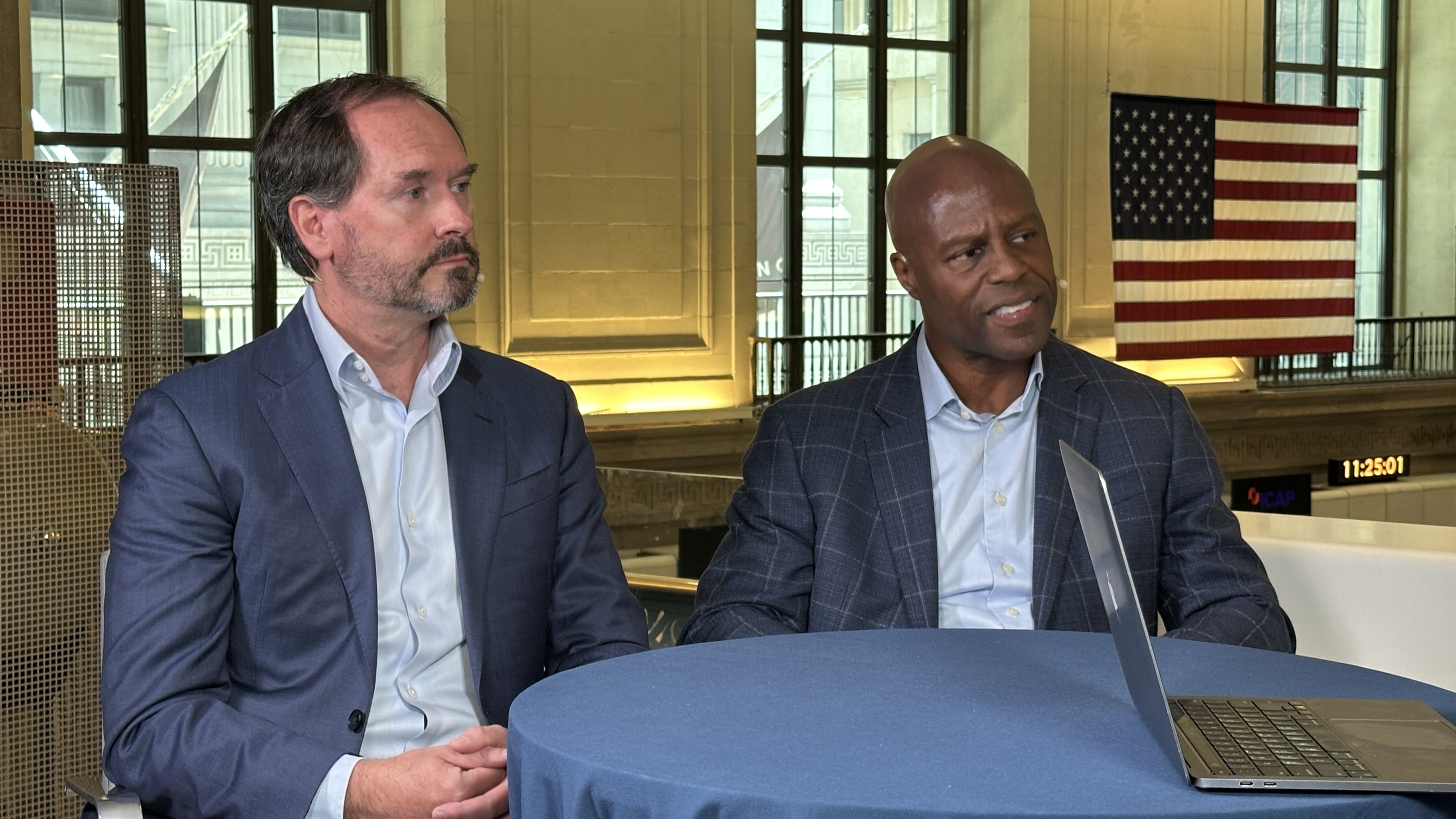
The latest video from theCUBE features Val Elbert, senior partner and managing director at Boston Consulting Group, alongside Jim Anderson, vice president of North America partner ecosystem and channels at Google Cloud. They discuss groundbreaking transformations in artificial intelligence and integration through the lens of their companies’ recent collaboration. The discussion is part of the Google Cloud AI Partner Series, filmed at the New York Stock Exchange Studio.
Val Elbert is introduced as a leading figure in business transformation at Boston Consulting Group. With expertise across the telecom, media and entertainment sectors, Elbert highlights the long-standing partnership with Google Cloud, which amplifies their ability to deliver large-scale business changes. Hosted by John Furrier with insights from theCUBE Research, the conversation covers the intersection of AI innovation, change management and technology integration.
In discussing key takeaways, Anderson explains how Google Cloud’s AI stack, coupled with Boston Consulting Group’s process and domain expertise, enables innovative business model transformations. Elbert emphasizes the significant opportunities AI presents for customization and improved efficiencies, using a specific example of a successful AI-driven customer service initiative with Verizon. According to the discussion, integrating AI into business operations is essential for maximizing the potential of existing data and developing future-ready strategies.
Forgot Password
Almost there!
We just sent you a verification email. Please verify your account to gain access to
Google Cloud Partner AI Series. If you don’t think you received an email check your
spam folder.
In order to sign in, enter the email address you used to registered for the event. Once completed, you will receive an email with a verification link. Open this link to automatically sign into the site.
Register For Google Cloud Partner AI Series
Please fill out the information below. You will recieve an email with a verification link confirming your registration. Click the link to automatically sign into the site.
You’re almost there!
We just sent you a verification email. Please click the verification button in the email. Once your email address is verified, you will have full access to all event content for Google Cloud Partner AI Series.
I want my badge and interests to be visible to all attendees.
Checking this box will display your presense on the attendees list, view your profile and allow other attendees to contact you via 1-1 chat. Read the Privacy Policy. At any time, you can choose to disable this preference.
Select your Interests!
add
Upload your photo
Uploading..
OR
Connect via Twitter
Connect via Linkedin
EDIT PASSWORD
Share
Forgot Password
Almost there!
We just sent you a verification email. Please verify your account to gain access to
Google Cloud Partner AI Series. If you don’t think you received an email check your
spam folder.
In order to sign in, enter the email address you used to registered for the event. Once completed, you will receive an email with a verification link. Open this link to automatically sign into the site.
Sign in to gain access to Google Cloud Partner AI Series
Please sign in with LinkedIn to continue to Google Cloud Partner AI Series. Signing in with LinkedIn ensures a professional environment.
Are you sure you want to remove access rights for this user?
Details
Manage Access
email address
Community Invitation
Val Elbert, Boston Consulting Group & Jim Anderson, Google Cloud
The latest video from theCUBE features Val Elbert, senior partner and managing director at Boston Consulting Group, alongside Jim Anderson, vice president of North America partner ecosystem and channels at Google Cloud. They discuss groundbreaking transformations in artificial intelligence and integration through the lens of their companies’ recent collaboration. The discussion is part of the Google Cloud AI Partner Series, filmed at the New York Stock Exchange Studio.
Val Elbert is introduced as a leading figure in business transformation at Boston Consulting Group. With expertise across the telecom, media and entertainment sectors, Elbert highlights the long-standing partnership with Google Cloud, which amplifies their ability to deliver large-scale business changes. Hosted by John Furrier with insights from theCUBE Research, the conversation covers the intersection of AI innovation, change management and technology integration.
In discussing key takeaways, Anderson explains how Google Cloud’s AI stack, coupled with Boston Consulting Group’s process and domain expertise, enables innovative business model transformations. Elbert emphasizes the significant opportunities AI presents for customization and improved efficiencies, using a specific example of a successful AI-driven customer service initiative with Verizon. According to the discussion, integrating AI into business operations is essential for maximizing the potential of existing data and developing future-ready strategies.
Val Elbert, Boston Consulting Group & Jim Anderson, Google Cloud
Jim Anderson
Vice President, NA Partner Ecosystem & ChannelsGoogle Cloud
Val Elbert
Senior Partner, Managing DirectorBoston Consulting Group
In this episode of the Google Cloud Partner AI Series, Val Elbert, Senior Partner and Managing Director at Boston Consulting Group (BCG), and Jim Anderson, VP of North America Partner Ecosystem at Google Cloud, join theCUBE’s John Furrier live from the New York Stock Exchange studio. The conversation offers a deep dive into how BCG and Google Cloud are partnering to drive AI-powered transformation across the telco and media industries, with a spotlight on real-world use cases, infrastructure modernization and strategic change management.
Elbert shares ...Read more
exploreKeep Exploring
What role do technology partners play in large-scale business transformations involving AI?add
What is an example of a company that has successfully integrated AI into customer service to improve customer experience?add
What role does BCG believe it plays in the change management space, and how is AI contributing to their approach?add
What has been the evolution of AI's significance in the tech, telco, and media sectors over the past few years?add
Val Elbert, Boston Consulting Group & Jim Anderson, Google Cloud
search
>> Welcome back around to theCUBE, here at our New York Stock Exchange Studio. Of course, we have our Palo Alto studio connecting Wall Street and Silicon Valley. I'm John Furrier, host of theCUBE, here for the Google Cloud AI partner series. Got two great guests, Jim Anderson, vice president, North America partner at Ecosystem and channels of Google Cloud, and Val Elbert, senior partner, manager of Boston Consulting Group, here in theCUBE. Thanks for coming and good to see you again. Val, first time on theCUBE. Thanks for coming on.
Val Elbert
>> It's fun. It's been fun so far.>> The Boston Consulting Group, obviously having obviously all the top customers, you guys help people with transformation. You're here with Google Cloud for their big event and here for the partner showcase. Talk about the relationship with Google Cloud and you guys, and what you guys are working on. What's the basis of the partnership?
Val Elbert
>> Yeah, well, first of all, Jim, great to see you again.
Jim Anderson
>> Good to see you.
Val Elbert
>> Our relationship now goes back almost seven years. We have been in the market together for these large-scale transformations. If you think about when a large-scale client needs a technology partner, often there is a change that needs to happen in the business, and that's where our relationship comes in, because we have relationships with the C-suite, with the business leaders who really are driving the change in the market, and bringing both of our parties together is usually what it takes to unlock it, and right now we're living in a fantastic moment because AI is really unlocking the possibilities in such a big way. I usually talk about comparing AI revolution to digital. With digital, folks digitized their existing processes and made them more efficient. With AI, we now have a possibility to completely rethink and reimagine, and that's where the strength of Google and BCG coming together really unlocks those possibilities.>> You head up the area telco and media entertainment, which obviously is super high. You mentioned digital. Media and entertainment is under a transformation, modernization. We see that happening every day, but telco, okay, one of our favorite areas on theCUBE, we've been covering that for all 16 years, has been very much a slow-moving IT-like transformative market, mainly because of their install base, but now with AI, that infrastructure, the value unlock is significant because they're networking the data. The edge and on-prem cloud distributed computing is super hot. Storage obviously enables all the AI we see, data platforms.
Val Elbert
>> That's right.>> The networking fabrics are key and the telcos have all that data. I mean, this is like a Cambrian explosion of next-level stuff for telco. What's your view on that?
Val Elbert
>> Look, I mean, we all remember the pandemic, when we all were working from home, and how important the telco infrastructure has been to getting us out into the open so that we can communicate, and telcos did wonderfully with that. Now is a moment for them to completely change and rethink what they're doing, because as you mentioned, data is there, and now with AI, you can actually understand that data, and many companies, and we'll talk a little bit about it through this journey, many telcos are using AI as a moment to come out and say, "We are taking advantage of what's available to change how the customers see us, to take the load off of the frontline employees and put it into AI." Verizon is a great example. It's a partner of ours. It's a partner of Google's, and a few weeks ago they had a massive announcement, they call it 6/24, which is the date when this new project launched, and with Google's help, they've taken a lot of the data that was sitting in the data warehouses and gave access to it for the customer. Now, within their app, you can interact with a chat agent powered by Gemini to solve all your needs, to explain your bill and to really bring the power of AI to the front and center. I think of Telco as a duck, right? It's moving, but it's moving slowly, but the feet are always moving, and with AI, they can turbocharge and become a super-duck.>> It's one of those industries, like you said, they're paddling under the water and no one sees, because they're running all the networks.
Val Elbert
>> All the infrastructure.>> They kind of fit into the, there's telco for AI and AI for telco, because they're sitting on a mountain set of data that could enable great experiences for the customers, if they can get that data, and then you've got AI for Telco where they can unlock the data, which they have tons of. I mean, they're tracking everything. I mean, Jim, this is a multi-faceted problem statement that has huge upside potential, especially around multimodal assist, search with vectors, enhanced security. This is a huge opportunity. As you guys partner, you've got the blueprints with BCG, looking at these big system-wide, network-wide opportunities, and you're sitting on the cloud tech. What do you see for them? Is the telco for AI, AI for Telco, kind of that, does that hang together?
Jim Anderson
>> Yeah, it definitely does. I mean, you look at Google, and I often talk about, we're this innovation house, right, where we're coming out with technology along the whole AI stack, right down from hardware to large language models, right, which will play in, even in a distributed environment, to a platform like Vertex AI for actually leveraging the governance and some of the operational capability when you implement AI, down to what you see with some of our technologies like Imagen 3, and text-to-video, video-to-text multimodal. It's about how you bring all that together to actually maximize the return on the bottom line, and working with a partner like BCG, what we're combining is all that innovation with their process and domain expertise, along with their change management expertise, to really reimagine how customers are doing business, even on the Telco side. That's the AI to telco and telco to AI, bringing it all together to make that data more usable.>> Now, talk about that change management piece, because I think that's also process and culture. How is that changing? How do you see some of those go-to-market joint initiatives working?
Val Elbert
>> Yeah. Well, I think historically BCG has been one of the top players in the change management space. We understand the business, we understand what needs to get done. We have the patience to go and explain to the customers, all the way down to the ranks of the front line, what needs to happen. For us, this is also a big moment because AI is making us better. We're now deploying AI on ourselves to empower our employees to be even more mindful, to be even more understanding of the context that the customer has. I'll give you one example. We're building a plan to integrate two companies. We're now putting AI out in front to say, "Okay, these are the two companies that you're trying to integrate. Where are going to be all the change management hotspots, so we can proactively get ahead of that?">> Are there patterns emerging on telco and media entertainment that are similar? What are some of the scope of the magnitude of these transformational projects that you guys are looking at? Can you give some examples?
Val Elbert
>> Yeah, I mean, I think a lot of people talk about customer service. Customer service is the first use case that really off the bat came in, and we're seeing fantastic implications there. We're seeing 20, 30, 40% efficiency improvements, where the work that used to take three days or a case that took three, four days to resolve is now being resolved in minutes, if not hours. The second use case that we're seeing really, really high penetration is software development. The software development life cycle is completely going to be reinvented. We thought offshoring was an opportunity, but this is just mind-blowing, because the kinds of things you can do, kinds of things you can build within AI is going to create so much more effectiveness in the IT function. The next one, and this one I'm really, really excited about, because it builds on some of the innovation that Google brought to market within their multimodal, is changing the office of the CMO. We have a list of 30 or 40 companies, many of them in telco and media, who are completely rethinking what their model is, how they work with agencies, because they recognize so much can be done in-house now with technology.>> Those things, let's take code for a second. What are some of the things you're seeing? Because with generative AI and analytics, I mean, telcos have been doing analytics. That's not new, so they have all the analytics, they have the data, but now you have the generative app building in production path. Now, clear line of sight, I mean, vibe coding was great. That was last year, or this year, but now you can go from vibe coding into actual production. This is the trend that we're seeing. Any thoughts on some projects there?
Val Elbert
>> I mean, if you think about telcos, right, telcos have been in existence for hundreds of years. Some of the code written in COBOL and other languages that have maybe one person in New York who understands, putting generative AI against this to explain what this code means, or even better, refactor the code and->> Here's a code base. Learn it.
Val Elbert
>> Yeah, exactly, and refactor-
Jim Anderson
>> I told you, I might go back to coding. I told you that last time, right? That's worth the challenge.
Val Elbert
>> That's where we all need to go, Jim.
Jim Anderson
>> Yeah, exactly.
Val Elbert
>> That use case just created things that, in the telco world, they used to be untouchable. It's like, "The billing system works. We're not going to touch it. It just works." Now we can actually understand it, and better yet, we can refactor it, build it into a modern language, and that translates both into much happier customers, because now they can understand what the bill actually says, and then much more efficiency for the telco. They can actually take those systems, retire legacy things that they don't need, and move into modern stack.>> Jim, talk about this, because in our previous chats, we always talked about service as software, as that transition from software as a service to service as software, and a lot of these end-to-end workflows with this data and domain expertise, this is like, it's rich for AI. It's got high nutrient value, right? You've got the data, you've got the workflows. The ability to abstract away and code is now going to create better integration, because billing systems, they're a system of record, so you don't want to mess with that, but also other integrations, I won't say are brittle, but they're working. Don't break what's working, but now you have the ability to abstract away and not kind of touch those systems, but that's got end-to-end data. This is where the cloud shines.
Jim Anderson
>> Oh, definitely. It allows you to scale your efforts, right, and it really accelerates the transition to the digital world. Right? If you think about it, what's happening now is we've democratized the ability to be creative with this technology, right? By enabling more and more people to go out there and code, to allow companies to refactor their code in ways they couldn't do it before, so therefore, I think what we're just adding is a lot more agility, and we're throwing on top of that access, we talked about earlier, to data, that were in a silo before, that now we have access to, from orchestration, things like agent space, so you can take advantage of that so you automate processes in ways we've never thought about it before.>> Give us your direction of where you guys are headed. How are you using AI?
Val Elbert
>> Yeah, so first and foremost, each of our employees has access to AI from day one, right? We encourage all of our team members. In fact, we look at which team members are using AI more and more, and we encourage that very strongly. We have hack-a-thons, we have hack-a-days, to get our teams building tools, and then we celebrate those that build the most advanced tools. We have this capability within BCG called BCGX. We have about 4000 engineers, probably one of the largest AI data scientist organizations after Google and the Magnificent Seven, and they are building tools for companies to go and bring the power of AI to them faster, so when they don't have enough engineers on their side or their engineers are bothered with the business or running of the business, we come in with our capabilities. I'll tell you one really interesting example. It's another project that we did with Google in France. Newspaper, one of the newspapers of record there, La Provence, we built, using Google technology for multimodal, we built a personal agent that each reader can do to create a curated audio feed of the news for themselves. When they're showering in the morning, and they say, "Tell me the stories about sports, politics, and weather," and using our technology with Google, we are able to construct that.>> Funny, BCG, you're almost an actual poster child of what AI is, because in the old days, now, speaking from my old experience, BCG was the go-to company for transformation.
Val Elbert
>> That's right.>> CEOs call you in, you lay out all the variables, the business architecture, you say, "Here's where you've got to go," and you go, "Okay, now go talk to someone else to go implement," I mean, and now you can actually, because you have that domain expertise, you can go to the next level and provide actually integration services with Google.
Val Elbert
>> That's right. BCG is not going to create its own LLMs. We have to work with technology partners to be able to understand where and how to plug them in, but we are able to go from the CEO suite all the way to the code base, at least to get projects started. Now, we ultimately want to hand it over to the clients back, to manage the business. We're not in the business of staying there for five, 10, 15 years. No.>> Just transform and pass the keys on.
Val Elbert
>> That's right.>> With Google, Jim, this is a huge point because this is the new ecosystem that's emerging. You're enabling them to basically be an integrator without being one, because they're the domain experts. You accelerate time to value, time to happiness, we say, because you can then accelerate, and they don't have to go through all kinds of different steps. You have an ecosystem behind you.
Jim Anderson
>> Yeah. We're enabling them to bring value to their customers in new ways. That's what's so exciting, right? We're giving them the technology where they can go to their customers and not just talk about re-imagining their business. We actually show them how they can re-imagine their business to be successful.>> Val, talk about the state of the market, because you said it earlier, an exciting time. Folks who have been pre-AI, who have been through either their technical training or business school, have been leaders, see how fast things are changing and the velocity. Just put the perspective on the opportunity and how cool it is, because you can solve problems so much faster. I mean, this has never happened before, at this level.
Val Elbert
>> Oh, it's fascinating.>> In my career, I've never seen it this great. In terms of, if you like that.
Val Elbert
>> Yeah, look, I'll talk about tech and telco and media, which are the spaces that I know. Well, two, three years ago, AI used to be just a hobby. I think now it's a board-level topic. The executives need to have a clear plan and also a clear payback, because what has happened over the, let's say, last 18 months, lots of companies started experiments, proof of concepts or ideations, or let 1000 flowers bloom. What they're realizing now is, in order for this technology to have real impact, we need some clear focus. We need really good guardrails, and we need to have a really clear partner at our table, somebody like Google, somebody like BCG, together, because if our teams try to do it themselves, it's just not going to work. What I'm seeing in a lot of the executive conversations, we're having AI, yes, it's a question. It's an accelerant. It's a way to touch things that used to be untouchable, like we talked about, billing systems. We talked about data, but there needs to be clear focus because the types of checks that they're asking to write for the CapEx investment are the size that the boards care about, and so you need a clear payback strategy.>> What about the customer engagement? Because you have multifaceted customers, they have customers who have customers. Customer experience, you briefly touched on that. Talk about the impact of that, because if you get the data, which you have, and you have the workflows, you get the super-computing of the cloud and all the data experiences that they have, the combination's a one-two punch. What are some of the customer outcomes or examples of their benefit? What do they see? What are you guys seeing for results with customers? Scope the value, if you could.
Val Elbert
>> Yeah. I mean, I think, look, we are still, I would say, in the second or third inning of the game, so for some of the companies of the size that we are talking about, it still has yet to fully change their bottom line perspective. However, the bets that they're taking are the types of bets that will change the trajectory of the company, whether it's the Verizon that we talked about, and their map. I mean, they effectively dedicated their whole marketing day just to customer experience enabled by AI. Something like that is fantastic. Altice recently announced, also working with Google, that they're completely changing their customer center operations, so these are now becoming events that people talk about, in their 10-Ks. I would say in two or three years, we'll be able to see the inflection points in their revenue and even the curves, when those programs got to scale.>> Yeah. Jim, what's your reaction to that? Because I mean, data as value, it'll be in the balance sheet someday. It's in the 10-Ks, because the business impact is significant.
Jim Anderson
>> Yeah, I think data is your asset, right? It is the key asset, and just imagine what you're talking about, a call center operation where you're just not responding to calls, but you're capturing the data associated with all those calls, so then you can be more proactive with regards to where you need to provide help or those types of things. Or, if you're a product, "Hey, where are my top questions coming from? What themes are evolving out of all these conversations?" Then actually design better products with it, so I think data is the asset right now, and leveraging these technologies like AI to make use of it is key to success moving forward, and that's why we have a great time partnering at customer sites.>> I love the early innings thing, comment, because it really feels early innings, and a lot of people I talk to, smart people have a lot of data. They actually understand that data has value, they want to unlock it, but their first order of business is to figure out what they have, and then what they could do with it. Once they get that, then AI gives them that progression where, once they get a win, new things emerge. You've got to be down the path. You have that same experience? Are you guys seeing that same dynamic?
Val Elbert
>> Well, let's separate the world. We have the digital natives for whom data's always been cleaned because they've been doing it from the start, but if you're talking about companies that are hundreds of years old, for them, data, cleaning the data is one of the top priorities. We've developed another sort of core offering with Google where we do data lineage, which is trying to figure out what data actually means, and where did it start? Where is our core key? Once you do that, then you can deploy LLMs on it, because one of the challenges or one of the problems with LLMs, if you put wrong data in that's unlabeled, and it's inconsistent, you're actually going to get worse results, so data is absolutely fundamental. Companies are realizing that it's an additional investment they need to make. Once data is clean, then you can begin to build innovative use cases or just simply to revolutionize.>> Yeah. I think that's one of the benefits and actually pleasant surprises coming out of Google Cloud, is that it's the tooling, not just the LLMs that are good, because that's the power tool to set the table for the data. Okay. Let's talk about the partnership. What's the status of the partnership? Can you give some data around the current relationship, how you guys engage? You go to market together, what's next?
Jim Anderson
>> Yeah, yeah.>> Let's talk about how you guys are working together.
Jim Anderson
>> Well, the status of the partnership is, we're both very excited, right? You have two companies that are really focused in on customer success and leveraging innovation to drive it. What we are seeing is that the combination of BCG, like I talked about, to address aspects, not just about technology, but the change management aspect, the governance aspect associated, the data aspect of it, combined with Google, and the pace that we're innovating, right, is a value to the customers, because you're not just investing with today. When we're talking about AI, we're always talking about, it's a journey, not a transaction, right? It's a real question about, who do you want to partner with on that journey? We believe we provide a good combination to do that, so we're really excited about the future, and I think we're still just beginning. We're still . >> What's your perspective on the partnership?
Val Elbert
>> I think what's been really remarkable for me to discover is how similar our DNAs are culturally, and that's what makes it really easy to get into a room and problem-solve together, right? Both of our companies are incredibly inquisitive, very technically savvy, and so when we put those assets together, both from the technology side and the business know-how, it actually creates a really remarkable combination. What's actually also fascinating is, we have this partnership in the US, of course, but it's also a global partnership, so we're able to take ideas from Hong Kong, bring them to the US, and then bring them to Paris, et cetera, so that accelerates the flow of information globally, and that's been really nice.>> Yeah, and BCG, you guys are well-prepared. You've got the AI internally. You guys are well-known for business consulting, business model advisory/re-architecting. IT transformation has been talked about for a decade, digital transformation. Now we're kind of in a business model transformation. What's your view on that? Because now, you're taking business model transformation, you said boardroom conversations, you're scaling that. I mean, this is now, you get operating leverage. Talk about business model transformation. What does it actually mean?
Val Elbert
>> From our perspective, what this means is, with the technology, now that we understand it, now that we could increase it, we're able to ask the questions of, "Let's go from future state back," because historically digital transformation has been, "Here's our current state, let's make incremental improvement A, B, C, D, E." Boards are now asking us, "Tell us what the AI first telco is going to be, and let's go build from the end backwards," and we're able to bridge that gap because we've been investing in AI, we have the business technology, and we're able to give them a blueprint and say, "In X number of years, you're going to be AI entirely operated, with sort of the agents running the show, here's what you need to do to get there, by function, by practice," and then build that plan by year.>> Your customers are making generational decisions right now. That's going to be foundational.
Val Elbert
>> That's right.>> That's the key.
Val Elbert
>> That's what we're dealing with, and people are excited, because what I actually think is fascinating, people are able to use this technology in their daily lives, whether it's Gemini or other products. They actually see the power of it. Whether you're a board member or CEO and you're saying, "Ah, I can imagine this now being inside of my corporation," and they're asking those really smart questions.>> Yeah. You could build a roadmap and actually deliver value today and extend that out with Headroom. Val, thanks for coming on. Jim, great to have you on. Thanks for being part of the series. Appreciate the commentary. Love it.
Val Elbert
>> Thank you.>> Okay. I'm John Furrier with theCUBE. We are here at our New York Stock Exchange CUBE Studios. Thanks for watching.