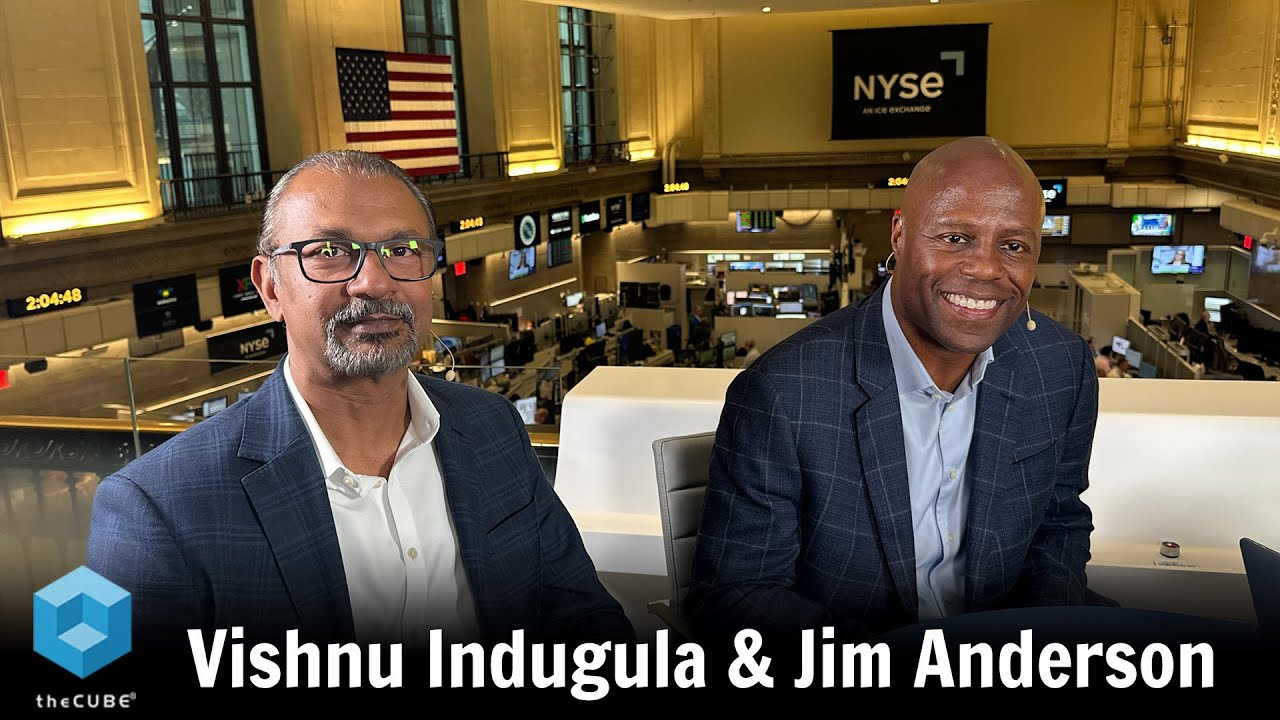
In this interview from the Google Cloud Partner AI Series, theCUBE’s John Furrier hosts Vishnu Indugula, SVP at Publicis Sapient, and Jim Anderson, VP of North American Partner Ecosystem and Channels at Google Cloud, for a deep dive into the future of AI-powered marketing transformation.
The discussion explores how Google Cloud and Publicis Sapient are partnering to unlock personalization at scale, break down traditional marketing silos and operationalize agentic AI across industries. Indugula explains how Publicis Sapient’s SPEED framework (Strategy, Product, Experience, Engineering, Data) ensures AI is deployed with strategic intent, not just hype. Anderson emphasizes that success in this fast-moving AI landscape requires more than technology, highlighting the importance of business-aligned outcomes and shared innovation.
Key use cases include dynamic content generation for CPG brands, competitive messaging optimization in healthcare and the use of AI agents to enhance both marketing workflows and developer productivity. The conversation also touches on how AI is compressing traditional transformation timelines, driving operational efficiency and creating new frontiers for MarTech innovation. Together, Google Cloud and Publicis Sapient are helping clients reimagine the role of marketing in an agent-driven enterprise environment.
Forgot Password
Almost there!
We just sent you a verification email. Please verify your account to gain access to
Google Cloud Partner AI Series. If you don’t think you received an email check your
spam folder.
In order to sign in, enter the email address you used to registered for the event. Once completed, you will receive an email with a verification link. Open this link to automatically sign into the site.
Register For Google Cloud Partner AI Series
Please fill out the information below. You will recieve an email with a verification link confirming your registration. Click the link to automatically sign into the site.
You’re almost there!
We just sent you a verification email. Please click the verification button in the email. Once your email address is verified, you will have full access to all event content for Google Cloud Partner AI Series.
I want my badge and interests to be visible to all attendees.
Checking this box will display your presense on the attendees list, view your profile and allow other attendees to contact you via 1-1 chat. Read the Privacy Policy. At any time, you can choose to disable this preference.
Select your Interests!
add
Upload your photo
Uploading..
OR
Connect via Twitter
Connect via Linkedin
EDIT PASSWORD
Share
Forgot Password
Almost there!
We just sent you a verification email. Please verify your account to gain access to
Google Cloud Partner AI Series. If you don’t think you received an email check your
spam folder.
In order to sign in, enter the email address you used to registered for the event. Once completed, you will receive an email with a verification link. Open this link to automatically sign into the site.
Sign in to gain access to Google Cloud Partner AI Series
Please sign in with LinkedIn to continue to Google Cloud Partner AI Series. Signing in with LinkedIn ensures a professional environment.
Are you sure you want to remove access rights for this user?
Details
Manage Access
email address
Community Invitation
Eliot Danner, Google Cloud & Miles Ward, SADA, An Insight Company
In this interview from the Google Cloud Partner AI Series, theCUBE’s John Furrier hosts Vishnu Indugula, SVP at Publicis Sapient, and Jim Anderson, VP of North American Partner Ecosystem and Channels at Google Cloud, for a deep dive into the future of AI-powered marketing transformation.
The discussion explores how Google Cloud and Publicis Sapient are partnering to unlock personalization at scale, break down traditional marketing silos and operationalize agentic AI across industries. Indugula explains how Publicis Sapient’s SPEED framework (Strategy, Product, Experience, Engineering, Data) ensures AI is deployed with strategic intent, not just hype. Anderson emphasizes that success in this fast-moving AI landscape requires more than technology, highlighting the importance of business-aligned outcomes and shared innovation.
Key use cases include dynamic content generation for CPG brands, competitive messaging optimization in healthcare and the use of AI agents to enhance both marketing workflows and developer productivity. The conversation also touches on how AI is compressing traditional transformation timelines, driving operational efficiency and creating new frontiers for MarTech innovation. Together, Google Cloud and Publicis Sapient are helping clients reimagine the role of marketing in an agent-driven enterprise environment.
Eliot Danner, Google Cloud & Miles Ward, SADA, An Insight Company
Eliot Danner
Managing Director, Google Distributed Cloud Sales and TechnologyGoogle Cloud
Miles Ward
Chief Technology OfficerSADA, An Insight Company
In this Google Cloud Partner AI Series segment, theCUBE’s Rebecca Knight sits down with Eliot Danner, managing director for Google Distributed Cloud sales and technology at Google Cloud, and Miles Ward, CTO of SADA, to unpack how enterprises are moving from AI “science experiments” to outcome-driven programs tied to revenue, cost and P&L impact. The discussion explores why a durable data strategy must underpin any AI strategy, how partners translate Google’s world-class AI stack into line-of-business results and why success starts with clear baselines and eva...Read more
exploreKeep Exploring
What has been the evolution of approaches toward utilizing AI in organizations?add
What role do partners like SADA play in adapting products and services to meet customer needs?add
What are common mistakes companies make when implementing AI, and how can they effectively align AI initiatives with business outcomes?add
What is the primary concern when discussing the modernization of legacy investments?add
What measures are being taken to ensure that AI can be trusted in high-stakes environments?add
Eliot Danner, Google Cloud & Miles Ward, SADA, An Insight Company
search
Rebecca Knight
>> Hello everyone and welcome to theCUBE Studios in Palo Alto and the Google Cloud Partner AI Series. I'm your host, Rebecca Knight. We've got two great guests for this next segment. I'd like to welcome Miles Ward, the CTO of SADA. Welcome, Miles.
Miles Ward
>> Howdy.
Rebecca Knight
>> And Eliot Danner, managing director Google Distributed Cloud sales and Technology. Welcome, Eliot.
Eliot Danner
>> Morning.
Rebecca Knight
>> So I'm actually going to start with you, Eliot, and the big picture because there's so much hype around ai, but now it seems as though customers are really focused on practical implementation rather than just imagining what might be possible. From your perspective, what is driving this mode?
Eliot Danner
>> I think we went through sort of the era of experimentation and now we're seeing the era of outcome expectation, right? And so the mode that we're in right now I think is the middle phase of customers going, okay, we've experimented with it, we've got some ideas about what we could do. We didn't actually see the results we expected in terms of actual revenue from the experimentation. So now we need to get into a more outcomes driven approach. I think we've also seen a lot of organizations discover that at the end of the day, AI is most powerful in unlocking the potential energy in their data, and the only way to really do that is to have a data strategy that goes along with the AI strategy. So we've sort of gone from experimentation to outcomes and then realizing the foundational things that are required in order to drive those outcomes.
Rebecca Knight
>> So Eliot, SADA has been a Google Cloud partner for 25 years with eight Partner of the wins. Congratulations. In fact, you're in town now for the Google Cloud North America Tech Forum.
Eliot Danner
>> That's right.
Rebecca Knight
>> What in your mind has kept this alliance so durable?
Eliot Danner
>> Sure. From the beginning, I think the first product we interacted with was the yellow search appliance box. It gives you some context for the duration we're talking here.
Rebecca Knight
>> Take me back.
Miles Ward
>> That's right. And I remember having been a Google employee setting foot the first time in the Google data centers, there's just something a little different. The level of pressure and the complexity and the challenges that Google as a business had to face has hardened the technology systems that they allow us to vend out to customers. It lets me be very, very comfortable making high bar promises to our customers, because I know the technical systems are beyond reproach.
Rebecca Knight
>> So Eliot, Google has the world-class AI stack, but as you started this conversation, we're really moving to connecting it to business outcomes. So how do you see partners like SADA bridging that gap?
Eliot Danner
>> Yeah, so were, and I'll just for a second say, SADA has really been with us from the beginning. So one of the things, when we think of who do we want to experiment with a little bit, SADA comes quickly to mind, but I was talking about this yesterday. One of the areas where partners bring a tremendous amount of value is that our partners know the inside and outside of our customer's business just extremely well. Google builds world-class products and services, but adapting those products and services to solve the individual business challenges, the outcomes that our customers are looking for, partners have that deeper expertise in the line of business, and that's where they become really critical. And SADA has differentiated itself by really knowing, inside and out, our joint customers and having the answers both when customers ask, but also when we ask where we need to adapt our products in order to match the market.
Rebecca Knight
>> So Miles, you have said that the biggest mistake that companies make is treating AI like a science experiment. I love it.
Miles Ward
>> So silly.
Rebecca Knight
>> But how do you get clients to think beyond that and to think as Eliot is talking, really connecting it to those outcomes? Think big, think impact, and focus on tying it directly to P&L?
Eliot Danner
>> Every company everywhere, any technology sufficiently advanced as indistinguishable from magic. This is maybe sort of genie magic. It's dangerous, it does things you don't expect. And so I think a lot of the experiments were not only couched in those terms, designed as sort of science projects, no real threshold for success, no measurement in many cases, but they were also critically placed way outside of the blast radius of where the business actually makes money, where the critical data sits. So of course, as a business analyst looking at the results of this, you're just out in the weeds instead of right in the middle of the company. So we've helped businesses take a really pragmatic approach. It's just not useful to experiment out in the periphery. You've got to work on the place where you make money or reduce costs. That's just the core of how every business is measured. And the more that we are thoughtful about the real center point of our customers, the more positive effect we can have.
Rebecca Knight
>> So let's talk about legacy software, which is exceedingly complicated and so overwhelming for so many organizations. Eliot, how is Google Cloud helping technology leaders modernize and make sense of this messy middle?
Eliot Danner
>> Yeah, so this is the perennial question when we talk to customers. How do I modernize my legacy investments and not completely scrap them? And so one of the things we've really-
Rebecca Knight
>> Is it even possible?
Eliot Danner
>> In most cases, yes, but there are some things that are too far gone. Actually going back to the science fair thing, I'll just share everyone on my team has a sticker that says, "No more science fair projects. " And that actually that comes from this science experiment methodology. Why that relates to legacy technology is I think a lot of legacy migrations rapidly turn into the what could we do versus what should we do. So when I think about Google's approach to this, we've built the expertise in the best practices for taking data and workflows from one set of applications to another, and then we look to partners like SADA to apply those to the specific customizations and the specifics of the enterprise environment that they're going into. As I mentioned before, one of the reasons SADA's so valuable to us and our partner ecosystem in general is that we need those signals. What are the enterprise? What are the legacy enterprise environments customers have? How do we take those legacy enterprise environments, figure out what actually matters versus what would be fun to do and focus on getting the things that actually matter from where they are today to where they need to be.
Rebecca Knight
>> The things that are fun are so fun.
Eliot Danner
>> The things that are fun are so fun. And as an engineer, I love the fun stuff, but the reality is business outcomes are not always in the fun stuff. Sometimes, but not always.
Miles Ward
>> Yeah, paychecks don't come from parlor tricks. And these things are incredible at doing little parlor tricks, right?
Miles Ward
>> They're incredible at it.
Miles Ward
>> Yeah, so a great example of the kind of collaboration that you're talking about, Agentspace, really a super powerful platform. So much potential in helping businesses orchestrate that work. We worked together with Google in the earliest incarnations of this product, working with very path-breaking customers who are ready to take on the work of being kind of those alpha testers. We put dozens of feedback requests into the system to work together to get the product to where it is. And a lot of that was about what are the internal data systems that Agentspace connects to so that you can really get through to the end goal, which is all this stuff working together in a way that moves the business forward.
Eliot Danner
>> Well, and Agentspace is a great example of how an organization that has an investment in legacy platforms can unlock the data that's in those legacy platforms, turn it into outcomes without necessarily needing to go through the pain of a re-platforming effort. And so when we talk about connectors and Agentspace, a lot of that is around making sure that customers can invest in outcomes rather than investing in a massive re-platforming effort first.
Rebecca Knight
>> So actually let's talk about outcomes because, Miles, you have said that it's context is that is what matters.
Eliot Danner
>> 100%.
Rebecca Knight
>> Because everyone can have access to models and this, but really it is about the data and the processes. That's where the real advantage lies. Can you talk about an example of how you've engineered that into an AI project?
Eliot Danner
>> Sure. Great example. I think everybody's realized these things are exceptional at eliminating tedium. And all of us in all of our businesses have figured out some really abhorrent little steps that are required in the connection between the ask from the customer and the delivery of value.
Rebecca Knight
>> And it will write all your emails.
Miles Ward
>> Right. Oh, it's going to summarize that email and then de-summarize it for my boss. It's magic. It's totally magic. So customer of ours, The Sherlock Company, every time you've ever watched a video on any of the streaming platforms, what movie am I going to watch next? There's a little screenshot from the movie at the top, right? But which still frame is it right in this action movie? It should it be when he flies out of the way of the plane or should it be the shot when he catches the girlfriend? What's the key frame? Well, okay, look, there's 24 frames a second times an hour and a half for every one of movies and there's how many movies are there exactly? And you need to cut into how many different formats and templates and types. So you're talking millions of individual photos have to be yes, hand curated.
Eliot Danner
>> Yup.
Miles Ward
>> And so that's exactly the kind of job that you want a system like this to take on. We were able to use the video intelligence APIs from Google, Gemini APIs, to be able to literally reduce that now to an automatic process of suggesting what are the best key frames out of every movie that they receive.
Miles Ward
They do that real time now. They can do that in the meeting with the customer instead of starting a laborious process that takes weeks and weeks. So it's really made them much more nimble. That technology stack, the combination of automatic video processing, search indexing, making that easily visible in user interfaces, we've now applied to dozens of customers.
Rebecca Knight
>> Right, because you can see how that is applicable. That's media and entertainment, but you can see how it's applicable to lot of industries.
Rebecca Knight
>> Everybody that has media... That's right.
Eliot Danner
>> Almost every organization has some level of media.
Eliot Danner
>> That's one of the things I think is most interesting about AI actually is if you abstract the industry from the use case, the use cases are very broadly applicable. In many cases, like organizations of any complexity have media, they have audio, they have large amounts of text, they have legacy data. They have all kinds of different things. And so when we talk about this, I think we have a tendency to say, "Well, it's an industry specific use case. " Absolutely there are industry specific use cases. But we shouldn't assume that in order to leverage the technology that solves an industry specific problem, you have to necessarily be in that industry.
Rebecca Knight
>> Exactly. Well, let's move to another industry though, public safety, because I know you have another great use case with Viiz communications that has used your joint solution to reduce non- emergency call times. So I want to hear you talk about the human impact of that too.
Eliot Danner
>> Anybody who's ever dialed 911, it's probably among the scariest times of your afternoon except for when it's not, and you're just trying to figure out how to get somebody to clear this flood.
Eliot Danner
>> .
Miles Ward
>> And governments and state, local agencies everywhere, they really struggle with kind of call routing and understanding how to get people to put in the right digits as they find the stuff they're looking for. So very often, if you don't know who else to call, you call 911. So working together with a couple of city groups, this first implementation built on Google's Contact Center as a Service and the CCAI tooling, we have a whole bunch of depth there and so made the implementation of that very straightforward. They were able to reduce, out of all the calls that come into this group, some 60 % of them are not emergencies.
Eliot Danner
>> Wow.
Miles Ward
>> So you have to just do that number over. That's 60% more time to carefully deal with actual emergencies. And we're correctly categorizing 98. 8% of those calls. So that really sets up... Their human auditors were nowhere near that level of performance. So being able to catch a user where they are, bring them to the point of value they need really quickly, and helping the folks that are actually in an emergency get very detailed, careful care from clear professionals with the human touch, that's a huge benefit of working in this way.
Eliot Danner
>> And that's a great example of not doing a science fair project and instead focusing on an outcome.
Miles Ward
>> That's right in the middle.
Eliot Danner
>> That's right there where it actually matters to people at the end of day.
Rebecca Knight
>> But you really have to trust it. Because this is, in some cases, a matter of life or death. Human lives could be at stake. So how, Eliot, are you ensuring that the AI underpinnings of it can be trusted in such a high stakes environment?
Eliot Danner
>> So grounding and making sure that our AI is linkable back to provable facts has been a key core component of AI development at Google. It's an area that we're an absolute leader in, and so we've spent a tremendous amount of time making sure that you can walk back the AI to a specific grounded element, that that grounded element is something that's been incorporated and really reducing hallucinations as aggressively as possible. That's sort of on the tech side. On the regulatory side, we've also spent a tremendous amount of time working on ensuring regulatory compliance, including sovereign compliance with our AI tools. The reality is regulatory burden is increasing, not decreasing. And so making sure that our AI tools remain compliant, let our customers get factual answers, let our customers make sure that they can walk back how those facts ground to the data in their organization, and making sure that they're within the regulatory compliance boundary that they need to be in is critical.
Miles Ward
>> Both of those are super important. I'll tell you, for a lot of our customers, there's something that's a lot more fundamental there. You remember the last time Gmail was down or search was down?
Eliot Danner
>> That's a good point.
Miles Ward
>> That's weird. I can't remember when either.
Rebecca Knight
>> Yeah.
Miles Ward
>> These systems are mission critical and they have to stay online-
Eliot Danner
>> That's a great point.
Miles Ward
>> And Google's infrastructure does.
Rebecca Knight
>> I think I would freak out. I don't even want to
Eliot Danner
>> think about it.
Miles Ward
>> It's how you know the internet doesn't work if search internet doesn't work.
Eliot Danner
>> If search is broken. Yeah, yeah.
Rebecca Knight
>> That's right.
Rebecca Knight
>> Right.
Miles Ward
there is a fundamental level of trust that's not just in the new high level application components that are being built, but in how the pavement is poured, how the walls are built. The real technical underpinnings that sit at the center of these things are incredible.
Eliot Danner
>> We've spent a lot of time building things from the ground up. When I think about what differentiates Google technology, it's really built from the ground up, and that means that we've considered stuff like that. Miles is exactly right. We've considered the resiliency, reliability, we've considered regulatory compliance, we've considered grounding. We've considered a lot of these things. And we have that advantage because really everything that we've done is from the ground up.
Rebecca Knight
>> So both of you, when you look across industries, what do you think differentiates the customers that are scaling effectively versus those that are spinning their wheels and playing with those science fair experiments?
Miles Ward
>> Eliot had it.
Eliot Danner
>> what your answer is.
Miles Ward
>> Eliot had a clear framing early that the data platform is just a crucial first ingredient. So it's sort of like showing up to the football game without your helmet, that's going to go badly for you. We have also a lot of customers, the difference for them has been creating connections in their business between the people who have the problem and their technical teams. I think sometimes this can be... It's so magical to build something so quickly, that you can end up in conflict with it. You're like, "Aha, I built this magic thing, I don't need you guys anymore. I can throw this stuff out on my own. You imagine, I can build apps on my own. "
So we want that delight and the superpowers that are being given to employees to keep growing, but they've got to do that in concert with the folks that have the keys to the kingdom, have all the sort of internal data, have all the protection and authorization controls, all the responsibilities for compliance. So I think companies that are building good internal teams are making really great progress. And maybe a third bit that's important is they are setting objective criteria for success. They think ahead about where do we have to get before we're all going to be proud about this case study, where we're all going to be excited about the outcome. And it's not enough to get a little better than the state of the art. For most of our customers, this is a tenfold improvement, a five-fold improvement, a real shift so that they don't have to equivocate about the impact. It's like, of course you can see how good this is.
Eliot Danner
>> So I often say there is no magic, there's only work. And that's true in the AI era as well. The core thing that differentiates organizations that are successful from those that are sort of foundering in this is having a plan.
Rebecca Knight
>> Okay.
Eliot Danner
>> And it's been true for the last 20 years I've been in tech. What differentiates things that work from things that don't. Things that work have a plan, things that don't don't have a plan.
Rebecca Knight
>> Well, and that gets back to something that you have talked about Miles, in that if you can't measure performance on a task, then you really shouldn't start it.
Eliot Danner
>> It's part of your plan.
Rebecca Knight
>> Right, exactly. And knowing you should know what the impact will be and you should be able to measure it. So how do you help customers really set those baselines? Because I think that a lot of them struggle.
Eliot Danner
>> We're cheating. We've done it hundreds of times. So I just break out the dashboards that worked for the last customer and go check it out. This is a fairly useful rule book. I think it's critical. It's critical. You can't test this kind of software. Test implies that it is deterministic, that it can do exactly what you expect. That stuff's not deterministic. You have to instead evaluate it. So we work together with customers to build the evaluation framework, the system they use to compare it to their other approaches as opposed to thinking of it as a thing that absolutely correctly works or absolutely does not correctly work. That evaluation approach, the history of having implemented this now across a bunch of different business domains where there's some real lessons to be learned about how businesses that have very, very tight timelines on performance are maybe approaching these things different than folks that have really huge data sets to digest. So that combination of context and experience shortens the path to value for all of our customers.
Rebecca Knight
>> Eliot, I want to go back to something that you were talking about in terms of governance and responsibility. And as you said, at Google Cloud, we've considered it. We have the foundations here. But other enterprises maybe don't have quite all of those foundations. So how do you help them innovate quickly but also safely and responsibly?
Eliot Danner
>> This is why I joke, there's no magic, there's only hard work. Part of the hard work of doing these things correctly so that you've got the outcomes that you need and the compliance that you need, with a view towards future compliance risks too, comes into really having a thought leadership or expertise on Google side. We spend a tremendous amount of time interfacing with regulators, understanding the direction of these things. And so when we go talk to a customer with our partners, one of the things that we're discussing is how are we going to ensure that not only is this a solution that is going to give you the outcomes that you want, but it's also a solution that you're not going to have to scrap in the next six months because of an upcoming compliance concern or something along those lines. It also means that we've had to take a lot of our expertise in data management, which obviously goes back. If your mission is to organize the world's information and make it universally accessible and useful, you have to have spent a fair amount of time thinking about data. A lot of our approach is to go back and sort of say, "All right, how are we fundamentally looking at how this data is secured? How are we making sure that the AI has appropriate access, that the agents have appropriate access, but we've got the right controls around it? ' And some of this is just expertise that we've built over the last 20-some years.
Miles Ward
>> This is because Google is customer zero for every one of the technologies we're talking about. And they're a pesky customer. They have exabytes of data to fuss with. They have billions of users to sort out. They got every map, every... The scale of what they have to interface these technologies to, I promise, is bigger than every customer I'm ever going to work with. So they've already been there, right? They've got the battle scar. They go, "Oh, you definitely take a left at Albuquerque. It's the right way to go." That kind of structural guidance from somebody that's not... AI isn't being built and then handed it over to customers, and good luck folks. It's absolutely a fundamental part of all of the product innovation that's happening right now at Google. So we see that in terms of the increasing pace, the number of features that they have been able to ship in even just the last six months is pretty daunting. Just reading all your stuff is kind of a heavy
Eliot Danner
>> Thankfully I have AI to summarize it quite a bit.
Miles Ward
>> But that change rate, I think belies for a lot of our customers that Google is certainly drinking this Kool-Aid and they're absolutely setting up their customers to take the same kind of benefit.
Rebecca Knight
>> All right, as we wrap up, I want you both to offer one piece of advice to our audience about how to approach AI in 2025. Miles, I'll start with you.
Eliot Danner
>> Well, I agree with Eliot, planning is critical. Planning is critical. Plans are useless, right? In six
Eliot Danner
>> Great point. Yeah. >> In six months from now, I promise you all the technology is going to change. Everyone and the building blocks is going to get different. So I think the critical piece for most of our customers is going to be having a very pragmatic view of what they're trying to get done. And that's a conversation. We can all work together to think through what is the most explicit way to move the business forward. I think having that pragmatic viewpoint sets them up to solve all the rest of the problems they'll encounter on the way.
Rebecca Knight
>> Eliot?
Eliot Danner
>> I would sort of jokingly say plan for 2026 because it is October. But the other thing that I would say is really understanding what outcomes are going to make a difference in your organization is critical. And giving that, I would say more expansive thought than organizations have applied in the past. So in the past, what are your plans for 2026? Well, it's to grow 2025 numbers 25% or something. I don't know. Pick something. I think that there's more of an opportunity for organizations to say, if we were to really try, at Google, we would call it a moonshot goal. But if we were really to try for a goal that is one step beyond our traditional year over year planning, what would that look like? What are the outcomes necessary in order to drive that? And how are we going to leverage technology to deliver those outcomes?
Miles Ward
>> Startups are being built right now with the intent of replacing whole company
Eliot Danner
>> 100%. .
Miles Ward
>> Every company's Oh yeah. Entire . Every company has to imagine you've just become one of those startups.
Eliot Danner
>> Yep, that's exactly right.
Miles Ward
>> Time to put on that hat. Time to think about reinvention.
Rebecca Knight
>> All right, I like it. Great advice.
Rebecca Knight
>> Miles and Eliot, thank you both so much for coming on this show.
Miles Ward
>> Thank you.
Eliot Danner
>> Thank you.
Rebecca Knight
>> And thank you for joining us on this edition of the Google Cloud Partner AI Series. Stay tuned for more.














 Rebecca Knight