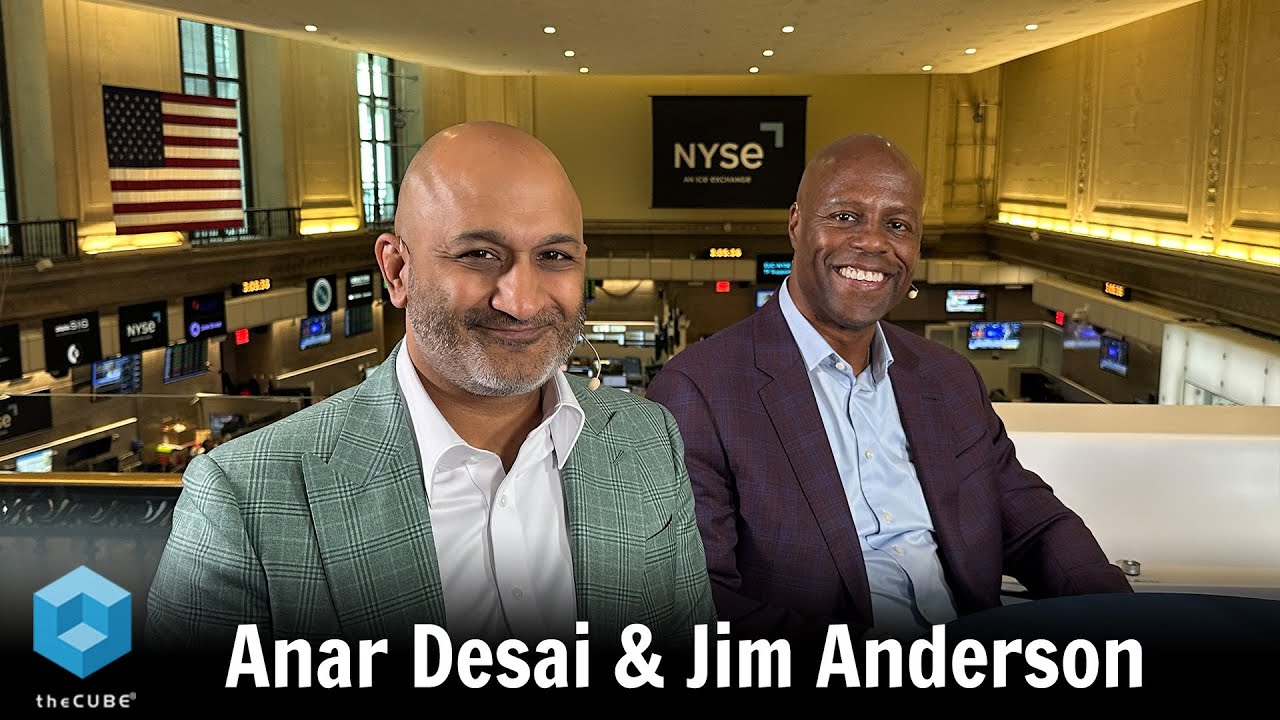
Kevin Laughridge of Deloitte Consulting and Jim Anderson of Google Cloud engage with John Furrier from theCUBE to explore the transformative role of advanced AI capabilities within the financial services industry. This conversation is part of the Google Cloud Partner Series, focusing on the innovation dynamics driving change.
In this insightful video, Laughridge and Anderson share their perspectives on how Google Cloud and Deloitte are collaborating to reshape financial services through AI-enabled solutions. With hosts from theCUBE Research, they discuss the critical role of distributed computing, the rise of agents in financial technology, and the increasing importance of data performance and application transformation. The dialogue highlights Laughridge's and Anderson's expertise and roles in navigating this evolving landscape.
Key takeaways from the discussion include an understanding of how AI revolutionizes customer experiences and compliance. Insights into the role of agents in business efficiency and process automation are also shared. The session delves into the strategic partnership between Google Cloud and Deloitte, highlighting how combined expertise accelerates digital transformation across the financial sector, according to Anderson and Laughridge.
Forgot Password
Almost there!
We just sent you a verification email. Please verify your account to gain access to
Google Cloud Partner AI Series. If you don’t think you received an email check your
spam folder.
In order to sign in, enter the email address you used to registered for the event. Once completed, you will receive an email with a verification link. Open this link to automatically sign into the site.
Register For Google Cloud Partner AI Series
Please fill out the information below. You will recieve an email with a verification link confirming your registration. Click the link to automatically sign into the site.
You’re almost there!
We just sent you a verification email. Please click the verification button in the email. Once your email address is verified, you will have full access to all event content for Google Cloud Partner AI Series.
I want my badge and interests to be visible to all attendees.
Checking this box will display your presense on the attendees list, view your profile and allow other attendees to contact you via 1-1 chat. Read the Privacy Policy. At any time, you can choose to disable this preference.
Select your Interests!
add
Upload your photo
Uploading..
OR
Connect via Twitter
Connect via Linkedin
EDIT PASSWORD
Share
Forgot Password
Almost there!
We just sent you a verification email. Please verify your account to gain access to
Google Cloud Partner AI Series. If you don’t think you received an email check your
spam folder.
In order to sign in, enter the email address you used to registered for the event. Once completed, you will receive an email with a verification link. Open this link to automatically sign into the site.
Sign in to gain access to Google Cloud Partner AI Series
Please sign in with LinkedIn to continue to Google Cloud Partner AI Series. Signing in with LinkedIn ensures a professional environment.
Are you sure you want to remove access rights for this user?
Details
Manage Access
email address
Community Invitation
Jim Anderson, Google Cloud & Kevin Laughridge, Deloitte
Kevin Laughridge of Deloitte Consulting and Jim Anderson of Google Cloud engage with John Furrier from theCUBE to explore the transformative role of advanced AI capabilities within the financial services industry. This conversation is part of the Google Cloud Partner Series, focusing on the innovation dynamics driving change.
In this insightful video, Laughridge and Anderson share their perspectives on how Google Cloud and Deloitte are collaborating to reshape financial services through AI-enabled solutions. With hosts from theCUBE Research, they discuss the critical role of distributed computing, the rise of agents in financial technology, and the increasing importance of data performance and application transformation. The dialogue highlights Laughridge's and Anderson's expertise and roles in navigating this evolving landscape.
Key takeaways from the discussion include an understanding of how AI revolutionizes customer experiences and compliance. Insights into the role of agents in business efficiency and process automation are also shared. The session delves into the strategic partnership between Google Cloud and Deloitte, highlighting how combined expertise accelerates digital transformation across the financial sector, according to Anderson and Laughridge.
Jim Anderson, Google Cloud & Kevin Laughridge, Deloitte
Kevin Laughridge
PrincipalDeloitte Consulting
Jim Anderson
Vice President, NA Partner Ecosystem & ChannelsGoogle Cloud
Kevin Laughridge of Deloitte Consulting and Jim Anderson of Google Cloud engage with John Furrier from theCUBE to explore the transformative role of advanced AI capabilities within the financial services industry. This conversation is part of the Google Cloud Partner Series, focusing on the innovation dynamics driving change.
In this insightful video, Laughridge and Anderson share their perspectives on how Google Cloud and Deloitte are collaborating to reshape financial services through AI-enabled solutions. With hosts from theCUBE Research, they discu...Read more
exploreKeep Exploring
What are some potential benefits of incorporating AI into financial services, according to a speaker?add
What are the two different approaches being taken by clients in the financial services industry towards adopting AI technology?add
What are some verticals other than financial services that are showing an appetite for AI technologies?add
What factors underpin your partnership and how do you ensure value is delivered to the client efficiently?add
What is the focus of Deloitte in advising their clients and how has it evolved over the last 20 years?add
Jim Anderson, Google Cloud & Kevin Laughridge, Deloitte
search
>> Hello, welcome to theCUBE, here in our Palo Alto Studios for the Google Cloud Partner Series where we explore the innovations driving the transformation in financial services. Today, we're going to talk about Google Cloud and Deloitte. They're reshaping FSI through advanced AI secure capabilities. Guys, thanks for coming on. Jim Anderson, you're heading up the North America partners, and we got Kevin Laughridge, who's the principal US Cloud Alliance Manager Lead at Deloitte. Thanks for coming on theCUBE. We appreciate it.
Kevin Laughridge
>> Thank you.
Jim Anderson
>> Thank you.>> All right. So the first question is setting the context. Are we at a tipping point? Obviously, FSI is a growing field. It's always been investing in tech, but with generative AI, there's a real balance between managing what's coming into the enterprise for value capture. While they're trying to create value, you're seeing all the system architecture changing. Cloud, on prem, edge is the hottest kind of architecture, distributed computing, it's hyper cloud. Check, we've done that. Kubernetes is a standard. Thank you very much, but now a whole nother software era is upon us.
Jim Anderson
>> Yes, I agree 100%. I would say that if you look at what AI can do and what it will do with regards to the experience in financial services, driving efficiency, helping with regards to obviously enhanced security and some of the other areas, we think that it's an exciting time to be working with our financial service partners, with partners like Deloitte.>> Deloitte's obviously been doing well and now we're in an era where there's more operating the technology, building the value, operating role, being more embedded into the customers. A lot of people are resetting their infrastructure. We're seeing a lot of that going on, and now they got to bring in new, faster, better, more intelligent systems. Agents are hot, but the data piece is critical. So I got to get the performance, I got to get the data right, and then I got this application layer transforming. Those are the hot areas. Give us the take. What's the scope? What are you guys working on now? What's the key innovation?
Kevin Laughridge
>> I think that's right, and I'll also say we have to do that while we provide great experience to the customers and be secure, to your point. So what we're really seeing in financial services is there's a bifurcation in the market. We have a few clients that are really going hard into AI. They see this as the future. They have been heavily invested in the last two years. We're seeing them build their IT infrastructure around that and starting to build processes to get that value, as you mentioned, the value capture. We have a few others that are saying, "I'm going to sit back and see how this goes for them, and I might be a fast follower." I'm a true believer that I think the financial services needs to adopt this technology because it will help them do better, faster, more compliant activities, and drive a better customer experience.>> What's the clients like now? Because we obviously see the investment. It's come down from the top. The bottom up, where it's gone, I mentioned Kubernetes stabilizes things, the cloud's pumping on all cylinders. What are they looking at right now? What's their focus? What are they optimizing for? What are you seeing there?
Kevin Laughridge
>> For a bank, it's going to be efficiency ratio, so it's how do I make sure that I'm actually delivering services and good revenue, at the same time, at a cost. That is really what most of our clients go back and say that's my KPI that I need to manage towards.>> And Google Cloud, you've got to get more horsepower at the higher level services. At Google Next, one of the things that came up was AI native, where you guys are doing AI in the services for Google to enable more services to be AI native on the client side. Can you share how that's going and what that's translating into for value?
Jim Anderson
>> Well, I think what we're trying to do is provide the full AI stack to our customers. We want to combine that with a robust data platform and also enhance security, and by combining those three things, obviously drive transformation with our customers. The exciting part for us is that we're working with partners like Deloitte where we combine domain-specific expertise, what I'm going to say is a core AI tech engine to actually drive transformation at our customers and actually accelerate that transformation.>> You oversee the ecosystem in North America. Deloitte, you guys are collaborating. The role of the ecosystem has changed. Just as you look back in the past three years specifically, more integrations, much more speed in terms of getting product out on your side. On the implementation side with the customers, they want to see more value capture, but they're also creating value. What's the dynamic in the collaboration with Deloitte? What are you guys working on? What's cool? What's the hottest thing? What are you guys seeing as the most pressing needs now? Is there a sequence of events that's going on in the customer's range? Is it still give me more horsepower in the data center or is there a real intentional pressure point to roll in the efficiency on the agent side?
Jim Anderson
>> Well, I think you brought up a couple of things. There's regulatory change, there's a drive for digital disruption out there that's happening faster than in a long time. There's security issues, and then there's simply the customer expectation around personalization. If you take those factors and you look at where we are from technology, we're bringing technology like agents to an Agentspace to multimodal technology, AI-assisted customer experience, AI-enhanced security and AI-assist. All those things are coming together to really drive improvement and efficiency with customers to go from there.
Kevin Laughridge
>> And what I really like about what Google has, and Jim mentioned it, is that it's all built on the same platform. And so two years ago, we were talking individual use cases, and the problem is use case by use case, it gets really expensive. But when we centralize it within a platform, I can get all of my connectors off of there. I can now build all of these use cases, exactly as Jim said. I get great efficiencies into my scale and that's where Deloitte and Google are partnering on. It gives us an ability to have an application like Agentspace. It gives us sitting on the platform a vertex. We get the multimodal, we get an open platform, and we get them to be able to connect back into all of our sources of record of data stores. I think that's hugely valuable.>> Kevin, that brings up a good point. I want to just double down on that because I think the operating leverage you get with the platform on the service side is great, and two, the speed. So on the agent piece, that's coming in super fast. A lot of people are poo-pooing it. "Oh yes, all hype." At RSA, our recent security conference we went to, we saw agents being deployed, and that's the very skeptical audience. And the enterprise agents are in there. They're growing, but they're pretty much use cases that are either pivoting off a platform where they can knock down some wins. Talk about that dynamic. One, do you agree with it, and two, what are those wins turning into? Because the pattern we're seeing is you get some AI in there, you get some leverage, operating leverage, the efficiency kicks in and then other things come out of it. Once you get three feet in the cloud of dust, you're rolling. That's when the action starts happening. Can you guys share any stories around that? Because I think this is a point we're seeing, one with the customers, because the old way, you buy something, you deploy it. Okay, where's the ROI. Now with AI, it's like you get more data, you get more value. As you go forward, you get that leverage.
Kevin Laughridge
>> You do, and because of Google's platform, they're advancing AI at such a rapid pace that we're getting new capabilities on a month-by-month basis. So to the point of how does this work? A year ago, we were deploying agents that were primarily inside of a company, they were human in the loop at all points, and they were accelerators. So I'm an individual, I had some questions, I needed some help. The AI would help as that. We are now getting into more autonomous actual capabilities, still within the organization. Where that goes is they're going to provide great value. Think about it like an internal IT help desk. We can actually provide in a low-risk scenario value on that. As you demonstrate KPIs, you get your average call handle time down, you get your actual satisfaction levels up. We can now start to roll those things out to the customer and have trust that this thing will actually operate in a correct way. There's still going to be tight guardrails. In financial services, we have to have those guardrails. In fact though, we're using AI to help us with those guardrails. It's a really interesting... It's a set of tooling that allows us to even build more tooling around it, and I think that's the value of what we're seeing with AI in agents.>> Yeah, I love the guardrail now that we were riffing last week around if you have guardrails, that implies a road. The road's the infrastructure, that's Google Cloud. The car is the customer driving the car, the human in the loop, so to speak. Talk about that dynamic, because you have a wave happening within the AI circles. I want to get you guys thoughts on this because wave one was RAG. Get some search going, get some data, play with it, and then you got the agents. Now we're seeing a trend towards intelligence, getting smarter. Can you guys share a story of how the collaboration is working with customers around, okay, we got some beachhead, we got some basic data action going on across the different verticals. We got some agents doing some tasks, autonomous tasks. Maybe they automated some workflows, but now the next one is how do you make those agents smarter? That seems to be where the action is. Give us an update on that.
Jim Anderson
>> I think what you highlight is the evolution of the technology and it's moving very fast. If you think about it, yes, we had agents that were, as you mentioned, simply doing tasks, but now we're looking at automation and actually automation maybe without a human look, right? And that's when you get into agents I like to say actually doing work for us, and I think that's an exciting time. And what you see with a lot of customers, at least we've seen, is they get in, they might start with something like AI assist and they're doing transcribing interaction between various customers and their call center. Then they learn, hey, you know what? I can now automate that. I now have a higher level of fidelity with my data and now I want to do more. So they get into wanting to develop their own agents, stuff like that, and that's where we really work with partners like Deloitte. This concept that Arthi talks about, from research to reality, is that we're bringing out this new technology so fast, we've got to make sure people like Deloitte can leverage that technology and are aware of it, so they apply their domain expertise to take customers on that journey.>> All right. So what are they doing? What are they working on? What are the customers doing that's getting them automated, getting intelligence? What are some of the patterns?
Kevin Laughridge
>> Investment advisors needing to do reports for their clients on what's happening with this specific domain or sector, we're now using deep research to be able to automate a lot of that. That is something which... And again, 18 months ago, Deloitte was building capability and bots to do these things with AI, and now here comes Google with an out of the box agent that does this incredibly well. So that's an example of we're not just doing something that's a mundane task. We're actually providing research and insight back into the investment advisor now takes that as a report and sends those pieces out. We're giving them the acceleration to help in places that they couldn't do before.>> So productivity's got two threads. It's one, the time that you save, and then now you're getting at the value piece.
Kevin Laughridge
>> We are.>> Yes.
Kevin Laughridge
>> But I'll just say, I don't think AI is just spend a dollar, get $10 in ROI. It's spend a dollar, get better client experience, get better compliance on processes, get much better accuracy of things. We're using AI in a variety of things with Gemini around software development life cycle. It's not just about writing code. It's actually about unpacking business requirements, getting better user stories. Actually infusing what we have from the last five years of development and user stories into current. Those are the things that I think with AI where we're getting value in places that isn't just a, how do I monetize this with a dollar? It's actually value throughout the whole thing. And what do we get? Better software out the back end of it, even if it's a little faster.>> How has the relationship changed your role? Do you guys have a plethora of activity in terms of client work, but also data experience? Do you guys have agents inside Deloitte? Because you guys have workflows that are-
Kevin Laughridge
>> We have some. I would like more, but it is a big part of our organization strategy these days of how do we actually... Because we're a knowledge management company. At the end of the day, we deploy a couple of hundred thousand people to do great things for our clients, and that's the goal, and we want to arm them with the most information. Agentspace is an example of a great piece of technology that we are working with to roll out to our firm so that they can actually tap into that information. I think one of the things, and Deloitte's an example of this, the goldmine of data that we haven't been able to tap is the unstructured, and AI is really great at tapping into unstructured data and actually getting the insights out of that.>> Talk about the power of the partnership, because one of the things we've been saying since cloud has come on, that we saw this horizontal scale with the cloud, but then you've got these vertical specialization domain experts and the domain data. The unlock of data in the verticals where the action is, that's where the business logic is.
Jim Anderson
>> Yes.>> So you're starting to see the conversation shift to what's the application layer look like where the business logic is at the point of the customer? To your point about it's not a dollar for 10. What's the value to the customer service application? So at the end of the day, it's the app.
Jim Anderson
>> It is the app, and it's the combination I think of their main expertise, industry-specific expertise where they actually understand the challenge and then the opportunity that challenge brings. And I like to say a lot of times, often we look at Deloitte as the what and why and we look at Google as the how, and you need all of that to be successful. And most customers will admit they can't do it on their own, so they're looking for that combination of partnership to try to reduce their risk and make their digital transformation.>> Talk about the Agentspace thing. You guys are leading that effort. How big is it? Can you scope the magnitude of what you are working on there? Because that's multi-agent, right? That's agents. Is that a multi-agent implementation?
Kevin Laughridge
>> It is. So we're working with Google right now on their largest implementation of Agentspace at a massive US bank. It is the single pane of glass to instantiate all agents. It comes with the ability to launch agents, actually create agents. It can also call third-party agents. And so one of the things that I'm really excited about is for our workforce, how do we give them the ability to instantiate agents quickly and accelerate what they do? And I see Agentspace as doing that and we're building around that. But it's great. We can actually take... So back to the use cases, how do I do control remediation within a bank and/or control testing? We can use Agentspace as that front end. And so it's not just an ability to call agents. It's an ability to recraft how people do their work in a much more efficient and effective way, and you stay within the confines of Agentspace to look up information, to actually take action, to communicate that action through emails, et cetera. That's what we're building with Google, and I see that as the vision of where Agentspace is going.>> Yeah. What products are you guys providing that's the key enablement? Is it Gemini, Vertex?
Jim Anderson
>> Well, I think there's a couple of things. So we talk about having the full stack, so you have that infrastructure that can scale. Then you talk about we have the intelligence with our models like a Gemini, Gemini Pro, Gemini Flash, those types of things. But then we also have a robust data platform, so we have BigQuery, because at the end of the day, data is key to the success of AI. And then we match that with, as you heard, with agents that are pre-packaged, but more importantly, we even have agent development kits and A to A protocols so that our companies that we work with and partners we work with can actually take the agents that we provide, and as they learn more, develop more complex agents that could even be more valuable to their customers.>> What about the customer use cases? Where are you guys seeing the best bang for the buck? Is it modernization projects or is there shadow AI going on in the companies? Where is the action with the customers? Where are you guys seeing the engagement, Kevin? Is it large scale modernization projects?
Kevin Laughridge
>> So it's a couple of things. One, we're injecting AI into everything that we do, so yes, on large scale modernization projects, because it gives us the ability to be better and faster. Where our clients are asking for it is any place where they have either pain or they want to demonstrate value. Where we're getting the most value out is where we're taking a specific use case and then broadening it to deliver against the whole process. So if you just automate a piece of a process, you'll get five, 7% efficiency. As we start to actually broaden it and go end to end, you're going to start seeing 25 or 30%. When we then take that and say, "Hey, I can now refactor how my organization is," I think you can end up getting a 50%.
It takes a couple of years to get there. Certainly our large enterprise clients take a little bit of time to change, as does Deloitte candidly. We're a large oil thinker as well, but I know this is the place where we're going to start to be because companies are organized by a set of tasks and a set of tools that they have, and we are now accelerating their tooling into some capabilities that we've never had before. And so that will lead to new structures and new organization designs, which I think will be better and faster.>> Outside of financial services, everyone knows they're spending money because they see the ROI, these customer experiences. Are there other verticals that are more lined up right now, have an appetite for the AI or is it all verticals?
Jim Anderson
>> Well, I would say that one of the things I'm most excited about is the whole customer experience, specific to financial services, using some of our customer engagement suite to deal with our call center and reduce call times. We have the Definity. They talk about they reduce call times by 3.5 minutes. That's 33% less call time, and at the same time, their employees were more engaged with the customer. I think the customer experience spans across all industries, whether financial services, whether you're healthcare, whether you're some other services segments out there, and that's what I'm really excited about.>> And you know the modernization also is not limited to financials. We hear PDFs, innovation with PDFs, like insurance companies to other folks, because it's magic to see, wow, I can make sense of all this stuff laying around, and then that spawns, will then kick off a modernization project, so you do a little search or you do integration. So I have to ask the question. As you guys look at the customer profiles, what does the day in the life look like? Is it, okay, let's knock down a little project here? If there's not a big modernization going on, is it let's get search going? Is it data cleansing? Where's the focus with people who want to lean into it? Not people who are like, "Hey, show me what to do." But when people say, "I want to go faster," and you have to go slow to go fast, slow is the new fast, but data, you got to get the data, so you got to go a little bit slower. They grind through it.
Kevin Laughridge
>> I'm a big believer that enterprise search provides value quickly and gives you the ability to start with Google Cloud platform and Vertex, and you can turn it on and your employees will see it and they will find that value, which then gives us the permission to continue to build and go with that.>> Exactly.
Kevin Laughridge
>> The other place that I would say is we see a lot of this starting within the CFO who says, "I need to change how we're doing work," and it's hard to change without a new set of tooling, and so it starts with that. What are places that we can just start to transform? And then last thing I'd say is data monetization is a big thing. Most of our organizations have an unbelievable amount of data that they can't make sense of, and Google and AI allows us now to start to take these things and we can start to understand a variety of concepts. I have a client story where we actually started to automate a process, and the value wasn't necessarily just the, I got less people to do it. It was the fact I actually understood what was happening in the process and I could now make different changes and different decisions associated with it, because now we have the data. And I think that's where looking at a couple of these different entrance points allow you to get onto the roadmap to change.>> Yeah, and that's the thing about just getting in the game quickly. You discover value that you had, or that, "Wait a minute, what's going on with that database over there?" So by getting the data reined in, you're setting the table for the scaling the agents.
Jim Anderson
>> And by the way, I think what you're also doing is you're democratizing creativity. We're going to have a whole lot more people coding now because of code assist and all those types of things, which is going to spawn more innovation, more ways to take advantage of that data. And I talk about return on intelligence with your data and go from there.>> Yeah, the whole coding thing is great because I hear people say, "Oh yeah, the job's going away." No, people are getting smarter. They're coding deeper in this stack, so a lot of the app stuff is going no code, low, code completely, but all the architecture, it's a systems architecture kind of mindset in the enterprise. Do you guys see that same picture?
Jim Anderson
>> Oh, yeah. Yeah. I think the code assist companies, startups are popping up all around that every month type of thing. But to me, the important aspect is innovation, and with these tools like code assist, it means people like myself who might not be a coder today, I was a computer science major but no longer, can actually->> Now you can get back in the game.
Jim Anderson
>> Exactly. I'm coming back in the game and that's what the technology's doing. So it's bringing more people into the game, driving more creativity, and I think driving more innovation, and I think that's the key.>> Jim, think about it. When we went to school, we had to code everything from scratch. Now with voice prompting, "Build me a web app that does this." So the voice is becoming a huge interface. Talk about the power of the partnership, because I want to get into the new dynamics. We're seeing a lot of changes in the ecosystem. Can you guys share from your perspective, also as a partner to Google Cloud, what's changed in the power of the partnership? What's the new normal relative to the expectations you have to create value for your customers and then for you to help Deloitte?
Jim Anderson
>> Yeah, I think what's happened is the pace has accelerated of technology. I tell the team, a lot of what we were focused on in November last year didn't even exist in March. That's how fast things are moving, so therefore, we need to be able to provide to our partners and keep them on, like they say, the frontier of technology. Because Google is out on the frontier of technology, and making sure our partners are aware of it and they can take advantage of it, and like I said, combine some of the expertise they have with that core AI tech stack I think is really what we're trying to do out in the marketplace to power this.>> By the way, the deep research stuff really adds a lot of value. It's not just applied research. It's targeted, intentional research, like BigQuery for instance had huge strides. What's different on your side that you expect more for less from Google? Because, well, it's double-edged sword.
Jim Anderson
>> More and less.>> More and less, because less is good in this case, but you need to move faster. What's different now with the power of the partnership?
Kevin Laughridge
>> One of the things that underpins our partnership is the fact that value has to be delivered to the client, and I think we both share that. And so when we look at this and we look at an opportunity, I view Google as, exactly as Jim said, an incredible team of capability providers, and Deloitte is how do we take those capability providers and get it to the client to get value fast and to deliver what they need? And so I'm not sure that I can say that something has changed on that with Google, and Deloitte has always been focused on that. What may have changed is just to your point, the pace. And so it is required for my team to make sure that we understand what is happening with Google. How do we keep up to pace with all of the new releases that are happening there? How do we adjust our products that we go in? I think about just Veo 3 that came out at I/O. It's exciting, and now I need to get to my marketing team on how to actually build these things in, so that pace is probably the biggest thing that's shifted, but not the we have to deliver value.>> It's like when the goodness is coming at an accelerated rate and you have to apply it, what does that do to your engagement with the customers? Does that change that relationship? So folks watching now that want to engage with Deloitte, what's that do for you? How's that changed the practice and outcomes?
Kevin Laughridge
>> Deloitte is always focused on being a great advisor to our client and telling them what is the right thing to be focused on and why, and/or helping them work on that. I would say that Deloitte has over the last 20 years evolved to be as focused on advising on technology on that, and so that's part of the relationship with Google. And making sure our teams understand what Google can provide and then put it into the business requirements and say, "This is what value you'll get."
Jim Anderson
>> And we also talk to a lot of people. I think AI is a journey, not a transaction, so the real question is who do you want to partner with to go on that journey? And that's why people come to Deloitte and Google, because obviously we can partner and help them reduce the risk with going on that journey.>> Relationship is really critical now because everything's integrated, it's end to end, the data is now the initial property, and there's more coming.
Kevin Laughridge
>> Indeed.>> Guys, thanks for coming on theCUBE. I appreciate the conversation.
Kevin Laughridge
>> Appreciate it. Thanks for the time.
Jim Anderson
>> Thank you.>> Okay, we are here in Palo Alto, the Google Cloud partner series. I'm John Furrier, host of theCUBE. Thanks for watching.