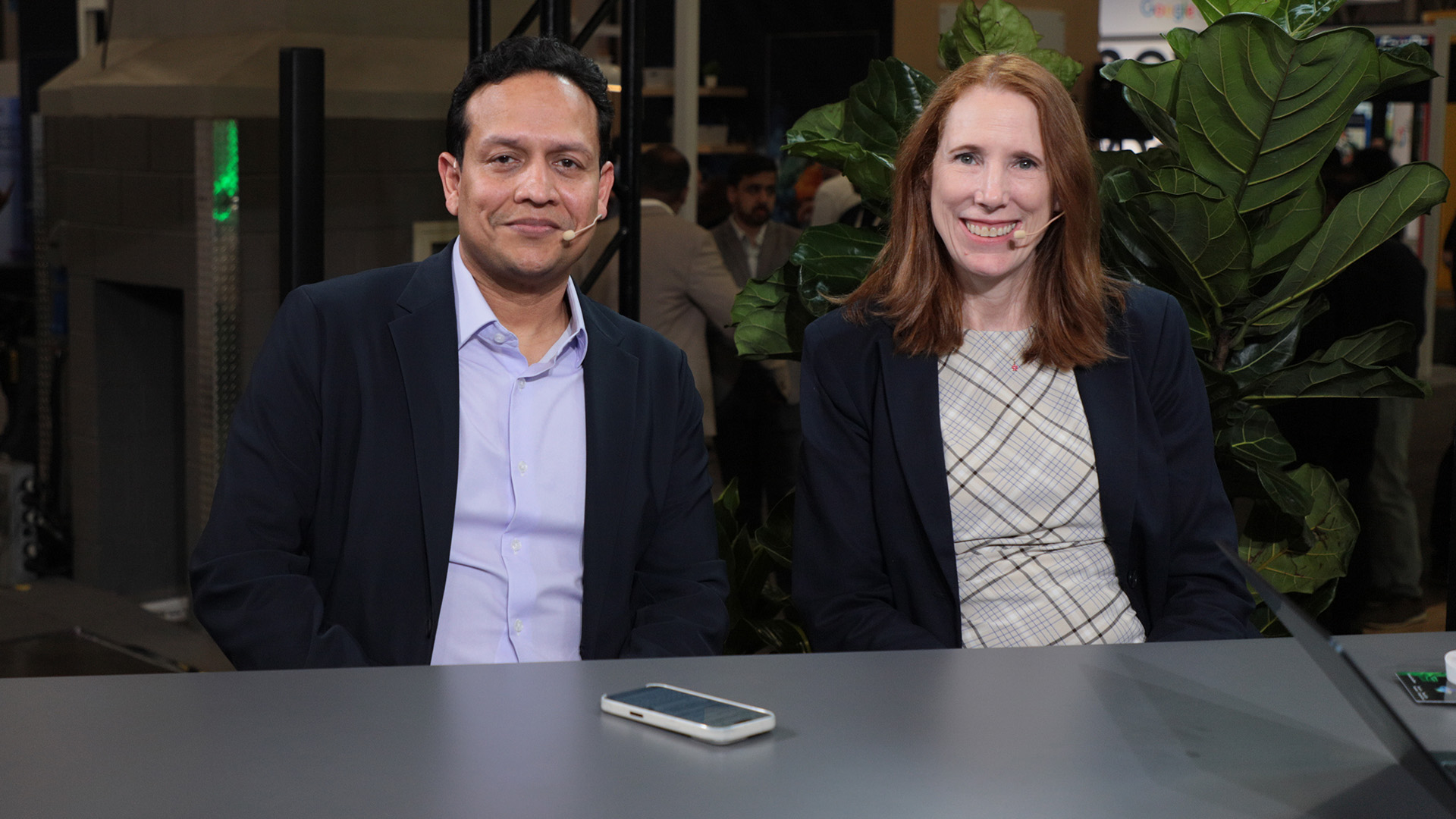
This discussion at Google Cloud Next '26 examines cloud adoption, artificial intelligence and healthcare transformation. theCUBE Research hosts Alison Kosik and John Furrier moderate a conversation with Maura McEnroe of UnitedHealthcare and Ritesh Mangal of Wipro. The conversation explores cloud migrations, marketing technology modernization, data readiness and AI-driven customer experience.
Maura McEnroe of UnitedHealthcare serves as chief marketing officer and previously serves as chief information officer. McEnroe emphasizes the necessity of a cloud foundation for clean accessible data and asserts that shared KPIs and joint business and technology accountability accelerate measurable outcomes. They describe how these elements enable hyper-personalization automation and improved customer experience.
Ritesh Mangal of Wipro serves as senior vice president. Mangal highlights agentic AI and data cloud capabilities such as Gemini and data indexing to generate dynamic insights and accelerate campaign-to-continuous-engagement transitions. They outline how these capabilities support MarTech modernization and enable faster movement from campaign-based programs to continuous engagement.
The discussion provides practical perspectives on cloud foundations, data readiness and the role of AI in enabling personalization, automation and operational efficiency across healthcare and marketing. View the full conversation on theCUBE Research at Google Cloud Next '26 for additional insights on cloud migrations, MarTech modernization, data cloud and customer experience.
Forgot Password
Almost there!
We just sent you a verification email. Please verify your account to gain access to
Google Cloud Next 2026. If you don’t think you received an email check your
spam folder.
In order to sign in, enter the email address you used to registered for the event. Once completed, you will receive an email with a verification link. Open the link to automatically sign into the site.
Register for Google Cloud Next 2026
Please fill out the information below. You will receive an email with a verification link confirming your registration. Click the link to automatically sign into the site.
You’re almost there!
We just sent you a verification email. Please click the verification button in the email. Once your email address is verified, you will have full access to all event content for Google Cloud Next 2026.
I want my badge and interests to be visible to all attendees.
Checking this box will display your presense on the attendees list, view your profile and allow other attendees to contact you via 1-1 chat. Read the Privacy Policy. At any time, you can choose to disable this preference.
Select your Interests!
add
Upload your photo
Uploading..
OR
Connect via Twitter
Connect via Linkedin
EDIT PASSWORD
Share
Forgot Password
Almost there!
We just sent you a verification email. Please verify your account to gain access to
Google Cloud Next 2026. If you don’t think you received an email check your
spam folder.
In order to sign in, enter the email address you used to registered for the event. Once completed, you will receive an email with a verification link. Open the link to automatically sign into the site.
Sign in to gain access to Google Cloud Next 2026
Please sign in with LinkedIn to continue to Google Cloud Next 2026. Signing in with LinkedIn ensures a professional environment.
Are you sure you want to remove access rights for this user?
Details
Manage Access
email address
Community Invitation
Maura McEnroe, United HealthCare & Ritesh Mangal, Wipro
This discussion at Google Cloud Next '26 examines cloud adoption, artificial intelligence and healthcare transformation. theCUBE Research hosts Alison Kosik and John Furrier moderate a conversation with Maura McEnroe of UnitedHealthcare and Ritesh Mangal of Wipro. The conversation explores cloud migrations, marketing technology modernization, data readiness and AI-driven customer experience.
Maura McEnroe of UnitedHealthcare serves as chief marketing officer and previously serves as chief information officer. McEnroe emphasizes the necessity of a cloud foundation for clean accessible data and asserts that shared KPIs and joint business and technology accountability accelerate measurable outcomes. They describe how these elements enable hyper-personalization automation and improved customer experience.
Ritesh Mangal of Wipro serves as senior vice president. Mangal highlights agentic AI and data cloud capabilities such as Gemini and data indexing to generate dynamic insights and accelerate campaign-to-continuous-engagement transitions. They outline how these capabilities support MarTech modernization and enable faster movement from campaign-based programs to continuous engagement.
The discussion provides practical perspectives on cloud foundations, data readiness and the role of AI in enabling personalization, automation and operational efficiency across healthcare and marketing. View the full conversation on theCUBE Research at Google Cloud Next '26 for additional insights on cloud migrations, MarTech modernization, data cloud and customer experience.
Maura McEnroe, United HealthCare & Ritesh Mangal, Wipro
Maura McEnroe
Chief Marketing OfficerUnited HealthCare
Ritesh Mangal
Senior Vice PresidentWipro
In this interview from Google Cloud Next 2026, Maura McEnroe, chief marketing officer of UnitedHealthcare, joins Ritesh Mangal, senior vice president at Wipro, to talk with theCUBE's John Furrier and co-host Alison Kosik about how a cloud-native data foundation is enabling agentic AI to reshape healthcare marketing and enterprise operations. McEnroe, who brings a rare CIO-to-CMO background, explains how those converging roles reflect a broader shift — marketing is now inseparable from technology, driven by real-time personalization, self-service and continuou...Read more
exploreKeep Exploring
Why is technology—particularly AI—becoming essential in marketing, and how is this changing the role of the CMO?add
How important is establishing a cloud foundation for accelerating enablement of AI-native applications and improving customer experience (e.g., hyper-personalization and automated insights)?add
How will moving to the cloud and adopting Gemini’s enterprise capabilities (enterprise app, agentic platform, agentic defense, and data cloud) enable agentic AI to improve data accessibility, identity resolution, personalization, campaign engagement, security, and drive better KPIs/outcomes?add
Maura McEnroe, United HealthCare & Ritesh Mangal, Wipro
search
Alison Kosik
>> Welcome back to Google Cloud Next '26. We are streaming live right here in Las Vegas. I'm Alison Kosik, joined alongside by John Furrier. And we're about to go to some guests who are going to be offering up a use case, which is so important.
John Furrier
>> Yeah. Healthcare is one of the target areas where they have the data, they've done all the tagging, the datas all in good place. Now, the AI comes in, you add intelligence. It impacts everywhere up and down the stack, in the care, how to operate. Everything's coming together in healthcare, in these industries where they have the data and AI just feeds on it.
Alison Kosik
>> All right. Well, let's get right to it. Let's bring in Maura McEnroe. She's a chief marketing officer of UnitedHealthcare. Welcome to theCUBE.
Maura McEnroe
>> Thank you.
Alison Kosik
>> And Ritesh Mangal, senior vice president of Wipro. Welcome to theCUBE as well.
Ritesh Mangal
>> Thank you. Thank you for having us over here.
Alison Kosik
>> Oh, our pleasure. So, Maura, let me start with you. I know that part of being a use case is so important, but also just knowing the layers of a space like this in the first place is so important. You are wearing different hats. You moved from CIO to CMO, and why is that so significant?
Maura McEnroe
>> I think it's really important in these days because the CIO and the CMO are more of a blended role because marketing used to be all about getting journeys out and campaign management. And now, we're so dependent on technology to get us closer to the customer, to do personalization, to get real-time updates, to do self-service, and all that's driven by technology. So, I get to bring more of a systemic approach to how marketing is viewed, as opposed to a more creative approach as what it has historically been in the past.
Alison Kosik
>> Sure. Sure. You bring more information and more perspective to your role?
Maura McEnroe
>> Correct. And AI, obviously, is the new buzzword and really where we're going. And having a good understanding of how to create an AI use case, how to develop AI, how to implement AI, coming into a marketing role where it's really ripe for AI. And think about how we write a campaign, how we write a brief, like Copilot and Gemini, and all those are things that enable the AI to move faster so that our marketing team can be really focused on getting closer to the customer and not doing a lot of the backend automation work that they've historically had to do.
Alison Kosik
>> Yeah. Yeah.
John Furrier
>> Laura and Ritesh, the show here has a ton of announcements. New TPUs, a lot of AI infrastructure, obviously a lot of stuff around the data lakes, Gemini's everywhere. But first of all, all great stuff. Security. One of the areas that's jumping out is customer experience. It's blended into the other announcements. If you don't have a strong foundation, you can't get there. So, a lot of these AI-native applications are going to come down to rethinking whether it's the MarTech stack or my software that I had before. So, there's a lot of re-imagination of that layer above the cloud. You guys are doing this as a partnership.
Ritesh Mangal
>> Yep.
John Furrier
>> The Cloud Foundation, if you both could talk about how important that is to get that enablement to go faster?
Ritesh Mangal
>> Yeah, absolutely. The moving to cloud is just not about accessibility of data, it's more about how do you have intelligent data structure that can help you with insights? And continuously, like where TK has announced, saying that they are going to build the entire database on cloud native to be more accessible to agentic AI infrastructure that's needed. So, it's going to become more and more intelligent insights that are going to lead to hyper-personalization that Laura was talking about. And that's what Maura has done in many of her engagements. The one engagement that we had, Wipro, Google, and USC did with Maura's sponsorship was moving the claims application to cloud. And what it has enabled now in her new role is to take those insights in the marketing sides to run campaigns, moving from campaigns to continuous engagement and bringing those predictive behaviors of your members. So, Maura-
John Furrier
>> Maura, weigh in on this because the C-suite is highly active in a lot of these re-engineering of the organizations. It's paying the company. It's not just IT.
Maura McEnroe
>> Correct.
John Furrier
>> But you got to do the work.
Maura McEnroe
>> Yeah. IT lays the foundation on which everything else will roll, right? So, we moved everything over to the cloud and that enabled our ability to be secure, to have the data readily available, to have cleaner data. And then, to Ritesh's point, that data then drives what the C-suite needs to see, right? In terms of not just marketing, but the way we manage our finance, the way we manage our sales program, right? The marketing team is very closely aligned to sales and being able to provide insights, lead information. All of that is dependent on clean data that the cloud really laid our foundation for us to do.
John Furrier
>> Talk about the user experience, the CX piece I mentioned, because it's internal and external. It used to be almost an external-facing concept. "Hey, the website looks great. I got a mobile app. All good." And then the workflows are behind it, static, deterministic. Now, you got non-deterministic behavior, which we think like non-deterministic people, we don't think in a deterministic way. How has the CX been enabled? How have you framed that and how do you think about that?
Maura McEnroe
>> I mean, at the end of the day, that's what's really important, right? To have consumers that can engage with us on a regular basis. And I think having the technology behind it enables us to give them information that's valuable at the right time, at the right place and how they want it. And I think that's what's really important and experience that they did something two weeks ago, it's already lost. So, it's really important for us to get in front of the consumer quickly, and that's what all of this technology is enabling us to do.
John Furrier
>> The data is the key to success. We've seen that and everyone knows that. You mentioned that earlier, the data's ready, clean. How has the cloud and the AI relationship worked for you on the data-readiness? If you're not ready for AI, it's going to go crazy and go wild or it's going to rewire you. And agents are going to be bounded by the data capacity, the context, intent.
Maura McEnroe
>> Yeah. I mean, it's garbage in, garbage out, right? So, as long as we are keeping the data current, clean, up to date, it's really what's going to drive. But it's also both ways. So, you also think about the data that we own in terms of what's on our websites and when these bots are coming out and asking for information, we've got to provide the right information about what UnitedHealth Group is providing. And so, we've got to have that data clean as well, not just the data on our membership and our subscribers, but really, what we're showing out to the public, so that when the bots are out there asking for things, we're giving right answers back.
John Furrier
>> Yeah. AI is working on their behalf. You got to feed the agents.
Maura McEnroe
>> Yes. Yeah, the AI agents are no longer really so much worried about humans, they're worried about other bots, other agents.
John Furrier
>> What's the biggest challenge you have right now if you had to put a statement out there and say, "Hey, we're thinking about blank"? How would you fill in that blank? What's your big focus right now?
Maura McEnroe
>> I think it's trying to keep up with everything. So, you mentioned earlier the MarTech stack. I think the MarTech stacks often are having a hard time putting all the pieces together. So, as a result, it relies on a lot of different tools on top of it. So, trying to manage all of that is somewhat of a challenge because you're moving a little bit slower when you have a lot of moving parts that have to move with you. And I think really just being able to provide a personalized approach is a big challenge that we got to just try and stay in front of, so that we can stay in front of our competitors and really be able to provide our employer groups and our members the information when they need it.
Alison Kosik
>> What strategies are you using to overcome those challenges?
Maura McEnroe
>> Well, it's a lot of working with our tech team very closely, working with our vendors very closely, so that we have a lot of hands helping us. It's also about using AI, not only to do agentic AI, but also to do automation because there's more places where we can automate a journey and a campaign in the back-end and then keep this stuff where we make it more human, being done by humans. So, I think that's a really big focus is using AI to our advantage, not only in how we work with our members, but how we provide efficiency in the backend workflow as well.
John Furrier
>> You know what's interesting is that a lot of things rhyme with other wave, but this one's really highly accelerated with cloud and AI coming together. Business impact is a huge discussion in these AI initiatives. Can you get an outcome? We're hearing outcomes are back on the table, not that they were off the table, it's actually gettable. In the old days it was, "Oh, IT serves the business," and then the domain experts on the business would use the IT services. Now, AI serves the business with the underpinning of IT supporting it, whether it's cloud-native distributed computing. So, as a CIO now to a CMO, you're serving the business yourself from your perspective with AI. So, how would you describe that view of AI serving the business in that IT metaphor? And how do you look at impacts? How do you think about business impacts? Because IT was like, "Well, the ROI on this project and the payback..." all these calculations were done in the day. And then, "We're done. Now, go use the tools." AI is a little bit different. Can you share your thoughts and vision on how you think about that?
Maura McEnroe
>> Yeah, I think that the underlying factors, we have to have shared KPIs, that's how you really get the business and technology and AI working together. And as you build the use cases for AI, I think we need a combined approach on what the business case is, what the business value is it's going to bring. And the KPIs are just really important that obviously from a marketing perspective, it's all about growth, right? So, how are we leading growth with lead generation, with renewals and all of that? I think when the business and technology come together, and it's not technology's KPIs and businesses' KPIs, but we do them as a joint accountability, that's where I think the value comes in and like AI is the driver that allows that to happen.
Alison Kosik
>> One amplifies the next, right?
Maura McEnroe
>> Yes, exactly.
Alison Kosik
>> Yeah.
John Furrier
>> Ritesh, talk about the Google Cloud angle because a lot of that enablement is accelerated through Google Cloud. Where are the touch points? Where's that leverage coming from on the implementation side?
Ritesh Mangal
>> So, if you look at from an implementation perspective, while moving to the cloud itself brings it to a tech stack, which is accessible through many other components of Gemini enterprise. Now, tomorrow you're going to use that. The agentic AI that sits on top of it can make intelligent decisions. The data is more accessible, intelligent, indexed, so that it can continuously... The data is not static, it's more dynamic now. And it can make decisions, it can detect the changes, the behavior changes, whether it's hyper-personalization or the campaigns that you do to the changing behavior of a provider or a member. So, if you do that, if you look at from an agentic AI perspective, whether you go and look at bringing insights into how the behaviors are changing and how do you manage to the KPIs that we are talking about, the outcomes. So, it's laying that layer of being the tool that's going to sit and provide access to all the other players, whether you're trying to do your campaigns, whether you are trying to drive an engagement with your members and providers. So, that's the key in terms of what cloud is doing.
John Furrier
>> And they've got all the Gemini announcement. We've got the enterprise app, the agentic platform, agentic defense, the data cloud. A lot of innovations and the security is phenomenal built in.
Ritesh Mangal
>> Yeah, absolutely.
John Furrier
>> But the data cloud has grown significantly. I mean, they're looking at having an alternative to Snowflake and Databricks all in one place. That's going to enable agents to fly out of the woodwork and just go crazy.
Maura McEnroe
>> I mean, it really allows for identification of the data, right? When you think about members' names, you could be Bob, Bobby, Robert. I think when you have everything in the cloud and you have it secure and everything's in one place, it allows for that identification pretty quickly, too.
John Furrier
>> That's come up a lot more. We've heard people talk about the identity names. You're a different name on Slack, you're a different name on this database, you're a different name in that database, maybe a different email address, but they all tie together. Sometimes I don't even know which email I use to sign up for whatever service I'm using. So, AI can solve that.
Ritesh Mangal
>> And there are a lot of big names. You don't even know who's chatting with you.
John Furrier
>> Yeah. This is where the data cloud, I think, is interesting. The data gravity is real. The other thing I'd love to ask you about is the data pipelining. Data pipelines that have been built over the years are causing gravity because fields could change and the data pipelines that were statically built, that's like putting in the plumbing, you dig up the ground, you pave over it, and it's like, "We got to go change out the plumbing." How is AI changing the data pipelining?
Maura McEnroe
>> Well, I think it's making it less relevant, quite honestly, because when you have AI, you can have it go out to 10, 15 different databases to try and find the information, as opposed to a human trying to match things up. I think that's where AI really is extremely powerful because it really makes a lot of things that we were completely dependent on not that long ago, almost irrelevant.
Ritesh Mangal
>> It's blurring the lines. Data pipelines were built on traditional concept of structured data. Now, structured data is becoming more irrelevant than the non-structured data, so that's where AI is bringing that context.
John Furrier
>> I mean, the ability to build abstractions. I mean, it takes brittle IT systems, puts a cap on it and handles all the stuff under the covers. And that's the beautiful thing about it, and there's no latency problems.
Maura McEnroe
>> Right. And it's a move from structured data to intelligent data, right?
John Furrier
>> Yeah.
Maura McEnroe
>> I mean, that's really what it's all about so that we're not spending, I don't know, months trying to put something out the door to a member or a group because we're trying to validate the data in the backend.
Alison Kosik
>> How has AI changed your organizational alignment? I'm talking about the importance of aligning teams, processes, culture to full leverage cloud-based data and AI capabilities, not just deploying the technology?
Maura McEnroe
>> I think that it's really brought teams that maybe weren't working very closely together, more together because AI is that now joining factor. So, tech would sit and take the requirements and build something out and then hand it over to whatever marketing or whatever business. And now, it's more of a joint approach because we're building use cases, and we're doing a lot of single-day planning. Where something might have taken a month to do, we'll get in a room with the developer, with the AI lead and the business, create a use case and actually see it working in a day, right? So, it's really bringing the teams together in a much different way.
John Furrier
>> It's demo, no memo.
Maura McEnroe
>> Yes.
John Furrier
>> That's the phrase we've been hearing. Show me. It's like you can build the defense. These forward deploy engineering concepts, you bring the engineering and auto coding to the domain experts.
Ritesh Mangal
>> One thing we are seeing is it's flattening the organizations. There are no seven, eight, nine levels of hierarchies that are being built. So, as Maura was talking about, you get very integrated teams. And it's also like CIO to CMO, it's also taking out the distinction between various functions. Now, everybody has to be AI-native, I would call them from a function perspective. So, technology is going to be part of every function.
John Furrier
>> It heightens the teamwork aspect of the humans-
Ritesh Mangal
>> Absolutely....
John Furrier
>> but I would also say that it's becoming unwieldy with the agent org structure. We're hearing agent quotas, "Hey, my agent headcount is bigger than yours." I mean, this was an old political deal back decades ago in management. "Oh, I have too much headcount."
Ritesh Mangal
>> Yeah, the human is-
John Furrier
>> And by the way, are the agents actually working? So, now, you get into a whole organizational agentic thinking. So, this is going to be very much a C-suite conversation. What is the outcomes? Are-