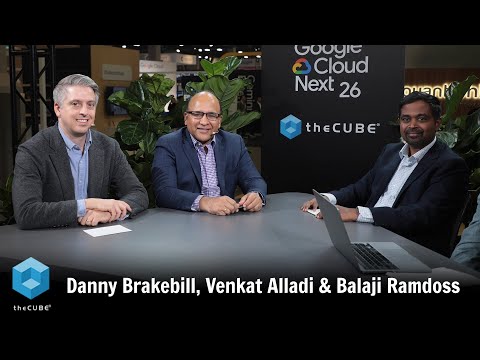
Sean Everhart & Daniel Prager, Slalom | Google Cloud Next 2026
Forgot Password
Almost there!
We just sent you a verification email. Please verify your account to gain access to
Google Cloud Next 2026. If you don’t think you received an email check your
spam folder.
In order to sign in, enter the email address you used to registered for the event. Once completed, you will receive an email with a verification link. Open the link to automatically sign into the site.
Register for Google Cloud Next 2026
Please fill out the information below. You will receive an email with a verification link confirming your registration. Click the link to automatically sign into the site.
You’re almost there!
We just sent you a verification email. Please click the verification button in the email. Once your email address is verified, you will have full access to all event content for Google Cloud Next 2026.
I want my badge and interests to be visible to all attendees.
Checking this box will display your presense on the attendees list, view your profile and allow other attendees to contact you via 1-1 chat. Read the Privacy Policy. At any time, you can choose to disable this preference.
Select your Interests!
add
Upload your photo
Uploading..
OR
Connect via Twitter
Connect via Linkedin
EDIT PASSWORD
Share
Forgot Password
Almost there!
We just sent you a verification email. Please verify your account to gain access to
Google Cloud Next 2026. If you don’t think you received an email check your
spam folder.
In order to sign in, enter the email address you used to registered for the event. Once completed, you will receive an email with a verification link. Open the link to automatically sign into the site.
Sign in to gain access to Google Cloud Next 2026
Please sign in with LinkedIn to continue to Google Cloud Next 2026. Signing in with LinkedIn ensures a professional environment.
Global Partner Development Lead, Google CloudSlalom
In this interview from Google Cloud Next 2026, Daniel Prager, global partner development lead at Slalom, joins Sean Everhart, managing director at Slalom, to talk with theCUBE's John Furrier and co-host Alison Kosik about the shift from AI experimentation to enterprise-scale agentic transformation. Prager and Everhart identify governance, security and talent as the primary bottlenecks slowing organizations that have already committed to AI investment. Everhart explains why the most significant leap is not from zero to AI assistant, but from assistant to agent...Read more
exploreKeep Exploring
What does it take to move from AI ambition to achieving real enterprise impact?add
What challenges and opportunities are organizations encountering as they try to deploy and scale AI across the enterprise?add
How should companies think about shifting from AI as an assistant to agentic platforms, and what opportunities and challenges are they encountering in that AI transformation?add
How are organizations adopting generative AI, who within the C-suite is taking ownership of AI strategy, and which departments are seeing the earliest and biggest impact?add
What does your company's AI transformation offering look like, and how does the "AI studio and factory" model (including outcomes-based contracts, AI office, agentic platforms, and cross-functional FDE teams) work?add
>> Welcome back to Google Cloud Next '26. We are streaming live right here in Las Vegas. I'm Alison Kosik alongside John Furrier, and let's keep the conversation going. Let's talk about going from vision to execution to real outcomes, and let's showcase a partnership.
John Furrier
>> Yeah. I mean, really the key to success right now is not a strategy risk. Everyone knows infuse AI in all your aspects of your business, business model, business transformation. The risk is execution. And I think when it comes down to AI, everyone's looking at where is the cost, where's the money being made, the business model? And what unlocks is new scenarios that no one's ever seen before. You can get new things with AI and I think that's going to open up tons of activities, tons of new services. So this next segment is leader in the area. So we're looking forward to it.
Alison Kosik
>> All right. I'll bring in our guests. We've got Daniel Prager, Global Partner Development Lead with Google Cloud Slalom. Welcome to theCUBE.
Daniel Prager
>> Thank you for having me.
Alison Kosik
>> And Sean Everhart, Managing Director of Google Cloud Slalom as well. Welcome to theCUBE.
Sean Everhart
>> Thank you. Glad to be here.
Alison Kosik
>> So I'm going to throw this question out. You guys can both answer as you wish. There's a lot of ambition around AI right now, but I'm curious what it really means to move from ambition to real enterprise impact.
Sean Everhart
>> Can you jump in that one?
Daniel Prager
>> Sure.
Sean Everhart
>> Okay.
Daniel Prager
>> What we're seeing right now is a lot of folks in the C-suite are very excited about AI. They've invested in AI. They're constantly asking VPs and below what's happening with AI in our enterprise? Why aren't we moving faster? Why aren't we realizing the vision that we've set out? And what we're seeing is that organizations can't quite move as quickly as they want due to concerns around governance, security, and then also talent, making sure that they can go fast, that they can do things well, and that they can also enable all employees to really use these amazing AI tools that the C-suite has set a vision for.
Alison Kosik
>> Sean, your thoughts?
Sean Everhart
>> Agree. So I think we've been looking at some of these transitions for years. We've seen organizations that they've taken AI and they've applied it to specific roles and they've used them as assistants. But what they've looked at is saying, "Hey, how do we take this and make a much more fundamental transformational change in our organization?" Some of that is saying, how do we make sure that all of our ecosystems... So it's data plus our ecosystems. How are they ready to make some of those transformations? We saw some of those pieces with the Google announcements this week, but the other pieces are with some of these changes, especially when we talk Agentic platforms or whatever, we're starting to see that we can tackle problems that have been too large to tackle before. And so I think now the portfolio of opportunities for our business is much broader than it has ever been.
John Furrier
>> Yeah, that's a great call out and highlight because one of the things that... Again, I've never seen this before in transformation projects. Let's start with the hardest problem. I've heard multiple times here on theCUBE at this show and other shows, that's a methodology, not just spray and pray. Let's target where we make the money. And let's go there first to get the big win, not a little win. And we used to say, "Hey, get the single, get on base."
Daniel Prager
>> Right.
John Furrier
>> No, no, no. People are going after the big wins because the C-suite wants to see this in action because their mandates are clear. We will be out of business if we don't lean into the new tooling. And any tool transition, the better product, in this case, it's a power tool. Why would I go the old way? The old is clear distinction. So there's no debate there. So what's your guys' reaction to that? How are your customers thinking about this? Does that hang together and what are some of the best practices?
Daniel Prager
>> Absolutely. I think that resonates deeply beyond the highest value use cases, which I think you did a great job laying out, right? Finding the ones that are going to have the largest top line and bottom line impact. We're also seeing organizations focus on those really difficult, challenging applications that may have been written in COBOL that are very legacy, very old, that have trapped some of this data. Maybe there's one IT manager or one person who knows how to run that system and it's critical to how they're running their business. And now with AI and being able to use AI to document some of those complexities and unlock what's inside those legacy applications, we've seen not only folks going after the highest value use cases, but some of the most difficult, hairy, nasty applications that they've been afraid to touch.
John Furrier
>> Talk about the complexity, because I remember you mentioned transformation products. You guys seen a lot of these before. SAP, we're going to migrate this. They're a little bit longer. And also the young guns that come out of school, they're so smart. "Oh, there's a problem. All these problems, let's fix them." Well, it's not that easy. It's kind of getting easier if you're focused on it. Can you guys share your thoughts on the speed and how the projects are intertwined now? It's not isolated projects. There's a lot going on. What's your guys' reaction to that?
Sean Everhart
>> Yeah. I think connecting the dots between those two. There have been a lot of those projects where we take a typical consulting approach towards those projects in the past. We'd be afraid of them because we say, okay, it might take us months for a large modernization project to just go through and figure out how do we decompose what the project is, turn it into executable stories and values and things like that. That takes months. And then a lot of that's very human intensive. We're going through doing interviews and things like gathering information. You take that today, we have tooling now that can come in, it can inspect this code. Whereas before a lot of these systems, we had so much technical debt, you call it fragile code. There are a lot of names for it, right? A lot of times as executives, we're scared to touch it, right? So we're afraid to touch it. Now we can take this, we can go in, deeply investigate these solutions and come up with options. And so it actually decreases the time, it decreases the risk. We used to say it's fast, good, and cheap, and now we can in many ways get all three of those.
John Furrier
>> How about your business? Because I've been a big fan of what you guys do, been covering many CUBE interviews with you guys. How has your business changed? Because you got to be licking your chops going, wow, this is really... This is a whole nother world. We can do stuff faster. We can make recommendations. And a common phrase we hear in theCUBE from executives, we're answering the question now, this is the companies, the question of, if I started my business over today with the tooling we have today, what could I do and what would it look like? Almost setting up shadow AI projects and using synthetic data. So there's a lot more capabilities to kind of not just propose ideas, but actually give a demo, not write the memo. So this is like tailwind for you guys. What's it like?
Daniel Prager
>> Absolutely. And it's a really exciting time to be a services company, to be in consulting. And I think one of the things that has fundamentally changed our business, maybe I'll put it into two parts, right? We have some of the internal tooling that we're using to be better whenever we show up to a client, right? We're showing up with demos, prototypes, things that can really tell the story about what we want to build and how we want to help them transform faster and sooner than we've ever been able to show that before. We also have lots of internal tooling that can connect dots between our 10,000 employees, right? So let's say you've talked to the same person three weeks ago, maybe before AI, we wouldn't have known that you had that meeting three weeks ago. But now because of our data and how it's connected and then some of our enterprise tooling, we can see who had the last meeting, what they were talking about, how we can bring some of these threads together. So the internal efficiency is something that we're really seeing and it makes it more fun to go to work, honestly. And then on the external side, when we're actually talking to clients and customers, we have been able to connect capabilities like we never have before, right? We've always had data offerings.
John Furrier
>> Give some examples.
Daniel Prager
>> Yeah. So we've had a data offering, we've had infrastructure offering, we've had a transformation offering. Now the questions our clients are asking are not, do you have people who can do data engineering? Do you have people who can move data from here to there? Do you have people who can set up a cloud foundation? What we're hearing is, okay, how can you unlock the data that we have and enable AI inside of our organization to solve our largest problems? So we're able to connect these threads of capabilities in a way that we haven't been able to for a very long time.
Sean Everhart
>> That's what I'd add to that. I would say some of the secret sauce that we've had for years at Slalom has been that we're a global consultancy, but we have still some of that local charm and relationships and markets around the world. And so we're able to tackle some of those internal pieces, like how do we change the way we work with our clients? And then add some of that pure play engineering piece in there. So we are truly technical experts. So we can come in and help bring our clients along. So how do we help you work in different ways? How do we think about collapsing parts of your life cycles for projects? So it's a little bit of exactly what Daniel said is how do we make sure we show up differently? How do we help our clients think about what are your skills? How do you change your ways of working? And then somewhat on the transformation side, once we think through new ways to achieve outcomes, then what are the different operating models or structures? What we're seeing is you can need completely different organizational structures for your teams today, and that means you have different roles with different responsibilities. Because some things that might have taken three months in the past can take four hours today, right? And so when you collapse some of those key moments in a life cycle, you need to change everything.
John Furrier
>> Excuse me. Go ahead.
Alison Kosik
>> Excuse me. I was going to ask based on what you just said, what do you think the biggest misconception is that companies have about AI transformation?
Sean Everhart
>> That's all right. I think it's the maturity a little bit. I think a lot of companies are still kind of over here on the left side saying, let's use AI as an assistant. They're used to chat interfaces. They're used to assistants in their personal life and they're thinking, let me just bring an assistant to people. I think the true opportunity is even... It's been wonderful to see that transition from AI to Agentic, right? So how do you take that AI from being an assistant to being a platform that has agents that are teams you're working with, teams you're directing, teams you're pausing and redirecting? It's teams of agents that our internal teams are directing and orchestrating and helping learn.
John Furrier
>> It's a whole new ...
Daniel Prager
>> Yeah. I think also maybe some of the blockers or challenges that we're seeing when it comes to AI transformation is it's new to a lot of folks, right? And there's a lot of fear around it, right? Especially when you think about Agentic workflows and agents. Is this going to replace what I'm doing? And the way that we approach it is we talk about augmentation, right? This can make you love your work in a way that maybe you haven't been able to before. Those Monday tasks that you don't like, maybe you can take those on in a new way. And we're also seeing inside organizations a lot of AI champions. So there'll be one, two, three people in different spots that are doing wild things with AI and then all of a sudden-
Alison Kosik
>> And it's like, "Oh my God, I'm going to do that too."
Daniel Prager
>> Exactly. Okay. So lots of people are using it for a chatbot and then somebody's over here doing generative media saying, "Oh, I actually figured out a way to make 10,000 versions of an ad in an hour." And everyone's eyes just get big and say, uh-oh, how do we deal with this? What do we do?
John Furrier
>> Well this brings up the shadow AI because remember shadow IT.
Daniel Prager
>> Exactly. Yes.
John Furrier
>> But IT, you go around IT, put your credit card down, go and get a couple EC2 instances, some storage and some viewing, and you do a prototype and you get promoted. Look what I did. I did budget. So that kind of helps scale. But shadow AI is everybody. CFOs are doing shadow ITs.
Daniel Prager
>> Yes.
John Furrier
>> And you're seeing it infusing everywhere. So that is like a lot of momentum. But the thing that jumps out at me, and I want to get your thoughts because I liked what you said about getting operating leverage, but also to the customer. CFOs are doing things. So you can talk to AI and make it your superpower. So you're seeing people see AI and say, "I can now use it faster." And a manager, whether a CFO or an ops person, they were once an engineer or a domain expert. Now they're a manager. I'm seeing guys come out, engineering leaders who are now coding and managing.
Daniel Prager
>> Yes.
John Furrier
>> They're like, "Hey, I became a manager because I'm older and I manage people, but I was once a coder. I'm coding." Right? So I haven't coded in 30 years, so I don't write code, AI codes. I just do code reviews. So you're seeing the executives at the C-suite who understand, but didn't have the tooling or capability to get in and direct and steer the business. Not the deep tech that you guys have that say, okay, they know you have it. They say, great, solve this problem.
Daniel Prager
>> And that's why enablement and AI enablement is so critical because even when you're talking about coding, you can do even more with natural language now, right? People are vibe coding full apps for processes within the finance organization or the marketing organization, right? So it's starting in the line of business and maybe folks who didn't even know how to code can now build a workflow to solve some of their thorniest challenges.
John Furrier
>> All right. So talk about the C-suite, because this is a good segue because the C-suite is highly active. We're seeing the developers certainly check, no-brainer there. The deep tech players, observability, all the enterprise stuff we talk about, that's rock and roll and you guys have been great there. But the C-suite now is very active. It's not just one champion. It's the CIO, CSO for sure, CFO, chief people officer, they kind of have to talk to each other because you've got all kinds of new dimensions of value. Revenue, costs, CFO, operations, teammates or HR. You got 10 agents reporting to you, how are they doing? So it's kind of like you have a C-suite dynamic. Are you guys seeing that? Tell us what you're seeing at the C-suite. What are some of the conversations that have elevated up that extend out what you guys do?
Sean Everhart
>> Yeah, there are several pieces outside. I think it starts at ... I mean, we're seeing CEOs. So if you go back about a year and a half, a lot of times your CIO kind of owned the AI strategy or you had a chief data officer or chief AI. And so what we've seen over the last 12 months is your senior CEO kind of owns the AI strategy today. And so that comes down. And so they're saying, "Listen, how do we drive more revenue? How do we cut costs? So how do we get products out more quickly?" And so that's what we're seeing. I love the comment around finance teams. So what we're seeing is kind of the initial piece of like, how do we go through and enable our organization to think through what's possible with AI, but then to cut the ... And what we're seeing is that next piece, especially in the C-suite, is they have ideas that have been there for years, maybe decades that they've never been able to unlock because they were multimillion dollar projects or they were multi-year projects and now all of a sudden, they have this idea and they can connect it and they can get really far down that path. You talked a little bit as consultants how we can go from like just doing PowerPoint so we can show a semi-functional app. A CFO can do the same thing. They can go through and say, okay, I'm looking at the ledger. I have some ideas and instead of having to create like some complex business intelligence tool, they can go in and make some assumptions and test them out. And what I'm seeing is that happens. And then when that needs to add more scale, then they can come back and say, "Hey, let's add a platform and some more scale to it."
John Furrier
>> And also they're becoming AI native by default. And so the legal department and finance are the two hottest areas we didn't expect on our Bingo card this year. I've done more FP&A interviews this year than ever before because they're closing books on the hour of the month. And by the way, they're finance people, so they know what the ROI is. So they go, wow, to their point, oh, the IT guy's over there and they're doing all this stuff. So they're starting to have evidence, legal. Oh my God, Harvey, AI, kicking ass, okay? Automation, perfect storm. So when you see the C-suite start to get it, it's not, "Hey, can I get approval for the project?" It's like, I see the value and I can get visibility order and magnitude on the unit economics or productivity.
Daniel Prager
>> And it makes perfect sense given where we've been on this generative AI journey, right? It started out, oh, let's play around with some things, then we'll do some pilots. Last year, what we saw is those pilots actually turn into real value. So now the C-suite is taking notice. We did a project with a large manufacturer focusing on their warranty claims process. We took 1% of their warranty claims and fed them through a workflow of AI agents. It saved them, I think, close to a million dollars top line just on that 1% of workflows, right? So the eyes get big when you see those pilots actually turn into real top line or bottom line revenue and there's a big investment because of it.
Sean Everhart
>> Yeah. One thing I'd add there, if you look at ... So for years, we've said a commentator that says ideas have some value, but an idea with execution behind it that actually is successful there, we said ideas aren't that valuable. Now we're going to a point where the execution has become so fast, all of a sudden the idea is much more valuable than it's ever been in my lifetime as a technologist. And that's why you come back to your C-suite. So you have this backlog of ideas and now we have execution engines that can make it real in a much lapsed timeframe.
John Furrier
>> Yeah. And I'm really glad we had this conversation because like we said before we came on camera, the most under told story, in my opinion, is the role of the service partner that has tech chops and can straddle the line between developer all the way to the C-suite and connect them all and bring all that capability to the table.
Daniel Prager
>> Absolutely. Yeah. And as that build collapses, right, as it becomes easier to build things, the challenge is around defining the problem in the right way, showing what the potential business value of the problem is, and then also making whatever tool that you've built, what other app you've built, what other technology you've invested in, that you are enabling folks to use it and maximize that value. So that's why it's such a fun time to be a services partner right now.
John Furrier
>> Well, great conversation guys. Final question is, what's the hottest products or solution you have right now? What's burning holes in the pockets of the customers? What's the hot topic?
Sean Everhart
>> I'd say, so we've transitioned kind of from services and offerings into outcomes. So we're willing to sign up for outcomes with our clients now. And so our hottest outcome right now is AI transformation. It takes you from everywhere for like an AI office where let's make sure we have responsible, ethical, governed AI with security to enablement, to how do we enable those C-suite, everyone across there to have those skills. But then I think really the hottest is something we call AI studio and factory. How do we build an Agentic platform and then how do we have teams ... So our FDEs are for deployed expertise. So instead of just an engineer, think of a product manager, an industry expert, a designer, and a set of engineers, maybe full stacked AI engineers coming in, tackling business products, you've got a factory and they're recreating business processes, just going across entire companies-
John Furrier
>> They're looping customer feedback into the product cycle at a high velocity.
Sean Everhart
>> Absolutely. And the same thing, they were going through it. It's not PowerPoint, it's not Docs. It is actual functional capabilities, agents, platforms that are replacing the old processes.
John Furrier
>> It's like scrums but always on.
Daniel Prager
>> Yes. And as the person who has to take our offerings and talk about how it relates to exciting Google technology, there's been so much to announce this week, specifically with Gemini Enterprise and how it can truly be kind of the UI for your entire workflow that ties perfectly with some of our AIR.
John Furrier
>> And that's the takeaway from the show for me is that what was a technology motion, Scrum, Ford deployed engineer, Ford deployed is a business model solution outcome. So you just apply the same thing and that's why I think the C-suite's hot guys, you guys nailed it. Thanks for coming on. Appreciate it.
Daniel Prager
>> Yeah. Thanks for having us.
Alison Kosik
>> Great conversation.
Daniel Prager
>> Appreciate it.
Alison Kosik
>> And you've been watching theCUBE, the leader in live technology coverage. We'll be right back.