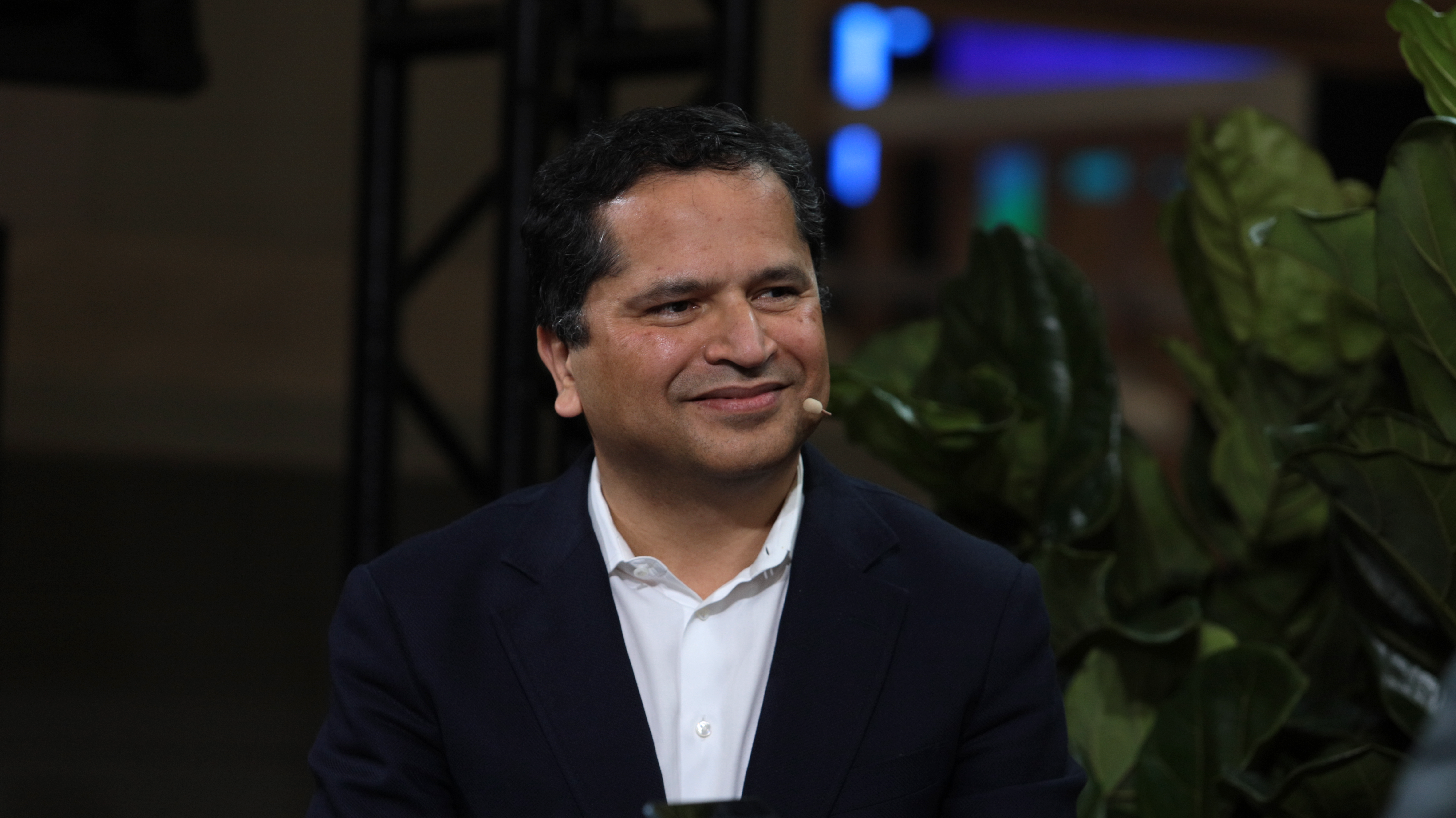
In this interview from Google Cloud Next 2026, Asutosh Padhi, senior partner and global leader of firm strategy at McKinsey and Company, joins theCUBE's John Furrier and co-host Alison Kosik to discuss why 80 to 90% of enterprise AI initiatives fail to deliver business value — and what C-suite leaders must do differently to close the gap. Drawing on McKinsey research and direct CEO conversations, Padhi identifies three root causes: insufficient C-suite ownership, fragmented data foundations and an organization's inability to absorb new technology into core workflows. He challenges the conventional wisdom of starting with simple use cases, arguing that tackling the toughest business problems is what drives the executive attention and organizational alignment needed to produce results that scale.
The conversation also explores McKinsey's concept of "distinctiveness" — the modern successor to core competency — and how companies are using digital twins of their business ontologies to unlock AI value without waiting years to remediate legacy data infrastructure. Padhi outlines how this approach underpins an "AI management operating system" that enables faster insights and superior decision-making from the C-suite to the frontline. He segments today's executives into three cohorts: proactive innovators, cautious wait-and-watchers and those in outright denial — warning that the latter two risk ceding compounding advantages to faster movers. On workforce impact, Padhi draws on McKinsey Global Institute research projecting that one-third to half of all roles will be fundamentally transformed, citing the Mayo Clinic's 50% increase in radiologist hiring as evidence that AI augments rather than eliminates human capability. From the three traits defining tomorrow's leaders — technology fluency, speed and human judgment — to the broader arc of AI as the most profound general-purpose technology revolution in living memory, Padhi provides a strategic framework for organizations navigating the shift from AI experimentation to AI-native operations.
Forgot Password
Almost there!
We just sent you a verification email. Please verify your account to gain access to
Google Cloud Next 2026. If you don’t think you received an email check your
spam folder.
In order to sign in, enter the email address you used to registered for the event. Once completed, you will receive an email with a verification link. Open the link to automatically sign into the site.
Register for Google Cloud Next 2026
Please fill out the information below. You will receive an email with a verification link confirming your registration. Click the link to automatically sign into the site.
You’re almost there!
We just sent you a verification email. Please click the verification button in the email. Once your email address is verified, you will have full access to all event content for Google Cloud Next 2026.
I want my badge and interests to be visible to all attendees.
Checking this box will display your presense on the attendees list, view your profile and allow other attendees to contact you via 1-1 chat. Read the Privacy Policy. At any time, you can choose to disable this preference.
Select your Interests!
add
Upload your photo
Uploading..
OR
Connect via Twitter
Connect via Linkedin
EDIT PASSWORD
Share
Forgot Password
Almost there!
We just sent you a verification email. Please verify your account to gain access to
Google Cloud Next 2026. If you don’t think you received an email check your
spam folder.
In order to sign in, enter the email address you used to registered for the event. Once completed, you will receive an email with a verification link. Open the link to automatically sign into the site.
Sign in to gain access to Google Cloud Next 2026
Please sign in with LinkedIn to continue to Google Cloud Next 2026. Signing in with LinkedIn ensures a professional environment.
Are you sure you want to remove access rights for this user?
Details
Manage Access
email address
Community Invitation
Asutosh Padhi, McKinsey & Company
In this interview from Google Cloud Next 2026, Asutosh Padhi, senior partner and global leader of firm strategy at McKinsey and Company, joins theCUBE's John Furrier and co-host Alison Kosik to discuss why 80 to 90% of enterprise AI initiatives fail to deliver business value — and what C-suite leaders must do differently to close the gap. Drawing on McKinsey research and direct CEO conversations, Padhi identifies three root causes: insufficient C-suite ownership, fragmented data foundations and an organization's inability to absorb new technology into core workflows. He challenges the conventional wisdom of starting with simple use cases, arguing that tackling the toughest business problems is what drives the executive attention and organizational alignment needed to produce results that scale.
The conversation also explores McKinsey's concept of "distinctiveness" — the modern successor to core competency — and how companies are using digital twins of their business ontologies to unlock AI value without waiting years to remediate legacy data infrastructure. Padhi outlines how this approach underpins an "AI management operating system" that enables faster insights and superior decision-making from the C-suite to the frontline. He segments today's executives into three cohorts: proactive innovators, cautious wait-and-watchers and those in outright denial — warning that the latter two risk ceding compounding advantages to faster movers. On workforce impact, Padhi draws on McKinsey Global Institute research projecting that one-third to half of all roles will be fundamentally transformed, citing the Mayo Clinic's 50% increase in radiologist hiring as evidence that AI augments rather than eliminates human capability. From the three traits defining tomorrow's leaders — technology fluency, speed and human judgment — to the broader arc of AI as the most profound general-purpose technology revolution in living memory, Padhi provides a strategic framework for organizations navigating the shift from AI experimentation to AI-native operations.
Senior Partner & Global Leader of Firm StrategyMcKinsey & Company
In this interview from Google Cloud Next 2026, Asutosh Padhi, senior partner and global leader of firm strategy at McKinsey and Company, joins theCUBE's John Furrier and co-host Alison Kosik to discuss why 80 to 90% of enterprise AI initiatives fail to deliver business value — and what C-suite leaders must do differently to close the gap. Drawing on McKinsey research and direct CEO conversations, Padhi identifies three root causes: insufficient C-suite ownership, fragmented data foundations and an organization's inability to absorb new technology into core wo...Read more
exploreKeep Exploring
Is it true that most enterprise IT/analytics initiatives fail to deliver clear business value, and if so, why?add
Are C-suite executives becoming paralyzed by the rapid pace of AI-driven change, and how should they approach adopting and embedding these tools to avoid paralysis and create value?add
How should organizations start embedding AI into their core operations — by tackling simple, low‑hanging use cases first or by addressing their toughest, high‑impact business problems?add
How should a company define and protect its distinctiveness (its modern core competencies) in the age of AI — deciding what capabilities to keep as unique and human-driven versus what to let AI or widely available technology handle?add
How has the emergence of AI changed digital twins, and can businesses build useful digital twins quickly without first spending years fixing their data management?add
>> Welcome back to Google Cloud Next 26. We are streaming live right here in Las Vegas. I'm Alison Kosik alongside John Furrier.
John Furrier
>> Yeah.
Alison Kosik
>> And we've got a great guest who's joining us right now to sort of take a 360 degree view, not from the technical aspect, but from the C-suite aspect, right?
John Furrier
>> Yeah. There's a lot of acts going on. Business model transformation, technology transformation. Up and down the stack, we're seeing massive resets and rebuilding and operating and investing. So it's a perfect storm of innovation.
Alison Kosik
>> All right. Let's bring in Asutosh Padhi, the senior partner and global leader of firm strategy at McKinsey and Company. Welcome to theCUBE.
Asutosh Padhi
>> Alison, great to be here with you and John.
Alison Kosik
>> So we see AI everywhere, but it seems that many CEOs, they're not really seeing real business impact. Why do you think this is happening? Are they just not embracing the transformation that's happening or is there just a feeling of being overwhelmed about what's happening and they don't know where to start first?
Asutosh Padhi
>> So Alison, it is the question. It is the question that we are getting from CEOs right now. There have been a number of different studies recently which talked about the fact that 90% of these efforts have not really yielded any business value. So in my conversations with CEOs and CFOs, the number one thing we hear is the fact that the spending on IT continues to go up, but the returns are totally and completely uncleared.
Alison Kosik
>> But is that factual? Is that based in fact that the returns aren't clear? And if that's the case, then why not? Why are there no returns?
Asutosh Padhi
>> Yeah, I think it is factually, I do not know if the 90% is, depending on the population set, it's a very high number. It's probably between 80 and 90%. So that is actually correct. There's a number of reasons why companies have really struggled. First and foremost is, I think it starts with ambition and saying, is this a C-suite topic or is this owned by the CIO, the chief analytics officers? In my conversation with the CEO or CFO and you ask the question, how's it going? And if they turn to the chief analytics officer, you know that it's game over. It's unlikely to yield value. The second thing that happens is data. Companies have historically gone through multiple periods of complex. They bought like a number of different ERP systems over periods of time, have gone through multiple acquisitions and integrations. And the data foundation, and there's ways around this with AI that I'll talk about, but they struggle with how to use data that is actually siloed and fragmented across different sources. And I'd say the third reason we talk about is change management and capability building. Ultimately, the technology is already here. The technology is progressing much faster. What is not progressing as fast is the ability of the organization to absorb it into the workflows as we see it.
John Furrier
>> That comes up a lot. I'm really glad you brought that up because we're seeing on the keynote here, even Google using the word forward deployed engineer. That's a change management, I guess, technique. Change management has always been a challenge, but now the speed, once you lock something in, it's changed the next 30 days. So we're seeing kind of a double-edged sword of value creation. Whoever takes advantage of the tools to the system get huge upside. If you get stuck, you get paralyzed. I want to ask you, are you seeing paralysis just by the sheer velocity at the C-suite level? Because I've seen both scenarios. It's almost counterintuitive to think that the value is so great that people would be paralyzed. Do you see that?
Asutosh Padhi
>> Yeah, totally. I see three things. I see executives in their personal life start to use AI tools and get really excited by it. Whether it is Gemini, whether it is other LLMs that they're using, but they start to use it and it sparks what the part of the possibility is. The second thing I see is many CEOs and others who are making these tools available on a broad basis across the organization. It kind of creates curiosity and adoption, but doesn't drive results. But the third part of, I think, what we see is the technology is actually progressing. So today when we talk about, we've been through many generations of AI, started with big data, AI ML models, generative AI, agentic AI, physical AI is going to be next as we look at it. But across this different generation, how do you start to embed this into the core of what you do? So what we are telling CEOs today is this idea of start with a simple use case, take something simple and show results. In fact, that's the opposite of what you should be doing. Rather than that, start with something which is your toughest, start with one of your tougher business problems. Demonstrate the fact that it works and then you can scale it up from there.
John Furrier
>> So that's almost counterintuitive to the low hanging fruit, knock down an easy win with the use case, go after with this friction and a big problem.
Alison Kosik
>> And then you see adoption follow.
John Furrier
>> That's kind of unique.
Asutosh Padhi
>> So here is why we say, we have seen too many companies go through a series of use cases and they'll have like 40, 50, 60, 70 use cases.
John Furrier
>> Too many pilots, basically.
Asutosh Padhi
>> Too many use cases, too many pilots. These things don't scale, they don't connect and they don't scale. If you look at the crux of it, I go back to what I said earlier. It starts with ambition, AI for growth, AI for productivity, and AI for new business models. You got to be clear on what you're trying to do with this. Second, get the data foundation right. And the third one is change management capability building. When you start with something that will be a needle mover for the enterprise value, then everyone pays attention. So the necessary focus from a change management and capability building standpoint goes into it. Whereas when you're working with something on a simple use case, it's something that's happening on the side that no one is really paying attention to. And even if it succeeds, no one really cares.
John Furrier
>> You remember the days back a couple decades ago, the big outsourcing craze and the old management philosophy was don't outsource your core competency and you can maybe get some resource. AI's got that similar vein. What you're getting at is hit your core. How would you reframe that core competency argument, outsource non-core and nail the core? Because with agents, what you're suggesting is hit the core competency or the core things and let the agents optimize there. So we almost got that same paradigm coming back where it's like, use AI for the core, don't outsource the AI, but yet away, you got to copilot, you got augmentation. How do you connect those dots? And how should CEOs think about that?
Asutosh Padhi
>> This is a term we have been using in McKinsey. It's called distinctiveness. It's kind of the modern version of core competence. The way we look at AI is if you're a marathon runner, hopefully it'll make you a better marathon runner. It won't make you a swimmer. Don't try to... It's not supposed to... Yes, you can start to swim, but will you be like the Olympian gold medalist? The answer is no. So back to this idea, you need to be crystal clear on what really, in many ways, it is back to the future. You need to be absolutely clear on what's your vision, what's your mission? What are you uniquely good at that none of your competitors can replicate? And what does your moat look like going forward that's different than what it was historically?
John Furrier
>> And on the core competency piece, what is the other piece that's okay to let go and let AI run wild or is that a scenario? Because people are experimenting. The question is which ones are fringe? Which ones are core?
Asutosh Padhi
>> So John, this might seem counterintuitive, but the aspect that will become more uniquely the fingerprint of a company, we talk about creating the digital twins through the ontology of a business. That is uniquely specific to a particular company. This idea of having what does leading edge industry and functional capabilities look like, that's unique. Human capital is actually going to become even more important. This idea of being core and saying, "What is the reason that you're going to attract the best in the world?" That is all unique. On the other hand, if you look at it, there's many aspects which are basically going to be available to everyone else, right? And I think a number of technology tools are actually going to be available for everyone to use. It's not a matter of whether it is available or not, but the question is how do you embed that into the core of what you do that will drive the real differentiation?
John Furrier
>> I love the digital twin ontology reference. I want to expand that if you don't mind, because a lot of people... I've brought this up in many conversations and people get confused. They think digital twin, they think simulation in a factory, drive efficiency and whatnot, but you're kind of getting at something else. You're saying create a digital twin of your ontology or your makeup of a company, not so much some visual reference. And you could do some things in there. Explain that further. I think this is going to be a very big conversation because a lot of winners are doing it.
Asutosh Padhi
>> Absolutely. So let me go back. Digital twins, really, the company that really talked about this was GE for the first time. And I think they talked about it in the context of manufacturing, turbines, et cetera. That was about almost more than a decade ago, much before predates the time of the current generation of generative and agentic AI. With AI, actually everything has changed. And look at the prior version of the digital twin, it was clunky, it was expensive, it was time-consuming, it was not usable. Today, our ability to actually ingest data, structured and unstructured, in like 600 different formats to be able to take and create the digital twin of a business. In our work with our clients, we are seeing that we are being able to take really complex problems, whether it's a top-notch insurance company, whether it's a world-leading telco, whether it's a leading industrial company and create those digital twins of specific business problems within three months. This actually gets at one of the biggest challenges that CEOs have faced when you talk to a CEO and said, "I've got to spend the next five years fixing my data management." And the answer is you don't. You can actually start by creating the digital twin or this ontology of your business and start to use that to drive value while you're continuing to work on the other things in parallel.
John Furrier
>> This is exciting. The first time I've heard this in public on theCUBE, we saw shadow IT. Go around IT, put your credit card down, go to the cloud, get a prototype, get promoted, scale it. Shadow AI, everyone's doing it. Well, you're kind of getting at a shadow company. So CEOs could create a replica because everyone asks the same question. If I started the company today, what would I build? What you're getting at is you can almost do a shadow company to say, let's simulate what we might be able to do. I mean, I'm kind of taking liberties here, but might be overstretching a little bit.
Asutosh Padhi
>> Let me build on that. Let me build on that. In effect, what we are talking to CEOs about is this idea of how do you create a new AI operating system? And what we mean by that is you've got your digital twin in the background. You start to use, back to technology, to start to think about and say all your current workflows that you have, how do you fundamentally redesign those? So things that used to new product introduction that took you four years, you can get it done at 20 to 30% of that time, 20 to 30, 70% faster, right? So the re-imagination of that. Then there's this idea of how do you build in the AI ML models. Together we create what is called as an always on operating system from the CEO to the frontline. Why do you do it? Not because you love the technology, but because one, it allows for much faster insights. Second, better decision making. You can use AI to actually throw up and say, "I want a red team and a blue team argument and much superior execution." That's the reason for this.
John Furrier
>> Yeah. This changes the whole mechanism we heard today from Google, full stack, and you see the migration from tools to operating systems. You're basically...
Asutosh Padhi
>> I'm talking about an AI management operating system that CEOs can put in place. And eventually that'll become the moat that companies can use to differentiate.
Alison Kosik
>> Yeah. Well, that's what you wrote about in-
John Furrier
>> Yeah, in my LinkedIn post went viral a couple days ago. The rise of the culture is huge. So I have to ask you, I know you guys aren't involved with companies on hiring, but I'm sure you have a recommendation. What is the modern tech athlete, CEO today or CFO, what's the makeup of a traditional, of today's version of a leader? Because you're bringing up a lot of things that involve building, operating, and investing. You need a multifaceted, multi-tool player, to use the sports analogy. What is the makeup of a leader today?
Asutosh Padhi
>> John, it's a great question. I'd say the requirement for leadership, the bar for being a great leader today is going to go up, not go down. And I think the premium in particular is going to be in three areas. First is learning. If you don't learn technology, and if you're going to think that you're going to outsource that, it's game over. Okay, you've now got to be conversant and fluent. You've got to be, we call this the technology caution. Second is speed. I think that this idea that I'm going to wait for another two years to see something, it essentially means someone else is going to create this compounding advantage and it doesn't work. And the third part of it is just the human factor to it, empathy, kindness, judgment, that there's going to be a real premium on those capabilities because information is going to become more available more easily. But the temptation, what you do with it is going to become even tougher and will require all of those skills.
Alison Kosik
>> I was going to say, are you sensing though that there is any kind of trepidation from various companies or organizations about being taken over or something rewired by AI instead of having AI working for them?
Asutosh Padhi
>> So Alison, that's a great question. What I'm hearing is, I'm hearing, I think in general, I think when I talk to CEOs, I see about a third of them who actually want to innovate, who want to co-create, who are experimenting. We're saying, "We don't have this all figured out because nobody does, but we are going to take the steps necessary to be able to learn." There's a third who are saying, "Let's wait and watch. Let's see what the first one third does. I want to look at what the success stories are, what's not as successful, and then we'll come back."
Alison Kosik
>> That's dangerous though waiting, right?
Asutosh Padhi
>> That's dangerous. But the third group is even more dangerous. They're like in this world of AI is happening, but that's not really in our industry. In my industry is so different. No one else can actually have got such unique capabilities that no one else can come in and actually do what we do. So AI is like, it's really meant for the folks on the Silicon Valley or on the West Coast. So I think that's the third group.
Alison Kosik
>> But what I'm trying to get to is the fear that maybe felt in the C-suite about headcount, I mean, about having employees, the value of that.
Asutosh Padhi
>> So let me broaden that discussion. One of the questions we get asked a lot is, what does the organization of the future look like? Headcount being an aspect of it, but fundamentally what happens? If you think about today's organization, it's been designed in a certain construct. You have a management team. You either have a business unit structure or you have a functional structure. You have a number of different layers in that organization. You call it spans and layers. You're building in capabilities and then you have some kind of a pyramid. And I think that drives the workforce and the headcount. You can make decisions. Going forward, many of the underpinnings of that model will fundamentally change because the nature of the work itself will change. Maybe two or three examples of that. One, I think that this idea that you will have a span breaker, that you'll have a manager in the middle whose only role is to be a span breaker to other people. Actually, that changes. Everybody now needs to be much more of a leader, right? Second, this idea that, for example, we had certain spans and ratios that I think you typically said, this is what we are essentially going to need as we look at this going forward. The spans and ratios are going to change. Third, there's a lot of trepidation around what is really going to happen to the workforce itself. And I think as part of a McKinsey Global Institute, we have looked at this in detail. Our sense is that with technology as it happens every time, about a third to half of the roles are going to be fundamentally transformed, fundamentally transformed, meaning it's going to look very different. Of course, there will be job losses, but there'll also be a lot of job creation. And one of the favorite examples that we've been talking about is the example of radiology. For example, there was a lot of concern about 10 years ago that when radiologists started to use AI, it's going to wipe out all the radiologists. You fast-forward the clock today, the Mayo Clinic today is hiring about 50% more radiologists today than it did five years ago. And you look at it till 2030, we are projecting a shortfall of radiologists in the United States today. So that's why I think that these things are going to take some time to be able to figure out.
John Furrier
>> We heard that same thing with bank tellers, with the ATM machines. There's more bank tellers now than ever before and ATM machines. I love that angle on where you sit in the curve. We've heard conversations, you're either the input to the AI or the output. Some say AI is a tool for the human or you'll be rewired by it. I post, I wrote, I think the New York Times actually had a similar story out there. You're either going to be rewired by AI if you don't get on the tooling. It's like you're building something. If you've got a hammer and a manual saw, that's going to be now you got the power tools. So this is a tooling job function that's meaningful.
Asutosh Padhi
>> Yes.
John Furrier
>> And now you have this, are you being rewired by AI or are you actually driving it? What's your reaction to that?
Asutosh Padhi
>> So it's a great question. I think AI is the latest in the series of what we call general purpose technologies. You go back to the steam engines like many years ago, you go back to electric motors, then you look at the days of the internet, mobile, et cetera. The thing that's very interesting when you look at those is that it took about 30 to 40 years for those technologies to go become mainstream, 30 to 40. And I've got pictures of how folks started to try and fit in electric motors into the original design of the textile mill and said that they did not see any benefits at all. It took about 25 years for them to redraw the textile mills the way it should be driven by electric motors to start to see real benefits.
John Furrier
>> You retrofit the wrong horse.
Asutosh Padhi
>> Retrofit the wrong horse, that's exactly right. And I think in some ways that's the phase that we are going through. People are taking AI tools and trying to fit it into the current workflows as opposed to say, what should the organization look like? And I think we are probably, in our mind, we'll go through a phase of initial excitement for the discovery, a phase where there's going to be a rapid expansion, a build out, there'll be a phase of consolidation, but ultimately there'll be a phase where this becomes mainstream and we start to see the benefits from AI.
John Furrier
>> What are you guys most excited about right now? And where do you spend a lot of your time? What's your focus these days? As this work because the velocity's there. I'm sure you got a lot... You're busy. CEOs and C-suite are highly active right now in learning. The roles are changing. What are you focused on?
Asutosh Padhi
>> So totally. I think I've been with McKinsey now for many years, but this is probably the most exciting time to be with our firm. I think this idea of how do you use AI to drive growth, I think is probably one of the most central and exciting ideas that we talked about. And it comes up in many different ways. With life sciences clients, it's around time to market acceleration. With industrial clients, it is fundamentally around how do you rethink and come up with new business models, come up with new different products that were not possible. I think we are going to get into the realm of scientific AI where you're going to start to solve problems, medical problems that we didn't think were solvable prior to this. So I think this idea, we put this all under this idea of like somewhat this idea of AI for growth when we talk to a CEO. And I think the opportunities to be able to explore those kinds of ideas and the capabilities to do that are going to be like much stronger than we've ever had.
John Furrier
>> And how would you peg this transformation? We've heard business model transformation many times, IT. How would you peg this one in the scheme of history? You mentioned steam engines earlier. How would you rank this transformation?
Asutosh Padhi
>> So if you look at all the general purpose technologies, I think a minimum it took was like 20 to 25 years to become mainstream. I think AI is going to be no different. I think we are the early stages of it because we are living it. We didn't live in the steam engine revolution. We didn't live the electric motors revolution. It's hard for us to imagine what that might have felt like. But from where we are sitting today, this is probably going to be the most profound revolution that we have seen, certainly in our lifetimes. And I think we are still in the initial phases of this. Agentic AI is a year old. Physical AI is probably two to three years away. Quantum is around the corner at some point, three to five years down the road.
John Furrier
>> Robotics.
Asutosh Padhi
>> Robotics, yeah. Robotics, which is physically, that's exactly. So all these things are just going to take... But you think about the compounding impact and you say the next five years are going to be a very exciting time for all of us.
John Furrier
>> Empathy. I see empathy coming right to the table. Thanks so much.
Alison Kosik
>> Thanks so much. Great conversation.
John Furrier
>> Yeah.
Asutosh Padhi
>> Thank you, Alison. Thank you, John.
Alison Kosik
>> All right. You've been watching theCUBE, the leader in live technology coverage, and we'll be right back with more.



















 Alison Kosik
 John Furrier