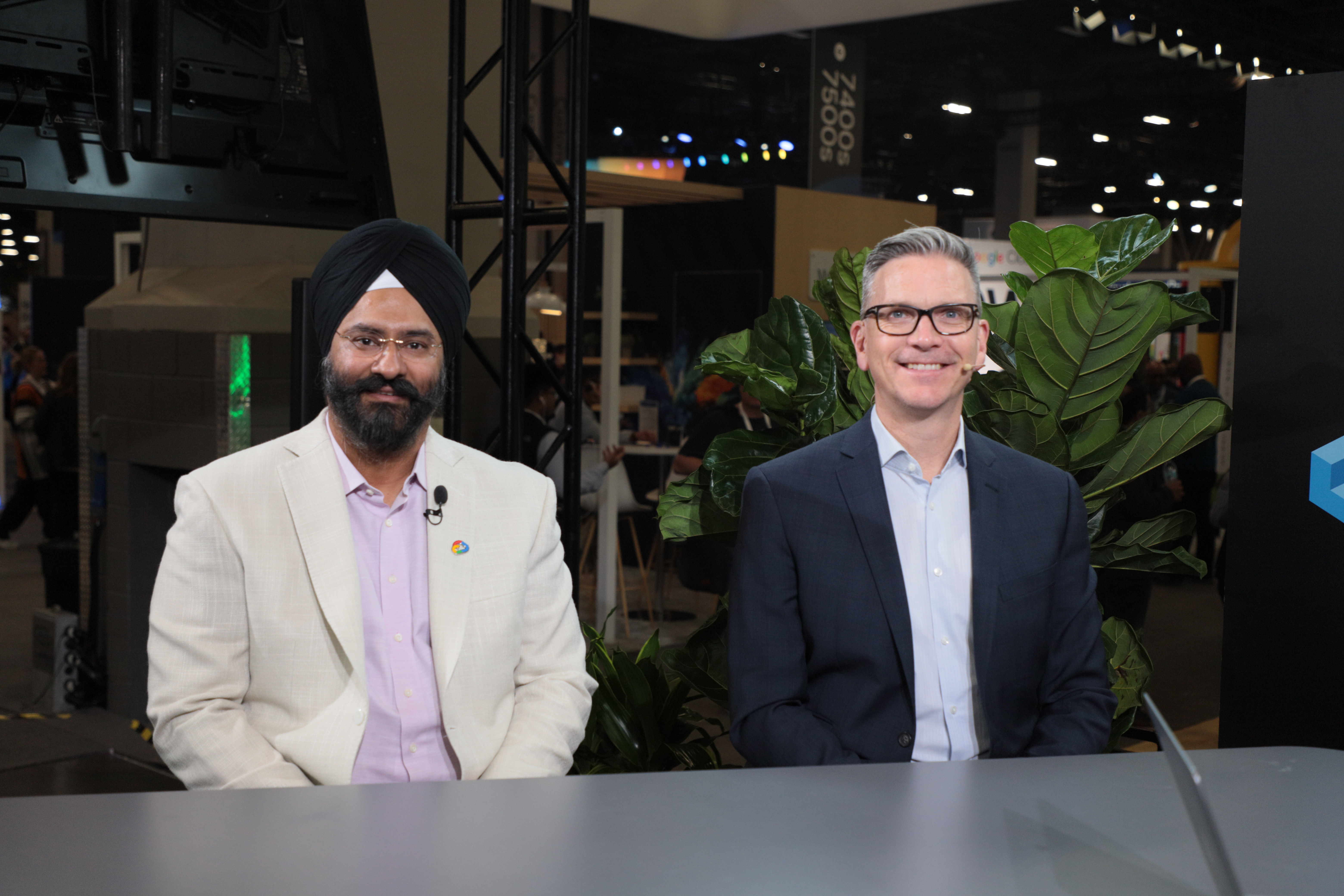
In this interview from Google Cloud Next 2026, Drew Bradstock, senior product director for Kubernetes and Google Compute Engine at Google, joins Muninder Sambi, vice president and general manager for networking and security at Google Cloud, to talk with theCUBE's John Furrier about how cloud-native infrastructure is becoming the operating system for the agentic AI era. Bradstock contends that Kubernetes has emerged as the essential substrate for AI — spanning training, inference and reinforcement learning — after years of deliberate CNCF community work to ensure it could handle agentic scale. Sambi details a major Google Distributed Cloud expansion: Gemini Flash foundation models will now run on NVIDIA Blackwell B200 and B300 GPUs inside customer data centers without data leaving the premises, delivered through a Dell and NVIDIA hardware-as-a-service partnership and managed by a new AI gateway covering the full inference stack for agentic, RAG-based and coding workloads.
The conversation also explores how AI sovereignty has evolved well beyond data residency — governments and regulated enterprises now demand that model refinement and AI-generated value remain in-country, pushing finance, healthcare and manufacturing toward on-premises deployments. Coding surfaces as a critical enterprise signal: after RAG search, it is the second most requested sovereign use case, fueled by the need to modernize COBOL-era applications, migrate VM-based stacks to containers and accelerate development cycles at a pace AI makes newly achievable. Security threads throughout, with Bradstock noting that the Wiz acquisition brings a genuinely multi-cloud perspective to Kubernetes and agentic defense. From modernizing decades-old legacy systems to locking down sovereign agent fleets with confidential inferencing and secure container sandboxes, Bradstock and Sambi outline why the cloud-native stack remains the indispensable foundation for enterprise AI transformation.
Forgot Password
Almost there!
We just sent you a verification email. Please verify your account to gain access to
Google Cloud Next 2026. If you don’t think you received an email check your
spam folder.
In order to sign in, enter the email address you used to registered for the event. Once completed, you will receive an email with a verification link. Open the link to automatically sign into the site.
Register for Google Cloud Next 2026
Please fill out the information below. You will receive an email with a verification link confirming your registration. Click the link to automatically sign into the site.
You’re almost there!
We just sent you a verification email. Please click the verification button in the email. Once your email address is verified, you will have full access to all event content for Google Cloud Next 2026.
I want my badge and interests to be visible to all attendees.
Checking this box will display your presense on the attendees list, view your profile and allow other attendees to contact you via 1-1 chat. Read the Privacy Policy. At any time, you can choose to disable this preference.
Select your Interests!
add
Upload your photo
Uploading..
OR
Connect via Twitter
Connect via Linkedin
EDIT PASSWORD
Share
Forgot Password
Almost there!
We just sent you a verification email. Please verify your account to gain access to
Google Cloud Next 2026. If you don’t think you received an email check your
spam folder.
In order to sign in, enter the email address you used to registered for the event. Once completed, you will receive an email with a verification link. Open the link to automatically sign into the site.
Sign in to gain access to Google Cloud Next 2026
Please sign in with LinkedIn to continue to Google Cloud Next 2026. Signing in with LinkedIn ensures a professional environment.
Sr. Product Director for Kubernetes & Google Compute EngineGoogle
Muninder Singh Sambi
VP/GM, Networking & SecurityGoogle
In this interview from Google Cloud Next 2026, Drew Bradstock, senior product director for Kubernetes and Google Compute Engine at Google, joins Muninder Sambi, vice president and general manager for networking and security at Google Cloud, to talk with theCUBE's John Furrier about how cloud-native infrastructure is becoming the operating system for the agentic AI era. Bradstock contends that Kubernetes has emerged as the essential substrate for AI — spanning training, inference and reinforcement learning — after years of deliberate CNCF community work to ens...Read more
exploreKeep Exploring
Do you agree that Kubernetes-based cloud-native hybrid architecture has become the standard foundation for AI agentic systems, and how will the new agentic layer and AI-native developers interact with the CNCF/cloud-native open-source ecosystem and infrastructure?add
How will Google deliver and deploy Gemini on-premises and in air‑gapped environments — what hardware, partners, and software are involved and what is shipped to customers?add
How are generative AI models like Gemini changing Kubernetes' role as an orchestration platform and the way DevOps tools, UIs, and documentation should be designed?add
How important is openness (open source, multi‑cloud compatibility, and avoiding vendor lock‑in) and the role of communities/organizations like the CNCF in driving innovation for AI—particularly agentic AI—and what challenges do competition and proprietary incentives create?add
What role will containers play in deploying agentic AI, and how does that relate to sovereignty, the blurring of cloud vs on‑prem environments, and the need for AI governance, security, and confidentiality?add
>> Welcome back everyone to the Cubes live coverage here in Las Vegas, Google Cloud 2026. Cube's coverage here, Alison Kosik and myself are here. And the whole team coverage is here. The stack is fully integrated. A lot of infrastructure, a lot of software. Again, all the action happening with agents as they come on board. We got two great guests to unpack it. Muninder Sambi, VP of Google Distributed Cloud at Google Cloud. Drew Bradstock, senior director, Kubernetes Orchestration, Google Cloud, both Cube alumni. Great to have you guys on. Good to see you back.
Drew Bradstock
>> Thank you for having us back.
Muninder Singh Sambi
>> Excited to be here.
John Furrier
>> You were talking networking with Bob Laliberte last year. Okay, so all the action is happening at this agentic layer. Okay. And the big story here at the show is Gemini, of course. It's looking really good, very tight. But the data cloud, that's where all the jewels are. But the agents are going to start playing in this layer that sits on top of the CNCF, and the cloud native open source community from the work that Kubernetes did. So you look at Kubernetes containers. So the cloud native hybrid architecture won. That's standard. You would agree with that?
Drew Bradstock
>> I would completely agree, there was a risk that it wasn't going to. We were really concerned as AI took off that something else had filled in, just like Mesos got replaced by Kubernetes.
John Furrier
>> Yeah.
Drew Bradstock
>> We worked hard in the OSS community to make sure it worked for it, and thankfully it paid off.
John Furrier
>> Yeah. And so, the spoils that come out of that, that we're all going to leverage is a nice solid foundation. So how do you guys see this? Because this is now the substrate that this new agentic layer, which has a little bit of cloud native vibe, but also the AI native developers are coming in. But they're kind of like infrastructure people, friends of ours. So talk about this dynamic, because it's going to grow super fast. And the Linux Foundation just announced the Agentic AI Foundation, which has already got over 200 members, and growing super fast run by an ex-Googler Madison over there. So, we're going to see a surge like we saw with the CNCF. So talk about this layer, control plane dynamic that's happening.
Drew Bradstock
>> I think one thing, it's awesome to see where the CNCF is going. They've really embraced a lot of the AI initiatives and getting the ecosystem going. They're good at nurturing a lot of other products. They're super happy that's occurring. On the agentic layer, it's fascinating because at its heart, these are standard stateless workloads that Kubernetes is really good at, but on steroids. Like legal steroids, but it's really taking off in terms of the scale. You've got the challenge on cost efficiency, bin packing. For us, it's a lot of experimentation, because I think a lot of people are here at CloudNext, they're still figuring out how it's going to work, but it is definitely the future. Because if you look at what OpenClaw has released, it's people understanding that they can do so much with agents themselves, and that's causing explosion personally and also with businesses. We're trying to get a good substrate that makes it easy for any startup to quickly build their own agent platform. And Google's platform is great, don't get me wrong, but there's a lot of companies like Lovable who want to build their own stuff.
John Furrier
>> OpenClaw is kind of like, I call it the tech drug that everyone was taking and got really high on it because it really was a use case and a commercial and a marketing opportunity for... Show everyone, "Look at, this is what it could look like." And it was fast and loose and some cool things were happening. Some kind of meme apps were built, which were very cool, but that shows what could be in the steady state. What's your guys' vision of that? Because certainly Nvidia just came out and said, "Hey, we'll put some security with OpenShell." Okay, that makes a lot of sense. But that's kind of the direction it seems to be going. Let's get this thing hardened with the security so we can bring it into the enterprise. Because all the enterprise people say, "Whoa, no OpenClaw here. Keep it out."
Well, I bet you're smiling. What do you think?
Muninder Singh Sambi
>> Yeah, I think first of all, it's very exciting to be part of infrastructure right now.
John Furrier
>> Yeah.
Muninder Singh Sambi
>> What infrastructure we have built for the last decades is not the infrastructure that's going to carry us forward in this agentic era. You need to be able to have the right level of hardware accelerators that we talked about, the compute that goes with it, the data and storage. And what we thought about storage as object file is going to be vastly different on how we're going to do it in the AI world. Pairable file systems, vector DB, table stakes. And that includes all the database and the data capabilities we bring, followed with across cloud network. And I think we talked about cross cloud network a couple of years ago. We are very pleased to see-
John Furrier
>> I think we call it supercloud, because everyone's calling it multi cloud, but no, but that's-
Drew Bradstock
>> Marketing didn't allow supercloud.
John Furrier
>> Yeah. No one liked supercloud, but we did. It was actually a super cool idea. Super apps, and you have super chips. No, but let's go back 17 years when we started the Cube. Enterprise wasn't a hot sector. You had the big storage guys like EMC, you had compute, and then hyperconverge came out for the data center, and then the cloud comes. And look where we are now. Look at the on prem opportunities to rethink how you put together these large scale supercomputer clusters.
Muninder Singh Sambi
>> Yes.
John Furrier
>> Little bit of Nvidia, a little bit of TPUs, you got some CPUs. It's a whole 'nother redesign because of footprint and budget.
Muninder Singh Sambi
>> And regulatory requirements.
John Furrier
>> Take us through that, the dynamics. What's going on in that world?
Muninder Singh Sambi
>> As you know, cloud, there's a lot of innovations in cloud. I think every day we're releasing new products, new innovations that's enabling this agentic era. The challenges customers have today is about 50% of the enterprises are still going to have their data on prem. Either, that's going to be their own data center, led by regulatory, low latency requirements, or a fully air gap isolated environment like the government and the intelligence agencies. The challenge is, they had a choice. Either you can be sovereign and be compliant or give up and go to the cloud, even if it's an IL-5 assured workload. With Google Distributed Cloud, we're actually bringing the power and the intelligence of Gemini and all that Google has to offer for an on prem environment. We are partnering with Nvidia and Dell on the hardware accelerators. So we're really pleased to announce that the Gemini foundation models, Flash, is now going to be supported on the GPUs Blackwell 200s and the Blackwell 300s on an on premise in their own data centers, without data leaving. And even in fully isolated environments.
John Furrier
>> That's an AI factory, basically.
Muninder Singh Sambi
>> I call it the AI engine.
John Furrier
>> AI engine.
Muninder Singh Sambi
>> The difference being, we are giving you the engine to build your own AI factory.
John Furrier
>> Okay. So let me take through this. This is awesome news. Congratulations, by the way. I love the strategy. How does that deploy? Is that Dell's racks? Is it Nvidia racks? Is it Google racks? Or what is being shipped to the customer?
Muninder Singh Sambi
>> So it depends on the deployment. In the air gap, it's a hardware as a service. We leverage the Dell Nvidia hardware, which is the HGX series. And we ship it to our customers. Our customers rack and stack it up. They work with our partners. We provide the software that goes all the way from containers, Kubernetes, the fleet management, into the AI tooling and the AI functions. We are bringing Gemini, a foundational model, but the foundational model is just a starting point, because our customers want to have a full inference stack that supports agentic workloads, coding applications, RAG based use cases, as well as the cognitive AI tools. They have to have an inference stack. And we're introducing AI gateway that provides that stack, and makes the best use of our foundational models, open source models on Blackwell Hardware with the best optimized, scalable, high performance, resilient infrastructure.
John Furrier
>> Okay. So, sorry, I didn't go deep on this, but I love this topic. Again, love the infrastructure. We really love infrastructure. Great time. So you guys are partnering on the hardware side. You're not shipping any Google hardware.
Muninder Singh Sambi
>> No, it's -
John Furrier
>> What about TPUs?
Muninder Singh Sambi
>> Right now, TPUs, none of our customers are asking for it. Mostly all our customers are air cooled. They have limitations in terms of wattage per rack, roughly about 17 to 20, but they're retrofitting it for the future. So I think in the next 12, 18 months, liquid cooling does become table stakes. At that point, we would consider having TPUs.
John Furrier
>> TPUs in the same channel with the same kind of partnership, go to market.
Muninder Singh Sambi
>> Depending on customer interest.
John Furrier
>> Yeah. So it depends on the footprint, the applications, workloads, whatnot. Great.
Drew Bradstock
>> I think the performance we're seeing on AT and AI will drive a lot of demand because with more... Obviously these chips can run both, but especially in the inference side, the ability just to get massive scale is definitely going to have customary interest outside of Google.
John Furrier
>> Drew, your title is senior director of Kubernetes and orchestration.
Drew Bradstock
>> Yeah.
John Furrier
>> I have to ask, because orchestration has been a big part of what the Kubernetes has done, has been called an orchestration layer among other things. Orchestration, Gemini is taking the sweet spot on the stack, orchestrating the workload. So you got a little Gemini vibe with Kubernetes.
Drew Bradstock
>> I think it's great.
John Furrier
>> Sort this out with us.
Drew Bradstock
>> We're all one family, first of all.
John Furrier
>> Yeah.
Drew Bradstock
>> So I love all my brothers and sisters. But I think from a serious side, Kubernetes has become the operating system for AI. From training, from inference to RL, this is really being the heart of everything. It's nice to see all the model producers there. What's been fascinating though is what customers are asking for for the speed of change. You mentioned Gemini. People are now using Gemini to write YAML. They're writing their own auto scaling, or cluster controllers. It's all coming out at a pace that would have taken forever to get done. So we're finding ourselves on the gun a lot more to adapt Kubernetes quite quickly. Even faster than the OSS community can keep up. So I think that the expectation of LLMs just building it is really changing the game of how people interact with systems.
John Furrier
>> The big debate going on in the industry and this more high level debate is that, do the humans wire up the AI, or does the AI wire the humans? And that's very abstract, but the point is how we use the tooling AI is going to be key. I mean, AI scales intellect, and we have intellect as humans.
Drew Bradstock
>> Well, it's fascinating. So the North Star for user experience right now for our group isn't us. It's not people. It's actually how do we give the best experience for agents? Because the new DevOps, and even the current DevOps are just using Claude, they're using Gemini to do all their work. So we're redesigning our UIs, the documentation, even our blogs, Suster designed around skills, not people at all. So the content I apologize might be awful and our PR team will hate me, but that's actually how people want to consume it. And that's a massive change from my days of slogging through many, many lines of YAML. Now I just let Gemini do it all, for better of for worse sometimes.
John Furrier
>> I mean, I saw stats Ali Gossier at Databricks put something on LinkedIn that said, Databricks, now they're internal tracking. Humans have now fallen the second place behind the agents on coding. So you're starting to already see that. We've seen examples of the coding. And I think the coding breakthrough in the enterprise is a tell sign of the adoption of agents. Because RAG search retrieval was great, solves a big low hanging fruit, marketing copy. But when you start getting into coding, when people see the results of coding, people can put a number to that. And they can say, "Okay, we saved a ton of time, we shipped the product faster." So when you see that kind of productivity, connect the dots to agents, you go, "Okay, let's tackle some revenue workflows."
Muninder Singh Sambi
>> And you'll be really surprised. You would imagine coding is one of the big applications in the cloud. For sovereign use cases, after RAG search, coding is the second most asked for because of three reasons. One, they've got legacy applications. I mean, I have customers who've said, "I have code and applications in Cobalt."
Drew Bradstock
>> I started in Cobalt and JCL, so shout out to Cobalt, right? And JCL. .
Muninder Singh Sambi
>> Those applications still exist today.
Drew Bradstock
>> Yeah.
Muninder Singh Sambi
>> And they want to be able to migrate to a much more modernized language. Second, their stack was built up with either VM based, but they want to move to a Kubernetes container.
Drew Bradstock
>> Which is great idea.
Muninder Singh Sambi
>> Great idea. And third, accelerate their development life cycle on an on prem environment where they can develop embedded systems, software, applications, databases, at a much faster pace than ever before.
John Furrier
>> AI is bringing all of us old guys out of the coding closet, who haven't coded in 30 years. But if you studied computer science in the 80s or 90s, you had to learn everything. And so to jump back on the bicycle when it's autonomous, it's like, "Build me architecture." You can lay it out, but this is what we're seeing. We're seeing a cultural revolution between young and old coming together around AI. Because, all the domain expertise in large companies are run by senior managers, and the developers are coming as young guns on the AI native side. So you're seeing this C-suite dynamic where they're much more engaged because the business value is being accelerated. I mean, the first time in my career, transformation is actually really happening.
Drew Bradstock
>> Well, it's interesting in terms of the young guns. So my 11 year old son taught himself programming for breadboards just using Gemini. And I'm like, "Do you know how the code works?" And he's like, "No," but he figured out and can iterate. So it jump starts so much, but I actually don't-
John Furrier
>> a video game for him.
Drew Bradstock
>> No, it is great. Hopefully he'll get a ROBLOX game that makes him a lot of money. But I think the change in enterprise is going to be, the young employees aren't going to get replaced. They're going to be able to jumpstart so much more and drive these transformation projects. Before you'd have that knowledge share, you definitely learn Cobalt. Now they can just get going, and they are going to learn to iterate, just be a different set of skills from what the three of us went through.
Muninder Singh Sambi
>> I think the major transformation that's also happened is, it's not just code writing. See, that was easy. That's faster to do.
Drew Bradstock
>> Easy.
Muninder Singh Sambi
>> But the thing is when you're not a developer or a professional developer, how do you reason and you refactor the code in natural language? I actually showed a demo in my session on the whole coding, where it took an existing app and had someone who was not a developer reason, add a comment just like you would do for your own code, and it was able to refactor the entire code to be compliant and sovereign.
John Furrier
>> Yeah. The sovereign's an interesting angle. Sovereign cloud was a conversation we've been having for a long time. GDPR, data privacy. Now you're starting to see, and I'd love to get your reaction, the AI sovereignty challenge where the governments are leaning in of countries. Because, AI is a revenue generator now inside the country. So we'll be at the Raise Summit July 7th and 8th, or 8th and 9th. Sovereign's the number one conversation international.
Muninder Singh Sambi
>> Yeah.
John Furrier
>> And so huge issue there. But it's not just data privacy, kind of keep the data in the domain, it's revenue in the country. So you're seeing data centers being built out there, distributed cloud deployments.
Muninder Singh Sambi
>> Huge. A lot of them, and actually the number one sovereign reason is not just about data residency, that has to be there.
John Furrier
>> Yeah.
Muninder Singh Sambi
>> Data in country has to be there. I mean, these are just table stakes. But as you move up the stack, they want to be able to take that data, make sure that the AI model is turning into value, not just for their citizens, but also for their enterprises.
John Furrier
>> I remember when GDPR came out many, many years ago, I was talking to a customer, Cube here actually, and when the camera was off, I'm like, "So how's that going? Hit me, what do you really think?" He goes, "John, I don't even know where the data stored." They didn't even know where the data was stored. Okay, fast forward to today. We have AI. So how do you see this playing out? Because it's more than just where the data is stored, because you have now sovereign issues. You need the intelligence to kind of get that out. The data stores, where it's processed. I mean, I'm not following this, but is that fixed?
Drew Bradstock
>> So two answers, would love to hear Muninder's view on it, but I think data residency was like old school, right? That was the first thing because people could touch it physically, they could hang onto it. Now they want the refinement of the models in country. I'm Canadian and I know there's been a big push by the federal government to do more in country with local town and have these models work for Canada. I spell color with a U. That should be the way the model is trained. But that is now a material decision even amongst banks and leading enterprise firms. It's not just the governments that are pushing this, because they realize it's a risk and also an opportunity as Muninder said.
Muninder Singh Sambi
>> Yeah. And governments obviously air gap fits well. Data lives and lives there, and you get the power of AI, especially Gemini. More and more enterprises, especially regulated industries, financials, healthcare, manufacturing, utilities. Their data has to be on prem, but they're okay with a cloud operated model. Which means software lifecycle management, attestation of the local hardware as well as the models is being protected in the cloud. That and our entire infrastructure is just opening up many more opportunities for us beyond just air gap and the government entities.
Drew Bradstock
>> And just one thing as well, it's agentic, it's the same thing. They really want all these agents running in country and they want the skills in house too. And that's a big change, because it wasn't as much the apps before. Now it's that part of the stack.
John Furrier
>> Yeah. Every use case kind of has a , but agents will have to have passports. So in a way, the identity challenge, kind of a joking aside, the identity is a huge part of the agents. Let's talk about that agent, because building on Kubernetes, what we've learned, I'm sure there'll be a ton of agents for DevSecOps teams. But as the agentic comes out, what do you guys see as the core community issue to solve? If you look at the community at large, not just Google Cloud, but in general, to make that horizontal control plane, highly intelligent, low latency, really tuned for agentic. For the context, reasoning, for the memory.
Drew Bradstock
>> I think one of the primary things is open. And you mentioned that earlier where people are building these platforms know they're going to run in multiple clouds. So how do we make sure everything they're working with is open? This is where Kubernetes and Google's a really good fit. They don't want proprietary. They won't really be locked in unless they're going for a fully managed offering, like what we announced this week, but that openness for the substrate is going to be key. One problem we have though is that there's so much competition in the AI space. There isn't a level of sharing we saw in the early platform and dev op days, where everyone worked together. Instead, people are seeing all the different tweaks as their own competitive advantage. So if we can build a better community, it's just going to speed up innovation across the board.
John Furrier
>> Yeah. I mean those early cloud days, OpenStack was kind of like a rallying point.
Drew Bradstock
>> Yeah.
John Furrier
>> Remember those days. And then the cloud happened. The AI thing is interesting. The question I have on the AI hype are excitement or proprietary nature of getting funding.
Drew Bradstock
>> .
John Furrier
>> Well, yeah, because the fundings are pretty much out of control. But it's the developers and then it's very venture based, very entrepreneurship. Open source really didn't have a lot of entrepreneurship other than, "We want to do this to enable entrepreneurship activities." But there is still a community doing agentic stuff that there's a lot of open source. That's why I think the CNCF was super important, and it will be important because I think the leaders of that next level will probably come from the CNCF. Or-
Drew Bradstock
>> I think so as well, because there's going to be so many components that feed into an agent. As Muninder mentioned earlier, data's the heart of this. Having good graphs can run with it. This is what CNCF is excellent for. So I think we're going to see a lot of CNCF graduates mature or adapt towards agentic use cases, but that will create a lot of entrepreneurship.
John Furrier
>> I'm very bullish on the Agentic AI Foundation or AAIF. Doesn't have a ring to it like CNCF does, but you know.
Drew Bradstock
>> It's like supercluster.
John Furrier
>> Yeah, supercluster. All right. Final question. Can roll the containers. Great for sovereignty.
Muninder Singh Sambi
>> Yes.
John Furrier
>> Great for moving things around and getting things done. I see containers being the lifeblood of agents. What's your thoughts?
Drew Bradstock
>> 100%, because they're so self-contained. This is where like Agent Sandbox from GKE. Having a really secure, unbreakable container is critical for the untrusted nature of a lot of these agents. And it's also consistent across so many environments, you're not pinned down to one thing. So I definitely think containers will continue to be the substrate for all of AI.
John Furrier
>> And it has to stay open, reliable.
Drew Bradstock
>> It has to stay open.
John Furrier
>> Security.
Drew Bradstock
>> Yeah.
John Furrier
>> What's your thoughts on sovereignty?
Muninder Singh Sambi
>> Very similar. Everything that Drew does, we bring it onto the Google distributed cloud. And I think every customer who has not modernized their app is being led to modernize their app driven by agentic AI.
John Furrier
>> It's almost like full circle moment. We have distributed computing with hybrid open source cloud tech principles.
Muninder Singh Sambi
>> Yeah.
John Furrier
>> But it's still distributed computing.
Drew Bradstock
>> Very much so.
John Furrier
>> On-prem is just another cloud node.
Muninder Singh Sambi
>> Just another cloud node.
John Furrier
>> This is a cloud native node, what do you want to call it? On prem. So there's no more distinction between cloud and on prem in the classical old school sense.
Muninder Singh Sambi
>> The only thing I would add is the AI governance, which is safety and security. The extra steps we have to do to make sure that the stack is fully confidential. It meets this regulatory requirements with safety and security built in. Can't be an afterthought. And moving to not just inferencing, but to confidential inferencing.
John Furrier
>> Yeah. I mean, the confidential computing paradigm is going to shift to intelligence where the intelligence will say, "Okay, this is proprietary. Don't tell anyone. Go to the cloud-"
Muninder Singh Sambi
>> Go to the cloud.
John Furrier
>> "Go to the passport." I mean, it's kind of crazy. Even the security guys we had early from the Mandiant team bring Wiz together with the threat intelligence, really is a game changer too on the agentic defense, because you got agents that have a lot of war gaming things going on. Bad agents and good agents. So every little department in Google, big department in Google has an agent impact.
Drew Bradstock
>> I think this is, Wiz finally being part of Google is excellent because they bring a true multi-cloud global view of this. And we've been strong partners even before the acquisition and looking forward to how they can change and help Kubernetes all up.
John Furrier
>> Yeah, it's a great combination. Guys, thanks so much for coming on the Cube.
Drew Bradstock
>> Thank you very much. Appreciate it.
John Furrier
>> Always a great conversation. And again, the cloud native set the table for the AI native world, and the full stack and all these elements coming together seems to be the use case to make all those things work in a very harmonious way and produce the results, which is going to be revenue from the agents. I'm John Furrier, host of The Cube with Alison Kosik here in Las Vegas. Thanks for watching.



















 John Furrier