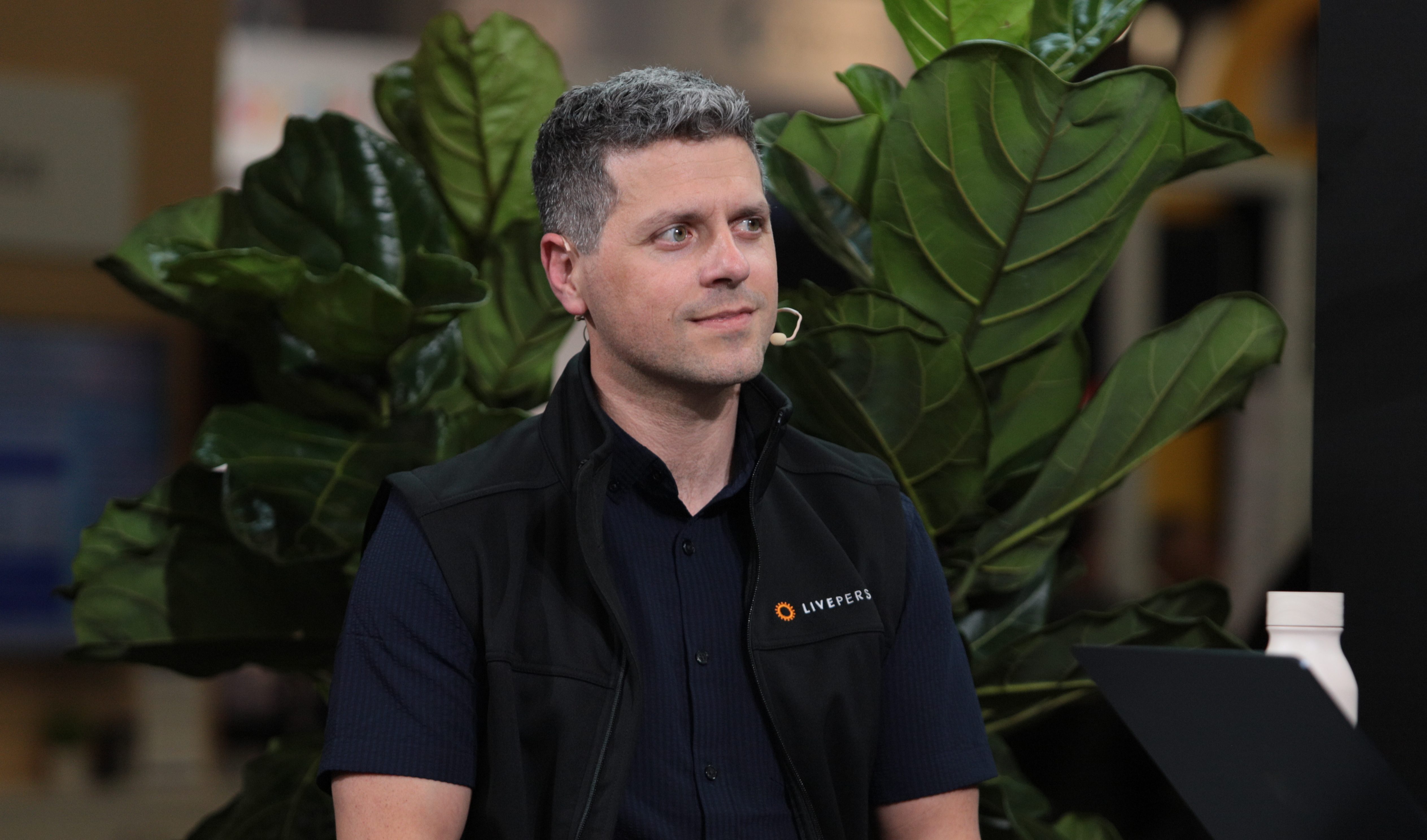
In this interview from Google Cloud Next 2026, Chris Mina, chief technology and product officer of LivePerson, joins theCUBE's John Furrier and co-host Alison Kosik to discuss how enterprises are overcoming "AI paralysis" to move from proof of concept to production-ready agentic customer experiences. Mina explains that while brands have made real progress building AI-powered self-service flows, many stall when edge cases surface and governance teams pump the brakes — a pattern he calls AI paralysis. To break the deadlock, LivePerson recently launched Syntrix, a testing platform that uses synthetic customers and generative scenarios to simulate hundreds or even thousands of complex conversation flows, giving brands the data they need to satisfy security, legal and AI council stakeholders before going live.
The conversation also explores the orchestration layer at the heart of LivePerson's platform, including a guardian agent that monitors 100% of conversations in real time and continuously evaluates whether to escalate, redirect or let an interaction run its course. Mina shares a financial services case study where remote branch workers — previously underutilized due to the rise of online banking — are now being trained and deployed as digital agents, making far better use of an existing workforce rather than simply reducing headcount. He also outlines LivePerson's deepening relationship with Google Cloud, including early adoption of Gemini Enterprise and a multi-year migration of the full LivePerson platform to GCP — a move that has reduced support tickets, streamlined deployment and made Gemini an out-of-box model option for customers. From breaking AI paralysis with simulation-based assurance to repositioning branch workers as a digital-first workforce, Mina makes the case that CX remains the last great frontier for agentic AI, with enterprise direct-to-consumer adoption still in the single digits and enormous room to grow.
Forgot Password
Almost there!
We just sent you a verification email. Please verify your account to gain access to
Google Cloud Next 2026. If you don’t think you received an email check your
spam folder.
In order to sign in, enter the email address you used to registered for the event. Once completed, you will receive an email with a verification link. Open the link to automatically sign into the site.
Register for Google Cloud Next 2026
Please fill out the information below. You will receive an email with a verification link confirming your registration. Click the link to automatically sign into the site.
You’re almost there!
We just sent you a verification email. Please click the verification button in the email. Once your email address is verified, you will have full access to all event content for Google Cloud Next 2026.
I want my badge and interests to be visible to all attendees.
Checking this box will display your presense on the attendees list, view your profile and allow other attendees to contact you via 1-1 chat. Read the Privacy Policy. At any time, you can choose to disable this preference.
Select your Interests!
add
Upload your photo
Uploading..
OR
Connect via Twitter
Connect via Linkedin
EDIT PASSWORD
Share
Forgot Password
Almost there!
We just sent you a verification email. Please verify your account to gain access to
Google Cloud Next 2026. If you don’t think you received an email check your
spam folder.
In order to sign in, enter the email address you used to registered for the event. Once completed, you will receive an email with a verification link. Open the link to automatically sign into the site.
Sign in to gain access to Google Cloud Next 2026
Please sign in with LinkedIn to continue to Google Cloud Next 2026. Signing in with LinkedIn ensures a professional environment.
Are you sure you want to remove access rights for this user?
Details
Manage Access
email address
Community Invitation
Chris Mina, LivePerson
In this interview from Google Cloud Next 2026, Chris Mina, chief technology and product officer of LivePerson, joins theCUBE's John Furrier and co-host Alison Kosik to discuss how enterprises are overcoming "AI paralysis" to move from proof of concept to production-ready agentic customer experiences. Mina explains that while brands have made real progress building AI-powered self-service flows, many stall when edge cases surface and governance teams pump the brakes — a pattern he calls AI paralysis. To break the deadlock, LivePerson recently launched Syntrix, a testing platform that uses synthetic customers and generative scenarios to simulate hundreds or even thousands of complex conversation flows, giving brands the data they need to satisfy security, legal and AI council stakeholders before going live.
The conversation also explores the orchestration layer at the heart of LivePerson's platform, including a guardian agent that monitors 100% of conversations in real time and continuously evaluates whether to escalate, redirect or let an interaction run its course. Mina shares a financial services case study where remote branch workers — previously underutilized due to the rise of online banking — are now being trained and deployed as digital agents, making far better use of an existing workforce rather than simply reducing headcount. He also outlines LivePerson's deepening relationship with Google Cloud, including early adoption of Gemini Enterprise and a multi-year migration of the full LivePerson platform to GCP — a move that has reduced support tickets, streamlined deployment and made Gemini an out-of-box model option for customers. From breaking AI paralysis with simulation-based assurance to repositioning branch workers as a digital-first workforce, Mina makes the case that CX remains the last great frontier for agentic AI, with enterprise direct-to-consumer adoption still in the single digits and enormous room to grow.
In this interview from Google Cloud Next 2026, Chris Mina, chief technology and product officer of LivePerson, joins theCUBE's John Furrier and co-host Alison Kosik to discuss how enterprises are overcoming "AI paralysis" to move from proof of concept to production-ready agentic customer experiences. Mina explains that while brands have made real progress building AI-powered self-service flows, many stall when edge cases surface and governance teams pump the brakes — a pattern he calls AI paralysis. To break the deadlock, LivePerson recently launched Syntrix,...Read more
exploreKeep Exploring
What is LivePerson and how does the company help brands engage with consumers?add
What are the key challenges and opportunities for brands and developers when integrating different AI models into consumer apps and devices?add
How do businesses ensure an end-to-end customer experience across multiple channels (SMS, RCS, web, voice), leverage AI to enable self‑service and decide when to route customers to live agents, and how is success measured?add
What are the barriers preventing brands from scaling conversational AI deployments, and how can tools like LivePerson's Syntrix (using synthetic customers and generative scenarios) help overcome them?add
>> Welcome back to Google Cloud Next '26. We are streaming live right here in Las Vegas. I'm Alison Kosik, alongside John Furrier, and we're about to talk about executing AI in our businesses, right?
John Furrier
>> Yeah. I mean, people want reliability. They want confidence that they're going to get value. And the data's all lining up, the full stack here at Google Cloud. It's changing the product market fit for the end users.
Alison Kosik
>> Yeah.
John Furrier
>> And business value is being created. So it should be a great conversation.
Alison Kosik
>> Let's bring in Chris Mina. He is the chief product and technology officer with LivePerson. Welcome to theCUBE.
Chris Mina
>> Thank you so much.
Alison Kosik
>> So for those who aren't familiar with your company, talk us through what LivePerson is.
Chris Mina
>> So LivePerson is digital engagement and messaging. We focus on connecting consumers and brands together through almost all digital channels. So social, app experiences, web. And we've really pushed the limits for many years now, in terms of how brands can deploy AI at scale to help build self-service experiences. And still recognizing the interplay of humans and AI. And we're not quite even with Agentic AI and generative AI quite there entirely for self-serve automations. And so we provide an end-to-end platform to support the entire life cycle.
John Furrier
>> It's interesting watching the progression. We've seen kind of ways before product market fit changes with new technology, but there's been such an adoption of the models. And you're seeing platforms being built with multiple tools. So as the head of product, you got the keys to the kingdom. You got the roadmap internally, you're looking at the customers. Engagement has been the holy grail on apps for years, onboarding, ease of use, reduce friction. How has the AI game changed for you guys the past year, as you look at the platform and all these benefits that are coming out for your customers?
Chris Mina
>> So we see two components of it. One is how can we use these models, these tools to help builders build better experiences? But where the real challenges are, are how do we actually get them into the apps, into the devices of consumers and in a trusted way that brands can actually deliver these AI experiences? To your point, we see a lot of queries around, "Hey, I use Gemini models. I use Open AI models. I use Anthropic. I want to be able to pick and choose which models for which experiences." And that's a big part of the product development challenge and opportunity, is building solutions that allow brands to bring the technology of their choice that they think is going to fit their needs the best. And they look to companies like LivePerson to help guide them on that journey and selection process.
John Furrier
>> The CX technology has gone a long way in the evolution. We've seen journey mapping. We've now got agents on the horizon here. There's a lot of stuff to optimize. How do you frame that as a product leader in your organization? Because you have to think about the customer.
Chris Mina
>> Yeah.
John Furrier
>> How are you looking at optimizing? Are you looking at the workflows? Is it the data? Take us through your mindset as a leader.
Chris Mina
>> So where we are in our business, we really concern ourselves with making sure that the entire customer experience is achieving the outcomes that the brands are looking for, that the consumers are trying to solve for. So this, in our case, typically starts at a self-service experience. And even that, if you take a step back, it's about the channel connectivity. Are you in SMS? Are you in Google RCS, which is represented here? Are you in a web form? Are you on a voice call? And taking that all the way through the end-to-end journey. And we try to make sure that we deliver through increasingly AI enabled tooling, the visibility of the entire customer experience and customer journey, that we're ensuring that a consumer who is able to be served through a bot is reaching a bot and they're able to wrap that conversation up quickly. We also recognize using more and more AI tools and capabilities. Should that customer be shuttled off to a live agent, to a live consumer? Should it be escalated? And how we are measured is how effectively those customers ultimately end up getting their problems solved. And increasingly, we used to hear channel of choice and the customer needs to be where they want to be. Now we're hearing, "Hey, the brand sort of knows best." They understand their employees, their automations, and they're also looking at us to help build tools and give them the tools to make sure that the consumer ends up in the channel that they can best be served to solve their problem most effectively.
Alison Kosik
>> How do you remove barriers to adoption?
Chris Mina
>> Yeah. So barriers are one of the biggest challenges that we face. In the past, it was very simple. We would roll out live agent experiences, we would roll out bot experiences. And in a deterministic flow, brands could sort of trust what was happening and they were quick to adopt.
John Furrier
>> Yeah.
Chris Mina
>> Where we've seen, and I'm sure you've heard plenty of times today even, brands are getting stalled. They build these great proof of concepts. They have these workflows and they sit around. They run some happy path use cases, and they say, "Wow, this is amazing." Consumers are really getting a much better experience. And then they hit the edge cases. They see the headlines about brands who have been... Their bots have been duped into speaking out or obscene language or whatever it is, and they stop. They don't move forward with these POCs and they kind of get to what we call, AI paralysis here. And increasingly, we see the decision making moving back into the AI councils where sometimes they just get blocked and even the CX leaders don't know how to get an escape. So at LivePerson, we recently launched a product called Syntrix. Syntrix is all about enabling brands to test their agents and their end-to-end workflows with fully simulated experiences using synthetic customers, generative scenarios, generative use cases, so that they can have the confidence to know that when they deploy something new, a new workflow, a new Agentic experience, a new bot, sometimes even a new campaign that's staffed by live agents, that they've been able to test the end-to-end flows in a hundred or even a thousand different complex scenarios that would be very, very difficult to test for in traditional ways.
John Furrier
>> Yeah.
Chris Mina
>> So Syntrix is one answer to overcoming the challenges of adoption and giving brands a lot more confidence to say, "Hey, we're ready. We're prepared. We're going to deploy this new technology." And when they get blocked by, whether it's their security, their legal or their otherwise AI councils, they can come with a set of data that says, "Look, we've tested in all of these scenarios. We feel confident and we've got the data and evidence to back it."
John Furrier
>> Yeah. I mean, it's interesting because we've all had experiences where we get an agent and it's like, "Okay, that's a bot." But now you've got sophistication with intelligence where it knows the knowledge base and knows... It has a brain. The brand has a brain.
Chris Mina
>> That's right.
John Furrier
>> It can figure out when to context switch to a human or a path. That's in a way, non-deterministic. We think non-deterministically.
Chris Mina
>> Yes.
John Furrier
>> So how do you guys look at that? How do you frame that? Because that's the holy grail because then, you're going to give the best experience, knock down the use cases that require maybe less tokens.
Chris Mina
>> That's right.
John Furrier
>> Cheaper tokens or your own tokens, and then move the reasoning to higher value activities. Do you guys look at that and how do you think about that?
Chris Mina
>> Absolutely. So we would consider that much of the orchestration capabilities of our platform and other platforms like us. Being able to help a brand virtually listen to all the signals that are happening in real time in a conversation, being able to make real time evaluations and decisions, should this continue on this path? Is it better served sometimes by an old school bot? And that's okay if that's the best way to serve an agent. More and more, we see questions of increasing complexity that can be solved through sophisticated knowledge bases and bringing a lot of different data sources together to give a real human-like answer. Brands are looking for that. It can come at a cost, but as we all know, that cost is oftentimes 10 times cheaper, a hundred times cheaper than passing it off to an agent. So the challenge often is not, are we consuming too many tokens? It's really making sure, are we using the right, best technology to solve the customer problem? We recently deployed something just as an example, that we call a guardian agent. This guardian agent, its only job is to listen to signals continuously on 100% of conversations, whether those signals are live agents, conversations, bot agents, Agentic solutions, and constantly be processing and churning through that information, saying, "Is this conversation moving in the right direction? Do we need to escalate? Do we need to transition?" And that orchestration is probably the most important part right now of allowing brands to deliver better customer experiences in the best way. And so it's a big part of what we deal with every day.
John Furrier
>> It's a good use of intelligence. I want to ask about productivity. We've heard many times with folks that have optimized, we heard about the personal productivity, faster answers and literally, stuff that would have to be looked up, documents, just overall greatness on the agent front. So like real agent, not agent agent, but like... Now, digital agents are coming into the realm. What's the path there? Because, okay, you got the guardrails, you got the confidence, almost the brand audit, if you will, my words, probably some work there. You got the productivity. Can you share some stories around how you've moved the needle with customers where they said, "We've seen specific performance of the agents, real humans and agent agents and how that's played out"?
Chris Mina
>> Definitely. So I'll give a little bit of a twist on it because I think it's a great story of how AI agents have impacted live agent use cases. And we've got a large customer in the financial services industry that has remote branches all across the, let's say, remote parts of the world. And they've had a challenge where they want to empower agents at some of these more remote rural locations to become digital agents, and start servicing customers who are calling in from many parts of the country. Until now, they've struggled to do that because they say, "Well, these agents in these remote locations and branches don't get exposed to enough use cases and scenarios." And so they're not really adept at dealing with the complexities of say, the masses who might be in a bigger city and are solving more difficult challenges financially in the bank's case. So they look at using our technologies not only to service them in the agent assist experiences and give them the real time knowledge, so that when these cases do come up, they've got agent assist, they have rewrite, they can speak in the brand's tone. But increasingly, we're seeing them using our tools and technologies to train these same agents on these very sophisticated, complex or unusual use cases so that instead of just sitting around waiting for a customer to walk in the door, they are now able to deploy them and augment their otherwise, contact center staff, making far better use of the workforce that they have. And it's not a small problem. Sometimes these banks might employ thousands of branch workers who simply because of the prevalence of online banking and other online services, are being underutilized. So a lot of times, we talk about efficiency and just how fast do you get through a conversation. I love this story because it's about utilizing the entire workforce more efficiently. And AI, and AI tooling and capabilities like Syntrix and LivePerson are empowering this particular customer to do amazing things with their workforce.
John Furrier
>> Well, we'd be remiss if we didn't talk about Google Cloud for a second. How has Google Cloud helped you guys? Because they got some pretty good stuff coming out. TPUs are out. They got the Nvidia relationship strong. You got the data clouds looking good. Now, they got Gemini layered in as an orchestration layer across all that domain expertise. How has all this impacted you?
Chris Mina
>> So Google Cloud, we have a very large and growing relationship with Google. We use them across our internal workforce. We were one of the first adopters of Gemini Enterprise. And so just speaking on that, they rolled that out. We've been able to successfully deploy that to our employees. This has cut down on engineering's time, on support time, just access to information. It plugs in all of our systems. Gemini is a great language model to work with. It's very conversational. And once we give it the data sources that we need and it uses all of our roles-based authentication of individuals, suddenly we've cut down on things like support tickets, cross domain, cross-functional requests. "Hey, tell me about this customer. When's their renewal coming? In the technology world, I'm trying to find a repository for this type of code base. We can just talk to Gemini."
So from a GCP world, it's had a demonstrative impact on our internal company. And then of course, we've recently rolled out our entire LivePerson platform on Google Cloud. This has been a multi-year endeavor that's overcoming 20 years of really difficult tech debt and on premises, networking and server usage. And it's truly streamlining so much of our deployment. Not only are we on a highly reliable cloud environment, but increasingly, we're using Google's own tools like Gemini, like SEC for security services, to help us manage the deployment, to help us manage the product, and ultimately, to serve the product too through Gemini as one of the language models that are out of the box available to our customers. So being at Google Next and seeing all the vendors that are benefiting in a similar way to us, it's a decision that I deeply appreciate. Google's been a great partner to work with in it. And I think our customers are already starting to feel the effects from reliability, stability, performance, and the model selection as Gemini out of the box is yielding some great results for us.
John Furrier
>> Yeah. How's the show going for you guys? What's like in the booth? Give us some update on flow, conversations. What's been the hot conversation?
Chris Mina
>> The hot topic is Syntrix. It's about AI assurance, AI testing, simulation, having the confidence before you deploy. We've got our conversational cloud, our engagement platform. Everyone that's coming over is saying, "Hey, tell me about this. What does it mean to test my agent? What does it mean to have confidence before we deploy?" And we've been doing a ton of demos on it, showing customers really what we're working on, what we're launching. It's great feedback for us. Brand new product in market. We launched it about six weeks ago, evolving quickly, our biggest investment at the company.
John Furrier
>> Congratulations.
Chris Mina
>> So it's been fantastic to see it resonating here and the interest in it.
John Furrier
>> Yeah. Congratulations. And CX is on the agenda, you're seeing it on the main stage. It's really the cherry on top for Google.
Chris Mina
>> This has been, I would say, ultimately deploying generative AI to the CX use cases is the ultimate goal of all these models. That's where it starts to hit the consumers in the billions. We're no longer talking about in the hundreds of millions of employees and countries. So internal use cases are suddenly starting to feel easy and controlled. CX is still the frontier that we're working towards and we're not there yet. Enterprise adoption of these tools is still direct to consumer, still sub 10%. It's single digit adoption.
John Furrier
>> And brands are shifting. It's clear. The brand brain is coming. They're seeing the AEO results. People are making... They're going to talk to their AI. Brand decisions been made.
Chris Mina
>> That's right.
John Furrier
>> Brand promises have to be in the system, all these things playing out.
Chris Mina
>> That's right. And you can't stop this train as it's moving forward right now. So to your point, the promise is there to the market, consumers expect it. We need to help all the brands be able to deliver on this promise safely, securely. And I think when we sit here a year from now, a lot of this is going to be resolved. We're going to be talking about the next frontier. It's moving so quickly, but there's still a long way to go and CX is the frontier to be talking about right now.
John Furrier
>> We appreciate you coming on. Thanks for coming on.
Chris Mina
>> Excellent. Thank you. Appreciate it.
Alison Kosik
>> Thanks so much. Great conversation.
Chris Mina
>> Thank you.
Alison Kosik
>> All right. You've been watching theCUBE, the leader in live technology coverage. Thanks for watching.




















 Alison Kosik
 John Furrier